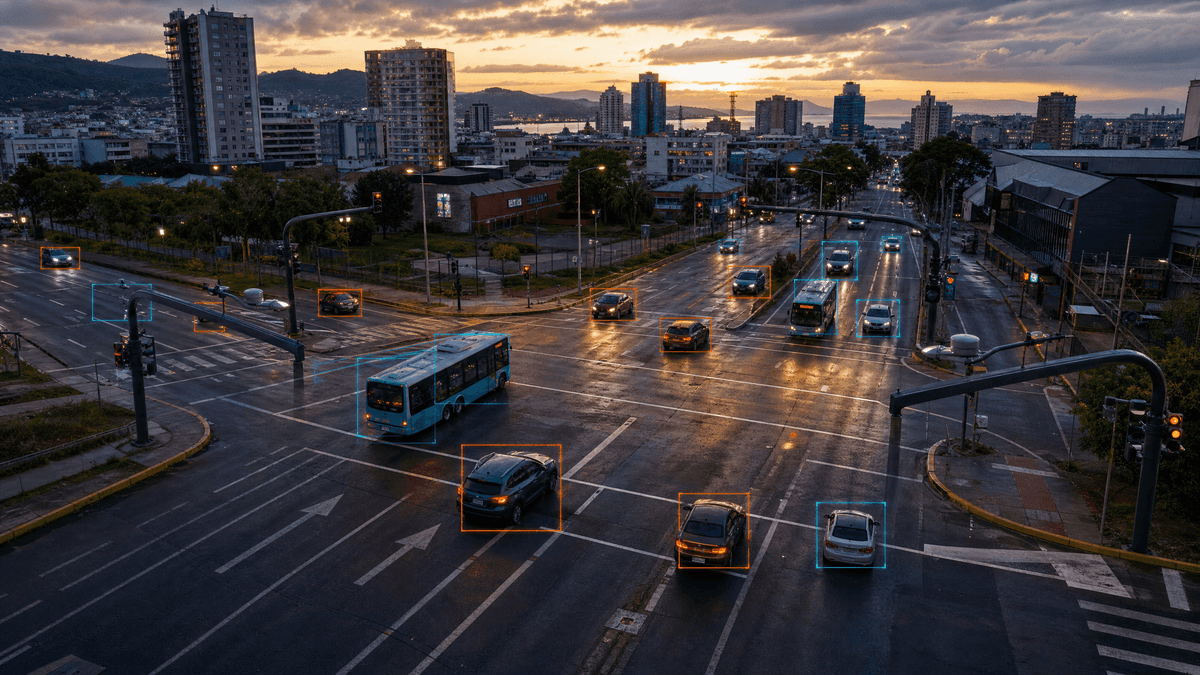
Concepción Smart Traffic System Market Analysis: 6-Intersection 8m L-Arm Configuration Guide
Summary
Concepción’s urban mobility profile supports a typical 6-intersection Smart Traffic System rollout using approximately 48 dark-grey 8m L-arm poles, 5G/fiber backhaul, and Jetson-based edge AI. According to Chile’s 2024 census update, the commune has 229,665 residents, while mmWave radar and 4K AI sensing can support sub-50ms response for adaptive signal control.
Key Takeaways
- A typical 6-intersection deployment in Concepción would use approximately 48 poles at 8m height, assuming 8 poles per intersection across four approaches plus auxiliary positions.
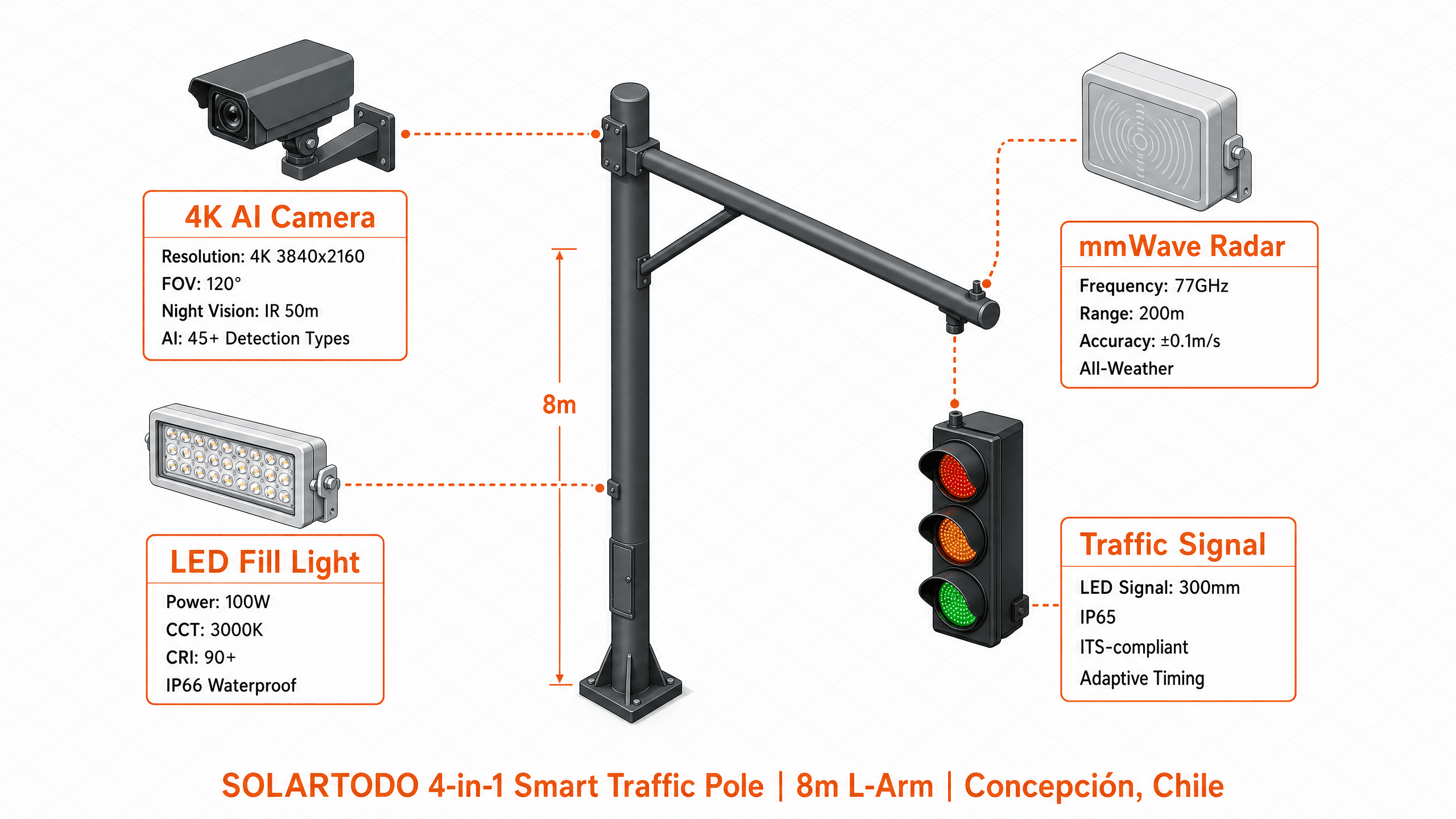
- Each pole combines 4 modules: 4K AI camera, 77GHz mmWave radar, LED fill light, and LED signal head on a hot-dip galvanized steel L-arm structure.
- Edge processing with NVIDIA Jetson supports <50ms response and up to 45+ detection types with stated AI recognition accuracy of 98%.
- Concepción’s commune population is 229,665, and the wider metropolitan area exceeds 1 million, which increases pressure on arterial intersections and school-zone crossings according to Chilean public statistics.
- Recommended communications are dual-path 5G/fiber backhaul to a TrafficGPT platform, with failover logic to maintain signal and alert continuity during telecom interruptions.
- A BOT structure can reduce upfront municipal CAPEX to 0, while lifecycle planning should still assume 10-15 years for pole structures and 5-7 years for active electronics refresh cycles.
- For signalized urban junctions in this profile, the 8m class is a better fit than 6m or 10m because it balances camera sightlines, radar coverage, and signal-head mounting without moving into highway gantry geometry.
- Standards alignment should include NTCIP for traffic communications and GB 25280 for signal hardware, with local civil and electrical approvals checked against Chilean municipal and transport requirements.
Market Context for Concepción
Concepción’s transport profile points to medium-density urban intersections where 8m smart poles are technically appropriate, especially on corridors linking the commune’s 229,665 residents to the larger metro area of more than 1 million people.
According to Chile’s Instituto Nacional de Estadísticas, the commune of Concepción records 229,665 inhabitants in the 2024 census update, while the metropolitan conurbation formed with Talcahuano, San Pedro de la Paz, Chiguayante, Hualpén and nearby communes functions as the core of Greater Concepción. That scale matters because signal timing problems in a metro area above 1 million residents usually appear first at radial junctions, bus corridors, hospital access points, and school-area crossings. For a Smart Traffic System assessment, the relevant issue is not only population but turning-movement complexity across 4 approaches and frequent pedestrian phases.
According to the Gobierno Regional del Biobío and regional planning documents, Concepción remains the administrative and service center of the Biobío Region, with heavy daily commuting between communes across the Biobío River system and coastal-industrial zones. This produces directional peaks that are sharper than those in smaller Chilean cities. In practice, a city with this commuting pattern benefits from adaptive signal optimization and incident auto-alert functions at intersections where queue spillback can propagate within 1-2 signal cycles.
Climate and coastal exposure also affect product selection. According to the Chilean Meteorological Directorate and regional climate summaries, Concepción has a temperate oceanic climate with winter rainfall concentrated over several months and persistent humidity. For street hardware, that means corrosion resistance is not optional. A hot-dip galvanized steel pole with dark-grey finish is better suited than painted carbon steel alone, particularly where annual wet days and salt-laden coastal air can shorten coating life on untreated structures.
Telecom availability is another local factor. Chile ranks high in Latin America for mobile and fiber connectivity, and according to the International Telecommunication Union (ITU) and OECD country reviews, fixed broadband and 4G/5G adoption are comparatively mature in urban Chilean markets. That makes 5G/fiber backhaul realistic for Concepción’s central and semi-central corridors. For SOLAR TODO, this matters because the Smart Traffic System depends on reliable uplinks from edge AI devices to the TrafficGPT central platform for natural-language querying, incident review, and timing adjustments.
There is also a road-safety rationale. The World Health Organization notes that road traffic injury remains a major urban public-health issue globally, especially for pedestrians and vulnerable road users. In a city with universities, hospitals, retail zones, and bus-heavy intersections, pedestrian detection and conflict monitoring are practical requirements rather than optional analytics. A typical Concepción deployment would therefore prioritize crossings with high pedestrian volumes, not only vehicle throughput.
As a technical planning conclusion, Concepción fits the single 8m intersection pole class from the SOLAR TODO Smart Traffic System range. The 6m option is more suitable for lower mounting heights and less complex sightlines, while 10m is better reserved for larger junctions, wider medians, or highway-style applications. For the specified scenario of 6 intersections, the 8m class is the correct baseline.
Recommended Technical Configuration
A typical 6-intersection Smart Traffic System layout in Concepción would consist of approximately 48 units of 8m L-arm steel poles, using 8 poles per junction to cover four approaches, pedestrian desire lines, and auxiliary signal positions.
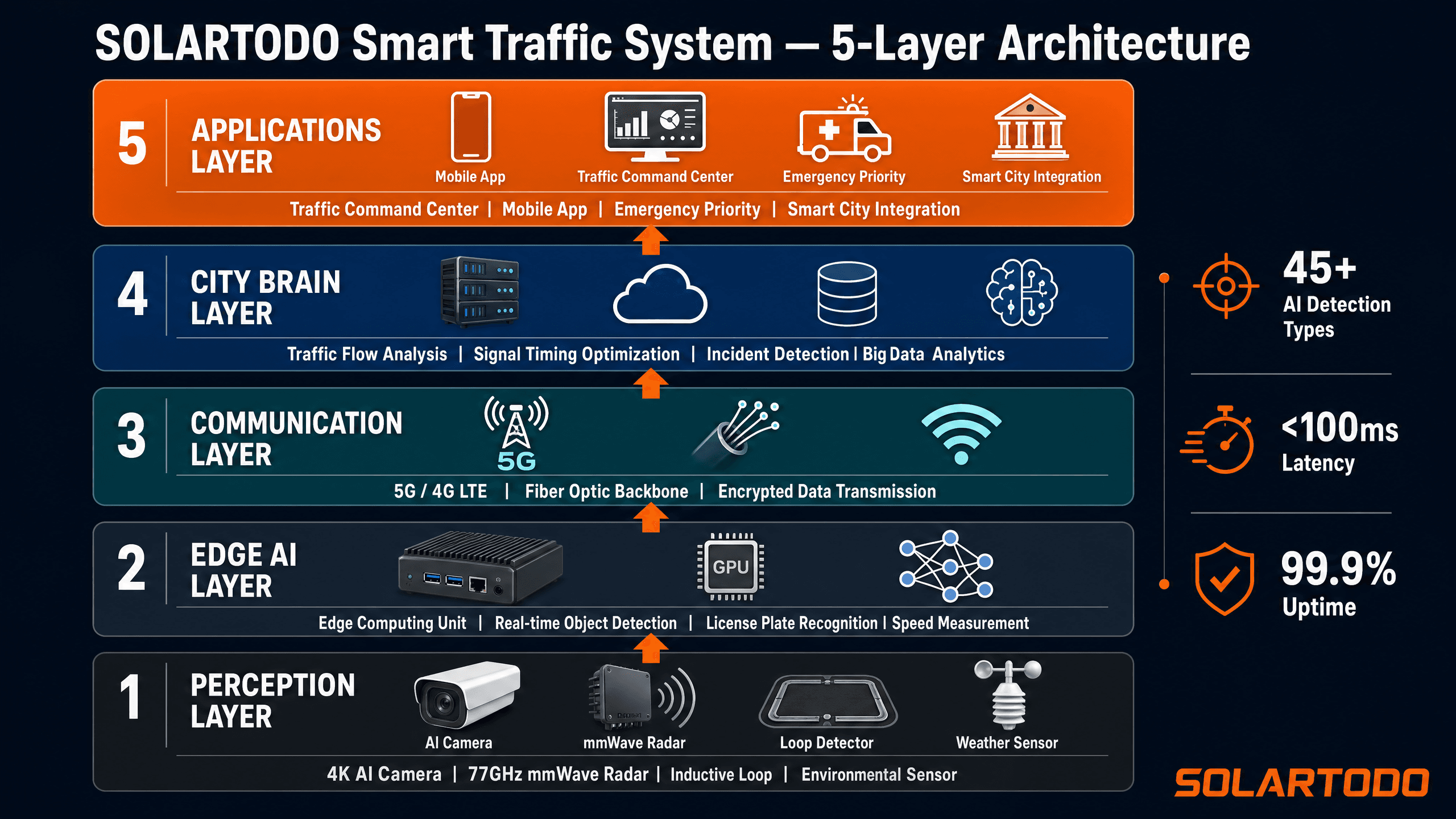
For this city profile, the recommended package follows the project-specific configuration exactly: 6 intersections × 8m L-arm steel pole in dark grey, fabricated from hot-dip galvanized steel. Each pole carries a 4-in-1 Smart Traffic System module set: 4K AI camera, 77GHz mmWave radar, LED fill light, and LED signal head. Edge processing runs on NVIDIA Jetson, and the functional stack supports pedestrian detection, adaptive signal optimization, and incident auto-alert.
A typical 6-intersection deployment at this density would use approximately 48 poles, assuming 8 poles per intersection. That count reflects one pole for each of the 4 approaches, plus auxiliary positions for better stop-line visibility, pedestrian crossing detection, or offset mounting where trees, utility lines, or corner geometry create blind spots. If a specific intersection has simpler geometry, the count could reduce to 4-6 poles; if it has skewed approaches or wide pedestrian refuges, it could move toward 10-12 poles.
The communication architecture should use 5G/fiber backhaul to the TrafficGPT central platform. Fiber is preferable for the primary link at high-volume intersections because it lowers latency and improves uptime for video transport, while 5G works well as a secondary path or where trenching costs are high. In a city center with mixed legacy and modern traffic cabinets, this dual-path design reduces the risk that a single telecom failure disables analytics or remote diagnostics.
The cooperation model specified for this Concepción market scenario is BOT (zero upfront). For municipalities facing budget constraints, BOT can shift initial equipment and integration costs away from year-1 CAPEX. However, procurement teams should still request clear service-level definitions for uptime, spare-part lead times, preventive maintenance intervals, and ownership transfer terms at the end of the BOT period.
SOLAR TODO should be evaluated here as a supplier of the integrated pole-and-edge stack rather than as a generic signal hardware vendor. The product value comes from combining sensing, processing, illumination, and signaling on a single structure. That reduces the number of separate roadside assets, which can simplify foundation planning, cable routing, and maintenance access across 6 intersections.
According to NEMA traffic control practice and NTCIP communication logic, interoperability is critical when adding adaptive functions to existing signal infrastructure. For Concepción, the recommended path is to keep the Smart Traffic System interoperable at cabinet level while using edge AI locally for fast event detection. That approach avoids forcing a full citywide controller replacement on day 1.
Technical Specifications
The recommended Concepción configuration is an 8m urban-intersection Smart Traffic System with 4 integrated modules, Jetson edge AI, NTCIP communications, and approximately 48 poles across 6 signalized junctions.
- Pole type: L-arm smart traffic pole
- Pole material: hot-dip galvanized steel
- Pole finish: dark grey
- Pole height: 8m
- Deployment scale: 6 intersections
- Typical pole quantity: approximately 48 units total, based on 8 poles per intersection
- Per-intersection range: 4-12 poles depending on geometry and auxiliary coverage needs
- Integrated sensing: 4K AI camera
- AI detection accuracy: 98%
- Detection library: 45+ detection types
- Edge response time: <50ms
- Radar type: 77GHz mmWave radar
- Lighting module: integrated LED fill light
- Signal module: integrated LED signal head
- Edge compute: NVIDIA Jetson
- Core functions: pedestrian detection, adaptive signal optimization, incident auto-alert
- Communications: 5G/fiber backhaul
- Central platform: TrafficGPT with natural-language query interface
- System stack: Perception → Edge AI → Communication → City Brain → Applications
- Cooperation model: BOT (zero upfront)
- Applicable standards: NTCIP, GB 25280
- Recommended use case: urban arterial intersections, school zones, hospital access roads, bus-priority corridors
According to NTCIP guidance, standardized communications reduce integration risk between field devices and traffic-management software. GB 25280 is relevant for traffic signal indications and hardware consistency, while local Chilean civil, electrical, and right-of-way approvals remain mandatory before procurement.
Implementation Approach
A phased 6-intersection rollout in Concepción would usually take 4 stages—survey, civil works, pole installation, and system commissioning—with a practical program window of roughly 12-20 weeks depending on permits and fiber readiness.
Stage 1 is the site survey and design package. This normally includes intersection geometry capture, mast-arm sightline checks, pedestrian conflict mapping, cabinet compatibility review, and telecom path verification. For 6 intersections, a survey team would typically need 2-3 weeks, especially if each junction requires utility clearance checks and as-built validation.
Stage 2 is civil and foundation work. The main tasks are foundation excavation, anchor-bolt placement, conduit routing, cabinet interface preparation, and earthing. In Concepción’s rainy season, civil scheduling should allow weather float because wet ground can slow concrete curing and trench reinstatement. For 48 poles, foundations are often sequenced in batches of 8-12 to reduce traffic disruption.
Stage 3 is pole erection and equipment mounting. Each 8m hot-dip galvanized L-arm pole is set, aligned, and connected to power and communications. The 4K AI camera, 77GHz radar, LED fill light, and LED signal head are then mounted and addressed. A trained crew can often complete 4-8 poles per day under normal urban access conditions, but lane-closure windows and police coordination can change that rate.
Stage 4 is software commissioning and optimization. The NVIDIA Jetson edge layer is configured first for local detection and event tagging, then linked over 5G/fiber to TrafficGPT. Adaptive signal logic should be tuned after at least 7-14 days of baseline traffic observation, because weekday peaks, weekend retail patterns, and school-hour pedestrian surges differ significantly. According to ITS practice, calibration quality often matters more than raw sensor count.
For procurement, SOLAR TODO would normally be asked to provide pole drawings, module interfaces, communication architecture, and maintenance schedules before contract close. Municipal buyers should request spare-part lists for at least 2 years, including camera units, radar modules, power supplies, surge protection, and controller interface parts. That reduces downtime risk once the system enters routine operation.
Expected Performance & ROI
A properly configured 6-intersection Smart Traffic System in Concepción could reduce delay and incident response times within the first 12 months, with financial value driven more by congestion and safety gains than by hardware replacement alone.
According to the U.S. Federal Highway Administration, adaptive signal control can reduce travel time by more than 10% in suitable corridors, while delay reductions often reach up to 50% depending on baseline conditions. Concepción should be viewed conservatively, so a planning assumption of 8-15% corridor delay reduction is more defensible for mixed urban traffic with buses, pedestrians, and variable side-street demand. That level of improvement can be material at 6 intersections if they are located on one coordinated corridor.
According to the World Bank, congestion costs in growing cities are not limited to fuel use; they also include lost productivity, public-transport unreliability, and higher incident risk. For a BOT model with zero upfront municipal CAPEX, the payback discussion should focus on avoided delay, lower manual enforcement cost, and fewer emergency callouts rather than only on equipment depreciation. In many Latin American city projects, the practical evaluation window is 3-7 years.
The safety case is equally important. According to WHO, safer pedestrian crossings and better speed/conflict detection are among the most effective urban interventions for vulnerable users. With 77GHz radar and 4K AI working together, the system can detect pedestrians in low-light and adverse-weather conditions better than camera-only layouts. That is relevant in Concepción’s rainy months, when visibility drops and crossing compliance can worsen.
Lifecycle economics should be split between passive and active assets. The 8m galvanized steel pole can reasonably be planned for a structural life of 10-15 years or more with proper coating maintenance, while edge electronics and communication modules usually need review or replacement in 5-7 years. This staggered refresh model is more cost-efficient than replacing separate standalone cameras, signals, lights, and brackets on different schedules.
[ITU] states, "Digital infrastructure is a foundational enabler of smart and sustainable cities." For Concepción, that means traffic intelligence should be treated as a transport-network function, not just an isolated roadside device purchase.
[World Health Organization] states, "Safe walking and cycling infrastructure can promote health and protect vulnerable road users." In intersection terms, that supports investment in pedestrian detection and responsive timing rather than fixed-cycle operation alone.
Results and Impact
For Concepción, the most realistic impact of a 6-intersection Smart Traffic System is better pedestrian protection, faster incident awareness, and measurable signal-efficiency gains in the 8-15% range when calibration and backhaul quality are maintained.
The first operational outcome would likely be improved visibility at conflict points. Because each pole combines a 4K camera, 77GHz radar, and LED fill light, the system can maintain detection coverage during low-light and rain better than a signal-only setup. On corridors with bus stops, schools, or hospital access, this improves the probability that pedestrians are detected before a phase change.
The second outcome is control quality. With <50ms edge response and central supervision through TrafficGPT, operators can review incidents, query event logs in natural language, and adjust timing plans based on actual turning movements rather than periodic manual counts. For a metro area above 1 million, that matters because demand patterns shift faster than annual signal retiming programs can usually track.
The third outcome is asset consolidation. A single 8m pole carrying 4 integrated functions reduces roadside clutter and simplifies maintenance routing. Instead of servicing separate camera poles, radar brackets, fill lights, and signal supports, the city can inspect one structural asset per mounting position. For 48 poles, that can reduce truck rolls and shorten fault isolation time.
SOLAR TODO is best positioned in this context when the buyer wants an integrated field device architecture, not a collection of unrelated components. The product page at /smart-traffic is the right starting point for module-level review, while project-specific civil and communications discussions should go through /contact.
Comparison Table
The table below compares three practical intersection-control options for Concepción, showing why the 8m integrated Smart Traffic System is the strongest fit for a 6-intersection urban corridor.
| Option | Pole Height | Sensing Package | Edge Processing | Backhaul | Typical Use Case | Main Limitation |
|---|---|---|---|---|---|---|
| Conventional signal pole | 6-8m | LED signal only | None | Basic cabinet comms | Low-complexity junctions | No real-time detection or incident analytics |
| Camera-only smart upgrade | 6-8m | 4K camera only | Limited or server-side | 4G/5G/fiber | Basic traffic counting | Lower reliability in rain, glare, and occlusion |
| SOLAR TODO Smart Traffic System | 8m | 4K AI camera + 77GHz radar + LED fill light + LED signal | NVIDIA Jetson, <50ms | 5G/fiber | Urban arterial intersections, pedestrian-heavy crossings | Higher integration planning requirement |
Pricing & Quotation
SOLAR TODO offers three pricing tiers for this product line: FOB Supply (equipment ex-works China), CIF Delivered (including ocean freight and insurance), and EPC Turnkey (fully installed, commissioned, with 1-year warranty). Volume discounts are available for large-scale deployments. Configure your system online for an instant estimate, or request a custom quotation from our engineering team at [email protected].
Frequently Asked Questions
A 6-intersection Concepción deployment typically raises 10 recurring questions covering 8m pole selection, BOT structure, installation time, maintenance cycles, standards, and return on investment.
Q1: Why is the 8m pole recommended for Concepción instead of 6m or 10m?
The 8m class fits most urban signalized intersections where sightlines must cover stop lines, crosswalks, and turning movements without moving into highway-style geometry. A 6m pole can limit camera and radar visibility at wider junctions, while 10m is usually better for gantry-like or very broad carriageway conditions.
Q2: What is included in the 4-in-1 Smart Traffic System configuration?
Each pole includes 4 integrated modules: a 4K AI camera, 77GHz mmWave radar, LED fill light, and LED signal head. The edge processor is NVIDIA Jetson, and the system supports pedestrian detection, adaptive signal optimization, and incident auto-alert with <50ms response and stated 98% AI accuracy.
Q3: How many poles would a typical 6-intersection deployment require?
A common planning assumption is approximately 48 poles total, based on 8 poles per intersection. The actual count can vary from 4 to 12 poles per junction depending on lane count, skew angle, medians, pedestrian islands, and whether auxiliary mounting points are needed for complete coverage.
Q4: How long would installation usually take in Concepción?
For 6 intersections, a practical implementation window is often 12-20 weeks. That includes survey, civil works, foundation curing, pole erection, communications setup, and software commissioning. Rainfall, municipal permits, utility conflicts, and fiber availability are the main schedule risks in Concepción.
Q5: What communications architecture is recommended—5G, fiber, or both?
The preferred design is fiber as primary and 5G as backup where available. Fiber is better for stable low-latency transport of video and event data, while 5G helps where trenching is costly or as a failover path. For adaptive control, dual-path communications improve uptime and simplify maintenance.
Q6: What ROI or payback period should municipalities expect?
Return is usually measured through reduced delay, fewer incident-related disruptions, and lower manual monitoring costs. Based on adaptive signal benchmarks, a planning horizon of 3-7 years is reasonable, especially under a BOT structure with zero upfront CAPEX. The exact payback depends on corridor traffic volume and baseline congestion.
Q7: How does this compare with a camera-only traffic monitoring upgrade?
A camera-only setup is cheaper initially, but it can perform worse in rain, glare, and partial occlusion. The 77GHz radar in this system adds detection resilience, especially for low-light and adverse-weather conditions. For Concepción’s wet season, multi-sensor detection is usually a better technical choice than video alone.
Q8: What maintenance regime is typical for this system?
Most operators plan quarterly inspections, annual calibration review, and event-based maintenance for damaged modules. Passive pole structures often follow a 10-15 year lifecycle, while active electronics are usually reviewed for refresh in 5-7 years. Spare cameras, radars, power units, and surge protectors should be stocked locally.
Q9: What standards should buyers ask for in the quotation?
At minimum, the quotation should reference NTCIP for traffic communications and GB 25280 for signal hardware. Buyers should also request local civil, electrical, grounding, and right-of-way compliance documents required in Chile. Interoperability with existing controllers and cabinets should be stated clearly in the technical schedule.
Q10: Is BOT the only commercial model available from SOLAR TODO?
No. Although this Concepción scenario uses BOT (zero upfront), the product line also supports EPC turnkey and joint venture structures. The right model depends on municipal budget rules, ownership preferences, and whether the city wants to treat the system as infrastructure CAPEX or managed service OPEX.
References
- Instituto Nacional de Estadísticas de Chile (2024): Censo 2024 preliminary/update figures showing 229,665 residents in the commune of Concepción.
- Gobierno Regional del Biobío (2023): Regional planning and mobility documents describing Greater Concepción as the service and transport core of the Biobío Region.
- International Telecommunication Union (2023): ICT development and urban digital infrastructure data relevant to Chile’s broadband and mobile connectivity environment.
- OECD (2024): Chile digital economy and connectivity reviews indicating comparatively strong fixed and mobile network conditions in urban Chile.
- World Health Organization (2023): Road safety guidance emphasizing pedestrian protection and safer urban mobility interventions.
- U.S. Federal Highway Administration (2023): Adaptive Signal Control Technologies guidance reporting travel-time and delay improvements under corridor optimization.
- NTCIP / AASHTO ITS practice references (latest applicable editions): Standardized communications framework for traffic field devices and central management systems.
Equipment Deployed
- 8m L-arm smart traffic pole, dark grey, hot-dip galvanized steel
- 4K AI camera with 98% stated accuracy and 45+ detection types
- 77GHz mmWave radar for vehicle and pedestrian detection
- Integrated LED fill light for low-light intersection coverage
- Integrated LED signal head compliant with GB 25280 framework
- NVIDIA Jetson edge AI processor with <50ms response
- 5G/fiber communication backhaul to TrafficGPT platform
- TrafficGPT central platform with natural-language query interface
- Pedestrian detection and adaptive signal optimization software
- Incident auto-alert module for traffic operations teams