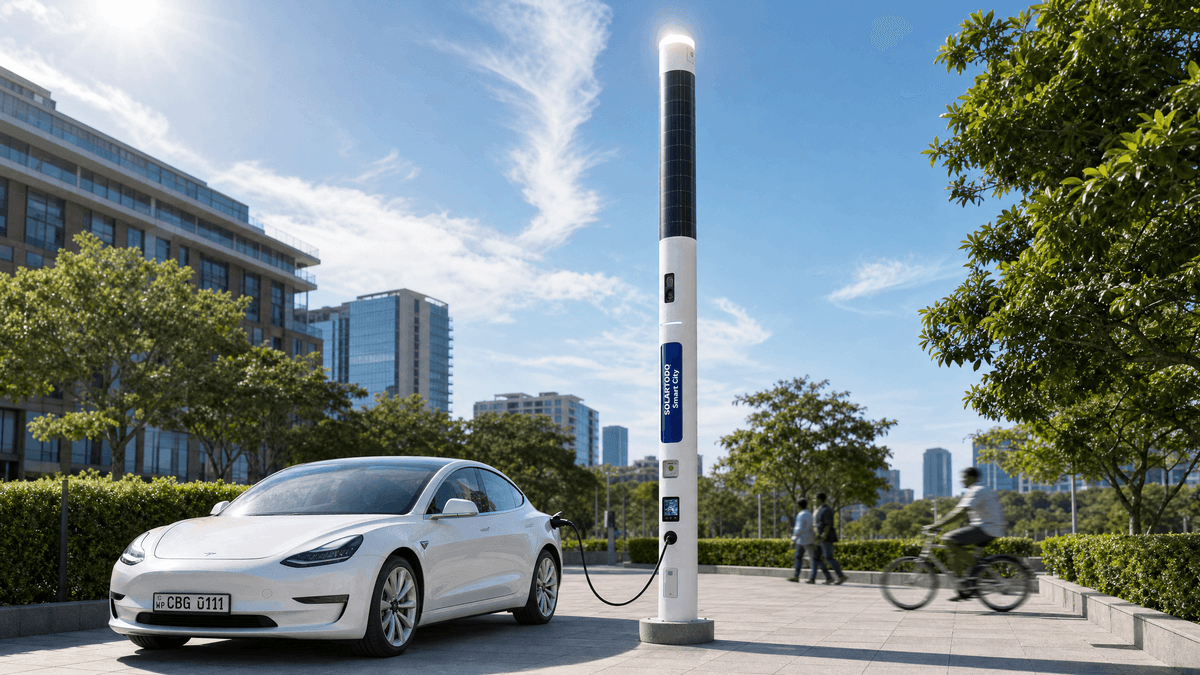
Colombo Smart Streetlight Market Analysis: Ø219mm Flush-Integrated Pole Configuration Guide for Urban Corridors
Summary
Colombo’s dense urban corridors, tropical rainfall, and mixed mobility demand favor a compact smart streetlight format at 25 m spacing; a typical 32-unit, 8 m Ø219 mm deployment would cover about 800 m while combining 100 W lighting, 11 kW AC charging, and 3,000 Wh LFP backup.
Key Takeaways
- Colombo’s municipal area is about 37 km² with a daytime population far above its resident base, which supports higher-density smart streetlight spacing of about 25 m on commercial corridors and transit streets.
- According to the Department of Census and Statistics Sri Lanka (2012), the City of Colombo has roughly 560,000 residents, while the wider Colombo District exceeds 2.3 million, indicating strong demand for multi-function curbside infrastructure.
- According to the World Bank (2023), Sri Lanka’s urban population is about 19% of total population; in Colombo, that urban intensity concentrates transport, public safety, and telecom needs into short road segments rather than suburban pole spacing.
- A typical 32-unit deployment in this profile would use 8 m seamless cylindrical Ø219 mm poles with 5 mm wall thickness, matte white RAL9003 finish, and 100 W / 15,000 lm multi-ring glow luminaires.
- The specified CIGS thin-film wrap provides about 160 W per pole across the 6.5 m to 7.3 m section, paired with a 3,000 Wh LFP battery and MPPT for backup of sensors, communications, display, and emergency functions.
- Each pole would include a fully flush 11 kW AC Type 2 EV charger, 5 m coiled cable, flush touchscreen at 1.5 m, and dual USB-A ports without widening the base beyond Ø219 mm.
- For an 800 m urban corridor, 32 poles at 25 m spacing would typically provide 480,000 lm total installed light output, 32 EV charge points, 32 panoramic cameras, and 32 environmental sensing nodes.
- Based on LED efficacy of 150 lm/W and smart dimming logic commonly used in urban lighting, electricity use for lighting can be materially lower than legacy HID systems, with maintenance intervals typically extending toward 50,000-hour LED life under IEC 60598-compliant luminaire design.
Market Context for Colombo
Colombo’s infrastructure profile supports high-density smart streetlight deployment because the city compresses transport, commerce, tourism, and municipal services into a small urban footprint of roughly 37 km². According to the Department of Census and Statistics Sri Lanka (2012), the resident population of Colombo Municipal Council is about 561,000, while Colombo District exceeds 2.3 million. That concentration matters because a 500 m to 1,000 m corridor in Colombo often carries more pedestrian, vehicle, and curbside activity than a longer suburban road in lower-density cities.
Climate also shapes the technical fit. According to the World Bank Climate Change Knowledge Portal (2021), Sri Lanka’s western coast receives high annual rainfall and maintains warm, humid conditions year-round, with Colombo commonly seeing temperatures around 26°C to 31°C. For pole design, this means corrosion protection, sealed embedded modules, and reduced external attachments are more suitable than bracket-heavy assemblies that create more water ingress points and visual clutter.
Power and telecom conditions also favor a grid-connected smart streetlight with local backup rather than a fully off-grid road-lighting model. According to the Ceylon Electricity Board, Sri Lanka’s low-voltage public supply is generally 230/400 V, 50 Hz, which matches standard AC charging and smart controller requirements for municipal streets. According to the Telecommunications Regulatory Commission of Sri Lanka (2023), mobile broadband usage and urban data demand continue to rise, so curbside poles increasingly serve as practical mounting points for Wi‑Fi, sensing, and future small-cell support.
Urban mobility policy adds another driver. Sri Lanka’s transport planning for the Colombo Metropolitan Region continues to emphasize congestion reduction, public transport modernization, and better street management. In that context, a smart streetlight is not only a luminaire; it becomes a curbside node for lighting, environmental data, public safety, wayfinding, and low-footprint EV charging on roads where sidewalk width is limited.
For Colombo specifically, the premium flush-integrated cylindrical form is technically suitable on seafront boulevards, commercial avenues, mixed-use districts, and civic frontage where visual control is important. The SOLAR TODO Smart Streetlight configuration analyzed here avoids side arms, external speaker columns, and separate charger pedestals, which helps on streets with constrained pedestrian clearances and stricter architectural expectations.
Recommended Technical Configuration
For Colombo’s dense urban corridors, a typical 32-unit smart streetlight deployment would use 8 m seamless Ø219 mm cylindrical poles at 25 m spacing to cover about 800 m with lighting, sensing, security, and curbside charging in one monolithic structure.
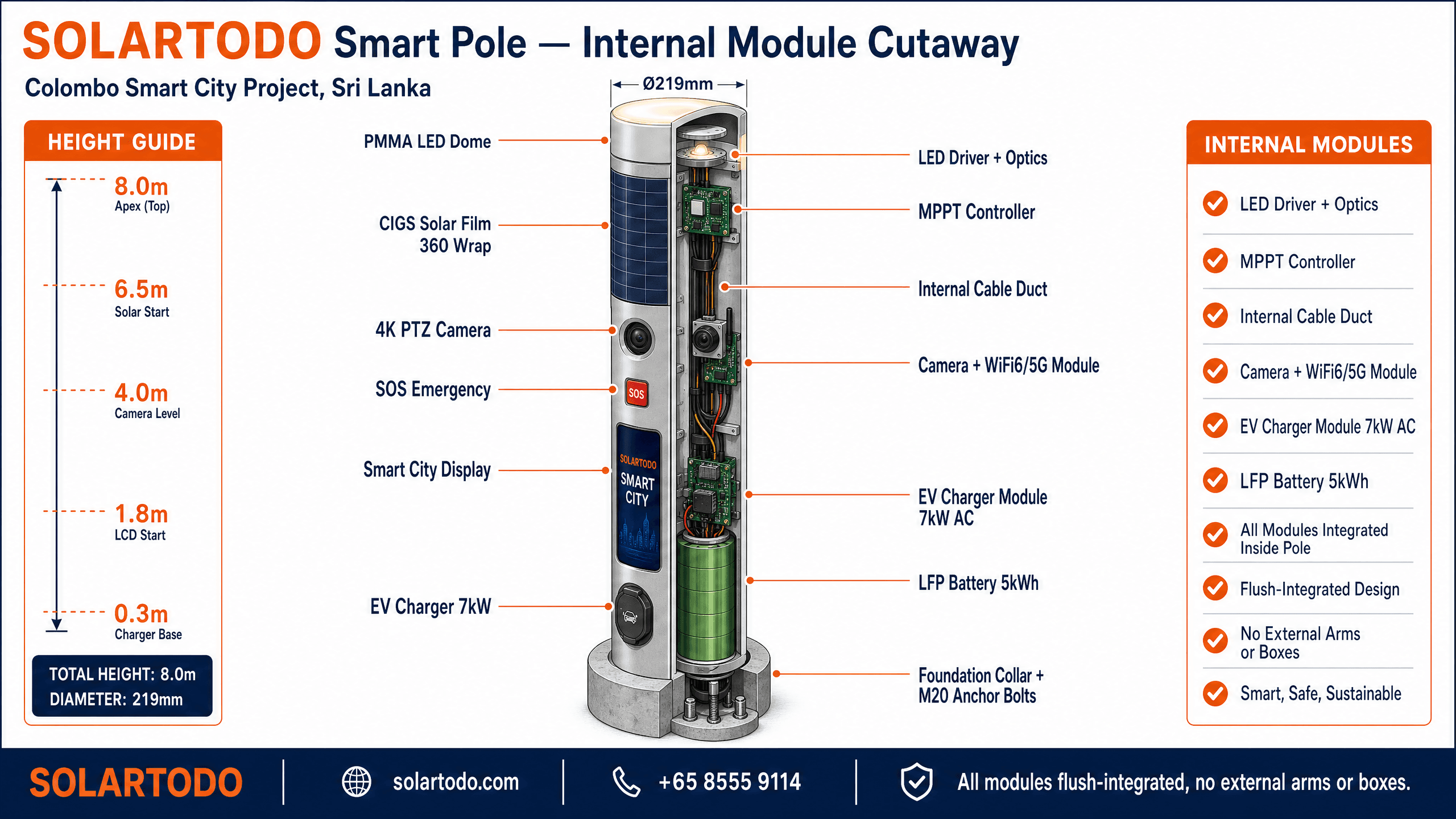
The recommended size class is the cylindrical premium smart streetlight variant rather than a standard octagonal pole with external accessories. Colombo’s central roads often face three constraints at once: narrow sidewalks, mixed pedestrian flows, and strong pressure to reduce visual clutter. A constant-diameter Ø219 mm pole with all modules flush-integrated into the cylinder skin addresses those constraints better than arm-mounted or box-mounted systems.
A typical 32-unit deployment of this scale would be suitable for one commercial avenue, a waterfront frontage, a government precinct edge, or a transit-oriented connector road. At 25 m spacing, the line length would be about 800 m. With 100 W LED luminaires at 15,000 lm each, the installed lighting package would total 3.2 kW and 480,000 lm across the corridor.
The embedded 11 kW AC charger in each pole is a notable fit for Colombo’s curbside conditions because it avoids separate EV pedestals that consume additional footpath width. If all 32 ports were energized simultaneously, connected load could reach 352 kW, so a practical municipal design would usually apply load management, feeder diversity, and phased charging logic rather than sizing the supply for full coincident demand. According to the IEA (2024), managed charging is increasingly necessary as urban EV infrastructure scales.
The thin-film solar wrap and 3,000 Wh LFP battery should be treated as resilience support for electronics, emergency functions, display, and partial lighting continuity rather than as the primary energy source for the 11 kW charger. Colombo’s cloud cover and tropical rain cycles can reduce solar yield consistency, but a 160 W CIGS wrap with MPPT still adds useful supplemental energy for low-power loads. According to NREL (2023), distributed PV output varies materially with orientation, shading, and weather, so wrapped thin-film on urban poles is best assessed as auxiliary generation.
SOLAR TODO’s flush-integrated format is also aligned with public-realm maintenance logic. Fewer protrusions mean fewer impact points from buses, delivery vehicles, signage conflicts, or vandalism. That matters on Colombo roads where curbside space is shared by parking, tuk-tuks, buses, and informal loading activity.
Technical Specifications
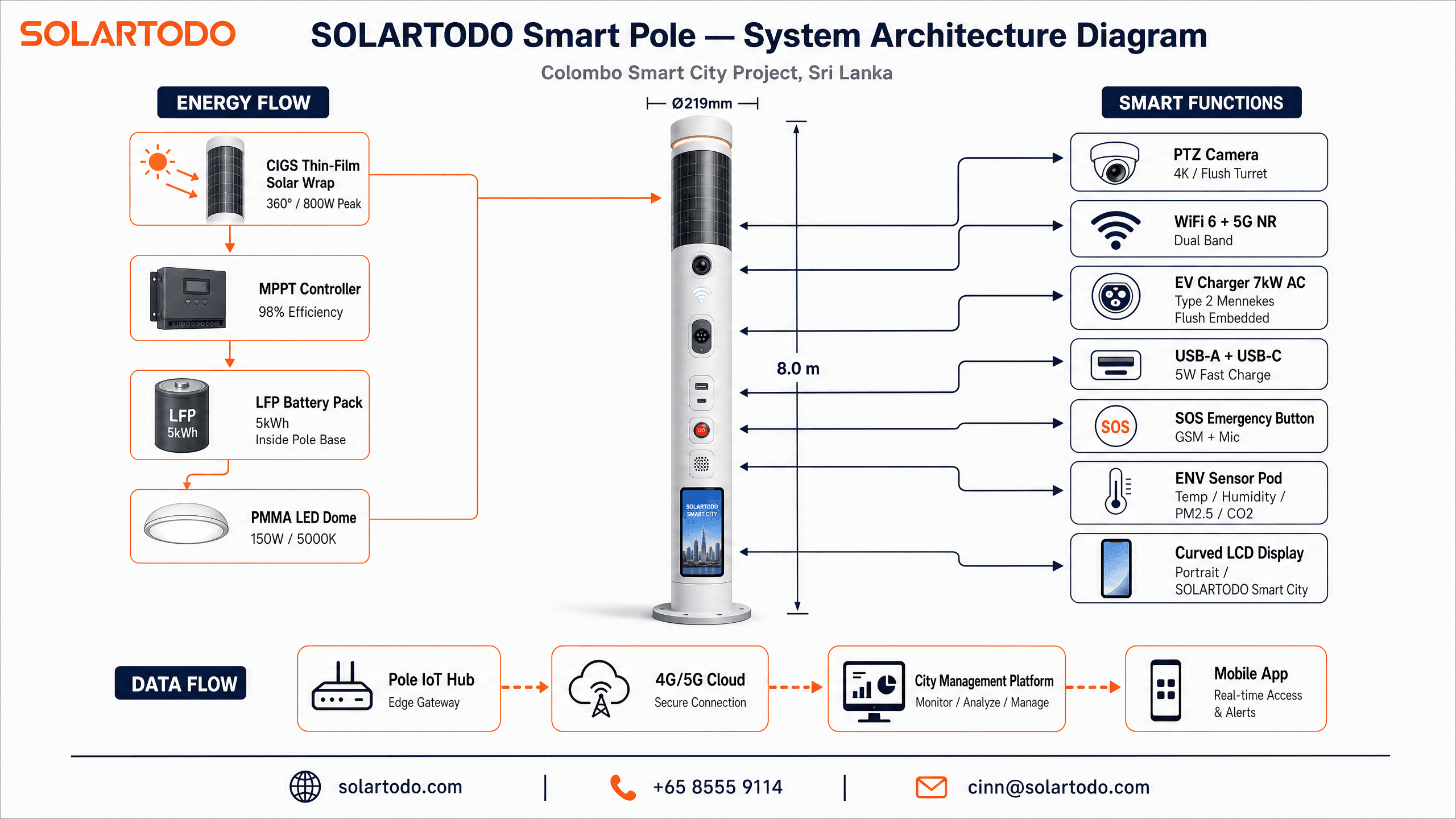
The recommended Colombo configuration is approximately 32 units of 8 m Ø219 mm seamless cylindrical smart streetlights with 100 W lighting, 160 W CIGS wrap, 3,000 Wh LFP backup, and fully flush 11 kW AC charging.
- Quantity: approximately 32 units
- Pole height: 8 m
- Pole form: seamless cylindrical, constant Ø219 mm top-to-bottom
- Wall thickness: 5 mm
- Material/finish: hot-dip galvanized steel, matte white RAL9003
- Structural concept: one monolithic cylinder; no side arms, no outriggers, no external equipment boxes
- Luminaire: Ø219 mm multi-ring glow column at top, 3 to 5 rings within top 1.5 m
- LED rating: 100 W
- Luminous flux: 15,000 lm
- CCT: 4000 K
- LED efficacy basis: 150 lm/W class under product line specification
- Solar section: CIGS flexible thin-film cells wrapped 360° around pole at 6.5 m to 7.3 m
- Solar capacity: approximately 160 W total per pole
- Solar appearance: dark blue-black semi-transparent film laminated flush to pole skin
- Battery: LFP 3,000 Wh inside pole base
- Charge control: MPPT integrated
- Camera: flush fisheye 180° panoramic camera behind dome glass, 8 MP
- Environmental sensing: 8-parameter sensor pod at dome top for temperature, humidity, wind, pressure, noise, PM2.5, PM10, and illuminance
- Communications: embedded WiFi 6 with internal antenna inside cylinder
- Emergency interface: flush SOS button with dual-way audio intercom through pinhole speaker grille only
- Public-address audio: not included
- EV charging: fully flush embedded 11 kW AC charger, Type 2 socket with flush flip-cap
- Cable: 5 m coiled Type 2 cable
- User interface: flush touchscreen at 1.5 m height
- Display: curved vertical LCD, about 2200 mm tall × 170 mm wide, inset flush into cylinder wall
- Display content restriction: text only, “SOLARTODO Smart City” stacked vertically, white sans-serif on deep blue
- USB: 2 × USB-A flush-mounted
- Pole spacing: 25 m typical
- Corridor coverage: about 800 m for 32 units
- Standards basis: IEC 60598 and GB/T 37024
This specification is technically consistent with Colombo’s need for premium streetscape control, moderate pole height, and multi-function service density. IEC 60598 remains the core luminaire safety reference, while GB/T 37024 is relevant for smart multifunction pole integration. For coastal urban use, galvanizing quality, sealed access points, and cable routing should be reviewed during detailed design because saline air can shorten coating life if fabrication quality is inconsistent.
Implementation Approach
A Colombo smart streetlight rollout would typically proceed in 4 phases over about 16 to 28 weeks, starting with corridor survey and utility checks, then moving through civil works, pole installation, systems integration, and commissioning.
Phase 1 is corridor definition and utility coordination. A municipal owner or EPC contractor would usually survey an 800 m section, verify footpath widths, identify underground utilities, and confirm feeder capacity at 230/400 V, 50 Hz. In Colombo, this step is important because drainage lines, telecom ducts, and roadside kiosks can constrain foundation locations within a 1 m to 2 m lateral window.
Phase 2 is detailed design and procurement. For 32 units, the design package would normally include foundation drawings, earthing layout, feeder segmentation, charger load management logic, and communications architecture. If the buyer imports complete poles or CKD/SKD assemblies, shipping lead time, customs clearance, and local testing should be built into the program rather than assuming direct site delivery.
Phase 3 is civil and electrical installation. Typical works include excavation, anchor cage or base preparation, conduit placement, earthing, feeder pull, and pole erection. Because this Ø219 mm design keeps all modules within the cylinder, site assembly is simpler than systems that require separate charger bollards, camera arms, or display frames.
Phase 4 is software commissioning and acceptance testing. Each pole would typically undergo luminaire function tests, charger energization checks, camera and sensor verification, touchscreen validation, and network onboarding. For a 32-unit line, a structured acceptance protocol should also confirm display content restrictions, emergency intercom operation, and data handoff to municipal or operator platforms.
A practical deployment sequence in Colombo would use night works or segmented lane closures on roads with bus traffic and high daytime pedestrian loads. Installation productivity depends on foundation curing method, utility conflicts, and crane access, but urban smart pole programs of this scale are commonly installed in batches of 4 to 8 units per work window once civil readiness is complete.
Expected Performance & ROI
For Colombo, a 32-unit smart streetlight corridor would typically deliver 480,000 lm of installed light, 32 curbside 11 kW charge points, and 32 environmental-security nodes, with ROI driven more by multi-use infrastructure consolidation than by solar yield alone.
The direct lighting efficiency case is straightforward. Replacing legacy 150 W to 250 W HID streetlights with 100 W LED units can reduce lighting energy use materially while improving controllability. According to the U.S. Department of Energy (2022), LED roadway lighting commonly cuts energy consumption by 40% to 60% compared with legacy systems, especially when dimming and scheduling are used.
The stronger business case in Colombo is infrastructure stacking. One pole can combine lighting, camera coverage, environmental sensing, emergency call capability, Wi‑Fi access, limited backup power, and AC charging in the same footprint. That can reduce the number of separate roadside assets, foundations, utility connections, and maintenance visits. According to IRENA (2023), integrated urban energy and mobility infrastructure can lower lifecycle costs when civil works and connection points are consolidated.
For EV charging, utilization will determine revenue more than hardware count. An 11 kW AC charger is suitable for destination and curbside charging where dwell times are typically 1 to 4 hours rather than 10 to 20 minutes. In Colombo’s commercial districts, that aligns better with office, retail, hotel, and municipal parking behavior than with highway fast-charging use.
Maintenance economics also favor the monolithic format. With no external camera pods, no side-arm luminaires, and no separate charger pedestal, there are fewer exposed joints and collision points. LED life is typically evaluated toward 50,000 hours, and LFP batteries commonly support several thousand cycles depending on operating temperature and depth of discharge. Colombo’s humidity still requires periodic inspection of seals, coating condition, and connector integrity at least 2 times per year.
Two authority statements are worth noting here. The IEA states, "Public charging infrastructure needs to expand in tandem with EV uptake and grid integration measures," which is directly relevant to Colombo’s curbside charging strategy. IEC states, "Luminaires shall be so designed and constructed that in normal use they function safely," a simple but important reminder that safety compliance remains the first procurement filter ahead of feature count.
A realistic payback model in Colombo would therefore combine 4 value streams: lower lighting energy, reduced maintenance versus legacy fittings, avoided cost of separate street furniture, and charger or data-service revenue where permitted. For municipal buyers, payback might fall in the medium-term range when charger utilization and asset consolidation are included; for purely lighting-led procurement without monetized charging, the return period would usually be longer.
Results and Impact
For Colombo, the expected impact of a 32-unit smart streetlight corridor is better public lighting, 32 distributed data points, and 32 flush curbside chargers across about 800 m without adding separate roadside cabinets or bollards.
From an urban design perspective, the constant Ø219 mm cylinder is the main differentiator. It keeps cameras, sensors, display, charger, and emergency interface inside one vertical line, which is useful on premium boulevards, civic districts, and frontage roads where conventional smart poles can appear crowded. For Colombo’s coastal and tourism-sensitive zones, that cleaner profile can be as important as the electrical specification.
From an operations perspective, the format supports a more unified asset-management model. A city or concessionaire can monitor lighting status, environmental data, charger availability, and emergency alerts through one pole inventory rather than several separate device classes. SOLAR TODO is therefore relevant where the procurement objective is not only illumination, but also curbside digital infrastructure with limited sidewalk intrusion.
Comparison Table
The table below compares the recommended Colombo flush-integrated cylindrical smart streetlight against a conventional modular smart pole approach for dense urban corridors.
| Metric | Recommended Colombo Configuration | Conventional Modular Smart Pole |
|---|---|---|
| Pole height | 8 m | 8–10 m |
| Pole diameter/form | Constant Ø219 mm seamless cylinder | Octagonal or tubular with accessory mounts |
| Wall thickness | 5 mm | Typically 4–6 mm |
| Lighting | 100 W, 15,000 lm, 4000 K | 80–150 W, often arm-mounted |
| Solar | 160 W CIGS wrap, flush | Often none or rigid side panel/bracket |
| Battery | 3,000 Wh LFP internal | Often optional or external cabinet |
| EV charging | 11 kW AC flush embedded | 7–11 kW, often separate pedestal or box |
| Camera | Flush 8 MP fisheye behind dome glass | External bullet/PTZ or protruding dome |
| Environmental sensing | 8 parameters | 4–8 parameters, often external pod |
| Wi‑Fi | WiFi 6 internal antenna | External antenna/disc common |
| Streetscape impact | Very low visual clutter | Medium to high depending on accessories |
| Sidewalk obstruction | Low; no widened base or bollard | Higher if charger cabinet is separate |
| Maintenance exposure points | Lower due to flush modules | Higher due to brackets and external housings |
| Best-fit Colombo use case | Premium urban corridors, civic frontage, waterfront roads | General urban roads with fewer visual constraints |
Pricing & Quotation
SOLAR TODO offers three pricing tiers for this product line: FOB Supply (equipment ex-works China), CIF Delivered (including ocean freight and insurance), and EPC Turnkey (fully installed, commissioned, with 1-year warranty). Volume discounts are available for large-scale deployments. Configure your system online for an instant estimate, or request a custom quotation from our engineering team at [email protected].
For Colombo buyers, quotation accuracy depends on 5 variables: corridor length in meters, charger diversity factor, foundation type, communications scope, and local installation method. A budgetary RFQ should therefore specify whether the project requires full civil works, utility connection, software platform integration, and local content. Product details for the SOLAR TODO Smart Streetlight line are available on the product page, and project-specific engineering inputs can be submitted through the contact us page.
Frequently Asked Questions
This FAQ answers 10 common Colombo procurement questions covering specs, installation, ROI, maintenance, EPC scope, and warranty for an 8 m Ø219 mm smart streetlight configuration.
Q1: Why is the Ø219 mm cylindrical smart streetlight a good fit for Colombo?
Colombo has dense sidewalks, heavy mixed traffic, and visually sensitive commercial streets. A constant Ø219 mm cylinder keeps the charger, camera, display, Wi‑Fi, and SOS interface inside one 8 m pole, which reduces street clutter. For corridors with 25 m spacing, this format can cover about 800 m with 32 poles while preserving pedestrian clearance better than separate cabinets or bollards.
Q2: Is the 160 W CIGS solar wrap enough to power the whole pole, including 11 kW EV charging?
No. The 160 W thin-film wrap is best treated as supplemental generation for electronics, emergency functions, communications, display loads, and limited backup charging through the 3,000 Wh LFP battery. The 11 kW AC charger is primarily grid-supplied at 230/400 V, 50 Hz. This is the correct design logic for Colombo’s urban curbside charging use case.
Q3: What road length does a typical 32-unit deployment cover?
At the specified 25 m spacing, 32 poles would cover about 800 m of corridor length. Actual coverage can vary slightly if end spacing, intersections, bus bays, trees, or utility conflicts require adjustments. On Colombo streets with irregular curb geometry, designers often refine spacing within a 22 m to 28 m band during detailed photometric and civil review.
Q4: How long would installation typically take in Colombo?
A 32-unit project would commonly require about 16 to 28 weeks from survey to commissioning, depending on utility approvals, shipping lead time, and civil readiness. Site installation itself can move faster once foundations and feeders are prepared. Urban road occupation permits, drainage conflicts, and feeder upgrades are usually the main schedule risks rather than pole erection time.
Q5: What kind of ROI should a buyer expect?
ROI depends on whether the project values only lighting savings or also monetizes EV charging, data services, and avoided street-furniture costs. LED lighting alone can reduce energy use by roughly 40% to 60% versus legacy HID systems, but the stronger payback usually comes from combining 32 lights, 32 sensors, 32 cameras, and 32 chargers into one asset class instead of several separate installations.
Q6: How does this compare with a standard modular smart pole?
The main difference is flush integration. This model keeps all major functions inside a constant Ø219 mm cylinder with no side arms, no external boxes, and no separate charger pedestal. A modular pole may be easier to reconfigure later, but it usually creates more visual clutter, more exposed components, and more sidewalk intrusion on constrained Colombo streets.
Q7: What maintenance regime is typical for this configuration?
A practical plan is 2 scheduled inspections per year, plus remote monitoring for charger, lighting, and communications alarms. Field checks should cover galvanizing condition, seal integrity, touchscreen function, charger socket wear, battery health, and lens cleanliness. The LED system is commonly designed toward 50,000-hour life, but Colombo’s humidity and salt exposure still justify regular preventive maintenance.
Q8: Does the EPC quotation usually include foundations and grid connection?
It can, but scope must be stated clearly. An EPC turnkey package often includes foundations, erection, feeder connection, commissioning, and basic training, while FOB or CIF supply does not. For Colombo, buyers should confirm whether trenching, earthing, utility metering, charger back-office integration, and traffic management are included, because those items can materially change installed project cost.
Q9: What warranty terms are typical for this product line?
The mandatory pricing paragraph specifies 1-year warranty for EPC turnkey scope. Beyond that, commercial warranty terms for pole structure, LED modules, charger components, display, battery, and electronics should be defined in the quotation and technical annex. Buyers should ask for separate warranty periods by subsystem because an LFP battery, LCD display, and steel pole do not age at the same rate.
Q10: Can this smart streetlight support future smart-city expansion in Colombo?
Yes, within the limits of the embedded design. The pole already combines WiFi 6, an 8 MP panoramic camera, 8-parameter environmental sensing, SOS intercom, USB charging, and an 11 kW AC EV charger in one 8 m structure. For Colombo, that supports phased smart-city rollout without adding multiple new roadside assets to the same corridor.
References
- Department of Census and Statistics Sri Lanka (2012): Census data for Colombo Municipal Council and Colombo District population.
- World Bank (2023): Urban population indicators for Sri Lanka and macro urbanization context.
- World Bank Climate Change Knowledge Portal (2021): Colombo/Sri Lanka climate patterns, rainfall and temperature ranges relevant to outdoor infrastructure.
- Ceylon Electricity Board (2023): Sri Lanka public electricity supply framework and low-voltage distribution context at 230/400 V, 50 Hz.
- Telecommunications Regulatory Commission of Sri Lanka (2023): National telecom and broadband market data relevant to urban connectivity demand.
- U.S. Department of Energy (2022): LED roadway and area lighting energy-saving benchmarks versus legacy HID systems.
- IEA (2024): Global EV Outlook findings on charging infrastructure growth and managed charging requirements.
- IRENA (2023): Urban energy system integration and distributed infrastructure planning considerations.
- IEC (2020): IEC 60598 luminaire safety requirements.
- Standardization Administration of China (2018): GB/T 37024 multifunction smart pole system framework.
Equipment Deployed
- 32 × 8 m seamless cylindrical smart streetlight poles, constant Ø219 mm, 5 mm wall, hot-dip galvanized, matte white RAL9003
- 32 × Ø219 mm multi-ring glow top luminaires, 100 W, 15,000 lm, 4000 K
- 32 × 360° wrapped CIGS thin-film solar sections, approximately 160 W per pole, mounted flush at 6.5 m to 7.3 m
- 32 × LFP battery packs, 3,000 Wh internal base-mounted with MPPT
- 32 × flush 8 MP fisheye 180° panoramic cameras behind dome glass
- 32 × 8-parameter environmental sensor pods for temperature, humidity, wind, pressure, noise, PM2.5, PM10, and illuminance
- 32 × embedded WiFi 6 communication modules with internal antenna
- 32 × flush SOS buttons with dual-way audio intercom through pinhole speaker grille
- 32 × fully flush embedded 11 kW AC EV chargers with Type 2 socket and flush flip-cap
- 32 × 5 m coiled Type 2 charging cables
- 32 × flush touchscreens mounted at 1.5 m height
- 32 × curved vertical LCD displays, approximately 2200 mm × 170 mm, text-only “SOLARTODO Smart City” format
- 64 × flush USB-A ports, 2 per pole
- LoRaWAN/4G-capable smart control and cloud platform integration as required by project scope