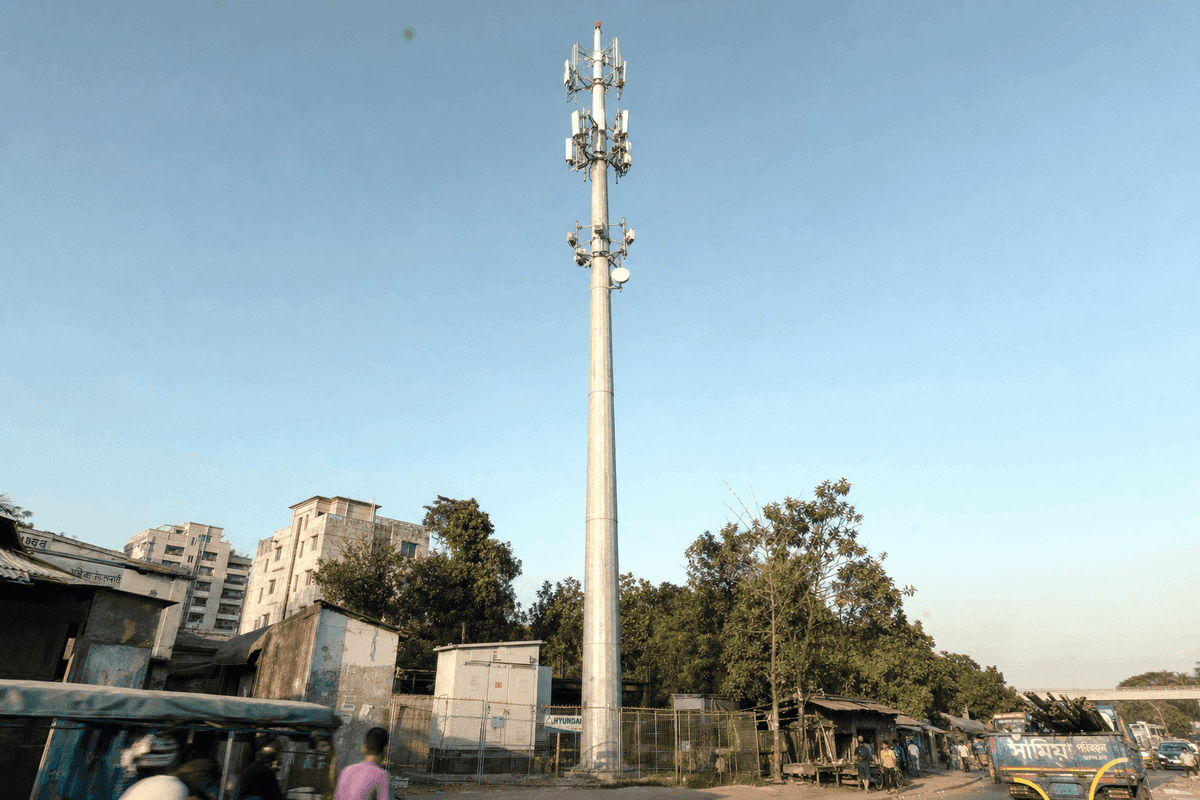
Chittagong Telecom Tower Market Analysis: 40m Steel Monopole Configuration Guide
Summary
Chittagong's 3.23 million city population, 168.07 km2 municipal area, and coastal cyclone exposure make a 40m steel monopole class suitable for regional macro coverage. A typical 11-unit configuration would use ~20t/tower, 40 m/s wind class, pile foundations, and CKD shipping.
Key Takeaways
Chittagong's telecom tower fit is driven by 3.23 million city residents, 5.65 million metro demand, and high-corrosion coastal exposure.
- A typical 11-unit deployment of this scale would use 40m tapered steel monopoles, each approximately 20t using the 500kg/m engineering rule.
- The correct size class is 35-45m highway/peri-urban, matching 2-3 platforms, 6-9 panel antennas, and 1-2 microwave links.
- The recommended antenna load is 9 panel antennas, 1 microwave dish, and 6 RRUs per tower for regional macro/high-coverage service.
- Wind class 1 equals 40 m/s with factor 1.0 under TIA-222-H design logic; coastal verification should still check site-specific gust maps.
- Pile foundations are recommended for 40m coastal sites because Chittagong has soft alluvial zones, high rainfall, and corrosion exposure.
- CKD shipping can reduce volume by 60-70%, improving container utilization for flanged bolt-on sectional monopoles.
- Production planning should assume 30-45 days for Q345 hot-dip galvanized steel fabrication before shipping and civil works.
- Design life is 30 years when coating, grounding, lightning protection, and periodic bolt-torque inspections are maintained.
Market Context for Chittagong
Chittagong requires macro telecom structures sized for a 3.23 million city corporation and a coastal metropolitan economy connected to Bangladesh's largest seaport.
According to the Bangladesh Bureau of Statistics 2022 census, Chittagong City Corporation has about 3.23 million residents within roughly 168.07 km2, while the wider urban agglomeration is commonly reported above 5.6 million. That density creates mixed radio-planning needs: dense urban infill near commercial corridors, high-capacity macro sites near transport arteries, and resilient backhaul around port, industrial, and peri-urban districts. For SOLARTODO, the relevant product fit is not a solar system; it is a steel Telecom Tower structure that supports operator antenna loading, microwave backhaul, and maintenance access.
According to BTRC-reported market statistics cited for 2025, Bangladesh had approximately 188.45 million mobile subscriptions and 133.61 million internet subscribers, including 119.29 million mobile internet users. This national scale matters in Chittagong because port logistics, export processing zones, universities, and residential expansion all increase traffic concentration. The practical implication is that regional macro towers should support 4G/5G overlay loads rather than single-operator, low-load rural antennas.
According to the World Bank Group 2024 Bangladesh climate risk profile, coastal and southern divisions face recurring cyclone, storm-surge, flood, and salinity risks. A 2023 statistical-physical storm-tide study projects Bangladesh's 100-year storm tide could rise from 3.5m to roughly 4.9-5.4m by late century, with the Meghna-North Chattogram region identified as highly vulnerable. The World Bank states, 'Bangladesh is highly vulnerable to climate-related disasters.' That is why corrosion zone, pile foundation selection, grounding, and lightning protection are core engineering choices, not optional accessories.
According to ITU Facts and Figures reporting, global internet use reached around 6 billion people in 2025, or about 75% of the world population. ITU states, '2.2 billion people remain offline,' which keeps pressure on operators to expand reliable coverage in emerging markets. For Chittagong, the market requirement is a tower form that can be shipped efficiently, erected predictably, and engineered for long design life under coastal maintenance conditions.
Recommended Technical Configuration
A typical 11-unit configuration in Chittagong would use 40m regional macro monopoles with 9 panels, 1 microwave dish, and 6 RRUs per tower.
Based on the specified project configuration and the size-class table, the correct selection is the 35-45m highway/peri-urban class. This class supports 2-3 antenna platforms, 6-9 panel antennas plus 1-2 microwave dishes, and 22-30t nominal tower range; however, the product-specific engineering rule sets this 40m telecom monopole at approximately 20t using 500kg/m. The configuration should be presented as approximately 11 units, not as a completed deployment or a past SOLARTODO installation.
The recommended pole is a tapered round or octagonal Q345 steel monopole, hot-dip galvanized, segmented for flanged bolt-on assembly. For Chittagong's regional macro profile, 40m height gives stronger line-of-sight and coverage continuity than 25-30m suburban structures while avoiding the mass and permitting complexity of 45-55m rural wide-coverage towers. A typical engineering package would include pile foundation drawings, anchor bolt template, tower shaft sections, platforms, ladder, safety cage, cable tray, grounding, lightning rod, and aircraft warning light.
The antenna configuration is capacity-oriented: 9 panel antennas, 1 microwave dish, and 6 RRUs. This sits between a dense urban hotspot load and a backhaul-focused suburban load, making it appropriate for a port-industrial city where coverage, sectorization, and microwave resilience all matter. SOLARTODO should position this as a technical recommendation for Chittagong procurement teams and operators, with final structural verification dependent on geotechnical survey, exact antenna dimensions, feeder routing, and local permit requirements.
Technical Specifications
The 40m Chittagong Telecom Tower configuration is a Q345 galvanized steel monopole with ~20t weight, wind class 1, and 30-year design life.
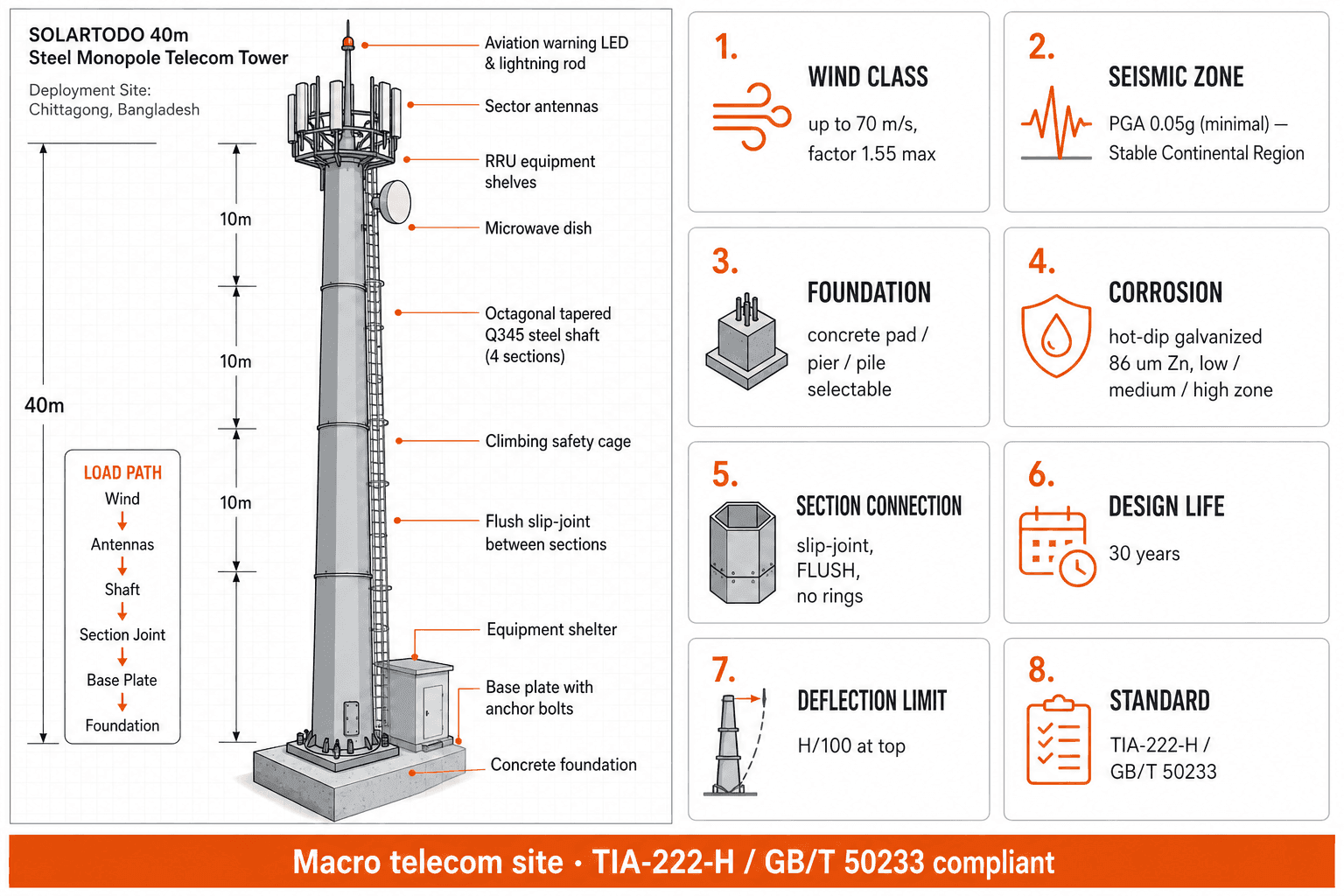
- Product form: Steel monopole tower only; tapered round or octagonal steel tube, not lattice, not FRP, and not joint-use.
- Quantity framing: approximately 11 units for a typical deployment of this scale in Chittagong.
- Height: 40m, matching the 35-45m highway/peri-urban and regional macro size class.
- Weight: approximately 20t per tower, calculated as 500kg/m x 40m.
- Steel grade: hot-dip galvanized Q345 steel, with Q420 optional for higher stress sections if final design requires it.
- Wind class: Class 1, 40 m/s, factor 1.0, with final checks aligned to TIA-222-H and local wind data.
- Corrosion zone: high, suitable for a Bay of Bengal coastal environment with salt-laden humidity.
- Antenna load: 9 panel antennas, 1 microwave dish, and 6 RRUs per tower.
- Foundation: pile foundation, selected for 40m coastal macro towers with variable soil bearing capacity.
- Connection: flanged bolt-on sectional design; slip-joint use should be limited to designs where section count and transport envelope justify it.
- Accessories: climbing ladder, cable tray, aircraft warning light, grounding system, lightning rod, 3 antenna platforms, and safety cage.
- Design life: 30 years with maintenance of galvanizing, grounding continuity, drainage, platform bolts, and access hardware.
- Logistics: CKD shipping with 60-70% volume reduction compared with fully assembled tower transport.
- Production lead time: 30-45 days before international shipping, civil works, erection, and commissioning.
According to TIA-222-H, telecom structures are designed under the 'Structural Standard for Antenna Supporting Structures and Antennas.' GB/T 50233 is also referenced for construction acceptance discipline on steel pole works, especially erection tolerance, bolt connection control, and grounding coordination. SOLARTODO's role in a Chittagong specification should be to provide tower drawings, material certificates, galvanizing reports, and load tables for buyer-side engineering review.
Implementation Approach
A typical 11-unit Chittagong rollout would move through 5 phases: survey, structural design, CKD fabrication, pile works, and commissioning.
The first phase is desktop and field survey. The buyer or EPC team would validate candidate coordinates around port roads, industrial edges, peri-urban residential zones, and backhaul routes. Geotechnical boreholes should determine pile diameter, depth, reinforcement, groundwater conditions, and chloride exposure before final anchor cage fabrication.
The second phase is structural design and procurement documentation. Antenna weights, wind area, platform count, RRU bracket positions, microwave dish diameter, cable tray fill, and maintenance loading should be frozen before tower fabrication. For a 40m macro pole, late antenna changes can materially affect shaft thickness, flange sizing, and foundation reactions.
The third phase is manufacturing and CKD shipping. SOLARTODO can package sectional Q345 galvanized monopoles as CKD assemblies to reduce shipping volume by 60-70%. A 30-45 day production window should be planned before ocean freight, import clearance, inland transport, and foundation readiness.
The fourth phase is civil work and erection. Pile foundations should be installed first, followed by curing, anchor template verification, tower section lifting, flange bolt tightening, platform installation, cable tray routing, aviation light wiring, grounding, and lightning rod integration. Installation teams should record bolt torque, verticality, grounding resistance, and coating touch-up locations.
The fifth phase is operator commissioning. Telecom teams would mount antennas, RRUs, microwave dish, feeder or hybrid cable, and sector labels, then perform alignment, sweep tests, microwave link tests, and safety handover. A practical Chittagong schedule should separate tower acceptance from radio acceptance so civil punch-list items do not block RF optimization.
Expected Performance & ROI
A 40m macro monopole can support 9-sector panel capacity and microwave backhaul readiness over a 30-year structural design life.
Expected performance should be framed as engineering capability, not as a fabricated operating result. The 40m height supports stronger coverage continuity than 25-35m suburban poles, especially along port approach roads, mixed-use industrial districts, and peri-urban corridors. The antenna load of 9 panels and 6 RRUs allows multi-sector 4G/5G overlay planning, while 1 microwave dish supports backhaul redundancy where fiber routing is delayed or expensive.
According to GSMA Mobile Economy reporting, 4G accounted for roughly 54% of global mobile subscriptions at the end of 2024, while 4G coverage reached about 93% of the global population. This benchmark suggests that emerging-market ROI is often driven less by basic coverage alone and more by densification, traffic offload, lease sharing, and lower lifecycle maintenance. For Chittagong, the commercial case would usually come from higher site utilization, faster CKD logistics, reduced corrosion-related downtime, and a 30-year asset horizon.
Payback should not be stated as a guaranteed number without operator lease rates, land rent, power availability, backhaul cost, and tenancy assumptions. As a technical benchmark, tower companies commonly model macro tower payback through 1-3 operator tenants, long-term lease contracts, and recurring colocation revenue. A recommended ROI model should compare capex, civil works, import duties, maintenance, expected tenant count, and avoided replacement cost from correct corrosion protection.
Results and Impact
The expected impact is a resilient 40m macro tower template that can standardize approximately 11 high-coverage sites without claiming completed deployment.
For Chittagong, the main result would be procurement clarity. Buyers can compare one consistent 40m Q345 galvanized monopole class across multiple sites instead of mixing rooftop poles, undersized suburban poles, and heavier rural structures. Standardizing height, flange design, platforms, ladder, cable tray, grounding, and warning lights also simplifies spare parts and maintenance training.
The technical impact is stronger lifecycle control. A pile-supported, high-corrosion-zone tower with 30-year design life is better aligned to Chittagong's coastal risk profile than low-cost light poles that understate wind, corrosion, or antenna load. The operational impact is faster site delivery because CKD packaging, flanged sections, and pre-engineered accessories reduce on-site fabrication needs.
Comparison Table
The 40m recommended monopole balances 20t structural weight, 3 platforms, and macro coverage better than 25m or 45m alternatives.
| Option | Size class | Typical antenna load | Tower weight guide | Best fit for Chittagong | Engineering note |
|---|---|---|---|---|---|
| 25m monopole | 15-25m rooftop/urban infill | 3-6 panels, 1 platform | 8-15t | Dense infill only | Lower visual impact but limited regional coverage |
| 30m monopole | 25-35m suburban/residential | 6-9 panels, 2 platforms | 15-22t | Residential expansion zones | Useful where zoning restricts 40m structures |
| 40m recommended monopole | 35-45m highway/peri-urban | 9 panels, 1 microwave, 6 RRUs, 3 platforms | ~20t by 500kg/m rule | Port, highway, peri-urban macro coverage | Best match for specified Chittagong configuration |
| 45m monopole | 35-45m highway/peri-urban | 6-9 panels plus 1-2 microwave | 22-30t | Wider corridors and edge coverage | Higher foundation reactions and permitting burden |
| 50m monopole | 45-55m rural/wide coverage | 9-12 panels, 3 platforms | 30-40t | Rural outskirts | Too heavy for many urban macro sites |
Pricing & Quotation
SOLARTODO provides 3 commercial quotation scopes for telecom towers while keeping site-specific EPC pricing dependent on drawings and geotechnical data.
SOLARTODO offers three pricing tiers for this product line: FOB Supply (equipment ex-works China), CIF Delivered (including ocean freight and insurance), and EPC Turnkey (fully installed, commissioned, with 1-year warranty). Volume discounts are available for large-scale deployments. Configure your system online for an instant estimate, or request a custom quotation from our engineering team at [email protected].
For Chittagong inquiries, a buyer should send coordinates, target height, antenna schedule, microwave dish diameter, soil report if available, preferred incoterm, and installation responsibility split. SOLARTODO can then align the 40m monopole design with TIA-222-H load checks, GB/T 50233 construction acceptance references, CKD packing plan, and export documentation. To discuss local procurement scope, contact us with tower count, site list, and preferred delivery window.
Frequently Asked Questions
Chittagong buyers typically need 10 checks before ordering: tower form, wind class, foundation, corrosion, logistics, installation, warranty, ROI, maintenance, and quotation scope.
Q1: What Telecom Tower configuration is recommended for Chittagong? A typical Chittagong configuration would use approximately 11 units of 40m tapered steel monopole towers, each about 20t, made from hot-dip galvanized Q345 steel. The recommended antenna load is 9 panel antennas, 1 microwave dish, and 6 RRUs per tower, with 3 platforms and pile foundations.
Q2: Why is a 40m monopole selected instead of a 25m or 30m tower? The 40m height fits the 35-45m highway/peri-urban size class, which supports regional macro coverage and microwave backhaul better than 25-30m infill poles. Chittagong's port, industrial corridors, and expanding residential edge need wider coverage while still avoiding the heavier foundation burden of 50m rural towers.
Q3: What standards apply to the tower design? The recommended design references TIA-222-H for antenna-supporting structure loads and GB/T 50233 for construction acceptance discipline. Final compliance should include site wind data, antenna projected area, foundation reactions, bolt grades, galvanizing inspection, grounding continuity, and local permit review by the buyer's engineer or EPC contractor.
Q4: How long would production and deployment normally take? Production should be planned at 30-45 days for Q345 steel fabrication, galvanizing, trial fit checks, and CKD packing. Total deployment time depends on shipping, customs, pile foundation curing, crane availability, and operator commissioning. A practical schedule separates manufacturing, civil works, tower erection, and RF acceptance.
Q5: What foundation is recommended for Chittagong coastal sites? Pile foundation is recommended for this 40m configuration because coastal Chittagong can include soft soils, high groundwater, salinity, and cyclone-related resilience requirements. Final pile depth and reinforcement should be based on geotechnical boreholes, uplift reactions, overturning moment, settlement limits, and chloride exposure class.
Q6: What ROI or payback should operators expect? Payback cannot be guaranteed without lease rates, land rent, tenancy count, backhaul cost, and power cost. A realistic model should compare 30-year structural life, 1-3 potential operator tenants, maintenance intervals, CKD logistics savings, corrosion protection, and avoided replacement risk from undersized tower selection.
Q7: How does this compare with a lattice tower? A steel monopole usually has a smaller ground footprint, cleaner urban appearance, and faster sectional erection than a lattice tower. A lattice tower may suit very heavy multi-operator loading, but this Chittagong recommendation is specifically for a 40m tapered monopole with 9 panels, 1 microwave dish, and 6 RRUs.
Q8: What maintenance is required over 30 years? Maintenance should include annual visual inspection, bolt torque checks, platform and ladder inspection, drainage checks, grounding resistance testing, lightning rod review, aircraft warning light testing, and coating touch-up. In high-corrosion Chittagong conditions, inspection frequency should increase after cyclones, flooding, or visible galvanizing damage.
Q9: Does SOLARTODO provide EPC pricing for Bangladesh? SOLARTODO can quote FOB Supply, CIF Delivered, or EPC Turnkey scope, but final EPC pricing depends on site access, soil report, crane availability, foundation design, import duties, local labor, and commissioning scope. Buyers should request a custom quotation rather than relying on generic per-tower assumptions.
Q10: What warranty scope is typical for this product line? The Pricing & Quotation section specifies EPC Turnkey with a 1-year warranty. Structural design life is 30 years, but warranty scope and exclusions should be confirmed in the purchase contract, including galvanizing defects, accessories, aviation light components, installation workmanship, and damage from unauthorized antenna loading.
References
This guide uses 7 authoritative references covering Chittagong population, Bangladesh telecom demand, climate risk, and tower engineering standards.
- Bangladesh Bureau of Statistics (2022): Population and Housing Census 2022 reports Chittagong City Corporation population around 3.23 million and supports city-density planning. https://bbs.gov.bd
- Chattogram City Corporation (2022): Municipal area data lists Chattogram City Corporation at approximately 168.07 km2, defining urban telecom planning density. https://ccc.gov.bd
- Bangladesh Telecommunication Regulatory Commission (2025): Mobile and internet subscriber statistics report Bangladesh at roughly 188.45 million mobile subscriptions and 133.61 million internet subscribers. https://www.btrc.gov.bd
- World Bank Group (2024): Bangladesh Climate Risk Profile identifies cyclone, flood, salinity, and coastal infrastructure risks relevant to high-corrosion tower design. https://climateknowledgeportal.worldbank.org
- International Telecommunication Union (2025): Facts and Figures reporting places global internet use near 6 billion people and highlights continued connectivity gaps. https://www.itu.int
- GSMA (2024): The Mobile Economy 2024 reports 4G at about 54% of global mobile subscriptions and 4G population coverage near 93%. https://www.gsma.com
- Telecommunications Industry Association (2022): TIA-222-H defines structural design practice for antenna supporting structures and antennas, including wind load methodology. https://tiaonline.org
Equipment Deployed
- Approximately 11 units x 40m tapered Q345 hot-dip galvanized steel monopole tower
- ~20t per tower using 500kg/m x 40m engineering rule
- Wind class 1: 40 m/s, factor 1.0, TIA-222-H referenced
- Antenna load: 9 panel antennas + 1 microwave dish + 6 RRUs per tower
- Pile foundation for coastal Chittagong soil and high-corrosion exposure
- Accessories: climbing ladder, cable tray, aircraft warning light, grounding system, lightning rod
- 3 antenna platforms plus safety cage for maintenance access
- CKD sectional flanged bolt-on shipping with 60-70% volume reduction
- 30-year design life with annual inspection and corrosion maintenance
- Production lead time: 30-45 days before shipping and site works