Summary
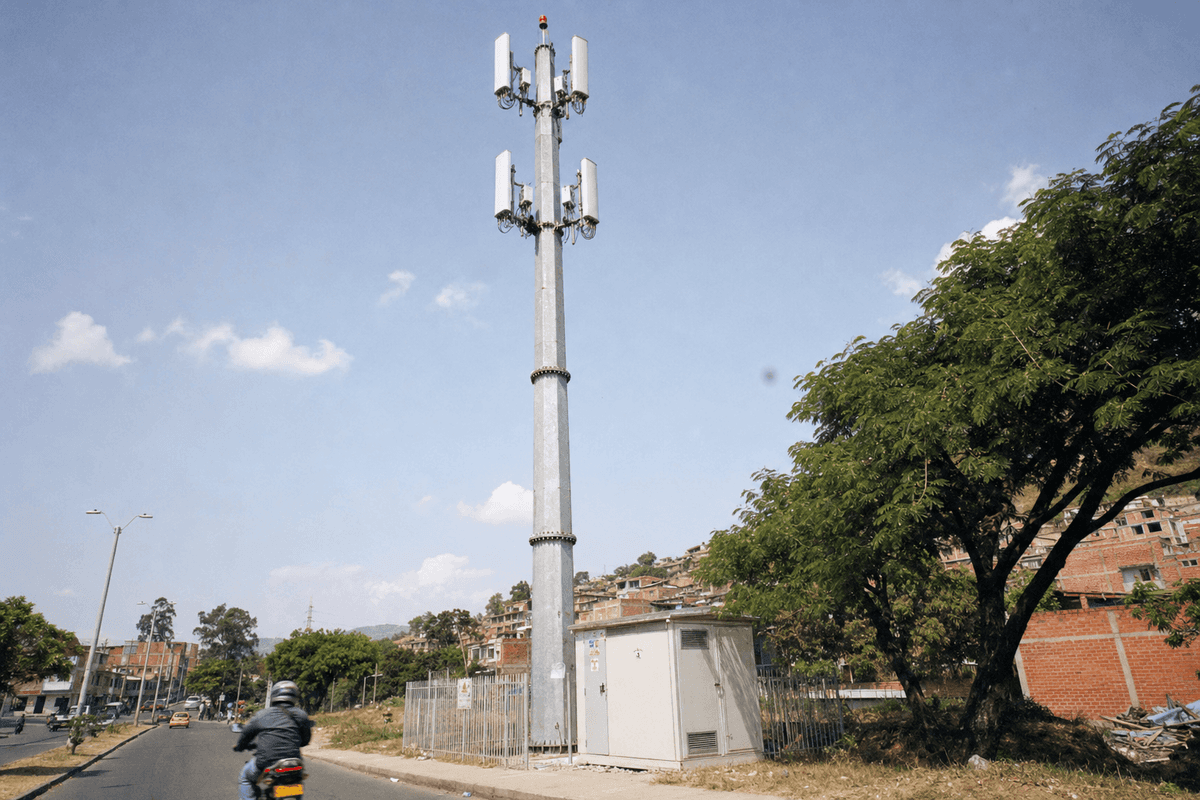
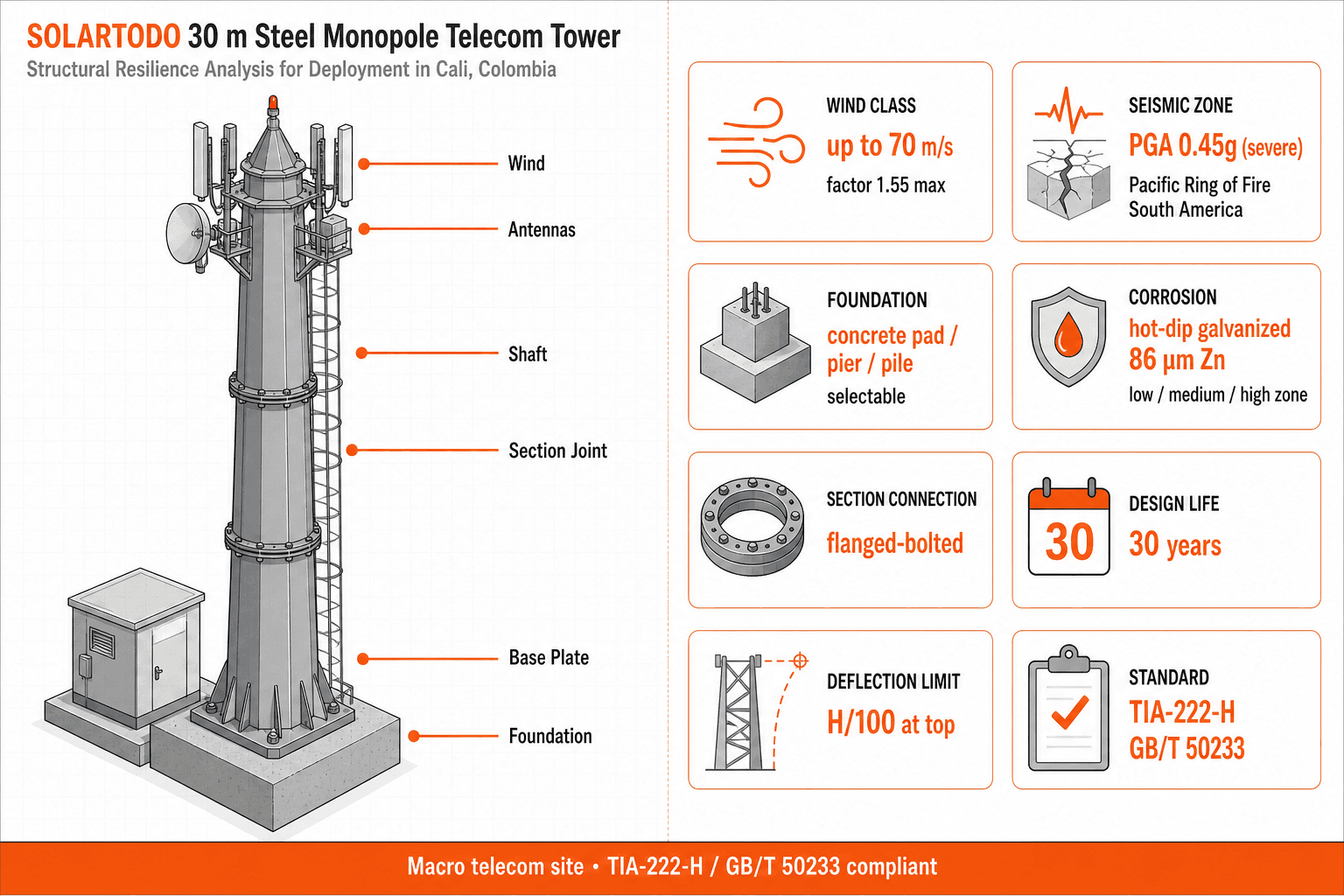
Cali’s best-fit SOLARTODO Telecom Tower profile is a 14-site, 30m galvanized steel monopole rollout: about 15t per tower, 40m/s wind design, pile foundations, and 6 panels plus 2 microwave dishes per site.
Key Takeaways
A Cali tower rollout should prioritize 30m monopoles, 14 repeatable sites, high-corrosion steel protection, and permit-ready documentation before procurement.
- Use 14 units × 30m tapered monopoles, each about 15t, based on the 500kg/m engineering rule.
- Specify hot-dip galvanized Q345 steel for Cali’s humid inland valley, where annual rainfall is about 1,850mm.
- Design around TIA-222-H Wind Class 1 at 40m/s, then confirm exposure, terrain, and foundation loads site by site.
- Configure each tower for 6 panel antennas + 2 microwave dishes, supporting 4G densification and selective 5G overlays.
- According to CRC (2024), Colombia’s mobile internet traffic reached 6.3 million TB, up 18.3% year over year.
- According to MinTIC (2023), Colombia assigned 4 blocks of 80MHz in the 3.5GHz band for 5G deployment.
- Use pile foundations where Cauca Valley alluvial soils, floodplain saturation, or filled road shoulders increase settlement risk.
- Plan CKD logistics for 60-70% shipping-volume reduction, then coordinate inland trucking, crane access, and street occupation permits.
Cali Site Conditions and Design Logic
Cali’s inland valley profile supports a 30m SOLARTODO monopole because rainfall, floodplain soils, and urban density matter more than coastal salt exposure.
Cali sits near 3.45°N, 76.53°W at roughly 1,000-1,070m above sea level, so it is not a direct marine corrosion site. The practical risk comes from humidity, long wet-season exposure, polluted runoff, and soil saturation near river corridors. A high-corrosion galvanizing specification is still justified because a 30-year tower asset must survive repeated wet-dry cycles.
According to Alcaldía de Cali (2025), the municipality covers about 562.8km² and includes low valley terrain and higher western mountain areas. That topography changes construction risk across only a few kilometers. Eastern lowlands need drainage and geotechnical checks, while hillside-edge routes require tighter access planning for cranes and CKD section delivery.
According to CRC (2024), Colombia deployed 1,433 5G base stations in 43 municipalities during the first year of commercial 5G operation. That makes Cali tower planning a capacity and upgrade-readiness issue, not only a coverage issue. The recommended SOLARTODO structure should therefore reserve platform, wind-load, cable-routing, and grounding capacity for later antenna changes.
Recommended SOLARTODO Telecom Tower Configuration
The recommended Cali package is 14 units of 30m galvanized monopoles, each about 15t, with pile foundations and macro-site antenna loading.
Each site should use a tapered round or octagonal steel monopole fabricated from hot-dip galvanized Q345 steel. The 30m height sits in the 25-35m suburban/residential macro class, which fits residential districts, logistics corridors, and peri-urban routes toward Yumbo, Palmira, Jamundí, and Buenaventura. The tower should be supplied in flanged bolt-on CKD sections to simplify container loading and staged site delivery.
The antenna load should be 6 panel antennas plus 2 microwave dishes per tower. This profile supports mobile coverage and microwave backhaul resilience where fiber routing is uneven or delayed by roadworks, utility conflicts, or right-of-way approvals. SOLARTODO should position this as a technical recommendation for a typical Cali deployment, not as a claimed completed project.
According to GSMA (2024), 5G is expected to represent 55% of Latin American mobile connections by 2030. That forecast supports using upgrade-ready structures instead of minimum-cost poles with little reserve capacity. For Cali, the procurement decision should compare lifecycle value, colocation readiness, maintenance burden, and future antenna loading rather than steel price alone.
Standards, Electrical Safety, and Compliance
A 30m Cali tower should align structural, grounding, lightning, and electrical interfaces across at least 5 applicable standards or official frameworks.
The structural basis should reference TIA-222-H for antenna-supporting structures and GB/T 50233 for steel tower construction and acceptance controls. Final calculations should confirm wind exposure, appurtenance area, steel section strength, flange bolt design, deflection, and foundation reactions. For Colombian review, drawings should be suitable for local professional validation and municipal land-use coordination.
According to IEC (2024), IEC 62305-2:2024 provides a risk-management procedure for lightning protection and includes updated treatment of damage frequency affecting internal system availability. That matters for telecom towers because lightning risk is tied to grounding, bonding, surge protection, equipment availability, and nearby public exposure. The Cali package should include a bonded lightning rod, down-conductor continuity, grounding grid, cable tray bonding, and surge-protected obstruction-light feeds.
According to IEEE (2013), IEEE Std 80 covers safe grounding practices for outdoor AC substations at 50Hz or 60Hz, which is relevant when tower sites include utility service, cabinets, or power-interface equipment. Colombian electrical work should also align with RETIE, NTC 2050 where applicable, and local inspection requirements. SOLARTODO should provide steel, accessories, drawings, material certificates, galvanizing records, and antenna load assumptions, while the local EPC confirms electrical conformity.
Logistics, Installation, and Procurement Model
CKD shipping can reduce transport volume by 60-70%, which is material for a 14-unit tower rollout moving from port routes into Cali.
Cali’s supply chain is strongly affected by Buenaventura port routing, mountain-road trucking, city access windows, and street-space occupation permits. A sectional monopole is easier to stage than long welded sections, especially where urban roads, drainage works, or overhead utilities restrict maneuvering. Production should be planned at 30-45 days before ocean freight, customs, inland delivery, foundation readiness, and crane scheduling.
According to BloombergNEF (2024), lithium-ion battery pack prices fell 20% to USD 115/kWh, which improves the economics of backup power for remote or unreliable-grid telecom sites. According to IEA (2023), the world needs to add or replace more than 80 million km of grids by 2040, highlighting why grid-interface reliability and backup planning remain important. These energy-sector signals do not replace telecom design standards, but they support planning resilient power cabinets and future hybrid backup options.
According to IRENA (2024), 91% of newly commissioned utility-scale renewable capacity delivered lower-cost electricity than the cheapest new fossil-fuel alternative. That context supports considering solar-plus-battery auxiliary power where remote sites face utility delays or high outage risk. The tower package itself remains radio-neutral steel infrastructure, but site procurement should leave space for cabinets, meters, grounding bonds, and optional backup systems.
Comparison Table
A 30m SOLARTODO monopole offers the best balance of 15t structural weight, urban footprint, backhaul loading, and 30-year maintainability.
| Option | Cali technical fit | Typical height/load | Main advantage | Main limitation |
|---|---|---|---|---|
| SOLARTODO 30m monopole | Best fit for regional macro sites | 30m, about 15t | Compact footprint and 6+2 antenna loading | Needs crane access and pile design |
| Rooftop mast | Selective dense urban infill | 15-25m | Avoids new ground lease | Depends on building capacity and landlord access |
| Lattice tower | Rural or large compounds | 35m+ | High loading flexibility | Larger footprint and more members to inspect |
| FRP pole | Light-duty or special corrosion cases | Lower load class | Non-metallic corrosion benefit | Not ideal for 6 panels plus 2 dishes |
| 35-45m monopole | Peri-urban range extension | 22-30t | Better clearance and reach | Higher foundation, crane, and permit burden |
Pricing and Quotation Guidance
SOLARTODO pricing should be quoted in 3 tiers: FOB supply, CIF delivered, and EPC turnkey with a 1-year installation warranty.
For budgetary planning, buyers should separate tower steel, accessories, foundation works, logistics, installation, electrical works, and antenna equipment. The recommended base scope includes the monopole sections, flanges, bolts, climbing ladder, cable tray, aircraft warning light, grounding system, lightning rod, 2 antenna platforms, and safety cage. Antennas, radios, microwave equipment, cabinets, utility connection, and civil works should be priced separately unless EPC scope is requested.
The three commercial routes are FOB Supply, CIF Delivered, and EPC Turnkey. FOB is best when the buyer controls freight and local contractors; CIF is useful when ocean freight and insurance should be bundled; EPC is appropriate when installation, commissioning, and a 1-year warranty are required. For a scoped estimate, use SOLARTODO Telecom Tower, Configure your system online, or request a custom quotation.
FAQ
These 10 FAQs answer Cali buyers’ main questions on price, specification, logistics, warranty, installation, compliance, maintenance, and tower alternatives.
Q1: What is the recommended tower specification for Cali?
The recommended specification is a 30m tapered Q345 steel monopole, hot-dip galvanized, supplied in flanged CKD sections, and designed for about 15t of steel weight per tower. Each site should support 6 panel antennas and 2 microwave dishes, with 2 antenna platforms, cable trays, grounding, lightning protection, obstruction lighting, climbing ladder, and safety cage.
Q2: Why is a 30m monopole better than a lattice tower in Cali?
A 30m monopole gives Cali a smaller footprint, simpler visual profile, and faster urban-edge installation than a lattice tower. Lattice towers can carry heavier loads, but they need more land, more member inspections, and more complex access control. For a 14-site macro rollout with moderate antenna loading, the monopole is the more practical default.
Q3: What price model should buyers request from SOLARTODO?
Buyers should request pricing in 3 tiers: FOB Supply, CIF Delivered, and EPC Turnkey. FOB covers equipment supply, CIF adds ocean freight and insurance, and EPC includes installation and commissioning with a 1-year warranty. The most accurate quote requires tower height, antenna schedule, wind basis, foundation preference, site count, delivery address, and accessory list.
Q4: How long does production and delivery usually take?
Standard production for the SOLARTODO tower package is typically 30-45 days before dispatch. Delivery time then depends on port availability, customs clearance, inland trucking from Buenaventura routes, and site readiness in Cali. Foundation works, utility coordination, and crane scheduling should start before the steel shipment arrives to avoid storage delays.
Q5: What foundation type is recommended for Cali sites?
Pile foundations are recommended as the conservative baseline for this 14-unit Cali profile. They are especially useful where alluvial soils, saturated ground, floodplain influence, or variable roadside fill may reduce shallow pad reliability. Final foundation dimensions should come from borehole results, tower reactions, groundwater conditions, scour risk, and local civil-engineering review.
Q6: Is this tower suitable for 5G deployment?
Yes. The tower is radio-neutral infrastructure suitable for 4G, 5G, microwave backhaul, and future antenna upgrades if the final loading is verified. According to MinTIC (2023), Colombia assigned 4 × 80MHz blocks in the 3.5GHz band, so structural reserve and platform planning should anticipate selective 5G overlays in high-demand corridors.
Q7: What maintenance should be planned after installation?
Plan a visual inspection every 6 months and a deeper annual check of bolts, coating condition, ladder safety, cable trays, grounding continuity, lightning protection, and warning lights. In humid inland valleys, maintenance should focus on water traps, coating damage, polluted runoff, and loose bonded connections. After severe storms, perform an additional grounding and obstruction-light check.
Q8: How does CKD logistics help a Cali telecom rollout?
CKD logistics can reduce shipping volume by about 60-70% compared with long assembled sections. That matters for container planning, Buenaventura-to-Cali trucking, tight urban roads, and staged delivery across multiple sites. Smaller sections also make it easier to coordinate storage, lifting, and installation when municipal works or traffic restrictions limit access windows.
Q9: What compliance documents should be prepared?
Prepare structural drawings, calculation notes, material certificates, galvanizing records, bolt specifications, antenna load assumptions, foundation reactions, grounding diagrams, and installation manuals. The local project team should also manage municipal land-use alignment, aviation obstruction review where applicable, RETIE electrical conformity, NTC 2050 interfaces, and lightning-protection practice aligned with IEC 62305 and NTC 4552.
Q10: What warranty and design life should be assumed?
The commercial EPC warranty should be stated as 1 year unless the quotation says otherwise. That warranty is separate from the intended 30-year structural design life, which depends on correct design, fabrication, galvanizing, installation, maintenance, and local environmental exposure. Buyers should confirm warranty scope for steel defects, coating, bolts, accessories, installation labor, and third-party equipment exclusions.
References
- CRC (2024), Colombia ICT industry report: mobile internet traffic of 6.3 million TB, 18.3% annual growth, and 1,433 5G base stations in 43 municipalities: https://www.crcom.gov.co/en/node/16183
- MinTIC (2023), Colombia IMT spectrum assignment: 4 blocks of 80MHz in the 3.5GHz band and an investment outlook near COP 28 trillion over 10 years: https://mintic.gov.co/micrositios/asignacion-espectro-imt-2023/
- GSMA (2024), The Mobile Economy Latin America 2024: 5G expected to reach 55% of Latin American mobile connections by 2030: https://www.gsma.com/solutions-and-impact/connectivity-for-good/mobile-economy/latam-2024/
- IEC (2024), IEC 62305-2:2024, lightning protection risk management for structures: https://webstore.iec.ch/en/publication/28137
- IEEE (2013), IEEE Std 80, Guide for Safety in AC Substation Grounding, applicable to outdoor AC grounding practices at 50Hz or 60Hz: https://standards.ieee.org/ieee/80/12145/
- IEA (2023), Electricity Grids and Secure Energy Transitions: more than 80 million km of grids must be added or refurbished by 2040: https://www.iea.org/reports/electricity-grids-and-secure-energy-transitions/executive-summary
- IRENA (2024), Renewable Power Generation Costs in 2024: 91% of newly commissioned utility-scale renewable capacity was cheaper than the lowest-cost new fossil alternative: https://www.irena.org/Digital-Report/Renewable-Power-Generation-Costs-in-2024
- BloombergNEF (2024), lithium-ion battery pack prices fell 20% to USD 115/kWh: https://about.bnef.com/insights/commodities/lithium-ion-battery-pack-prices-see-largest-drop-since-2017-falling-to-115-per-kilowatt-hour-bloombergnef/
Equipment Deployed
- 14 units x 30m tapered steel monopole Telecom Tower
- Q345 hot-dip galvanized steel, high-corrosion-zone specification
- Approx. 15t per tower using 500kg/m engineering rule
- Wind class 1: 40 m/s, factor 1.0, per TIA-222-H design basis
- Antenna load: 6 panel antennas plus 2 microwave dishes
- Pile foundation for floodplain, soft-soil, and high-water-table risk areas
- 2 antenna platforms with climbing ladder, cable tray, and safety cage
- Grounding system, lightning rod, and aircraft warning light
- Flanged bolt-on sectional design suitable for CKD export shipping
- CKD shipment with 60-70% volume reduction and 30-45 day production window