
SOLAR TODO delivered a containerized Battery Energy Storage (BESS) system in Cairo, Egypt (MENA) to strengthen critical-site reliability during grid disturbances and planned maintenance windows. The project was deployed at a commercial facility with a clear operational requirement: provide dependable emergency backup power using a monthly test cycle while maintaining safe, compliant storage performance in Cairo’s hot, variable ambient conditions.
Answer Capsule: In Cairo, SOLAR TODO deployed a 100kWh / 25kW containerized BESS with LFP chemistry, forced-air cooling, and aerosol fire suppression—built to IEC 62619, UL 9540, and NFPA 855 for monthly emergency backup.
Project Overview: Reliability Under Cairo’s Grid and Heat Constraints
Cairo’s power environment combines peak demand stress, occasional voltage fluctuations, and periodic outages that can impact commercial operations and safety-critical loads. For sites that must remain functional during grid interruptions—especially those with operational or security dependencies—backup power needs to be predictable, tested, and resilient.
SOLAR TODO’s approach focused on delivering a containerized Battery Energy Storage (BESS) that could be installed with minimal disruption and operated safely under local infrastructure realities: high ambient temperatures, limited tolerance for prolonged downtime, and the need for clear compliance alignment with international and fire-safety expectations. The system was configured specifically for Emergency backup power (monthly test cycle) using a conservative operational profile of 0.05 cycles/day and 90% depth to match the planned testing regime.
Why a Containerized BESS for Cairo?
Containerized energy storage is designed for repeatable deployment: the battery, protection, cooling, and safety architecture are integrated into a single 20ft unit. For Cairo, this mattered for two reasons:
- Operational continuity: The monthly test-cycle requirement benefits from a system that can remain staged and ready without complex reconfiguration.
- Safety and compliance: Cairo deployments require robust fire-safety design and documentation. The SOLAR TODO unit integrates BMS management, forced air cooling, and aerosol fire suppression, supporting a controlled response strategy consistent with recognized standards.
Technical Specifications (Project Configuration)
The installed system was a commercial BESS: 100kWh / 25kW, using 1× 20ft container with LFP battery modules and a full power conversion chain.
- Energy / Power rating: 100kWh / 25kW
- Containerization: 1× 20ft container
- Battery chemistry: LFP (Lithium Iron Phosphate)
- Round-trip efficiency: 95%
- Depth of Discharge (DoD) for operation: 90% DoD
- Cycle life: 8000 cycles
- Degradation rate: 2.5%/yr
- Warranty: 15-year warranty
- BMS & safety controls: BMS with forced-air cooling and aerosol fire suppression
- Power conversion: PCS inverter + step-up transformer
- Operating mode used: Emergency backup power (monthly test cycle)
- Test-cycle profile: 0.05 cycles/day, 90% depth
- Standards compliance: IEC 62619, UL 9540, NFPA 855
System Architecture: Battery, Cooling, Protection, and Power Conversion
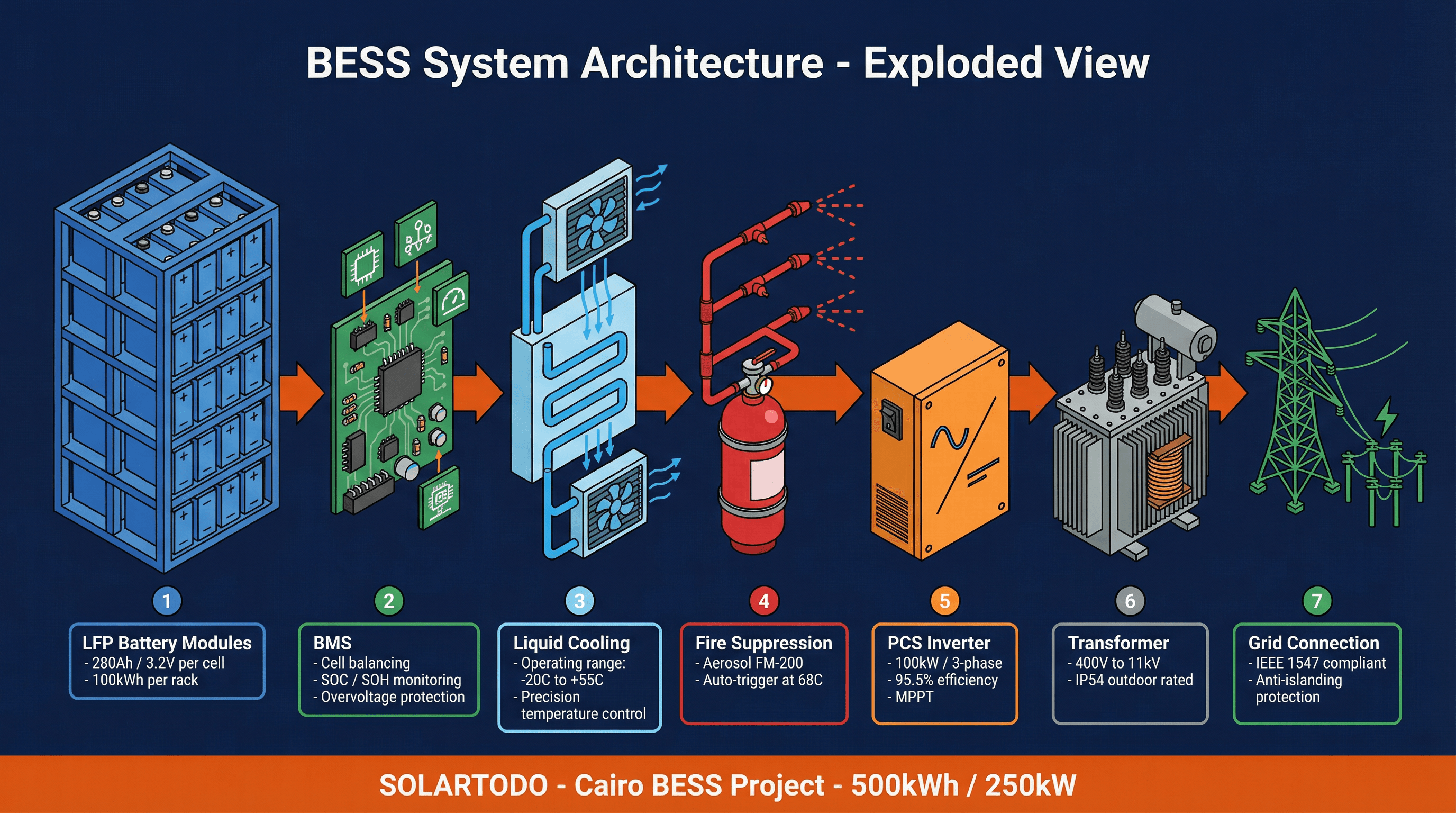
At the core of the deployment is the LFP battery system managed by a dedicated Battery Management System (BMS). In Cairo’s operating environment, stable thermal management is crucial—both for performance consistency and for long-term reliability. The unit therefore uses forced air cooling, actively regulating internal temperatures rather than relying on passive heat dissipation.
Fire Safety Strategy: Aerosol Suppression Integration
SOLAR TODO integrated aerosol fire suppression as part of the container’s safety subsystem. This is not an add-on; it is designed into the unit’s safety concept, coordinated with the BMS and the overall protective design. By aligning the system’s safety approach with recognized requirements under UL 9540 and NFPA 855, the project supports structured risk management for energy storage installations.
PCS Inverter + Step-Up Transformer
The energy conversion chain is implemented using a PCS inverter paired with a step-up transformer. This configuration supports stable power delivery during backup operation and ensures the system can interface properly with the facility’s power needs in the intended mode.
Operating Mode Focus: Emergency Backup Power
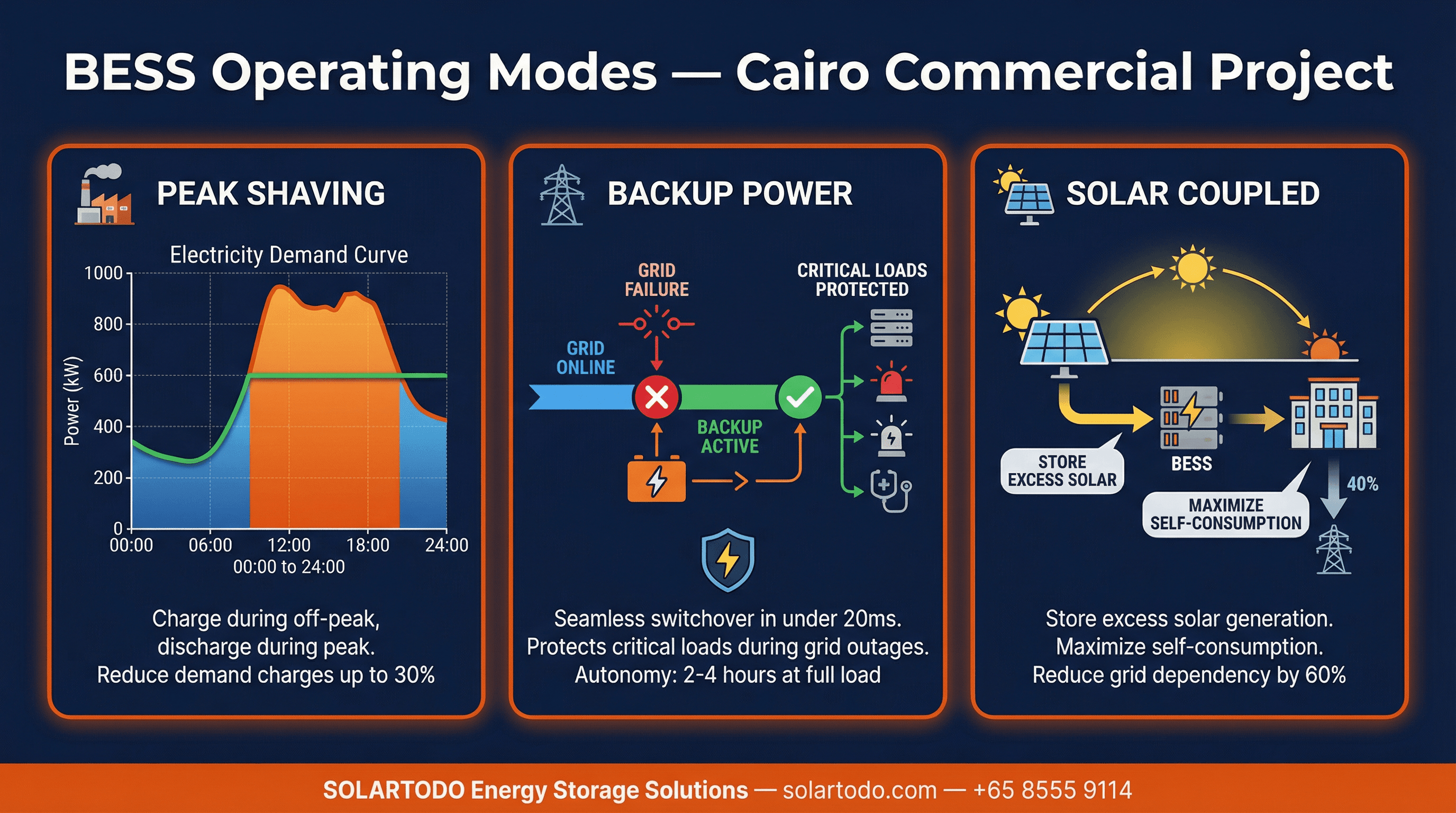
Although the broader SOLAR TODO Battery Energy Storage (BESS) product family supports multiple operating modes (including peak-shaving, backup power, and solar-coupled self-consumption), this Cairo project was configured specifically for Emergency backup power with a monthly test cycle. The operational profile—0.05 cycles/day at 90% depth—was selected to match the facility’s testing cadence while maintaining healthy lifecycle usage aligned with the specified 8000 cycle life and 2.5%/yr degradation expectations.
Deployment Details in Cairo (MENA)
The project was installed as one 20ft containerized BESS unit at the commercial site in Cairo (Latitude 30.04, Longitude 31.24). Containerized deployment typically reduces field complexity by packing the battery modules, BMS functions, cooling, and suppression systems into a single engineered footprint. For local infrastructure teams, this improves schedule predictability and reduces the chance of incomplete commissioning due to fragmented equipment installation.
From a commissioning perspective, SOLAR TODO emphasized two practical deliverables for Cairo:
- Verification of emergency backup readiness: ensuring the system responds correctly during the monthly test cycle and that the power interface behaves as designed.
- Thermal and safety readiness under high ambient conditions: confirming forced-air cooling performance and confirming that safety systems are integrated and documented according to the applicable standards.
Results and Impact
The Cairo deployment delivered measurable improvements in operational resilience and compliance readiness.
- Emergency backup capability established: a 100kWh / 25kW storage unit configured for monthly testing using 0.05 cycles/day at 90% depth.
- High efficiency for backup availability: 95% round-trip efficiency supports reliable energy delivery during test and emergency events.
- Lifecycle alignment with planned duty: 8000 cycle life and 2.5%/yr degradation provide a strong basis for predictable long-term performance under the specified test regime.
- Safety and regulatory alignment: design and documentation targeted IEC 62619, UL 9540, and NFPA 855, supporting safer energy storage operation in Cairo’s urban environment.
Beyond the technical metrics, the containerized design helped the facility’s maintenance and operations teams manage the system confidently—staging, testing, and readiness checks became repeatable processes rather than one-off engineering efforts.
Standards and Authority References
SOLAR TODO’s design and commissioning approach for this Battery Energy Storage (BESS) project is informed by internationally recognized guidance and safety frameworks, including:
- IEC 62619 (secondary lithium cells and batteries for industrial applications) for battery and system safety expectations.
- UL 9540 (energy storage systems and equipment) for energy storage system safety evaluation.
- NFPA 855 (Standard for the Installation of Stationary Energy Storage Systems) for installation and fire safety considerations.
- NREL and IEEE materials on grid-interactive storage performance and reliability provide additional engineering context for lifecycle and operational planning.
These references support a structured engineering mindset: protect personnel, ensure safe operation, and provide consistent performance across the system’s operating profile.
Internal Links
Learn more about the SOLAR TODO Battery Energy Storage (BESS) offering here: product page. For project discussions in Cairo or across MENA, contact our team at contact us.
Frequently Asked Questions
Q1: What is the battery chemistry used in this Cairo BESS project?
A: The project used LFP (Lithium Iron Phosphate) battery modules inside a 1× 20ft container configuration.
Q2: What backup duty cycle was configured for emergency testing?
A: The system was configured for Emergency backup power (monthly test cycle) with 0.05 cycles/day and 90% depth (90% DoD).
Q3: How does the system manage heat in Cairo’s hot climate?
A: SOLAR TODO’s containerized unit includes BMS with forced air cooling, designed to actively regulate internal temperatures for stable performance and long-term reliability.
Q4: What fire-safety standards and suppression method were used?
A: The installation targeted UL 9540 and NFPA 855 and included aerosol fire suppression integrated into the container’s safety design.
Equipment Deployed
- Commercial Battery Energy Storage (BESS) containerized system: 100kWh / 25kW, 1× 20ft container, LFP battery modules, 95% round-trip efficiency, 90% DoD, 8000 cycle life, 2.5%/yr degradation, 15-year warranty, BMS + forced air cooling + aerosol fire suppression
- PCS inverter + step-up transformer for backup power conversion and interfacing
- Safety and compliance design set aligned to IEC 62619, UL 9540, and NFPA 855 for stationary energy storage installation and operation