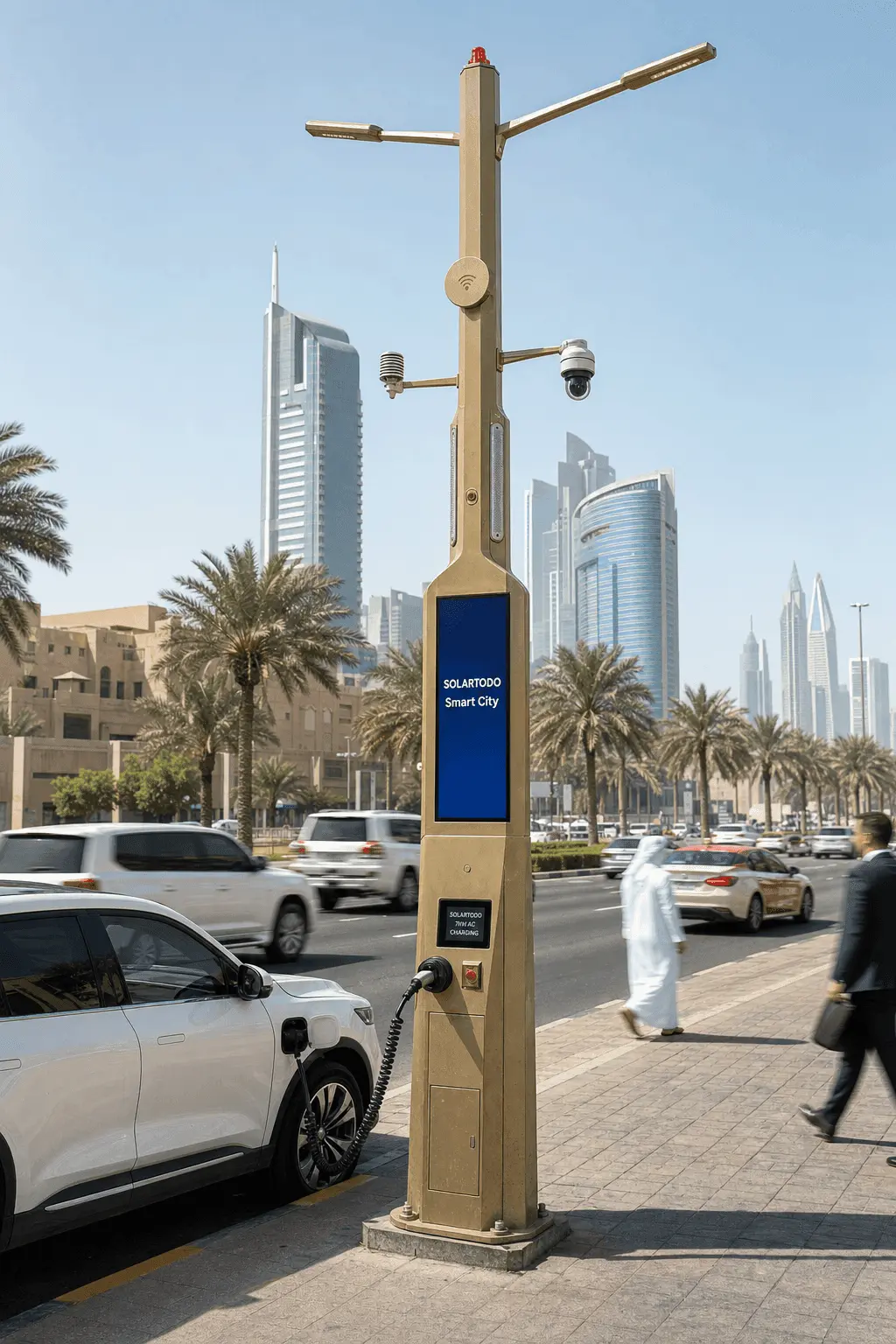
Buenos Aires Smart Streetlight Technical Fit: 10m Integrated EV-Charging Pole Configuration
Summary
Buenos Aires, with 3.12 million residents in 205.9 km², fits a 10m Smart Streetlight class: a typical 176-unit, 35m-spacing corridor would add LED, 7kW EV charging, PTZ security, 5G, and air-quality sensing.
Key Takeaways
- A typical 176-unit deployment at 35m spacing would cover approximately 6.16km of urban corridor frontage.
- Each pole uses a 10m octagonal tapered steel body, narrowing from Ø45cm at the base to Ø15cm at the top.
- Lighting output is 2 × 80W LED per pole, or 160W total, at 150 lm/W and 4000K neutral white.
- The lower 2.2m is the integrated 7kW AC EV charging cabinet, not a separate roadside charger.
- The recommended EV interface is IEC 62196-2 Type 2 with OCPP 1.6J and a 5m coiled cable.
- The P4 LED advertising display is 960 × 1920mm, portrait format, and specified above 5500 cd/m².
- A 5G NR n78 4T4R MIMO small cell at 8.7m provides an indicative 200m urban coverage radius.
- Standards alignment should include IEC 60598, GB/T 37024, and IEC 62196-2 for lighting, smart pole, and EV interfaces.
Market Context for Buenos Aires
Buenos Aires requires dense, multifunction street infrastructure because 3.12 million residents occupy only 205.9 km², creating a density near 15,161 people/km².
According to INDEC (2023), the Autonomous City of Buenos Aires had 3,121,707 residents in the 2022 census across 205.9 km². That density supports a city-pole strategy where lighting, camera, environmental sensing, EV charging, public address, SOS, and telecom equipment share one streetscape asset rather than competing for sidewalk space.
Buenos Aires also sits inside the larger AMBA mobility and utility market. According to INDEC (2024), the Buenos Aires metropolitan region exceeds 13.9 million people when the city and 24 surrounding partidos are counted. For transport corridors, retail districts, and waterfront redevelopment zones, that regional scale makes EV-ready street furniture more relevant than conventional lighting-only poles.
Climate matters for hardware selection. According to Argentina’s Servicio Meteorológico Nacional climate normals and public climate summaries, Buenos Aires has a humid subtropical climate with annual precipitation around 1,250mm and frequent storm events influenced by Pampero and Sudestada wind patterns. A corrosion-controlled, hot-dip-galvanized or protected steel system with sealed access doors, IP-rated electronics, and secure cable management is therefore preferable to exposed modular add-ons.
The grid context also favors grid-powered AC equipment. Low-voltage public lighting and small commercial loads in Argentina commonly use 220/380V AC distribution, while urban distribution feeders are served by Edenor and Edesur in northern and southern concession areas. For a SOLARTODO Smart Streetlight, this supports the Smart Streetlight grid_12m family adapted here as a 10m urban pole with 220/380V AC input and integrated 7kW charging.
ITU states, “A smart sustainable city is an innovative city that uses information and communication technologies,” which is directly relevant to poles combining lighting, sensors, communications, and emergency services. IEC states that IEC 62196 covers “plugs, socket-outlets, vehicle connectors and vehicle inlets,” making it the correct EV interface reference for public AC charging.
Recommended Technical Configuration
A recommended Buenos Aires configuration is a typical 176-unit, 10m Smart Streetlight deployment spaced at 35m for about 6.16km of urban coverage.
The correct size class is the urban smart streetlight class, not a highway traffic pole and not a park garden-lighting product. The specified 10m height works for city avenues, premium commercial streets, transit-adjacent parking bays, and municipal service corridors where lighting uniformity, pedestrian safety, surveillance, charging, and connectivity must coexist.
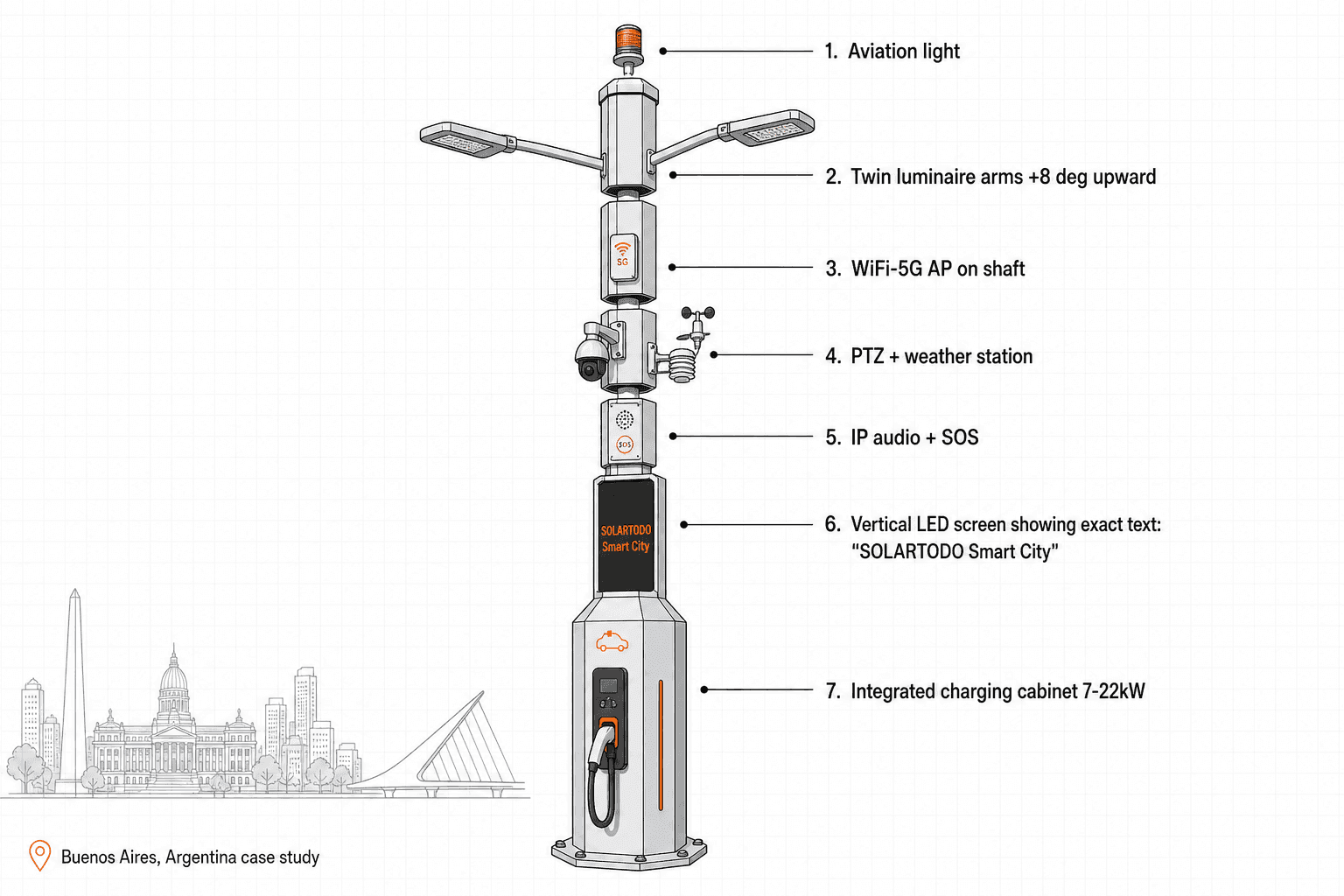
A typical 176-unit deployment of this scale would consist of grid-powered AC 220/380V poles in champagne gold RAL1036 pearl gold brushed finish. Each pole would use a 10m octagonal tapered steel body with the lower 2.2m formed as the EV charging cabinet. This is a continuous welded pole-as-charger structure, not a separate pillar beside the pole.
The recommended spacing is 35m, within the common 25-50m density range for urban smart poles. At 35m, approximately 30 poles per km are required, and 176 poles cover roughly 6.16km before allowing for intersections, driveways, utility conflicts, or protected heritage frontage. Final placement should be validated by photometric design, grid connection availability, accessibility clearances, and telecom radio-frequency planning.
Technical Specifications
The 10m Buenos Aires Smart Streetlight specification integrates 160W LED lighting, 7kW AC charging, PTZ security, 12-parameter sensing, and 5G n78 small-cell readiness.
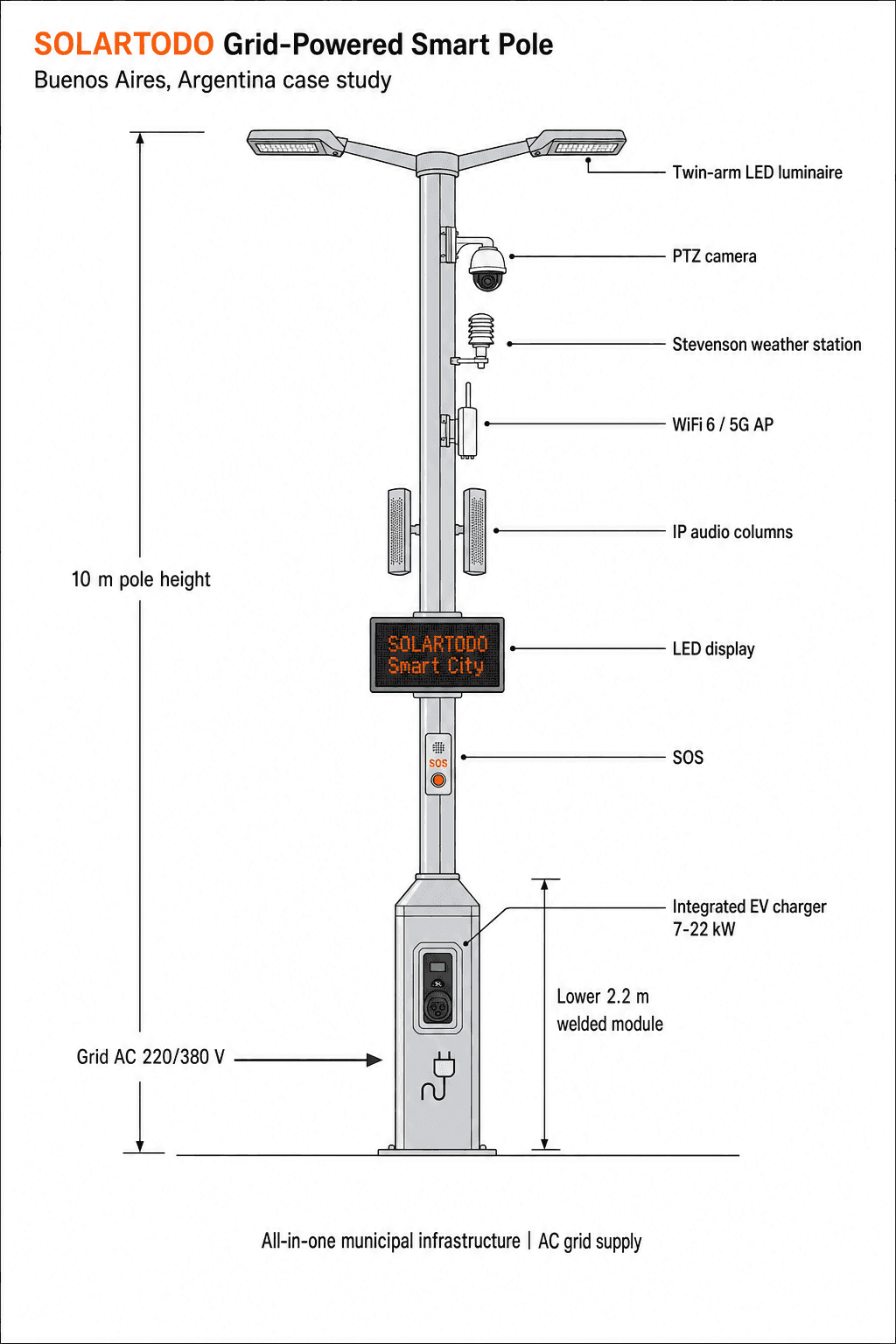
- Pole body: 10m octagonal tapered steel smart pole, base Ø45cm to top Ø15cm.
- Finish: champagne gold RAL1036 pearl gold brushed, suitable for premium urban streetscapes.
- Power: grid-powered AC 220/380V.
- Integrated EV charging: lower 2.2m of the pole is the welded charging cabinet, forming one continuous steel structure.
- Charger: 7kW single-gun AC charger, Mennekes Type 2 IEC 62196-2, OCPP 1.6J.
- Cable: 5m coiled Type 2 cable, no extra charging port.
- User interface: 8-inch touchscreen at 1.5m height, red mushroom E-stop, stainless maintenance door.
- LED luminaire: twin symmetric 1.5m arms with +8° upward tilt and 2 × 80W SOLARTODO LED heads.
- LED performance: 150 lm/W, 4000K, 160W total per pole.
- Camera: 22cm white PTZ dome, 360° rotation, 25x zoom, IR 150m, mounted on 50cm L-bracket outrigger.
- Top sensor: 12-parameter environmental sensor covering meteorology, air quality, rain, CO, NO2, and O3.
- Public address: 1 × IP audio column, Ø10 × 50cm, 30W/93dB, TCP/IP networked, flush color-matched tube.
- Emergency function: one-press SOS button with camera linkage.
- Display: P4 vertical LED screen, 960 × 1920mm portrait, above 5500 cd/m², showing only “SOLARTODO Smart City” in white sans-serif on deep blue.
- Telecom: 5G NR n78 small cell, 4T4R MIMO, 200m indicative coverage, flush-mounted at 8.7m.
- Standards: IEC 60598, GB/T 37024, IEC 62196-2.
According to IEC (2025), IEC 62196-2 defines dimensional compatibility requirements for AC pin-and-contact-tube EV accessories. According to Open Charge Alliance (2024), OCPP defines communication between EV charging stations and central management systems, which supports remote monitoring, authorization, diagnostics, and billing integration.
Implementation Approach
A 176-unit Buenos Aires rollout would typically require 6 phased workstreams: survey, design, procurement, civil works, erection, and commissioning.
The first phase should confirm corridor geometry, foundation locations, underground utilities, feeder capacity, telecom line-of-sight, accessibility, and municipal advertising rules. For Buenos Aires, heritage streets, narrow sidewalks, bus lanes, trees, and dense underground services can be more important than pole manufacturing constraints.
The second phase is engineering design. This would include photometric simulation for 2 × 80W luminaires, foundation calculations, wind-load checks, EV circuit protection, earthing, OCPP backend integration, camera privacy zoning, and 5G RF planning. The output should be an IFC or construction package, not only a product datasheet.
The third phase is procurement and logistics. SOLARTODO equipment can be planned as factory-built pole assemblies with integrated charging cabinets, LED modules, display housings, sensor brackets, and telecom-ready flush zones. For Latin America, CKD or semi-assembled shipping may reduce handling risk, while final local assembly can support customs, commissioning, and maintenance readiness.
Civil works would typically proceed by segment. Crews prepare foundations, conduits, earthing, feeder taps, and inspection chambers before pole erection. Commissioning should verify lux levels, charger safety, OCPP connectivity, PTZ alignment, SOS call routing, public-address audio levels, environmental data reporting, and display brightness limits.
Expected Performance & ROI
Expected performance centers on asset consolidation: one 10m pole can combine 8 major functions while reducing duplicated foundations and cabinets.
According to the U.S. Department of Energy (2017), LED street lighting projects commonly report energy savings of 40-60% versus legacy high-intensity discharge systems when properly designed. In this configuration, each pole uses 160W of LED load, so lighting energy should be modeled against the incumbent lamp wattage, ballast losses, dimming schedule, and local tariff.
The EV charging contribution should be evaluated as utilization-driven infrastructure rather than guaranteed revenue. A 7kW AC charger is suited to dwell-time parking, municipal fleets, taxis, retail curbside stops, and residential overnight use near dense corridors. Payback would depend on charger sessions per day, electricity tariff, payment policy, advertising permissions, maintenance cost, and whether the city values avoided sidewalk clutter as a public-realm benefit.
Telecom and data services can improve the business case. A 5G NR n78 small cell with a 200m indicative radius may support operator leasing or municipal private-network use, subject to spectrum, backhaul, and permitting. Environmental sensors also create operational value by measuring PM2.5, NO2, O3, wind, rain, and illuminance at street level rather than relying only on distant reference stations.
For lifecycle planning, the strongest ROI argument is multi-function replacement. Instead of installing separate streetlight poles, EV pedestals, CCTV masts, sensor boxes, public-address columns, SOS points, LED display structures, and small-cell mounts, a SOLARTODO Smart Streetlight condenses those functions into one maintained asset class.
Results and Impact
A typical 176-unit configuration would provide 28.16kW of installed LED lighting and up to 1.232MW of distributed AC charging capacity.
For Buenos Aires, the expected impact is not a fabricated deployment result; it is a planning estimate based on specified equipment. At 176 poles, installed LED load equals 176 × 160W, or 28.16kW. EV charging nameplate capacity equals 176 × 7kW, or 1.232MW, although real simultaneous demand should be managed through load control and feeder studies.
Public-safety impact would come from continuous lighting, 150m IR PTZ visibility, SOS activation, and IP audio announcements. Urban operations impact would come from environmental sensing and OCPP-connected charger diagnostics. Streetscape impact would come from integrating the charger into the lower 2.2m of the pole rather than adding a separate cabinet on the sidewalk.
Comparison Table
This comparison shows 5 urban pole approaches and why the integrated 10m Smart Streetlight is the preferred fit for Buenos Aires corridors.
| Option | Height / form | Power and charging | Urban fit for Buenos Aires | Key limitation |
|---|---|---|---|---|
| SOLARTODO recommended grid Smart Streetlight | 10m octagonal tapered steel | 220/380V AC, integrated 7kW Type 2 charger | Best fit for dense streets needing lighting, EV, CCTV, 5G, and sensing | Requires coordinated feeder and civil works |
| Standard modular smart pole | 6-12m octagonal | Grid-powered, optional EV module | Good for phased accessory upgrades | More visible add-on hardware |
| Cylindrical premium smart pole | Ø180/200/315/400mm seamless cylinder | Flush EV charger, CIGS wrap option | Strong for premium districts and minimal visual clutter | Different form factor than specified project configuration |
| Hybrid wind-solar pole | 12m hybrid self-power | VAWT/HAWT 100-300W, panels, LFP, grid backup | Useful where grid access is limited | Less relevant where 7kW EV charging needs reliable grid AC |
| Conventional LED streetlight | 8-10m lighting-only pole | Lighting circuit only | Lowest functional complexity | No EV charging, PTZ, SOS, 5G, display, or environmental sensing |
Pricing & Quotation
Pricing for a 176-unit Buenos Aires Smart Streetlight package should be quoted by supply scope, shipping term, and installation responsibility, not by generic online unit claims.
SOLARTODO offers three pricing tiers for this product line: FOB Supply (equipment ex-works China), CIF Delivered (including ocean freight and insurance), and EPC Turnkey (fully installed, commissioned, with 1-year warranty). Volume discounts are available for large-scale deployments. Configure your system online for an instant estimate, or request a custom quotation from our engineering team at [email protected].
For Buenos Aires, quotation inputs should include pole count, foundation type, utility interface, cabinet protection requirements, display permissions, SIM or fiber backhaul, OCPP platform scope, camera retention policy, and whether commissioning is handled by SOLARTODO, a local EPC, or a municipal contractor. Contact SOLARTODO with the corridor length, spacing target, and grid-connection assumptions.
Frequently Asked Questions
The following 10 answers address Buenos Aires Smart Streetlight specifications, deployment, ROI, maintenance, EPC pricing, warranty, and installation planning.
Q1: What Smart Streetlight configuration is recommended for Buenos Aires? A typical Buenos Aires corridor would use approximately 176 grid-powered 10m octagonal tapered steel poles at 35m spacing. Each pole combines 2 × 80W LED lighting, a 7kW Type 2 AC charger, PTZ camera, 12-parameter environmental sensor, IP audio, SOS, P4 LED display, and 5G NR n78 small-cell readiness.
Q2: Why is the EV charger integrated into the pole body? The lower 2.2m of the pole is specified as the EV charging cabinet, welded into one continuous steel structure with the upper pole. This reduces sidewalk clutter, protects cable routing, improves streetscape appearance, and avoids the maintenance complexity of a separate standalone charger beside a lighting pole.
Q3: How long would installation typically take? A 176-unit rollout is normally phased by corridor segments rather than installed at once. The practical schedule depends on permits, utility approvals, foundation curing, shipping, and commissioning. For planning, municipalities should separate survey, engineering, procurement, civil works, pole erection, and systems commissioning into distinct milestones.
Q4: What ROI factors matter most for Buenos Aires? ROI depends on avoided asset duplication, LED energy savings, EV charger utilization, advertising permissions, telecom leasing, and maintenance cost. The strongest case is usually integrated infrastructure: one 10m pole replaces separate lighting, CCTV, EV pedestal, sensor, SOS, public-address, display, and small-cell mounting assets.
Q5: How is this different from a normal LED streetlight? A conventional LED streetlight mainly provides illumination. This SOLARTODO Smart Streetlight adds 7kW AC charging, 360° PTZ security with 25x zoom, 150m IR, SOS linkage, environmental monitoring, public address, P4 LED display, OCPP connectivity, and 5G n78 readiness in one 10m steel structure.
Q6: What maintenance is required? Maintenance should include LED driver inspection, charger safety checks, Type 2 cable inspection, touchscreen cleaning, E-stop testing, PTZ lens cleaning, sensor calibration, door gasket inspection, earthing checks, OCPP diagnostics, and firmware updates. The stainless maintenance door should be included in routine access-control and corrosion inspections.
Q7: Does the system support EPC turnkey delivery? Yes. The product line can be quoted as FOB Supply, CIF Delivered, or EPC Turnkey. For Buenos Aires, EPC scope should define foundations, trenching, feeder connections, earthing, SIM or fiber backhaul, charger commissioning, photometric acceptance, camera configuration, and municipal handover documents before contract award.
Q8: What standards should buyers verify? Buyers should verify IEC 60598 for luminaires, GB/T 37024 for smart pole system requirements, and IEC 62196-2 for the Type 2 AC charging interface. OCPP 1.6J should also be tested with the selected charging management platform before full deployment.
Q9: Is 7kW charging sufficient for public curbside use? A 7kW AC charger is suitable for dwell-time charging where vehicles park for several hours, such as residential streets, municipal fleets, taxis, and retail corridors. It is not a replacement for DC fast charging, but it is a practical fit for distributed curbside charging integrated into lighting assets.
Q10: What warranty should be requested? The pricing model includes a 1-year warranty for EPC Turnkey scope, but buyers should request component-level warranty details for LED modules, charger electronics, display modules, PTZ camera, sensors, and structural coating. Acceptance tests should document electrical safety, network connectivity, and physical condition at handover.
References
These 7 references support the Buenos Aires market context, smart-city framing, lighting efficiency, EV interface, and implementation standards used in this guide.
- INDEC (2023): 2022 Census results for Ciudad Autónoma de Buenos Aires report 3,121,707 residents and 205.9 km²; https://www.indec.gob.ar/.
- INDEC (2024): Región Metropolitana Buenos Aires census publication defines the wider metropolitan population context; https://www.indec.gob.ar/.
- Gobierno de la Ciudad de Buenos Aires (2021): Climate Action Plan 2050 frames urban emissions, resilience, and public infrastructure modernization; https://buenosaires.gob.ar/.
- U.S. Department of Energy (2017): Municipal LED street lighting programs commonly target 40-60% energy savings versus legacy systems; https://www.energy.gov/eere/ssl/street-lighting-and-blue-light.
- IEC (2025): IEC 62196-2 defines dimensional compatibility requirements for AC EV plugs, socket-outlets, vehicle connectors, and inlets; https://webstore.iec.ch/.
- ITU (2014): Smart sustainable city definition emphasizes ICT-enabled quality of life, efficiency, services, and competitiveness; https://www.itu.int/.
- Open Charge Alliance (2024): OCPP defines communication between EV charging stations and central management systems; https://openchargealliance.org/protocols/open-charge-point-protocol/.
Equipment Deployed
- 176 units typical 10m octagonal tapered steel Smart Streetlight, base Ø45cm to top Ø15cm, RAL1036 pearl gold brushed
- Integrated lower 2.2m pole-as-charger cabinet, 7kW single-gun AC, IEC 62196-2 Type 2, OCPP 1.6J
- Twin 1.5m symmetric luminaire arms with +8° tilt and 2 × 80W SOLARTODO LED heads, 150 lm/W, 4000K
- 22cm white PTZ dome camera, 360° rotation, 25x zoom, IR 150m, 50cm L-bracket outrigger
- 12-parameter top environmental sensor for meteorology, air quality, rain, CO, NO2, and O3
- IP audio column Ø10 × 50cm, 30W/93dB, TCP/IP networked, flush color-matched integration
- P4 vertical LED display, 960 × 1920mm portrait, >5500 cd/m², SOLARTODO Smart City text only
- 5G NR n78 small cell, 4T4R MIMO, 200m indicative coverage, flush-mounted at 8.7m