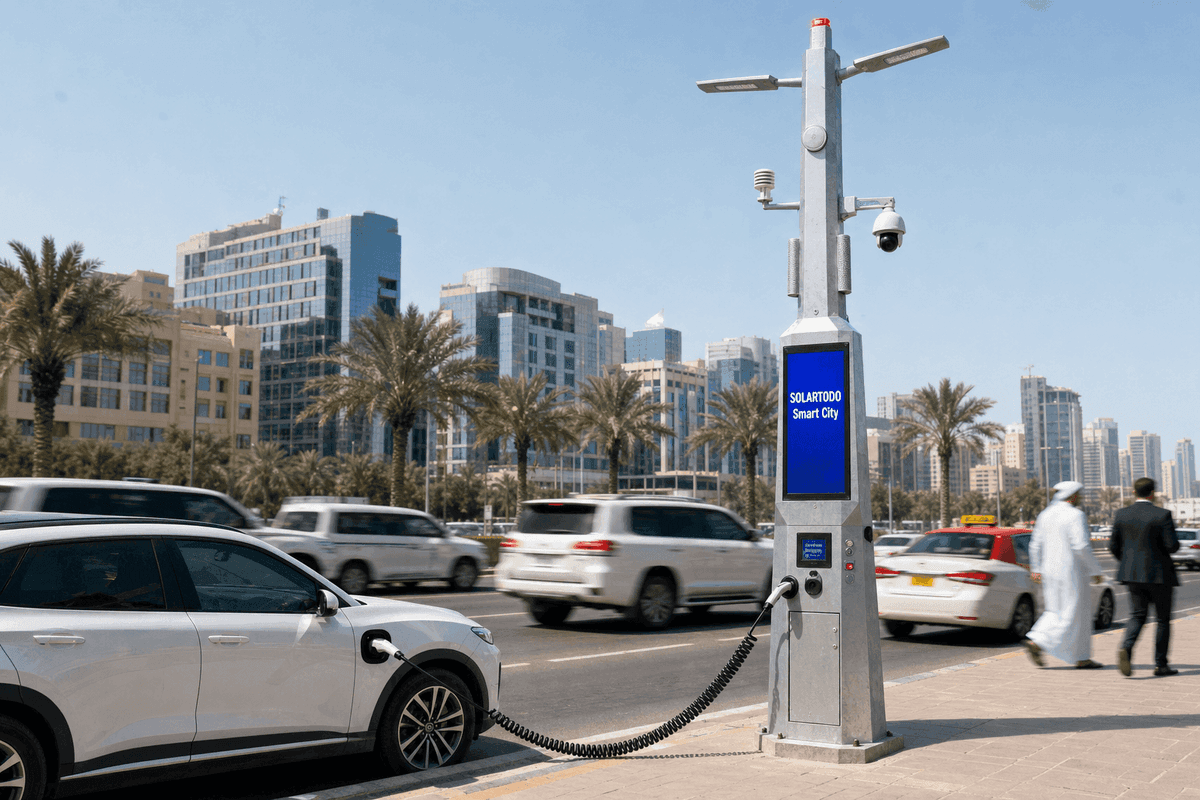
Budapest Smart Streetlight Market Analysis: 12m Grid-Powered EV-Charging Pole Configuration Guide
Summary
Budapest’s 1.68 million residents, dense arterial roads, and EU-aligned e-mobility targets support a typical 202-unit smart streetlight corridor plan at 28 m spacing, using 12 m grid-powered poles with integrated 22 kW AC charging, twin 80 W LED lighting, and 5G/WiFi 6 connectivity.
Key Takeaways
A Budapest smart streetlight program of this profile would typically align 202 units over roughly 5.6 km at 28 m spacing, matching dense urban boulevard and mixed-use corridor conditions.
- Budapest has about 1.68 million residents in the city proper, creating high demand for multi-use curbside infrastructure on busy urban streets rather than highway-class poles.
- A typical 202-unit deployment at 28 m spacing would cover approximately 5.6 km of corridor length, suitable for district-level renewal or boulevard modernization.
- The recommended pole class is a 12 m octagonal tapered steel pole with base diameter 45 cm and top diameter 15 cm, supplied for AC 220/380 V urban distribution environments.
- Each pole would combine 2 × 80 W LED luminaires at 150 lm/W and 4000 K, delivering 160 W total connected lighting load per pole with twin 1.5 m arms tilted +8°.
- The lower 2.2 m of each pole would function as the integrated EV charging cabinet, housing a 22 kW single-gun AC charger with Type 2 interface and OCPP 1.6J compliance.
- Communications would combine WiFi 6, a 5G gateway, GbE uplink, and LoRaWAN, with the flush-mounted gateway positioned at 8.7 m on the pole face.
- Safety and urban management functions would include a 25x PTZ dome camera with IR 150 m range, a 30 W IP audio column, SOS alarm, and emergency broadcast trigger.
- The applicable standards baseline is IEC 60598, GB/T 37024, and IEC 62196-2, with charger interoperability and luminaire safety both important for Budapest public procurement review.
Market Context for Budapest
Budapest combines high urban density, tram and bus corridors, and rising EV adoption pressure, which makes a 12 m multifunction smart streetlight more suitable than a basic 6–8 m lighting pole on arterial streets.
Budapest is Hungary’s capital and largest city, with approximately 1.68 million residents in the municipality and a metropolitan population above 2.4 million depending on boundary definition. According to the Hungarian Central Statistical Office (KSH) (2024), Budapest remains the country’s dominant employment and transport hub. That matters for smart streetlight planning because urban pole assets in such cities are expected to carry more than lighting: surveillance, public information, emergency communication, and EV charging all compete for curbside space within a 25–50 m spacing logic.
Climate and operating conditions also support a steel smart pole configuration with corrosion protection and urban-grade electronics. According to Climate-Data.org (2024), Budapest’s average annual temperature is about 11–12°C, with summer highs regularly above 30°C and winter periods below 0°C. This range is not extreme by utility standards, but it does require sealed electrical enclosures, stable LED thermal management, and charger components that tolerate freeze-thaw cycles and road-salt exposure. For that reason, hot-dip galvanized steel and flush-mounted devices are a practical fit.
From the power side, Hungary operates a European low-voltage and medium-voltage framework centered on 230/400 V end-use supply and distribution systems that connect urban public infrastructure to local feeders. According to the International Energy Agency (IEA) (2022), Hungary continues to modernize electricity demand management and electrification infrastructure, especially where transport decarbonization intersects with municipal assets. For a Budapest smart streetlight, this supports a grid-powered AC design rather than an off-grid solar form factor, especially on shaded boulevards, tram corridors, and dense streets with mature tree cover.
Telecom readiness is another local driver. According to the European Commission DESI methodology and national digital infrastructure reporting summarized in recent EU digital economy publications, Hungary has broad 4G coverage and expanding 5G service in major urban areas, with Budapest as the primary node. That makes a pole with WiFi 6, 5G gateway support, and LoRaWAN backhaul practical for district-scale smart city layers. The International Telecommunication Union states, "5G and IoT are enabling new municipal service models across transport, safety and environmental monitoring." That statement fits Budapest’s need for shared street assets rather than single-function poles.
EV charging demand also supports integrated curbside charging. According to the European Alternative Fuels Observatory (EAFO) (2024), Hungary’s public charging network continues to expand, but urban charging density still varies by district and streetscape constraints often limit standalone charger placement. In central and mixed-use Budapest districts, the lower 2.2 m integrated charger format can reduce street clutter versus placing a separate charger cabinet beside a lighting column.
The standards context is equally important. IEC states, "IEC 60598 specifies general requirements and tests for luminaires." For procurement teams in Budapest, this matters because luminaire safety, charger interface compliance under IEC 62196-2, and network interoperability under OCPP 1.6J are easier to review when the smart streetlight uses recognized international standards from the start.
Recommended Technical Configuration
For Budapest arterial and mixed-use urban streets, the most suitable configuration is a typical 202-unit deployment of 12 m grid-powered smart streetlights with integrated 22 kW AC charging and twin-arm LED lighting.
Based on Budapest’s dense curbside environment, tram-adjacent corridors, and 230/400 V urban supply conditions, the best fit from the SOLAR TODO range is the 12 m grid-powered form rather than a smaller modular pole or a hybrid self-powered model. A 12 m height gives better camera sightlines, larger display visibility, and cleaner separation between pedestrian interaction zones and upper-mounted telecom or sensing hardware. It also fits city-street scale better than highway traffic poles, which are outside this product class.
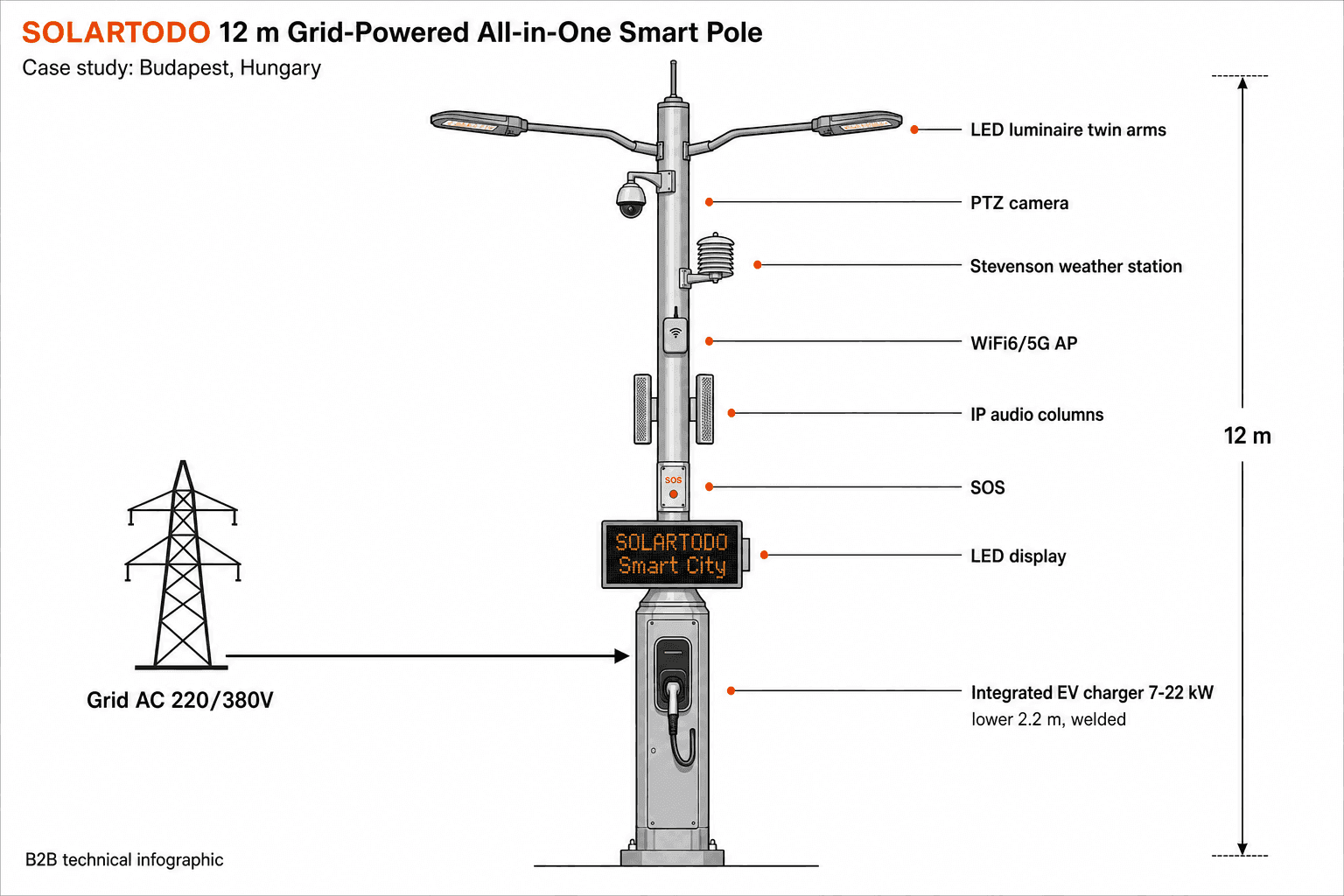
A typical 202-unit deployment of this scale would consist of 202 units × 12 m octagonal tapered steel smart poles, each with a base diameter of 45 cm and top diameter of 15 cm. The finish would be silver-grey hot-dip galvanized original, selected for long life in a Central European urban environment with winter de-icing exposure. The electrical architecture would use grid-powered AC 220/380 V supply, which is appropriate for municipal lighting circuits and local three-phase distribution arrangements.
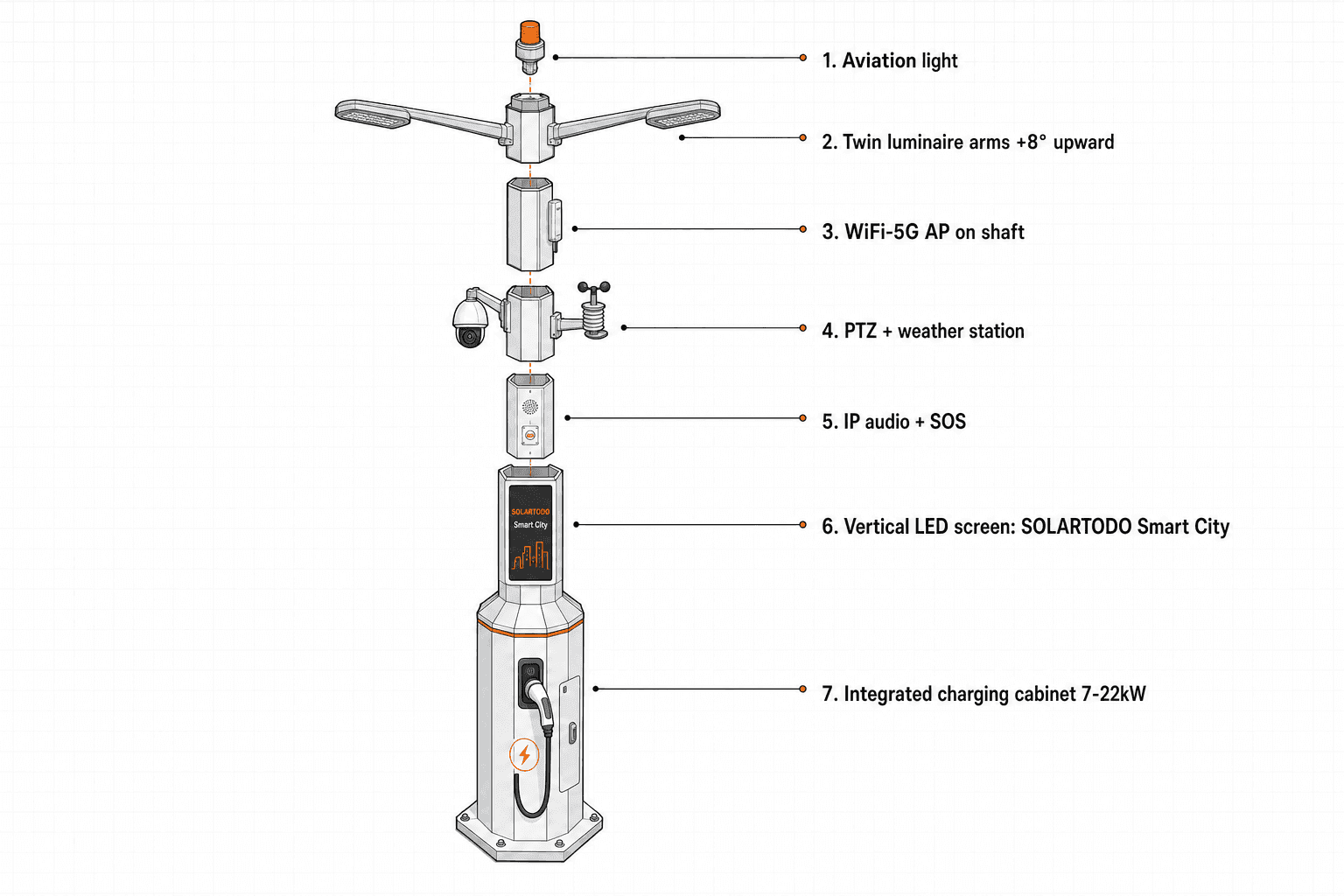
The most important design feature is the integrated EV charging structure. In this configuration, the lower 2.2 m of the pole is the EV charging cabinet itself, welded as one continuous steel structure with the upper pole. This is not a separate charger standing beside the pole. For Budapest sidewalks where clear pedestrian width is tightly regulated, that single-body format can reduce clutter and simplify visual coordination with heritage-sensitive streets compared with a two-object installation.
Lighting output is configured for city streets rather than highways. Each pole would carry twin symmetric 1.5 m arms with a +8° upward tilt, supporting 2 × 80 W SOLAR TODO LED luminaires rated at 150 lm/W and 4000 K. That gives 160 W of connected lighting load per pole and about 24,000 lm total nominal output before optical losses. On a 202-unit corridor, the aggregate connected LED load would be about 32.3 kW, excluding chargers, displays, and communications equipment.
For safety and public management, each pole would add a 22 cm white PTZ dome camera with 360° rotation, 25x zoom, and IR range up to 150 m, mounted on a 50 cm L-bracket outrigger. Environmental sensing would use a 4-parameter top sensor for temperature, humidity, wind speed, and noise. Public communication would be handled by one IP audio column sized Ø10 × 50 cm, rated 30 W and 93 dB, mounted flush against the flat pole face in a color-matched finish.
The EV charging specification is suitable for destination and curbside charging rather than DC fast-turnover charging. Each pole would include one integrated 22 kW single-gun AC fast charger with Type 2 interface, OCPP 1.6J compatibility, a 5 m coiled cable, an 8-inch touchscreen at 1.5 m height, a red mushroom emergency stop, and a stainless maintenance door. In Budapest, that format suits mixed-use streets, municipal parking lanes, and public institution frontages where dwell times commonly exceed 1 hour.
SOLAR TODO also specifies a vertical P5 LED advertising display sized 1280 × 2560 mm in portrait orientation with brightness above 5000 cd/m². In this configuration, content is restricted to the text "SOLARTODO Smart City" in white sans-serif on deep blue, with no other imagery. Communications hardware would combine dual-mode WiFi 6 and 5G gateway functions, with GbE uplink and LoRaWAN, mounted flush on the pole face at 8.7 m.
For planning purposes, 28 m spacing is a strong fit for boulevard, district avenue, and mixed-use collector road applications in Budapest. At that pitch, 202 poles cover roughly 5,628 m of corridor. That is close to 5.6 km of continuous urban frontage, enough for a district package rather than an isolated pilot.
Technical Specifications
The Budapest-recommended smart streetlight configuration uses a 12 m grid-powered steel pole, 22 kW Type 2 AC charging, 2 × 80 W LED lighting, and 28 m spacing across a typical 202-unit corridor package.
- Pole structure: 12 m octagonal tapered steel smart pole
- Pole diameter: base Ø45 cm to top Ø15 cm
- Surface finish: silver-grey hot-dip galvanized original
- Power input: grid-powered AC 220/380 V
- Integrated charger structure: lower 2.2 m of the pole is the EV charging cabinet, welded as one continuous steel structure
- Lighting arms: twin symmetric arms, each 1.5 m long, +8° upward tilt
- LED luminaires: 2 × 80 W SOLAR TODO LED, 150 lm/W, 4000 K
- Total lighting wattage per pole: 160 W
- Approximate total lumens per pole: 24,000 lm nominal
- Camera: 22 cm white PTZ dome, 360° rotation, 25x zoom, IR 150 m
- Camera bracket: 50 cm L-bracket outrigger
- Environmental sensor: 4-parameter top sensor for temperature, humidity, wind speed, and noise
- Public address: 1 × IP audio column, Ø10 × 50 cm, 30 W, 93 dB
- Emergency functions: SOS button, panic alarm, camera linkage, emergency broadcast trigger
- EV charging: integrated 22 kW single-gun AC charger, Type 2, OCPP 1.6J
- Charging cable: 5 m coiled Type 2 cable
- User interface: 8-inch touchscreen at 1.5 m height
- Safety hardware: red mushroom emergency stop, stainless maintenance door
- Display: P5 vertical LED screen, 1280 × 2560 mm, portrait, >5000 cd/m²
- Display content restriction: "SOLARTODO Smart City" text only, white sans-serif on deep blue
- Communications: WiFi 6 + 5G gateway + GbE uplink + LoRaWAN
- Gateway position: flush-mounted on flat pole face at 8.7 m
- User convenience: Qi wireless phone charging pad + USB-A
- Pole spacing: 28 m typical
- Standards: IEC 60598, GB/T 37024, IEC 62196-2
Implementation Approach
A Budapest rollout of 202 smart streetlights would typically proceed in 4 phases over about 6–12 months, from corridor survey and utility review to commissioning and software integration.
Phase 1 is corridor definition and utility coordination. For a 5.6 km route, the municipality or EPC contractor would first verify right-of-way width, parking geometry, feeder capacity, and telecom backhaul options. Because each charger is rated 22 kW, not every pole would necessarily be energized at full coincident charging load at the same time; load diversity and smart charging logic should be included in the electrical design. According to IEA (2023), managed charging is increasingly important where public charging expands faster than local distribution upgrades.
Phase 2 is civil and electrical design. Foundation sizing would depend on soil class, frost depth, and wind loading under local code checks, while feeder design would review lighting circuits separately from charger circuits where required. In Budapest, winter freeze-thaw conditions and road-salt exposure make cable sealing, drainage, and anti-corrosion detailing important at the pole base and access door interfaces. This is also the phase where display brightness, camera privacy zones, and emergency audio policy should be approved.
Phase 3 is fabrication, logistics, and installation. SOLAR TODO would typically supply the pole body as a factory-fabricated integrated unit, with the lower 2.2 m charger section already part of the structure. Installation sequencing would generally follow foundation works, anchor setting, feeder pull-in, pole erection, luminaire mounting, charger commissioning, and network acceptance testing. For a 202-unit package, district-by-district commissioning often reduces traffic disruption compared with a single corridor shutdown.
Phase 4 is platform integration and acceptance. The WiFi 6, 5G gateway, LoRaWAN, PTZ camera, audio column, SOS trigger, and display all need addressing, cybersecurity checks, and role-based access control before handover. According to NIST guidance for connected infrastructure and common smart city procurement practice, device inventory, firmware control, and event logging should be defined before public operation. A practical acceptance plan would include charger interoperability tests, lighting photometric checks, camera focus zones, and emergency broadcast drills.
Expected Performance & ROI
A 202-unit Budapest smart streetlight package would primarily deliver space efficiency, lighting modernization, and shared-asset economics, with simple LED energy savings often reaching 50% or more versus legacy sodium systems.
For lighting alone, the expected energy profile is straightforward. At 160 W per pole, 202 poles draw about 32.3 kW for luminaires. Assuming 4,100 annual operating hours, annual lighting consumption would be about 132,448 kWh. If replacing older 250 W to 400 W conventional streetlights with lower efficacy, the LED portion alone could reduce lighting electricity use by roughly 35% to 60%, depending on the baseline optics and ballast losses. According to the U.S. Department of Energy and NREL street-lighting studies, LED roadway upgrades commonly cut municipal lighting energy use by around 40% to 60%.
The larger financial case in Budapest is not only electricity. It is asset consolidation. A conventional street build-out may require one lighting pole, one separate EV charger pedestal, one camera mast or bracket, one emergency call point, and sometimes a separate digital sign structure. Combining those into one 12 m steel asset can reduce trenching points, sidewalk obstructions, and maintenance visits. According to IRENA (2023), integrated urban electrification assets can lower balance-of-system and operations costs when procurement is standardized.
Charging revenue depends on tariff design and utilization, so any payback estimate must be conditional. If charger occupancy is low, the project behaves mainly like a lighting and smart-city infrastructure upgrade. If curbside charging utilization is moderate to high, the 22 kW Type 2 interface can materially improve the business case, especially near offices, retail streets, municipal buildings, and park-and-ride edges. In Budapest, a realistic ROI model should therefore separate three value streams: lighting energy savings, charging service income, and telecom/digital service value.
Lifecycle cost planning should assume periodic maintenance for chargers, screens, seals, and communications hardware rather than only luminaire replacement. LED modules rated for long service life can reduce relamping frequency, but the public-facing charger cable, touchscreen, and emergency button require more frequent inspection. A 10–15 year financial model is usually more realistic than a 3-year simple payback model for multi-function poles, especially when civil works are included.
Comparison Table
For Budapest city streets, a 12 m integrated EV-charging smart streetlight provides better function density than a standard modular pole, but with higher electrical planning requirements due to the 22 kW charger load.
| Metric | Recommended Budapest Configuration | Basic Smart Pole Alternative |
|---|---|---|
| Pole height | 12 m | 8–10 m |
| Pole form | Octagonal tapered steel | Octagonal modular steel |
| Power mode | Grid AC 220/380 V | Grid AC 220/380 V |
| EV charging | Integrated 22 kW AC Type 2 | Optional 7 kW class or none |
| Charger structure | Lower 2.2 m is part of pole body | Usually separate cabinet or add-on box |
| Lighting | 2 × 80 W LED, 150 lm/W | 1 × 80–120 W LED |
| Camera | PTZ, 25x zoom, IR 150 m | Fixed or lighter PTZ option |
| Display | P5, 1280 × 2560 mm, >5000 cd/m² | Smaller display or none |
| Connectivity | WiFi 6 + 5G + GbE + LoRaWAN | 4G/LoRaWAN typical |
| Typical spacing | 28 m | 25–35 m |
| Streetscape clutter | Lower, due to integrated charger | Higher if charger is separate |
| Best fit in Budapest | Boulevards, mixed-use corridors, civic streets | Secondary streets, lighter smart-city scope |
Pricing & Quotation
SOLAR TODO offers three pricing tiers for this product line: FOB Supply (equipment ex-works China), CIF Delivered (including ocean freight and insurance), and EPC Turnkey (fully installed, commissioned, with 1-year warranty). Volume discounts are available for large-scale deployments. Configure your system online for an instant estimate, or request a custom quotation from our engineering team at [email protected].
Frequently Asked Questions
A Budapest buyer typically compares charger rating, pole height, spacing, standards, and maintenance intervals first, because those 5 factors determine both utility approval and 10-year operating cost.
Q1: Why is a 12 m smart streetlight recommended for Budapest instead of a shorter pole?
A 12 m pole gives better camera coverage, display visibility, and separation between pedestrian-touch components and upper-mounted devices. On dense Budapest boulevards, it also supports twin 1.5 m lighting arms and a flush 5G/WiFi 6 gateway at 8.7 m without overcrowding the lower service zone.
Q2: Is the EV charger a separate pedestal next to the pole?
No. In this recommended configuration, the lower 2.2 m of the pole is the charger cabinet itself, welded into one continuous steel structure. That matters in Budapest because curb and sidewalk space is limited, and a one-body design reduces clutter compared with separate charger pedestals.
Q3: What electrical supply is required for this smart streetlight?
The specified version uses grid-powered AC 220/380 V input. In practice, Budapest projects would confirm local feeder capacity, phase balance, protection settings, and charger load management before procurement. The 22 kW Type 2 charger is suitable for urban destination charging, not ultra-fast DC charging.
Q4: How long would a 202-unit deployment typically take?
A district-scale package of about 202 poles would usually require around 6–12 months, depending on utility approvals, civil permits, and feeder upgrades. Projects move faster when foundations, electrical works, and software commissioning are phased by corridor rather than waiting for all 202 sites together.
Q5: What kind of ROI can municipalities expect?
ROI depends on the baseline lighting system and charger utilization. LED lighting alone can often reduce energy use by 35% to 60% versus older fixtures, while charger income and telecom value can improve the business case. A 10–15 year lifecycle model is more realistic than a short simple-payback calculation.
Q6: How does this compare with a standard smart pole without integrated charging?
A standard pole is simpler and usually lighter on feeder capacity, but it may require a separate charger pedestal if EV service is needed. This 12 m configuration consolidates lighting, charging, camera, emergency audio, and display into one asset, which can reduce street furniture count.
Q7: What maintenance should be planned each year?
Annual maintenance should include charger cable inspection, touchscreen checks, emergency stop verification, luminaire cleaning, door seal inspection, and communication device diagnostics. Camera lens cleaning and firmware updates are also important. Public-facing hardware usually needs more frequent checks than the LED engine itself.
Q8: Which standards are relevant for procurement in Budapest?
The core standards in this configuration are IEC 60598 for luminaires, GB/T 37024 for smart poles, and IEC 62196-2 for the Type 2 charging interface. Buyers may also request local electrical code alignment, EMC documentation, charger interoperability records, and structural calculations for wind loading.
Q9: Can the display show municipal information instead of advertising?
Technically yes, but this specified configuration restricts display content to the text “SOLARTODO Smart City” in white sans-serif on deep blue. If Budapest tenders require public messaging, wayfinding, or emergency content, the display control policy should be defined before final quotation and software setup.
Q10: Is EPC pricing available for Budapest, and what affects quotation accuracy?
Yes. EPC quotations depend on foundation design, cable route length, utility connection scope, customs terms, and software integration requirements. Charger energization strategy also affects cost because 202 poles with 22 kW chargers may require staged feeder design rather than assuming full simultaneous charging at every location. For project-specific support, buyers can review the Smart Streetlight product page or contact us.
References
- Hungarian Central Statistical Office (KSH) (2024): Budapest population and metropolitan demographic statistics.
- International Energy Agency (IEA) (2022): Hungary energy profile and electricity system modernization context.
- European Alternative Fuels Observatory (EAFO) (2024): Hungary public EV charging network development and alternative fuels infrastructure indicators.
- IEC (2023): IEC 60598 luminaire safety requirements and IEC 62196-2 conductive charging interface requirements.
- International Telecommunication Union (ITU) (2023): Smart sustainable cities guidance and 5G/IoT municipal infrastructure context.
- IRENA (2023): Urban electrification and integrated infrastructure cost considerations for public assets.
- U.S. Department of Energy / NREL (2022): LED street lighting energy savings benchmarks and municipal lighting performance guidance.
Equipment Deployed
- 202 × 12 m octagonal tapered steel smart pole, base Ø45 cm to top Ø15 cm, silver-grey hot-dip galvanized
- Grid-powered AC 220/380 V electrical architecture
- Integrated EV charging cabinet formed by lower 2.2 m of pole body
- Twin symmetric 1.5 m lighting arms with +8° upward tilt
- 2 × 80 W SOLAR TODO LED luminaires per pole, 150 lm/W, 4000 K
- 22 cm white PTZ dome camera, 360° rotation, 25x zoom, IR 150 m
- 50 cm L-bracket camera outrigger
- 4-parameter environmental sensor for temperature, humidity, wind speed, and noise
- IP audio column speaker, Ø10 × 50 cm, 30 W, 93 dB
- SOS button + panic alarm + camera linkage + emergency broadcast trigger
- Integrated 22 kW single-gun AC charger, Type 2, OCPP 1.6J
- 5 m coiled Type 2 charging cable
- 8-inch touchscreen mounted at 1.5 m height
- Red mushroom emergency stop and stainless maintenance door
- P5 vertical LED display, 1280 × 2560 mm, portrait, >5000 cd/m²
- WiFi 6 + 5G gateway with GbE uplink and LoRaWAN, flush-mounted at 8.7 m
- Qi wireless phone charging pad + USB-A