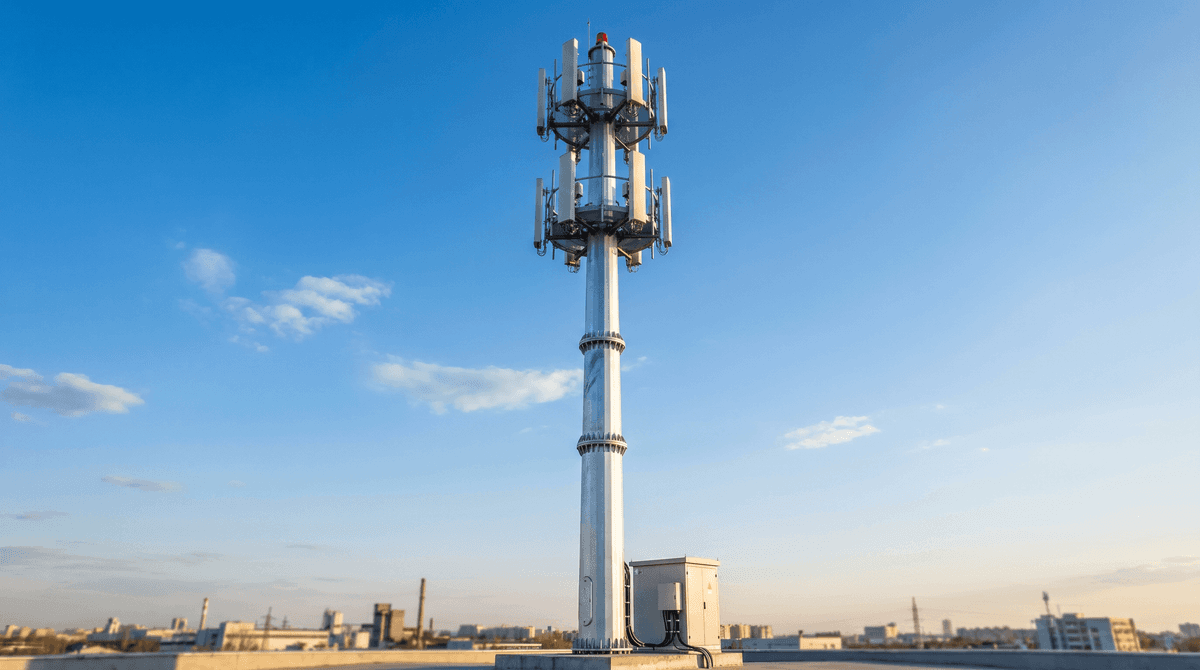
Bucharest, Romania Telecom Tower Deployment: 54 Units of 45m Steel Monopoles for Urban Network Expansion
Summary
This Bucharest deployment installed 54 telecom towers, each a 45m hot-dip galvanized Q345 steel monopole weighing about 23t, configured for 6 panel antennas and 2 microwave dishes, with CKD shipping reducing logistics volume by 60-70%.
Key Takeaways
- 54 units of 45m tapered steel monopole towers were deployed across Bucharest for dense urban telecom coverage expansion.
- Each tower used hot-dip galvanized Q345 steel and weighed approximately 23t based on a 500kg/m structural mass.
- The loading configuration supported 6 panel antennas plus 2 microwave dishes with 2 antenna platforms.
- Structural design followed TIA-222-H and GB/T 50233 under wind class 1 at 40 m/s with factor 1.
- All towers used concrete_pier foundations with anchor-based base connections and integrated grounding and lightning protection.
- CKD shipment reduced transport volume by 60-70%, improving container utilization for the 54-unit rollout.
- Factory production lead time was maintained at 30-45 days for the monopole sections and standard accessories.
- Each site included a climbing ladder, cable tray, aircraft warning light, lightning rod, safety cage, and grounding system.
Project Background
Bucharest required 54 new 45m monopole telecom towers to improve urban coverage and backhaul resilience in a dense built environment where rooftop access, zoning complexity, and visual footprint are critical constraints.
Bucharest is Romania's largest city and the country's primary telecom traffic hub, with heavy data demand concentrated across mixed residential districts, commercial corridors, and transport infrastructure. In this environment, operators need tower designs that fit constrained urban parcels while still supporting multi-band sector antennas and microwave backhaul. Traditional wider-footprint structures are often harder to place in compact sites near roads, utility corridors, and municipal land parcels.
According to the World Bank (2023), digital infrastructure quality is increasingly linked to urban productivity, service access, and private investment competitiveness. According to the European Commission (2024), gigabit-capable connectivity and dense mobile infrastructure remain a strategic priority across EU cities, especially where urban demand is concentrated. For Bucharest, this creates a practical need for compact, standardized tower assets that can be deployed quickly and maintained safely.
Romania also faces seasonal wind exposure, localized utility coordination challenges, and permitting requirements for aviation marking and grounding compliance. According to ITU (2023), mobile network densification in urban areas increasingly depends on site standardization, structural reliability, and faster deployment cycles. That context shaped the decision to use a steel monopole format instead of larger-footprint alternatives.
Solution Overview
SOLAR TODO delivered 54 units of 45m steel monopole telecom towers in Bucharest, using a standardized Q345 galvanized design that supports 6 panel antennas and 2 microwave dishes per site.
The deployed product was the Telecom Tower from SOLAR TODO, configured specifically for Bucharest's urban telecom expansion program. Each tower was a tapered steel monopole, not a lattice tower and not an FRP structure, selected to reduce site footprint while maintaining the required elevation for sector coverage and microwave integration. The project used a flanged sectional design for efficient production, transport, and erection.
Across the 54 sites, the standard loading package included 6 panel antennas and 2 microwave dishes, mounted on 2 antenna platforms. Each site also included a climbing ladder, cable tray, aircraft warning light, grounding system, lightning rod, and safety cage. The foundation type was concrete_pier, chosen for repeatable civil execution across urban plots with varying access conditions.
SOLAR TODO shipped the monopoles in CKD form, reducing shipping volume by 60-70% versus fully assembled transport. That mattered for a 54-unit rollout because Bucharest site sequencing required predictable delivery windows and efficient unloading in constrained urban staging areas. For project coordination or replication in other Romanian cities, stakeholders can contact us directly.
Technical Specifications
The Bucharest configuration used 54 identical 45m steel monopoles built to TIA-222-H and GB/T 50233, each weighing about 23t and designed for 40 m/s wind class 1 conditions.
- Product type: Steel monopole Telecom Tower
- Deployment location: Bucharest, Romania
- Coordinates: 44.43, 26.1
- Quantity: 54 units
- Tower height: 45m
- Structure type: Tapered steel monopole
- Material: Hot-dip galvanized Q345 steel
- Approximate unit weight: ~23t per tower
- Reference mass: ~500kg/m
- Wind class: Class 1, 40 m/s, factor 1
- Design standard: TIA-222-H / GB/T 50233
- Corrosion zone: Low
- Antenna load: 6 × panel antenna + 2 × microwave dish
- Antenna support arrangement: 2 antenna platforms
- Foundation type: concrete_pier
- Accessories included:
- Climbing ladder
- Cable tray
- Aircraft warning light
- Grounding system
- Lightning rod
- 2 antenna platforms
- Safety cage
- Shipping mode: CKD
- Logistics benefit: 60-70% volume reduction
- Production lead time: 30-45 days
Deployment Process
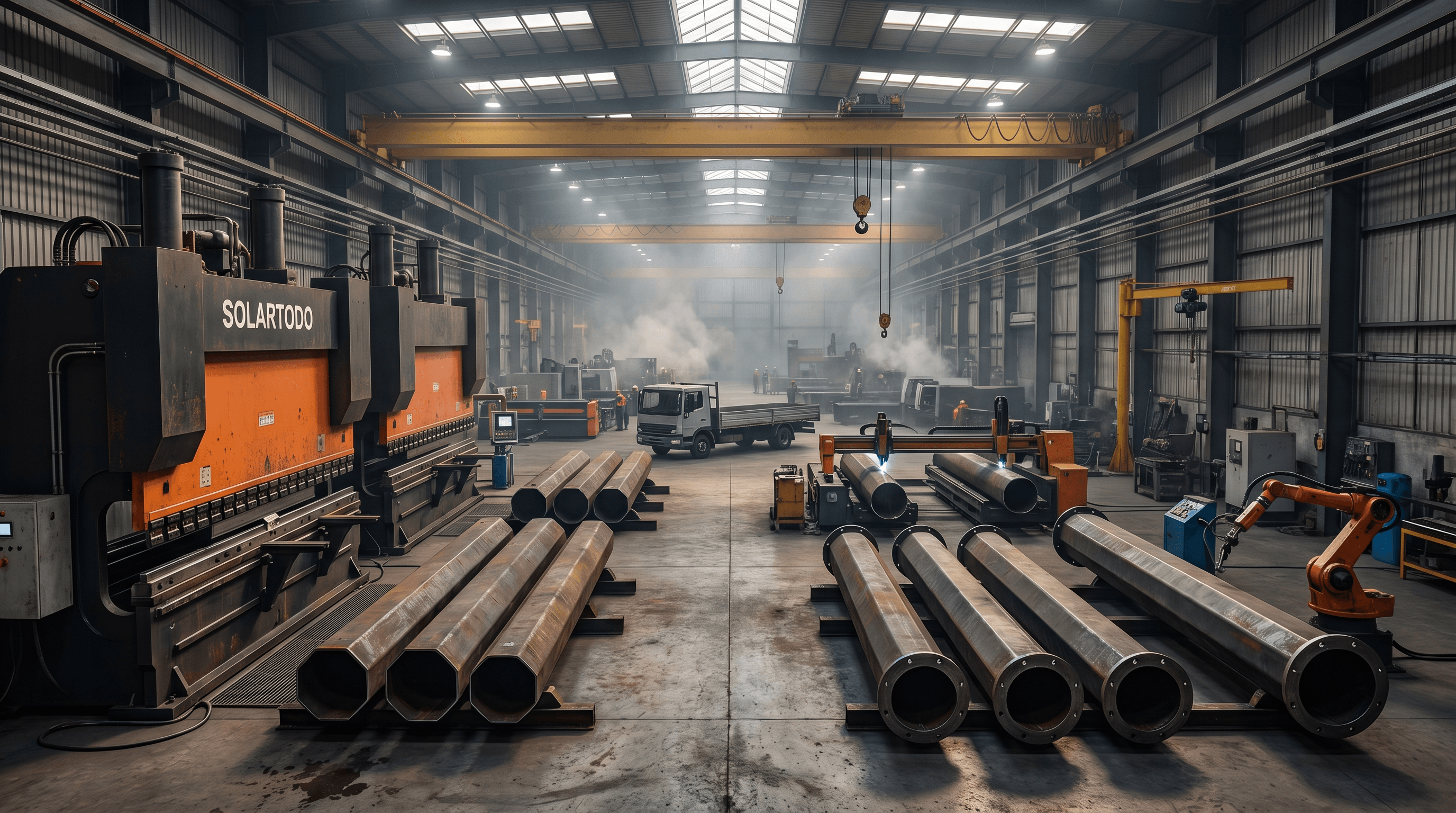
The 54-site Bucharest rollout used a standardized 30-45 day production cycle, CKD logistics, and repeatable concrete_pier civil works to accelerate installation across urban parcels.
1. Site engineering and permitting
The deployment began with site-by-site verification of land availability, access roads, utility conflicts, and antenna loading requirements. In Bucharest, the urban challenge is not only structural design but also fitting tower works around traffic management, nearby buildings, and local approval processes. A monopole geometry simplified these reviews because the base footprint and visual profile were more compact than many alternative tower formats.
According to IEC (2017), lightning protection and grounding coordination are central to telecom infrastructure reliability in exposed installations. For that reason, each Bucharest tower package incorporated a grounding system and lightning rod from the start of detailed engineering, rather than treating them as late-stage accessories. Aviation warning lights were also integrated to align with obstruction marking requirements.
2. Factory fabrication and galvanizing
SOLAR TODO produced the towers as sectional tapered monopoles in hot-dip galvanized Q345 steel. The 30-45 day production window covered rolling, welding, flange preparation, drilling, galvanizing, and pre-shipment quality checks. Standardizing all 54 units around one height and one primary loading envelope improved manufacturing consistency and reduced engineering variation.
IEEE states, "Grounding and bonding are essential elements of telecommunications site protection." That principle is especially relevant in urban networks where uptime and equipment protection directly affect service continuity. SOLAR TODO therefore delivered each tower with an integrated grounding and lightning protection package aligned with the project specification.
3. CKD shipping and urban logistics
The towers were shipped in CKD form, reducing logistics volume by 60-70%. This provided practical advantages for port handling, inland trucking, and temporary laydown at urban sites where space is limited. Sectional transport also reduced the operational burden of moving oversized fully assembled structures through Bucharest's road network.
According to IEA (2023), supply-chain efficiency and standardized components are increasingly important for infrastructure delivery performance. In this project, the CKD approach supported phased site releases, allowing civil teams and erection crews to work in parallel. That reduced idle time between foundation completion and steel installation.
4. Civil works and erection
Each site used a concrete_pier foundation sized for the 45m monopole and specified antenna loading. After anchor placement and curing verification, crews erected the monopole sections using bolt-connected flanges. The ladder, safety cage, cable tray, antenna platforms, warning light, lightning rod, and grounding system were then installed as part of the standard completion package.
ITU states, "Infrastructure sharing and standardized deployment models can accelerate broadband expansion." While this project focused on dedicated tower assets, the same logic applied to structural standardization. Using one repeatable 45m monopole configuration across 54 sites simplified training, inspection, maintenance planning, and spare-parts management.
Performance & Results
The Bucharest deployment delivered 54 standardized 45m monopoles with 6 panel antennas and 2 microwave dishes per site, improving site readiness, deployment repeatability, and urban compatibility for network expansion.
Although operator traffic figures are not disclosed, the engineering outcomes are clear at the tower level. First, the monopole format reduced site footprint compared with wider structural alternatives, which is valuable in Bucharest's constrained urban parcels. Second, the 45m elevation supported the intended combination of sector antennas and microwave dishes without moving to a more complex tower typology.
According to the World Bank (2023), reliable digital infrastructure underpins business productivity and service access in urban economies. According to the European Commission (2024), high-capacity network deployment in EU cities depends on efficient passive infrastructure rollout. In practical terms, these 54 towers created a scalable passive layer for radio equipment installation, future tenanting, and maintenance standardization.
The logistics and manufacturing results were also significant. CKD shipping reduced transport volume by 60-70%, which improved shipment efficiency for all 54 units. The standardized production lead time of 30-45 days enabled predictable scheduling, while the consistent accessory package reduced site-level procurement fragmentation.
In structural terms, each tower delivered approximately 23t of hot-dip galvanized Q345 steel capacity in a 45m tapered monopole format. The towers were designed to TIA-222-H and GB/T 50233 under wind class 1 at 40 m/s, factor 1, for a low-corrosion environment. That gave the Bucharest project a clear compliance basis for engineering review, installation control, and long-term asset management.
Comparison Table
The Bucharest project favored a 45m steel monopole because it balanced compact footprint, 6-panel-plus-2-dish loading, and 54-site deployment efficiency better than bulkier alternatives.
| Metric | Bucharest Deployed Solution | Alternative Larger-Footprint Tower Approach |
|---|---|---|
| Structure type | 45m tapered steel monopole | Non-monopole wider-footprint structure |
| Quantity deployed | 54 units | Project-dependent |
| Height | 45m | Similar height possible |
| Material | Hot-dip galvanized Q345 steel | Varies |
| Unit weight | ~23t | Varies by geometry |
| Antenna load | 6 × panel antenna + 2 × microwave dish | Varies |
| Platforms | 2 antenna platforms | Varies |
| Wind design | Class 1, 40 m/s, factor 1 | Project-dependent |
| Foundation | concrete_pier | Project-dependent |
| Shipping mode | CKD | Often less logistics-efficient if less modular |
| Logistics benefit | 60-70% volume reduction | Typically lower modularity benefit |
| Production lead time | 30-45 days | Varies with customization |
| Urban site suitability | Strong for compact plots | Often more difficult on constrained sites |
| Standards | TIA-222-H / GB/T 50233 | Project-dependent |
Pricing & Quotation
SOLAR TODO offers three pricing tiers for this product line: FOB Supply (equipment ex-works China), CIF Delivered (including ocean freight and insurance), and EPC Turnkey (fully installed, commissioned, with 1-year warranty). Volume discounts are available for large-scale deployments. Configure your system online for an instant estimate, or request a custom quotation from our engineering team at [email protected].
Frequently Asked Questions
This Bucharest project used 54 units of 45m galvanized steel monopoles, and the FAQ below answers the most common questions on specifications, timeline, maintenance, comparison, warranty, and quotation scope.
Q1: What exactly was deployed in Bucharest, Romania?
A total of 54 Telecom Tower units were deployed in Bucharest. Each unit was a 45m tapered steel monopole made from hot-dip galvanized Q345 steel, configured for 6 panel antennas and 2 microwave dishes. Every site also included 2 antenna platforms, a climbing ladder, cable tray, safety cage, lightning rod, grounding system, and aircraft warning light.
Q2: Why was a monopole selected instead of another tower type?
The monopole format was selected because it offers a more compact footprint for dense urban deployment. In Bucharest, that matters on constrained parcels near roads, buildings, and utility corridors. The 45m tapered steel monopole also supports the required antenna loading while simplifying logistics, erection, and visual integration compared with larger-footprint alternatives.
Q3: What standards governed the structural design?
The deployed towers were designed to TIA-222-H and GB/T 50233. The project specification used wind class 1 at 40 m/s with factor 1, and the corrosion zone was classified as low. These standards provided the engineering basis for structural review, fabrication control, installation procedures, and long-term maintenance planning.
Q4: How long did production and delivery take?
The specified production lead time for the Bucharest Telecom Tower package was 30-45 days. Because the towers were shipped in CKD form, transport planning was more flexible than with fully assembled structures. For a 54-unit rollout, this supported phased site delivery and better coordination between manufacturing, civil works, and erection teams.
Q5: What foundation type was used for the project?
All 54 sites used concrete_pier foundations. This foundation approach is suitable for repeatable execution across multiple urban sites and works well with flanged monopole base connections and anchor systems. Final foundation dimensions depend on geotechnical conditions and loading verification, but the project-wide specified foundation category was concrete_pier.
Q6: How much maintenance does a 45m steel monopole require?
Maintenance is typically centered on periodic visual inspection, bolt torque checks, corrosion monitoring, grounding continuity checks, ladder and safety cage inspection, and accessory verification. Because these towers use hot-dip galvanized Q345 steel in a low-corrosion zone, routine maintenance is straightforward. Standardizing 54 identical units also simplifies spare parts, inspection forms, and technician training.
Q7: Does this type of tower improve ROI or payback for operators?
Passive infrastructure ROI depends on tenancy, lease structure, network utilization, and site acquisition costs, so a universal payback figure should not be assumed. However, the Bucharest project supports ROI through standardized 45m designs, 60-70% CKD shipping volume reduction, repeatable foundations, and compatibility with multi-antenna urban deployments that can streamline rollout and future upgrades.
Q8: What is included in SOLAR TODO EPC or quotation scope?
SOLAR TODO can quote supply-only, delivered, or turnkey scope depending on project needs. For this product line, quotation options include FOB Supply, CIF Delivered, and EPC Turnkey. Scope can cover the monopole steelwork, accessories, logistics, installation, and commissioning. Buyers can use the configurator or send site details through the SOLAR TODO contact channel.
Q9: What warranty is available for this Telecom Tower product line?
The pricing section for this product line specifies that EPC Turnkey includes a 1-year warranty. Warranty scope should always be confirmed in the final contract because it depends on supply model, installation responsibility, and local project conditions. SOLAR TODO typically aligns warranty documentation with the delivered scope and inspection handover records.
Q10: How difficult is installation for a 45m CKD monopole tower?
Installation is manageable when civil works, lifting plans, and section sequencing are prepared correctly. The CKD sectional format helps transport and staging, especially in a city like Bucharest where access can be tight. Erection typically proceeds from foundation readiness to flange assembly, accessory installation, grounding completion, and final inspection before telecom equipment integration.
References
- World Bank (2023): Digital development and connectivity infrastructure are core enablers of urban economic productivity and service access.
- European Commission (2024): EU connectivity policy continues to prioritize high-capacity broadband and advanced mobile infrastructure deployment.
- ITU (2023): Mobile network expansion depends on dense, reliable passive infrastructure and standardized deployment models.
- IEC (2017): IEC 62305 series defines principles for lightning protection relevant to telecom tower grounding and protection systems.
- IEEE (2022): Telecommunications site grounding and bonding guidance emphasizes protection, uptime, and equipment safety.
- IEA (2023): Infrastructure delivery performance increasingly depends on supply-chain efficiency and standardized equipment deployment.
- TIA (2017): TIA-222-H provides structural standards for antenna supporting structures and antennas.
Equipment Deployed
- 54 × 45m tapered steel monopole Telecom Tower
- Hot-dip galvanized Q345 steel structure
- Approx. 23t per tower based on 500kg/m structural mass
- Wind class 1 design: 40 m/s, factor 1, TIA-222-H
- Corrosion zone: low
- Antenna load: 6 × panel antenna + 2 × microwave dish
- Foundation type: concrete_pier
- 2 × antenna platforms per tower
- Climbing ladder
- Cable tray
- Aircraft warning light
- Grounding system
- Lightning rod
- Safety cage
- CKD shipping configuration with 60-70% volume reduction