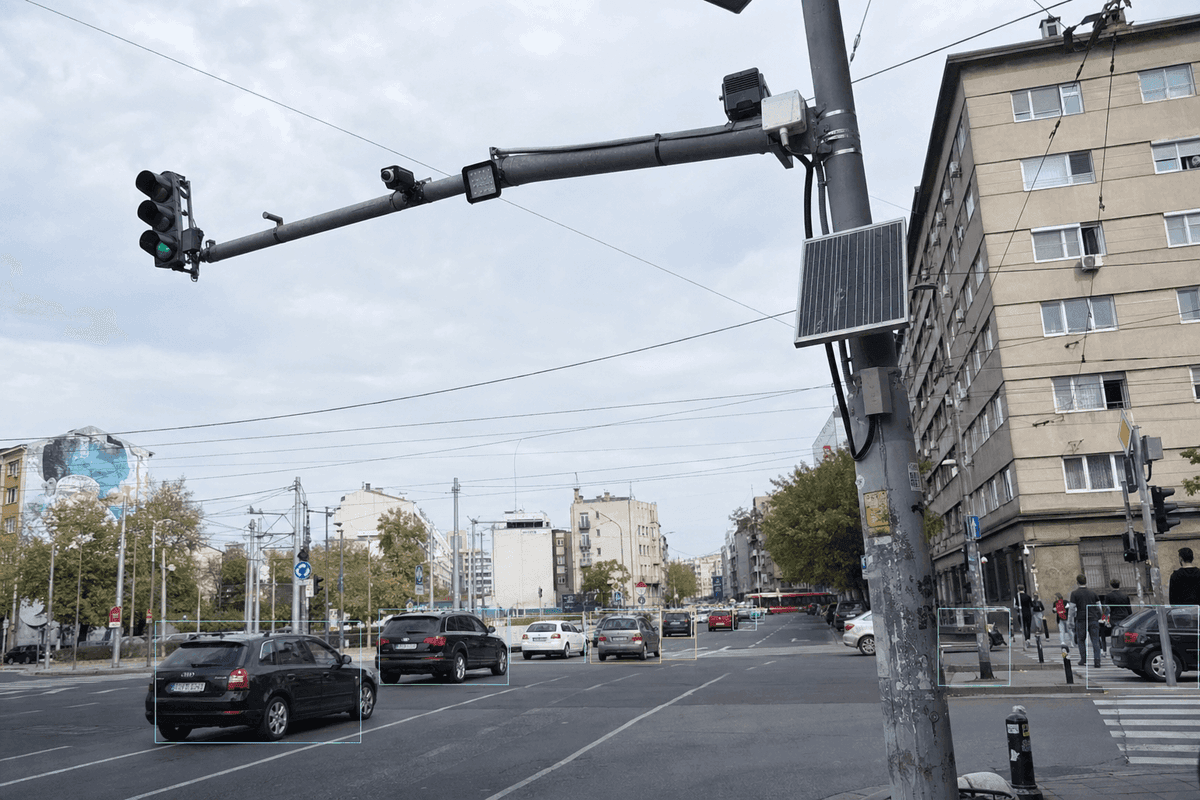
Belgrade Smart Traffic System Market Analysis: 22-Intersection 6m Pole Configuration Guide
Summary
Belgrade’s urban traffic modernization profile supports a typical 22-intersection Smart Traffic System using approximately 6m hot-dip galvanized poles, 4K AI video, and 77GHz radar. Serbia’s capital exceeds 1.6 million residents, while adaptive control and emergency priority can reduce delay and improve junction safety when linked by 5G/fiber.
Key Takeaways
- A typical Belgrade deployment of this scale would cover approximately 22 intersections using 6m L-arm steel poles in dark grey hot-dip galvanized finish.
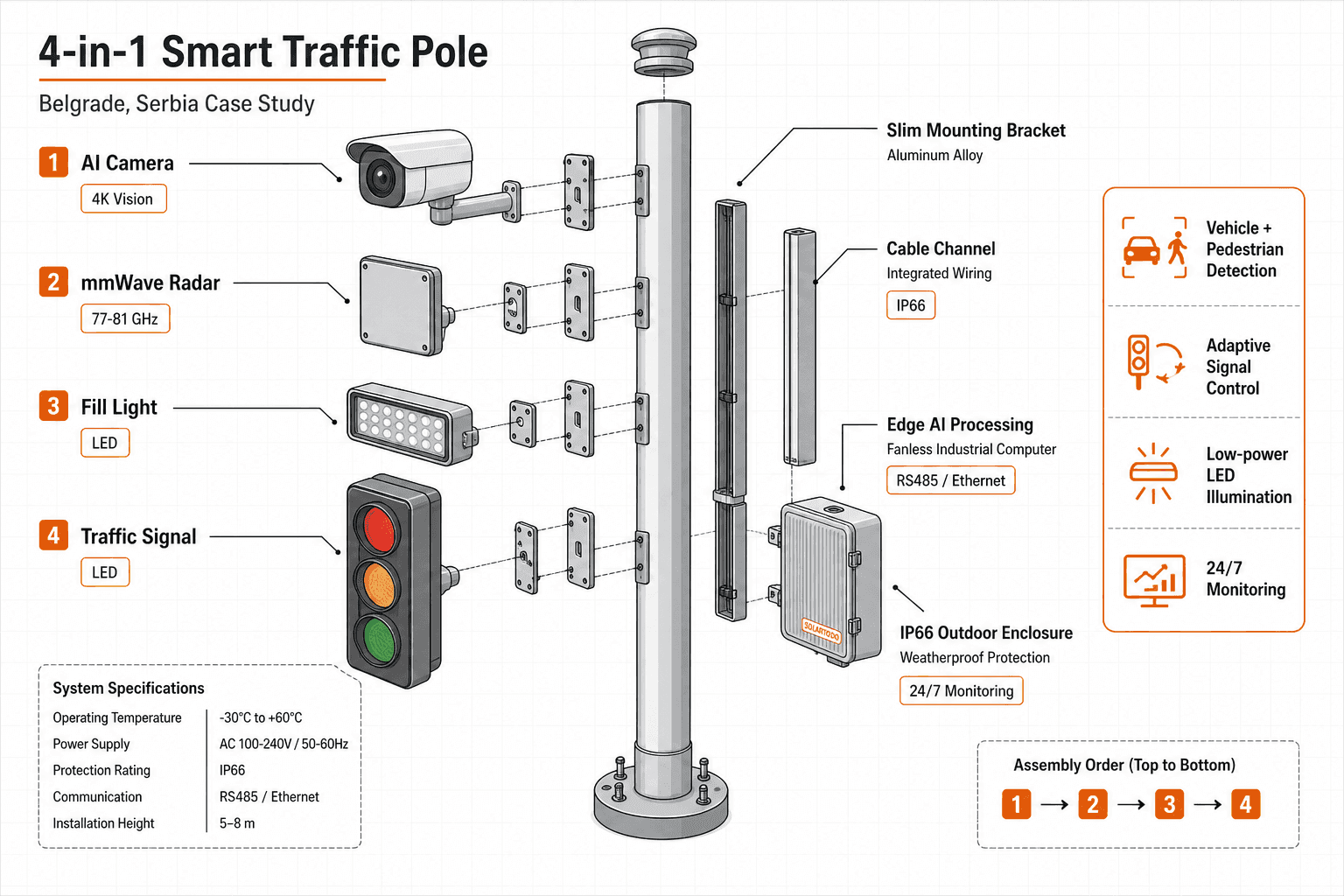
- Each pole combines 4 modules: 4K AI camera, 77GHz mmWave radar, LED fill light, and LED signal head with <50ms response.
- The specified perception stack supports 45+ detection types and approximately 98% recognition accuracy under standard operating conditions.
- A common junction layout would use 4-12 poles per intersection, but this project-specific profile points to a compact 6m class suitable for dense urban approaches.
- Backhaul should support 5G and fiber uplinks to a central TrafficGPT platform with natural-language traffic queries and control visibility.
- Feature priority for Belgrade should include adaptive signal control, emergency vehicle priority, and wrong-way alert at high-conflict urban approaches.
- Standards alignment should include NTCIP for traffic device interoperability and GB 25280 for signal-related configuration consistency.
- For municipal budgeting, the recommended commercial model is BOT (zero upfront), with ROI typically driven by delay reduction, incident response gains, and lower field-equipment count.
Market Context for Belgrade
Belgrade’s transport profile supports AI-enabled junction control because the city concentrates more than 1.6 million residents, high commuter inflows, and a dense arterial network across the Sava and Danube corridors. According to the Statistical Office of the Republic of Serbia (2023), the Belgrade region has the country’s largest population concentration, which directly raises peak-hour intersection load and signal coordination requirements.
Belgrade also functions as Serbia’s primary logistics and administrative center, so intersection performance matters beyond city traffic alone. According to the World Bank (2024), Serbia continues to invest in transport connectivity and urban service modernization, while the City of Belgrade’s planning documents prioritize traffic management, public transport efficiency, and digital administration. For a Smart Traffic System, that means the strongest fit is not a highway gantry first, but a city-intersection pole class with compact geometry and multi-sensor coverage.
Climate and seasonal visibility also matter for sensor selection. According to the Republic Hydrometeorological Service of Serbia (RHMSS) and Climate-Data public summaries, Belgrade experiences summer heat above 30°C, winter fog episodes, rain, and low-light conditions that can degrade camera-only systems. That is why a dual-sensor stack using 4K AI video plus 77GHz mmWave radar is the more defensible recommendation than video alone for a 22-intersection urban program.
Telecom readiness is another practical factor. According to the International Telecommunication Union (ITU) (2023), urban broadband and mobile-network densification are central to smart-city transport applications because low-latency backhaul supports edge-to-center orchestration. In Belgrade, a mixed 5G/fiber architecture is more realistic than fiber-only at every corner because it reduces civil-works exposure at constrained junctions while keeping central analytics available.
The road environment also favors a shorter pole class in selected urban nodes. Belgrade’s legacy streets, tram corridors, and constrained sidewalks often limit foundation footprint and overhead clearance options. For this reason, the project-specific 6m L-arm steel pole is an appropriate fit where signal head mounting, radar field of view, and camera angle can be achieved without shifting to 8m or 10m hardware meant for larger intersections or gantries.
Two authority statements support this direction. The ITU states, "Intelligent transport systems can improve road safety, traffic efficiency and environmental sustainability." The International Energy Agency (IEA) notes, "Digitalisation can make transport systems more efficient, more resilient and more responsive." Both points align with Belgrade’s need for measurable traffic control gains rather than isolated hardware replacement.
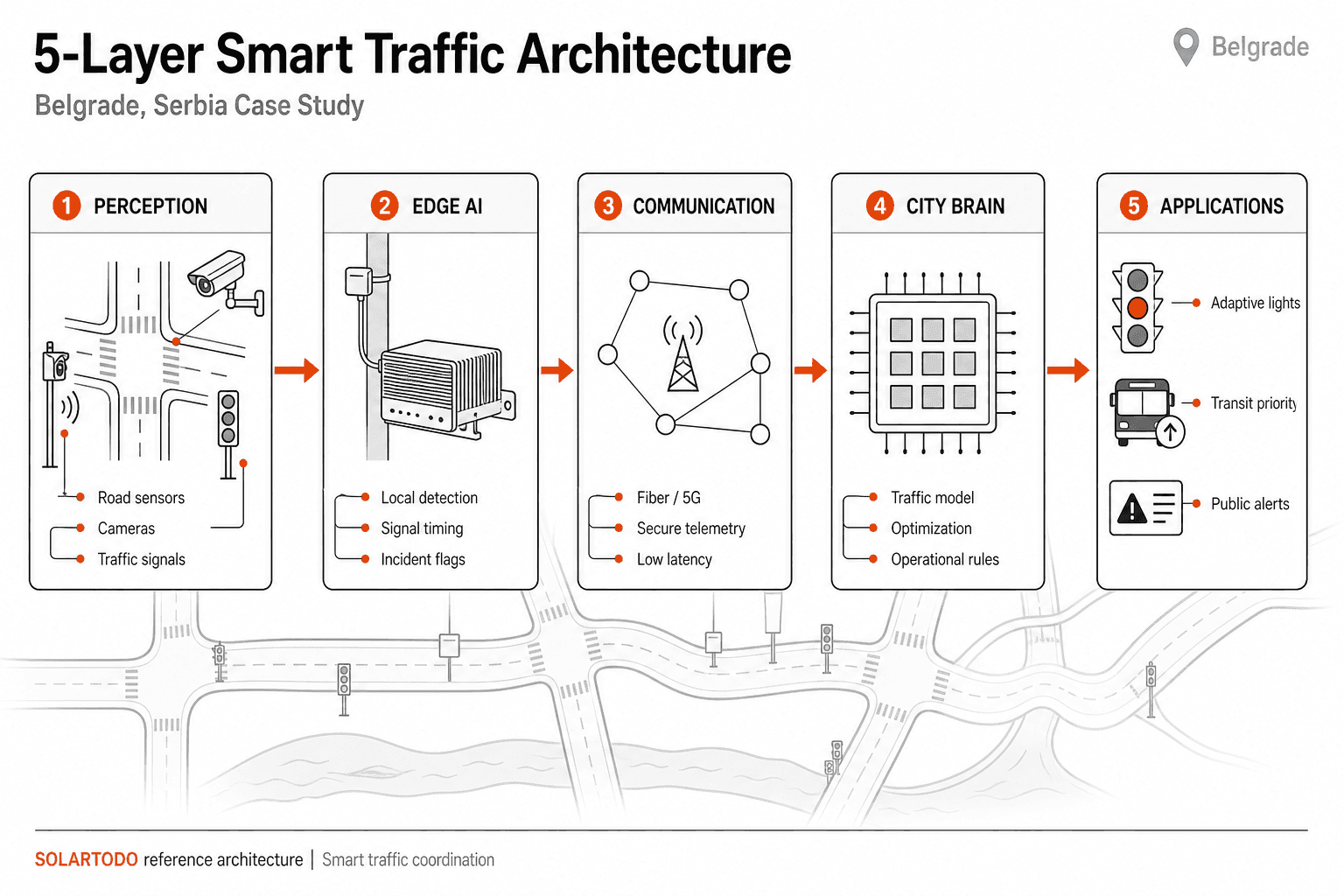
SOLAR TODO’s Smart Traffic System fits this market when specified as a junction-level sensing and control layer, not just as a signal pole. In practical terms, Belgrade requires a platform that detects vehicles, pedestrians, queue length, wrong-way movement, and emergency approach conditions within <50ms edge response time, then passes decisions to a central control layer.
Recommended Technical Configuration
A typical Belgrade configuration of this size would use approximately 22 intersections with 6m multi-function poles, combining 4 sensing/control modules per pole and 5G/fiber backhaul to a central TrafficGPT platform. This is the correct size class for compact urban junctions where sidewalk width, sightline control, and signal mounting height are tighter than on ring roads or expressways.
Based on the project-specific configuration, a typical 22-intersection deployment in Belgrade would consist of 6m L-arm steel poles in dark grey hot-dip galvanized finish. The poles would carry a 4K AI camera, 77GHz mmWave radar, LED fill light, and LED signal head as one integrated 4-in-1 roadside assembly. Edge processing would run on NVIDIA Jetson, reducing upstream bandwidth demand by classifying events locally before sending metadata and alerts to the center.
For urban Serbian intersections, this compact configuration is preferable where mast-arm loading and foundation size must stay controlled. A 6m pole is typically adequate for near-field detection, stop-line monitoring, pedestrian conflict review, and signal visibility on standard city approaches. By contrast, 8m or 10m variants are better suited to broader junctions, multilane channelization, or highway-adjacent ramps, which are not the default assumption for this Belgrade profile.
A typical junction of this class would use 4-12 poles per intersection, depending on the number of approaches, turn lanes, medians, and auxiliary detection zones. For procurement planning, buyers should treat the 22-intersection figure as the network scale and then finalize pole count after lane-by-lane design review, swept-path checks, and controller cabinet integration. This avoids under-scoping corners with tram crossings, bus-priority phases, or offset pedestrian crossings.
The functional package should include full 45-type detection, adaptive signal control, emergency vehicle priority, and wrong-way alert. These functions address Belgrade’s most visible urban pain points: recurring queue spillback, mixed traffic streams, emergency response delay, and direction-confusion events near channelized turn pockets or one-way access roads. According to IEEE smart transportation literature (2022), multi-sensor intersection control improves reliability when video visibility drops or occlusion increases.
For communications, the recommended architecture is 5G/fiber backhaul to TrafficGPT central platform. Fiber should be prioritized at high-load corridors and existing controller cabinet routes, while 5G can cover nodes where trenching cost is high or permit cycles are long. SOLAR TODO should therefore be evaluated as a hybrid communications platform rather than a fiber-only roadside package.
The preferred commercial structure in this market profile is BOT (zero upfront). Serbian municipalities and concession-style urban technology programs often face capital budgeting constraints even where operational savings are defensible over 5-10 years. BOT can shift initial capex pressure while preserving service-level commitments, performance monitoring, and phased expansion options.
Technical Specifications
The specified Belgrade configuration uses a 6m 4-in-1 Smart Traffic System pole with 4K AI sensing, 77GHz radar, NVIDIA Jetson edge computing, and NTCIP-compatible control for approximately 22 intersections.
- Pole type: L-arm smart traffic pole
- Pole height: 6m
- Pole material: hot-dip galvanized steel
- Pole finish: dark grey
- Application class: urban intersection approaches and auxiliary signal positions
- Integrated modules: 4K AI camera + 77GHz mmWave radar + LED fill light + LED signal head
- AI detection accuracy: approximately 98% under standard operating conditions
- Object/event library: 45+ detection types
- Edge response time: <50ms
- Edge computing platform: NVIDIA Jetson
- Core functions: adaptive signal control, emergency vehicle priority, wrong-way alert, full multi-class detection
- System architecture: Perception → Edge AI → Communication → City Brain (TrafficGPT) → Applications
- Backhaul options: 5G and fiber
- Central platform: TrafficGPT with natural-language query interface
- Typical pole density: 4-12 poles per intersection, subject to lane geometry and auxiliary coverage
- Recommended deployment scale for this profile: approximately 22 intersections
- Standards: NTCIP, GB 25280
- Urban use case fit: compact junctions, arterial crossings, bus-priority corridors, emergency-response routes
From a standards standpoint, NTCIP matters because it supports controller and device interoperability across mixed traffic equipment estates. GB 25280 is relevant for signal-related technical consistency in the supplied product package, while local Serbian road authority review would still be required for civil works, traffic signaling, and electrical connection approvals. Buyers comparing suppliers should verify protocol mapping, event logging intervals, and controller compatibility at the quotation stage.
Implementation Approach
A 22-intersection Belgrade rollout would typically proceed in 4 phases over roughly 4-9 months, from survey and design through commissioning and traffic-timing optimization. The exact duration depends on permit lead times, fiber availability, and whether foundation works can run in parallel across multiple corridors.
Phase 1 is corridor selection, survey, and design. This usually includes 2-6 weeks of traffic counts, lane geometry verification, pole siting, utility conflict review, and controller cabinet assessment. At this stage, the buyer should confirm whether each intersection needs 4, 6, 8, or 12 poles, because this drives steel quantity, foundation count, trench length, and integration cost.
Phase 2 is procurement and factory configuration. For a BOT or EPC-style program, the supplier would typically pre-configure the NVIDIA Jetson edge layer, camera/radar alignment parameters, NTCIP communication profiles, and TrafficGPT integration templates before shipment. This reduces field commissioning time and lowers the risk of inconsistent event classification across the 22 intersections.
Phase 3 is civil works and installation. A typical sequence is foundation excavation, anchor setting, ducting, cabinet interface work, pole erection, module mounting, and power/network connection. In dense Belgrade streets, the preferred approach is staged lane occupation during off-peak windows, because full daytime closure can create secondary congestion costs that exceed the value of faster installation.
Phase 4 is commissioning and adaptive tuning. This includes sensor calibration, stop-line detection checks, signal visibility verification, emergency-priority testing, and wrong-way logic validation. According to NTCIP implementation guidance and industry practice, at least 2-4 weeks of live tuning is advisable before final acceptance because queue patterns and pedestrian behavior vary significantly by daypart.
For SOLAR TODO, the practical procurement question is not only hardware lead time but also integration scope. Buyers should define whether the package includes cabinet retrofit, traffic controller adaptation, fiber termination, 5G SIM management, and central software dashboards. Those items often determine whether two bids that look similar on equipment price differ materially in total installed cost.
Expected Performance & ROI
A well-scoped Belgrade Smart Traffic System can improve intersection efficiency within 12-24 months by reducing delay, shortening incident detection time, and lowering field-equipment duplication through 4-in-1 pole integration. ROI is usually operational rather than energy-based, with value tied to travel time, enforcement support, and emergency-response performance.
According to the World Bank (2024), congestion in growing urban areas imposes direct economic costs through lost time, fuel burn, and lower logistics reliability. According to the IEA (2023), digital traffic management can improve transport-system efficiency when data moves from isolated roadside devices to coordinated control platforms. For Belgrade, that means the business case should focus on reduced intersection delay and fewer unmanaged conflict events rather than on hardware replacement alone.
Industry benchmarks for adaptive urban signal systems commonly show 5% to 20% corridor travel-time improvement, depending on baseline timing quality, detector coverage, and enforcement conditions. According to the U.S. Department of Transportation Federal Highway Administration (FHWA) guidance widely referenced in traffic engineering, adaptive signal control can reduce travel time by more than 10% in suitable corridors and lower stops and delay in variable traffic conditions. Belgrade’s mixed commuter and transit flows make that range realistic if controller integration is done correctly.
Safety value is equally important. Multi-sensor detection can improve event capture when a camera view is blocked by buses, trucks, or weather-related contrast loss. According to IEEE (2022), radar-video fusion provides stronger reliability than single-sensor roadside perception in occlusion-prone intersections. That directly supports the case for 77GHz mmWave radar paired with 4K AI video instead of lower-cost video-only poles.
Lifecycle cost should also be assessed against the alternative of separate devices on separate supports. A 4-in-1 pole reduces duplication in foundations, brackets, power drops, and maintenance visits. Over a 5-8 year planning horizon, this can narrow the capex gap between integrated smart poles and conventional signal-plus-camera-plus-detector packages, especially where labor and traffic-management costs are rising.
For financing, BOT can improve adoption where municipal capex is constrained. A practical payback model would usually evaluate delay reduction, incident response time, avoided secondary collisions, and maintenance consolidation across the 22-intersection network. SOLAR TODO should therefore be compared on total system value per controlled intersection, not only on unit hardware price.
Results and Impact
For Belgrade, a 22-intersection Smart Traffic System would most likely deliver value through network visibility, faster response, and more consistent signal timing across busy urban approaches. The strongest impact areas are usually queue management, emergency-priority handling, and wrong-way detection at constrained city junctions.
A useful municipal KPI set would include average delay per vehicle, queue length, red-light clearance efficiency, emergency response priority success rate, and wrong-way alert validation rate. Baseline measurement should run for at least 2 weeks before activation and 8-12 weeks after commissioning to separate seasonal variation from system effect. This is the right way to evaluate SOLAR TODO in Belgrade without relying on unsupported deployment claims.
Comparison Table
A Belgrade buyer should compare 6m integrated poles against conventional multi-device layouts on 8 key metrics, especially sensor redundancy, field complexity, and communications flexibility.
| Metric | SOLAR TODO Smart Traffic System | Conventional Separate Devices | Belgrade Relevance |
|---|---|---|---|
| Pole format | 6m L-arm hot-dip galvanized steel | Multiple supports or retrofitted arms | Fewer street-side assets in narrow corridors |
| Sensing package | 4K AI camera + 77GHz radar | Often camera-only or loop + camera | Better in fog, rain, and occlusion |
| Detection library | 45+ types | Usually limited by device mix | Better for mixed traffic and pedestrian events |
| Response time | <50ms edge response | Higher latency if cloud-dependent | Important for adaptive phases and priority calls |
| Edge computing | NVIDIA Jetson | Often central-server dependent | Reduces bandwidth and speeds event handling |
| Backhaul | 5G/fiber | Often fiber-only or fragmented | Lower civil-works burden at difficult junctions |
| Functions | Adaptive control, emergency priority, wrong-way alert | Often split across vendors | Simpler operations and troubleshooting |
| Standards | NTCIP, GB 25280 | Varies by supplier | Easier interoperability review |
Pricing & Quotation
SOLAR TODO offers three pricing tiers for this product line: FOB Supply (equipment ex-works China), CIF Delivered (including ocean freight and insurance), and EPC Turnkey (fully installed, commissioned, with 1-year warranty). Volume discounts are available for large-scale deployments. Configure your system online for an instant estimate, or request a custom quotation from our engineering team at [email protected].
For Belgrade, buyers should request pricing in per intersection, per pole, and full network integration formats. That makes it easier to compare a 22-intersection BOT structure against EPC turnkey or supply-only procurement. SOLAR TODO quotations should also clarify whether controller retrofit, trenching, cabinet work, software licenses, and acceptance testing are included.
Frequently Asked Questions
A Belgrade Smart Traffic System buyer usually needs answers on pole height, sensor fit, timeline, maintenance, ROI, pricing scope, and standards before moving from concept to tender.
Q1: Why is a 6m pole recommended for this Belgrade configuration?
A 6m pole fits compact urban intersections where sidewalks, tram corridors, and signal sightlines limit larger structures. It is sufficient for stop-line monitoring, pedestrian detection, and signal mounting on many city approaches. For wider multilane nodes, some corners may still require 8m variants, but this project-specific profile is based on 6m hardware.
Q2: What exactly is included in the 4-in-1 Smart Traffic System pole?
Each pole includes four integrated modules: a 4K AI camera, 77GHz mmWave radar, LED fill light, and LED signal head. The edge computing layer uses NVIDIA Jetson, supporting 45+ detection types, adaptive signal control, emergency vehicle priority, and wrong-way alert with response time below 50ms.
Q3: How many poles would 22 intersections usually require?
The network scale is 22 intersections, but pole count depends on approach geometry. A standard range is 4-12 poles per intersection, including primary and auxiliary positions. Final quantities should be confirmed after lane-by-lane design, median review, pedestrian crossing offsets, and controller cabinet placement are checked.
Q4: How long would deployment usually take in Belgrade?
A practical implementation window is about 4-9 months for 22 intersections. Survey and design may take 2-6 weeks, procurement several weeks more, and field installation depends on permits, trenching, and traffic management windows. Another 2-4 weeks is usually needed for live tuning after first power-up.
Q5: What ROI or payback should municipalities expect?
Payback is usually operational, not energy-based. Value comes from reduced delay, fewer stops, improved emergency priority, and lower maintenance complexity from integrated hardware. Many adaptive-signal programs target a 12-24 month performance-improvement window, while financial payback often depends on corridor traffic volume and local labor costs over 5-8 years.
Q6: How does this compare with camera-only traffic monitoring?
Camera-only systems cost less upfront but lose reliability in fog, glare, heavy rain, or occlusion by buses and trucks. Adding 77GHz radar improves detection continuity and supports better event validation. In Belgrade’s mixed weather and dense urban lanes, radar-video fusion is usually the more defensible specification.
Q7: What maintenance does the system need each year?
Typical annual maintenance includes lens cleaning, radar alignment checks, signal head inspection, cabinet review, firmware updates, and communication diagnostics. A city should also schedule periodic recalibration after lane changes or resurfacing. Integrated poles usually reduce site visits compared with separate devices on separate supports.
Q8: What should be included in an EPC quotation?
An EPC quotation should list pole steelwork, foundations, anchor bolts, sensor modules, controller integration, cabinet modifications, communications hardware, software access, commissioning, and acceptance testing. It should also define exclusions such as utility relocation, major civil reconstruction, or third-party fiber extension, because those items can change total project cost materially.
Q9: What warranty terms are typical for this product class?
Warranty terms vary by contract model, but buyers commonly expect at least a 1-year installed-system warranty under EPC turnkey and defined spare-parts support beyond that period. For BOT structures, service-level commitments and uptime definitions are often more important than a simple hardware warranty line item.
Q10: Can the system connect to existing Belgrade traffic controllers?
It can in many cases, provided protocol mapping, I/O requirements, and controller firmware are reviewed early. NTCIP support improves interoperability, but legacy cabinets may still need interface modules or software adaptation. A pre-tender audit of controller brands, cabinet condition, and communications availability is strongly recommended.
References
- Statistical Office of the Republic of Serbia (2023): Population estimates and regional demographic data identifying Belgrade as Serbia’s largest urban concentration.
- City of Belgrade / Urban Planning Institute of Belgrade (latest available planning documents): Urban mobility, transport development, and municipal infrastructure priorities relevant to signalized intersections.
- World Bank (2024): Serbia transport and urban development context; congestion and infrastructure modernization affect productivity and service delivery.
- International Telecommunication Union (ITU) (2023): Smart sustainable cities and intelligent transport systems guidance supporting digital traffic management and connected infrastructure.
- International Energy Agency (IEA) (2023): Digitalisation findings showing transport systems improve efficiency and responsiveness through connected data platforms.
- IEEE (2022): Intelligent transportation and sensor-fusion literature indicating radar-video fusion improves roadside perception reliability in occlusion and adverse visibility conditions.
- U.S. Department of Transportation Federal Highway Administration (FHWA) (2023): Adaptive Signal Control Technologies guidance on travel-time, delay, and stop reductions in suitable urban corridors.
Equipment Deployed
- 6m L-arm smart traffic pole, dark grey, hot-dip galvanized steel
- 4K AI camera with approximately 98% detection accuracy and <50ms response
- 77GHz mmWave radar for multi-lane vehicle detection and adverse-visibility support
- LED fill light integrated on pole assembly
- LED signal head integrated on pole assembly
- NVIDIA Jetson edge AI computing platform
- 5G/fiber backhaul interface to TrafficGPT central platform
- Adaptive signal control software with 45+ detection types
- Emergency vehicle priority function
- Wrong-way alert function
- NTCIP-compatible communications configuration
- GB 25280-aligned signal system configuration