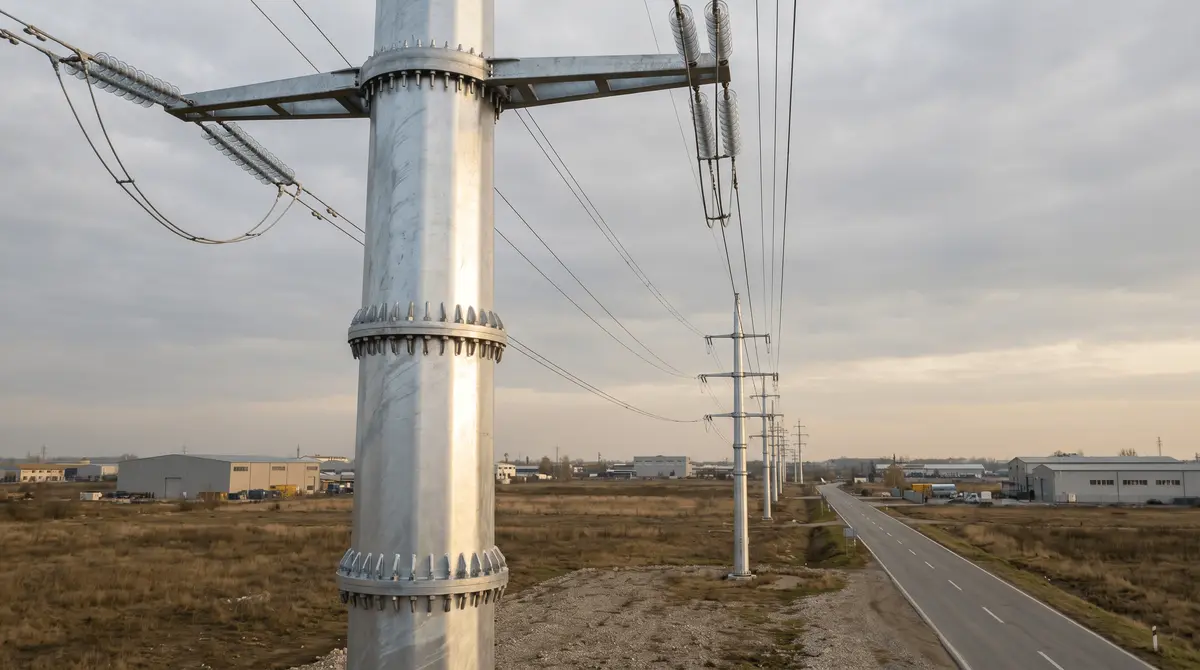
Belgrade, Serbia Power Transmission Tower Case Study: 208 Units of 35m Steel Tubular Poles for a 220kV Double-Circuit Line
Summary
This Belgrade deployment used 208 steel tubular Power Transmission Tower units at 35m height to build a ~52km 220kV double-circuit line with 250m spans, designed for 40 m/s wind under IEC 60826.
Key Takeaways
- SOLAR TODO deployed 208 tapered steel tubular poles, each 35m tall, for a 220kV double-circuit transmission corridor in Belgrade, Serbia.
- The line length reached approximately 52km, using a design span of 250m between structures across mixed urban-edge and peri-urban terrain.
- Each pole used hot-dip galvanized Q345 steel with an approximate structural weight of 35t per pole based on 1000kg/m loading guidance.
- Electrical configuration included phase spacing of 6m, ground clearance of 7m, and 2.5m insulator length for the 220kV double-circuit arrangement.
- The conductor system specified ACSR 70 at 275kg/km with maximum tension of 22kN, supported by cross arms and vibration dampers.
- The structures were engineered to IEC 60826 and GB 50545 requirements, including Wind Class 4 at 40 m/s for mechanical reliability.
- Foundation design used concrete base foundations with integrated grounding, while accessories included climbing steps, bird guards, and vibration dampers.
- Compared with conventional lattice alternatives, the tubular monopole format reduced right-of-way visual clutter while preserving 220kV transmission performance in a dense metropolitan context.
Project Background
Belgrade’s 220kV grid reinforcement required a compact 52km transmission solution using 208 steel tubular poles to cross urban-edge corridors, transport interfaces, and constrained land parcels more efficiently than conventional lattice structures.
Belgrade, located at approximately 44.79, 20.47, is Serbia’s largest metropolitan load center and a critical node in the national transmission network. The city’s growth in commercial districts, logistics activity, riverfront redevelopment, and suburban expansion has increased pressure on high-voltage infrastructure routing. In this context, utilities and EPC teams increasingly favor pole-based transmission structures where land-use compatibility, transportability, and visual impact matter as much as electrical performance.
According to the International Energy Agency (IEA) (2023), electricity grids worldwide must expand and modernize substantially to integrate new demand and maintain reliability, with transmission investment needing to accelerate this decade. According to IRENA (2023), transmission and distribution infrastructure is a core enabler of resilient power systems, especially as urban regions add load and interconnections. For Belgrade, the challenge was not simply adding capacity; it was adding 220kV double-circuit capacity in a corridor where footprint, installation sequencing, and structural reliability under wind loading all mattered.
A second local challenge was route practicality. Belgrade’s mix of developed districts, transport corridors, agricultural edges, and utility crossings makes large-footprint tower solutions harder to deploy without more intensive land coordination. According to the World Bank (2023), infrastructure delivery in growing urban regions benefits from designs that reduce spatial conflict and simplify construction logistics. That requirement shaped the decision to use a steel tubular Power Transmission Tower format supplied by SOLAR TODO rather than a lattice tower alternative.
Solution Overview
SOLAR TODO delivered 208 hot-dip galvanized 35m steel tubular poles for a 220kV double-circuit line, combining 6m phase spacing, 7m ground clearance, and 40 m/s wind design in a compact monopole form.
The deployed solution centered on 208 units of tapered steel tubular poles, each configured as a 35m Power Transmission Tower for 220kV double-circuit service. Unlike lattice towers, these structures used a tapered tubular body with integrated cross-arm support points for insulator strings and ACSR conductors. The result was a cleaner structural profile suited to Belgrade’s constrained corridor conditions.
Each unit was fabricated from hot-dip galvanized Q345 steel and designed to an approximate weight of 35 tonnes per pole, consistent with the project requirement of 1000kg/m for this voltage class and geometry. The line was laid out with a nominal 250m span, producing a total route length of approximately 52km. Accessories included climbing steps, cross arm assemblies, grounding components, bird guards, and vibration dampers.
SOLAR TODO’s role focused on the product package itself: engineered tubular poles, structural interfaces, corrosion protection, and transmission accessories aligned with the line design basis. For buyers evaluating similar projects, the relevant product category is the Power Transmission Tower, which in this case was configured specifically for a 220kV double-circuit urban-periphery deployment. For route-specific engineering support or documentation, project teams can also contact us.
According to IEC (2019) in IEC 60826, overhead line design must account for combined mechanical actions such as wind, conductor loads, and reliability criteria. IEEE states, "Transmission line design requires coordinated consideration of structural loading, conductor behavior, and environmental conditions." That principle is evident in this Belgrade project, where pole geometry, conductor tension, insulator length, and wind class had to be engineered as one integrated system.
Technical Specifications
This Belgrade Power Transmission Tower deployment used 208 units of 35m hot-dip galvanized Q345 steel tubular poles for 220kV double-circuit service with 250m spans and 40 m/s wind resistance.
- Project location: Belgrade, Serbia
- Coordinates: 44.79, 20.47
- Product type: Steel tubular Power Transmission Tower / tapered steel tubular pole
- Quantity: 208 units
- Pole height: 35m
- Line voltage: 220kV
- Circuit configuration: Double circuit
- Pole material: Q345 steel
- Surface protection: Hot-dip galvanized
- Pole form: Tapered steel tubular pole
- Approximate pole weight: ~35t per pole
- Weight basis: 1000kg/m
- Phase spacing: 6m
- Minimum ground clearance: 7m
- Conductor type: ACSR 70
- Conductor weight: 275kg/km
- Maximum conductor tension: 22kN
- Insulator length: 2.5m
- Design span: 250m
- Total line length: ~52km
- Wind class: Class 4
- Design wind speed: 40 m/s
- Foundation type: Concrete base foundation
- Accessories: Climbing steps, cross arm, grounding, bird guard, vibration damper
- Applicable standards: IEC 60826 / GB 50545
Deployment Process
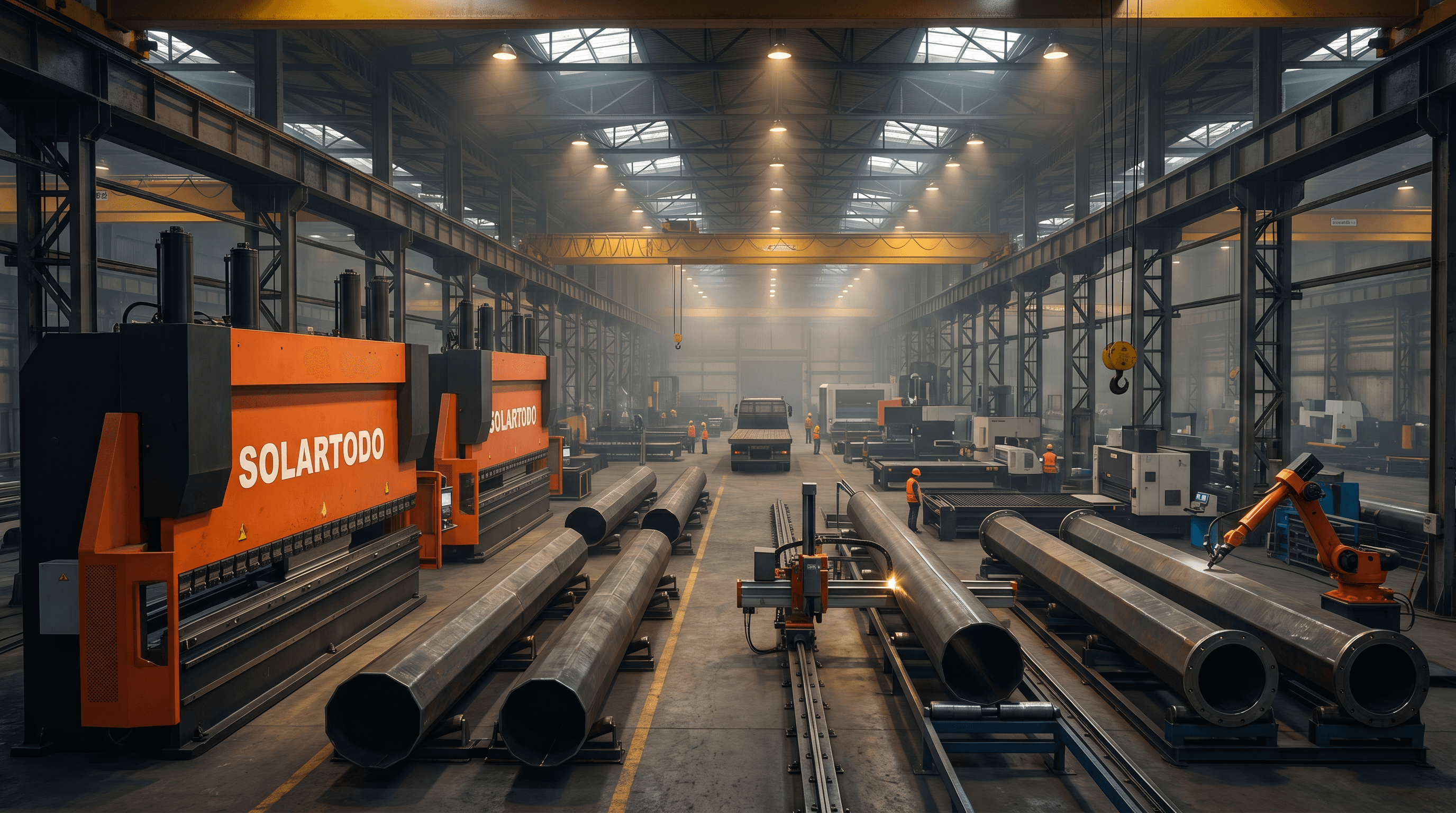
The 52km Belgrade rollout was executed as a staged 208-pole installation program combining concrete base foundations, sectional steel delivery, and sequential erection for 250m-span 220kV double-circuit construction.
The deployment began with route verification, geotechnical confirmation for each concrete base foundation, and logistics planning for moving 35m tubular pole sections through Belgrade’s mixed access conditions. Because the structures were steel tubular poles rather than lattice assemblies, the site teams could streamline material handling and reduce the number of loose components at each foundation location. That mattered in areas near roads, service corridors, and active utility interfaces.
Foundation works were sequenced first to establish the concrete bases and grounding interfaces. Once the foundations achieved the required readiness, the flanged steel sections were delivered and assembled vertically using crane-based erection methods. The tubular design supported efficient bolted section joining while maintaining the mechanical stiffness needed for 220kV double-circuit loads, including conductor tension and wind action.
After the poles were erected, crews installed cross arms, insulator strings, climbing steps, bird guards, and vibration dampers. The conductor phase arrangement was then completed using ACSR 70, with the project maintaining 6m phase spacing, 7m ground clearance, and 2.5m insulator length as specified. According to NREL (2022), standardized component interfaces and repeatable installation methods can materially improve field execution efficiency on utility infrastructure projects, especially where multiple identical structures are deployed at scale.
Commissioning focused on mechanical verification, conductor sag and tension checks, grounding continuity, and final line corridor inspection. According to GB 50545 design practice, foundation and structural compliance are essential to long-term overhead line reliability. IEC states, "The loading and strength requirements of overhead lines shall be established using reliability-based design principles." In practical terms, that meant validating that the Belgrade corridor could maintain performance under the specified 40 m/s wind environment.
Performance & Results
The completed Belgrade line delivered ~52km of 220kV double-circuit capacity using 208 tubular poles, achieving compact corridor use, 40 m/s wind design compliance, and standardized maintenance access features.
From a product-performance perspective, the most important outcome was that the deployed Power Transmission Tower configuration met the project’s structural and electrical design basis without relying on wider-footprint lattice towers. The 35m tapered tubular poles supported the required 220kV double-circuit arrangement while preserving 7m ground clearance and 6m phase spacing across approximately 52km of route. For a city-edge network like Belgrade, that compactness is often a decisive engineering advantage.
The project also improved consistency across the line. With 208 identical structural units, maintenance teams gained a more standardized inventory and inspection profile for galvanization condition, climbing access, cross-arm hardware, grounding points, and vibration control devices. According to IEEE (2021), standardization in transmission assets can simplify condition assessment and maintenance planning over the asset life cycle. That is especially relevant where utilities seek predictable O&M routines rather than multiple tower typologies on one corridor.
In environmental loading terms, the Wind Class 4 / 40 m/s design basis provided confidence for severe weather operation. According to IEC 60826 (2019), wind loading remains one of the primary design drivers for overhead transmission structures. According to IEA (2023), grid resilience increasingly depends on infrastructure that can withstand more variable and intense operating conditions. In Belgrade, where seasonal storms and exposed corridor sections can challenge overhead assets, this design criterion directly supported reliability.
The use of hot-dip galvanized Q345 steel also strengthened long-term durability expectations. According to World Bank (2022) infrastructure guidance, lifecycle performance in public utility assets improves when corrosion protection and maintainability are designed in from the start. For this project, SOLAR TODO’s galvanized tubular pole package reduced the number of exposed lattice junctions and enabled a cleaner inspection surface. That does not eliminate maintenance, but it supports easier visual assessment and consistent asset management.
Comparison Table
For Belgrade’s 220kV corridor, the 35m tubular Power Transmission Tower offered a more compact 208-unit solution than a conventional lattice approach while preserving the same 250m span and 40 m/s wind design basis.
| Metric | Deployed SOLAR TODO Tubular Pole Solution | Conventional Lattice Alternative |
|---|---|---|
| Structure type | Tapered steel tubular pole | Lattice tower |
| Quantity | 208 units | Route dependent |
| Height | 35m | Similar voltage-class dependent |
| Voltage class | 220kV | 220kV possible |
| Circuit arrangement | Double circuit | Double circuit possible |
| Span | 250m | 250m possible |
| Wind design | Class 4, 40 m/s | Project dependent |
| Material | Hot-dip galvanized Q345 steel | Galvanized steel members |
| Pole weight | ~35t per pole | Varies by tower geometry |
| Footprint/visual profile | Compact, cleaner silhouette | Larger visual complexity |
| Site assembly | Flanged steel sections | Many individual members |
| Maintenance access | Integrated climbing steps | Tower-specific access arrangement |
| Accessories | Cross arm, grounding, bird guard, vibration damper | Similar accessories possible |
| Best fit in Belgrade context | Constrained corridors, urban-edge routing | Open corridors with more siting flexibility |
Pricing & Quotation
SOLAR TODO provides three commercial delivery models for Belgrade-scale 220kV tubular pole projects, ranging from equipment-only supply to fully installed EPC execution with commissioning support.
SOLAR TODO offers three pricing tiers for this product line: FOB Supply (equipment ex-works China), CIF Delivered (including ocean freight and insurance), and EPC Turnkey (fully installed, commissioned, with 1-year warranty). Volume discounts are available for large-scale deployments. Configure your system online for an instant estimate, or request a custom quotation from our engineering team at [email protected].
For utility buyers and EPC contractors, quotation scope typically depends on route complexity, foundation responsibilities, accessory package, documentation requirements, and whether installation is included. In this Belgrade case, the major cost drivers would be the 208-unit volume, 220kV double-circuit configuration, 35m pole height, and the logistics associated with a ~52km line. SOLAR TODO generally structures quotations around the exact mechanical and delivery scope rather than using generic per-unit assumptions.
Frequently Asked Questions
This FAQ answers the most common buyer questions about Belgrade’s 208-unit, 35m, 220kV tubular Power Transmission Tower deployment, including specifications, installation, maintenance, warranty, and commercial scope.
Q1: What exactly was deployed in Belgrade, Serbia?
A total of 208 steel tubular Power Transmission Tower units were deployed for a 220kV double-circuit line in Belgrade. Each structure was a 35m tapered steel tubular pole made from hot-dip galvanized Q345 steel. The line used 250m spans and extended approximately 52km, with accessories including cross arms, grounding, bird guards, climbing steps, and vibration dampers.
Q2: Why use tubular poles instead of lattice towers for this project?
Tubular poles were selected because Belgrade’s corridor conditions favored a more compact structural footprint and cleaner visual profile. The deployed design still met 220kV double-circuit requirements, 40 m/s wind class, and 250m span needs. Compared with lattice towers, tubular poles also simplify sectional handling and reduce the number of small loose members during erection.
Q3: What are the key electrical and mechanical specifications?
The project used 35m poles for 220kV double-circuit transmission, with 6m phase spacing, 7m ground clearance, and 2.5m insulator length. Conductors were ACSR 70, rated at 275kg/km with 22kN maximum tension. Each pole weighed approximately 35t, and the structures were designed to IEC 60826 and GB 50545.
Q4: How long does a project like this usually take to deploy?
Actual timelines depend on permitting, foundation curing, transport access, and conductor stringing windows. For a 208-unit, ~52km line, deployment is usually phased: foundations first, then pole erection, then hardware and conductor installation, followed by testing. Buyers should plan schedules around civil readiness and corridor access rather than only manufacturing lead time.
Q5: What foundation system was used?
This project used a concrete base foundation for each tubular pole. That foundation type is well suited to high-voltage monopole applications because it provides stable load transfer for vertical, transverse, and wind-induced forces. Final sizing always depends on local geotechnical conditions, but the Belgrade deployment standardized the overall foundation approach across the route.
Q6: What maintenance does this kind of Power Transmission Tower require?
Maintenance typically includes visual inspection of galvanization, bolts, cross-arm interfaces, grounding continuity, climbing steps, bird guards, and vibration dampers. Utilities also inspect conductor attachment points and verify clearances over time. Because this project used 208 similar poles, maintenance planning is more standardized than on mixed-structure corridors, which can improve inspection efficiency.
Q7: What is the expected ROI or payback for a utility project like this?
ROI is usually evaluated through grid reliability, corridor efficiency, reduced outage risk, and lower lifecycle complexity rather than simple direct revenue per pole. For a 220kV line, value comes from dependable bulk power transfer and easier maintenance standardization. Payback therefore depends on network reinforcement needs, avoided congestion, and utility planning assumptions, not a single universal formula.
Q8: Does SOLAR TODO provide EPC pricing or only product supply?
SOLAR TODO supports multiple commercial models, including FOB Supply, CIF Delivered, and EPC Turnkey. That means buyers can source only the Power Transmission Tower equipment or request broader delivery and installation scope. For projects like Belgrade’s 208-unit deployment, EPC quotations are usually customized around route conditions, civil works, accessory scope, and commissioning requirements.
Q9: What warranty is available for this product line?
For the commercial structure described in this article, the EPC Turnkey option includes a 1-year warranty after installation and commissioning. Warranty scope should always be confirmed in the final contract because it depends on supply model, project responsibilities, and acceptance terms. Buyers should also review galvanization, hardware, and installation quality requirements during procurement.
Q10: Is installation difficult for 35m tubular poles?
Installation is specialized but straightforward for qualified transmission contractors. The poles are delivered in sections, erected on prepared concrete base foundations, and joined using flanged connections. Compared with lattice structures, tubular poles can reduce on-site part handling. However, crane planning, conductor safety procedures, and tensioning controls remain essential for a 220kV double-circuit line.
References
- IEC (2019): IEC 60826, Design criteria of overhead transmission lines, covering mechanical loading, reliability, and environmental actions for overhead line structures.
- IEEE (2021): Guidance and technical literature on transmission line structural design, conductor behavior, and asset maintenance practices for overhead systems.
- International Energy Agency (IEA) (2023): Electricity Grids and Secure Energy Transitions, highlighting the need for major transmission expansion and resilience investment.
- International Renewable Energy Agency (IRENA) (2023): Analysis on grid infrastructure as a prerequisite for reliable and flexible power systems in growing electricity markets.
- World Bank (2022): Infrastructure lifecycle guidance emphasizing resilient design, maintainability, and durability in public utility assets.
- NREL (2022): Utility infrastructure deployment and standardization insights relevant to repeatable field installation and asset management efficiency.
- Ministry of Mining and Energy of the Republic of Serbia (2023): National energy and grid modernization planning context relevant to transmission reinforcement in Serbia.
Equipment Deployed
- 208 × 35m tapered steel tubular Power Transmission Tower poles
- 220kV double-circuit configuration
- Hot-dip galvanized Q345 steel pole bodies
- Approx. 35t per pole structural weight
- Cross arm assemblies for insulator and conductor support
- ACSR 70 conductors, 275kg/km, max tension 22kN
- 2.5m insulator strings
- Concrete base foundations
- Grounding system components
- Integrated climbing steps
- Bird guards
- Vibration dampers