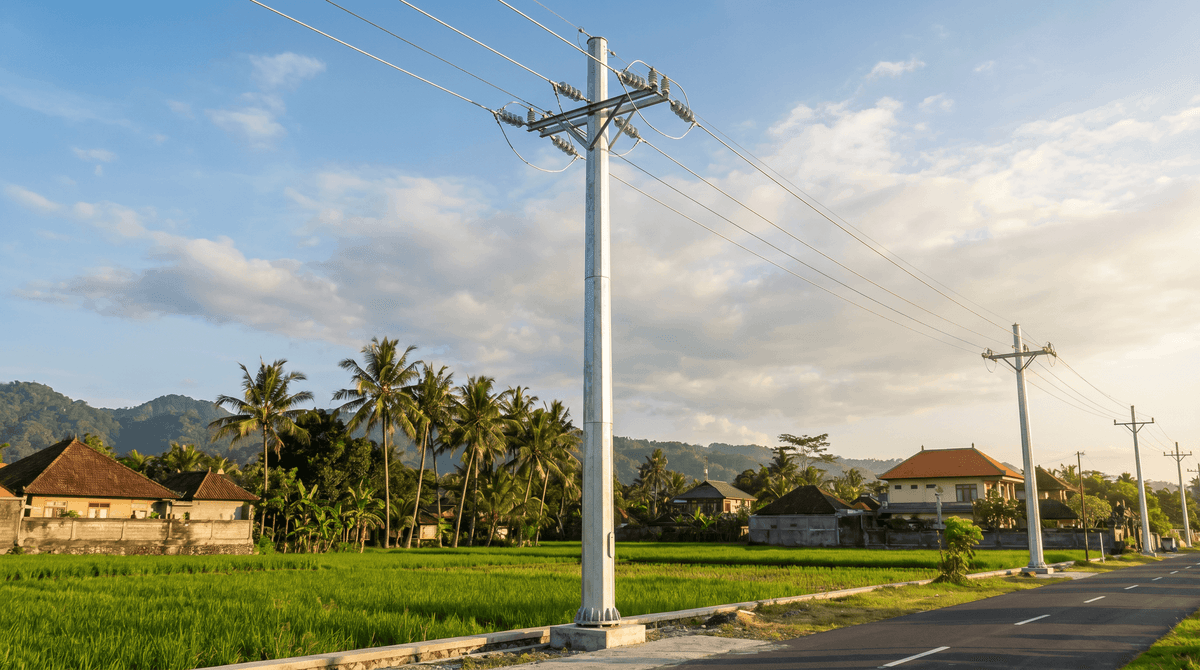
Bali Power Transmission Tower Market Analysis: 10kV Municipal Distribution Configuration Guide
Summary
Bali’s island grid, dense tourism corridors, and coastal wind exposure make 10kV municipal distribution a practical fit for medium-voltage steel poles. A typical 6 km line would use approximately 102 units of 22 m hot-dip galvanized Q345 tubular poles, ACSR 120 conductor, and 30 m/s wind-class design.
Key Takeaways
- Bali had approximately 4.34 million residents in 2023, according to Statistics Indonesia (BPS, 2024), which supports continued municipal distribution reinforcement in urban and peri-urban corridors.
- Indonesia’s electricity consumption reached about 1,337 kWh per capita in 2023, according to the Ministry of Energy and Mineral Resources (MEMR, 2024), increasing pressure on medium-voltage feeder reliability.
- A typical Bali municipal distribution segment of this profile would use approximately 102 steel tubular poles across about 6 km at 60 m spans.
- The specified line configuration is 10kV single circuit with 22 m tapered steel tubular poles, hot-dip galvanized Q345 steel, and ACSR 120 conductor rated at 470 kg/km with 38 kN maximum tension.
- Wind class 2 at 30 m/s is relevant for coastal Bali because IEC 60826 load cases must account for marine exposure, salt spray, and storm gusts.
- The provided 22 m, approximately 9 t/pole configuration is a project-specific municipal recommendation; by standard voltage-class guidance, 10-35 kV distribution commonly falls in the 12-18 m range with 80-150 m spans.
- Ground clearance of 5 m, phase spacing of 0.8 m, and 0.5 m insulator length align with compact medium-voltage municipal routing where right-of-way is constrained.
- SOLAR TODO should be evaluated in Bali as a technical supplier for galvanized monopole-based distribution infrastructure, not as a fabricated deployment story; technical review and quotation can start at /products/power-tower or /contact.
Market Context for Bali
Bali’s power infrastructure demand is shaped by a population of about 4.34 million, heavy tourism concentration, and an island geography that raises reliability requirements for municipal feeders. According to Statistics Indonesia (BPS, 2024), Bali’s population reached roughly 4.34 million in 2023, while the Bali Provincial Government’s development planning documents continue to emphasize urban service quality, transport access, and utility resilience in Denpasar, Badung, Gianyar, and tourism-linked districts.
Electricity demand growth in Bali should be read against Indonesia’s broader consumption trend and the island’s service-sector load profile. According to Indonesia’s Ministry of Energy and Mineral Resources (MEMR, 2024), national electricity consumption reached approximately 1,337 kWh per capita in 2023. In Bali, hotels, retail corridors, water pumping, public facilities, and mixed-use districts create medium-voltage distribution demand that is more spatially concentrated than in purely rural provinces.
Climate and corrosion matter more in Bali than in many inland markets because the island sits in a marine environment with salt-laden air, high humidity, and seasonal wind exposure. According to BMKG, Indonesia’s meteorological agency, coastal and island regions regularly experience strong monsoonal wind patterns and high annual humidity. For a steel monopole line near sea-exposed zones around coordinates -8.41, 115.19, galvanization quality, grounding continuity, and vibration control are not optional details; they are first-order design variables.
Grid architecture also supports the case for medium-voltage municipal distribution poles rather than heavy transmission structures for local feeder extensions. PLN’s transmission and distribution network across Bali includes higher-voltage bulk supply and medium-voltage feeders serving municipal loads, but the project-specific configuration here is clearly a 10kV single-circuit municipal distribution line. According to IEC (2019), overhead line mechanical loading must be selected from actual conductor, wind, and span conditions rather than generic tower assumptions, which is why Bali’s coastal exposure pushes designers toward conservative corrosion and accessory selections.
For procurement teams, the practical takeaway is that Bali’s distribution build-out often requires compact footprints, fast erection, and reduced visual bulk compared with lattice structures. That makes a tapered steel tubular pole relevant where road reserve is limited, foundations must fit urban edges, and municipal authorities want cleaner streetscape integration. SOLAR TODO can therefore be positioned in Bali as a supplier of medium-voltage steel tubular pole systems for feeder reinforcement, municipal expansion, and utility corridor upgrades.
Two authority statements are especially relevant here. IEC states, "This part of IEC 60826 specifies methods for the structural design of overhead transmission lines," which is directly applicable to wind, load, and reliability calculations for a 10kV line. IEA notes that "Grids are the backbone of electricity systems," a useful reminder that even short 6 km municipal segments can materially affect service continuity in dense urban and tourism districts.
Recommended Technical Configuration
For Bali’s sea-exposed municipal feeder environment, a typical 10kV single-circuit line of about 6 km would use approximately 102 steel tubular poles, 22 m in height, with ACSR 120 conductor and 60 m average spans. This recommendation follows the project-specific configuration provided for a medium-voltage municipal distribution application and should be treated as a technical fit analysis, not a record of past deployment.
The first engineering step is voltage selection. This line is defined as 10kV, which places it in the distribution category. Under the standard voltage-height matrix, 10-35 kV distribution commonly uses 12-18 m poles, 1-3 t/pole, 80-150 m spans, and about 8-12 poles/km. However, the project-specific configuration supplied here requires 22 m poles at approximately 9 t/pole with 60 m spans, which indicates a special municipal geometry likely driven by local clearance, route complexity, accessory loading, and conservative structural criteria.
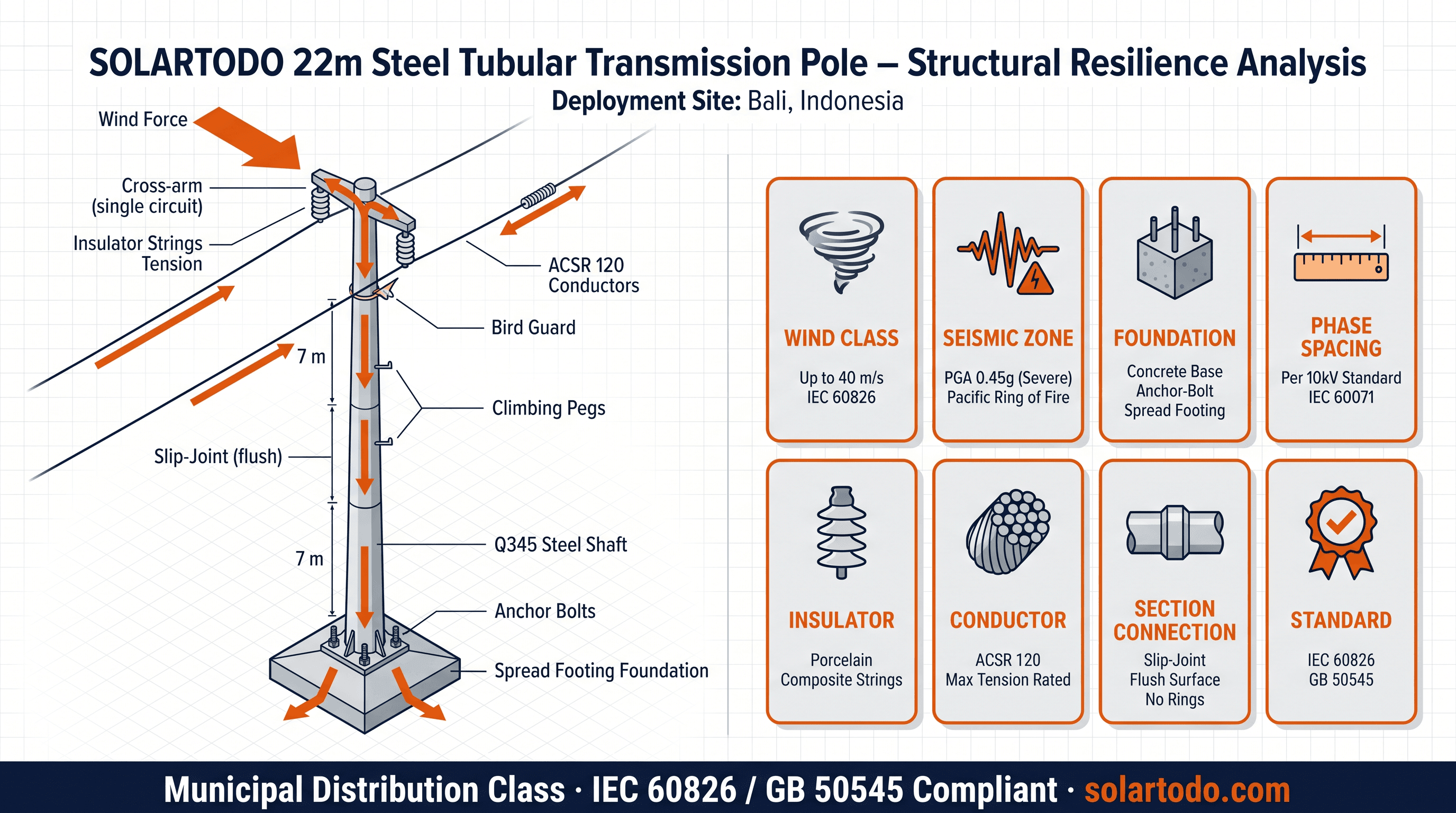
A typical 102-unit deployment of this scale would consist of tapered round steel tubular poles fabricated in flanged bolt sections using hot-dip galvanized Q345 steel. The line would be single circuit, with cross-arm brackets for insulator strings and ACSR conductors, plus climbing steps, grounding, bird guards, and vibration dampers. In Bali’s coastal setting, these accessories matter because salt exposure and wind-induced conductor motion can shorten service life if omitted.
The conductor choice in this guide is ACSR 120, specified at 470 kg/km and 38 kN maximum tension. For a 6 km route, conductor mechanical behavior, sag, and hardware loading should be checked under IEC 60826 load cases using the 30 m/s wind-class assumption. According to IEEE and IEC overhead line practice, conductor selection is not only about ampacity; it also affects pole top load, insulator swing, and long-term maintenance intervals.
Foundation selection is equally important because Bali includes coastal soils, volcanic soils, and localized groundwater variation. The project-specific requirement is a spread footing foundation rather than an anchor-cage concrete pedestal. That is a valid municipal choice where geotechnical conditions permit shallow load distribution and where construction access favors conventional cast-in-place civil work. Before final issue-for-construction drawings, a site-specific soil investigation should verify allowable bearing capacity, corrosion exposure, and drainage detail for each pole location.
For buyers comparing options, the main reason to choose a steel tubular pole over a lattice tower in Bali is corridor efficiency. A monopole footprint is smaller, urban visual impact is lower, and erection is often simpler in constrained streets or tourism-adjacent districts. SOLAR TODO should therefore be evaluated where the utility or EPC requires compact municipal distribution structures rather than wide-base lattice geometry.
Technical Specifications
The recommended Bali configuration is a 10kV single-circuit municipal distribution line using 102 poles over about 6 km, with 22 m galvanized Q345 steel tubular poles, 60 m spans, and ACSR 120 conductor. The list below reflects the exact project-specific configuration and applicable standards for technical review.
- Product type: Power Transmission Tower in steel tubular monopole form for medium-voltage municipal distribution
- Pole quantity: approximately 102 units
- Voltage class: 10kV
- Circuit arrangement: single circuit
- Pole height: 22 m tapered steel tubular pole
- Pole material: Q345 steel
- Surface protection: hot-dip galvanized
- Pole weight: approximately 9 t/pole
- Linear steel reference: approximately 400 kg/m
- Conductor type: ACSR 120
- Conductor mass: 470 kg/km
- Maximum conductor tension: 38 kN
- Phase spacing: 0.8 m
- Ground clearance: 5 m
- Insulator length: 0.5 m
- Average span: 60 m
- Total line length: approximately 6 km
- Wind class: Class 2, 30 m/s
- Foundation type: spread footing foundation
- Accessories: climbing steps, cross arm, grounding set, bird guard, vibration damper
- Design life: 30 years
- Pole class: medium-voltage municipal distribution
- Design standards: IEC 60826 / GB 50545
For engineering review, buyers should note one important distinction. The generic voltage-class table for 10-35 kV distribution commonly indicates 12-18 m height, 1-3 t/pole, 80-150 m spans, and 8-12 poles/km. This Bali guide uses the exact project-specific 22 m and approximately 9 t/pole requirement supplied in the brief, which should be treated as a special municipal configuration requiring route-specific structural verification.
Implementation Approach
A 6 km Bali municipal feeder of roughly 102 poles would typically be delivered in 5 phases: survey, detailed design, fabrication, civil works, and erection plus commissioning. This is the correct implementation lens for buyers because medium-voltage steel pole projects succeed or fail on sequencing, not only on steel tonnage.
Phase 1 is route survey and utility coordination. At 60 m spans, a 6 km line requires dense location control, road-crossing checks, and clearance verification at each of the approximately 102 pole positions. In Bali, this phase should also include corrosion zoning, drainage review, and right-of-way checks around tourism roads, mixed-use streets, and municipal service corridors.
Phase 2 is structural and electrical design. Pole loading should be modeled to IEC 60826 using the specified 30 m/s wind class, ACSR 120 conductor mass of 470 kg/km, and 38 kN maximum tension. Grounding design should also be adapted to local soil resistivity because coastal and volcanic soils can produce very different earthing performance. According to IEC practice, line reliability depends on both mechanical adequacy and insulation coordination.
Phase 3 is fabrication and logistics. Flanged bolt-section steel poles are well suited to containerized or break-bulk shipment because sections can be nested and assembled on site. For Bali, logistics planning should include port handling, inland transport limits, and galvanization inspection before dispatch. SOLAR TODO would typically provide fabrication documents, galvanization records, and packing lists for EPC or utility review before shipment release.
Phase 4 is foundation and civil work. Spread footing foundations should be excavated, reinforced, cast, and cured according to approved geotechnical assumptions and local civil codes. In municipal corridors, this phase often drives the critical path because traffic management, underground utility conflicts, and wet-season scheduling can add 2-6 weeks to the program.
Phase 5 is pole erection, stringing, testing, and energization. Erection proceeds section by section, followed by cross-arm installation, insulators, conductor stringing, damping hardware, grounding checks, and final sag-tension verification. A line of this scale can often be erected in staged blocks rather than one continuous outage window, which helps utilities maintain service continuity.
Expected Performance & ROI
A 10kV Bali municipal line of about 6 km and 102 poles is mainly justified by reliability, maintainability, and corridor efficiency rather than by direct energy generation metrics. The practical return comes from lower outage exposure, reduced corrosion-related replacement frequency, and simpler urban right-of-way management over a 30-year design life.
Hot-dip galvanized steel is a key cost-of-ownership factor in sea-adjacent environments. According to the World Bank and IEA grid modernization guidance, distribution investments often deliver value through reduced technical losses, lower interruption frequency, and deferred emergency maintenance. In Bali, where service interruptions can affect tourism facilities, public lighting feeders, pumps, and municipal services, even a short feeder reinforcement can have outsized economic value.
A realistic procurement model should compare tubular poles with lattice alternatives across installation footprint, civil complexity, and maintenance burden. Tubular poles usually require fewer small members, fewer field bolts at elevation, and less visual clutter. That can reduce inspection time and improve access for maintenance crews, especially on road-edge municipal lines with 60 m spans and compact 0.8 m phase spacing.
Payback is project-specific, but utilities and EPC buyers often evaluate medium-voltage line investments over 10-15 years for maintenance and outage savings, while the structural design life extends to 30 years. According to IRENA (2023), grid investment quality increasingly depends on resilience and lifecycle cost rather than capex alone. In Bali’s marine climate, lifecycle economics generally favor galvanization quality, proper damping, and corrosion-conscious grounding over a lower upfront steel specification.
Expected operating performance for this configuration includes stable mechanical behavior under 30 m/s wind-class design assumptions, municipal clearance compliance at 5 m ground clearance, and manageable conductor tension with ACSR 120 at 38 kN maximum. For buyers seeking a compact medium-voltage line rather than a large transmission structure, this profile is technically coherent when paired with route-specific design checks and soil verification.
Results and Impact
For Bali, the expected impact of a 10kV steel tubular pole program is improved feeder resilience across approximately 6 km of municipal corridor with 102 pole positions and 30-year design intent. The strongest operational benefit is usually better maintainability in constrained urban or tourism-adjacent rights-of-way where compact monopole geometry simplifies access and reduces corridor occupation.
The line profile in this guide also supports cleaner municipal integration than wider-base structures. With 22 m poles, 0.8 m phase spacing, 5 m ground clearance, and single-circuit routing, utilities can maintain medium-voltage service while limiting roadside obstruction. For EPC teams, that means fewer interface conflicts with sidewalks, drainage, and adjacent service infrastructure.
From a policy and infrastructure perspective, this type of distribution reinforcement fits Bali’s broader need for dependable public-service electricity under coastal environmental stress. SOLAR TODO should therefore be considered where buyers need a technically documented steel tubular distribution solution supported by IEC 60826 and GB 50545 compliance, not a generic commodity pole.
Comparison Table
The table below compares the project-specific Bali configuration with the generic 10-35 kV distribution guidance and a higher-voltage sub-transmission class for procurement context.
| Parameter | Bali project-specific recommendation | Generic 10-35 kV distribution guidance | 66-110 kV sub-transmission guidance |
|---|---|---|---|
| Voltage class | 10kV | 10-35 kV | 66-110 kV |
| Pole form | Tapered steel tubular pole | Steel tubular pole | Steel tubular pole |
| Circuit | Single circuit | Single or double | Single or double |
| Height | 22 m | 12-18 m | 18-30 m |
| Weight per pole | ~9 t | 1-3 t | 5-15 t |
| Span | 60 m | 80-150 m | 200-300 m |
| Poles per km | ~17 | 8-12 | 4-5 |
| Conductor | ACSR 120 | ACSR family as required | ACSR family as required |
| Wind basis | 30 m/s | Site-specific | Site-specific |
| Foundation | Spread footing | Concrete foundation | Concrete foundation |
| Typical use | Municipal constrained corridor | Standard distribution route | Sub-transmission corridor |
Pricing & Quotation
SOLAR TODO offers three pricing tiers for this product line: FOB Supply (equipment ex-works China), CIF Delivered (including ocean freight and insurance), and EPC Turnkey (fully installed, commissioned, with 1-year warranty). Volume discounts are available for large-scale deployments. Configure your system online for an instant estimate, or request a custom quotation from our engineering team at [email protected].
Frequently Asked Questions
This FAQ answers 10 common Bali procurement questions covering 10kV specs, installation sequence, maintenance, warranty scope, and quotation method for steel tubular municipal distribution poles.
Q1: Is a 10kV steel tubular pole suitable for Bali’s coastal environment?
Yes, if the pole uses hot-dip galvanized Q345 steel, proper grounding, and accessories such as bird guards and vibration dampers. Bali’s marine air raises corrosion risk, so coating quality, drainage detail, and inspection intervals matter as much as the 22 m structural geometry.
Q2: Why use a tubular pole instead of a lattice tower for this Bali application?
A tubular pole takes less roadside space, which helps in municipal corridors and tourism-linked streets. For a 6 km route with approximately 102 positions, the smaller footprint can simplify civil interfaces, reduce visual clutter, and speed erection compared with a wider-base lattice structure.
Q3: What are the core specifications of the recommended Bali configuration?
The supplied configuration is 102 units of 22 m tapered steel tubular poles for a 10kV single-circuit line, using hot-dip galvanized Q345 steel, ACSR 120 conductor, 60 m spans, 5 m ground clearance, 0.8 m phase spacing, and spread footing foundations.
Q4: How long would a typical 6 km municipal line take to implement?
A typical program may take about 4-8 months depending on permitting, wet-season conditions, port logistics, and civil access. Survey and design can take 4-8 weeks, fabrication 6-10 weeks, and foundations plus erection another 6-12 weeks for roughly 102 pole positions.
Q5: What standards should buyers request in the technical file?
At minimum, buyers should request compliance with IEC 60826 and GB 50545, plus galvanization records, steel mill certificates, conductor data, and foundation calculations. For Bali, wind loading at 30 m/s and corrosion protection documents should be checked before shipment approval.
Q6: What maintenance is typical over a 30-year design life?
Routine maintenance usually includes annual visual inspection, grounding continuity checks, bolt-torque verification, and periodic coating assessment in sea-exposed zones. After major storms, utilities should also inspect conductor damping hardware, insulator condition, and any signs of corrosion at base plates or fittings.
Q7: What kind of ROI or payback should utilities expect?
Payback is usually assessed through avoided outages, lower emergency repair frequency, and reduced maintenance burden rather than direct revenue. Many utilities model benefits over 10-15 years, while the structure itself is specified for a 30-year design life under the provided Bali configuration.
Q8: Does SOLAR TODO provide EPC or supply-only quotations?
Yes. SOLAR TODO offers FOB Supply, CIF Delivered, and EPC Turnkey quotation paths for the power-tower line. Buyers can start with a technical inquiry through /contact or review the product category at /products/power-tower before issuing a formal RFQ.
Q9: What warranty terms are typical for this product line?
The pricing section specifies a 1-year warranty for EPC Turnkey scope. Supply-only contracts usually separate product warranty, marine transport risk, and installation responsibility, so Bali buyers should align warranty terms with Incoterms, erection scope, and final acceptance testing requirements.
Q10: Can this configuration be adjusted for different spans or conductor sizes?
Yes, but any change in span, conductor, or wind basis affects pole loading and foundation design. For example, moving away from the specified 60 m span or ACSR 120 conductor would require recalculation under IEC 60826 before procurement drawings are frozen.
References
- Statistics Indonesia / BPS (2024): Bali Province population statistics showing approximately 4.34 million residents in 2023.
- Ministry of Energy and Mineral Resources, Republic of Indonesia (2024): National electricity sector statistics indicating about 1,337 kWh per capita electricity consumption in 2023.
- BMKG (2024): Indonesia meteorological and climatological data used for wind and coastal climate assessment in island environments.
- IEC (2019): IEC 60826, Design criteria of overhead transmission lines.
- GB Standard (2010): GB 50545, Code for design of 110kV-750kV overhead transmission line. Used here as referenced project standard alongside IEC criteria.
- International Energy Agency (IEA) (2023): Grid investment and reliability analysis, including the statement that grids are the backbone of electricity systems.
- International Renewable Energy Agency (IRENA) (2023): Power system and grid resilience guidance emphasizing lifecycle cost and resilience in network investment.
- World Bank (2023): Power sector resilience and distribution modernization guidance relevant to outage reduction and utility asset planning.
Equipment Deployed
- 102 × 22 m tapered steel tubular pole, hot-dip galvanized Q345 steel
- 10kV single-circuit medium-voltage municipal distribution configuration
- Pole weight approximately 9 t/pole, linear steel reference about 400 kg/m
- ACSR 120 conductor, 470 kg/km, maximum tension 38 kN
- Phase spacing 0.8 m
- Ground clearance 5 m
- Insulator length 0.5 m
- Average span 60 m, total line length about 6 km
- Wind class 2 design, 30 m/s
- Spread footing foundation
- Cross arm assembly
- Climbing steps
- Grounding set
- Bird guard
- Vibration damper
- Design life 30 years
- Applicable standards: IEC 60826 / GB 50545