Baku Smart Agriculture Monitoring Market Analysis: 159-Hectare 4G LTE Configuration Guide
Summary
Baku’s semi-arid climate, annual rainfall near 200 mm, and strong digital infrastructure make a 159-hectare Smart Agriculture Monitoring layout technically viable with 2 weather stations, 16 soil nodes, 16 AI pest traps, and 2 disease monitors on 4G LTE.
Key Takeaways
- A typical 159-hectare deployment in the Baku market profile would use 2× 4-sensor weather stations, matching the medium-farm class rather than a small <30 ha layout.
- The specified soil layer would consist of approximately 16 moisture + temperature probes at 15-30 cm depth, giving practical zoning density for irrigation decisions across 159 hectares.
- Pest coverage at this scale fits 16× pheromone + AI photo-counting smart traps, aligned to 2 hectares per unit in higher-risk production blocks.
- Disease surveillance would typically require 2× spore capture + AI microscopy units, enough to add early-warning capability without over-specifying hardware.
- For Baku’s strong mobile network environment, 4G LTE nodes at 10-100 Mbps are a practical choice where image and video transmission matter more than ultra-low-power LoRaWAN.
- Off-grid operation is feasible with 80 W solar panels + 400 Wh batteries per node set, supporting 25 W loads and reducing dependence on field-side AC power.
- The professional platform tier adds AI prediction, 3-year data history, and API access, which is important for agribusiness reporting and integration into farm management systems.
- Based on the provided performance assumptions, expected gains are +3% from weather data, +8% from soil monitoring, +5% from pest control, and +7% from disease alerts, subject to crop type and response discipline.
Market Context for Baku
Baku combines a dry coastal climate, dense telecom coverage, and growing pressure on water-efficient farming, which makes a 159-hectare digital monitoring architecture more relevant than manual scouting alone.
Baku sits on the Absheron Peninsula at approximately 40.41°N, 49.87°E, where low precipitation and wind exposure shape field operations. According to the World Bank Climate Change Knowledge Portal (2021), Azerbaijan’s eastern lowland and coastal zones have relatively low annual rainfall, and Baku commonly records around 200 mm per year. That matters because irrigation timing errors in low-rainfall areas can quickly reduce yield quality across 100+ hectare production blocks.
The broader agricultural context also supports sensor-led management. According to the Food and Agriculture Organization, agriculture in Azerbaijan remains sensitive to water availability, salinity, and pest pressure in irrigated systems. In parallel, the World Bank (2023) notes that digitalization and climate adaptation are increasingly important in the country’s non-oil sectors, including agribusiness. For a farm operator near Baku, that means better value from data layers that reduce unnecessary irrigation cycles, target scouting, and improve treatment timing.
Telecom conditions are favorable for image-based monitoring. According to the International Telecommunication Union (2023), mobile broadband coverage in Azerbaijan is extensive, and urban-adjacent regions benefit from stronger network availability than remote upland areas. That supports 4G LTE at 10-100 Mbps for AI pest image uploads and disease-monitoring data, which is more suitable than LoRaWAN when multiple camera or microscopy endpoints are included.
Baku’s climate adds another technical factor: wind. According to Azerbaijan’s national meteorological reporting and WMO-aligned climate summaries, the Absheron area is known for frequent strong winds. In practice, this means weather station mast design, solar bracket fastening, and enclosure sealing should be selected for exposed conditions rather than sheltered inland assumptions. SOLAR TODO should therefore position Smart Agriculture Monitoring in Baku as a wind-aware, low-rainfall, irrigation-led monitoring system rather than a generic farm IoT package.
The city itself is not Azerbaijan’s main farming center, but its peri-urban and adjacent agricultural zones create demand for demonstration-scale and commercial blocks in the 100-500 hectare range. That directly aligns with the product size-class logic for a medium farm deployment. A 159-hectare system is therefore technically consistent with the medium class, not a small farm package and not a 1,000+ hectare estate architecture.
[ITU] states, "Meaningful connectivity depends not only on coverage, but also on the quality of service available to end users." For Baku-area agriculture, that quote supports choosing communications based on payload type, especially AI image traffic. [WMO] states, "Observations must be made and reported according to standardized procedures." That is directly relevant to weather-station siting, calibration, and data comparability under WMO practice.
Recommended Technical Configuration
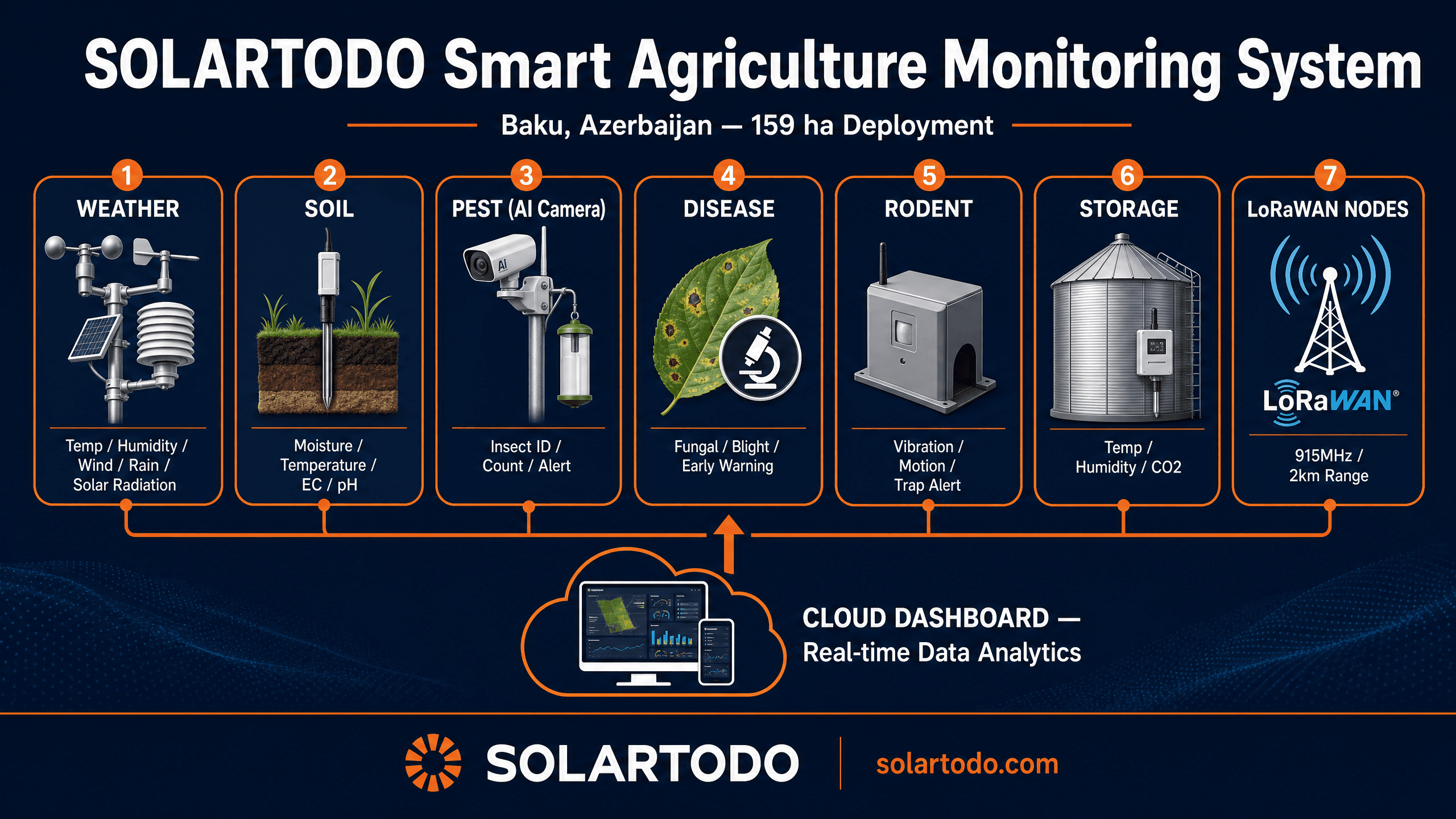
For a 159-hectare Baku-area farm, the correct fit is a medium-class Smart Agriculture Monitoring system with 2 weather stations, 16 soil probes, 16 AI pest traps, 2 disease units, and 4G LTE communications.
A typical deployment of this scale would be specified around the exact project configuration provided, because 159 hectares sits squarely within the 100-500 hectare medium-farm range from the product matrix. That range calls for 2-3 weather stations, 15-25 soil sensors, 2-3 pest devices, and 1-2 disease units as a baseline. The supplied configuration stays within that engineering envelope while increasing pest-node density to suit 2-hectare coverage per smart trap.
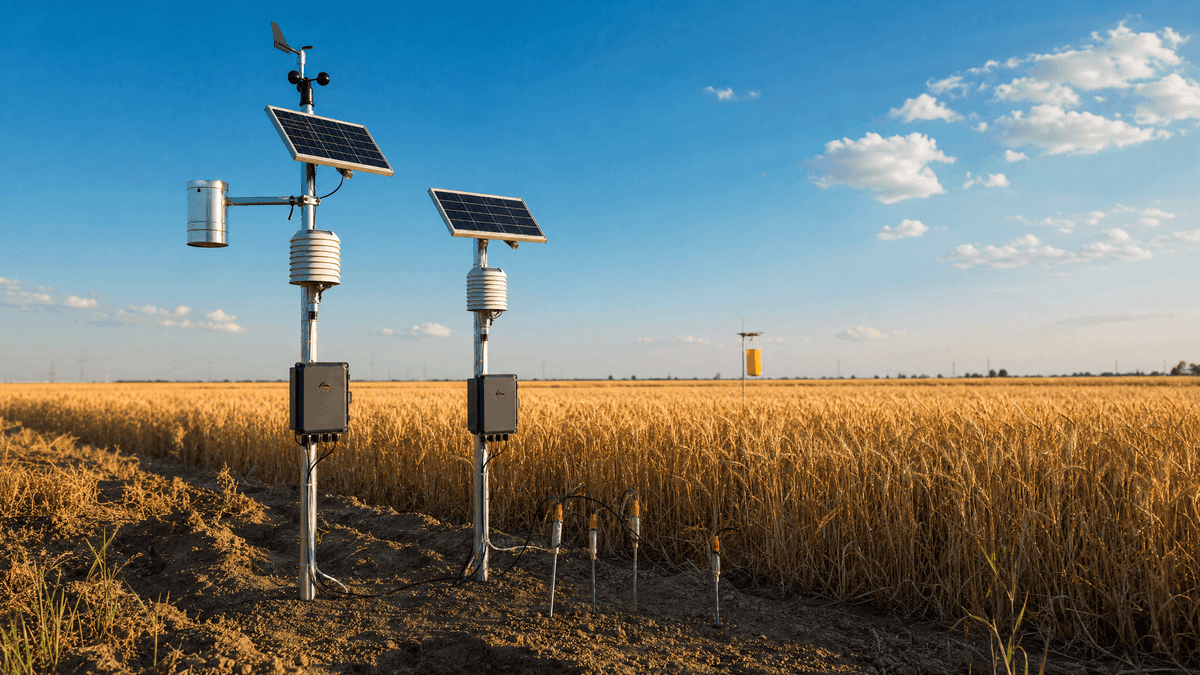
The recommended weather layer is 2× basic 4-sensor stations measuring temperature, humidity, rainfall, and wind speed, with ±0.5°C temperature accuracy and ±3%RH humidity accuracy. For Baku, this choice is practical because wind and rainfall timing are often more operationally important than a full 10-sensor agrometeorological suite on a 159-hectare site. Two stations also provide better micro-zone representation than a single mast when fields are spread across irrigation sections or varied topography.
The soil layer is approximately 16 moisture + temperature probes installed at 15-30 cm depth. This density is consistent with irrigation management for medium-scale horticulture, orchards, or open-field crops where root-zone response matters more than laboratory-style over-instrumentation. It also avoids the unrealistic over-spec pattern of assigning 50-100 probes to a sub-200-hectare site, which typically weakens ROI.
For pest monitoring, the correct device type is 16× smart pheromone traps with AI photo counting, not insect-killing lamps. At 2 hectares per unit, that layout gives focused surveillance in higher-risk production zones, border rows, or crop blocks with known pest pressure. In Baku’s warm season, this configuration supports faster threshold-based action than manual counting rounds conducted every 3-7 days.
The disease layer uses 2× volumetric spore capture units with AI microscopy identification. This is a sensible level for 159 hectares, especially where fungal pressure can escalate after irrigation, dew formation, or short humidity spikes. The value is not in replacing agronomy decisions, but in shortening the interval between spore presence and treatment planning.
The rodent layer adds 4× smart traps with activity sensors. Although rodent monitoring is not part of the standard size-class table, it is technically appropriate for perimeter zones, storage-adjacent plots, and irrigation infrastructure corridors. On a 159-hectare site, four units are typically enough for targeted surveillance rather than blanket field saturation.
Communications should use 4G LTE rather than LoRaWAN or NB-IoT for this exact specification. The reason is payload size: AI pest photos, disease microscopy images, and professional-platform synchronization benefit from 10-100 Mbps bandwidth. In Baku’s telecom environment, 4G also reduces the need for building a private gateway backbone for a medium site.
Power should use the medium solar kit: 80 W panel + 400 Wh battery, supporting 25 W load per node package. Because the system is fully solar-powered and off-grid capable, installation is less constrained by field-side transformers or buried power lines. For peri-urban agriculture around Baku, that simplifies deployment in leased or fragmented plots.
The platform tier should be professional, with AI prediction, 3-year history, and API access. This matters when the buyer is not a single grower but an agribusiness, exporter, cooperative, or managed-farm operator that needs historical analytics and system integration. SOLAR TODO can position this as the right tier when agronomic decisions depend on trend analysis rather than single-point alerts.
Technical Specifications
The specified 159-hectare configuration uses medium-class node density with 2 weather stations, 16 soil sensors, 16 AI pest traps, 2 disease monitors, 4 rodent traps, 4G LTE, and off-grid 80 W/400 Wh solar power.
- Coverage scale: 159 hectares, classified as a medium farm under the product size table for 100-500 hectares.
- Weather monitoring: 2× basic 4-sensor weather stations measuring temperature, humidity, rainfall, and wind speed.
- Weather accuracy: ±0.5°C temperature, ±3%RH humidity.
- Soil monitoring: 16× moisture + temperature sensors.
- Soil installation depth: 15-30 cm root-zone band.
- Pest monitoring: 16× pheromone + AI photo-counting smart traps.
- Pest coverage rule: 2 hectares per unit, suited to block-based surveillance rather than broad uncontrolled spacing.
- Disease monitoring: 2× spore capture + AI microscopy identification units.
- Rodent monitoring: 4× smart traps with activity sensors.
- Communications: 4G LTE, video-capable, 10-100 Mbps.
- Power system: 80 W solar panel + 400 Wh battery per medium node package.
- Supported load: up to 25 W.
- Platform tier: Professional, including AI prediction, 3-year history, and API access.
- Power mode: All solar-powered, off-grid capable.
- Expected performance assumptions: weather +3%, soil +8%, pest +5%, disease +7% yield improvement contribution.
- Standards alignment: WMO for meteorological observation practice and ISO 11461 for soil quality terminology and measurement consistency.
- Recommended procurement path: supply of field devices, mounting hardware, solar kits, LTE configuration, cloud onboarding, and operator training.
- Product page: Smart Agriculture Monitoring
- Commercial inquiry: contact us
According to ISO (1995), ISO 11461 standardizes soil quality vocabulary, which helps keep moisture and temperature reporting consistent across agronomy teams and vendors. According to WMO (2023), station exposure, sensor maintenance, and observation practice directly affect data reliability, so mast placement and service intervals are not secondary issues.
Implementation Approach
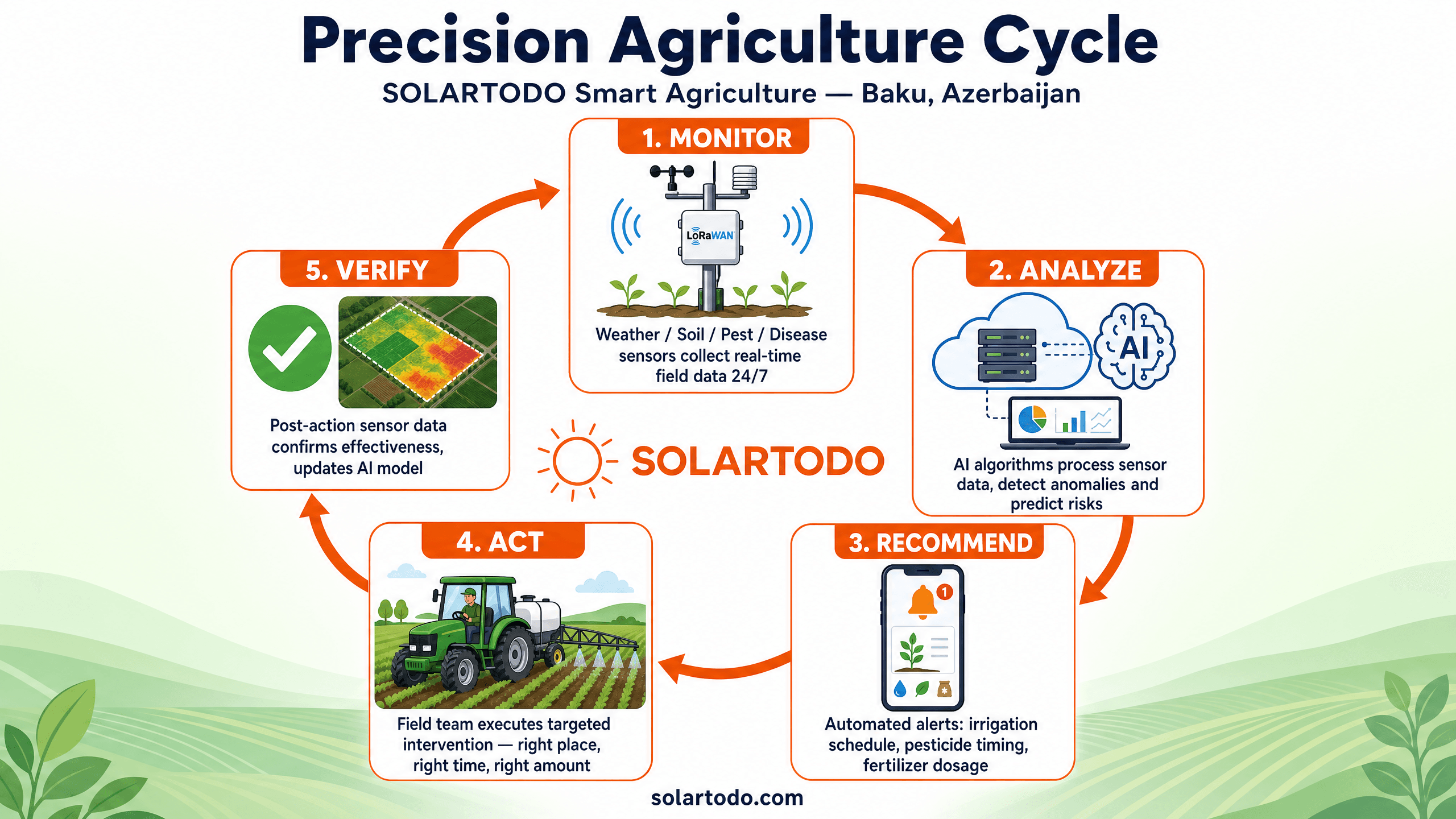
A typical Baku-area implementation would take about 4-8 weeks from site survey to cloud commissioning, depending on field access, crop cycle timing, and LTE signal verification.
The first phase is site assessment and zoning. For a 159-hectare site, this usually means dividing the farm into 8-16 management zones based on crop type, irrigation blocks, elevation, and disease history. Weather stations should be sited away from obstructions, while soil probes should be placed in representative root zones rather than field edges or vehicle tracks.
The second phase is communications and power validation. With 4G LTE nodes, the installer should test signal strength at all planned weather, pest, and disease points before pole placement. The 80 W / 400 Wh solar kit should be checked against local winter irradiance, expected daily load, and enclosure orientation, especially in windy conditions common on the Absheron Peninsula.
The third phase is mechanical installation. Weather stations are mounted on stable masts with clear rain and wind exposure, while soil sensors are inserted at 15-30 cm depth after confirming representative soil structure. Pest traps should be positioned by crop rows and perimeter risk zones, and spore monitors should be placed where airflow and disease spread patterns make detection meaningful.
The fourth phase is platform onboarding and calibration. Each of the 2 weather stations, 16 soil nodes, 16 pest traps, 2 disease units, and 4 rodent traps should be mapped to named field blocks in the professional cloud platform. Alert thresholds can then be configured for irrigation deficit, pest counts, spore events, battery level, and communication loss.
The final phase is agronomy workflow setup. Data has little value if field staff do not act on it within 24-48 hours. SOLAR TODO should therefore recommend standard operating procedures for irrigation review, scouting response, spray timing, and weekly exception reporting through the API or dashboard.
Expected Performance & ROI
For a 159-hectare Baku farm, the strongest business case usually comes from water-use discipline, earlier pest response, and disease timing, with payback often driven by one or two avoided loss events in a single season.
Using the supplied assumptions, the expected yield-improvement contribution is +3% from weather, +8% from soil, +5% from pest, and +7% from disease monitoring. These figures should not be added as a simple 23% total because agronomic effects overlap. A more realistic interpretation is that integrated monitoring can improve decision quality across irrigation, scouting, and treatment timing, with realized gains depending on crop value, baseline management quality, and response speed.
According to FAO (2022), digital agriculture tools can improve input efficiency when matched to local agronomic practice rather than deployed as isolated hardware. According to the World Bank (2023), climate-smart agriculture in water-stressed regions depends on better information for irrigation and risk management. In Baku’s low-rainfall context, soil moisture visibility at 15-30 cm can reduce overwatering and support more stable root-zone conditions.
Maintenance economics are also relevant. A 4G LTE architecture removes the need for a private gateway layer, but it does introduce SIM management and carrier dependency. In return, it supports image-heavy devices such as AI pest and disease units, which can produce better operational value than low-bandwidth counters when the buyer needs remote verification.
From an ROI perspective, medium-scale farms often evaluate three cost drivers: labor reduction, input optimization, and avoided crop loss. If manual scouting currently covers 159 hectares only once every 5-7 days, AI pest counting and spore alerts can shorten response time to same day or next day. That timing difference is often more valuable than the hardware count itself.
Results and Impact
For Baku-area agriculture, a 159-hectare Smart Agriculture Monitoring system is most likely to improve irrigation timing, shorten scouting cycles, and create auditable field data over a 3-year platform horizon.
The practical impact starts with better visibility. Two weather stations and 16 soil probes provide enough density to identify whether stress is weather-driven, irrigation-driven, or localized to a specific block. That helps managers avoid treating the whole farm as one uniform zone when actual field conditions differ across 159 hectares.
The second impact is faster intervention. With 16 AI pest traps and 2 spore-monitoring units, the farm can move from periodic manual inspection to threshold-based action. For high-value crops, avoiding even one mistimed spray or one delayed disease response can materially affect pack-out quality and seasonal margin.
The third impact is reporting discipline. The professional platform stores 3 years of history and supports API access, which is useful for agronomy audits, contract farming oversight, and exporter documentation. For buyers comparing vendors, this is where SOLAR TODO should emphasize measurable data continuity rather than generic smart-farm claims.
Comparison Table
For a 159-hectare Baku deployment, 4G LTE with AI traps and disease monitoring provides higher decision value than a minimal sensor-only layout, especially where image transmission matters.
| Configuration Item | Recommended for Baku 159 ha | Minimal Medium Layout | Operational Effect |
|---|---|---|---|
| Weather stations | 2× basic 4-sensor | 1× basic 4-sensor | Better micro-zone visibility across irrigation blocks |
| Soil sensors | 16× moisture + temp | 8-10× moisture only | Stronger irrigation zoning at 15-30 cm depth |
| Pest monitoring | 16× pheromone + AI photo traps | 3-6 manual traps | Faster threshold detection and remote verification |
| Disease monitoring | 2× spore + AI microscopy | 0-1 basic spore unit | Earlier disease-risk identification |
| Rodent monitoring | 4× smart traps | 0 | Added perimeter and storage-area visibility |
| Communications | 4G LTE, 10-100 Mbps | LoRaWAN or NB-IoT | Better for photo and microscopy payloads |
| Power | 80 W + 400 Wh | 30 W + 150 Wh | More reserve for image-capable nodes |
| Platform | Professional, 3-year + API | Basic dashboard, 30 days | Better analytics and enterprise reporting |
| Standards basis | WMO / ISO 11461 | Partial | More consistent data interpretation |
Pricing & Quotation
SOLAR TODO offers three pricing tiers for this product line: FOB Supply (equipment ex-works China), CIF Delivered (including ocean freight and insurance), and EPC Turnkey (fully installed, commissioned, with 1-year warranty). Volume discounts are available for large-scale deployments. Configure your system online for an instant estimate, or request a custom quotation from our engineering team at [email protected].
Frequently Asked Questions
This FAQ answers the main procurement and engineering questions for a 159-hectare Smart Agriculture Monitoring system in Baku, including specs, timeline, maintenance, warranty, and quotation scope.
Q1: Why is 4G LTE recommended instead of LoRaWAN for this Baku configuration?
Because this layout includes 16 AI pest traps and 2 spore + AI microscopy units, the data payload is heavier than a simple sensor network. 4G LTE at 10-100 Mbps supports image upload, remote verification, and faster cloud synchronization. In Baku’s strong mobile environment, that often reduces system complexity compared with building a private gateway network.
Q2: Is 159 hectares really a medium-size deployment for this product line?
Yes. The product matrix defines 100-500 hectares as the medium class. A 159-hectare site therefore fits the range that typically uses 2-3 weather stations, 15-25 soil sensors, and 1-2 disease units. The provided specification stays within that logic while adding denser pest coverage based on 2 hectares per trap.
Q3: What would a normal deployment timeline look like?
A typical schedule is 4-8 weeks after final site survey. That includes zoning, LTE testing, mounting, solar power setup, sensor installation at 15-30 cm, cloud onboarding, and alert-rule setup. Timing depends on crop access, weather, and whether civil works or custom mounting structures are required.
Q4: How much maintenance does the system need each year?
Most sites should plan for quarterly inspection and annual calibration review. Tasks include cleaning rain funnels, checking mast alignment, verifying battery health, inspecting solar brackets, replacing pheromone lures, and validating sensor readings against field reference checks. Wind exposure around Baku makes mechanical inspection especially important.
Q5: What kind of ROI should buyers expect?
ROI depends on crop value, irrigation cost, labor intensity, and current scouting quality. The supplied performance assumptions are +3% weather, +8% soil, +5% pest, and +7% disease contribution, but actual gains overlap and should not be summed directly. Many buyers justify the system through reduced water waste and one avoided pest or disease loss event.
Q6: Does the system work without grid power?
Yes. This specification is fully solar-powered and off-grid capable, using 80 W panels and 400 Wh batteries that support 25 W loads. That suits remote blocks, leased plots, and fields without nearby AC supply. Off-grid design also simplifies installation where trenching or utility permits would delay the project.
Q7: How does this compare with manual scouting only?
Manual scouting across 159 hectares often happens every 3-7 days, depending on labor availability. AI pest traps and spore monitoring can push alerts to the same day, which improves treatment timing. The system does not replace agronomists, but it gives them earlier signals and better block-level evidence.
Q8: What is included in an EPC quotation versus supply-only?
A supply-only quotation usually covers hardware, mounting accessories, solar kits, and platform licensing. An EPC Turnkey scope would typically add installation, commissioning, LTE setup, field mapping, operator training, and handover testing. Buyers should confirm whether SIM cards, civil works, and seasonal consumables are included.
Q9: What warranty structure is typical for this product line?
The pricing section specifies 1-year warranty for the EPC Turnkey option. For procurement review, buyers should also ask about warranty scope by component, such as sensors, cameras, batteries, and solar charge hardware. Clear fault-response terms are important when the system includes 4G-connected image devices.
Q10: Are the pest devices insect-killing lamps?
No. The specified pest units are pheromone + AI photo-counting smart traps. They are designed for monitoring and threshold detection, not for insect killing. That distinction matters because monitoring traps provide cleaner population data and are better suited to integrated pest management workflows.
References
- World Bank (2023): Azerbaijan country analysis and climate-smart development priorities affecting agriculture, water use, and digital modernization.
- World Bank Climate Change Knowledge Portal (2021): Azerbaijan climate profiles showing low rainfall conditions in eastern/coastal zones, relevant to Baku-area irrigation management.
- International Telecommunication Union (2023): ICT and mobile broadband development indicators for Azerbaijan, supporting the feasibility of 4G LTE field connectivity.
- Food and Agriculture Organization (2022): Digital agriculture and irrigation-efficiency guidance relevant to water-stressed farming systems.
- World Meteorological Organization (2023): Guide to Instruments and Methods of Observation; station exposure, maintenance, and standardized observation practice.
- ISO (1995): ISO 11461 Soil quality — Determination of soil water content as a volume fraction using coring sleeves; terminology and measurement consistency context.
- IRENA (2022): Renewable-powered distributed systems and rural productivity guidance, relevant to off-grid solar-powered field instrumentation.
Equipment Deployed
- 2× 4-sensor weather stations: temperature / humidity / rain / wind speed, accuracy ±0.5°C, ±3%RH
- 16× soil moisture + temperature sensors, installation depth 15-30 cm
- 16× smart pheromone pest traps with AI photo counting, 2 ha coverage per unit
- 2× disease monitoring units with spore capture + AI microscopy identification
- 4× rodent smart traps with activity sensors
- 4G LTE communication nodes, video-capable, 10-100 Mbps
- Medium solar power kits: 80 W panel + 400 Wh battery, supports 25 W load
- Professional cloud platform with AI prediction, 3-year history, and API access
- All equipment solar-powered and off-grid capable
- Standards alignment: WMO / ISO 11461