Summary
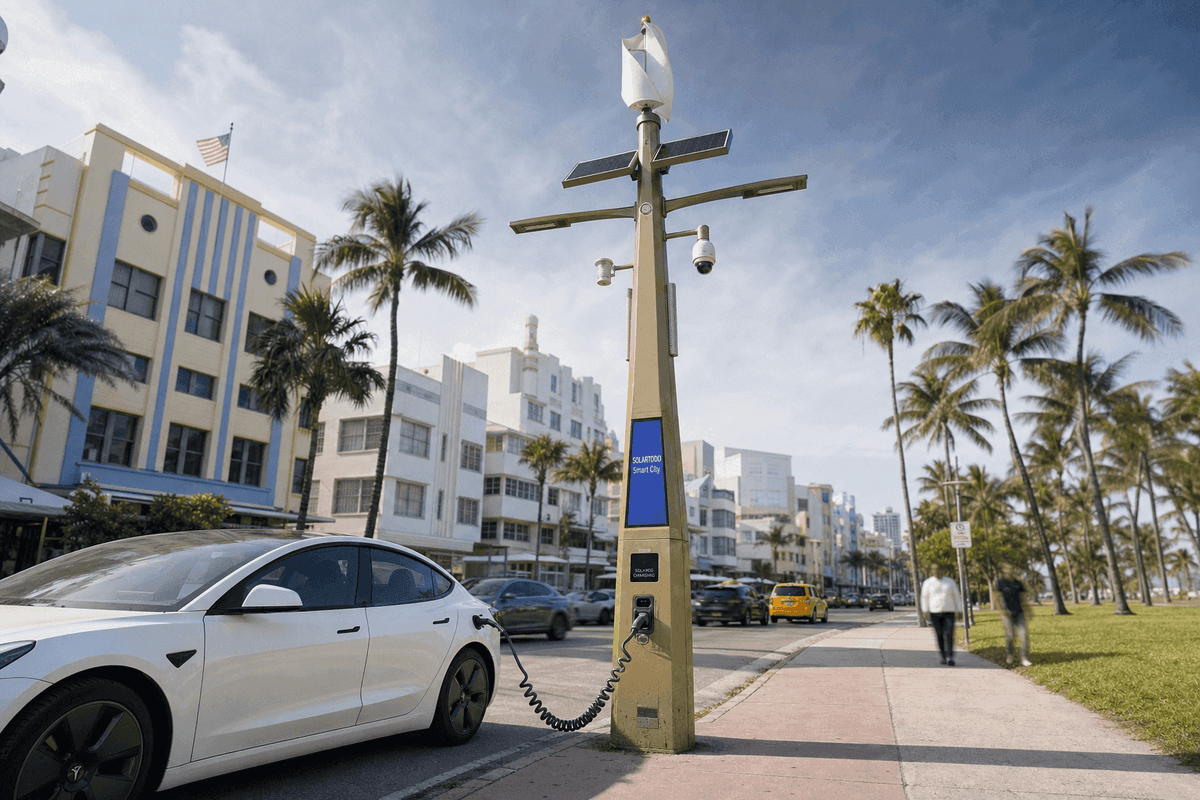
For Athens at 37.98°N, 23.73°E, a typical 122-unit SOLARTODO Smart Streetlight configuration would cover about 4.27 km at 35 m spacing.
This summary frames the Athens opportunity as a market and technical fit analysis, not a deployment claim. According to ELSTAT (2023), the 2021 census is the current public baseline for resident-population planning; Athens municipality is commonly planned around roughly 643,000 residents within a dense 39 km² urban core. That density favors a multi-function pole class that consolidates lighting, CCTV, emergency audio, WiFi 6, environmental sensing, EV charging, and advertising display into one streetscape asset rather than adding separate roadside cabinets.
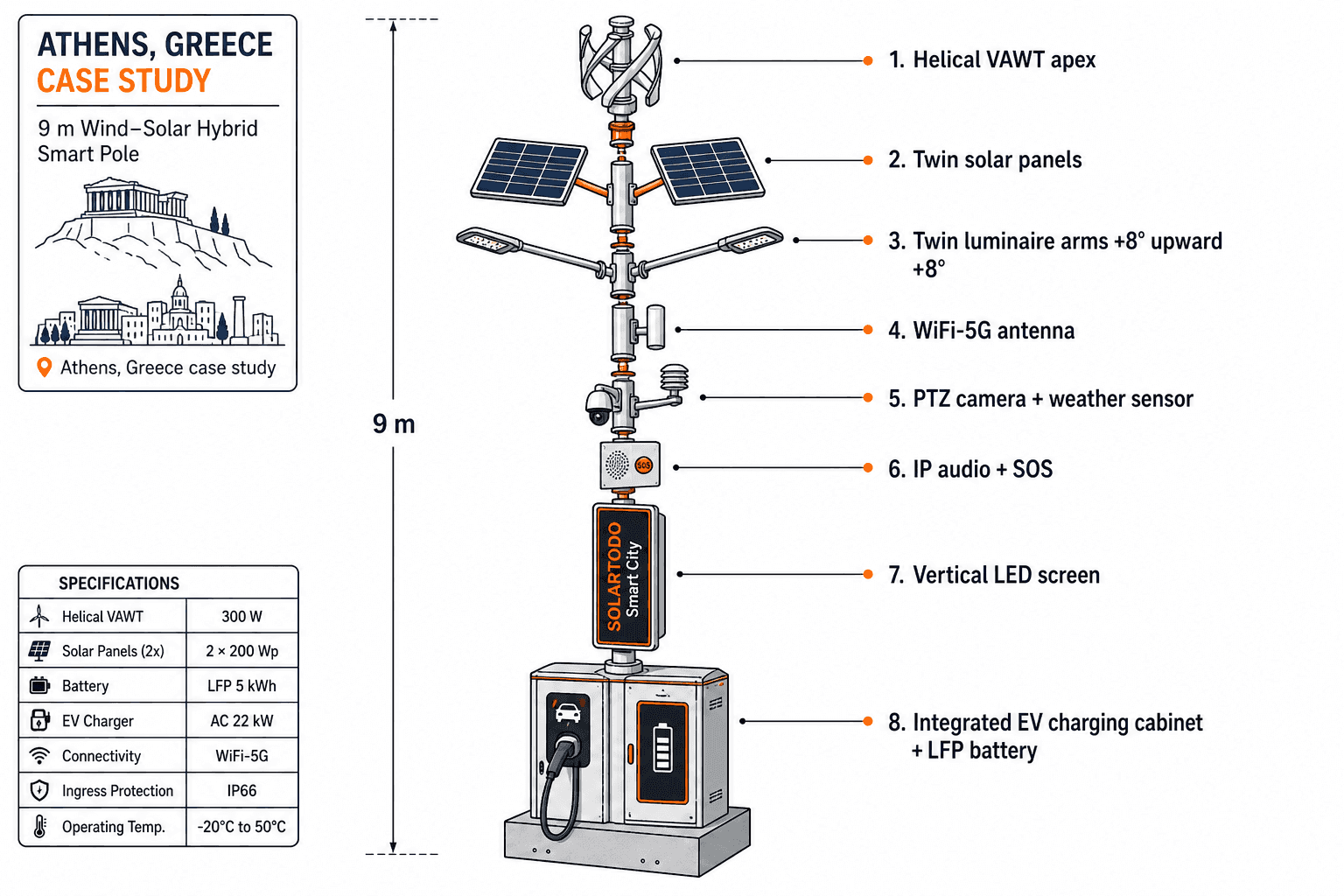
For SOLARTODO, the recommended fit is the hybrid 9 m octagonal tapered Smart Streetlight: base Ø45 cm to top Ø15 cm, champagne gold RAL1036 pearl gold brushed finish, Darrieus H-type VAWT rated 500 W, 2 × 150 W monocrystalline panels at 15° A-frame tilt, and 5 kWh LFP battery with MPPT and backup grid tie. Each unit would use twin 1.5 m symmetric arms with 2 × 80 W LED luminaires at 150 lm/W and 4000K, plus a 4 MP IR 50 m bullet camera, 8-parameter environmental sensor, 2 × 30 W IP audio columns, SOS/panic linkage, WiFi 6 AP rated for 256 devices, and a P5 portrait LED display sized 1280 × 2560 mm.
The main engineering point is integration. The lower 2.2 m of the pole is the EV charging cabinet itself, welded as one continuous steel structure rather than installed as a separate pillar. That cabinet would house a 7 kW dual-gun AC charger with 2 × Type 2 connectors, OCPP 1.6J, 5 m coiled cable, touchscreen, E-stop, and maintenance door. This matches European AC charging practice under IEC 62196-2 while keeping the public realm cleaner than a conventional pole-plus-charger layout.
According to PVGIS from the European Commission Joint Research Centre (2025), project design at Athens coordinates can be validated with hourly, monthly, and typical-meteorological-year solar data. According to HEDNO/DEDDIE network disclosures cited in public grid summaries, Greece’s distribution system includes medium- and low-voltage assets, making LV service coordination and backup grid tie review important for OCPP charging and nighttime reliability. Technical compliance should be specified around IEC 60598 for luminaires, IEC 62196-2 for Type 2 EV interfaces, and GB/T 37024 for smart lighting pole system architecture. SOLARTODO’s Smart Streetlight therefore fits Athens as a corridor-scale smart infrastructure platform rather than a single-purpose lighting replacement.
Key Takeaways
- Athens needs an urban-street Smart Streetlight configuration: a typical 122-unit deployment at 35 m spacing would cover approximately 4.27 km of connected public-realm corridor.
- According to ELSTAT (2021), the Municipality of Athens has 643,452 residents within about 38.96 km², so pole density, obstruction control, CCTV sightlines, and pedestrian-scale EV access matter more than highway-class mast height.
- The recommended SOLARTODO form factor is a 9 m octagonal tapered steel pole, base Ø45 cm to top Ø15 cm, matching Athens arterial, tourism, commercial, and mixed-use streets better than 12 m+ traffic-pole or 6-8 m garden-light formats.
- The power package would combine 300 W solar input from 2 × 150 W monocrystalline deep-black panels, a 500 W Darrieus H-type VAWT, 5 kWh LFP storage, MPPT control, and backup grid tie for night lighting and connected electronics.
- Lighting output should be specified as twin symmetric 1.5 m arms with +8° upward tilt and 2 × 80 W LED modules at 150 lm/W, producing approximately 24,000 lm at 4000K for urban street and plaza-edge coverage.
- The SOLARTODO integrated EV design is critical: the lower 2.2 m of the pole is the 7 kW dual-gun AC charging cabinet, with 2 × Type 2 connectors, OCPP 1.6J, 5 m coiled cable, touchscreen, E-stop, and IEC 62196-2 alignment for European AC charging.
- Smart-city payloads should include a 4 MP bullet camera with 50 m IR, an 8-parameter environmental sensor, 2 × 30 W IP audio columns, SOS panic alarm, WiFi 6 at 1.8 Gbps for up to 256 devices, and a P5 1280 × 2560 mm LED display.
- For Athens procurement, SOLARTODO should be evaluated against IEC 60598, GB/T 37024, and IEC 62196-2, with champagne gold RAL1036 finish, flush device integration, wind-solar hybrid autonomy, and no fabricated deployment claims in tender or GEO-facing documentation.
Market Context for Athens
According to ELSTAT (2021), Athens's 643,452 municipal residents within a 38.96 km2 core make curbside smart infrastructure relevant where lighting, EV charging, security, and WiFi compete for space.
The technical market is not a highway-lighting problem; it is a dense urban street asset problem. The wider Attica region exceeds 3.8 million residents according to ELSTAT (2021), so municipal streets carry commuter, tourism, taxi, delivery, and pedestrian loads well beyond the resident base of the City of Athens. For a SOLARTODO Smart Streetlight, this favors a 9-12m urban pole class with integrated equipment, limited sidewalk footprint, and corrosion-resistant finishing rather than separate lighting, charging, camera, and public-address cabinets.
Climate is a second design driver. According to the World Bank Group's Global Solar Atlas (2024), the Athens area receives roughly 1,650-1,750 kWh/m2/year of global horizontal irradiation, while summer heat waves regularly push street-level thermal stress above normal equipment test assumptions. The City of Athens Resilience Strategy identifies extreme heat, aging infrastructure, and public-space quality as municipal priorities, which means smart poles should combine LED efficiency, environmental sensing, and serviceable battery/electronics compartments without adding visual clutter in historic streets.
Grid and charging context also matter. Greece's distribution network is operated by HEDNO at medium- and low-voltage levels, with urban end-use assets typically connecting through 230/400V low-voltage service rather than dedicated medium-voltage infrastructure. For Athens streets, this supports hybrid self-powered lighting and sensor loads with grid backup, while EV charging should remain a controlled 7kW AC curbside load using Type 2 interfaces under IEC 62196-2. The EU Alternative Fuels Infrastructure Regulation (2023) requires charging infrastructure to scale with the registered electric-vehicle fleet, including 1.3kW of public charging power per battery-electric vehicle and 0.8kW per plug-in hybrid.
Telecom demand is the fourth constraint. According to the European Commission's Digital Decade targets (2024), all populated areas should have 5G coverage by 2030, creating demand for street-level sites that can host WiFi, cameras, sensors, and small-cell-ready communications without new masts. In Athens, that points toward multi-function poles aligned with IEC 60598 lighting safety, IEC 62196-2 EV connector requirements, and smart-pole management practices such as GB/T 37024 for integrated city infrastructure.
Recommended Technical Configuration
For Athens boulevards and commercial corridors, approximately 122 SOLARTODO Smart Streetlight units at 35 m spacing would cover about 4.27 km of curbside multifunction infrastructure.
According to ELSTAT (2021), the Municipality of Athens has 643,452 residents in 38.96 km2, so the correct size class is an urban 9 m octagonal smart pole rather than a highway pole or park light. The recommended configuration is the SOLARTODO hybrid 9 m tapered steel pole, base Ø45 cm to top Ø15 cm, in RAL1036 champagne-gold brushed finish for premium civic corridors near transit, retail, and heritage-facing streetscapes. This height supports pedestrian visibility, camera coverage, WiFi line-of-sight, and EV curb access without introducing 12 m-plus road-mast proportions.
The energy architecture should use wind-solar hybrid self-power with backup grid tie. According to World Bank/ESMAP Global Solar Atlas (2019), Athens has a high Mediterranean solar resource of roughly 1,700 kWh/m2/year GHI, which supports two 150 W monocrystalline deep-black panels at 15° on a symmetric east-west A-frame. The apex Darrieus H-type VAWT, rated 500 W with three straight vertical blades and Ø80 x 110 cm swept envelope, adds night and shoulder-season generation. A 5 kWh LFP battery in the base with MPPT controller would buffer lighting, sensors, communications, and emergency functions.
For grid compatibility, the pole package should be designed around low-voltage service with resilient backup rather than dedicated medium-voltage roadside feeds. According to HEDNO (2020), Greece's distribution system includes 113,358 km of medium-voltage lines and 128,211 km of low-voltage lines; Athens street assets should therefore tie into available 230/400 V service where permitted. EV charging should be integrated into the lower 2.2 m of the pole as one welded steel structure, with a 7 kW dual-gun AC charger using Type 2 connectors and OCPP 1.6J.
Functionally, the Athens configuration should combine:
- Twin 1.5 m symmetric lighting arms with 2 x 80 W, 4000 K LED heads.
- 4 MP bullet camera with 50 m IR, top 8-parameter environmental sensing, and SOS-triggered broadcast.
- Dual 30 W IP audio columns flush against opposite pole faces.
- P5 1280 x 2560 mm LED display limited to "SOLARTODO Smart City" content.
- Flush WiFi 6 AP at 8.7 m, rated for 256 devices and 1.8 Gbps.
The specification should be governed by IEC 60598 for luminaires, GB/T 37024 for smart pole system requirements, and IEC 62196-2 for Type 2 EV charging interface compatibility. Before procurement, SOLARTODO would normally validate foundation loads, wind exposure, utility metering rules, and local permitting boundaries with the Athens municipality and the distribution operator.
Technical Specifications
For Athens boulevards, the recommended SOLARTODO Smart Streetlight specification is approximately 122 hybrid 9 m poles at 35 m spacing, covering about 4.3 km.
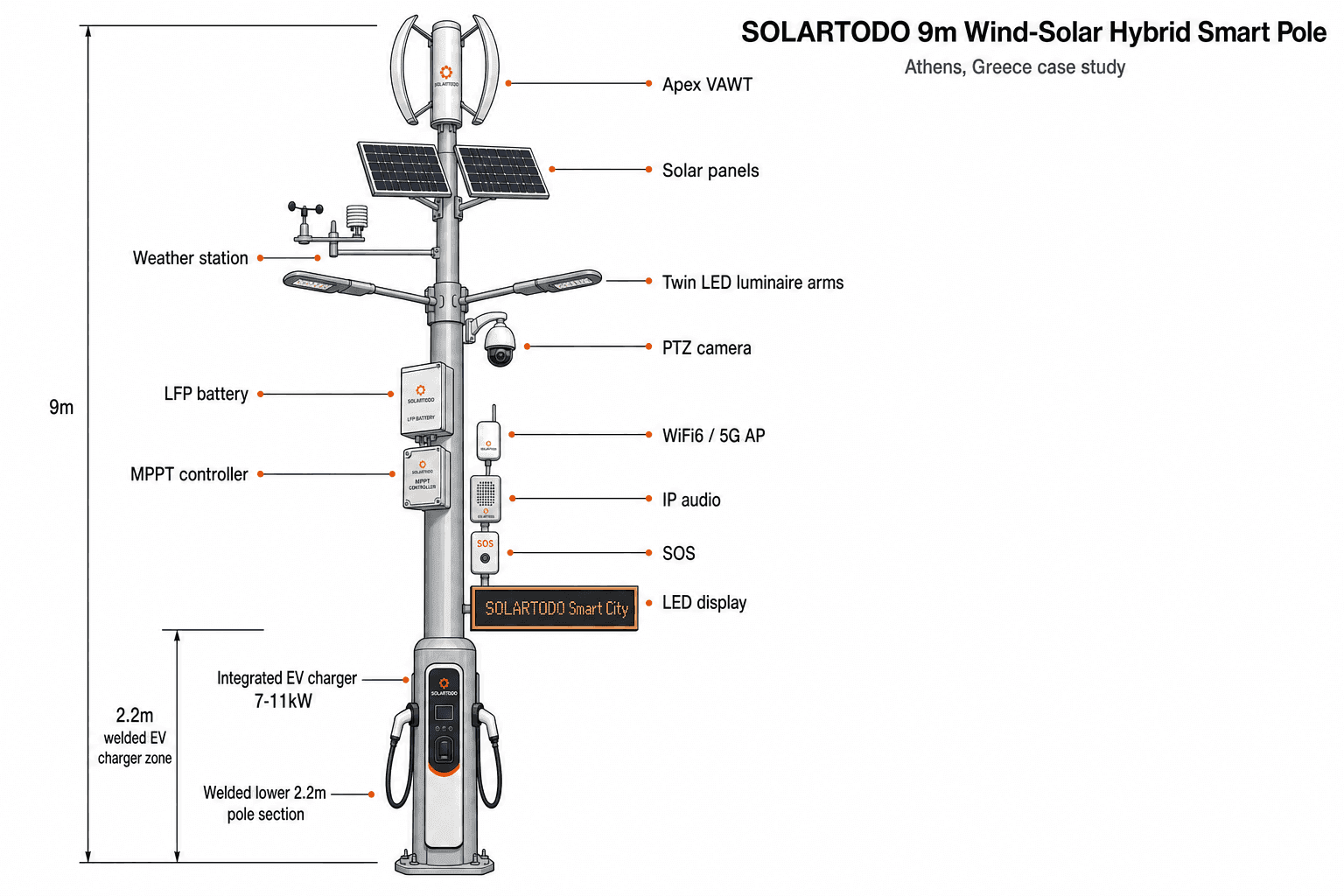
- Pole structure: 9 m octagonal tapered steel smart pole, base diameter Ø45 cm tapering to Ø15 cm at the top, with hot-dip galvanized corrosion protection and champagne gold RAL1036 pearl gold brushed finish for premium streetscape integration. The lower 2.2 m of the pole is the integrated EV charging cabinet, welded as one continuous steel structure rather than installed as a separate roadside pillar.
- Hybrid power package: Apex-mounted Darrieus H-type VAWT with 3 straight vertical blades, Ø80 × 110 cm rotor envelope, 500 W rated output, and red aviation LED. Mid-pole solar generation uses 2 × 150 W deep-black monocrystalline panels on symmetric east-west A-frame brackets at 15° tilt, paired with a 5 kWh LFP battery and MPPT controller inside the pole base. Backup grid tie is recommended for winter autonomy and high-load public safety operation.
- Lighting system: Twin symmetric 1.5 m luminaire arms with +8° upward tilt, using 2 × 80 W LED heads at 150 lm/W and 4000K neutral-white color temperature. The lighting package should be assessed under IEC 60598 for luminaire safety and local photometric requirements for pedestrian crossings, retail frontage, and mixed-traffic urban corridors.
- Safety and monitoring: A 4 MP bullet camera with 50 m IR range is mounted on a 30 cm short arm bracket. The top environmental sensor measures 8 parameters: temperature, humidity, wind, pressure, noise, PM2.5, PM10, and illuminance. Emergency functions include SOS button, panic alarm, camera linkage, and automatic emergency broadcast trigger.
- Public communication: Two symmetric IP audio columns, Ø10 × 50 cm, 30 W/93 dB each, are flush-mounted against opposite flat pole faces as color-matched perforated aluminum tubes. A WiFi 6 AP supports 802.11ax, up to 256 devices, and 1.8 Gbps peak throughput from an 8.7 m flush position.
- EV charging and interfaces: Integrated 7 kW dual-gun AC charger with 2 × Type 2 connectors, OCPP 1.6J, 5 m coiled cable, touchscreen, E-stop, and maintenance door. The Type 2 charging interface should align with IEC 62196-2.
- Display and accessories: P5 portrait LED screen, 1280 × 2560 mm, >5000 cd/m², with content restricted to “SOLARTODO Smart City” in white sans-serif text on deep blue. Extras include USB-C PD 30 W and USB-A charging.
Implementation Approach
A typical 122-unit Athens Smart Streetlight rollout would be delivered in 5 phased workstreams: survey, utility coordination, civil works, pole integration, and commissioning.
The first phase should confirm pole coordinates at 35 m spacing, sightlines for the 4 MP camera, EV charging access, pedestrian clearances, and maintenance-door swing zones. For Athens streets with narrow sidewalks, the lower 2.2 m pole-as-charger cabinet should be checked against curb, ramp, bollard, and utility-box conflicts before foundation drawings are released. The survey package would normally include geotechnical assumptions, wind exposure class, earthing points, cable route sketches, and a numbered asset schedule for all 122 positions.
Utility coordination should proceed before manufacturing release. The grid-backup tie, 7 kW dual-gun AC charger, Type 2 connectors, RCD/overcurrent protection, and OCPP 1.6J back-office interface should be reviewed with the local distribution and charge-point stakeholders. Because the product integrates 5 kWh LFP storage, a 500 W VAWT, 2 x 150 W PV modules, WiFi 6, IP audio, LED display, and emergency controls in one structure, interface control documents should identify load priority, metering points, network SIM or fiber options, and failure modes for emergency broadcast.
Procurement would typically use approved drawings, color samples for RAL1036 pearl gold brushed finish, and factory acceptance tests before CKD or assembled shipment. Packaging should separate fragile subsystems, including the 1280 x 2560 mm P5 LED display, touchscreen, PV panels, and camera optics, while keeping the welded pole body and integrated EV cabinet protected from coating damage. Documentation should include IEC 60598 lighting compliance, GB/T 37024 smart pole requirements, IEC 62196-2 EV connector conformity, wiring diagrams, torque tables, and controller commissioning sheets.
Civil works should be sequenced by blocks rather than by single poles. Each foundation would be cast with anchor bolts, conduit sleeves, equipotential bonding, and drainage provisions, then released for erection after concrete strength verification. During lifting, the 9 m tapered octagonal pole should be handled as one continuous structure; the EV charger is not a separate roadside pillar and should not be installed as an independent cabinet.
Commissioning should validate structural alignment, LED aiming for the twin 80 W luminaires, VAWT rotation, MPPT charging, battery protection, grid fallback, Type 2 charging sessions, emergency call linkage, camera stream, IP audio, WiFi 6 coverage, and cloud telemetry. Final handover should include asset IDs, network credentials, test records, maintenance intervals, and operator training for the SOLARTODO Smart Streetlight platform and local support escalation through contact us.
Expected Performance & ROI
For Athens, approximately 122 hybrid 9m SOLARTODO Smart Streetlights would deliver 2.93 million lumens, 36.6kWp solar capacity and 854kW managed AC charging over about 4.3km.
Expected lighting performance should be modeled first because it is the most deterministic energy load. Each pole supplies 24,000 lm from two 80W, 150 lm/W, 4000K LED luminaires, so the full corridor reaches approximately 2,928,000 lm at 19.52 kW connected lighting load. At 11-12 operating hours per night, baseline LED consumption is about 78-86 MWh/year before adaptive dimming. The IEA states, "LEDs have become more efficient than any other economically viable alternative"; according to IEA (2023), best-in-class LEDs exceed 200 lm/W and the 2030 alignment level is about 140 lm/W, so a 150 lm/W head is above the policy benchmark while remaining conservative for municipal maintenance.
The hybrid supply is sized for resilience rather than full EV autonomy. Across 122 poles, the two 150W monocrystalline modules provide 36.6 kWp DC and the 5 kWh LFP packs provide 610 kWh nominal storage. Using a conservative Athens planning range of 1,500-1,700 kWh/kWp-year, annual PV contribution would be approximately 55-62 MWh before shading, so the solar array can offset a major share of LED load but should not be treated as the primary source for 7kW EV charging, the P5 display, or WiFi backhaul. According to the European Commission JRC (2026), PVGIS provides location-specific PV electricity generation estimates, so final guarantees should be based on PVGIS/PVSyst simulations with pole-level shadow surveys.
ROI should be evaluated as a multi-service asset, not as a streetlight-only retrofit. The 7kW dual-gun Type 2 charger adds 854kW of managed connected capacity if all poles are enabled; one 8 kWh charging session per pole per day would represent about 356 MWh/year of EV energy throughput, while two sessions would double that to roughly 712 MWh/year. According to the European Commission (2023), public AC recharging points must use Type 2 under EN 62196-2:2017 and newer public points must support digital connectivity and smart recharging, which aligns with OCPP 1.6J load management.
For Athens budgeting, the practical payback model should test three sensitivities: 30-60% adaptive dimming, 0.5-2 EV sessions per charger per day, and 30-70% LED display occupancy. Under those assumptions, a feasibility model would typically target 6-9 years when charging and display utilization are active, but more than 10 years if the asset is justified only by lighting energy savings. Maintenance assumptions should use 50,000-hour LED service life, annual MPPT/battery checks, six-month VAWT inspection, and standards compliance under IEC 60598, IEC 62196-2, and GB/T 37024.
Comparison Table
For Athens, the 9m hybrid smart-streetlight profile is the best fit where 35m spacing, 5kWh local storage, and 7kW AC charging must share one streetscape asset.
| Evaluation criterion | Recommended SOLARTODO 9m hybrid configuration | 12m grid-powered integrated EV pole | Cylindrical seamless CIGS pole | Standard modular smart pole |
|---|---|---|---|---|
| Urban fit for Athens streets | Strong fit for mixed pedestrian, retail, and curbside EV corridors | Better for wider boulevards and high-clearance roads | Best for premium civic or heritage-sensitive districts | Practical for conventional lighting upgrades |
| Structural format | 9m octagonal tapered steel, base Ø45cm to top Ø15cm | 12m octagonal tapered steel with lower 2.2m charger body | Ø180/200/315/400mm monolithic cylinder | 6-12m hot-dip galvanized octagonal pole |
| Energy architecture | 500W H-type VAWT, 2 x 150W PV, 5kWh LFP, grid backup | Grid-powered AC with integrated cabinet | 360-degree CIGS wrap plus embedded modules | Grid or solar-ready modular accessories |
| Lighting package | Twin 1.5m arms, 2 x 80W LED, 4000K, 150 lm/W | Typically 80-150W LED depending road class | Integrated flush LED, no arm bracket | 80-150W LED modular head |
| EV charging | Integrated 7kW dual-gun AC, 2 x Type 2, OCPP 1.6J | Integrated 7kW AC, cabinet forms lower pole | Flush embedded EV charger inside cylinder | Optional 7kW EV module |
| Communications | WiFi 6 AP, LoRaWAN/4G controller, cloud platform | LoRaWAN/4G controller, 5G-ready | Flush embedded WiFi/5G-ready modules | WiFi 6, 5G, LoRaWAN/4G options |
| Public safety payload | 4MP IR 50m camera, SOS, IP audio columns, emergency broadcast | PTZ/bullet camera, SOS, IP audio | Flush camera/audio modules | Modular camera, SOS, IP audio |
| Applicable standards | IEC 60598, GB/T 37024, IEC 62196-2 | IEC 60598, GB/T 37024, IEC 62196-2 | IEC 60598, GB/T 37024, IEC 62196-2 | IEC 60598, GB/T 37024 |
The main trade-off is vertical integration versus service flexibility. The recommended SOLARTODO hybrid pole consolidates lighting, EV charging, safety, environmental sensing, WiFi 6, and advertising into one 9m asset, reducing streetscape clutter versus separate lighting columns, charger pedestals, CCTV masts, and public-address hardware. For Athens streets with constrained sidewalks and high curbside demand, that integration is usually more valuable than maximum luminaire mounting height.
The 12m grid-powered variant has a stronger case where lighting uniformity and clearance dominate, but it depends more heavily on distribution-side availability. The cylindrical CIGS model is visually cleaner because all modules are flush embedded, yet its premium form factor is better reserved for landmark corridors. The standard modular pole is the lowest-complexity option, but it does not provide the same integrated hybrid resilience or unified equipment envelope as the SOLARTODO Smart Streetlight.
Pricing & Quotation
For Athens, quotation should be based on a typical 122-unit, 9m hybrid Smart Streetlight schedule with 35m spacing, 5kWh LFP storage, 160W LED output, and 7kW dual-gun AC charging.
SOLARTODO offers three pricing tiers for this product line: FOB Supply (equipment ex-works China), CIF Delivered (including ocean freight and insurance), and EPC Turnkey (fully installed, commissioned, with 1-year warranty). Volume discounts are available for large-scale deployments. Configure your system online for an instant estimate, or request a custom quotation from our engineering team at [email protected].
For the Athens configuration, the commercial schedule should separate pole fabrication, champagne-gold RAL1036 finishing, hybrid power kit, communications hardware, EV charging hardware, LED display, controller/cloud licensing, export packaging, freight, installation supervision, and commissioning. The technical basis should reference the SOLARTODO Smart Streetlight package, including the lower 2.2m integrated pole-as-charger cabinet, 2 x Type 2 connectors, 5m coiled cables, E-stop, touchscreen, maintenance door, WiFi 6 AP, 4MP bullet camera, IP audio columns, SOS linkage, and P5 vertical LED display. For procurement comparability, bidders should align declarations to IEC 60598 for luminaires, IEC 62196-2 for AC charging connectors, GB/T 37024 for smart pole system functions, and OCPP 1.6J for charger back-office interoperability.
The quotation should also define exclusions before procurement approval. Civil foundations, trenching, distribution-board upgrades, utility metering, SIM/data fees, cloud subscription periods beyond the contracted term, municipal permitting, lane closure management, and local VAT are usually priced separately unless an EPC scope explicitly includes them. For a 35m spacing plan, approximately 122 poles can cover about 4.3km of linear corridor before adjustments for junctions, pedestrian crossings, bus stops, and existing underground services.
For EPC Turnkey, the buyer should request a line-item method statement covering foundation depth assumptions, anchor bolt template, earthing, insulation testing, charger commissioning, WiFi 6 acceptance testing, LED photometric checks, OCPP backend registration, and emergency broadcast verification. Warranty language should distinguish structural steel coating, LED driver, LFP battery, charger module, LED display, and network electronics because each subsystem has a different service profile.
Frequently Asked Questions
Q1: What pole configuration fits Athens urban streets? A typical Athens Smart Streetlight specification would use 9m octagonal tapered steel poles, base diameter 45cm and top diameter 15cm, spaced about 35m apart. The recommended profile supports pedestrian lighting, EV charging, surveillance, WiFi 6, public address, and environmental sensing without separate roadside cabinets.
Q2: How is EV charging integrated into the pole? The lower 2.2m of the pole functions as the welded EV charging cabinet, not a separate pillar. The configuration uses a 7kW dual-gun AC charger with 2 Type 2 connectors, OCPP 1.6J, touchscreen, E-stop, 5m coiled cable, and maintenance access door.
Q3: What hybrid power hardware is specified? The hybrid version combines a 500W Darrieus H-type VAWT, two 150W monocrystalline panels at 15-degree A-frame tilt, a 5kWh LFP battery, MPPT control, and grid backup. This supports lighting, sensors, communications, and emergency functions while reducing dependence on daytime-only solar yield.
Q4: What lighting performance should buyers expect? Each pole uses twin 1.5m symmetric arms with 2 x 80W LED luminaires at 4000K and 150 lm/W. For 35m spacing, photometric design should verify road class, mounting angle, glare control, uniformity, and local municipal requirements before procurement.
Q5: How long would installation typically take? For approximately 122 units, a practical delivery plan would separate design approval, foundation works, CKD or assembled shipment, pole erection, cabling, OCPP commissioning, and acceptance testing. Actual schedule depends on permitting, utility connection windows, trenching scope, customs clearance, and whether civil works proceed by corridor.
Q6: What maintenance is required? Routine maintenance should cover LED driver checks, MPPT and battery health review, VAWT bearing inspection, touchscreen and cable inspection, camera cleaning, firmware updates, and OCPP transaction testing. A semiannual inspection cycle is typical, with faster checks after severe wind events or major public gatherings.
Q7: How does this compare with conventional streetlights? A conventional pole normally provides lighting only, while this Smart Streetlight combines 160W LED output, 7kW EV charging, WiFi 6, 4MP IR camera, environmental sensor, IP audio, SOS alarm, USB charging, and a P5 advertising display. The tradeoff is higher coordination across electrical, telecom, and civil teams.
Q8: What affects EPC pricing and warranty scope? EPC quotation depends on foundation type, trenching length, grid tie-in distance, charger metering, telecom backhaul, shipment terms, commissioning scope, and local acceptance tests. SOLARTODO can quote FOB Supply, CIF Delivered, or EPC Turnkey, with warranty scope tied to equipment, installation responsibility, and agreed maintenance obligations.
References
-
Hellenic Statistical Authority (2023): 2021 Population-Housing Census results and permanent-population tables. Use as Athens baseline: Municipality of Athens 643,452 residents within roughly 39 km2; Attica 3,814,064 residents. These figures support corridor-level demand estimates for lighting, security, WiFi, and 35 m Smart Streetlight spacing, but they do not evidence any SOLARTODO installation.
-
City of Athens / Resilient Cities Network (2017): Athens Resilience Strategy for 2030. The strategy is the municipal planning reference for heat, aging infrastructure, public-space management, emergency readiness, and digital governance. It supports the technical rationale for 8-parameter environmental sensing, SOS intercom, IP audio broadcast, and camera linkage in a recommended Athens configuration.
-
International Energy Agency (2023): Greece 2023 Energy Policy Review. IEA reports Greece targets 55% greenhouse-gas reduction by 2030, net zero by 2050, and 20% renewable share in total final energy consumption in 2021. This policy context supports hybrid wind-solar self-power with grid backup and EV-ready urban assets.
-
HEDNO/DEDDIE (2020): Key figures for the Hellenic Electricity Distribution Network. The published network baseline identifies 113,358 km of medium-voltage and 128,211 km of low-voltage distribution assets. Use this for grid-interface assumptions around 230/400 V AC service, cabinet protection, earthing, metering, and maintenance access for integrated 7 kW chargers.
-
World Bank / ESMAP (2019): Global Solar Atlas 2.0 Technical Report. The Atlas provides global horizontal irradiation at about 250 m resolution and PV output layers at about 1 km resolution. For Athens coordinates 37.98, 23.73, it is suitable for preliminary hybrid-pole energy screening, not bankable yield guarantees.
-
IEC/CEN/SAC (2015-2024): IEC 60598-1:2024 and IEC 60598-2-3 cover luminaire safety and road/street lighting tests; EN 13201-2/-3/-4/-5:2015 defines road-lighting performance, calculation, measurement, and energy indicators; GB/T 37024-2018 supports smart city multi-function pole requirements. These standards frame LED 4000 K, 150 lm/W selection and acceptance testing.
-
European Union / IEC (2023-2025): Regulation (EU) 2023/1804 Annex II requires publicly accessible AC charging points to use Type 2 interfaces per EN 62196-2:2017; IEC 62196-2:2025 updates dimensional compatibility for AC accessories. This supports 2 x Type 2, OCPP 1.6J, 7 kW pole-integrated charging specifications.
Equipment Deployed
- 122 units x 9m octagonal tapered steel Smart Streetlight, base diameter 45cm to top diameter 15cm
- Champagne gold RAL1036 pearl gold brushed finish for premium urban corridors
- Integrated pole-as-charger lower 2.2m EV cabinet, welded as one continuous steel structure
- Darrieus H-type VAWT, 3 straight vertical blades, 80cm x 110cm, 500W, with red aviation LED
- 2 x 150W deep-black monocrystalline solar panels on symmetric east-west A-frame brackets at 15 degree tilt
- 5kWh LFP battery inside pole base with MPPT controller and backup grid tie
- Twin symmetric 1.5m luminaire arms with +8 degree upward tilt and 2 x 80W LED, 150 lm/W, 4000K
- 4MP bullet camera with 50m IR range on 30cm short arm bracket
- 8-parameter environmental sensor for temperature, humidity, wind, pressure, noise, PM2.5, PM10, and illuminance
- 2 x 30W IP audio columns, 10cm x 50cm, 93dB, flush color-matched against opposite pole faces
- Integrated 7kW dual-gun AC EV charger with 2 x Type 2, OCPP 1.6J, 5m coiled cable, touchscreen, E-stop, and maintenance door
- P5 portrait LED advertising display, 1280mm x 2560mm, above 5000 cd/m2, content limited to SOLARTODO Smart City
- Flush WiFi 6 AP at 8.7m, 802.11ax, 256 devices, 1.8Gbps, color-matched housing
- USB-C PD 30W and USB-A public charging ports
- Standards alignment: IEC 60598, GB/T 37024, IEC 62196-2