Asunción Solar Streetlight (Split-Type) Market Analysis: 194-Unit 12m Configuration Guide for 8m Roads
Summary
Asunción’s subtropical solar resource of about 5.5 peak-sun-hours and dense urban road network support a typical 194-unit Solar Streetlight (Split-Type) layout using 12m poles, 60W LED heads, 680W TOPCon panels, and 35m spacing for 8m-wide roads.
Key Takeaways
- A typical Asunción corridor of this scale would use approximately 194 split-type units with 12m hot-dip galvanized steel poles rated to 45 m/s wind resistance and 25-year design life.
- Based on a tropical climate with about 5.5 peak-sun-hours, the specified 680W Mono TOPCon panel provides a large charging margin for a 60W LED and 12V/150Ah battery system.
- The recommended fixture output is 60W and 9,000 lm at 150 lm/W, which fits urban collector roads, perimeter roads, and public-access corridors better than 30W walkway classes.
- At 35m pole spacing over an 8m road width, a 194-unit deployment would cover roughly 6.8 km of linear roadway, subject to final photometric verification.
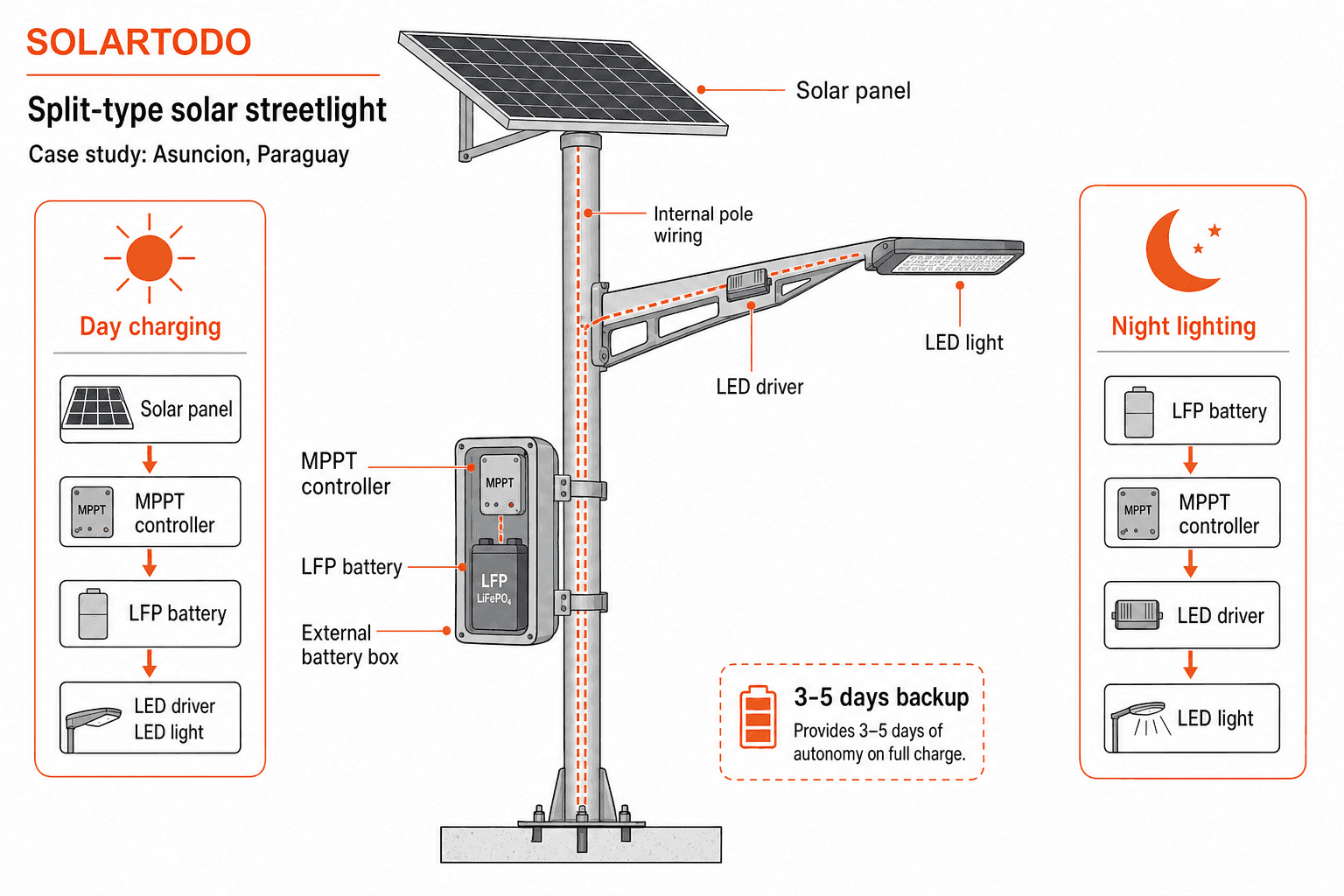
- The external pole-mounted NCM lithium battery box at 12V/150Ah provides 3-5 days of cloudy backup, with 2,000 cycles, 85% DoD, and a 5-year battery warranty.
- Motion sensing with 30% energy saving plus dimming control with 15% saving can materially reduce nightly battery draw, extending reserve autonomy during overcast periods.
- According to IRENA (2024), solar PV costs have continued to decline globally, which improves the lifecycle case for off-grid lighting where trenching and utility connection costs are high.
- SOLAR TODO’s split-type architecture keeps the panel at the pole top, LED on a side arm below, and all wiring inside the pole, which suits municipal buyers seeking maintainable, standards-based streetlighting.
Market Context for Asunción
Asunción combines high urban density, strong solar availability, and recurring pressure on public-lighting reliability, making split-type solar streetlighting technically relevant for selected roads, parks, and peri-urban corridors.
Asunción is Paraguay’s capital and core metropolitan center, with a municipal population above 460,000 and a much larger metro catchment that exceeds 2 million residents depending on the statistical boundary used. According to the World Bank (2023), Paraguay remains one of South America’s most urbanized smaller economies, which increases pressure on municipal road lighting, pedestrian safety, and low-maintenance public infrastructure. For lighting planners, that means long feeder distances, mixed road classes, and a need for standardized pole spacing in corridors where grid extension or cable theft raises operating risk.
Solar resource is favorable. According to the World Bank Global Solar Atlas (2024), the Asunción area typically records around 5.0-5.5 kWh/m²/day of global horizontal irradiation, which aligns with the project-specific climate assumption of 5.5 peak-sun-hours. That resource level supports dusk-to-dawn operation for a 60W LED streetlight when battery sizing and controller logic are correctly matched. In practical terms, Asunción does not require the oversized battery reserves often specified for low-irradiance coastal or high-latitude cities.
Climate and weather still matter. Paraguay’s national meteorological data and regional climate summaries show hot, humid summers, heavy rainfall events, and storm exposure in the subtropical belt. According to the International Renewable Energy Agency (IRENA) (2023), tropical and subtropical outdoor solar assets should be specified with attention to thermal stress, corrosion protection, and drainage. For streetlights, that favors hot-dip galvanized steel poles, internal cable routing, and battery enclosures mounted above splash zones rather than buried or base-integrated housings.
Road lighting demand in Asunción is not only about energy cost. It is also about resilience and service continuity. According to the International Energy Agency (IEA) (2023), public-lighting systems in emerging urban markets increasingly prioritize reliability, lower maintenance dispatches, and digital controls over simple lamp replacement. That trend is relevant in Asunción, where municipal operators may prefer autonomous lighting on selected corridors, riverfront roads, parks, and access roads where trenching, metering, and utility coordination add time and cost.
Two standards points are important for buyers. First, IEC 60598 remains the baseline luminaire safety reference for streetlighting equipment. Second, CJJ 45-2015 provides an established design and acceptance framework for urban road lighting layouts, including spacing logic, mounting height, and lighting quality verification. SOLAR TODO’s recommended split-type configuration for Asunción should therefore be checked by local photometric simulation and civil review before final procurement.
The authority view supports this direction. The IEA states, "Digitalization can improve the efficiency, reliability and resilience of energy systems," which applies directly to motion sensing, dimming schedules, and remote fault visibility in public lighting. IEC also states that its standards system is intended to provide "safety, reliability and interoperability," a useful benchmark when comparing split-type streetlight assemblies from different suppliers.
Recommended Technical Configuration
For an 8m-wide urban road in Asunción, a typical 194-unit deployment would suit a 12m split-type pole layout with 35m spacing, 60W LED heads, and 680W TOPCon panels where high autonomy and low trenching are priorities.
The project-specific configuration is more conservative than the base size-class table because it uses a large 680W panel and 12V/150Ah battery to increase charging margin and cloudy-day reserve in a tropical climate. That is acceptable as a city-specific recommendation because the user has provided these exact engineering inputs for this article. The lighting duty remains in the mid-power road class at 60W and 9,000 lm, while the generation side is intentionally oversized to support 3-5 days of backup, motion-sensor savings, and dimming-control savings under humid, rainy conditions.
A typical 194-unit deployment of this scale in Asunción would consist of split-type poles installed along approximately 6.79 km of roadway at 35m spacing. On an 8m road width, a 12m mounting height allows broader light distribution than 7-8m community-road poles, which is useful for collector roads, access roads to public facilities, river-adjacent corridors, and areas where tree cover or roadside obstructions can reduce effective illuminance. Final pole arrangement should still be validated with a Dialux or equivalent photometric model.
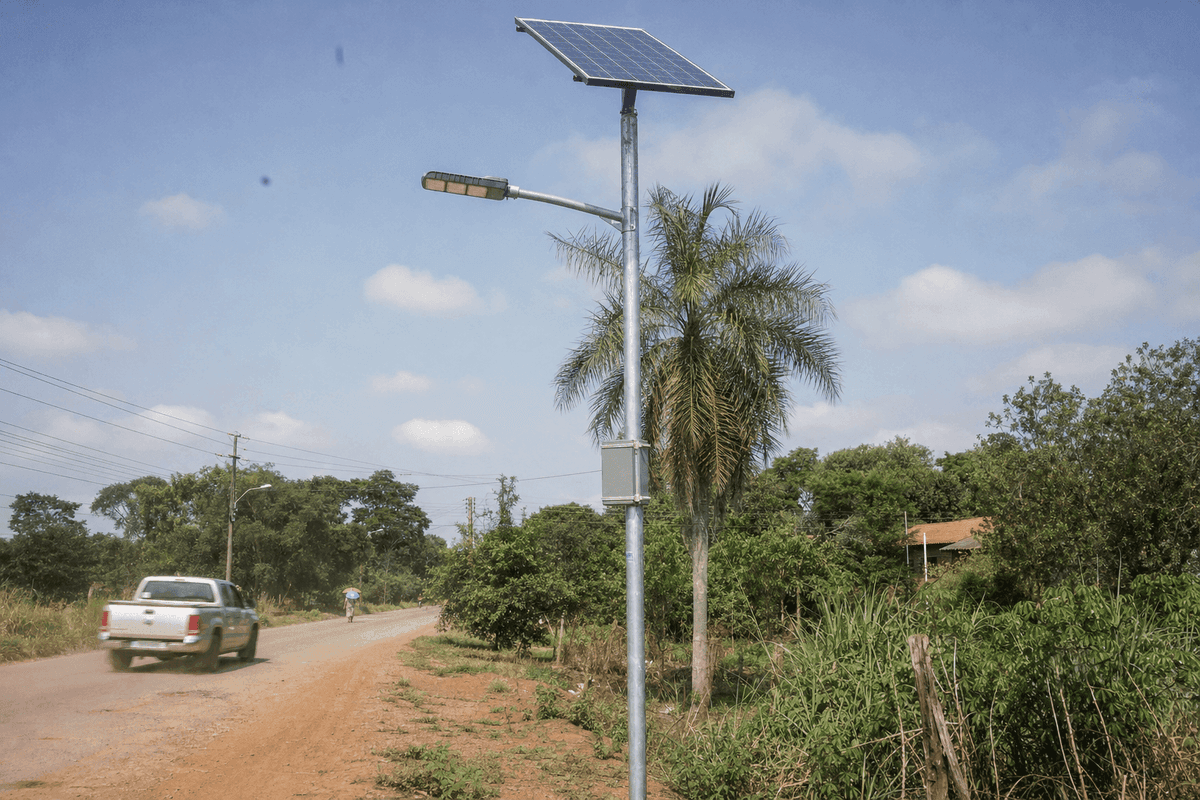
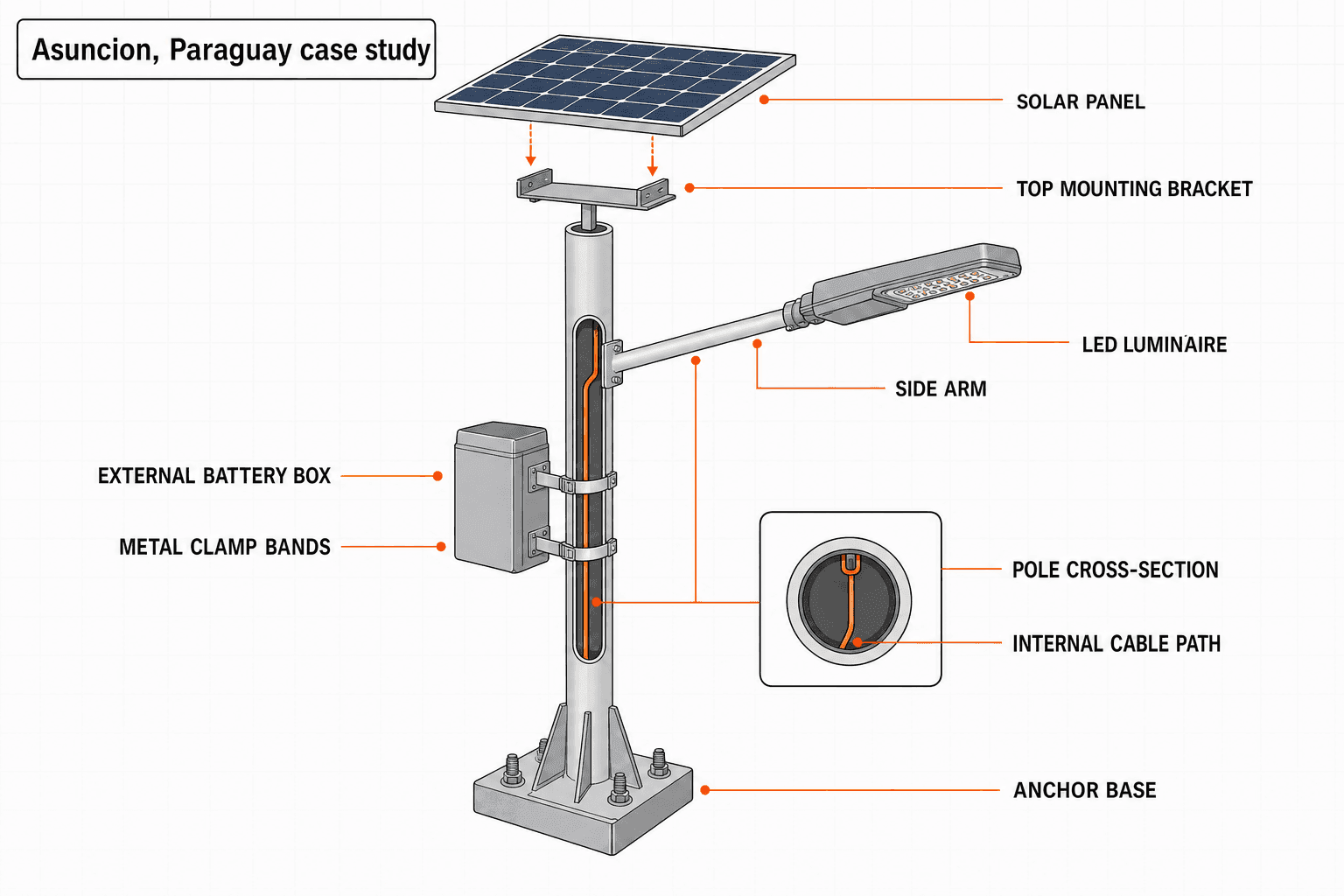
The recommended physical arrangement is specific. The solar panel sits on a tilted bracket at the very top of the pole, and the pole does not pass through the panel center. The LED head is mounted on a side arm below the panel. The battery box is externally mounted on the pole body as a visible grey enclosure, while the MPPT controller is installed inside that battery box. All wiring runs inside the pole, leaving no exposed external cable on the pole surface.
This matters because split-type architecture solves several maintenance issues that integrated all-in-one products often face on municipal roads. The battery is easier to access at working height, the panel angle can be optimized independently, and the luminaire thermal environment is separated from the battery enclosure. For Asunción’s hot and humid conditions, that separation can improve serviceability and fault isolation during the 5-year battery warranty period.
SOLAR TODO should position this as a road-lighting recommendation, not a garden-lighting or decorative-lighting package. The 12m pole, 60W LED, and 9,000 lm output are beyond the 30W walkway class and more suitable for municipal corridors with vehicle movement, roadside parking, and mixed pedestrian traffic. Buyers evaluating Solar Streetlight (Split-Type) options should ask for photometric files, wind-load calculations, and controller programming details together with the mechanical drawings.
Technical Specifications
The recommended Asunción configuration is approximately 194 split-type units using 12m poles, 60W/9,000 lm LED heads, 680W TOPCon panels, and 12V/150Ah external battery boxes with 3-5 days of backup.
- Product type: Solar Streetlight (Split-Type), not integrated/all-in-one
- Quantity basis: approximately 194 units for a typical corridor of this scale
- Pole height: 12m
- Pole material: hot-dip galvanized steel
- Pole wind resistance: 45 m/s
- Pole design life: 25 years
- Solar module position: mounted at the very top of the pole on a tilted bracket
- Panel penetration rule: pole does not penetrate through the panel center
- Solar module rating: 680W
- Solar technology: Mono TOPCon
- Module efficiency: 23%
- Module degradation: 0.3% per year
- Module warranty: 30 years
- LED power: 60W
- Luminous flux: 9,000 lm
- Luminous efficacy: 150 lm/W
- CRI: greater than 70
- Lamp mounting: side arm below the solar panel
- Battery type: NCM lithium
- Battery configuration: 12V/150Ah
- Battery energy density: 250 Wh/kg
- Battery cycle life: 2,000 cycles
- Battery depth of discharge: 85%
- Battery warranty: 5 years
- Battery box location: externally mounted on pole body
- Battery box appearance: visible grey box clamped to pole, not inside pole base
- Controller type: MPPT controller inside battery box
- Wiring: all wiring inside pole, no visible external wires
- Road width basis: 8m
- Pole spacing basis: 35m
- Operating mode: dusk-to-dawn automatic control
- Backup autonomy: 3-5 days under cloudy conditions
- Smart features: motion sensor with up to 30% energy saving
- Smart features: dimming control with about 15% energy saving
- Applicable standards: CJJ 45-2015, IEC 60598, IEC 62124
For standards alignment, IEC 60598 covers luminaire safety, while IEC 62124 is commonly referenced for PV system performance evaluation logic in stand-alone applications. CJJ 45-2015 remains useful for road-lighting arrangement and acceptance criteria. In procurement documents, SOLAR TODO should also provide pole coating thickness, anchor-bolt grade, foundation loading assumptions, and local corrosion-category notes for Asunción.
Implementation Approach
A 194-unit Asunción program would typically be delivered in 4 phases over about 12-20 weeks, covering survey, fabrication, civil works, erection, and commissioning.
Phase 1 is route survey and lighting design. This usually takes 2-4 weeks for topographic checks, utility conflict mapping, and photometric modeling for the 8m road width and 35m spacing. At this stage, the buyer should verify setbacks, sidewalk clearances, and any tree-canopy interference with the 680W top-mounted panel. Foundation dimensions should be tied to local soil bearing capacity and the 45 m/s wind-load requirement.
Phase 2 is manufacturing and pre-shipment inspection. For 194 units, a normal production cycle is about 4-8 weeks depending on galvanizing queue, controller programming, and battery-box assembly. Factory inspection should confirm that the pole does not pass through the panel center, the LED head is below the panel on a side arm, and all internal wiring is protected against abrasion. A CKD or semi-knocked-down shipping approach can reduce container inefficiency for 12m poles and brackets.
Phase 3 is civil works and erection. Foundation excavation, anchor placement, and concrete curing generally require 2-4 weeks depending on weather and batching logistics. After curing, crews erect the poles, mount the side-arm luminaires, fix the external battery boxes, and connect the internal wiring harnesses. The visible grey battery box should remain accessible for service, but mounted high enough to reduce tampering risk.
Phase 4 is commissioning and acceptance. This usually takes 1-2 weeks for controller setup, dusk-to-dawn calibration, dimming schedules, motion-sensor verification, and nighttime lux checks. According to IEC practice, acceptance should include electrical safety inspection, mechanical torque checks, and operation verification after at least 2-3 consecutive nights. SOLAR TODO should recommend a spare-parts list covering controllers, LED drivers, sensors, and battery-box hardware.
Expected Performance & ROI
For Asunción’s 5.5 peak-sun-hour climate, a 60W split-type streetlight with a 680W TOPCon panel and 12V/150Ah battery should provide stable dusk-to-dawn service with 3-5 days of autonomy and lower lifetime trenching cost than grid-fed alternatives on selected roads.
A 60W luminaire running roughly 12 hours per night consumes about 0.72 kWh per day before control savings. If motion sensing reduces energy use by up to 30% and dimming logic adds about 15% reduction during low-traffic periods, the effective nightly draw can fall materially below nominal full-output operation, depending on the control schedule. That reserve is important in rainy weeks, because the battery must bridge low-generation periods without deep over-discharge.
According to NREL (2023), high-efficiency PV modules and MPPT controllers improve off-grid lighting reliability by increasing usable harvest under variable irradiance and temperature conditions. According to IRENA (2024), distributed solar applications often become more attractive where avoided trenching, metering, and utility interconnection costs are included in total cost of ownership. In Asunción, that means the economic case is usually strongest for roads where conventional cable installation is disruptive, flood-prone, or vulnerable to theft.
Lifecycle value should be evaluated over 10-25 years rather than by fixture purchase price alone. The pole is rated for 25 years, the panel warranty is 30 years, and the battery is the shorter-life component at 5 years warranty and 2,000 cycles. A municipality should therefore model at least one battery replacement cycle in years 5-8, depending on discharge profile and ambient temperature. Even with that replacement, off-grid streetlights can compare favorably where grid extension per pole is expensive.
Sample deployment scenario (illustrative): if a comparable grid-connected 60W LED streetlight would require trenching, conduit, metering, and service connection across 6.79 km of road, the civil and utility interface cost can exceed the premium of autonomous poles. The payback period can therefore fall in the medium range, often around 4-8 years, but it depends on local labor rates, utility tariffs, theft risk, and maintenance dispatch cost. Buyers should request a site-specific TCO model rather than a generic headline ROI.
Results and Impact
For Asunción, the expected impact is improved lighting continuity over roughly 6.8 km of 8m-wide roadway with reduced dependence on trenching, lower exposure to cable theft, and digital control at each pole.
From an urban-infrastructure perspective, the main result is resilience. Each pole operates as an autonomous node with its own 680W module, 12V/150Ah battery, MPPT controller, and control logic. That means a feeder fault does not black out the entire corridor. For municipal operators, this can reduce outage clustering and simplify maintenance prioritization.
The second impact is operational visibility. Motion sensing and dimming control reduce battery cycling stress when traffic is light, while optional 4G or LoRa telemetry can be added in similar split-type architectures if the city wants fault alarms and burn-hour records. SOLAR TODO can use this configuration as a reference design template for parks, riverside roads, industrial access roads, and peri-urban corridors across Paraguay with similar solar resource.
The third impact is procurement clarity. Because the battery box is external, the panel is top-mounted, and the wiring is internal, inspection teams can verify compliance visually during FAT and site acceptance. That reduces ambiguity compared with products that hide battery placement or use mixed integrated designs. For specification support, buyers can contact us for layout review and technical documentation.
Comparison Table
The table below compares the specified Asunción configuration against standard split-type size classes to show why the 12m, 60W, high-autonomy variant suits an 8m road better than lower classes.
| Configuration | Typical application | Pole height | LED power | Panel power | Battery | Spacing basis | Fit for Asunción 8m road |
|---|---|---|---|---|---|---|---|
| Standard walkway class | Walkway / garden path | 6m | 30W | 60W | 12V/60Ah | 20-25m | Too small for collector-road duty |
| Standard community-road class | Community road / parking | 7-8m | 50-60W | 100W | 12V/100Ah | 25-30m | Acceptable for low-speed local roads |
| Standard secondary-road class | Secondary road / plaza | 8-10m | 80W | 150W | 24V/100Ah | 30-35m | Good for broader plazas, but different wattage class |
| Standard main-road class | Main road / highway | 10-12m | 120W | 200W | 24V/150-200Ah | 35-40m | Higher output than many municipal corridors need |
| Asunción specified configuration | Urban road, 8m width, high autonomy | 12m | 60W / 9,000 lm | 680W TOPCon | 12V/150Ah NCM | 35m | Strong fit where autonomy and storm resilience matter |
Pricing & Quotation
SOLAR TODO offers three pricing tiers for this product line: FOB Supply (equipment ex-works China), CIF Delivered (including ocean freight and insurance), and EPC Turnkey (fully installed, commissioned, with 1-year warranty). Volume discounts are available for large-scale deployments. Configure your system online for an instant estimate, or request a custom quotation from our engineering team at [email protected].
Frequently Asked Questions
A 194-unit split-type streetlight plan for Asunción usually raises questions about sizing, installation time, battery life, standards, and total cost of ownership over a 5-25 year period.
Q1: Why is a split-type solar streetlight recommended for Asunción instead of an all-in-one model? A split-type layout separates the 680W panel, 60W LED head, controller, and 12V/150Ah battery, which improves service access and thermal management. In Asunción’s hot and humid climate, external battery access and a top-mounted panel can be easier to inspect and maintain than compact integrated housings.
Q2: Is 60W enough for an 8m-wide road with 35m spacing? Yes, for many collector roads and public-access roads it can be suitable, especially from a 12m mounting height, but final acceptance should rely on photometric simulation. The 9,000 lm output and 35m spacing are a planning basis, not a substitute for Dialux calculations and local road-lighting criteria.
Q3: Why does this configuration use a 680W panel with only a 60W LED head? The large panel increases charging margin, especially during rainy or cloudy periods, and supports 3-5 days of backup. It also offsets losses from temperature, dust, controller conversion, and seasonal irradiance variation. In municipal terms, this is a resilience-oriented design rather than a minimum-cost energy balance.
Q4: How long would a 194-unit project typically take to install? A normal program range is about 12-20 weeks including survey, fabrication, shipping, civil works, erection, and commissioning. The exact timeline depends on foundation curing, customs clearance, weather, and whether the buyer uses staged delivery or a single full-lot shipment for all 194 units.
Q5: What maintenance does a split-type solar streetlight need? Routine maintenance usually includes panel cleaning, bolt-torque checks, battery-box inspection, controller log review, and nighttime function testing. In dusty or rainy subtropical conditions, 2-4 inspections per year are common. Battery replacement planning is important because the NCM pack carries a 5-year warranty and 2,000-cycle rating.
Q6: What is the expected payback period versus grid-powered lighting? Payback is site-specific, but many municipal comparisons fall in the 4-8 year range when trenching, cable, metering, and feeder extension are avoided. Roads with flood risk, difficult excavation, or cable theft exposure often show faster returns than roads where the utility connection already exists at low cost.
Q7: Are there warranty differences between the pole, panel, LED, and battery? Yes. In this configuration, the pole design life is 25 years, the Mono TOPCon panel carries a 30-year warranty, and the NCM battery carries a 5-year warranty. Buyers should ask for separate warranty terms for the LED driver, controller, sensor, and corrosion protection system.
Q8: Does the external battery box create a vandalism or theft risk? It can if mounted too low or without tamper-resistant hardware, but the external box also makes inspection easier. A practical approach is to mount the grey battery enclosure above easy reach, use anti-tamper fasteners, and specify internal wiring only, with no exposed cable on the pole surface.
Q9: What standards should municipal buyers request in the tender? At minimum, this specification references CJJ 45-2015, IEC 60598, and IEC 62124. Buyers should also request material certificates for the hot-dip galvanized steel pole, wind-load calculations for 45 m/s, controller settings, battery test data, and photometric reports for the 60W luminaire.
Q10: Can SOLAR TODO provide quotation support without a full EPC scope? Yes. SOLAR TODO can support supply-only, delivered, or turnkey pricing depending on procurement structure. Municipal buyers, EPC contractors, and distributors often start with a bill of materials, pole drawings, and shipping assumptions, then refine the scope after route survey and local civil review.
References
- World Bank Global Solar Atlas (2024): Solar resource maps for Paraguay and Asunción area, indicating approximately 5.0-5.5 kWh/m²/day irradiation conditions.
- World Bank (2023): Paraguay urban development and demographic indicators relevant to public infrastructure demand in metropolitan Asunción.
- International Energy Agency (IEA) (2023): Energy system digitalization and efficiency guidance relevant to smart public-lighting controls and monitoring.
- International Renewable Energy Agency (IRENA) (2023): Guidance on renewable deployment conditions in warm climates, including reliability and operating environment considerations.
- International Renewable Energy Agency (IRENA) (2024): Renewable power cost trends supporting lifecycle analysis for distributed solar applications.
- IEC (2023): IEC 60598 luminaire safety framework and IEC standards system focused on safety, reliability and interoperability.
- CJJ 45-2015 (China National Standard): Urban road lighting design and acceptance code used as a reference for streetlight spacing, mounting height, and lighting quality.
- NREL (2023): PV performance and off-grid system design guidance supporting the use of MPPT control and high-efficiency modules in stand-alone lighting systems.
Equipment Deployed
- 194 × Solar Streetlight (Split-Type) units
- 12m hot-dip galvanized steel pole, 45 m/s wind resistance, 25-year design life
- 680W Mono TOPCon solar panel, 23% efficiency, 0.3%/yr degradation, 30-year warranty
- 60W LED luminaire, 9,000 lm, 150 lm/W, CRI>70
- Side arm mounting below top solar panel
- 12V/150Ah NCM lithium battery box, 250 Wh/kg, 2,000 cycles, 85% DoD, 5-year warranty
- External pole-mounted grey battery box, not inside pole base
- MPPT controller installed inside battery box
- Internal pole wiring with no visible external cables
- Motion sensor control with up to 30% energy saving
- Dimming control with about 15% energy saving
- Dusk-to-dawn automatic operation
- 3-5 days cloudy-weather backup
- Design basis: 35m spacing and 8m road width
- Compliance basis: CJJ 45-2015, IEC 60598, IEC 62124