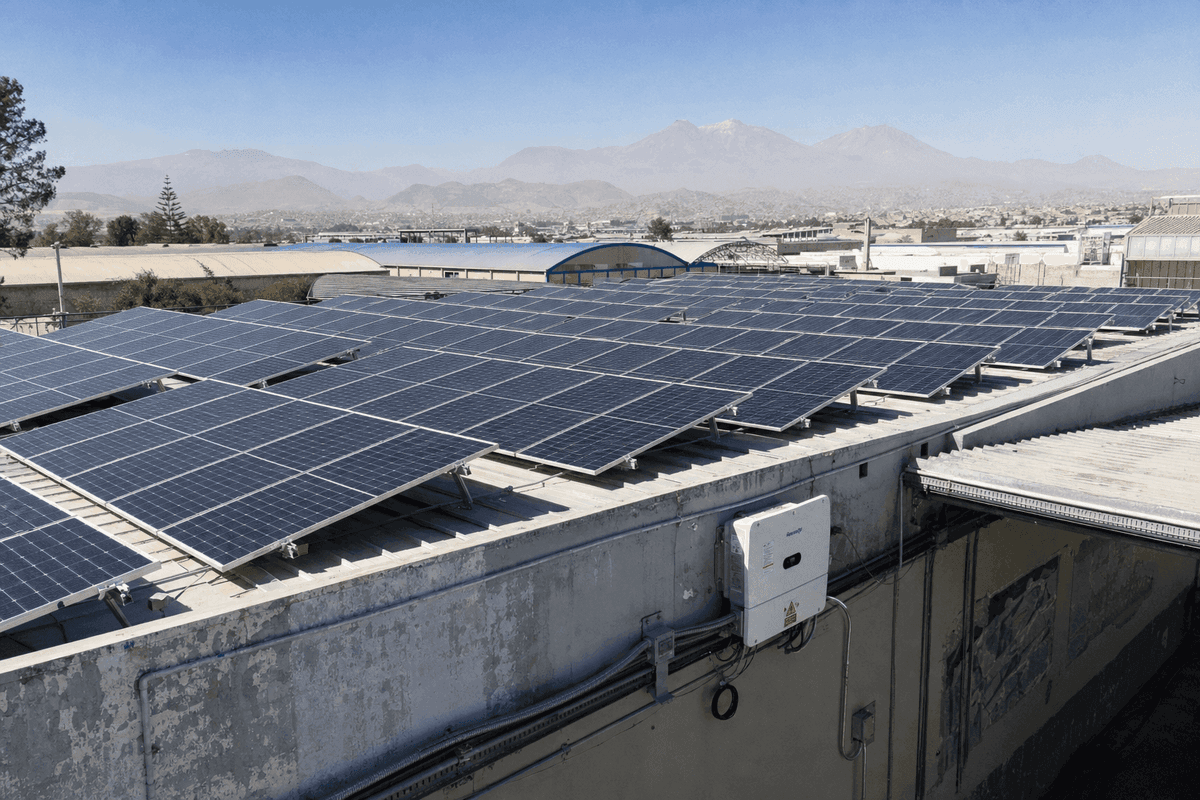
Arequipa Solar PV System Market Analysis: 1.3 MW Industrial Rooftop Configuration Guide
Summary
Arequipa’s 1.3 MW industrial Solar PV System fit uses 2,180 TOPCon 590 W panels, 25° fixed tilt, 5.5 kWh/m²/day irradiance, and about 2,220,215 kWh annual yield for C&I rooftops.
Key Takeaways
A 1.3 MW Arequipa Solar PV System should be specified as a C&I rooftop asset, not a residential or utility-scale configuration.
- A recommended Arequipa industrial rooftop configuration is 1.3 MW DC using approximately 2,180 TOPCon modules at 590 W each.
- The system uses 25° fixed tilt, matching Arequipa’s high-altitude solar profile near -16.41 latitude.
- Expected annual generation is approximately 2,220,215 kWh, assuming 5.5 kWh/m²/day irradiance and about 14% system losses.
- The C&I architecture fits SOLARTODO’s 500 kW-5 MW class, with central inverter conversion and optional LV-to-10/35 kV step-up where required.
- The project-specific DC/AC ratio is 1.15, with a 98% CEC-efficiency central inverter and a 5-year inverter warranty.
- TOPCon panel degradation is 0.4% per year, with a 25-year panel warranty and 30-year system design life.
- Estimated carbon reduction is about 932 tons CO2 per year, equivalent to roughly 41,940 trees.
Market Context for Arequipa
Arequipa’s solar PV market fit is driven by a 1.19 million-person metro area, dry high-irradiance climate, and concentrated industrial daytime demand.
Arequipa is Peru’s second-largest urban economy and a major southern industrial hub serving manufacturing, mining services, logistics, food processing, and commercial buildings. According to the World Bank (2024), Peru’s urbanization rate is above 78%, concentrating electricity demand in cities such as Lima, Arequipa, and Trujillo. According to Arequipa’s metropolitan planning data cited by IMPLA / Municipalidad Provincial de Arequipa (2023), the metropolitan area is estimated at about 1,190,847 residents, creating a sizable commercial and industrial electricity base.
The city’s location near coordinates -16.41, -71.54 gives it strong solar access with limited seasonal cloud cover compared with coastal fog zones. According to Global Solar Atlas / World Bank and ESMAP (2024), southern Peru is a high-resource PV screening zone, and this guide uses the project-specific irradiance assumption of 5.5 kWh/m²/day. That value supports industrial rooftop PV economics when a facility can self-consume most daytime generation.
Peru’s power system also favors technical discipline in grid-tied design. According to the IEA (2024), Peru continues to integrate renewable electricity while relying on coordinated grid operation and distribution interconnection. In Arequipa, a 1.3 MW rooftop Solar PV System should therefore be treated as a C&I generator with utility synchronization, anti-islanding protection, AC protection, metering, and an interconnection review.
IEC states, “IEC 61215 lays down requirements for the design qualification and type approval” of PV modules. That standard relevance matters in Arequipa because rooftop systems face high ultraviolet exposure, thermal cycling, dust, and wind uplift. SOLARTODO’s recommendation is to specify IEC 61215 and IEC 61730 certified TOPCon modules rather than relying on generic module datasheets without type-approval evidence.
Recommended Technical Configuration
A typical 1.3 MW Arequipa industrial rooftop system should use SOLARTODO’s 500 kW-5 MW C&I architecture with central inverter conversion.
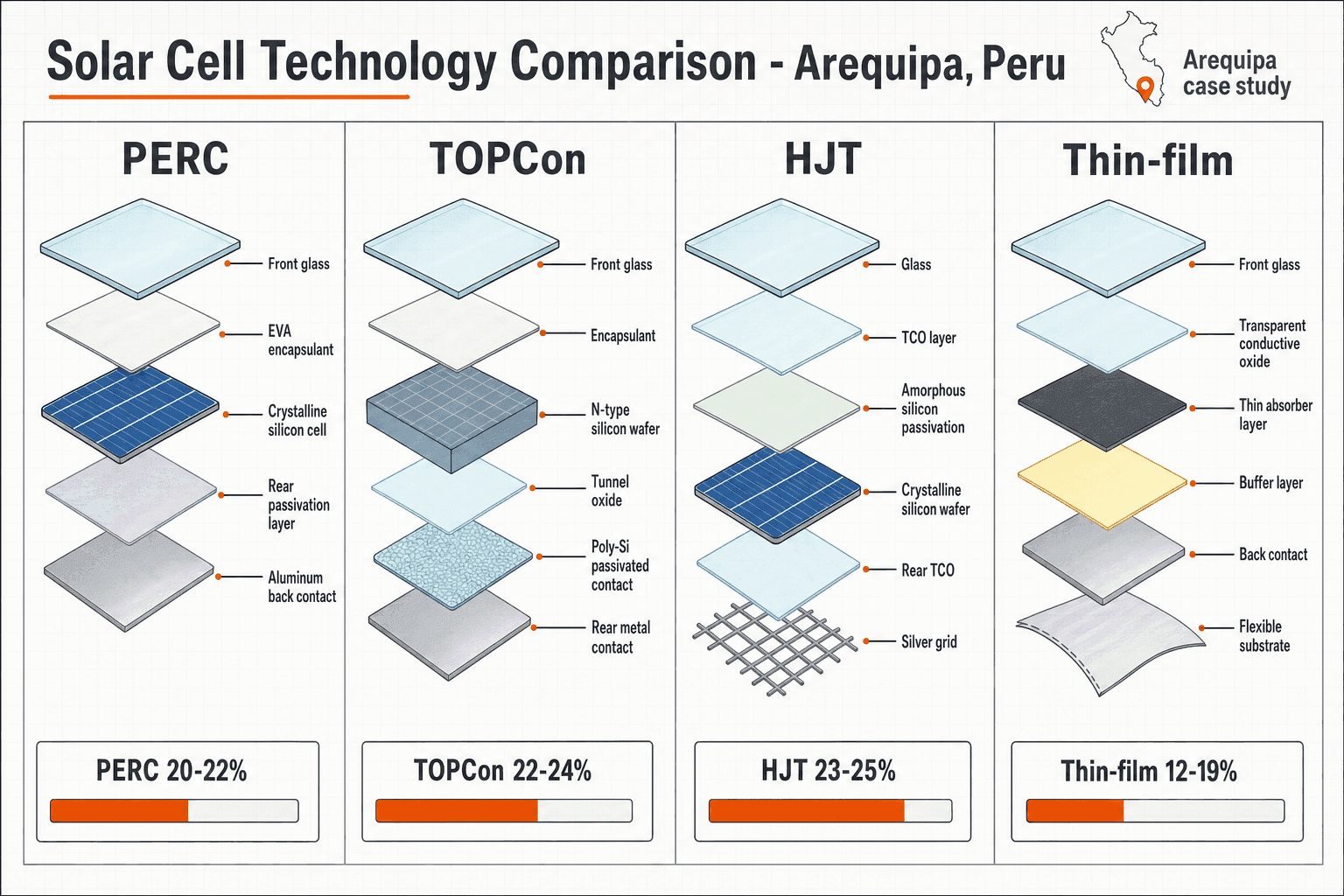
The project-specific configuration is a 1.3 MW industrial rooftop solar PV system using approximately 2,180 TOPCon panels, each rated at 590 W with 25% efficiency and 0.4% annual degradation. This falls squarely into the 500 kW-5 MW C&I / industrial category in the SOLARTODO Solar PV System architecture. For this size class, the correct configuration is multiple inverter blocks or a central inverter, AC protection, transformer integration where needed, and grid-tied metering; it is not a residential single-string design.
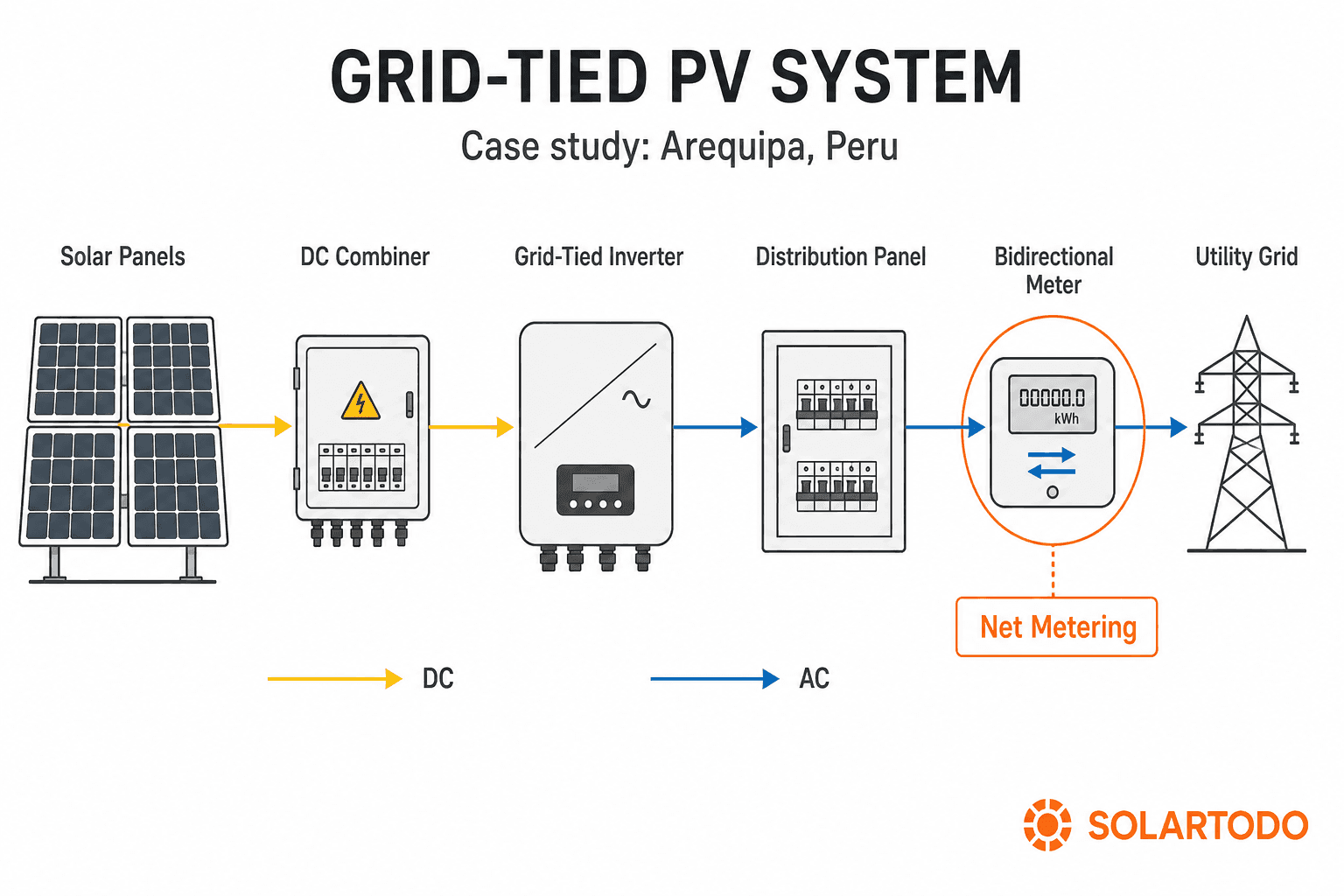
A recommended Arequipa configuration would include fixed aluminum tilt racks at 25°, DC string grouping, DC combiner protection, a 98% CEC-efficiency central inverter, AC distribution, and bi-directional net metering where allowed. The specified DC/AC ratio of 1.15 is appropriate for improving inverter loading without forcing extreme clipping assumptions. For a factory or warehouse roof, the engineering review should confirm structural loading, waterproofing details, cable tray routing, fire setbacks, and maintenance walkways.
According to NREL (2023), PV performance modeling depends heavily on irradiance, tilt, losses, and inverter efficiency rather than nameplate capacity alone. Applying the provided assumptions, the annual energy yield is approximately 2,220,215 kWh after about 14% losses from soiling, shading, mismatch, wiring, and availability. This is the correct way to frame the system: as a technical recommendation for Arequipa’s site conditions, not as a claimed completed SOLARTODO deployment.
SOLARTODO would position this design for industrial customers with daytime load profiles such as cold storage, packaging, light manufacturing, shopping centers, logistics sheds, and mining-service workshops. The best-fit buyer has large daytime consumption, available roof area, predictable maintenance access, and utility bills where avoided energy imports improve payback. For export-heavy facilities, the interconnection study should verify reverse-power limits and transformer loading before procurement.
Technical Specifications
This Arequipa configuration uses 2,180 TOPCon 590 W modules, a 1.15 DC/AC ratio, 25° fixed tilt, and IEC-qualified components.
- Product line: SOLARTODO Solar PV System for industrial rooftop C&I applications.
- Nominal size class: 1.3 MW industrial rooftop solar PV system.
- Architecture class: 500 kW-5 MW C&I / industrial, using inverter blocks with optional step-up transformer from LV to 10/35 kV where required by the interconnection study.
- PV module type: TOPCon monocrystalline panels.
- Panel quantity: approximately 2,180 panels.
- Module rating: 590 W per panel.
- Module efficiency: 25%.
- Panel degradation: 0.4% per year.
- Mounting system: aluminum fixed-tilt rooftop racks.
- Tilt angle: 25° fixed tilt.
- Inverter: central inverter, 98% CEC efficiency, 5-year warranty.
- DC/AC ratio: 1.15.
- System losses: approximately 14%, including soiling 2%, shading 3%, mismatch 2%, wiring 3%, and availability 3%.
- Solar resource assumption: 5.5 kWh/m²/day irradiance.
- Annual yield: approximately 2,220,215 kWh.
- CO2 reduction: approximately 932 tons per year, or about 41,940 trees equivalent.
- Design life: 30 years.
- Warranty: 25-year panel warranty and 5-year inverter warranty.
- Standards: IEC 61215 and IEC 61730 for PV module qualification and safety.
According to IEC (2023), IEC 61730 addresses PV module safety qualification, including construction and testing requirements. For a high-UV rooftop environment such as Arequipa, those safety requirements are material to procurement quality, insurance review, and long-term operations. IEEE states that IEEE 1547 provides “requirements relevant to the performance, operation, testing, safety, and maintenance” of interconnection, which is directly relevant to a grid-tied C&I PV system.
Implementation Approach
A 1.3 MW Arequipa rooftop PV rollout would typically proceed through survey, interconnection review, engineering, procurement, installation, commissioning, and monitoring activation.
The first phase is technical due diligence. Engineers would review 12 months of load data, roof drawings, structural capacity, shading from parapets and adjacent equipment, utility transformer rating, and available switchgear space. At this stage, the target configuration remains approximately 2,180 modules, but final string count and roof zoning should be confirmed only after electrical and structural surveys.
The second phase is design and permitting. The design package should include single-line diagrams, module layout, string schedule, inverter and combiner schedule, earthing and lightning protection design, AC protection settings, and metering configuration. According to IEEE (2018), distributed energy resources should coordinate interconnection behavior, including abnormal voltage and frequency response, with the local grid code.
Procurement would then align the module, inverter, rack, DC combiner, AC distribution, cable, connector, monitoring, and safety equipment packages. SOLARTODO can support FOB Supply, CIF Delivered, or EPC Turnkey delivery, but the engineering package should still define acceptance tests before shipment. For Arequipa, special attention should be given to dust exposure, rooftop wind uplift, cable UV rating, and corrosion protection for roof-mounted hardware.
Installation would typically move from roof preparation to rack anchoring, module placement, DC cabling, inverter installation, AC tie-in, and monitoring setup. Commissioning should include insulation resistance testing, polarity checks, open-circuit voltage verification, inverter startup, protection checks, portal activation, and baseline performance-ratio recording. A typical schedule for a 1.3 MW rooftop system is often measured in weeks rather than days, with utility approval and roof readiness usually driving the critical path.
Expected Performance & ROI
With 5.5 kWh/m²/day irradiance and 14% losses, the recommended Arequipa system would generate about 2.22 GWh per year.
The expected annual yield of 2,220,215 kWh is the central performance indicator for this configuration. It reflects the provided irradiance assumption, a 25° fixed tilt, a 1.15 DC/AC ratio, 98% central inverter efficiency, and realistic losses. According to NREL (2023), losses such as soiling, shading, wiring, mismatch, and availability should be explicitly modeled because they can materially change annual production.
ROI depends on tariff structure, self-consumption ratio, financing, local taxes, and the value assigned to avoided carbon emissions. For an Arequipa industrial customer with strong daytime load, the commercial goal is to maximize on-site use of the 2.22 GWh/year rather than export low-value surplus. Payback should therefore be calculated from the customer’s interval load profile and utility tariff, not from generic national averages.
According to IRENA (2023), about 86% of renewable capacity added in 2022 had lower costs than fossil-fuel-fired electricity. IRENA also reported that renewable capacity added since 2000 reduced electricity-sector fuel costs by at least USD 520 billion in 2022. Those global benchmarks support C&I solar adoption, but project economics still need site-specific quotation and grid review.
Maintenance requirements are moderate but not optional. Arequipa’s dry climate increases the importance of soiling inspection and cleaning frequency, especially during low-rain months. A practical O&M plan would include visual inspection, IV curve or string diagnostics when underperformance appears, inverter alarm review, thermal imaging for connectors and combiner boxes, and annual torque checks on accessible mounting points.
Comparison Table
The 1.3 MW Arequipa recommendation fits the C&I class, exceeding small commercial yield while avoiding utility-scale substation complexity.
| Metric | 100 kW Small Commercial | 1.3 MW Arequipa Industrial Recommendation | 10 MW Utility Small |
|---|---|---|---|
| SOLARTODO architecture class | 15-100 kW | 500 kW-5 MW C&I / industrial | 5-50 MW utility small |
| Typical site | Small roof or carport | Factory / warehouse rooftop | Open land tracker |
| Module technology | PERC or TOPCon | TOPCon, 590 W, 25% efficiency | TOPCon or utility module |
| Approximate module count | 170-190 modules at 590 W | 2,180 modules at 590 W | 16,900+ modules at 590 W |
| Inverter approach | 1-2 string inverters | Central inverter, 98% CEC efficiency | Multiple central inverters |
| Interconnection | LV commercial service | LV with possible 10/35 kV step-up | 35 kV collector / substation |
| Annual yield basis | Site-specific | 2,220,215 kWh at 5.5 kWh/m²/day | Utility-scale model required |
| Procurement complexity | Low to moderate | Moderate, roof and utility studies required | High, land and grid studies required |
Pricing & Quotation
SOLARTODO provides Arequipa buyers with 3 quotation paths for a 1.3 MW industrial Solar PV System: FOB, CIF, and EPC Turnkey.
SOLARTODO offers three pricing tiers for this product line: FOB Supply (equipment ex-works China), CIF Delivered (including ocean freight and insurance), and EPC Turnkey (fully installed, commissioned, with 1-year warranty). Volume discounts are available for large-scale deployments. Configure your system online for an instant estimate, or request a custom quotation from our engineering team at [email protected].
For technical review before quotation, buyers can compare the product scope at SOLARTODO Solar PV System and then contact us with roof drawings, 12 months of load data, utility bills, transformer rating, and preferred delivery scope. No price should be finalized until roof structure, interconnection limits, logistics, and local installation responsibilities are confirmed.
Frequently Asked Questions
A strong Arequipa Solar PV System specification should answer 10 procurement questions covering capacity, warranty, installation, ROI, maintenance, and grid connection.
Q1: What Solar PV System size is recommended for an industrial rooftop in Arequipa? A typical recommendation is a 1.3 MW industrial rooftop system using approximately 2,180 TOPCon 590 W panels. This sits in SOLARTODO’s 500 kW-5 MW C&I category, where central inverter conversion, AC distribution, monitoring, and possible 10/35 kV step-up integration are more appropriate than residential string-inverter architecture.
Q2: How much electricity would the Arequipa configuration generate each year? Using the project-specific assumption of 5.5 kWh/m²/day irradiance and about 14% total system losses, the expected annual yield is approximately 2,220,215 kWh. Actual output should be validated with roof layout, shading analysis, module orientation, inverter clipping review, soiling assumptions, and a bankable simulation model.
Q3: What panels are specified for this system? The recommended configuration uses TOPCon monocrystalline panels rated at 590 W each, with 25% efficiency and 0.4% annual degradation. The modules should comply with IEC 61215 for design qualification and IEC 61730 for safety qualification, which are important for industrial procurement, insurance review, and long-term durability.
Q4: What inverter configuration is used? The project-specific design uses a central inverter with 98% CEC efficiency and a 5-year warranty. For a 1.3 MW industrial rooftop, this is technically aligned with C&I architecture, provided the final design includes DC combiner protection, AC switchgear, monitoring, utility synchronization, and protection settings accepted by the local distributor.
Q5: How long would deployment typically take? A 1.3 MW rooftop deployment is typically planned in phases: survey, engineering, interconnection review, procurement, installation, commissioning, and monitoring activation. The physical installation may take several weeks, but the overall timeline depends on roof readiness, utility approval, shipping scope, structural reinforcement needs, and whether the buyer selects FOB Supply, CIF Delivered, or EPC Turnkey.
Q6: What maintenance is required in Arequipa’s climate? Arequipa’s dry, high-irradiance environment makes soiling management important. The model assumes 2% soiling loss, but cleaning intervals should be adjusted after monitoring actual production. O&M should include module cleaning, inverter alarm checks, thermal inspections, DC connector review, combiner inspection, earthing checks, and annual mechanical checks on the fixed-tilt rack system.
Q7: What is the expected ROI or payback period? ROI should be calculated from the customer’s tariff, self-consumption ratio, financing terms, and export compensation rules. The technical base case produces about 2.22 GWh/year, so industrial sites with high daytime load generally have better payback than export-heavy sites. SOLARTODO should model low, base, and high tariff scenarios before final quotation.
Q8: How does this compare with a smaller 100 kW commercial system? A 100 kW system may fit a small shop, carport, or office roof, but it cannot offset the same industrial daytime load as a 1.3 MW system. The Arequipa recommendation uses approximately 2,180 panels, central inverter conversion, and C&I-level protection, while smaller systems usually use fewer strings and one or two string inverters.
Q9: Does SOLARTODO provide EPC pricing? Yes. SOLARTODO offers FOB Supply, CIF Delivered, and EPC Turnkey quotation paths, but prices are not stated in this analysis. EPC pricing should be based on roof structure, interconnection point, installation labor, logistics, taxes, protection requirements, monitoring scope, and commissioning responsibilities after technical documents are reviewed.
Q10: What warranty applies to the Arequipa configuration? The project-specific warranty basis is a 25-year panel warranty and a 5-year central inverter warranty. The TOPCon panels also carry a 0.4% annual degradation assumption over a 30-year system design life. Buyers should confirm warranty documents, exclusions, claim procedures, and local service responsibilities during procurement.
References
These 8 references support the Arequipa 1.3 MW PV sizing, including population, irradiance, IEC safety standards, interconnection, and renewable-cost context.
- World Bank (2024): Peru urban population indicators show national urbanization above 78%, supporting city-focused C&I energy planning. https://data.worldbank.org/indicator/SP.URB.TOTL.IN.ZS?locations=PE
- IMPLA / Municipalidad Provincial de Arequipa (2023): Metropolitan planning data estimates Arequipa Metropolitana at approximately 1,190,847 residents. https://www.impla.gob.pe/
- Global Solar Atlas / World Bank and ESMAP (2024): Solar resource maps identify southern Peru and Arequipa as high-irradiance areas suitable for PV feasibility screening. https://globalsolaratlas.info/
- NREL (2023): PVWatts and PV performance modeling guidance emphasizes irradiance, tilt, inverter efficiency, and explicit system-loss assumptions. https://pvwatts.nrel.gov/
- IEC (2021): IEC 61215 defines terrestrial PV module design qualification and type approval requirements. https://webstore.iec.ch/publication/61345
- IEC (2023): IEC 61730 defines PV module safety qualification requirements for construction and testing. https://webstore.iec.ch/publication/67425
- IEEE (2018): IEEE 1547 establishes interconnection and interoperability requirements for distributed energy resources. https://standards.ieee.org/ieee/1547/5915/
- IRENA (2023): Renewable Power Generation Costs report documents global renewable cost competitiveness and USD 520 billion in 2022 fuel-cost savings. https://www.irena.org/Publications/2023/Aug/Renewable-power-generation-costs-in-2022
Equipment Deployed
- 2,180 × TOPCon monocrystalline solar panels, 590 W each, 25% efficiency
- Fixed-tilt aluminum rooftop rack system, 25° tilt angle
- Central inverter, 98% CEC efficiency, 5-year warranty
- DC combiner and string protection equipment
- AC distribution panel and grid-tied protection equipment
- Bi-directional net metering interface
- Monitoring and commissioning package
- IEC 61215 and IEC 61730 compliant PV module documentation