Ankara Telecom Tower Market Analysis: 35m Steel Monopole Configuration Guide
Summary
Ankara's 5.91 million residents and Turkey's 80.69 million mobile connections create a macro-site need where a typical 28-unit, 35m steel monopole configuration would provide 252 panel positions over a 30-year design life.
Key Takeaways
For Ankara, the recommended Telecom Tower baseline is 35m, approximately 18t per tower, and 28 units supporting 252 panel antennas.
- A typical 28-unit deployment would use 35m tapered steel monopoles, yielding 252 panel antenna positions and 168 RRU positions.
- Each tower weighs approximately 18t, following the engineering rule of 500kg/m x 35m, for about 504t total steel.
- Wind design should use TIA-222-H wind class 1, equal to 40m/s with factor 1.0 for this configuration.
- The recommended antenna load is 9 panel antennas, 1 microwave dish, and 6 RRUs per tower with 2 antenna platforms.
- CKD shipping would reduce volume by 60-70%, while production should be planned at 30-45 days after drawing approval.
- The size class is 25-35m suburban/residential, matching 2 platforms, 6-9 panel antennas, and 15-22t per tower.
- The foundation should be concrete drilled pier, with grounding, lightning rod, aircraft warning light, cable tray, ladder, and safety cage.
- The design package should reference TIA-222-H / GB/T 50233 and a 30-year design life in a high corrosion zone.
Market Context for Ankara
Ankara's 25-district capital profile, 5.91 million residents, and 938m elevation make macro tower siting a coverage-and-resilience planning issue for operators.
According to Turkish Statistical Institute (2026), Ankara Province reached 5,910,320 residents as of 31 December 2025, making it Turkey's second largest city market. The metropolitan province spans about 25,632 km2 and 25 districts, which creates both dense urban demand and long suburban coverage corridors. At 39.93 latitude, 32.85 longitude and about 938m elevation, Ankara is an inland capital with broad plateaus, dense residential districts, and transport approaches that reward macro height. This article is a market analysis and technical guide, not a record of a completed SOLARTODO installation.
Local Demand Signals
According to DataReportal (2024), Turkey had 80.69 million cellular mobile connections at the start of 2024, equal to 93.8% of the population. The same source reported 74.41 million internet users and 86.5% internet penetration, while Ookla-based data showed 33.96 Mbps median mobile speed. Those figures indicate demand for capacity, backhaul resilience, and repeatable macro-site structures in large cities such as Ankara. DataReportal states, 'A total of 80.69 million cellular mobile connections were active'.
According to ITU (2025), 5G reaches more than half of the global population and accounts for more than one third of mobile broadband subscriptions. ITU states, 'Mobile broadband coverage is nearly universal, but quality and affordability gaps persist.' For Ankara, that means tower planning should not be reduced to raw coverage only; operators also need elevation, backhaul mounting, grounding, and maintainable access for 4G/5G overlays. According to Turkish State Meteorological Service climate normals, Ankara's annual precipitation is about 414mm, with monthly mean temperatures around 0.9C in January and 24.3C in July, so freeze-thaw, dust, UV exposure, and seasonal expansion should be considered.
Recommended Technical Configuration
A typical 28-unit Telecom Tower deployment in Ankara would use 35m monopoles because the 25-35m class matches suburban macro coverage.
The correct size class is 25-35m | suburban/residential | 2 platforms | 6-9 panels | 15-22t per tower. A 35m monopole sits at the upper edge of this class, providing macro clearance without moving into a heavier 40m or 45m tower family. The antenna load includes 9 panel antennas plus 1 microwave dish and 6 RRUs; the microwave dish is a backhaul add-on validated in the structural calculation, not a shift into lattice construction. SOLARTODO's SOLARTODO Telecom Tower recommendation remains one product form: tapered steel monopole, not lattice, not FRP, and not joint-use.
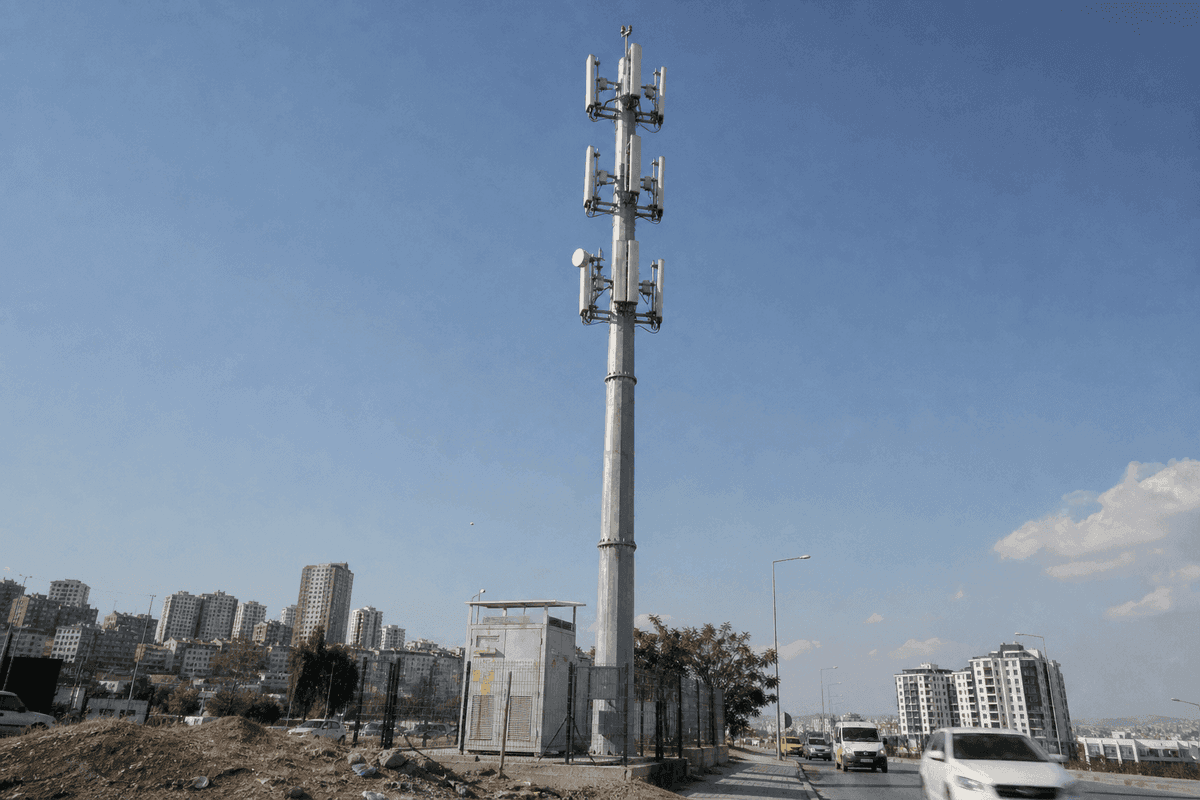
A typical 28-unit deployment in this profile would consist of approximately 28 tapered round or octagonal steel tube monopoles, each 35m high and about 18t. The weight follows 500kg/m x 35m = 17.5t, rounded to approximately 18t, which is consistent with the 15-22t size class. Each site would be configured for 9 panel antennas, 1 microwave dish, and 6 RRUs, with 2 antenna platforms and a climbing ladder with safety cage for maintenance. The pole class is regional macro / high-coverage tower for suburban and edge-of-urban Ankara corridors.
For foundations, concrete drilled pier foundations are appropriate for the 35m height where geotechnical drilling confirms bearing capacity, groundwater level, and lateral resistance. Pier foundations reduce surface footprint compared with large pad foundations, which is useful near roads, utility corridors, and constrained municipal parcels. Final pier diameter, depth, reinforcement, anchor bolt cage, and grounding electrode layout should be confirmed by soil report, Turkish permitting requirements, and TIA-222-H load combinations. SOLARTODO should treat approximately 28 units as a procurement planning scope, not evidence of past Ankara delivery.
Technical Specifications
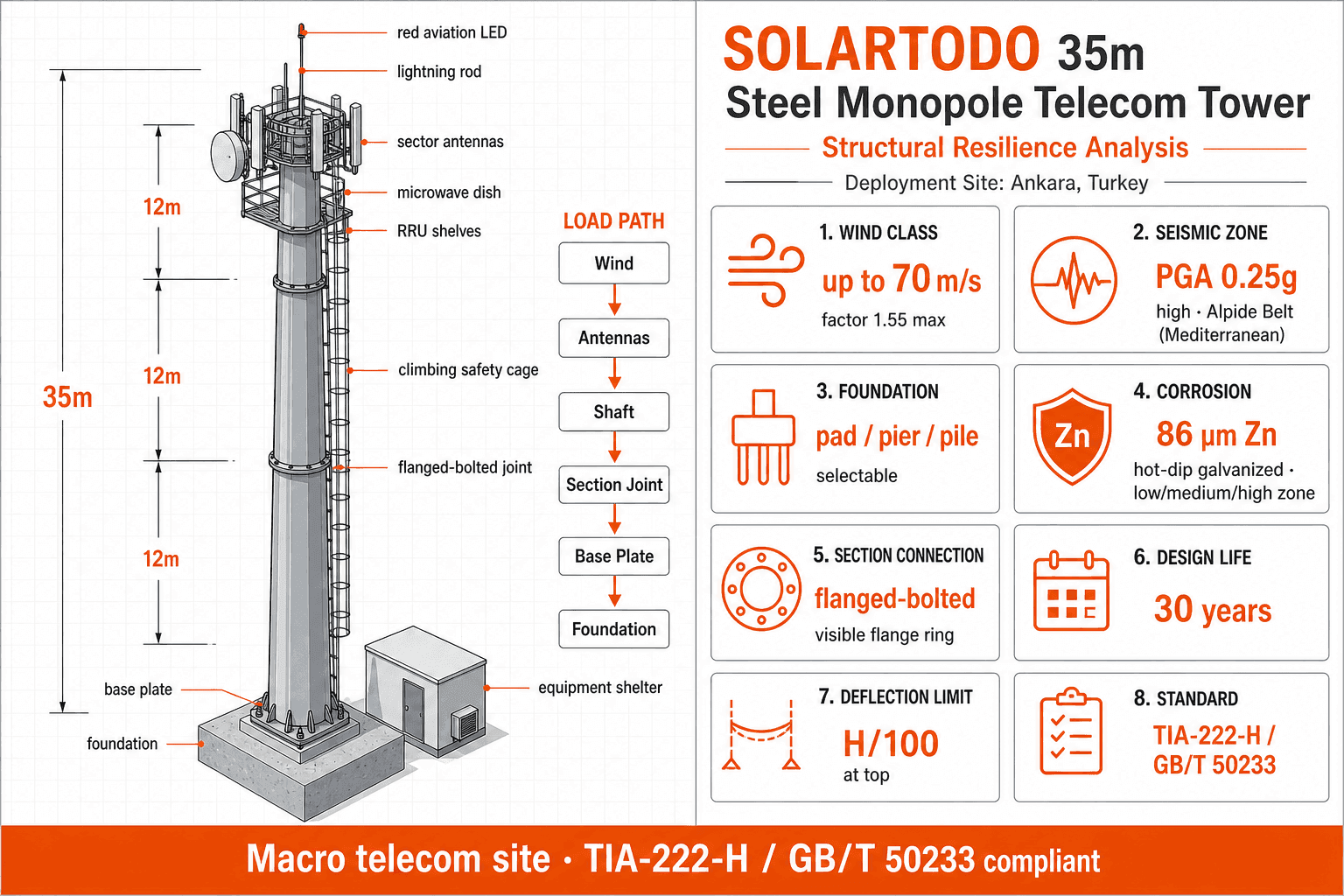
The Ankara recommendation is a 35m, approximately 18t hot-dip galvanized Q345 steel monopole with 40m/s wind design and 30-year life.
TIA states, 'TIA develops standards ensuring quality, security, interoperability, and reliability across infrastructure.' According to TIA (2017), ANSI/TIA-222-H provides the structural reference basis for antenna-supporting towers, including wind and reliability design checks. According to IEC (2010), IEC 62305 organizes lightning protection for structures and electronic systems, which is relevant to the specified lightning rod and grounding system. The technical configuration below uses SOLARTODO's product engineering inputs and the matched 25-35m size class.
- Quantity: approximately 28 units as a recommended Ankara planning package.
- Tower form: tapered round or octagonal steel monopole only, with flanged bolt-on sectional design.
- Height and weight: 35m, approximately 18t per tower, based on 500kg/m x 35m.
- Matched size class: 25-35m suburban/residential, 2 platforms, 6-9 panel class, 15-22t per tower.
- Material: hot-dip galvanized Q345 steel for a specified high corrosion zone.
- Antenna load: 9 panel antennas, 1 microwave dish, and 6 RRUs per tower.
- Foundation: concrete pier, drilled pier type, finalized after geotechnical confirmation.
- Wind class: class 1, 40m/s, factor 1.0 per TIA-222-H design basis.
- Accessories: climbing ladder, cable tray, aircraft warning light, grounding system, lightning rod, 2 antenna platforms, and safety cage.
- Logistics: CKD shipping with 60-70% volume reduction for container efficiency.
- Production and life: 30-45 days production and 30-year design life.
- Standards: TIA-222-H / GB/T 50233, with IEC 62305 alignment for lightning protection where specified.
Implementation Approach
A practical Ankara rollout would sequence 30-45 days of fabrication before CKD shipment, drilled-pier foundations, tower erection, grounding, and RF commissioning.
The first phase would be desktop planning, permitting, and site validation. Candidate parcels should be checked for RF coverage need, microwave line-of-sight, access road condition, setback limits, aviation marking requirements, and utility conflicts. Geotechnical drilling should confirm whether the drilled pier foundation is adequate at each location. The 28-unit bill of materials should be frozen only after antenna loading, platform height, and grounding layout are approved.
The second phase would be fabrication and logistics. Q345 steel sections should be cut, formed, welded, flange-matched, hot-dip galvanized, and trial-fitted before packing. CKD shipment is preferred because sectional monopoles reduce shipping volume by 60-70% compared with fully assembled pole transport. For Ankara import planning, this reduces container pressure and simplifies staged delivery to multiple districts.
The third phase would be civil works, erection, and commissioning. Drilled piers should be reinforced, poured, cured, and surveyed before anchor bolt acceptance. Erection should use controlled crane lifts, flange bolt torque records, verticality checks, grounding resistance tests, aircraft warning light checks, and antenna platform inspection. RF commissioning then validates panel orientation, microwave alignment, RRU cabling, feeder routing, and as-built documentation.
Expected Performance & ROI
The 28-unit configuration would create 252 panel positions, 28 microwave positions, and 168 RRU positions across a 30-year asset base.
The main performance output is structural readiness for macro coverage, not a promise of network throughput. Approximately 28 towers x 9 panel antennas equals 252 panel positions, while 28 towers x 6 RRUs equals 168 RRU positions. The 28 microwave dish positions support backhaul-focused links where fiber is unavailable, delayed, or commercially inefficient. Actual 4G/5G performance depends on spectrum, radio vendor, antenna azimuth, backhaul capacity, interference planning, and operator core-network design.
ROI should be modeled rather than claimed. A responsible Ankara model should test 6-year, 8-year, and 10-year payback scenarios using local site lease assumptions, civil works, import logistics, maintenance, energy, backhaul, and tenancy. The 30-year design life allows the structural asset to be annualized over a long period, while radio equipment can be refreshed on a shorter cycle. Collocation from one anchor tenant to a second tenant can improve payback because steel, foundation, grounding, and access costs are already in place.
Lifecycle cost control comes from standardizing the 35m tower package across similar suburban macro sites. Annual inspections should check coating condition, bolt torque, ladder and safety cage integrity, grounding continuity, aviation light operation, and platform corrosion. A 3-5 year coating and hardware review cycle is appropriate in a high corrosion specification, even though Ankara is inland rather than marine. The financial model should treat SOLARTODO supply scope, CIF delivery, and EPC turnkey separately because each tier moves different logistics, installation, and warranty responsibilities into the buyer's cost base.
Comparison Table
This comparison shows why 35m and 18t fit Ankara better than 25m infill or 40m peri-urban tower classes for this profile.
| Metric | Recommended Ankara Configuration | 25m Urban Infill Alternative | 40m Peri-Urban Alternative |
|---|---|---|---|
| Product form | Steel monopole | Steel monopole | Steel monopole |
| Size class | 25-35m suburban/residential | 15-25m rooftop/urban infill | 35-45m highway/peri-urban |
| Tower height | 35m | 25m | 40m |
| Typical platforms | 2 platforms | 1 platform | 2-3 platforms |
| Panel antenna class | 6-9 panels, using 9 panels | 3-6 panels | 6-9 panels plus 1-2 microwave |
| Approximate weight class | ~18t, within 15-22t | 8-15t | 22-30t class |
| Backhaul support | 1 microwave dish per tower | Usually limited | 1-2 microwave dishes |
| Foundation direction | Drilled concrete pier | Pad or rooftop interface | Pier or pile by soil |
| Best Ankara fit | Suburban macro and regional coverage | Dense infill | Highway or outer peri-urban coverage |
| Quotation implication | Balanced steel, height, and logistics | Lower tower mass but more sites may be needed | Higher structural and foundation class |
Pricing & Quotation
SOLARTODO structures Telecom Tower quotation paths into 3 tiers while keeping Ankara engineering inputs tied to 28 units and 35m specifications.
SOLARTODO offers three pricing tiers for this product line: FOB Supply (equipment ex-works China), CIF Delivered (including ocean freight and insurance), and EPC Turnkey (fully installed, commissioned, with 1-year warranty). Volume discounts are available for large-scale deployments. Configure your system online for an instant estimate, or request a custom quotation from our engineering team at [email protected].
Frequently Asked Questions
These 10 FAQs address tower specifications, installation, maintenance, warranty, EPC scope, and ROI modeling for a 35m Ankara Telecom Tower package.
Q1: What is the recommended Telecom Tower specification for Ankara? The recommended configuration is a 35m tapered steel monopole, approximately 18t per tower, using hot-dip galvanized Q345 steel. It supports 9 panel antennas, 1 microwave dish, and 6 RRUs with 2 antenna platforms. The package is framed as approximately 28 units for planning, not as a past SOLARTODO deployment.
Q2: Why use a steel monopole instead of lattice, FRP, or joint-use towers? A steel monopole gives Ankara macro sites a smaller visual footprint than lattice towers while preserving structural capacity for panels, RRUs, and microwave backhaul. FRP is not the specified product form and is not appropriate for this 35m, 18t macro class. Joint-use utility structures also introduce different loading, clearance, and ownership constraints.
Q3: How long would production and deployment take? Factory production should be planned at 30-45 days after drawings, antenna loads, foundation interface, and galvanizing requirements are approved. Site deployment depends on permits, soil drilling, pier curing, crane availability, and RF commissioning windows. A realistic program separates manufacturing, CKD shipping, civil works, erection, grounding, and antenna commissioning.
Q4: What foundation is recommended for the 35m Ankara tower? The recommended foundation is a concrete drilled pier, also called a concrete pier foundation. It suits 35m monopoles where soil bearing capacity and lateral resistance are confirmed by geotechnical investigation. Final pier depth, diameter, reinforcement, and anchor bolt cage should be engineered per site, especially near roads, slopes, utilities, or groundwater.
Q5: What maintenance is expected over the 30-year design life? Maintenance should include annual visual inspection, bolt torque checks, grounding continuity tests, aviation light checks, cable tray inspection, and platform safety review. In a high corrosion specification, coating condition should be reviewed every 3-5 years. RRUs, antennas, and microwave equipment may be upgraded without replacing the 35m steel monopole.
Q6: How should ROI and payback be modeled? Payback should be modeled with local site lease rates, civil works, backhaul, power, maintenance, and tenancy assumptions, not asserted as a fixed result. For Ankara planning, compare 6-year, 8-year, and 10-year scenarios. Collocation improves payback because a second tenant uses the same tower, foundation, grounding, and access infrastructure.
Q7: What EPC pricing options are available? SOLARTODO structures quotation scope as FOB Supply, CIF Delivered, or EPC Turnkey. FOB focuses on equipment ex-works China, CIF adds freight and insurance, and EPC includes installation, commissioning, and 1-year warranty. The article intentionally avoids price figures because final quotation depends on site count, foundation design, freight route, and installation scope.
Q8: What warranty approach is typical for this product line? The EPC Turnkey tier includes a 1-year warranty as stated in the SOLARTODO quotation paragraph. Buyers should define warranty boundaries for steel fabrication, galvanizing, accessories, aviation lights, grounding components, and workmanship. Long-term durability is separately supported by the 30-year design life, routine inspection, and corrosion-control maintenance plan.
Q9: How does the 35m monopole compare with a 40m tower? At 35m, the Ankara configuration remains in the 25-35m suburban/residential class with 2 platforms and 15-22t tower weight. A 40m tower moves toward the 35-45m highway/peri-urban class, typically requiring heavier steel, larger foundations, and more stringent logistics. The 35m option balances coverage, permitting, and cost control.
Q10: What standards and permits matter for installation? Structural design should reference TIA-222-H and GB/T 50233 as specified, with IEC 62305 considered for lightning protection practice. Turkish local permitting, land access, aviation obstruction marking, RF licensing, and municipal civil approvals remain site-specific. Final compliance should be checked by local licensed engineers before procurement or tower erection.
References
The 7 references below support Ankara demographics, Turkey connectivity demand, 5G context, tower structural design, lightning protection, and shipping assumptions.
- Turkish Statistical Institute and General Directorate of Mapping (2026): Address Based Population Registration System and provincial area data support Ankara's 5,910,320 population, 25 districts, and approximately 25,632 km2 area - https://data.tuik.gov.tr/ and https://www.harita.gov.tr/
- Turkish State Meteorological Service (2020): Ankara climate normals support approximately 414mm annual precipitation and 0.9C to 24.3C monthly mean temperature range - https://www.mgm.gov.tr/
- DataReportal (2024): Digital 2024 Turkey reports 74.41 million internet users, 80.69 million mobile connections, 93.8% mobile-connection ratio, and 33.96 Mbps median mobile speed - https://datareportal.com/reports/digital-2024-turkey
- International Telecommunication Union (2025): Measuring Digital Development: Facts and Figures 2025 reports 2.2 billion people offline and 5G coverage reaching more than half of global population - https://www.itu.int/itu-d/reports/statistics/facts-figures-2025/
- Telecommunications Industry Association (2017): ANSI/TIA-222-H Structural Standard for Antenna Supporting Structures and Antennas; used for wind and structural reliability basis - https://tiaonline.org/
- International Electrotechnical Commission (2010): IEC 62305 lightning protection series; relevant to lightning rods, grounding, and protection of electronic systems - https://webstore.iec.ch/publication/679
- Ministry of Housing and Urban-Rural Development of China (2014): GB/T 50233 construction and acceptance code referenced for steel pole fabrication and acceptance documentation - https://www.mohurd.gov.cn/
Equipment Deployed
- 28 units x 35m tapered steel monopole tower, approximately 18t per tower
- Hot-dip galvanized Q345 steel, round or octagonal tapered tube
- 9x panel antenna + 1x microwave dish + 6x RRU load allowance per tower
- Concrete drilled pier foundation package with anchor bolt cage
- Climbing ladder, cable tray, aircraft warning light, grounding system, lightning rod, 2 antenna platforms, and safety cage
- Flanged bolt-on sectional design for CKD shipping with 60-70% volume reduction
- TIA-222-H / GB/T 50233 design documentation with 40m/s wind class 1 basis