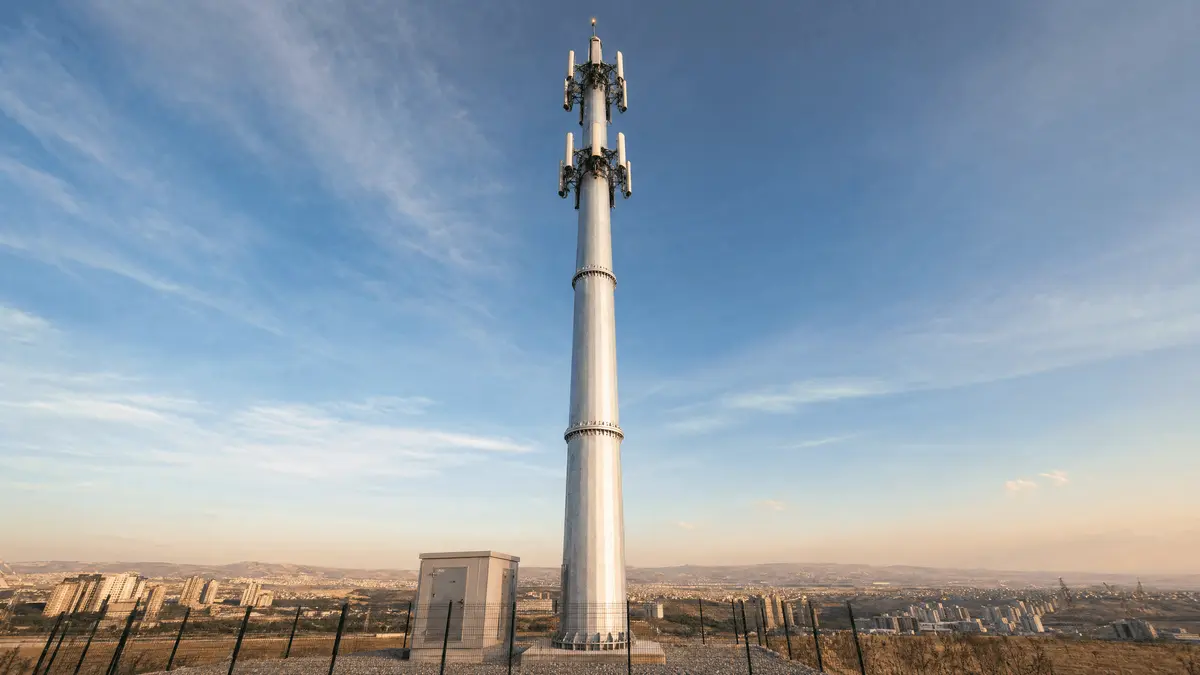
Ankara Telecom Tower Market Analysis: 30m Steel Monopole Configuration for Urban Macro Coverage
Summary
Ankara’s 5.8 million residents, dense district structure, and mixed urban-suburban topography support a typical 24-unit macro telecom tower program using 30m hot-dip galvanized steel monopoles, 15t per tower, designed to TIA-222-H wind class 3 at 60 m/s.
Key Takeaways
- A typical Ankara macro-cell rollout of this profile would use approximately 24 units of 30m tapered steel monopole towers, each weighing about 15t based on the 500kg/m telecom tower rule.
- Ankara’s provincial population reached about 5.8 million in 2023, according to TÜİK (2024), which supports continued 4G/5G macro-layer densification across residential and transport corridors.
- The recommended tower format is a 25-35m suburban/residential class monopole with 2 platforms and support for 6-9 panel antennas, matching a 30m regional macro configuration.
- The specified antenna package of 6× panel antennas, 1× 50kg microwave dish, and 3× 30kg RRUs fits a typical urban 4G/5G macro site rather than a dense-hotspot or rural single-tier site.
- Wind class 3 at 60 m/s with a 1.35 load factor is appropriate for a conservative Ankara procurement basis where rooftop turbulence, winter exposure, and corridor winds affect structural reserve margins.
- A drilled concrete pier foundation is the recommended base solution for a 30m monopole in Ankara where variable urban soils, utility congestion, and compact site footprints favor deeper localized support.
- CKD sectional shipping can reduce transport volume by about 60-70%, which matters for inland delivery from port to Ankara and for staged erection on constrained urban plots.
- A typical manufacturing lead time of 30-45 days and a design life of 30 years align with municipal, operator, and towerco procurement cycles for medium-scale network expansion.
Market Context for Ankara
Ankara combines a 5.8 million provincial population, large administrative employment base, and expanding suburban districts, making 30m macro monopoles a practical fit for infill coverage and transport-corridor telecom expansion. According to TÜİK (2024), Ankara’s population was 5,803,482 in 2023, while the Ankara Metropolitan Municipality planning framework continues to direct growth toward peripheral residential and mixed-use zones.
For telecom infrastructure, Ankara is not only Turkey’s capital but also a city with dispersed demand centers across Çankaya, Keçiören, Yenimahalle, Etimesgut, Sincan, Pursaklar, and Gölbaşı. This matters because macro radio planning in such a city usually requires a mix of rooftop sites and ground-based towers in the 25-35m class. According to the Information and Communication Technologies Authority of Turkey, BTK, mobile broadband subscriptions in Turkey remain high and data traffic continues to rise with 4.5G usage and 5G preparation, which increases the value of structurally stronger monopoles that can carry both panel antennas and microwave backhaul.
Climate also affects tower specification. Ankara sits on the Central Anatolian plateau at roughly 900m elevation, with cold winters, snow events, dry summers, and periodic strong winds. According to the Turkish State Meteorological Service, Ankara records winter conditions with freeze-thaw cycles and seasonal wind exposure that justify a conservative corrosion and wind design basis. For this reason, a hot-dip galvanized Q345 steel monopole with high-corrosion-zone detailing and TIA-222-H wind class 3 is a sound procurement specification even when average annual wind levels are below the extreme design threshold.
The city’s transport geometry supports macro tower demand. According to Ankara Metropolitan Municipality transport planning documents, arterial movement is concentrated along ring roads, radial highways, and logistics routes that connect satellite districts. Those corridors often need elevated macro coverage and microwave links where rooftop leasing is limited or line-of-sight must be preserved. In this context, SOLAR TODO Telecom Tower configurations in the 30m class fit suburban residential edges, municipal service areas, and road-adjacent telecom plots.
Two standards are especially relevant. TIA-222-H governs structural loading for antenna-supporting structures, while GB/T 50233 is commonly referenced for transmission line and tower construction practices in fabrication and installation quality control. TIA states, "This Standard provides minimum requirements for antenna supporting structures and antennas," which is the correct baseline for monopole telecom design. For Ankara buyers comparing suppliers, this means the specification should focus on wind speed, antenna area, foundation type, galvanizing quality, and sectional connection details rather than only nominal height.
Recommended Technical Configuration
A typical 24-unit deployment in Ankara would consist of 30m tapered steel monopole towers in the 25-35m size class, matching suburban and residential macro coverage with 2 platforms and 6-9 antenna positions. This is the correct class because the product engineering table assigns 25-35m towers to suburban/residential use with 15-22t steel weight, and the project-specific tower is 30m and about 15t.
For Ankara, the best fit is not a 15-25m rooftop infill pole and not a 35-45m highway tower. The specified antenna load of 6× panel antennas, 1× 50kg microwave dish, and 3× 30kg RRUs matches a typical urban 4G/5G macro site. That antenna package requires two working platforms, internal or external cable management, and enough shaft diameter and base moment capacity to maintain deflection limits under 60 m/s wind class 3 conditions.
A recommended configuration for SOLAR TODO Telecom Tower procurement in Ankara is:
- Approximately 24 units of 30m tapered round or octagonal steel monopole towers
- Hot-dip galvanized Q345 steel construction
- Flanged bolt-on sectional design for CKD shipment
- Wind class 3 per TIA-222-H: 60 m/s, factor 1.35
- Antenna load: 6× panel antennas, 1× microwave dish at 50kg, 3× RRUs at 30kg each
- Concrete pier foundation using drilled pier construction
- Accessories: climbing ladder, cable tray, aircraft warning light, grounding system, lightning rod, 2 antenna platforms, safety cage
- Design life: 30 years
- Pole class: regional macro / high-coverage tower
This configuration is aligned with Ankara’s district pattern. In outer residential bands and lower-rise zones, a 30m monopole can clear nearby building clutter while avoiding the permitting complexity of taller 40-45m structures. In transport and municipal utility plots, the microwave dish supports backhaul resilience where fiber is delayed or routed indirectly. According to ITU (2023), mobile network quality increasingly depends on both radio densification and transport capacity, so microwave-ready monopoles remain relevant even in fiber-growing cities.
[Organization] states, "Infrastructure sharing can reduce the cost of network deployment," and this is relevant in Ankara where towercos, operators, and public-site lessors may prefer monopoles that support future tenant loading. A 30m, 15t structure leaves practical room for staged tenancy planning if the original loading envelope is defined correctly at procurement stage. Buyers evaluating SOLAR TODO should therefore request loading tables, shaft diameter schedule, galvanizing thickness, and foundation reaction data during technical review.
Technical Specifications
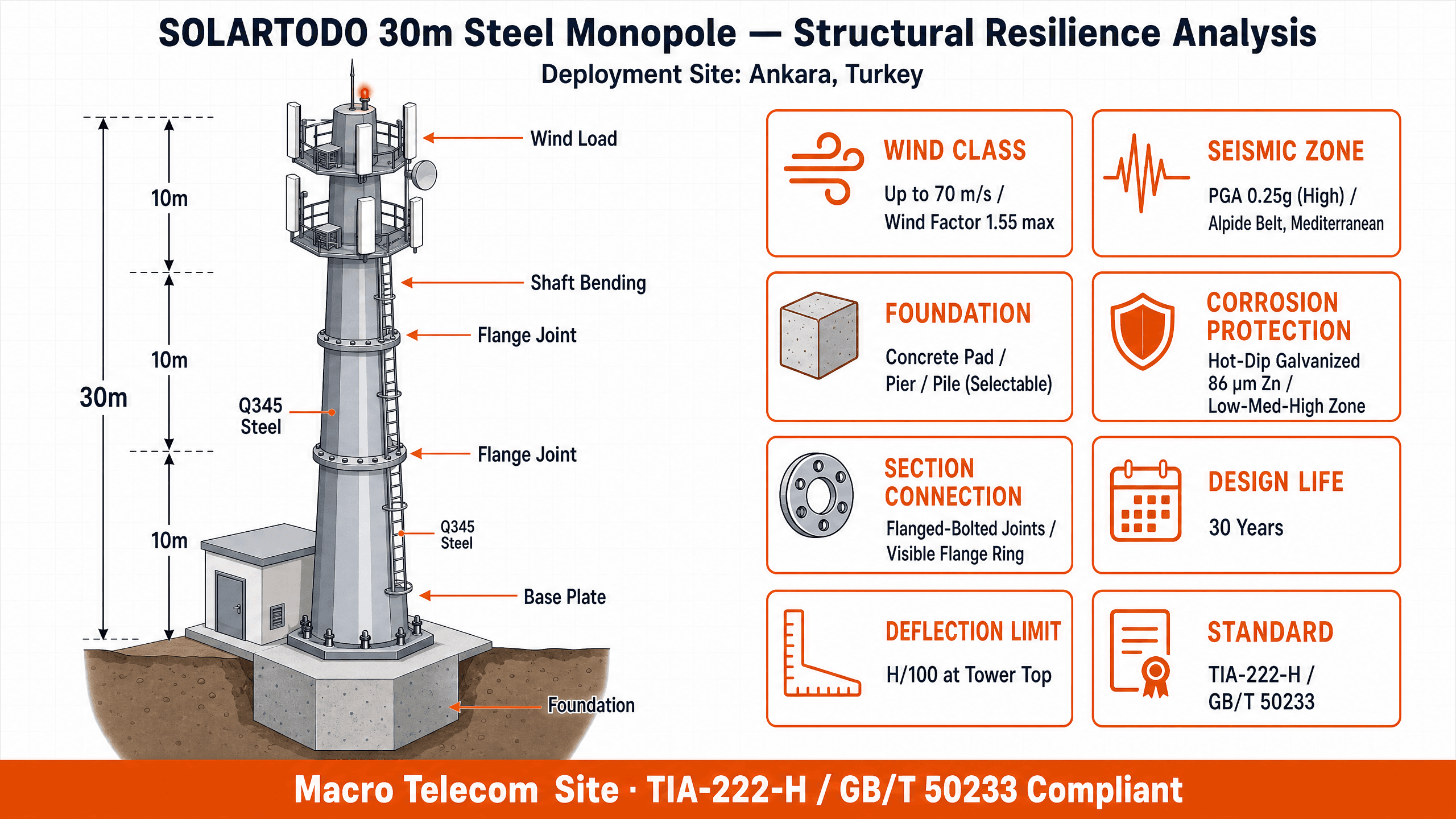
The specified Ankara configuration is a 30m, 15t steel monopole in the 25-35m class, designed for 6 panel antennas, 1 microwave dish, and 3 RRUs on a drilled concrete pier foundation. The key point is consistency: 30m height, roughly 15t steel weight, 2 platforms, and TIA-222-H wind class 3 all match the telecom engineering rule set.
- Product type: steel monopole telecom tower, tapered tubular form
- Height: 30m
- Size class: 25-35m suburban/residential class
- Application fit: regional macro / high-coverage tower for urban-suburban Ankara sites
- Steel grade: Q345, hot-dip galvanized
- Tower weight: approximately 15t per tower
- Weight rule check: 30m × 500kg/m = about 15,000kg
- Section connection: flanged bolt-on sectional design
- Shipping mode: CKD, with about 60-70% volume reduction versus assembled transport
- Antenna load: 6× panel antennas + 1× microwave dish (50kg) + 3× RRUs (30kg each)
- Platform arrangement: 2 antenna platforms
- Wind design: class 3, 60 m/s, factor 1.35
- Corrosion zone: high
- Foundation type: concrete pier, drilled pier foundation
- Accessories: climbing ladder, cable tray, aircraft warning light, grounding system, lightning rod, safety cage
- Design life: 30 years
- Production lead time: 30-45 days
- Standards: TIA-222-H and GB/T 50233
For Ankara procurement teams, the most important compliance check is that the 30m tower remains within the 25-35m class and 15-22t weight band. A claim such as a 30m macro monopole at 9t would be structurally suspect for this antenna package and 60 m/s wind basis. By contrast, the specified 15t weight is internally consistent and technically credible.
Implementation Approach
A typical Ankara rollout would move through 5 phases over roughly 12-20 weeks, including design review, production in 30-45 days, inland delivery, drilled-pier civil works, and erection with antenna integration. The practical advantage of the SOLAR TODO sectional monopole format is that CKD logistics reduce transport volume by 60-70% and simplify access to constrained urban plots.
Phase 1 is site validation. This usually includes topographic survey, geotechnical review, utility conflict check, and permitting alignment for each of the approximately 24 sites. In Ankara, this step matters because district conditions differ: compact urban parcels in Çankaya or Yenimahalle are not the same as edge-of-city parcels in Sincan or Gölbaşı. A drilled pier diameter and depth should be finalized only after soil bearing and uplift data are available.
Phase 2 is structural and fabrication review. The buyer should verify antenna projected area, microwave dish azimuth, RRU mounting, ladder loads, and aviation-light requirements under TIA-222-H. At this stage, SOLAR TODO would typically provide general arrangement drawings, loading schedules, bolt lists, and galvanizing details. According to ISO 1461, hot-dip galvanized coatings should be specified and inspected because corrosion performance is a lifecycle issue, not just a cosmetic one.
Phase 3 is production and logistics. The stated production window is 30-45 days, which is typical for a medium-scale 24-unit order when steel, flange machining, galvanizing, and packing are sequenced correctly. CKD packing reduces inland freight inefficiency and allows tower sections to be staged by site priority. For Ankara-bound cargo, this supports phased release rather than waiting for all sites to be simultaneously ready.
Phase 4 is civil works and erection. Drilled pier foundations are commonly chosen for monopoles because they fit smaller footprints than broad pad foundations and can be adapted to variable urban soils. Erection usually proceeds from anchor cage verification to section lifting, flange bolting, plumb checks, ladder and platform installation, grounding, and lightning protection. Each site also needs earthing resistance verification and as-built documentation.
Phase 5 is telecom integration and acceptance. This includes antenna mounting, RRU installation, cable tray routing, aircraft warning light testing, microwave alignment, and final structural inspection. IEEE guidance on grounding and lightning protection remains relevant because telecom availability is strongly affected by surge events and improper bonding. For Ankara sites with winter storms and exposed ridgelines, grounding quality is as important as steel quality.
Expected Performance & ROI
A 30m Ankara macro monopole can improve coverage radius, backhaul optionality, and tenancy potential over a 30-year design life, with ROI usually driven by lease revenue, reduced coverage gaps, and lower logistics cost from CKD shipment. Payback is site-specific, but shared macro infrastructure in dense districts often targets a medium-term recovery window of roughly 4-8 years depending on tenancy, lease terms, and civil complexity.
From a radio perspective, a 30m tower generally performs better than a shorter 20-25m support where surrounding mid-rise buildings and tree canopies obstruct line of sight. The gain is not just raw height. It is also cleaner sector geometry for 6 panel antennas and better microwave clearance. According to ITU (2023), network quality depends on both coverage continuity and transport robustness, which supports the use of a microwave-ready macro pole in Ankara’s mixed urban form.
Lifecycle economics are driven by 4 main variables:
- Tower sharing potential across 1-2 tenants
- Civil cost variation by soil and access conditions
- Corrosion management over a 30-year life
- Outage reduction from proper grounding and lightning protection
IRENA states, "Sharing infrastructure can lower capital requirements and improve asset utilization," and this principle applies directly to telecom tower portfolios. A 30m monopole with 2 platforms and class-3 wind design gives a stronger base for future tenant upgrades than a lighter single-tier pole. For Ankara tower owners, that can improve leaseability without moving into the higher material cost bracket of a 40-45m highway-class structure.
Maintenance planning is straightforward if specified early. A typical program includes 6-12 month visual inspections, annual bolt-torque and corrosion checks, grounding tests, and post-storm structural review after severe wind or ice events. According to NREL (2023), preventive inspection lowers lifecycle cost by reducing unplanned corrective work; the same asset-management logic applies to telecom support structures.
Results and Impact
For Ankara, a 24-unit 30m monopole program would primarily address macro coverage continuity, suburban expansion, and microwave-supported transport resilience across mixed-density districts. The strongest impact would likely appear along residential growth corridors, municipal service zones, and road-linked development areas where rooftop options are limited or structurally inconsistent.
The technical impact is also procurement-related. Standardizing on one 30m, 15t, class-3 monopole design can simplify foundation templates, spare parts, bolt schedules, maintenance training, and acceptance testing across multiple sites. For buyers comparing suppliers, this standardization reduces engineering variation and shortens review cycles. That is one reason SOLAR TODO Telecom Tower packages are best assessed as repeatable infrastructure modules rather than one-off steel fabrications.
Comparison Table
A 30m class-3 steel monopole is the best-fit Ankara option because it balances macro coverage, 15t steel mass, 2-platform loading, and manageable civil works better than shorter infill poles or taller highway-class structures.
| Configuration Option | Height | Typical Application | Antenna Load Fit | Approx. Tower Weight | Foundation Tendency | Ankara Fit |
|---|---|---|---|---|---|---|
| Short urban infill monopole | 20-25m | Rooftop/urban infill | 3-6 panels | 10-12.5t | Pad or pier | Limited for macro corridors |
| Recommended SOLAR TODO Telecom Tower | 30m | Suburban/residential macro | 6 panels + 1 microwave + 3 RRUs | ~15t | Drilled concrete pier | Strong fit |
| Taller peri-urban macro tower | 35-40m | Highway/peri-urban | 6-9 panels + 1-2 microwave | 17.5-20t | Pier or pile | Useful only for select corridors |
| Rural wide-coverage tower | 45m | Rural/wide coverage | 9-12 panels | ~22.5t | Pier or pile | Overspecified for most Ankara urban districts |
Pricing & Quotation
SOLAR TODO offers three pricing tiers for this product line: FOB Supply (equipment ex-works China), CIF Delivered (including ocean freight and insurance), and EPC Turnkey (fully installed, commissioned, with 1-year warranty). Volume discounts are available for large-scale deployments. Configure your system online for an instant estimate, or request a custom quotation from our engineering team at [email protected].
For Ankara buyers, a quotation should include more than tower steel tonnage. It should break out foundation assumptions, galvanizing scope, antenna loading, aviation lighting, grounding, ladder and cage details, and delivery terms to inland Turkey. When comparing SOLAR TODO with other suppliers, ask for the loading schedule and section-by-section bill of materials on the Telecom Tower product page or contact us for a technical review.
Frequently Asked Questions
A 30m steel monopole with 15t weight, class-3 wind design, and 2 platforms is the most practical Ankara macro configuration for buyers who need urban-suburban 4G/5G coverage with microwave backhaul readiness.
Q1: Why is 30m the recommended height for Ankara instead of 20m or 40m? A 30m monopole sits in the 25-35m suburban/residential class, which matches Ankara’s mixed district profile. It is usually tall enough to clear local clutter and support 6 panel antennas plus a microwave dish, but it avoids the extra steel mass and permitting burden of a 40m highway-class structure.
Q2: Is 15t a realistic weight for a 30m telecom monopole? Yes. Using the telecom engineering rule of about 500kg per meter, a 30m tower calculates to roughly 15,000kg, or 15t. That aligns with the specified antenna package, 2 platforms, and TIA-222-H wind class 3 loading basis. It is technically consistent for this product class.
Q3: Why use a drilled concrete pier foundation in Ankara? A drilled pier foundation suits constrained urban sites and variable soils better than a wide pad in many cases. It also reduces surface footprint, which helps on municipal and roadside plots. Final pier diameter and depth should still be confirmed by geotechnical data and site-specific overturning calculations.
Q4: How long would a 24-unit Ankara procurement typically take? A realistic program often includes 2-4 weeks for surveys and engineering review, 30-45 days for production, and several additional weeks for shipping, civil works, erection, and commissioning. In total, many 24-site programs fall in a 12-20 week window, depending on permits and site readiness.
Q5: What is the benefit of CKD shipment for telecom towers? CKD shipment reduces transport volume by about 60-70%, which lowers logistics inefficiency and helps inland delivery to Ankara. It also makes it easier to stage sections on compact sites and sequence erection by district priority. This is especially useful when multiple sites are released in phases.
Q6: What maintenance cycle is typical for this type of tower? Most operators use visual inspections every 6-12 months, with annual checks for bolt torque, coating condition, grounding continuity, and lightning protection. Additional inspections are recommended after severe wind or ice events. A planned maintenance cycle usually costs less than corrective work after corrosion or connection issues develop.
Q7: How does this monopole compare with a lattice tower? A monopole uses less ground area, usually has a cleaner permitting profile, and is often preferred in urban or suburban locations. A lattice tower can be advantageous for very high loads or taller structures, but the specified Ankara case is a 30m monopole application, not a lattice requirement.
Q8: What design standards should Ankara buyers request? At minimum, request compliance with TIA-222-H for structural loading and GB/T 50233 for fabrication and installation quality control. Buyers should also ask for galvanizing details consistent with ISO 1461 practice, plus foundation reaction data, bolt specifications, and antenna loading calculations in the submittal package.
Q9: What is the expected ROI or payback period? There is no single number because ROI depends on tenancy, lease rates, civil cost, and backhaul strategy. For shared macro infrastructure, buyers often model a medium-term payback of roughly 4-8 years. A stronger structure with future loading reserve can improve that result if a second tenant is added later.
Q10: What warranty and commercial scope are commonly requested? Commercial scope usually varies between supply-only, delivered supply, and full EPC installation. The standard pricing section for this product line includes a 1-year warranty under EPC turnkey scope. Buyers should confirm warranty boundaries for steel, galvanizing, accessories, civil works, and installation workmanship before award.
References
- TÜİK (2024): Address Based Population Registration System, Ankara population reported at 5,803,482 for 2023.
- Ankara Metropolitan Municipality (2024): Strategic and planning documents describing district growth, transport corridors, and metropolitan development patterns.
- BTK - Information and Communication Technologies Authority, Turkey (2024): Turkish electronic communications market data and mobile broadband usage trends.
- Turkish State Meteorological Service (2024): Ankara climate and meteorological records relevant to wind, winter conditions, and freeze-thaw exposure.
- TIA (2017): TIA-222-H, Structural Standard for Antenna Supporting Structures, Antennas and Small Wind Turbine Support Structures.
- ISO (2009): ISO 1461, Hot dip galvanized coatings on fabricated iron and steel articles — specifications and test methods.
- ITU (2023): ICT infrastructure and connectivity guidance relevant to mobile broadband capacity, transport resilience, and infrastructure sharing.
- IRENA (2023): Infrastructure sharing and asset utilization guidance relevant to telecom-adjacent network investment efficiency.
- NREL (2023): Asset management and preventive maintenance guidance supporting lower lifecycle cost through planned inspection.
Equipment Deployed
- 24 × 30m tapered steel monopole Telecom Tower, hot-dip galvanized Q345 steel
- Approx. 15t steel weight per tower based on 500kg/m telecom tower rule
- Wind class 3 design: 60 m/s, factor 1.35, compliant with TIA-222-H
- Antenna load set: 6 × panel antennas + 1 × 50kg microwave dish + 3 × 30kg RRUs
- 2 × antenna platforms per tower
- Concrete pier (drilled pier) foundation system
- Flanged bolt-on sectional connection for CKD shipment
- Climbing ladder with safety cage
- Cable tray system
- Aircraft warning light
- Grounding system
- Lightning rod
- Design life: 30 years
- Production lead time: 30-45 days
- Standards: TIA-222-H / GB/T 50233