
Ankara Telecom Tower Market Analysis: 40m Monopole Configuration Guide for Macro Coverage and Microwave Backhaul
Summary
Ankara’s 5.8 million population, continental wind exposure, and expanding suburban mobility corridors support a typical 16-unit, 40m steel monopole telecom tower program using Wind Class 3 (60 m/s) design, drilled pier foundations, and 6-panel plus 2-dish backhaul loading for regional macro coverage.
Key Takeaways
- A typical Ankara macro-cell reinforcement package would use approximately 16 units of 40m tapered steel monopole towers for peri-urban and corridor coverage.
- The specified tower profile fits the 35-45m size class, which aligns with highway/peri-urban applications and supports 6-9 panels plus 1-2 microwave dishes.
- Based on the project-specific configuration, each tower would weigh about 20 tonnes using the telecom rule of ~500 kg/m × 40m.
- The recommended structural basis is Q345 hot-dip galvanized steel, Wind Class 3, with a 60 m/s basic wind design and 1.35 load factor under TIA-222-H.
- For Ankara’s mixed alluvial and urbanized ground conditions, a concrete drilled pier foundation is the practical default for 40m monopoles with medium corrosion exposure.
- A standard antenna package for this profile is 6 panel antennas + 2 microwave dishes, supported by 2 antenna platforms, ladder, cable tray, grounding, lightning rod, and aircraft warning light.
- CKD shipment can reduce logistics volume by about 60-70%, which matters for inland delivery from Turkish ports to Ankara’s logistics and industrial zones.
- A realistic supply window for this configuration is 30-45 days for production, followed by civil works, erection, and commissioning under TIA-222-H / GB/T 50233.
Market Context for Ankara
Ankara’s telecom tower requirement is shaped by a metropolitan population above 5 million, a wide service area, and transport-linked suburban growth that favors 35-45m macro monopoles rather than short rooftop-only structures.
Ankara is Türkiye’s capital and one of its largest metropolitan areas. According to the Turkish Statistical Institute, Ankara Province has a population of roughly 5.8 million in recent reporting, making it the country’s second-largest urban market after Istanbul. That scale matters for telecom planning because macro coverage must serve dense central districts, low-rise residential belts, industrial estates, and highway approaches in one province. For B2B buyers, this creates a mixed topology where 40m monopoles are often more practical than very short urban infill poles.
According to the International Telecommunication Union (ITU) (2023), mobile broadband traffic growth continues to shift capacity demand from voice-led planning to data-led planning, increasing the need for both radio densification and stronger backhaul. Ankara fits that pattern because it combines government campuses, universities, logistics corridors, and suburban commuting zones. A tower program in this market would therefore need to balance broad-area RF coverage with microwave backhaul resilience. That is why a 6-panel + 2-dish loading set is a technically coherent fit.
Climate and wind also matter. Ankara sits on the Central Anatolian plateau at roughly 900 m elevation, with cold winters, summer heat, and open-exposure districts outside the dense core. According to the Turkish State Meteorological Service, the city has a continental climate with winter snow, seasonal icing risk, and gust exposure in open terrain. For telecom structures above 35m, this supports a conservative structural approach using TIA-222-H Wind Class 3 at 60 m/s rather than a lower wind category.
The municipality and national transport plans also point to continued corridor development. According to Ankara Metropolitan Municipality planning documents and Türkiye’s broader transport and logistics investment programs, growth remains tied to ring roads, industrial clusters, and intercity transport links. These are exactly the areas where 40m regional macro towers with microwave dishes are useful, because fiber is not always immediately available at every candidate site. In those conditions, microwave backhaul remains a practical part of the network design.
Two authority statements are relevant here. The ITU states, "Infrastructure sharing and efficient deployment of passive infrastructure remain important enablers of broadband expansion." TIA states in TIA-222-H that antenna-supporting structures must be designed for site-specific environmental loading, including wind, ice, and serviceability criteria. For Ankara, both points support a standardized monopole solution with repeatable civil works and repeatable antenna loading.
SOLAR TODO should therefore be viewed in this market as a supplier of standardized steel monopole infrastructure for macro telecom use, not as a generic pole vendor. The product fit is strongest where operators, tower companies, EPC firms, and public-sector connectivity programs need 40m, flanged, galvanized monopoles with microwave-ready top loading. Buyers comparing SOLAR TODO with local fabrication options should focus on standards compliance, shipping efficiency, and repeatable erection methodology.
Recommended Technical Configuration
For Ankara’s peri-urban and corridor coverage profile, the recommended fit is a typical 16-unit deployment of 40m steel monopoles in the 35-45m size class with 6 panels, 2 microwave dishes, and drilled pier foundations.
The correct engineering row from the product size table is the 35-45m | highway/peri-urban class. That row supports 2-3 platforms and 6-9 panels + 1-2 microwave, which matches the provided project-specific load case. It also corresponds to a structural mass of 22-30 tonnes in the generic class range, while the exact project configuration here is fixed at about 20 tonnes per 40m tower using the given telecom rule of ~500 kg/m × height. Since the user supplied the exact tower weight, that project value should govern the recommendation.
A typical Ankara deployment of this scale would consist of approximately 16 units × 40m tapered steel monopole towers fabricated from hot-dip galvanized Q345 steel. The loading package would be 6 panel antennas + 2 microwave dishes, which is suitable for macro-cell coverage with independent backhaul redundancy. This is not a dense urban hotspot configuration; it is a regional macro / high-coverage tower profile intended for suburban edges, transport corridors, and lower-density districts.
The preferred foundation for this configuration is a concrete pier foundation, specifically a drilled pier system. That recommendation is consistent with 40m monopoles where overturning moments are concentrated at a single shaft and where urban plots may limit large spread footings. Ankara includes mixed soils across developed and expanding districts, so final geotechnical verification is still required, but a drilled pier remains the most defensible baseline assumption for tender-stage planning.
A sectional flanged bolt-on design is the right connection approach for this height and shipping model. It supports CKD shipment with 60-70% volume reduction, which improves container efficiency and inland transport handling. For buyers in Türkiye, that matters because imported tower steel often moves through coastal ports before final delivery to inland assembly points around Ankara. SOLAR TODO’s CKD approach is relevant here because logistics cost and crane time are material cost drivers even when ex-works steel prices are competitive.
The accessory package should include a climbing ladder, cable tray, aircraft warning light, grounding system, lightning rod, 2 antenna platforms, and safety cage. Ankara’s aviation and high-point visibility requirements vary by site, but warning-light provision is a prudent standard inclusion for 40m structures. Grounding and lightning protection are also non-negotiable because Central Anatolia experiences seasonal thunderstorms and exposed topography in outer districts.
From a procurement standpoint, SOLAR TODO can position this configuration as a repeatable macro-tower standard for towercos, MNOs, and EPC contractors that need consistent structural calculations across multiple candidate sites. The production window of 30-45 days is suitable for staged rollouts where civil works and permitting run in parallel. For Ankara, that staging can reduce idle time between foundation curing and steel erection.
Technical Specifications
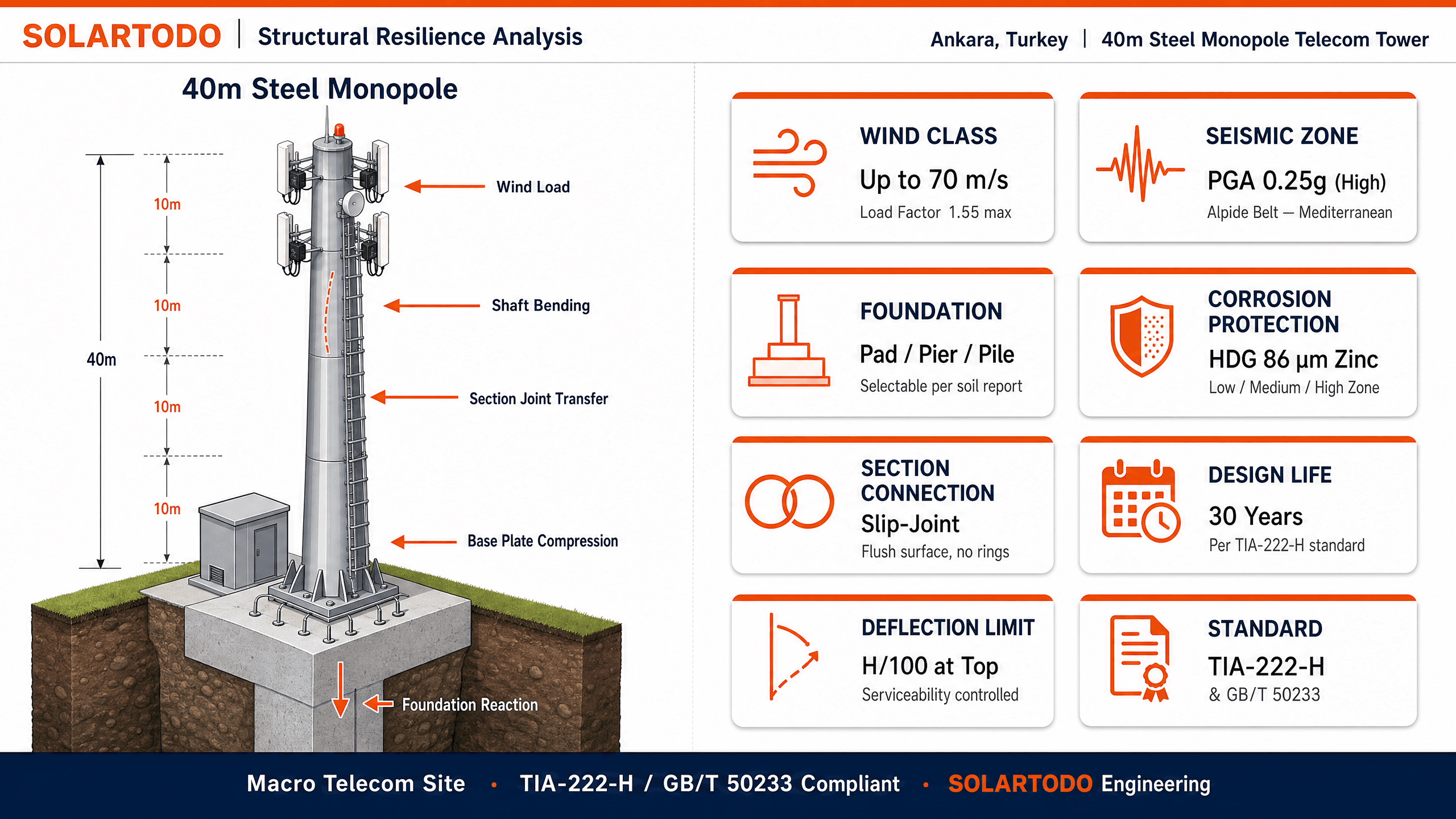
The specified Ankara configuration is a 40m, Wind Class 3, Q345 galvanized steel monopole with 6 panel antennas, 2 microwave dishes, drilled pier foundation, and a 30-year design life under TIA-222-H and GB/T 50233.
- Product type: Steel Telecom Tower, tapered monopole form
- Application class: Regional macro / high-coverage tower
- Recommended city profile: Ankara suburban, peri-urban, highway, and backhaul-linked macro coverage
- Quantity basis: Approximately 16 units for a typical rollout of this scale
- Tower height: 40m
- Size class match: 35-45m | highway/peri-urban
- Tower weight: Approximately 20 tonnes per tower
- Weight rule used: ~500 kg/m × 40m = ~20,000 kg
- Material: Q345 steel
- Corrosion protection: Hot-dip galvanized
- Corrosion zone: Medium
- Wind class: Class 3
- Basic wind speed: 60 m/s
- Wind factor: 1.35
- Antenna load: 6 × panel antennas + 2 × microwave dishes
- Platforms: 2 antenna platforms
- Foundation type: Concrete pier foundation (drilled pier)
- Connection type: Flanged bolt-on sectional design
- Accessories: Climbing ladder, cable tray, aircraft warning light, grounding system, lightning rod, safety cage
- Design life: 30 years
- Shipping mode: CKD, with 60-70% volume reduction
- Production lead time: 30-45 days
- Standards: TIA-222-H / GB/T 50233
According to TIA (2017), tower design must account for wind, ice, deflection, fatigue, and appurtenance loading in a single structural framework. According to IEC guidance used widely in transmission and structural loading practice, corrosion environment and site exposure directly affect life-cycle durability assumptions. For Ankara’s medium-corrosion inland environment, hot-dip galvanizing remains the standard protective choice for a 30-year design basis.
Implementation Approach
A typical Ankara telecom tower rollout would proceed in 5 steps over roughly 10-18 weeks, from site validation and geotechnical review to CKD delivery, drilled pier construction, steel erection, and RF commissioning.
The first phase is site screening and engineering validation. For a 16-site package, buyers would normally review zoning, access roads, geotechnical conditions, and line-of-sight requirements for microwave paths. At 40m, even small changes in terrain can affect path clearance and antenna azimuth planning. This phase should also confirm whether local aviation marking rules apply to each site.
The second phase is structural detailing and manufacturing. SOLAR TODO would supply a flanged sectional monopole using Q345 steel with galvanizing suitable for a medium corrosion environment. Fabrication and galvanizing typically require 30-45 days, assuming approved shop drawings and no major scope revision. For Turkish buyers, this timeline is compatible with parallel civil procurement and permit processing.
The third phase is logistics and foundation work. CKD shipping reduces transport volume by 60-70%, which can improve container utilization and reduce inland handling complexity. On site, the drilled pier foundation is installed first, with reinforcement cage, anchor template, concrete pour, and curing sequence controlled to the approved civil design. Foundation completion timing depends on soil, but curing and dimensional verification should be complete before steel arrival.
The fourth phase is tower erection and accessory installation. A 40m monopole normally requires staged crane lifting of flanged sections, bolt torque verification, verticality checks, and installation of platforms, ladder, cable tray, safety cage, and lightning components. The RF hardware package of 6 panels + 2 dishes should be mounted only after structural and grounding checks are signed off. This reduces rework risk and protects the galvanized finish.
The fifth phase is integration and acceptance. Grounding resistance tests, plumbness checks, bolt inspection, warning light verification, and microwave alignment are completed before handover. According to industry practice reflected in TIA-based acceptance procedures, final documentation should include as-built drawings, galvanizing records, material certificates, and foundation test data. For Ankara, this documentation is important because many tower buyers operate under multi-vendor procurement and need standardized records.
Expected Performance & ROI
For Ankara macro coverage, a 40m monopole with 6 panels and 2 microwave dishes would typically improve area coverage and backhaul flexibility, while a 30-year steel life and CKD logistics can reduce total ownership cost versus ad hoc site-by-site fabrication.
The main performance benefit is coverage geometry. A 40m monopole generally provides better clutter clearance than a 25-30m suburban pole, especially along ring roads, logistics parks, and low-rise residential belts. In practical terms, this can reduce the number of infill sites needed to close corridor-level coverage gaps. According to ITU and GSMA infrastructure planning guidance, improved passive infrastructure siting lowers the marginal cost of adding radio capacity because antennas and backhaul can be collocated on a structurally prequalified asset.
The second benefit is backhaul resilience. The specified 2 microwave dishes allow operators or towercos to support primary and secondary links, hub-and-spoke routing, or phased migration before fiber reaches the site. According to the World Bank (2023), middle-mile and backhaul bottlenecks remain a recurring constraint in broadband expansion across emerging and mixed-density markets. For Ankara’s outer districts, microwave-ready towers can therefore shorten service activation timelines.
The third benefit is life-cycle cost control. A 30-year design life, hot-dip galvanizing, and standardized accessories reduce maintenance uncertainty compared with non-standard local builds. According to NREL (2023), standardized balance-of-system procurement and repeatable installation practice can materially reduce project execution risk and O&M variability across distributed infrastructure portfolios. While NREL is not telecom-specific, the procurement principle applies directly to multi-site steel structures.
ROI should be modeled at the network level, not only per tower. For operators, the return comes from added subscribers, lower dropped-call rates, higher data throughput, and faster service launch in uncovered corridors. For towercos, the return depends on tenancy ratio, lease-up speed, and avoided retrofit cost. A realistic planning assumption is that standardized 40m monopoles can improve long-run cost efficiency when compared with one-off custom poles, especially where at least 2 tenants or phased antenna additions are expected over a 30-year life.
Maintenance requirements are straightforward. Annual visual inspection, grounding checks, bolt re-torque review where required, and galvanizing condition surveys are standard. In Ankara’s inland medium-corrosion environment, the inspection burden is lower than in marine climates, but snow, freeze-thaw exposure, and occasional icing still justify scheduled structural review. SOLAR TODO should therefore be evaluated on documentation quality, spare-part consistency, and standards traceability as much as on steel tonnage.
Results and Impact
For Ankara, a 16-unit 40m monopole program would typically target wider macro coverage, fewer corridor blind spots, and faster microwave-enabled service activation than shorter suburban poles.
The likely impact is strongest in peri-urban districts, transport corridors, and industrial edges where rooftop inventory is limited and fiber access is uneven. In those conditions, a 40m monopole can support both radio reach and transmission flexibility in one asset. For buyers planning a phased network build, this reduces the chance of needing an early structural upgrade when tenant loading increases from 1 operator profile to 2 operator profiles.
A second impact is procurement consistency. Using the same Q345, 60 m/s, drilled pier, and 2-platform specification across approximately 16 units simplifies design review, QA documentation, and spare-part planning. That is useful for Ankara because the market mixes public-sector, towerco, and operator-led procurement models. SOLAR TODO’s value in this context is the ability to supply a repeatable tower package rather than a one-off fabricated mast.
Comparison Table
For Ankara buyers, the main decision is whether a 40m macro monopole gives better coverage economics than shorter suburban poles or heavier dense-urban structures.
| Configuration | Height | Typical Load | Application in Ankara | Approx. Tower Weight | Foundation | Main Advantage | Main Limitation |
|---|---|---|---|---|---|---|---|
| Short suburban monopole | 30m | 6 panels | Residential infill | ~15t | Pad or pier | Lower visual profile | Less clutter clearance |
| Recommended SOLAR TODO Telecom Tower | 40m | 6 panels + 2 microwave dishes | Peri-urban, highways, industrial edges | ~20t | Drilled pier | Coverage + backhaul in one structure | Higher civil load than 30m |
| Dense urban hotspot monopole | 35-40m | 9 panels + RRUs + small cells | CBD hotspot | ~18-22t | Pier | High sector capacity | Not optimized for long microwave paths |
| Rural wide-coverage tower | 45m | 9-12 panels | Outer rural districts | ~22.5t | Pier or pile | Maximum area reach | More steel and visibility impact |
Pricing & Quotation
SOLAR TODO offers three pricing tiers for this product line: FOB Supply (equipment ex-works China), CIF Delivered (including ocean freight and insurance), and EPC Turnkey (fully installed, commissioned, with 1-year warranty). Volume discounts are available for large-scale deployments. Configure your system online for an instant estimate, or request a custom quotation from our engineering team at [email protected].
For technical review before quotation, Ankara buyers should confirm geotechnical data, target tenant count, microwave dish diameter, local permit constraints, and grounding requirements. A faster tender comparison is usually possible when all bidders price the same 40m, Wind Class 3, Q345, 2-platform basis. Buyers can also review the product page for the Telecom Tower or contact us for site-specific engineering input.
Frequently Asked Questions
This FAQ answers the most common Ankara telecom tower questions, including 40m monopole specs, installation timing, maintenance, ROI logic, warranty scope, and quotation structure.
Q1: Why is a 40m monopole recommended for Ankara instead of a 25m or 30m tower?
A 40m tower fits Ankara’s peri-urban and corridor profile better because it clears low-rise clutter and supports 2 microwave dishes in addition to 6 panel antennas. Shorter 25-30m poles work for infill, but they usually provide less propagation advantage on ring-road, industrial, and suburban-edge routes.
Q2: Is the specified 20-tonne weight reasonable for a 40m telecom monopole?
Yes. The provided engineering rule is ~500 kg/m × height, so 40m × 500 kg/m = ~20,000 kg, or about 20 tonnes. That is consistent with a steel telecom monopole. It avoids the common error of overstating or understating mass relative to the antenna load and wind class.
Q3: Why use Q345 hot-dip galvanized steel in Ankara?
Q345 is a common structural steel grade for telecom towers and pairs well with hot-dip galvanizing for a 30-year design life. Ankara is an inland medium-corrosion environment, so galvanizing is the practical baseline. It provides better durability than painted-only protection for exposed steel at 40m height.
Q4: Why is a drilled pier foundation recommended?
A drilled pier suits a 40m monopole because the structure concentrates load into one main shaft and creates significant overturning moment under 60 m/s wind design. It also works well where urban plots are constrained. Final dimensions still depend on geotechnical data, reinforcement design, and local concrete specifications.
Q5: How long would a 16-unit Ankara tower package typically take?
Production is typically 30-45 days for the steel package after drawing approval. Total project duration often reaches 10-18 weeks when geotechnical review, civil works, curing time, steel erection, microwave alignment, and acceptance testing are included. Weather, permits, and access roads can extend that schedule.
Q6: What maintenance does this telecom tower need over 30 years?
Routine maintenance usually includes annual visual inspection, bolt checks, grounding tests, platform and ladder inspection, and galvanizing condition review. After severe wind or icing events, an extra inspection is prudent. In Ankara’s inland climate, corrosion is moderate, but freeze-thaw cycles and seasonal weather still justify a scheduled inspection plan.
Q7: How does this monopole compare with a lattice tower?
A monopole uses less footprint, has simpler urban acceptance, and is usually faster to erect in constrained plots. A lattice tower may support heavier loading at some heights, but this product line is specifically a tapered steel monopole, not a lattice structure. For Ankara macro sites with 6 panels + 2 dishes, the monopole remains a practical fit.
Q8: What is the ROI logic for a telecom tower if no tariff or lease rate is stated?
ROI is usually modeled from improved coverage, added subscribers, lower congestion, faster service launch, or tenant lease-up rather than from steel cost alone. For towercos, the key variables are tenancy ratio and lease timing. For operators, the main value is network performance over a 30-year asset life, not only initial capex.
Q9: Does SOLAR TODO provide EPC or supply-only quotation options?
Yes. The quotation structure includes FOB Supply, CIF Delivered, and EPC Turnkey options. That lets Ankara buyers compare pure equipment procurement against delivered logistics or full installation scope. The best option depends on whether the buyer already has a local civil contractor, crane provider, and RF integration team.
Q10: What warranty scope should buyers expect?
The required pricing paragraph specifies EPC Turnkey with a 1-year warranty. Buyers should still request a formal warranty matrix covering steel fabrication, galvanizing, bolts, accessories, and workmanship exclusions. For long-life assets, documentation quality and standards compliance often matter as much as the base warranty period.
References
- Turkish Statistical Institute (TÜİK) (2023): Ankara provincial population statistics showing a metropolitan population of roughly 5.8 million.
- International Telecommunication Union (ITU) (2023): ICT and broadband infrastructure guidance indicating continued mobile broadband traffic growth and the importance of passive infrastructure deployment.
- Telecommunications Industry Association (TIA) (2017): TIA-222-H, Structural Standard for Antenna Supporting Structures, Antennas and Small Wind Turbine Support Structures.
- Ankara Metropolitan Municipality (recent planning documents): Urban development, transportation corridor, and metropolitan planning context relevant to suburban and peri-urban infrastructure growth.
- Turkish State Meteorological Service (MGM) (recent climate normals): Ankara climate data covering continental conditions, winter exposure, and seasonal wind considerations.
- World Bank (2023): Digital development and broadband reports noting the importance of middle-mile and backhaul infrastructure in network expansion.
- NREL (2023): Infrastructure procurement and standardization guidance relevant to repeatable multi-site asset deployment and life-cycle cost control.
- GB/T 50233 (current edition): Chinese code for construction and acceptance related to transmission and steel structure installation practices referenced for fabrication and erection control.
Equipment Deployed
- 16 × 40m tapered steel monopole Telecom Tower, hot-dip galvanized Q345 steel
- Wind Class 3 structural design, 60 m/s basic wind speed, factor 1.35
- Approx. 20t per tower based on 500 kg/m × 40m rule
- Antenna load set: 6 × panel antennas + 2 × microwave dishes
- Concrete pier foundation (drilled pier) for each tower
- 2 × antenna platforms per tower
- Flanged bolt-on sectional connection design
- Climbing ladder with safety cage
- Cable tray system
- Aircraft warning light
- Grounding system
- Lightning rod
- CKD shipment format with 60-70% volume reduction
- Design life: 30 years
- Standards: TIA-222-H / GB/T 50233