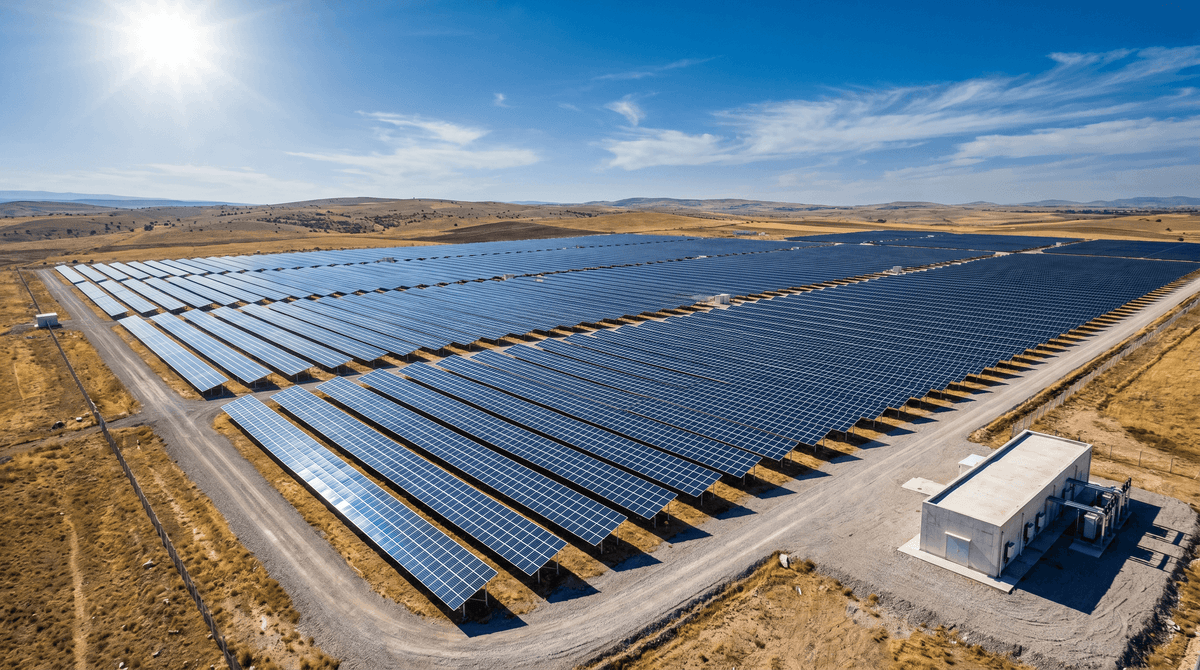
Ankara Solar PV System Market Analysis: 12.6MW Utility Configuration Guide for Fixed-Tilt Ground-Mount Generation
Summary
Ankara’s utility-scale solar profile supports a recommended 12.6MW ground-mount Solar PV System using 21,749 TOPCon 580W modules, 25° fixed tilt, and a 1.15 DC/AC ratio, with modeled annual output of about 17,817,906 kWh at 4.5 kWh/m²/day irradiance.
Key Takeaways
- Ankara sits in Türkiye’s inland Anatolian solar belt, where a utility-scale site with 4.5 kWh/m²/day irradiance can support a 12.6MW fixed-tilt ground-mount configuration.
- A typical project of this size would use approximately 21,749 TOPCon modules rated 580W each, giving 12.614MW DC nameplate capacity.
- The recommended array geometry is fixed tilt at 25°, which fits Ankara’s latitude near 39.93°N and reduces tracker complexity in windy continental conditions.
- With ~14% total system losses split across 2% soiling, 3% shading, 2% mismatch, 3% wiring, and 3% availability, annual generation is modeled at ~17,817,906 kWh.
- The electrical design uses a central inverter with 98% CEC efficiency, 5-year inverter warranty, and a DC/AC ratio of 1.15 suited to utility-scale interconnection.
- Panel performance assumptions are strong for long-horizon procurement: 25-year module warranty, 0.4%/yr degradation, and 30-year system life.
- Based on Türkiye’s grid structure and utility-scale practice, a project in this class would typically require LV collection plus step-up to 35kV before substation export.
- Estimated environmental impact is material at ~7,484 tons of CO₂ reduction per year, roughly equivalent to 336,780 trees on a standard comparison basis.
Market Context for Ankara
Ankara combines a large electricity demand base with inland solar conditions that make utility-scale PV technically credible at 10MW+ size. According to the Turkish Statistical Institute, Ankara’s population exceeds 5.8 million, making it the country’s second-largest provincial market and a major public-sector, industrial, logistics, and commercial load center.
The city’s geographic position at 39.93°N, 32.85°E supports a practical fixed-tilt utility design rather than a small rooftop-only approach. According to the Global Solar Atlas (World Bank Group/ESMAP, 2024), central Anatolia generally records strong photovoltaic resource compared with many European urban markets, and Ankara-area solar conditions are consistent with utility-scale bankability screening.
Grid context also matters. Türkiye’s transmission backbone is operated by TEİAŞ, while distribution in Ankara is handled through regional utility structures that commonly use 34.5kV/35kV-class medium-voltage distribution architecture for collection and industrial supply. For that reason, Ankara is a better fit for a 5-50MW utility-small solar design class than for a fragmented commercial rooftop profile when the target is a single 12.6MW site.
According to IEA (2024), solar PV continues to be one of the lowest-cost new-build power technologies globally, especially where irradiation is above 4.0 kWh/m²/day and land is available near existing grid corridors. Ankara’s outer districts and industrial periphery provide the type of land-grid combination where a fixed-tilt ground-mount plant can be assessed without forcing a high-cost tracker or urban rooftop strategy.
Two policy signals reinforce this direction. According to IRENA (2024), utility-scale PV remains a core path for reducing system emissions and limiting fuel-price exposure in import-dependent power systems. TEİAŞ planning documents and Türkiye’s broader energy strategy also continue to emphasize network reinforcement, renewable integration, and medium-voltage/ transmission interconnection capacity, which is relevant for 12.6MW class projects.
As an authority benchmark, IEA states, "Solar PV is expected to account for the largest share of renewable capacity expansion." That observation is directly relevant to Ankara because a 12.6MW fixed-tilt plant sits in the size range where grid integration, yield forecasting, and O&M standardization are already mature. For buyers evaluating SOLAR TODO Solar PV System, this is the local market logic behind the recommended configuration.
Recommended Technical Configuration
A utility-scale site near Ankara would typically be best served by a 12.6MW fixed-tilt ground-mount Solar PV System with 21,749 TOPCon 580W modules, central inversion, and 35kV export architecture. This size aligns with the product’s 5-50MW utility-small class and avoids under-sizing the grid interface.
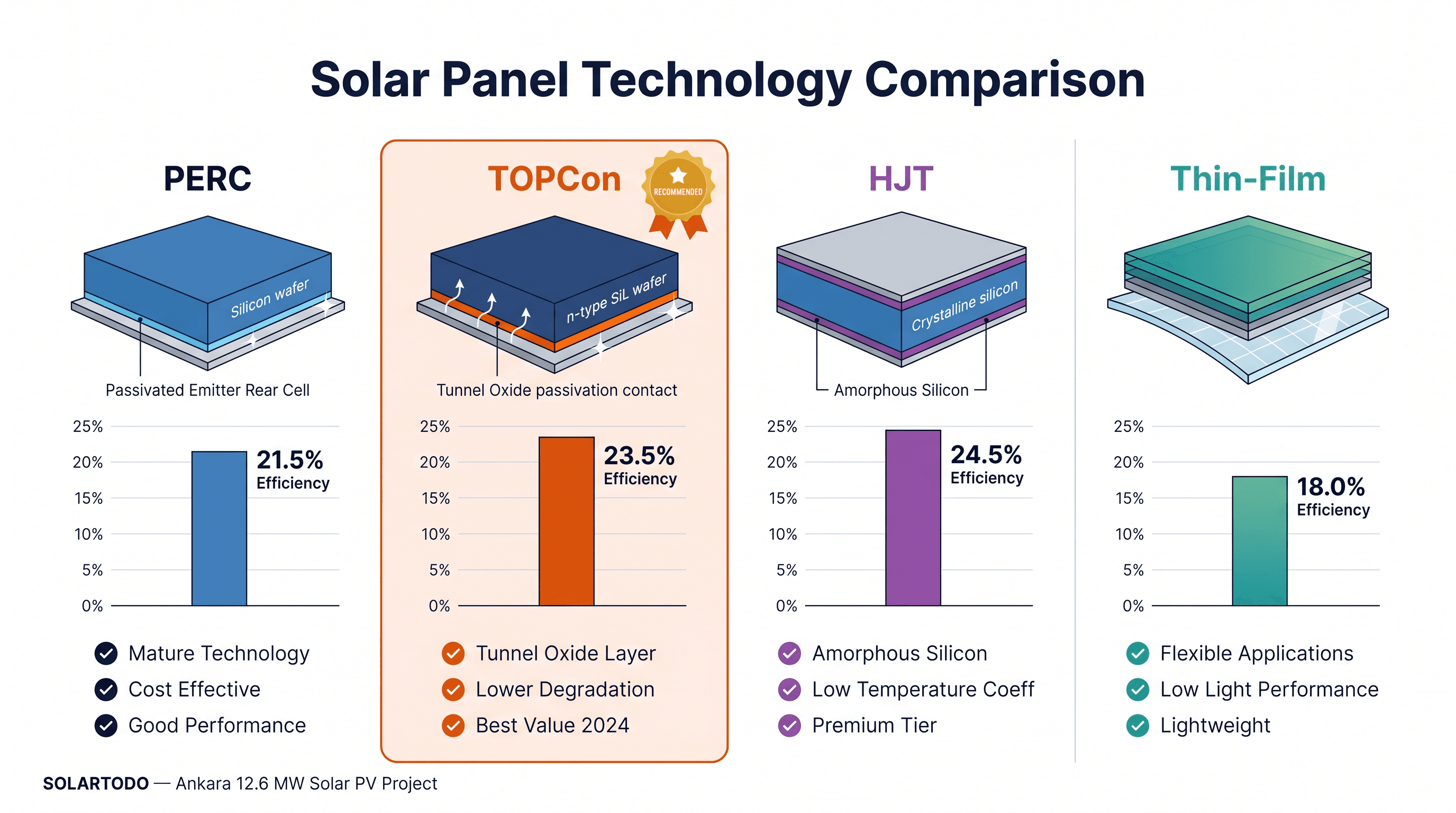
A typical deployment scenario of this scale would consist of approximately 21,749 monocrystalline TOPCon modules rated 580W, arranged for a total DC capacity of 12.614MW. The specified 25% module efficiency is high for utility procurement because it reduces land take and balance-of-system quantities compared with older 20-22% module classes. SOLAR TODO should present this as a utility-generation configuration, not as a commercial rooftop package, because the inverter topology and interconnection level are different.
The inverter strategy is also size-correct. For 12.6MW, the recommended architecture uses a central inverter with 98% CEC efficiency and a DC/AC ratio of 1.15. That is consistent with utility-scale practice where large DC blocks are collected efficiently before medium-voltage step-up. A 3-15kW residential string-inverter layout would be technically mismatched here, while a 50MW+ 110/220kV interconnection would be oversized for Ankara sites in this capacity band.
The mechanical layout should remain simple. A fixed-tilt 25° support structure is appropriate for Ankara’s latitude and seasonal sun path, while also limiting moving-part maintenance versus single-axis trackers. According to NREL (2024), fixed-tilt systems can remain attractive where O&M simplicity, wind exposure, and capex discipline matter more than extracting the final few percentage points of yield.
Loss assumptions need to stay explicit because buyers will ask where modeled energy goes. The specified total system loss is ~14%, divided into 2% soiling, 3% shading, 2% mismatch, 3% wiring, and 3% availability. Those values are reasonable for a utility site if row spacing, cleaning frequency, and electrical QA are controlled. SOLAR TODO should keep these assumptions visible in every quotation and energy model.
On environmental performance, the modeled output of ~17,817,906 kWh/year translates to annual CO₂ reduction of ~7,484 tons. That is large enough to matter for municipal decarbonization, industrial power hedging, and ESG reporting. For Ankara buyers comparing procurement channels, the useful question is not whether solar works in principle, but whether the land parcel, interconnection point, and permitting path support a 12.6MW block efficiently. Buyers that need project-specific review can contact us.
Technical Specifications
The recommended Ankara configuration is a 12.6MW utility-scale fixed-tilt ground-mount system using 21,749 TOPCon 580W modules, 25° tilt, 1.15 DC/AC ratio, and IEC 61215/61730 compliance. The specification below keeps the design within the correct utility-small class.
- System type: Grid-tied utility-scale ground-mount Solar PV System
- Recommended size class: 5-50MW utility small
- Nominal DC capacity: 12.614MW from 21,749 × 580W modules
- Module technology: Monocrystalline TOPCon, 25% efficiency
- Module degradation: 0.4%/yr
- Module warranty: 25 years
- Inverter type: Central inverter
- Inverter efficiency: 98% CEC efficiency
- Inverter warranty: 5 years
- Array structure: Ground-mount, fixed tilt 25°
- DC/AC ratio: 1.15
- Irradiance assumption: 4.5 kWh/m²/day
- System losses: ~14% total
- Soiling: 2%
- Shading: 3%
- Mismatch: 2%
- Wiring: 3%
- Availability: 3%
- Annual energy yield: ~17,817,906 kWh
- Estimated CO₂ reduction: ~7,484 tons/year
- Tree-equivalent impact: ~336,780 trees
- Design life: 30 years
- Standards: IEC 61215, IEC 61730
- Typical grid interface for Ankara profile: LV collection with 35kV step-up and utility interconnection review
According to IEC, "IEC 61215" defines design qualification and type approval for terrestrial photovoltaic modules, while "IEC 61730" covers PV module safety qualification. Those two standards should remain baseline requirements in any SOLAR TODO utility bid package for Ankara.
Implementation Approach
A 12.6MW utility-scale Solar PV System in Ankara would typically be implemented over several phases: site due diligence, grid study, procurement, civil works, mechanical erection, electrical installation, and commissioning. For a project of this size, the practical delivery sequence usually runs 6-12 months depending on permitting, interconnection approvals, and weather windows.
The first phase is land and grid screening. A buyer would normally check geotechnical conditions, slope, flood risk, right-of-way access, and distance to the nearest 34.5kV/35kV interconnection node. According to World Bank ESMAP solar development guidance, early-stage screening should quantify irradiation, topography, and grid distance before locking module count or inverter block size. In Ankara, this is important because peri-urban land can vary sharply in grading cost over short distances.
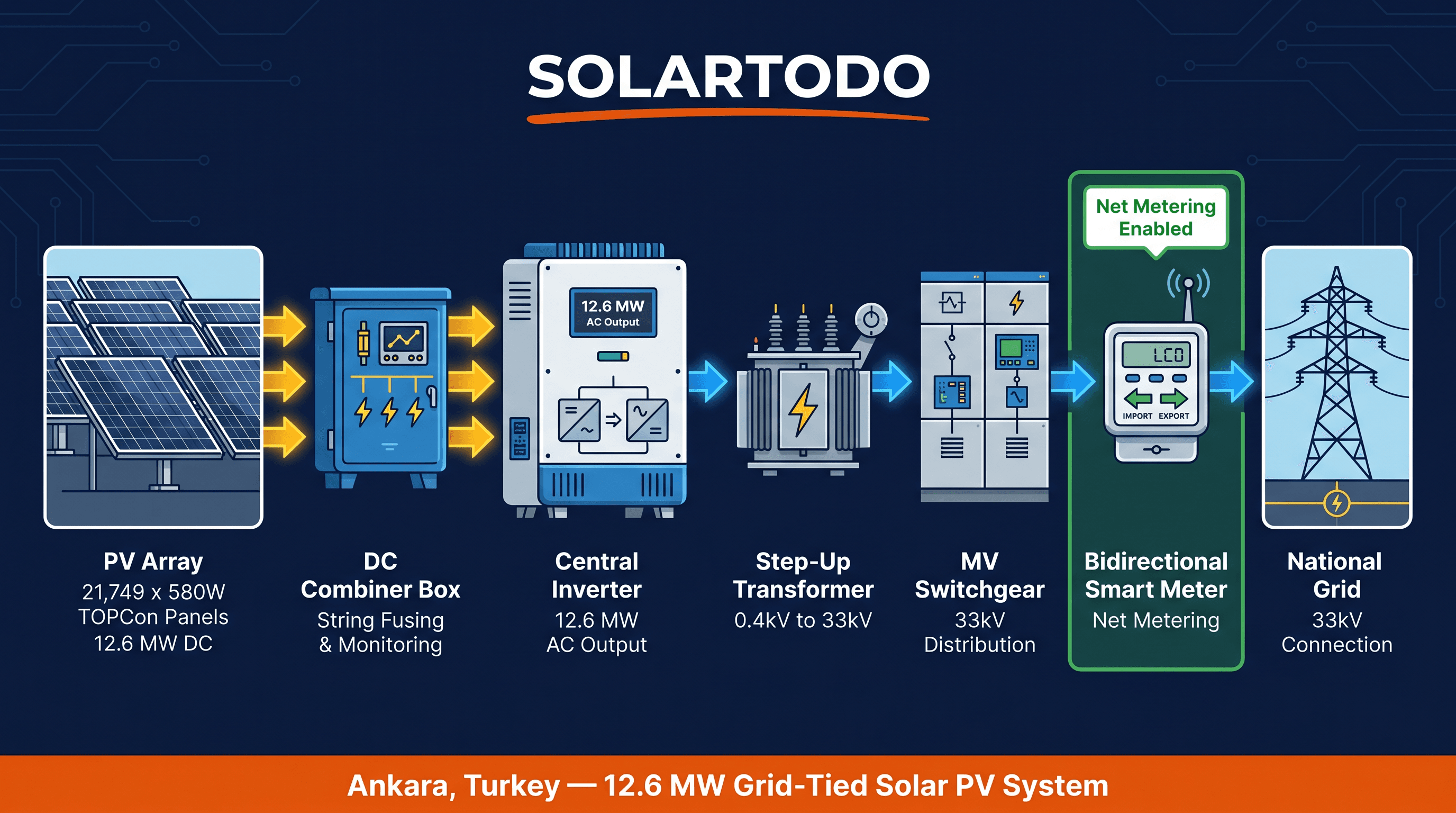
The second phase is detailed electrical and mechanical design. That includes string/block design around the 1.15 DC/AC ratio, central inverter placement, cable routing, earthing, SCADA, and step-up transformer scope. At 12.6MW, collection losses should be checked carefully because the design assumption already allocates 3% to wiring. SOLAR TODO should also define cleaning access lanes and row spacing early, since shading loss is budgeted at 3%.
The third phase is procurement and logistics. Utility projects in this class typically move modules, inverter skids, mounting steel, combiner equipment, and transformer packages in sequenced deliveries rather than a single bulk drop. Module QA should verify flash-test consistency, serial traceability, and IEC certificates before shipment. For Ankara, inland transport planning matters because the project is not a coastal delivery point.
The fourth phase is field execution. Civil works include fencing, access roads, pile or foundation installation, drainage, and equipment pads. Mechanical erection follows with rack assembly and module installation, then DC cabling, central inverter hookup, transformer installation, protection, and metering. A project at 12.6MW should also include utility witness tests, insulation resistance checks, IV-curve verification, and performance ratio review before commercial operation.
The final phase is O&M setup. Utility buyers should define spare parts, inverter service response, vegetation control, panel cleaning intervals, and annual thermography from day one. According to NREL (2023), preventive maintenance and availability management materially affect long-term yield, and this is visible in the specified 3% availability loss assumption. SOLAR TODO should therefore treat O&M data visibility as part of the technical offer, not an afterthought.
Expected Performance & ROI
A 12.6MW Ankara configuration is modeled to produce about 17.82GWh per year, with 14% system losses and 0.4% annual module degradation over a 30-year operating life. The financial outcome depends on tariff structure, self-consumption ratio, and interconnection terms rather than a single universal payback number.
The annual generation figure of ~17,817,906 kWh implies a specific yield of roughly 1,413 kWh/kWp/year based on 12.614MW DC installed capacity. That is a plausible utility-scale output for an Ankara-area site using 4.5 kWh/m²/day irradiance and a fixed 25° tilt. According to NREL and IEA benchmark methods, this yield level generally sits within the investable range for inland Mediterranean/continental solar markets when losses are transparently modeled.
For lifecycle planning, the 0.4%/yr degradation rate is favorable. After 10 years, expected module output remains materially higher than older module classes degrading at 0.5-0.7%/yr. Over 30 years, the lower degradation rate improves long-run energy delivery and can support stronger debt-service assumptions if the offtake structure is stable. This is one reason the specified TOPCon module set is technically stronger than older PERC-only utility packages.
Return analysis should be framed by use case. If the plant offsets industrial daytime consumption, value comes from avoided purchased electricity and reduced exposure to tariff volatility. If it exports under a utility or merchant structure, value depends on grid code compliance, curtailment risk, and settlement mechanics. According to IRENA (2024), utility-scale solar remains cost-competitive globally, but project economics are highly sensitive to financing cost and local grid conditions.
A practical planning range for utility PV in markets with moderate-to-strong irradiation is often 5-10 years for simple payback under favorable tariff and financing conditions, but Ankara-specific ROI must be modeled from actual land cost, grid upgrade scope, and offtake terms. That is why SOLAR TODO should present ROI as a scenario analysis rather than a fixed claim. For procurement teams, the correct next step is a site-specific energy and interconnection study using the exact 21,749-module layout.
Results and Impact
A 12.6MW utility-scale Solar PV System in Ankara would primarily deliver 17.82GWh of annual clean electricity and about 7,484 tons of CO₂ reduction, while fitting standard 35kV export practice. The main impact is not only carbon reduction, but also daytime generation close to a major demand center.
For public-sector and industrial buyers, the first measurable result is energy volume. At ~17,817,906 kWh/year, the plant can support municipal infrastructure loads, industrial estates, cold storage, logistics facilities, or mixed public-service demand. The second measurable result is emissions reduction at ~7,484 tons/year, which is relevant for corporate reporting and local decarbonization targets.
The third result is operational predictability. A fixed-tilt system with 25° geometry, 98% central inverter efficiency, and transparent 14% loss budgeting is easier to audit than an overcomplicated design. For Ankara buyers, that matters because land, interconnection, and financing decisions are easier when generation assumptions remain simple and standards-based. This is the technical position SOLAR TODO should emphasize.
Comparison Table
The table below compares the recommended Ankara 12.6MW utility configuration with smaller solar classes to show why a utility-small architecture is the correct fit. It also highlights where inverter topology and grid interface change materially.
| Configuration Class | Capacity Range | Typical Use Case | Inverter Topology | Grid Interface | Suitability for Ankara Utility Site |
|---|---|---|---|---|---|
| Residential rooftop | 3-15 kW | House roof | 1 string inverter | Low voltage | Poor fit for 12.6MW requirement |
| Small commercial | 15-100 kW | Shops, schools, carports | 1-2 string inverters | Low voltage | Too small for utility export |
| Mid commercial | 100-500 kW | Factory roof, ground-mount | String or central inverter | LV/MV transformer | Still undersized for grid-scale generation |
| C&I / industrial | 500 kW-5 MW | Large rooftop or land | Multiple inverters + step-up transformer | LV to 10/35kV | Possible for phased captive use, but below target scale |
| Recommended utility-small | 5-50 MW | Open land generation | Central inverter | 35kV step-up + substation | Best fit for Ankara 12.6MW project |
| Utility large | 50 MW+ | Regional generation | Central inverter blocks | 110/220kV | Oversized for this profile |
| Key Metric | Recommended Ankara Configuration | Notes |
|---|---|---|
| DC capacity | 12.614 MW | From 21,749 × 580W modules |
| Module efficiency | 25% | TOPCon monocrystalline |
| Tilt angle | 25° | Fixed-tilt ground-mount |
| Irradiance | 4.5 kWh/m²/day | Site modeling assumption |
| Annual yield | 17,817,906 kWh | With ~14% losses |
| DC/AC ratio | 1.15 | Utility-scale design choice |
| Inverter efficiency | 98% CEC | Central inverter |
| CO₂ reduction | 7,484 tons/year | Estimated annual impact |
| Design life | 30 years | Long-horizon asset planning |
Pricing & Quotation
SOLAR TODO offers three pricing tiers for this product line: FOB Supply (equipment ex-works China), CIF Delivered (including ocean freight and insurance), and EPC Turnkey (fully installed, commissioned, with 1-year warranty). Volume discounts are available for large-scale deployments. Configure your system online for an instant estimate, or request a custom quotation from our engineering team at [email protected].
Frequently Asked Questions
A 12.6MW Ankara utility Solar PV System would typically raise questions about module count, grid connection, timeline, ROI, maintenance, and warranty; the concise answers below use the specified 21,749-panel configuration. These FAQs are written for procurement and engineering review.
Q1: What is the recommended system size for Ankara in this guide?
The recommended configuration is 12.6MW DC using 21,749 TOPCon 580W modules on a fixed-tilt ground-mount layout. This fits the utility-small 5-50MW product class and aligns better with Ankara’s medium-voltage grid environment than rooftop or small commercial solar formats.
Q2: Why is a fixed-tilt 25° design recommended instead of trackers?
A 25° fixed tilt is a practical match for Ankara’s latitude near 39.93°N and reduces moving parts, spare parts demand, and O&M complexity. Trackers can improve yield, but fixed-tilt systems often offer simpler maintenance and more predictable lifecycle cost on inland utility sites.
Q3: How much electricity can this system generate each year?
Using the provided assumptions of 4.5 kWh/m²/day irradiance and ~14% total losses, the modeled annual output is ~17,817,906 kWh. Actual yield depends on site grading, row spacing, cleaning frequency, and interconnection constraints, so a bankable energy model should still be prepared for the final parcel.
Q4: What inverter type is suitable for a 12.6MW project?
This guide recommends a central inverter with 98% CEC efficiency and a 5-year warranty. At 12.6MW, central inversion is usually more appropriate than a residential or small-commercial string layout because it simplifies utility-scale block design and medium-voltage export integration.
Q5: What grid connection voltage is typical in Ankara for this project size?
For a project in the 12.6MW range, the usual approach is LV collection followed by step-up to 35kV for interconnection review. Final voltage and protection requirements depend on the utility study, but 34.5kV/35kV-class distribution practice is common in Türkiye for this scale.
Q6: What are the main loss assumptions in the model?
The total modeled loss is ~14%, broken into 2% soiling, 3% shading, 2% mismatch, 3% wiring, and 3% availability. These values are realistic for preliminary planning, but they should be refined after topographic survey, equipment selection, and O&M strategy are finalized.
Q7: What is the expected project timeline?
A typical utility-scale project of 12.6MW may require about 6-12 months from detailed design to commissioning, assuming land rights and grid approvals move on schedule. The biggest schedule variables are permitting, interconnection studies, civil works, and delivery timing for modules, inverter equipment, and transformers.
Q8: What warranties apply to this Solar PV System?
The specified module package carries a 25-year panel warranty, while the central inverter carries a 5-year warranty. Buyers should also ask for warranty claim procedures, spare-part lead times, and performance documentation because warranty value depends on service response as much as on the written term.
Q9: What maintenance does a 12.6MW plant require?
Routine O&M usually includes module cleaning, vegetation control, thermographic inspection, torque checks, inverter service, protection testing, and SCADA monitoring. Because the model already assumes 3% availability loss, disciplined preventive maintenance is important if the operator wants actual output to stay close to the 17.82GWh/year estimate.
Q10: What payback period should Ankara buyers expect?
There is no single universal payback because land cost, financing, tariff structure, and grid upgrade scope vary by site. In many moderate-to-strong solar markets, utility PV can fall into a 5-10 year simple-payback range, but Ankara decisions should be based on a project-specific financial model rather than a generic claim.
Q11: How does this compare with a commercial rooftop system?
A rooftop system in the 100kW-5MW range usually uses string inverters and low-voltage building integration, while this guide covers a 12.6MW ground-mount utility plant with central inversion and 35kV export. The procurement path, civil scope, and interconnection process are therefore materially different.
Q12: How should buyers request an EPC quotation from SOLAR TODO?
Buyers should provide target capacity, site coordinates, available land area, preferred interconnection voltage, and whether the project is for self-consumption or export. For Ankara, adding geotechnical notes and substation distance is useful because those two items can materially affect BOS scope, schedule, and final quotation quality.
References
- Turkish Statistical Institute (TÜİK) (2024): Ankara provincial population statistics showing a population above 5.8 million, relevant to electricity demand context.
- World Bank Group / ESMAP / Global Solar Atlas (2024): Solar resource mapping for Türkiye and central Anatolia; Ankara-area solar conditions support utility-scale PV screening.
- International Energy Agency (IEA) (2024): Renewable market outlook and solar PV expansion trends; confirms PV as a leading source of new renewable capacity.
- International Renewable Energy Agency (IRENA) (2024): Renewable Power Generation Costs; utility-scale solar remains cost-competitive under favorable irradiation and financing conditions.
- NREL (2024): PV performance modeling methods and fixed-tilt system benchmarking used for yield and loss assessment.
- IEC (2021): IEC 61215 photovoltaic module design qualification and type approval requirements.
- IEC (2023): IEC 61730 photovoltaic module safety qualification requirements.
- TEİAŞ (2023): Türkiye transmission system planning and grid interconnection framework relevant to medium-voltage and utility-scale renewable integration.
- TEDAŞ / regional distribution technical practice documents (latest available): Common 34.5kV/35kV distribution architecture relevant to Ankara-area project connection studies.
SOLAR TODO should use these references as the baseline for Ankara pre-feasibility, then refine the design with parcel-specific survey, utility feedback, and a final production model. For buyer review, the most important point is that this article is a market analysis and technical recommendation, not a claim of past deployment.
Equipment Deployed
- 21,749 × monocrystalline TOPCon PV modules, 580W each, 25% efficiency, 0.4%/yr degradation
- 12.614MW DC total installed module capacity
- Central inverter system, 98% CEC efficiency, 5-year warranty
- Ground-mount fixed-tilt support structure, 25° tilt angle
- DC collection system sized for 1.15 DC/AC ratio
- AC collection and step-up transformer package for typical 35kV export architecture
- DC combiner and AC distribution equipment for utility-scale block collection
- Bi-directional metering and grid synchronization equipment
- Monitoring and SCADA package for utility performance tracking
- IEC 61215 and IEC 61730 compliant module set with 25-year panel warranty