Ankara Smart Traffic System Market Analysis: 22-Intersection 6m L-Arm Configuration Guide
Summary
Ankara's 5.91M-person, 25-district market fits a 22-intersection Smart Traffic System using 6m L-arm poles, 4K AI cameras, 77GHz radar, and 5G/fiber backhaul. BOT can keep upfront municipal CAPEX at 0 while preserving NTCIP/GB 25280 alignment.
Key Takeaways
For Ankara, the recommended 22-intersection configuration uses 6m L-arm poles because compact urban approaches usually need 4-6 smart poles each.
- A typical 22-intersection deployment would require approximately 88-132 smart traffic poles, depending on lane count and auxiliary pedestrian approaches.
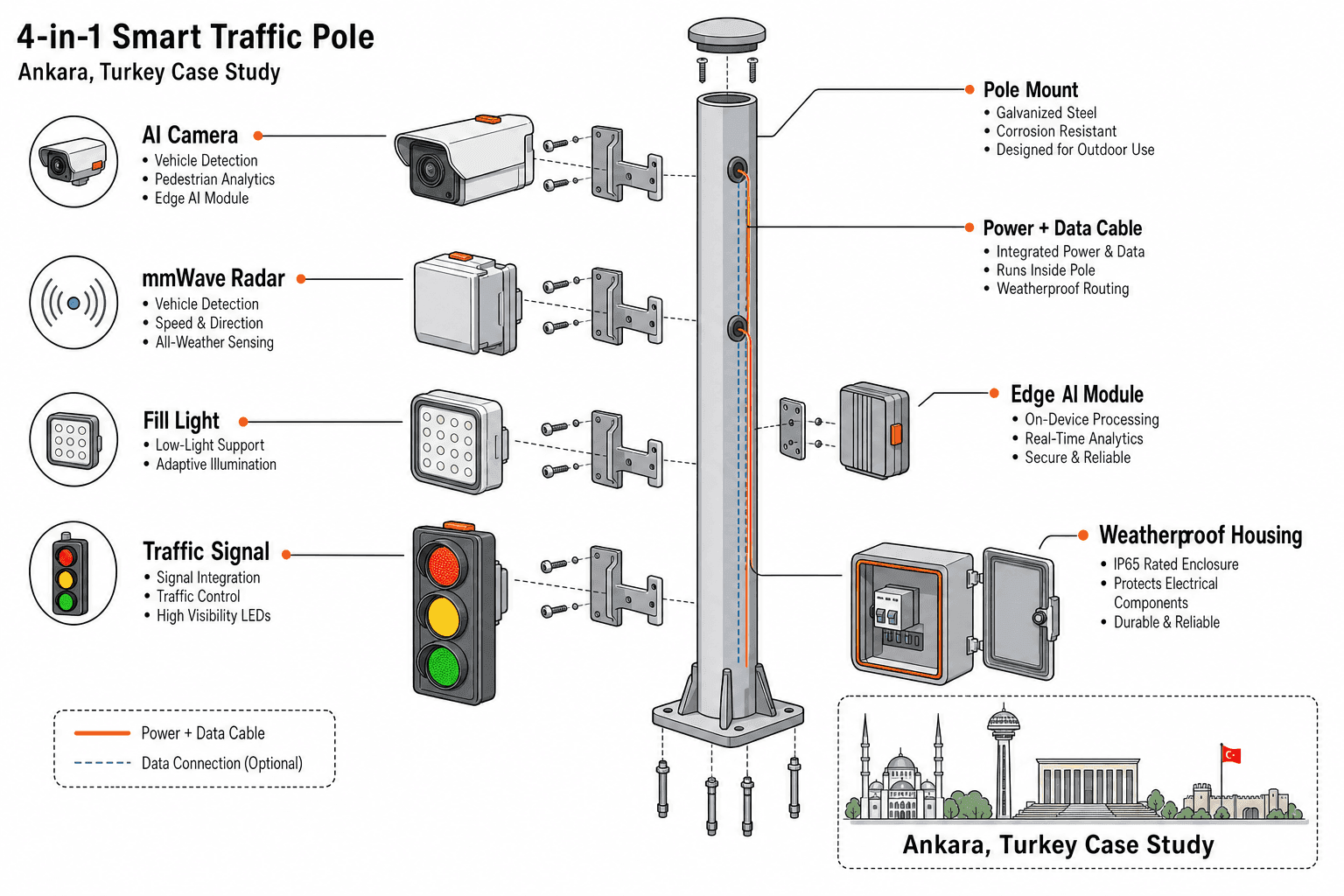
- Each 6m dark grey L-arm pole integrates 4 modules: 4K AI camera, 77GHz mmWave radar, LED fill light, and LED signal head.
- The AI stack supports 45 detection types, 98% recognition accuracy under specified conditions, and less than 50ms edge response.
- NVIDIA Jetson edge AI reduces raw-video backhaul load by processing events locally before 5G or fiber transmission.
- 5G/fiber backhaul links intersections to the TrafficGPT central platform for natural-language queries and corridor analytics.
- BOT financing can set municipal upfront CAPEX at 0, with repayment structured through availability payments or operating savings.
- NTCIP and GB 25280 support procurement language for traffic controller interoperability and signal compliance.
Market Context for Ankara
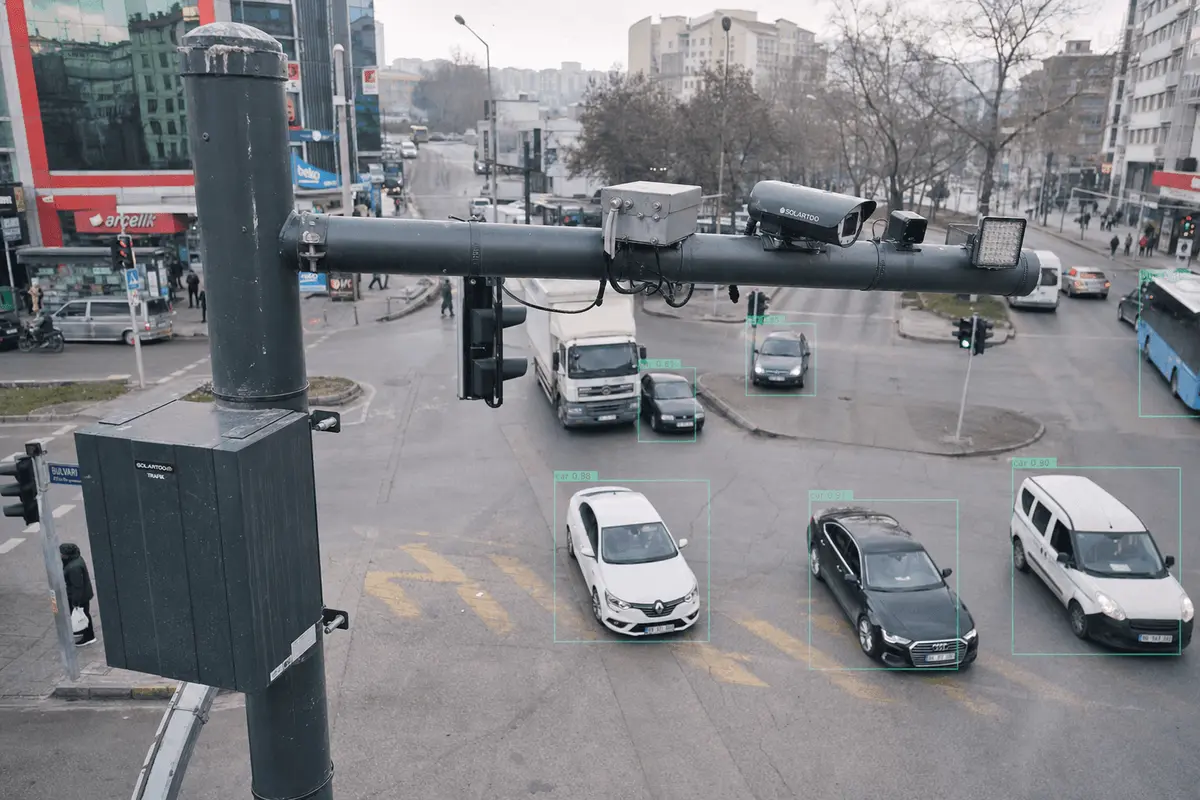
Ankara's 5.91 million residents, 938m elevation, and 25-district metropolitan structure make junction-level traffic intelligence more valuable than isolated CCTV upgrades. According to Turkish Statistical Institute (2026), Ankara province reached 5,910,320 residents as of 31 December 2025, making it Turkey's second-largest urban market after Istanbul. The metropolitan area covers dense central districts such as Çankaya, Keçiören, Yenimahalle, Mamak, Etimesgut, and Sincan, where signal timing, emergency priority, and wrong-way detection have higher operational value than passive monitoring.
According to the General Directorate of Highways (2025), Turkey's national road network included 3,796km of motorways, 30,832km of state roads, and 33,922km of provincial roads. Ankara sits at the center of that network, so arterial intersections often carry commuter, intercity, bus, logistics, and emergency traffic in the same signal cycle. A smart traffic design for Ankara should therefore emphasize multi-approach detection, controller interoperability, low-latency backhaul, and field equipment that withstands inland winter conditions.
According to the Turkish State Meteorological Service (2024), Ankara has hot, dry summers, cold snowy winters, and a semi-arid continental profile in Central Anatolia. That climate favors hot-dip galvanized steel, sealed camera/radar housings, and LED fill lighting for low-visibility winter nights. For a 39.93, 32.85 urban coordinate profile, SOLARTODO should position the Smart Traffic System as a compact intersection upgrade rather than a highway gantry package.
NTCIP states, 'mix and match' traffic systems can use equipment from different manufacturers, which is critical for multi-vendor municipal procurement. The European Union ITS Directive defines ITS as ICT applied to road transport, traffic management, and mobility management; that framing matches Ankara's need for traffic intelligence at the junction, corridor, and control-center layers.
Recommended Technical Configuration
A 22-intersection Ankara Smart Traffic System should use 6m L-arm hot-dip galvanized poles with approximately 88-132 units for compact urban approaches.
The recommended SOLARTODO configuration is a 22-intersection package using 6m L-arm steel poles in dark grey hot-dip galvanized finish. The 6m variant is the correct size class for signalized urban approaches because it provides adequate signal-head visibility and sensor mounting without the visual mass of 8m arterial or 10-12m highway gantry structures. A typical N-unit deployment of this scale would use 4 poles per four-leg intersection as the minimum, plus auxiliary poles for left-turn lanes, pedestrian crossings, bus priority lanes, or complex geometry.
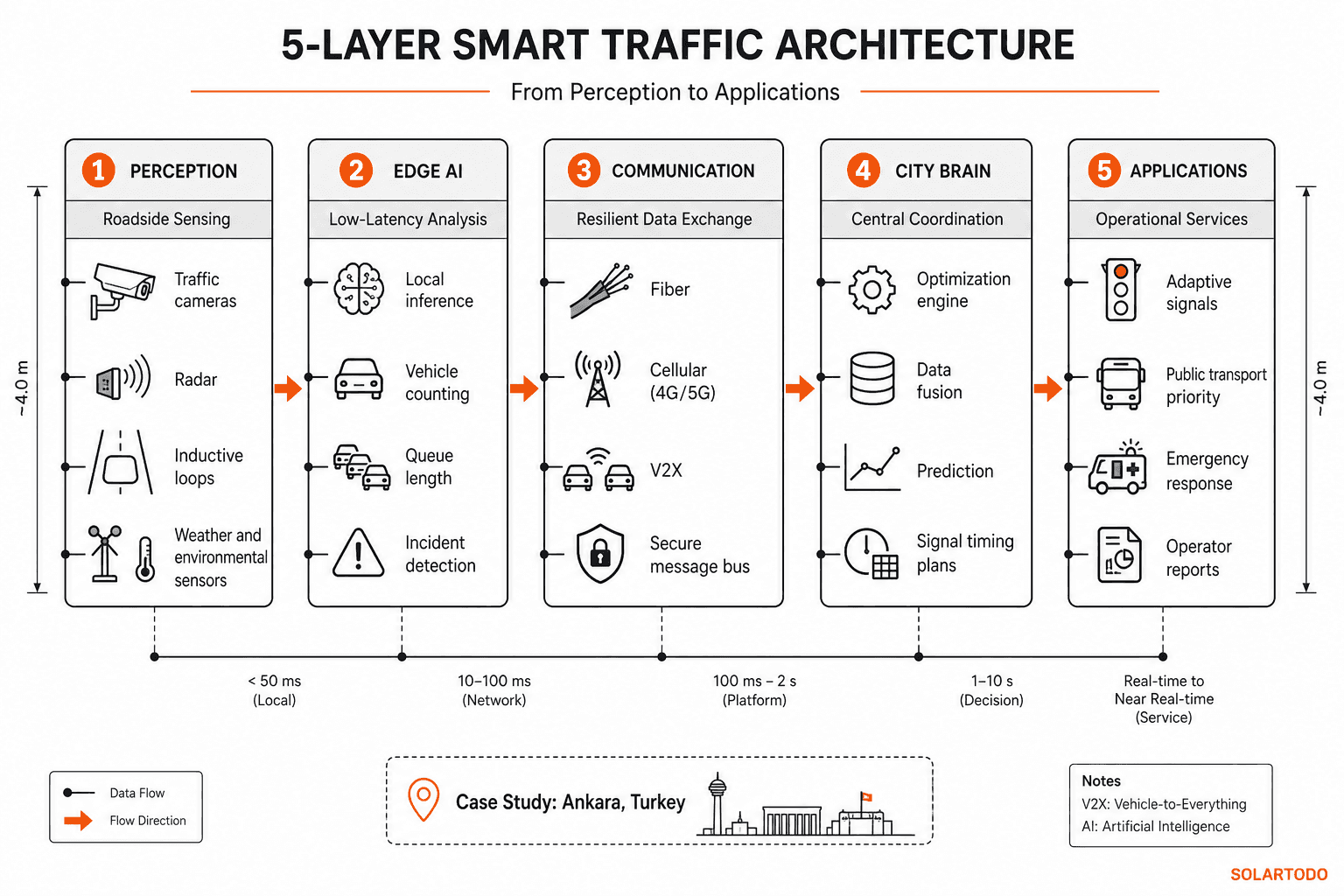
Each pole should be specified as a 4-in-1 Smart Traffic Pole with a 4K AI camera, 77GHz mmWave radar, LED fill light, and LED signal head. The control architecture should follow the 5-layer stack: Perception, Edge AI, Communication, City Brain, and Applications. In this configuration, perception data is processed on NVIDIA Jetson edge AI, event metadata is sent over 5G or fiber, and the TrafficGPT central platform supports natural-language operational queries.
The recommended feature set includes full 45-type detection, adaptive signal timing, emergency vehicle priority, and wrong-way alerting. For procurement, SOLARTODO Smart Traffic System documentation should state NTCIP compatibility for center-to-field integration and GB 25280 alignment for road traffic signal controller requirements. The cooperation model should be BOT, so Ankara agencies can evaluate a zero-upfront structure while preserving technical control over acceptance testing.
Technical Specifications
This 6m L-arm specification combines 4K AI vision, 77GHz radar, and sub-50ms edge response for 22 Ankara intersections.
- Product form: 4-in-1 Smart Traffic Pole, one base form, L-arm hot-dip galvanized steel pole, dark grey finish.
- Height class: 6m urban-intersection variant for the Ankara 22-intersection configuration.
- Perception module: 4K AI camera with 98% stated recognition accuracy under specified training and installation conditions.
- Radar module: 77GHz mmWave radar for speed, presence, lane occupancy, and poor-visibility support.
- Lighting and signal module: LED fill light plus integrated LED signal head.
- Edge AI: NVIDIA Jetson processor for local event inference and reduced backhaul load.
- Detection scope: 45-type detection, including vehicle class, pedestrian, queue, violation, wrong-way, and emergency-vehicle priority events.
- Response target: less than 50ms edge response for qualifying perception-to-event workflows.
- Communication: 5G/fiber backhaul to TrafficGPT central platform with natural-language query capability.
- Standards: NTCIP for ITS communications interoperability and GB 25280 for road traffic signal controller alignment.
- Cooperation model: BOT with zero upfront municipal CAPEX, subject to contract scope and acceptance criteria.
According to ITU-R (2017), IMT-2020 defines 1ms URLLC latency and 10^6 connected devices per square kilometer as 5G performance targets. Field engineering should still validate actual end-to-end latency because camera inference, controller logic, fiber routing, and control-center processing add delay beyond the radio interface. For Ankara, this means the system design should keep emergency-priority logic close to the edge while forwarding aggregated analytics to TrafficGPT.
Implementation Approach
A 22-intersection BOT rollout in Ankara would typically move through 5 phases from survey to TrafficGPT commissioning.
Phase 1 is intersection audit and baseline measurement. Engineers would map lane geometry, existing controller cabinets, pedestrian push buttons, emergency corridors, fiber availability, cellular signal strength, pole foundation constraints, and sight lines for the 4K camera and 77GHz radar. The output should be a junction-by-junction bill of quantities, not a generic city estimate.
Phase 2 is technical design and procurement. The design package should define 6m pole locations, L-arm orientation, signal head visibility, camera field of view, radar coverage zones, fill-light aiming, controller cabinet interfaces, and cybersecurity rules. Because NTCIP is intended for multi-vendor traffic control environments, the municipality should require interface testing before citywide expansion.
Phase 3 is manufacturing, CKD logistics, and site preparation. Hot-dip galvanized poles, signal heads, cameras, radar units, LED fill lights, Jetson edge boxes, brackets, cables, and cabinets can be packed for staged delivery. Civil works would include foundations, ducting, grounding, cabinet pads, and temporary traffic management.
Phase 4 is installation and commissioning. Field teams would erect poles, mount sensors, align radar zones, calibrate AI detection classes, integrate signal controllers, configure 5G/fiber links, and test fail-safe signal behavior. Acceptance testing should include daytime, night, rain, snow, high-glare, bus-lane, pedestrian, emergency-vehicle, and wrong-way scenarios.
Phase 5 is BOT operations. Under this model, SOLARTODO can maintain platform availability, firmware updates, AI model tuning, and preventive maintenance while the city measures service levels. For technical scoping or contract discussion, buyers can contact us with sample intersection layouts and controller cabinet photos.
Expected Performance & ROI
The expected ROI case for Ankara should model 0 upfront BOT CAPEX, 22 intersections, and measurable delay, safety, and operations KPIs.
This guide does not claim a completed Ankara deployment or guaranteed citywide result. Expected performance should be validated through before-and-after data at each intersection, including queue length, average delay, red-light violation events, wrong-way alerts, emergency response priority calls, controller uptime, and maintenance tickets. A practical acceptance framework is 30-60 days of baseline measurement followed by 60-90 days of tuned operation.
According to FHWA (2024), adaptive signal control changes signal timing based on actual traffic demand rather than fixed plans. For Ankara, the most defensible ROI model compares existing fixed-time or semi-actuated control against adaptive timing with multi-sensor detection. Payback should be calculated from avoided controller visits, reduced manual monitoring, fewer secondary incidents, lower delay cost, and BOT availability terms rather than from unverified congestion claims.
A BOT model can reduce initial budget pressure because the city does not need to purchase all equipment as upfront CAPEX. A typical ROI model for a 22-intersection package would test 5-8 year scenarios using equipment availability, energy use, communications fees, platform licensing, maintenance labor, and monetized travel-time benefits. SOLARTODO should present this as a sensitivity model, not as a promise of past Ankara savings.
Comparison Table
The Ankara fit analysis favors 6m poles because 8m and 10-12m structures are better suited to wider arterials or highway gantries.
| Configuration option | Typical use | Height | Sensor package | Ankara 22-intersection fit | Notes |
|---|---|---|---|---|---|
| Recommended compact urban pole | Signalized city intersections | 6m | 4K AI camera, 77GHz radar, LED fill light, LED signal | High | Best match for compact approaches and pedestrian crossings |
| Arterial smart pole | Wider boulevards and larger approaches | 8m | Same 4-in-1 package | Conditional | Use where sight lines require higher mounting |
| Highway gantry variant | High-speed corridors and gantry mounting | 10-12m | Camera/radar/signal package adapted to gantry geometry | Low for this scope | Better for expressways than central junctions |
| Conventional CCTV-only upgrade | Monitoring without adaptive control | Varies | Camera only | Limited | Lacks radar redundancy, LED signal integration, and edge AI |
| Loop detector plus fixed signal | Presence detection only | Not pole-based | Inductive loop and controller | Limited | Requires pavement cuts and cannot provide 45-type AI detection |
Pricing & Quotation
SOLARTODO offers three pricing tiers for this product line: FOB Supply (equipment ex-works China), CIF Delivered (including ocean freight and insurance), and EPC Turnkey (fully installed, commissioned, with 1-year warranty). Volume discounts are available for large-scale deployments. Configure your system online for an instant estimate, or request a custom quotation from our engineering team at [email protected].
Frequently Asked Questions
This FAQ covers 10 procurement questions for a 22-intersection, 6m L-arm Smart Traffic System in Ankara.
Q1: What is the recommended Smart Traffic System specification for Ankara? The recommended Ankara configuration is a 22-intersection Smart Traffic System using 6m dark grey L-arm hot-dip galvanized steel poles. Each pole integrates a 4K AI camera, 77GHz mmWave radar, LED fill light, and LED signal head. Edge AI runs on NVIDIA Jetson, with 5G/fiber backhaul to TrafficGPT for central monitoring and natural-language traffic queries.
Q2: Why is the 6m pole class preferred instead of 8m or 10m? The 6m class fits compact urban signalized intersections where sensors and signal heads must cover lanes, pedestrian crossings, and stop lines without highway-scale structures. The 8m variant is better for wide arterials, while 10-12m gantry options suit high-speed corridors. Ankara's 22-intersection scope is therefore best treated as an urban L-arm package.
Q3: How many poles would a 22-intersection Ankara project require? A typical 22-intersection deployment would use approximately 88-132 poles if each junction requires 4-6 smart poles. The final quantity depends on lane count, turning pockets, pedestrian islands, bus priority needs, and cabinet locations. Complex five-leg or offset intersections may need additional auxiliary poles for complete radar and camera coverage.
Q4: What deployment timeline should buyers expect? A realistic schedule is usually 12-24 weeks after survey approval, depending on customs, civil works, fiber availability, and traffic management permits. The process includes site audit, engineering design, manufacturing, shipping, foundation work, pole erection, sensor calibration, controller integration, and TrafficGPT commissioning. Larger corridors may be phased to keep intersections operational during works.
Q5: How should ROI and payback be evaluated? ROI should be modeled from measured baseline data, not assumed from a case study. For a 22-intersection BOT package, buyers should compare 5-8 year scenarios across delay reduction, maintenance savings, emergency priority value, incident detection, communications fees, and platform service payments. SOLARTODO can structure the model around availability KPIs and municipal acceptance tests.
Q6: What maintenance does the system require? Maintenance normally includes quarterly visual inspections, lens cleaning, radar alignment checks, cabinet thermal checks, grounding inspection, firmware updates, and AI model review. Winter conditions in Ankara make seal integrity and pole coating important. Jetson edge devices should also be monitored for temperature, storage health, network uptime, and event-processing errors.
Q7: How does this compare with a CCTV-only traffic upgrade? CCTV-only systems support viewing and recording, but they usually do not provide radar redundancy, integrated signal heads, adaptive timing, or 45-type AI event detection. The SOLARTODO configuration combines 4K vision, 77GHz radar, LED signaling, and edge AI on the same 6m pole, reducing separate mounting hardware and simplifying intersection-level commissioning.
Q8: Which standards matter for procurement? NTCIP matters because it supports interoperable center-to-field traffic communications, reducing vendor lock-in across controllers and management software. GB 25280 matters for road traffic signal controller alignment. For Ankara, procurement documents should also define cybersecurity, electrical safety, grounding, local permitting, Turkish language interface needs, and acceptance testing for all 22 intersections.
Q9: Can emergency vehicle priority be included? Yes. The recommended configuration includes emergency vehicle priority using AI detection, radar confirmation, and controller logic. The safest architecture keeps priority decisions close to the edge for fast response, while TrafficGPT records events centrally. Final behavior should be coordinated with ambulance, fire, police, and municipal traffic operations teams.
Q10: What warranty and EPC pricing options are available? SOLARTODO offers FOB Supply, CIF Delivered, and EPC Turnkey tiers, with EPC including installation, commissioning, and a 1-year warranty. Under BOT, upfront municipal CAPEX can be structured at 0, subject to contract terms. Warranty scope should specify pole coating, camera/radar modules, LED components, Jetson edge hardware, and platform support.
References
These 7 references support Ankara demographics, traffic infrastructure context, ITS interoperability, 5G backhaul assumptions, and signal-controller standards.
- Turkish Statistical Institute (2026): Address-Based Population Registration System reported Ankara province at 5,910,320 residents as of 31 December 2025. Source: https://www.tuik.gov.tr/
- Ankara Metropolitan Municipality (2025): Metropolitan governance covers 25 districts, relevant for phased intersection procurement and traffic operations. Source: https://www.ankara.bel.tr/
- General Directorate of Highways, Turkey (2025): National network statistics list 3,796km motorways, 30,832km state roads, and 33,922km provincial roads. Source: https://www.kgm.gov.tr/
- Turkish State Meteorological Service (2024): Ankara climate profile supports galvanized steel, sealed electronics, and winter-ready optics. Source: https://www.mgm.gov.tr/
- NTCIP Joint Committee (2026): NTCIP defines ITS communications standards and supports multi-vendor traffic control interoperability. Source: https://www.ntcip.org/about/
- ITU-R (2017): IMT-2020 minimum requirements include 1ms URLLC latency and 10^6 connected devices per square kilometer. Source: https://www.itu.int/
- National Standard of China GB 25280 (2016): Road traffic signal controller requirements used for controller compliance alignment in procurement specifications.
Equipment Deployed
- 22-intersection Smart Traffic System configuration using 6m dark grey L-arm hot-dip galvanized steel poles
- 4-in-1 smart pole package with 4K AI camera, 77GHz mmWave radar, LED fill light, and LED signal head
- NVIDIA Jetson edge AI processor supporting 45-type detection, 98% stated accuracy, and less than 50ms edge response
- 5G/fiber backhaul from intersections to TrafficGPT central platform with natural-language queries
- Adaptive signal control, emergency vehicle priority, and wrong-way alert feature set
- NTCIP and GB 25280 aligned traffic control and signal controller specification
- BOT cooperation model with zero upfront municipal CAPEX structure