Addis Ababa Smart Streetlight Market Analysis: 11m Multi-Function Pole Configuration Guide
Summary
Addis Ababa’s dense arterial corridors, growing EV demand, and expanding 4G/5G capacity support a typical 136-unit Smart Streetlight scheme at 35 m spacing. A recommended 11 m grid-powered AC configuration combines 2×80 W LED lighting, 11 kW AC charging, and n78 small-cell readiness.
Key Takeaways
- A typical Addis Ababa corridor deployment would use approximately 136 units at 35 m spacing, covering about 4.76 km of urban roadway.
- The recommended pole class is 11 m octagonal tapered steel, with base diameter 45 cm and top diameter 15 cm, suited to city arterial and collector roads rather than highways.
- Each Smart Streetlight would carry 2×80 W LED luminaires on 1.5 m twin arms with +8° tilt, delivering 150 lm/W at 4000 K for roadway visibility.
- The integrated charger is not a separate pedestal: the lower 2.2 m of the pole is the 11 kW single-gun AC EV charger with Type 2, OCPP 1.6J, and a 5 m coiled cable.
- Telecom co-location is viable through a 5G NR n78 small cell at 8.7 m, using 4T4R MIMO and an estimated 200 m coverage radius in dense streetscapes.
- Safety and public-service modules include 1 SOS button, dual-way intercom, 2 IP audio columns rated 30 W / 93 dB, and a 15 cm PTZ dome camera with 20× zoom and 100 m IR.
- A vertical P4 LED display sized 960×1920 mm and rated above 5500 cd/m² supports municipal messaging while keeping the pole footprint compact.
- Applicable standards for this configuration include IEC 60598, GB/T 37024, and IEC 62196-2; Addis Ababa buyers should also check local utility connection and right-of-way approvals before tender.
Market Context for Addis Ababa
Addis Ababa combines a population above 5 million with high transport demand, making multi-function roadside infrastructure more relevant on arterial corridors than single-purpose lighting alone. According to the World Bank (2023), Ethiopia remains one of Africa’s largest urbanizing economies, and Addis Ababa is the country’s principal administrative and commercial hub. According to UN-Habitat (2020), Addis Ababa’s metropolitan population exceeds 5 million, which increases pressure on road lighting, public safety systems, and curbside utility access.
The city’s elevation of roughly 2,300 m and mild year-round temperatures reduce heat stress on electronics compared with lowland African cities, but seasonal rainfall still matters for enclosure design, drainage, and corrosion protection. According to Climate-Data.org (2024), Addis Ababa receives approximately 1,100 mm of annual rainfall, concentrated in the June-September wet season. That pattern supports hot-dip galvanized steel, sealed access doors, and IP-rated field devices rather than exposed add-on cabinets.
Power availability is a central factor because this recommended configuration is grid-powered AC, not an off-grid solar pole. According to the International Energy Agency (2023), Ethiopia continues expanding electricity access and grid infrastructure, with hydropower dominating national generation. For Addis Ababa streets with utility access, an AC 220/380 V Smart Streetlight is a better fit than a self-powered form factor because the load stack includes 160 W lighting, a 11 kW charger, display electronics, audio, camera, and telecom modules.
Telecom densification also supports a smart-pole business case. According to the GSMA (2023), Sub-Saharan Africa continues increasing mobile broadband adoption, and urban centers such as Addis Ababa are priority zones for 4G capacity and early 5G use cases. The International Telecommunication Union states, "5G networks will rely on denser and more heterogeneous infrastructure," which directly supports pole-mounted small cells on city streets. In Addis Ababa, that means a Smart Streetlight can support lighting, public safety, and telecom tenancy on the same right-of-way asset.
Road geometry is another reason to select the urban street class rather than highway or park lighting. Addis Ababa’s major corridors carry mixed traffic, buses, minibuses, pedestrians, and roadside commerce, so a 30-50 poles per km density is consistent with city-street deployment rather than expressway mast lighting. A 35 m spacing plan fits this profile well because it balances lighting uniformity, charging access, and telecom line-of-sight without creating excessive civil works density.
SOLAR TODO should therefore be considered in Addis Ababa as a multi-service urban infrastructure product rather than only a lamp post. The value case comes from combining roadway illumination, curbside EV charging, emergency communications, IP surveillance, public information display, and 5G-ready mounting in one steel structure. For buyers comparing separate cabinets, separate chargers, and separate telecom poles, the integrated form reduces street clutter and simplifies utility coordination.
Recommended Technical Configuration
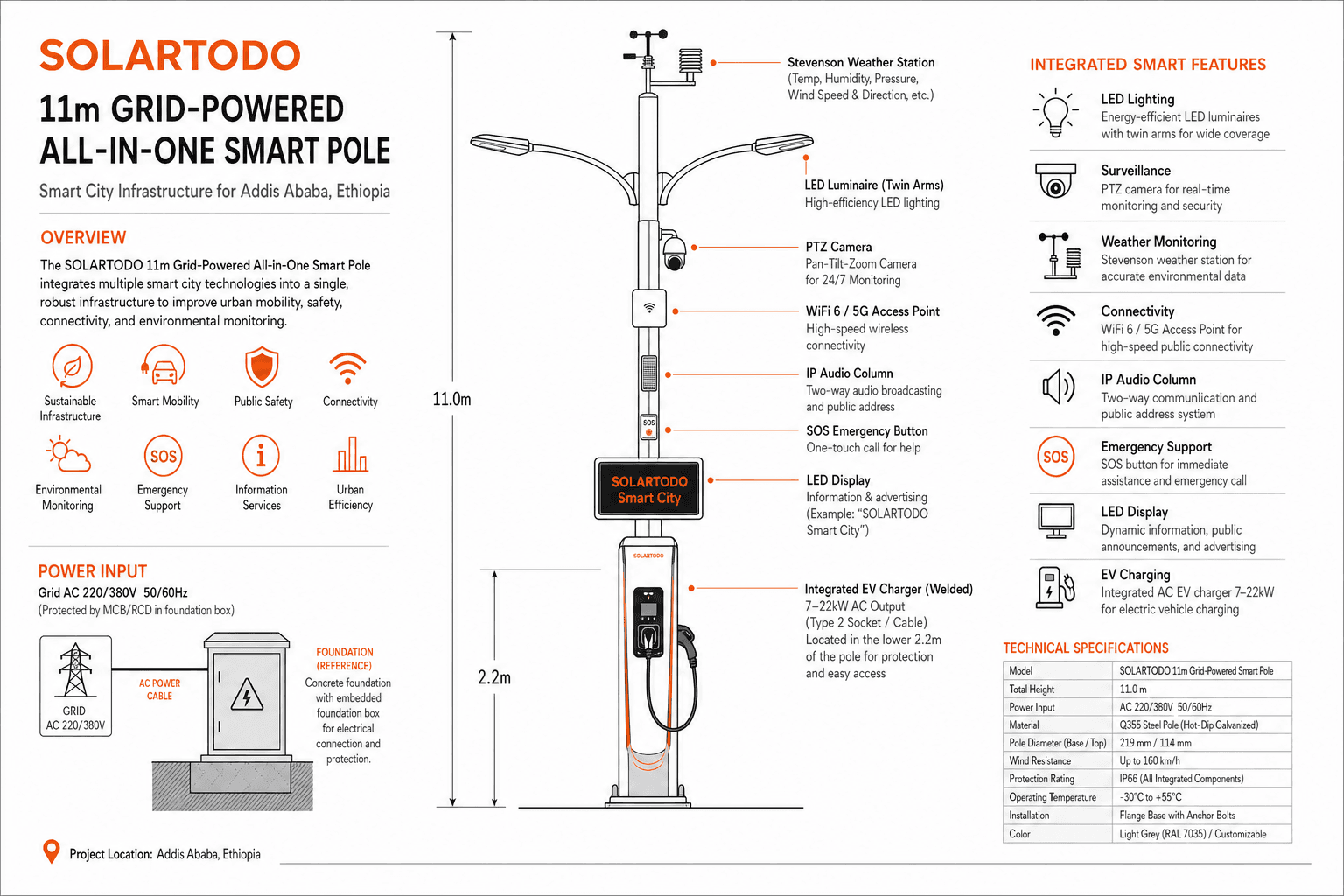
For Addis Ababa arterial and collector roads, the recommended Smart Streetlight is an 11 m grid-powered octagonal tapered steel pole with 136 units as a typical corridor-scale deployment over about 4.76 km. This size class matches dense urban streets, not highways, and supports the full accessory stack without moving into a larger traffic-pole category.
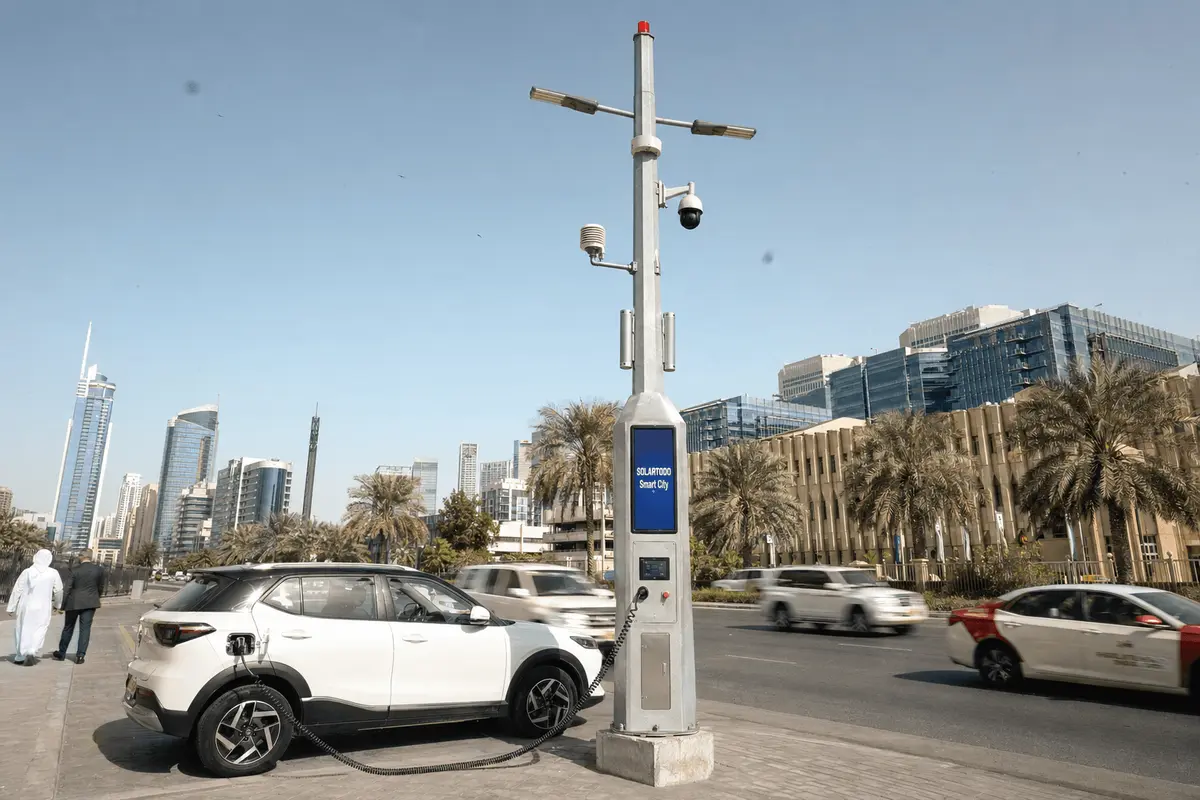
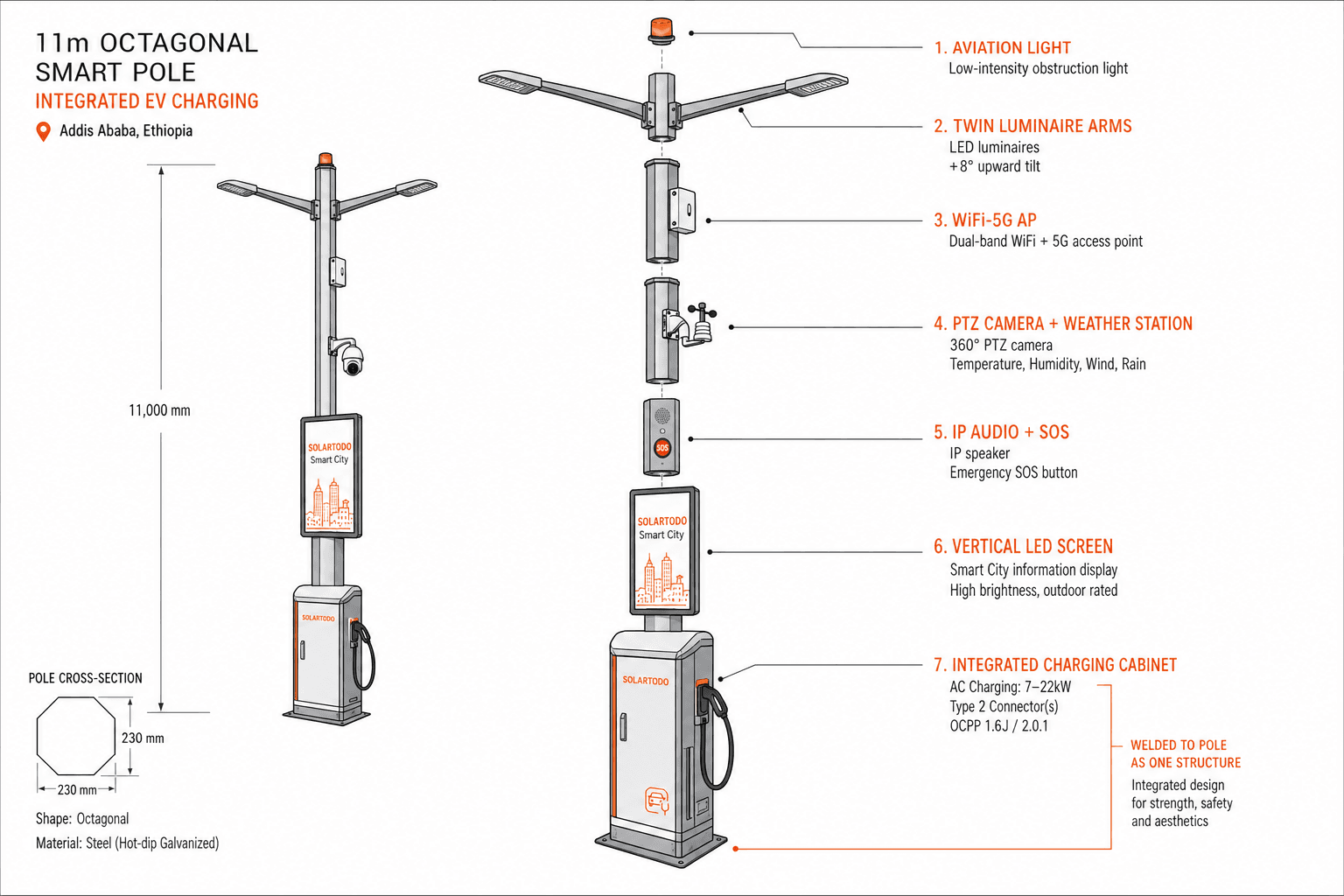
A typical 136-unit deployment of this scale would consist of poles fabricated in silver-grey hot-dip galvanized steel, powered by AC 220/380 V, and placed at 35 m spacing. The critical design point is the charger integration: the lower 2.2 m of each pole is the EV charging cabinet itself, welded as one continuous steel structure with the upper shaft. That avoids the common street-clutter problem of placing a separate charger pedestal beside the lighting pole.
For roadway lighting, the recommended head arrangement is twin symmetric 1.5 m arms with +8° upward tilt, each carrying one 80 W SOLAR TODO LED luminaire. Total lighting load per pole is therefore 160 W, with efficacy rated at 150 lm/W and color temperature at 4000 K. According to the International Energy Agency (2022), LED street lighting commonly reduces electricity use by 50% or more versus legacy sodium systems when properly specified, which supports lifecycle savings in municipal corridors.
For public safety, each pole would include a 15 cm mini white PTZ dome camera with 360° rotation, 20× zoom, and 100 m IR, mounted on a 40 cm L-bracket. The top sensor package is a 4-parameter environmental sensor measuring temperature, humidity, wind speed, and noise. This is narrower than an 8-in-1 package, but it aligns with the project-specific configuration and keeps data collection focused on street operations and weather response.
For public communication, the recommended audio package uses 2 symmetric IP audio columns sized Ø10×50 cm, each rated 30 W / 93 dB, mounted by side clamp. This is important because the specification is for IP columns, not horn speakers. Emergency response is handled by one-press SOS, dual-way audio intercom, and a visual LED indicator, allowing the pole to function as a visible roadside help point in busier districts.
For EV service, each unit incorporates an integrated 11 kW single-gun AC charger with Type 2 connector, OCPP 1.6J, 5 m coiled cable, 8-inch touchscreen at 1.5 m height, a red mushroom emergency stop, and a stainless maintenance door. According to IEC (2016), IEC 62196-2 defines dimensional compatibility for AC charging connectors including Type 2, which is useful for fleets, hotels, mixed-use developments, and public charging operators evaluating interoperability.
For digital and telecom functions, the recommended display is a P4 vertical LED screen sized 960×1920 mm, above 5500 cd/m², with content restricted to “SOLARTODO Smart City” in white sans-serif on deep blue. A 5G NR n78 small cell mounted at 8.7 m with 4T4R MIMO and about 200 m coverage gives the pole telecom-lease potential where operator agreements are available. This makes SOLAR TODO relevant not only to municipalities, but also to EPCs, telecom neutral hosts, and mixed-use developers.
Technical Specifications
This Addis Ababa configuration centers on an 11 m AC-powered Smart Streetlight with 136 units, 35 m spacing, and an integrated 11 kW charger built into the lower 2.2 m of the pole.
- Deployment scale: approximately 136 units
- Recommended spacing: 35 m center-to-center
- Coverage length: about 4.76 km of corridor
- Pole type: 11 m octagonal tapered steel smart pole
- Pole diameter: Ø45 cm base → Ø15 cm top
- Finish: silver-grey hot-dip galvanized original finish
- Power input: grid-powered AC 220/380 V
- Integrated design: lower 2.2 m of pole is the EV charging cabinet, welded as one continuous steel structure
- Lighting arms: twin symmetric arms, 1.5 m each, +8° upward tilt
- LED luminaires: 2 × 80 W SOLAR TODO LED, 150 lm/W, 4000 K
- Camera: 15 cm mini white PTZ dome, 360°, 20× zoom, IR 100 m
- Camera bracket: 40 cm L-bracket
- Top sensor: 4-parameter sensor for temperature, humidity, wind speed, and noise
- Public address: 2 × IP audio columns, Ø10×50 cm, 30 W / 93 dB, TCP/IP networked
- Emergency module: 1 SOS button, dual-way audio intercom, visual LED indicator
- EV charger: 11 kW single-gun AC, Type 2, OCPP 1.6J
- Charging cable: 5 m coiled Type 2 cable
- User interface: 8-inch touchscreen at 1.5 m height
- Safety hardware: red mushroom E-stop, stainless maintenance door
- LED display: P4 vertical, 960×1920 mm, portrait, >5500 cd/m²
- Display content: “SOLARTODO Smart City” text only, white sans-serif on deep blue
- Telecom module: 5G NR n78 small cell, 4T4R MIMO, mounted at 8.7 m
- Estimated radio coverage: about 200 m radius in urban streets
- User charging extras: Qi wireless phone charging pad + USB-A
- Standards: IEC 60598, GB/T 37024, IEC 62196-2
According to IEC (2020), "IEC 60598 specifies general requirements and tests for luminaires," which is the relevant base standard for the lighting assembly. According to IEC (2016), "IEC 62196-2 applies to plugs, socket-outlets, vehicle connectors and vehicle inlets for conductive charging of electric vehicles," which covers the Type 2 charging interface in this configuration.
Implementation Approach
A corridor-scale Addis Ababa Smart Streetlight program would typically be executed in 5 phases over roughly 16-28 weeks, depending on utility approvals, civil access, and customs lead times. The sequence should start with corridor survey, utility mapping, and photometric layout before fabrication release, because charger placement and telecom mounting both affect foundation and feeder design.
Phase 1 is design and permitting. This usually includes roadway classification, lighting simulation, load schedule, telecom coordination, and utility point-of-connection review for 220/380 V AC service. At this stage, buyers should also confirm right-of-way rules, charger billing platform requirements, and whether the 11 kW OCPP 1.6J charger will be municipally owned or operated by a charge-point partner.
Phase 2 is factory fabrication and FAT. The pole shaft, lower charger section, doors, arm geometry, and mounting interfaces should be checked as one integrated structure because the lower 2.2 m is not a bolt-on cabinet. Factory acceptance should verify touchscreen placement at 1.5 m, arm tilt at +8°, small-cell bracket elevation at 8.7 m, and display dimensions of 960×1920 mm.
Phase 3 is civil and electrical works. Typical works include excavation, reinforced concrete foundations, anchor setting, conduits, earthing, feeder cabling, and backfill. Because each pole combines lighting and EV charging, cable sizing should be calculated for the charger load of 11 kW plus auxiliary loads, not only the 160 W lighting circuit.
Phase 4 is erection and device installation. The pole is lifted as a single main structure, then the PTZ camera, IP audio columns, display, sensor, and telecom module are mounted and terminated. Commissioning should include charger handshake on OCPP 1.6J, camera stream validation, audio test at 30 W / 93 dB, and night photometric verification.
Phase 5 is software integration and handover. This includes user roles, fault alarms, charging records, display control, emergency call routing, and preventive maintenance scheduling. For Addis Ababa buyers, a practical acceptance package would include as-built drawings, pole serial tracking, insulation and grounding records, charger function tests, and spare-part lists for at least 12 months of operation.
Expected Performance & ROI
An Addis Ababa Smart Streetlight deployment of 136 units would create a dense urban service layer across about 4.76 km, combining illumination, charging, safety, and telecom tenancy on one pole line. The strongest ROI usually comes not from lighting alone, but from stacking 4 revenue or cost centers: lower LED electricity use, EV charging income, telecom lease potential, and reduced need for separate roadside cabinets.
For lighting energy, each pole uses 160 W of LED load, or 21.76 kW across 136 units before auxiliary devices. Assuming 12 hours/day of lighting operation, annual lighting consumption is about 95,300 kWh/year. According to the IEA (2022), LED street lighting can cut electricity demand by more than 50% compared with legacy technologies, so retrofit corridors may realize meaningful savings even before considering maintenance reductions.
For charging revenue, utilization is the main variable. If each 11 kW charger averages only 1-2 charging sessions per day, the business case changes materially versus a lighting-only pole. According to the International Council on Clean Transportation (2023), early public charging utilization in emerging EV markets varies widely by site selection and fleet concentration, so Addis Ababa buyers should prioritize hotel districts, commercial streets, airports links, government zones, and mixed-use developments rather than low-traffic residential streets.
Maintenance economics also matter. LEDs rated for long service life, galvanized steel, and integrated civil works can lower truck rolls versus maintaining separate poles, separate charger pedestals, and separate public-address columns. According to NREL (2020), networked outdoor infrastructure benefits from remote fault visibility and scheduled maintenance rather than reactive inspection alone. In practice, that means fewer site visits for failed drivers, charger alarms, or offline communication devices.
A realistic payback range for Addis Ababa would therefore depend on which functions are monetized. Lighting-only economics may lean toward a 6-10 year municipal lifecycle case, while adding charger income and telecom tenancy can shorten effective payback toward 3-6 years on strong corridors. SOLAR TODO should be evaluated with a corridor-specific pro forma that includes electricity tariff, charger utilization, data backhaul cost, and any operator lease revenue.
Comparison Table
This comparison shows why an 11 m integrated Smart Streetlight is usually a better fit for Addis Ababa arterials than separate single-function roadside assets.
| Metric | Recommended SOLAR TODO Smart Streetlight | Conventional streetlight + separate charger + separate telecom pole |
|---|---|---|
| Pole height | 11 m | Typically 9-12 m light pole + separate assets |
| Pole spacing | 35 m | Lighting at 30-40 m, charger spacing separate |
| Lighting load | 2×80 W = 160 W | Similar lighting, but no integrated service stack |
| EV charging | Integrated 11 kW AC Type 2 in lower 2.2 m | Separate pedestal charger required |
| Camera | PTZ, 20× zoom, IR 100 m | Usually added on separate bracket or omitted |
| Public audio | 2× 30 W / 93 dB IP columns | Separate PA hardware often needed |
| Display | P4, 960×1920 mm, >5500 cd/m² | Requires separate sign structure |
| Telecom readiness | 5G NR n78, 4T4R, 200 m | Separate telecom pole or rooftop needed |
| Street clutter | One integrated structure | 3 or more roadside structures possible |
| Civil works footprint | One foundation corridor plan | Multiple foundations and utility interfaces |
| Standards basis | IEC 60598, GB/T 37024, IEC 62196-2 | Mixed compliance across multiple vendors |
| Best fit in Addis Ababa | Arterials, collectors, mixed-use corridors | Fragmented deployments with more coordination burden |
Pricing & Quotation
SOLAR TODO offers three pricing tiers for this product line: FOB Supply (equipment ex-works China), CIF Delivered (including ocean freight and insurance), and EPC Turnkey (fully installed, commissioned, with 1-year warranty). Volume discounts are available for large-scale deployments. Configure your system online for an instant estimate, or request a custom quotation from our engineering team at [email protected].
For Addis Ababa tenders, quotation accuracy depends on 4 main variables: foundation design, utility connection distance, charger backend scope, and telecom integration scope. Buyers comparing bids should request a line-by-line BoQ covering pole steelwork, LED heads, charger module, display, camera, audio, controller, cabling, civil works, FAT, and commissioning. More product details are available on the Smart Streetlight product page, and project-specific layouts can be discussed via contact us.
Frequently Asked Questions
This FAQ answers 10 common Addis Ababa buyer questions on 11 m Smart Streetlight configuration, 11 kW charging, 35 m spacing, standards, maintenance, and quotation scope.
Q1: What Smart Streetlight configuration is the best fit for Addis Ababa roads?
For arterial and collector roads, an 11 m octagonal tapered steel pole with 35 m spacing is the most balanced option. It supports 2×80 W LED lighting, an 11 kW AC charger, camera, audio, display, and 5G n78 mounting without moving into a larger highway-pole class.
Q2: Is this pole solar-powered or grid-powered?
This Addis Ababa recommendation is grid-powered AC 220/380 V. That is the correct choice because the combined load includes 160 W lighting, an 11 kW charger, display electronics, PTZ camera, audio, and telecom equipment. A grid connection gives more stable performance for dense urban corridors.
Q3: How many poles would a typical corridor need?
At 35 m spacing, a typical 136-unit deployment covers about 4.76 km of roadway. The final quantity depends on road width, junction density, median design, and whether both sides of the road require poles. Photometric simulation should confirm the exact count before procurement.
Q4: How is the EV charger integrated into the pole?
The lower 2.2 m of the pole is the charger cabinet itself, welded into one continuous steel structure with the upper shaft. It is not a separate pedestal beside the pole. The charger is 11 kW AC, single-gun, Type 2, with OCPP 1.6J, a 5 m coiled cable, and an 8-inch touchscreen.
Q5: What deployment timeline is typical for Addis Ababa?
A normal program runs about 16-28 weeks from design freeze to commissioning. The schedule usually includes survey and approvals, fabrication, shipping, civil works, erection, and software integration. Utility connection and customs clearance are often the two biggest schedule variables in East African projects.
Q6: What payback period is realistic?
For lighting-only economics, payback may fall in the 6-10 year range depending on baseline energy costs and maintenance savings. If the site also earns charging revenue and telecom lease income, effective payback can move closer to 3-6 years on strong commercial corridors. Utilization assumptions should be tested carefully.
Q7: What maintenance does this system require?
A practical plan is quarterly inspection plus remote monitoring of charger status, lighting faults, camera uptime, and communication alarms. Annual work usually includes cleaning optics and screens, checking door seals, verifying grounding, and testing the E-stop and SOS intercom. Galvanized steel reduces corrosion risk in Addis Ababa’s rainy season.
Q8: How does this compare with a standard streetlight without charger or telecom hardware?
A standard streetlight is cheaper at first purchase but provides only illumination. This Smart Streetlight adds 11 kW EV charging, PTZ surveillance, IP audio, LED display, and 5G small-cell support on the same pole. That lowers roadside clutter and can improve total lifecycle value where multiple services are needed.
Q9: What should be included in an EPC quotation?
An EPC quotation should list the 11 m pole, 2×80 W LEDs, charger, display, camera, audio, sensor, small-cell mounting, foundations, conduits, feeder cables, earthing, commissioning, and training. Buyers should also request exclusions clearly, especially utility extension works, backend software licensing, and civil reinstatement outside the pole footprint.
Q10: What warranty and standards should buyers request?
At minimum, buyers should request compliance with IEC 60598, GB/T 37024, and IEC 62196-2, plus a defined warranty matrix for LEDs, charger electronics, display, and structural steel. For turnkey supply, a 1-year warranty is the baseline stated in the pricing section, while component warranties may vary by scope.
References
- World Bank (2023): Ethiopia urban development and infrastructure indicators; used for Addis Ababa urbanization context.
- UN-Habitat (2020): Addis Ababa city profile and metropolitan population estimates above 5 million.
- International Energy Agency (2023): Ethiopia energy profile and grid expansion context.
- GSMA (2023): Mobile Economy Sub-Saharan Africa; telecom densification and broadband growth trends.
- International Telecommunication Union (2022): 5G deployment guidance; denser heterogeneous infrastructure requirement.
- IEC (2020): IEC 60598 luminaires — general requirements and tests.
- IEC (2016): IEC 62196-2 plugs, socket-outlets, vehicle connectors and vehicle inlets for conductive charging of electric vehicles.
- NREL (2020): Networked lighting and smart-city infrastructure operations; remote monitoring and maintenance value.
- Climate-Data.org (2024): Addis Ababa climate averages, including rainfall around 1,100 mm annually.
- International Council on Clean Transportation (2023): Public charging utilization considerations in emerging EV markets.
Equipment Deployed
- 11 m octagonal tapered steel smart pole, base Ø45 cm to top Ø15 cm, silver-grey hot-dip galvanized
- Integrated lower 2.2 m EV charging cabinet welded as one continuous steel structure
- Grid-powered AC 220/380 V electrical input
- Twin symmetric 1.5 m lighting arms with +8° upward tilt
- 2 × 80 W SOLAR TODO LED luminaires, 150 lm/W, 4000 K
- 15 cm mini white PTZ dome camera, 360°, 20× zoom, IR 100 m, on 40 cm L-bracket
- 4-parameter environmental sensor: temperature, humidity, wind speed, noise
- 2 × IP audio columns, Ø10×50 cm, 30 W / 93 dB, TCP/IP networked
- One-press SOS button with dual-way audio intercom and visual LED indicator
- Integrated 11 kW single-gun AC EV charger, Type 2, OCPP 1.6J
- 5 m coiled Type 2 charging cable
- 8-inch touchscreen mounted at 1.5 m height
- Red mushroom emergency stop and stainless maintenance door
- P4 vertical LED display, 960×1920 mm, portrait, >5500 cd/m²
- 5G NR n78 small cell, 4T4R MIMO, mounted at 8.7 m, approx. 200 m coverage
- Qi wireless phone charging pad and USB-A port