Abu Dhabi Solar Streetlight (Split-Type) Market Analysis: 12m Smart Roadway Configuration Guide for 439-Unit Scale
Summary
Abu Dhabi’s high-irradiance subtropical climate, 12m roadway profiles, and municipal smart-city targets make a typical approximately 439-unit Solar Streetlight (Split-Type) scheme technically viable. A recommended configuration uses 12m SUS304 poles, 100W LED heads, 1240W Mono PERC panels, and 12V/250Ah LiFePO4 storage with 35m spacing.
Key Takeaways
- A typical deployment of this scale in Abu Dhabi would use approximately 439 units with 12m stainless steel 304 poles rated to 50 m/s wind resistance and 40-year design life.
- Based on a 12m road width and 35m pole spacing, a 100W / 15,000 lm LED layout fits arterial or collector-road lighting better than 30W or 60W walkway classes.
- Abu Dhabi records strong solar resource; according to the World Bank Global Solar Atlas (2024), the UAE has high PV potential, supporting a design assumption of about 4.8 peak-sun-hours/day for this subtropical profile.
- The specified 1240W Mono PERC panel at 21% efficiency with 0.4%/year degradation and 25-year warranty provides large recharge margin for 3-5 days cloudy backup.
- The visible external battery box should use 12V/250Ah LiFePO4, about 160 Wh/kg, 3500 cycles, 90% DoD, and 8-year warranty, with the MPPT controller inside the battery box.
- Smart control should include dimming control and 4G/LoRa remote monitoring; according to IEA (2023), connected lighting controls can materially reduce operating energy and maintenance visits in public-lighting networks.
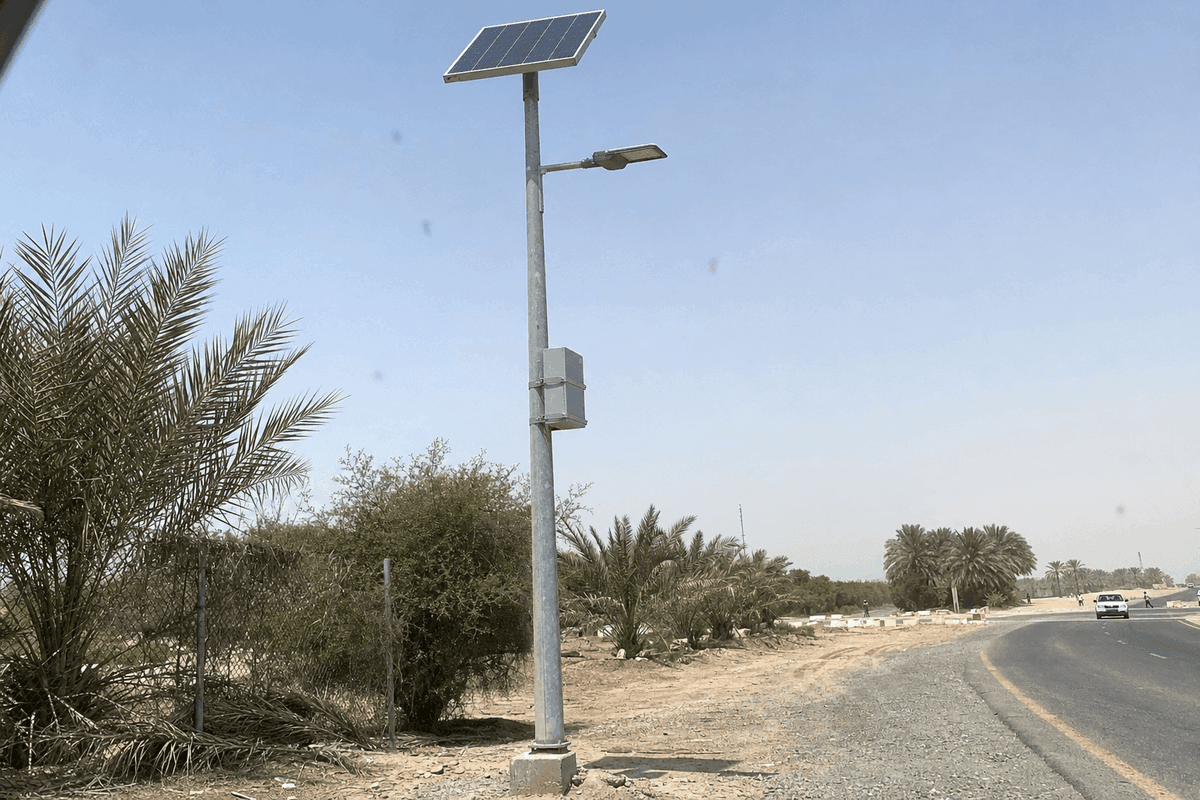
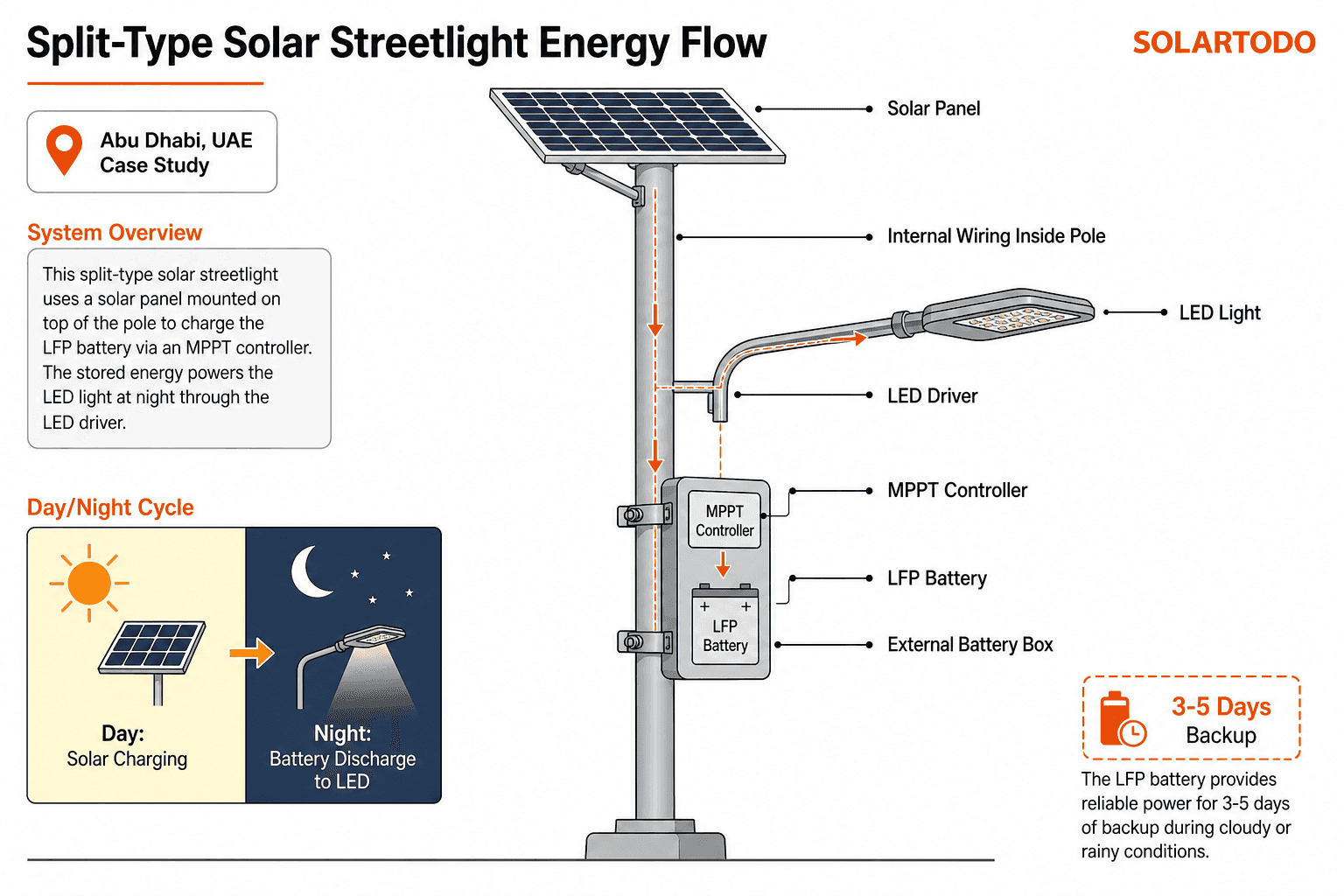
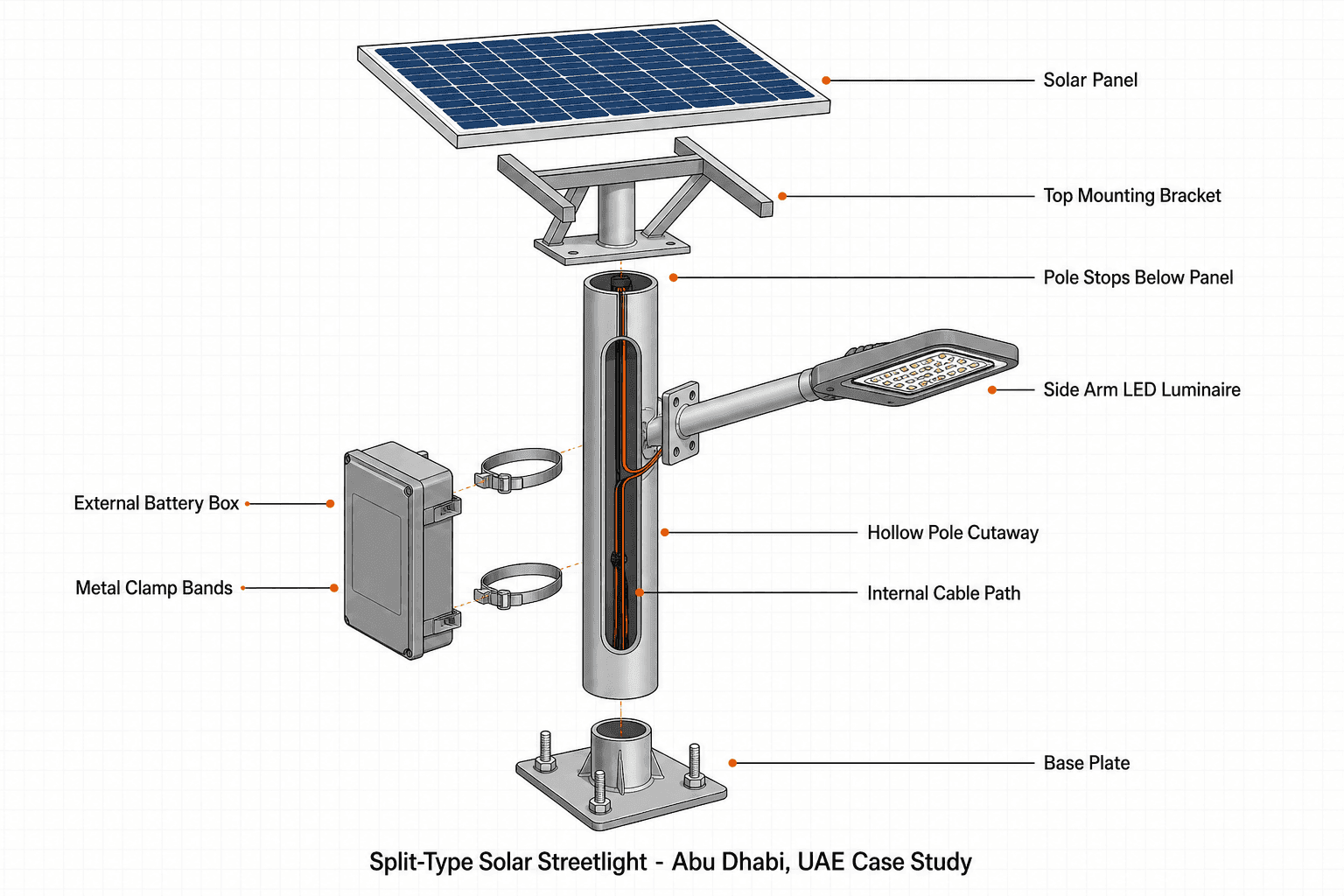
- The product must remain split-type, not all-in-one: panel at the very top, LED on a side arm below the panel, external battery box on the pole body, and all wiring inside the pole.
- Compliance should align with CJJ 45-2015, IEC 60598, and IEC 62124, with dusk-to-dawn automatic operation and corrosion-resistant materials suited to Gulf heat, dust, and coastal salinity.
Market Context for Abu Dhabi
Abu Dhabi combines high solar resource, long roadway corridors, and harsh environmental exposure, which makes a split-type solar streetlight architecture more suitable than compact all-in-one formats for many 10-12m road classes. According to Statistics Centre – Abu Dhabi (2023), the emirate’s population exceeds 3.8 million, and its urban growth continues to expand transport, residential, and mixed-use corridors that require reliable public lighting.
According to the World Bank’s Global Solar Atlas (2024), the UAE sits in a high-irradiation zone with strong annual photovoltaic output potential, while the climate profile around Abu Dhabi supports a practical design assumption of roughly 4.8 sun-hours/day for streetlight sizing. That solar resource is favorable, but local design cannot rely on irradiation alone because ambient summer temperatures often exceed 40°C, which raises battery temperature stress and LED driver thermal load.
According to the UAE Government portal and Abu Dhabi smart-city planning documents (2023-2024), the emirate continues to invest in smart infrastructure, digitized municipal services, and energy-efficiency programs across public assets. For lighting, this means buyers increasingly expect remote monitoring, fault visibility, and dimming schedules rather than simple dusk-to-dawn switching only.
The local environment also matters mechanically. Abu Dhabi roads face dust, salinity near coastal zones, and occasional strong wind events. That is why a 12m stainless steel 304 pole, 50 m/s wind resistance, internal cable routing, and an externally mounted serviceable battery box are practical choices for long-life operation. SOLAR TODO positions the Solar Streetlight (Split-Type) in this exact use case: larger poles, separated components, and easier maintenance access than sealed compact units.
Two authority statements support this direction. The IEA states, "Digitalization can improve the efficiency, reliability and resilience of energy systems," which directly supports monitored lighting networks. IEC states, "Luminaires shall be designed and constructed so that in normal use they function safely," a core requirement under IEC 60598 for roadway lighting assemblies.
Recommended Technical Configuration
A typical approximately 439-unit Abu Dhabi roadway deployment would require a 12m split-type configuration with 100W LED output, 1240W top-mounted solar panel, and 12V/250Ah LiFePO4 storage to handle heat, dust, and 3-5 cloudy days. This is a high-capacity municipal road profile rather than a small-pathway lighting class.
From the standard size-class table, Abu Dhabi’s road profile most closely aligns with the main road / highway class, which uses a 10-12m pole and 120W-class energy platform. The project-specific configuration provided here uses a 12m pole and 100W LED, which is slightly below the 120W row in LED wattage but clearly belongs to the same large-roadway structural class because the road width is 12m and spacing is 35m. In practical terms, this is a high-mount road-lighting layout, not a 6m walkway or 8m community-road system.
A typical 439-unit deployment in this profile would consist of:
- Approximately 439 split-type solar streetlights
- 12m stainless steel 304 poles
- Top-mounted 1240W Mono PERC solar panels on tilted brackets
- 100W LED luminaires delivering 15,000 lm at 150 lm/W
- 12V/250Ah LiFePO4 battery boxes mounted externally on the pole body
- MPPT controllers installed inside the battery box
- Dimming control plus 4G/LoRa remote monitoring
- Dusk-to-dawn automatic switching with 3-5 days backup autonomy
This configuration is intentionally larger than the base engineering table because the provided specification is for a higher-energy Abu Dhabi road application. In Gulf conditions, oversizing the energy side can be justified when the buyer prioritizes autonomy, reduced outage risk during dust or cloud events, and lower battery cycling stress. According to NREL (2023), high ambient temperatures can reduce battery life if thermal conditions and depth-of-discharge are not managed carefully; a larger solar array and higher storage reserve help moderate that duty cycle.
For buyers comparing form factors, SOLAR TODO should be assessed here as a split-type system only. The panel sits at the very top of the pole, the pole does not penetrate the panel center, the LED head is mounted on a side arm below the panel, and the battery box remains visible on the pole body. That geometry matters because it affects maintenance access, wind loading, panel cleaning, and visual inspection.
Internal wiring is also important in Abu Dhabi. Exposed external cables degrade faster under UV, dust abrasion, and vandalism risk. The specified arrangement keeps all wiring inside the pole, which is preferable for municipal roads and aligns with cleaner asset management practice.
Technical Specifications
The recommended Abu Dhabi configuration uses approximately 439 split-type units with 12m SUS304 poles, 100W LED heads, 1240W Mono PERC panels, 12V/250Ah LiFePO4 batteries, and 35m spacing for 12m-wide roads under CJJ 45-2015, IEC 60598, and IEC 62124.
- Product type: Solar Streetlight (Split-Type), not integrated/all-in-one
- Typical quantity for this scale: approximately 439 units
- Application profile: municipal road / collector road / arterial road
- Pole height: 12m
- Pole material: stainless steel 304
- Wind resistance: 50 m/s
- Pole service life: approximately 40 years
- Road width basis: 12m
- Pole spacing basis: 35m
- Solar panel position: at the very top of the pole on a tilted bracket
- Panel penetration rule: pole does not pass through the panel center
- Solar panel power: 1240W
- Panel technology: Mono PERC
- Panel efficiency: 21%
- Panel degradation: 0.4%/year
- Panel warranty: 25 years
- LED power: 100W
- Luminous flux: 15,000 lm
- Luminous efficacy: 150 lm/W
- CRI: >70
- Luminaire position: side arm below the panel
- Battery chemistry: LiFePO4 (LFP)
- Battery capacity: 12V/250Ah
- Battery energy density: 160 Wh/kg
- Cycle life: 3500 cycles
- Depth of discharge: 90% DoD
- Battery warranty: 8 years
- Battery box location: externally mounted on pole body as a visible grey box
- Controller type: MPPT, installed inside battery box
- Wiring: all wiring inside the pole, no external surface cables
- Autonomy: 3-5 days cloudy backup
- Control mode: dusk-to-dawn automatic
- Smart features: dimming control and 4G/LoRa remote monitoring
- Climate basis: subtropical, approximately 4.8h sun
- Applicable standards: CJJ 45-2015, IEC 60598, IEC 62124
A note on engineering-table fit is necessary for procurement review. The standard table pairs 120W LED with 200W panel, 24V/150-200Ah, and 10-12m pole for main-road class. The Abu Dhabi configuration provided here is a project-specific high-capacity variant with a 12m pole and much larger 1240W panel plus 12V/250Ah LFP storage. Because this article follows the supplied specification exactly, buyers should treat it as a municipal custom configuration rather than a small standard package from the base table.
Implementation Approach
A typical Abu Dhabi rollout of approximately 439 units would proceed in 5 phases over about 12-20 weeks, depending on civil permits, logistics batch size, and inspection windows. The most efficient sequence is survey, foundation works, pole and bracket installation, electrical assembly, then remote-monitoring commissioning.
1) Site survey and lighting design
The first phase should verify road width, setback, underground utilities, and target lux levels across the 12m carriageway. Pole spacing at 35m needs confirmation against junction density, medians, and pedestrian crossings. In Abu Dhabi, this phase should also review wind exposure, coastal salinity if relevant, and cleaning access for the 1240W panel surface.
2) Foundation and anchor preparation
For a 12m pole with a top-mounted panel, the foundation design should account for combined dead load and wind sail area. Local structural review should check base plate, anchor bolts, and soil bearing capacity against the 50 m/s wind criterion. Stainless steel 304 improves corrosion resistance, but the civil interface still needs proper grout, bolt protection, and drainage.
3) Pole, luminaire, panel, and battery-box assembly
The pole should be erected first, then the side-arm LED head, top bracket, and solar module. The external battery box is mounted visibly on the pole body for service access, while the MPPT controller stays inside that enclosure. All DC and control wiring should run inside the pole, with no loose external cable loops.
4) Control setup and network commissioning
Each unit should be configured for dusk-to-dawn operation, dimming schedules, and 4G/LoRa communication. A practical municipal profile is 100% output during evening peak traffic, then reduced output in lower-traffic hours to extend battery reserve. According to IRENA (2023), digital energy controls improve operational visibility and support lower maintenance overhead in distributed energy assets.
5) Inspection, acceptance, and O&M handover
Commissioning should verify panel polarity, battery state-of-charge, luminaire output, controller charging logic, and communications signal quality. Acceptance testing should also confirm 3-5 day backup assumptions under programmed dimming. SOLAR TODO buyers should request a maintenance matrix covering panel cleaning intervals, battery health checks, and spare-part lead times before final sign-off; contact us if a project-specific checklist is needed.
Expected Performance & ROI
A 12m Abu Dhabi split-type solar streetlight with 100W LED, 1240W PV, and 12V/250Ah LiFePO4 storage would typically target full-night operation, 3-5 days autonomy, and lower grid trenching cost than conventional streetlighting on new road corridors. The strongest ROI case appears where grid extension, ducting, and utility approvals are expensive or slow.
The daily lighting load depends on dimming profile. If the 100W luminaire ran at full output for 12 hours, demand would be about 1.2 kWh/day per pole. With dimming control, practical nightly demand can fall meaningfully below that level. According to the U.S. Department of Energy (2020), networked and adaptive lighting controls can reduce outdoor lighting energy use substantially, especially in low-traffic periods.
The specified 1240W panel is large relative to the LED load, which creates recharge margin after cloudy weather and reduces chronic deep cycling of the 12V/250Ah LFP battery. That matters in Abu Dhabi because summer heat accelerates degradation when batteries remain at high temperature and low state of charge. According to NREL (2023), lithium battery lifetime is strongly affected by temperature and cycling conditions; larger solar input and dimming logic can improve usable life.
For ROI, buyers usually compare solar streetlights against conventional grid-connected poles on greenfield roads, industrial parks, perimeter roads, or remote access routes. In those cases, savings come less from lamp wattage alone and more from avoiding trenching, copper cabling, feeder pillars, and utility connection delays. Depending on civil conditions, a payback band of roughly 4-8 years is often realistic for off-grid roadway lighting, though the exact number depends on labor rates, road length, and maintenance policy.
Operationally, the smart layer adds value beyond energy. Remote monitoring can identify battery faults, controller alarms, or communication losses without dispatching crews to all 439 units. For municipal operators, that can reduce inspection cycles and improve uptime. SOLAR TODO can therefore be evaluated not only as a lighting asset, but also as a monitored roadside infrastructure platform linked to maintenance workflows.
Results and Impact
For Abu Dhabi, a typical 439-unit split-type scheme would mainly address lighting coverage on 12m roads where grid extension is costly, while improving asset visibility through 4G/LoRa monitoring and preserving 3-5 days of autonomy. The expected impact is lower civil dependency, better maintenance control, and stronger resilience during local outages.
The main infrastructure challenge is not solar resource; Abu Dhabi has strong irradiance. The challenge is delivering reliable road lighting under high heat, dust, salinity, and long municipal maintenance cycles. A split-type arrangement with a visible serviceable battery box, internal wiring, and 12m mounting height is better suited to those constraints than compact decorative systems.
For planners, the practical result is a road-lighting asset that can be deployed on new corridors without waiting for every section of grid cabling and feeder infrastructure. For O&M teams, the practical result is easier battery-box access, remote fault visibility, and component-level replacement rather than full-head replacement. SOLAR TODO should therefore be assessed in Abu Dhabi as a technical fit for roadway resilience and maintenance efficiency, not as a decorative small-scale solar lamp.
Comparison Table
The table below compares the supplied Abu Dhabi configuration with standard split-type size classes to show why this is a custom high-capacity road application rather than a walkway package.
| Configuration | Typical Application | Pole Height | LED Power | Solar Panel | Battery | Smart Features | Fit for Abu Dhabi 12m Road |
|---|---|---|---|---|---|---|---|
| Standard small class | Walkway / garden path | 6m | 30W | 60W | 12V/60Ah | Timer / sensor optional | Too small |
| Standard medium class | Community road / parking | 7-8m | 50-60W | 100W | 12V/100Ah | Dimming optional | Usually undersized |
| Standard large class | Secondary road / plaza | 8-10m | 80W | 150W | 24V/100Ah | Remote optional | Borderline for 12m road |
| Standard arterial class | Main road / highway | 10-12m | 120W | 200W | 24V/150-200Ah | Dimming + remote | Closest standard class |
| Abu Dhabi recommended custom configuration | 12m municipal road / collector road | 12m | 100W / 15,000 lm | 1240W Mono PERC | 12V/250Ah LiFePO4 | Dimming + 4G/LoRa | Strong fit for high-autonomy use |
Pricing & Quotation
SOLAR TODO offers three pricing tiers for this product line: FOB Supply (equipment ex-works China), CIF Delivered (including ocean freight and insurance), and EPC Turnkey (fully installed, commissioned, with 1-year warranty). Volume discounts are available for large-scale deployments. Configure your system online for an instant estimate, or request a custom quotation from our engineering team at [email protected].
For Abu Dhabi tenders, the quotation should separate equipment, marine logistics, local civil works, erection labor, and communication-platform scope. Buyers should also confirm whether pricing includes foundations, anchor cages, SIM/data plans for 4G, and cleaning tools for 1240W panel maintenance. The product page for technical review is here: Solar Streetlight (Split-Type).
Frequently Asked Questions
A buyer evaluating approximately 439 split-type units in Abu Dhabi usually asks about sizing, installation time, maintenance cycles, controls, warranty, and commercial scope before issuing a technical RFQ.
Q1: Why is split-type preferred over all-in-one for Abu Dhabi roads? Split-type is better for 12m poles and larger road widths because the panel, LED, and battery are separated. That improves thermal management, maintenance access, and component replacement. In Abu Dhabi, dust, heat above 40°C, and long service intervals make an external battery box and top-mounted panel more practical than compact integrated housings.
Q2: Is a 100W LED enough for a 12m-wide road at 35m spacing? For many collector-road or arterial profiles, 100W with 15,000 lm at 35m spacing can be workable, but final lux compliance should be checked by photometric simulation. Junction density, median width, mounting setback, and target uniformity all matter. A municipal buyer should request a Dialux-style calculation before approving the final pole layout.
Q3: Why does this specification use a 1240W panel for one 100W luminaire? The large 1240W panel creates recharge margin and supports 3-5 days autonomy with lower battery stress. In hot climates, avoiding repeated deep discharge helps extend LiFePO4 life. It also gives better recovery after dusty or cloudy periods, which is useful on roads where maintenance crews cannot respond immediately.
Q4: How long would a 439-unit project typically take to deliver and install? A typical schedule is about 12-20 weeks, depending on approvals, sea freight, civil readiness, and batch installation strategy. Manufacturing and inspection may take 4-8 weeks, shipping 2-5 weeks, and site works 4-7 weeks. Large road packages often move faster when foundations are prepared before equipment arrival.
Q5: What maintenance does this system need in Abu Dhabi? Routine work usually includes panel cleaning, battery-box inspection, fastener checks, and remote alarm review. In dusty conditions, panel cleaning may be needed every 2-6 weeks depending on site exposure. Electrical inspection is often quarterly, while battery health and controller logs should be reviewed at least every 6-12 months.
Q6: What payback period is typical for solar streetlights in Abu Dhabi? Payback commonly depends on avoided trenching, cable runs, feeder pillars, and utility connection delays rather than energy savings alone. For remote or greenfield roads, a rough benchmark is 4-8 years. Exact ROI should include cleaning cost, battery replacement cycle, local labor rates, and whether smart controls reduce nighttime output.
Q7: What standards should appear in the technical file? For this configuration, the core references are CJJ 45-2015, IEC 60598, and IEC 62124. Buyers may also request material certificates for stainless steel 304, battery test reports, panel warranty terms, and wind-load calculations for 50 m/s. For public tenders, communication protocol documentation for 4G/LoRa is also useful.
Q8: Does the battery have to be inside the pole base? No. In this specified design, the battery box is externally mounted on the pole body as a visible grey enclosure. That arrangement improves service access and keeps the product consistent with the required split-type architecture. It should not be hidden in the base, and the MPPT controller should remain inside the battery box.
Q9: What smart features are most useful for municipal operators? For Abu Dhabi roads, the most useful features are dimming control and 4G/LoRa remote monitoring. Dimming reduces overnight energy demand, while remote monitoring flags faults, low battery state, and communication loss. On a network of about 439 units, that can reduce unnecessary site visits and improve maintenance planning.
Q10: What warranty structure is reasonable for this product class? Based on the supplied specification, buyers should expect about 25 years for the Mono PERC panel performance warranty and 8 years for the LiFePO4 battery warranty. Pole life is approximately 40 years if corrosion control and foundation details are correct. Luminaire and controller warranty terms should be confirmed in the quotation.
References
- Statistics Centre – Abu Dhabi (2023): Population and demographic indicators for Abu Dhabi Emirate, supporting infrastructure demand planning.
- World Bank Global Solar Atlas (2024): UAE solar resource maps and photovoltaic power potential data relevant to Abu Dhabi irradiation conditions.
- International Energy Agency (IEA) (2023): Digitalization improves energy-system efficiency, reliability, and resilience; relevant to smart lighting controls and monitoring.
- International Renewable Energy Agency (IRENA) (2023): Digitalization and distributed energy management guidance relevant to monitored off-grid lighting assets.
- IEC (2020): IEC 60598 luminaire safety requirements for lighting equipment used in normal service.
- IEC (2017): IEC 62124 performance evaluation guidance for stand-alone photovoltaic systems relevant to off-grid lighting verification.
- U.S. Department of Energy (2020): Outdoor lighting controls guidance indicating measurable energy savings from adaptive and networked lighting systems.
- NREL (2023): Battery lifetime and performance considerations under temperature and cycling stress, relevant to LiFePO4 sizing in hot climates.
- CJJ 45-2015 (China National Standard): Code for design of road lighting, commonly referenced for roadway lighting layout and spacing.
SOLAR TODO should be specified in Abu Dhabi with clear component separation, internal wiring, and road-class photometric review. For procurement support, buyers can review the product page at Solar Streetlight (Split-Type) or contact us for a project-specific technical checklist.
Equipment Deployed
- 439 × Solar Streetlight (Split-Type)
- 12m stainless steel 304 pole, 50 m/s wind resistance, 40-year life
- 1240W Mono PERC solar panel, 21% efficiency, 0.4%/yr degradation, 25-year warranty
- 100W LED luminaire, 15,000 lm, 150 lm/W, CRI>70
- Side arm luminaire mount below panel
- 12V/250Ah LiFePO4 battery, 160 Wh/kg, 3500 cycles, 90% DoD, 8-year warranty
- External pole-mounted grey battery box
- MPPT controller installed inside battery box
- Internal pole wiring, no visible external cables
- Dimming control system
- 4G/LoRa remote monitoring module
- Dusk-to-dawn automatic control