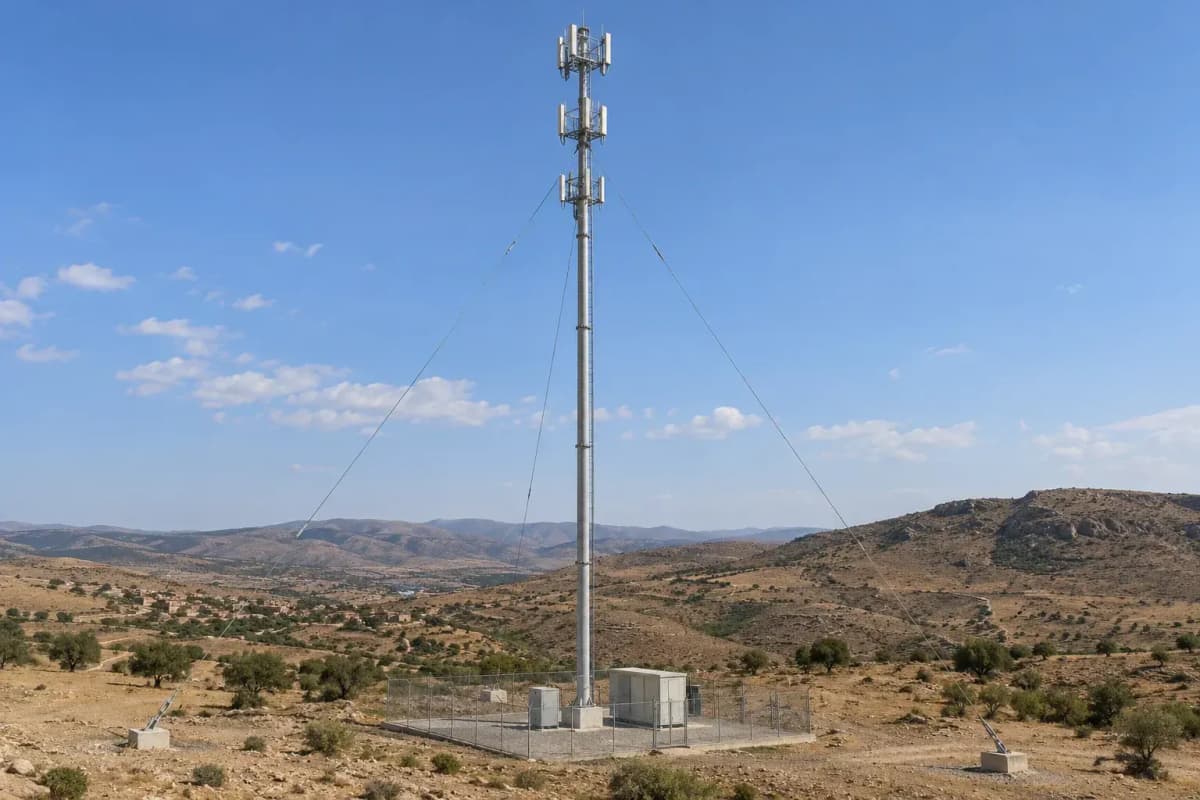
60m Guyed Tower Rural Wide Coverage Flanged - 47 m/s Steel Telecom Mast
Key Features
- 60 m steel-tube guyed mast for rural macro coverage and microwave line-of-sight
- 47 m/s design wind speed, equivalent to approximately 169 km/h before site-code adjustments
- 3 antenna platform levels with capacity for 12 antennas across cellular and backhaul systems
- Foundation concept includes 1 central concrete base plus 4 guy-wire anchor blocks
- EPC turnkey price range is USD 63,070-86,020 with 1-year warranty
The 60m Guyed Tower Rural Wide Coverage Flanged is a hot-dip galvanized steel-tube telecom mast with 3 antenna platforms, 12 antenna positions, and a 47 m/s design wind speed for rural macro-cell coverage. EPC turnkey pricing is USD 63,070-86,020, including engineering, procurement, construction, commissioning, and a 1-year warranty.
Description
The 60m Guyed Tower Rural Wide Coverage Flanged is a steel-tube telecom mast engineered for rural macro coverage, 3 antenna platform levels, 12 antenna positions, and a 47 m/s design wind speed. The tower uses flanged section joints, a central concrete base, and 4 guy-anchor directions to provide a cost-efficient 60 m elevation where open land is available.
Product Overview
A 60 m guyed tower is typically selected when coverage radius, microwave line-of-sight, and low USD-per-meter steel cost matter more than compact land use. This SOLARTODO configuration supports 4G/5G panel antennas, microwave dishes, GPS timing antennas, aviation warning lights, and outdoor feeder routing on 3 serviceable levels, with a nominal 30-year design life under planned inspection and galvanized-steel maintenance.
For rural networks, the engineering logic is simple: a 60 m antenna centerline can improve horizon clearance compared with 30 m poles, while the guyed structure reduces primary steel mass compared with many self-supporting lattice towers of similar height. The trade-off is land: the guy radius is normally 30-50% of tower height, so this model should reserve about 18-30 m from the mast center to each anchor block before road, fence, or land-title constraints are finalized.
System Architecture
The tower system is organized into 5 physical layers: the 60 m steel-tube mast, 4 guy-wire systems at staged elevations, 3 antenna platforms, 1 vertical access and cable-management route, and a grounding/lightning network with target earth resistance below 4 ohm. Flanged connections allow factory-drilled sections to be bolted on site, reducing field welding exposure and improving dimensional control during erection.
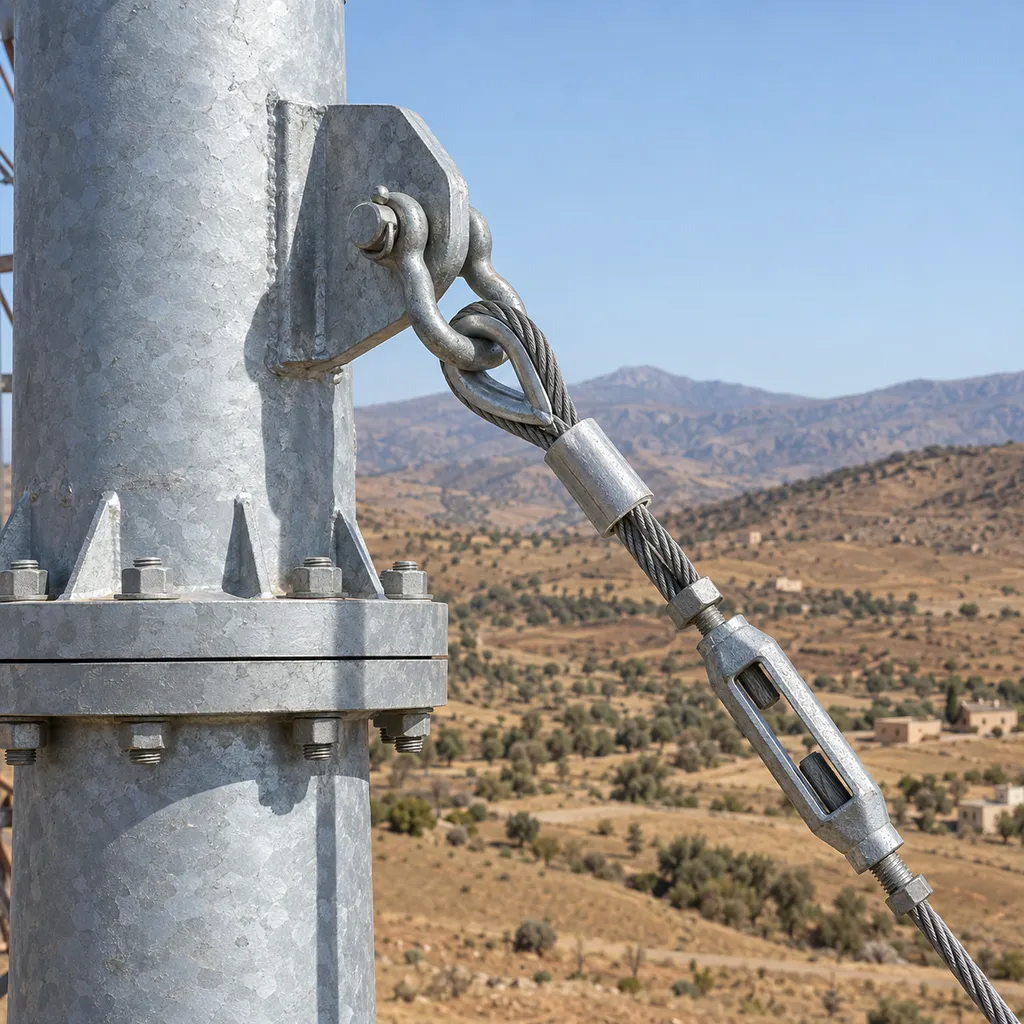
The structural basis is aligned with recognized tower practice rather than a single-market shortcut: TIA identifies ANSI/TIA-222-H as the structural standard for antenna supporting structures, antennas, and small wind turbine support structures, and its TR-14 committee covers wind, snow, ice, and seismic environmental requirements TIA TIA-222. For European procurement packages, EN 1993-3-1 applies to the structural design of lattice towers and guyed masts supporting bluff elements EN 1993-3-1 listing.
Technical Specifications
| Parameter | Value |
|---|---|
| Tower height | 60 m |
| Tower type | Guyed steel-tube mast |
| Connection type | Flanged bolted sections |
| Antenna platforms | 3 levels |
| Antenna capacity | 12 antennas |
| Design wind speed | 47 m/s |
| Estimated total tip load | 950 kg |
| Guy radius planning range | 18-30 m |
| Foundation system | 1 central base + 4 anchor blocks |
| Grounding target | Less than 4 ohm |
| Design life | 30 years |
The 47 m/s wind-speed rating corresponds to approximately 169 km/h, so the final design should still validate local exposure category, topography, ice loading, antenna projected area, and microwave dish diameter before fabrication drawings are released. SOLARTODO treats antenna schedule, feeder count, cable tray loading, and aviation-light voltage as project inputs because a 12-antenna mast with 2 microwave dishes can impose a different overturning profile than a 12-panel-only cellular layout.
Lightning protection is based on 1 air terminal, 1 continuous down-conductor path, equipotential bonding, surge protection coordination, and a ground ring tested against the less-than-4-ohm project target. IEC 62305-1:2024 provides general principles for protecting structures, installations, contents, and persons against lightning IEC 62305-1, while IEEE 81-2025 covers earth resistivity, ground impedance, and surface-potential measurement methods for grounding systems IEEE 81-2025.
Applications
This 60 m rural wide-coverage tower is designed for 4 primary site types: agricultural villages, highway corridors, utility rights-of-way, and renewable-energy or water-infrastructure sites needing backhaul plus security communications. A typical bill of loading includes 9 sector panel antennas across 3 sectors, 2 microwave dishes for backhaul, and 1 GPS or timing antenna, leaving cable routing and platform working space for maintenance.
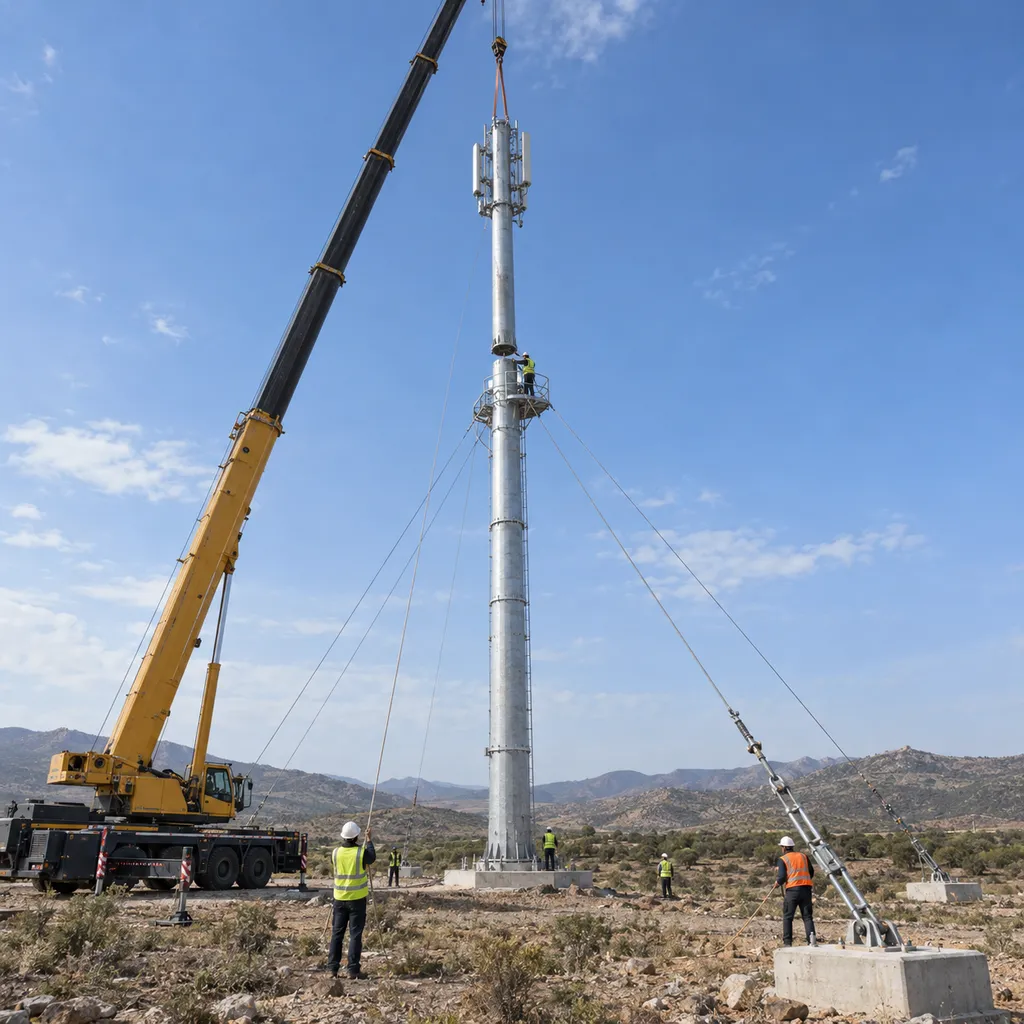
For a representative MENA solar farm scenario, 1 tower at 60 m can combine carrier radio coverage, 2 microwave backhaul links, 4 perimeter-security camera uplinks, and SCADA communications for a 5-20 MW rural energy site, subject to terrain and radio-planning study. This is a representative engineering scenario only, not a claim that any customer deployed, purchased, approved, or achieved a measured result with this configuration.
Compared with a conventional 60 m self-supporting lattice tower, a guyed mast can reduce tower steel tonnage by about 20-35% in open terrain because guy wires carry a large portion of lateral load. The economic advantage is strongest when land is low-cost and anchor radii of 18-30 m are acceptable; the self-supporting alternative is better where a fenced compound is limited to about 10-15 m across.
EPC Investment Analysis and Pricing Structure
SOLARTODO EPC scope includes 5 work packages: engineering design, procurement and factory QA, ocean or inland logistics, civil construction and tower erection, plus commissioning with a 1-year warranty. Buyers can also compare related models at View all Telecom Tower products, size a project through Configure your system online, or Request a custom quotation with a 12-antenna loading schedule.
| Pricing tier | Scope | Price range |
|---|---|---|
| FOB Supply | Equipment only, ex-works China | USD 39,103-58,494 |
| CIF Delivered | Equipment + ocean freight + insurance | USD 50,006-74,804 |
| EPC Turnkey | Installed, commissioned, 1-year warranty | USD 63,070-86,020 |
| Volume band | Discount assumption | Procurement note |
|---|---|---|
| 50+ towers | 5% | Best for 1 regional rollout batch |
| 100+ towers | 10% | Best for 2-3 provincial packages |
| 250+ towers | 15% | Best for national framework orders |
ROI depends on the business model, but a 60 m rural macro tower often has a payback case when it replaces 2 shorter repeater sites, removes 1 extra microwave hop, or avoids 1 diesel-serviced off-grid cabinet. If a self-supporting 60 m tower package costs 15-25% more in steel and foundation scope, a USD 75,000 EPC guyed site can preserve roughly USD 11,000-19,000 in capital budget before land and permitting are counted.
Payment terms are normally 30% T/T advance plus 70% against bill of lading, or 100% irrevocable L/C at sight for bankable buyers. Project financing can be reviewed for programs above USD 1,000,000, and EPC quotations should be requested through [email protected] with site coordinates, wind code, soil bearing capacity, antenna list, and required delivery month.
Engineering, Standards, and QA
Steel components are specified as hot-dip galvanized steel tube, with marine-grade corrosion protection available for coastal zones and industrial C4/C5 environments. Galvanizing thickness, bolt grade, flange flatness, weld traceability, and trial assembly checks should be recorded before shipment because a 60 m structure with 3 platforms and 4 guy directions depends on millimeter-level fit-up at each bolted joint.
The tower should be inspected at 3 intervals: incoming material QA, pre-shipment dimensional inspection, and post-erection acceptance testing. Site acceptance typically includes torque verification, guy tension recording, verticality measurement, grounding resistance test below 4 ohm, aviation-light functional test, and antenna-mount alignment before the 1-year warranty clock begins.
NREL notes that telecommunications facilities require backup power to maintain constant supply and network operability during outages NREL telecom backup power. For remote sites, this means the tower package should be coordinated with a DC power plant, battery autonomy target, surge protection, and optional solar or hybrid power so that radio uptime is not limited by the mast structure alone.
Grid, Energy, and Infrastructure Context
Rural telecom towers increasingly sit inside broader energy and infrastructure programs, including solar farms, irrigation districts, highway ITS, and village broadband. The IEA reports that power grids require major modernization to support secure energy transitions IEA Electricity Grids, and telecom towers add a communications layer that can support grid monitoring, security alarms, and remote maintenance across 24-hour operations.
Renewable power can also change tower operating cost. IRENA reported that its renewable-cost database covered more than 25,000 projects by 2024 and that renewables remained a cost-competitive source of new electricity in 2024 IRENA Renewable Power Generation Costs 2024. For off-grid or weak-grid telecom sites, SOLARTODO can pair this 60 m tower with solar, battery storage, smart lighting, and security equipment under a single infrastructure procurement package.
Procurement Notes
A buyer should freeze 6 inputs before ordering: site coordinates, governing standard, design wind speed, soil report, antenna loading table, and power-system architecture. When these 6 inputs are known, SOLARTODO can issue general arrangement drawings, foundation reactions, anchor geometry, packing dimensions, and an EPC schedule with approximately 30-75 days for manufacturing and shipping depending on order volume.
For product education and standards background, buyers can review Learn about topic before issuing an RFQ, then compare this tower against monopoles, self-supporting towers, and rooftop mounts. The strongest fit is a rural site with at least 1,200-3,000 m² of controllable land, low obstruction height, and a requirement for 3-sector macro coverage rather than dense urban small-cell service.
Why SOLARTODO
SOLARTODO supplies solar, energy storage, smart lighting, security, telecom towers, power towers, and smart-agriculture infrastructure from 1 integrated B2B sourcing platform. For a 60 m guyed telecom tower, that integration matters because tower steel, grounding, aviation lighting, cabinet power, battery backup, cameras, and cloud monitoring can be specified together instead of being purchased as 6 disconnected packages.
Use this model when the project needs a 60 m antenna height, 12-antenna capacity, low structural cost per meter, and enough land for 4 anchor directions. Do not use it where the compound cannot accept an 18-30 m guy radius, where municipal aesthetics require a concealed pole, or where local law requires a freestanding structure inside a compact 1-fence parcel.
Technical Specifications
| Tower Height | 60m |
| Tower Type | Guyed |
| Material | Steel tube |
| Connection Type | Flanged bolted sections |
| Antenna Platforms | 3levels |
| Antenna Capacity | 12antennas |
| Design Wind Speed | 47m/s |
| Total Tip Load | 950kg |
| Foundation Type | Central concrete base plus 4 guy anchor blocks |
| Corrosion Protection | Hot-dip galvanized / marine grade optional |
| Grounding Resistance Target | <4ohm |
| Design Life | 30years |
| Standards | TIA-222-H / EN 1993-3-1 / IEC 62305 / IEEE 81 |
Price Breakdown
| Item | Quantity | Unit Price | Subtotal |
|---|---|---|---|
| Hot-dip galvanized steel-tube mast sections | 31 t | $1,500 | $46,500 |
| Guy wire set with turnbuckles and hardware | 4 sets | $1,500 | $6,000 |
| Steel antenna platform, installed | 3 pcs | $800 | $2,400 |
| External climbing ladder and safety rail | 60 m | $15 | $900 |
| Vertical cable tray system | 60 m | $10 | $600 |
| Lightning protection and grounding system | 1 system | $500 | $500 |
| Aircraft warning light set | 2 sets | $300 | $600 |
| Central foundation and 4 anchor blocks | 38 m3 | $300 | $11,400 |
| Steel tower installation labor | 31 t | $200 | $6,200 |
| Engineering, drawings, and QC documentation | 1 lot | $4,700 | $4,700 |
| Commissioning and acceptance testing | 1 lot | $2,100 | $2,100 |
| 1-Year Warranty and support reserve | 1 lot | $2,600 | $2,600 |
| Total Price Range | $63,070 - $86,020 | ||
Frequently Asked Questions
What is included in the EPC turnkey price for this 60m guyed tower?
How much land is needed for the 60m guyed tower anchors?
Can this tower support 5G antennas and microwave dishes together?
Which standards are used for structural and grounding design?
Why choose a guyed tower instead of a self-supporting tower?
Certifications & Standards



Data Sources & References
- •Telecommunications Industry Association TIA-222 standard page
- •EN 1993-3-1 towers and guyed masts standard listing
- •IEC 62305-1:2024 lightning protection principles
- •IEEE 81-2025 grounding measurement standard
- •NREL Fuel Cells for Backup Power in Telecommunications Facilities
- •IEA Electricity Grids and Secure Energy Transitions
- •IRENA Renewable Power Generation Costs in 2024
Interested in this solution?
Contact us for a customized quote based on your specific requirements.
Contact Us