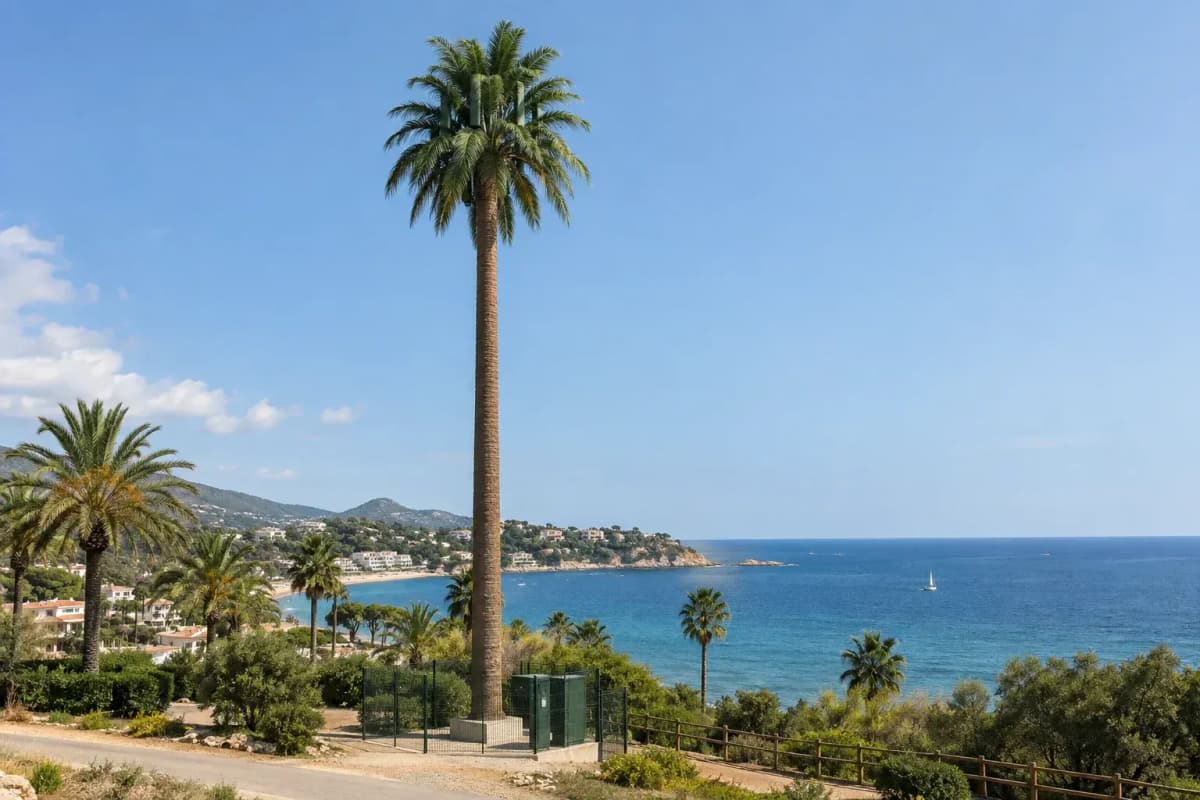
27m Monopalm Coastal Tourism Flanged - 41 m/s Stealth Telecom Tower
Key Features
- 27 m camouflage monopalm tower for coastal tourism telecom sites
- 41 m/s design wind speed, equal to approximately 147.6 km/h
- 2 antenna platform levels with capacity for 6 antennas
- Representative 450 kg total tip load for antennas and accessories
- EPC turnkey price range of 50,274-75,924 USD per tower
The 27m Monopalm Coastal Tourism Flanged is a steel telecom monopole with FRP palm cladding, 2 antenna platform levels, 6 antenna positions, and a 41 m/s wind-speed design for coastal tourism zones. It is specified for low-visual-impact 4G/5G coverage where TIA-222-H, EN 1993-3-1, IEC 62305, and marine corrosion control are required.
Description
The 27m Monopalm Coastal Tourism Flanged is a 27 m camouflage telecom tower engineered for 6 antennas on 2 platform levels, a 41 m/s design wind speed, and coastal tourism sites where visual impact must be reduced without hiding structural requirements. The system combines a steel flanged monopole, marine-grade corrosion protection, and FRP palm cladding to support 4G/5G panels, microwave backhaul, GPS accessories, aviation warning lights, and lightning protection under TIA-222-H and EN 1993-3-1 design logic.
Product Overview
This SOLARTODO telecom tower is designed for resorts, waterfront roads, scenic parks, coastal villages, island utilities, and 2-sector or 3-sector mobile coverage nodes where a conventional bare steel pole can create 1 visible industrial landmark in a tourism corridor. The 27 m height gives practical antenna centerline options around 24 m to 26 m, while the 2 platform levels allow separation of cellular panels and microwave or RF ancillary equipment. For a coastal deployment with chloride exposure, the steel shaft is specified with hot-dip galvanizing and optional marine coating, while the FRP leaves and trunk texture provide RF-transparent concealment for selected antennas and cables.
The structural basis follows the same engineering discipline used for non-camouflaged telecom towers, including TIA-222-H for antenna-support structures, EN 1993-3-1 for steel towers and masts, IEC 62305 for lightning protection, and ISO 1461 for galvanizing thickness control. The 41 m/s wind speed equals approximately 147.6 km/h, which places the product in a severe coastal-wind class for many island and shoreline markets. Industry energy-infrastructure guidance from IEA, IRENA, NREL, IEC, IEEE, and BloombergNEF consistently emphasizes resilient grid and communications infrastructure as a prerequisite for distributed-energy, emergency-response, and smart-city systems.
View all Telecom Tower products for adjacent steel monopoles, FRP stealth poles, lattice towers, and smart poles in the 20 m to 45 m class. Buyers can Configure your system online with 6, 9, or 12 antenna positions, different wind speeds, and site-specific foundation assumptions. For procurement packages, stamped drawings, or multi-site coastal programs above 50 units, Request a custom quotation with soil data, antenna dimensions, cable count, and preferred port.
Technical Specifications
| Parameter | Specification |
|---|---|
| Tower height | 27 m |
| Tower type | Camouflage monopalm telecom tower |
| Primary material | Steel pole with FRP cladding |
| Connection type | Flanged sections with anchor-bolt base |
| Antenna platforms | 2 levels |
| Antenna capacity | 6 antennas |
| Design wind speed | 41 m/s |
| Representative total tip load | 450 kg |
| Foundation type | Reinforced concrete block or pile-cap foundation |
| Corrosion protection | Hot-dip galvanized steel plus marine-grade coating option |
| Design life | 30 years for steel with scheduled maintenance |
| Standards basis | TIA-222-H, EN 1993-3-1, IEC 62305, ISO 1461 |
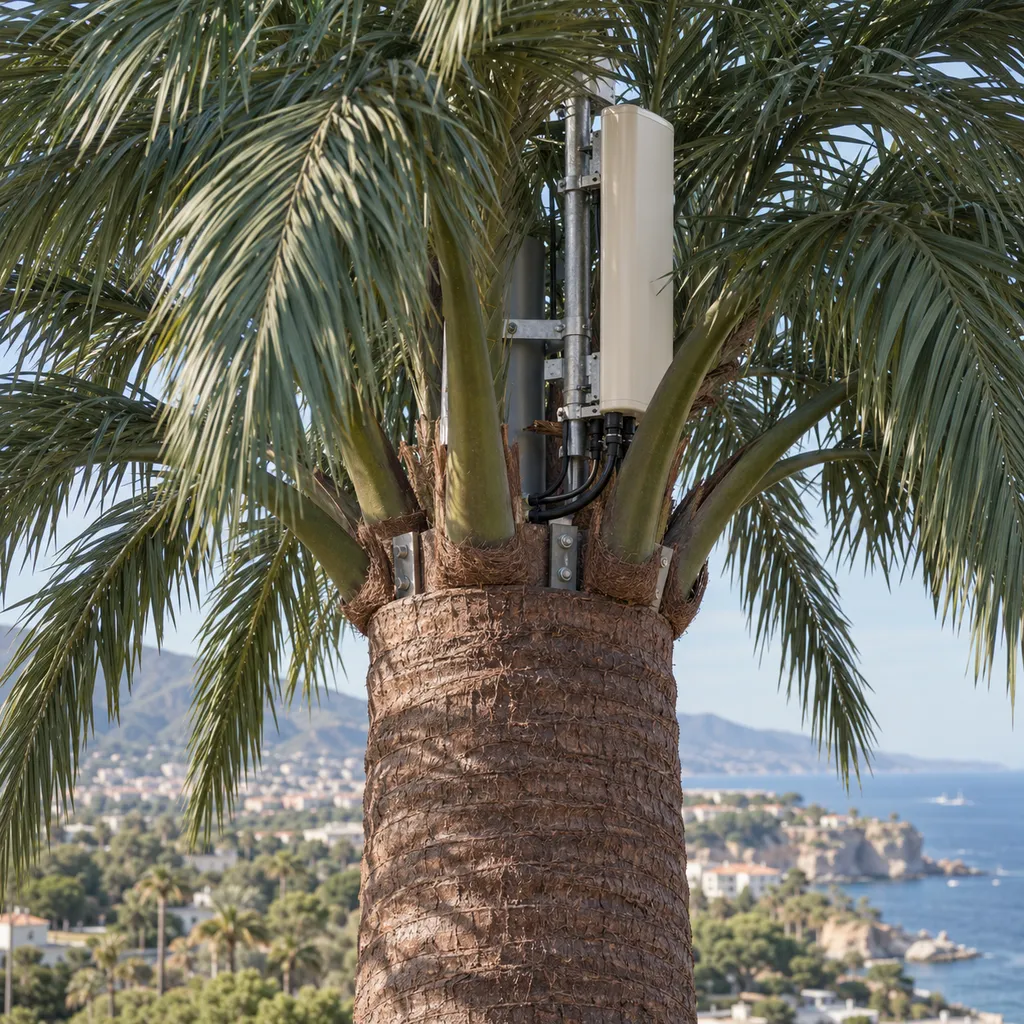
The 27 m flanged structure is normally divided into transportable steel sections to reduce shipping risk and support containerized export, with each flange sized for bolt pre-load, shear transfer, and erection tolerance. A representative 450 kg tip-load allowance covers 6 panel antennas, mounting brackets, remote radio heads, RF jumpers, aviation warning equipment, and reserve load for 1 compact microwave dish. Final load values must be confirmed against antenna projected area, ice assumptions if any, local exposure category, and geotechnical bearing capacity before fabrication.
System Architecture
The system architecture contains 7 principal subsystems: galvanized steel monopole, flanged base and section joints, FRP trunk cladding, FRP palm canopy, 2 antenna platform assemblies, internal or external cable routing, and lightning/earthing equipment. The steel pole carries the primary bending and overturning moment, while FRP cladding provides the visual monopalm form and can reduce the apparent industrial profile by 70% to 90% compared with an exposed galvanized telecom monopole of the same 27 m height. Because FRP is dielectric and RF-friendly, concealed antenna placement can be evaluated when radio-planning teams accept the insertion-loss and pattern-impact limits.
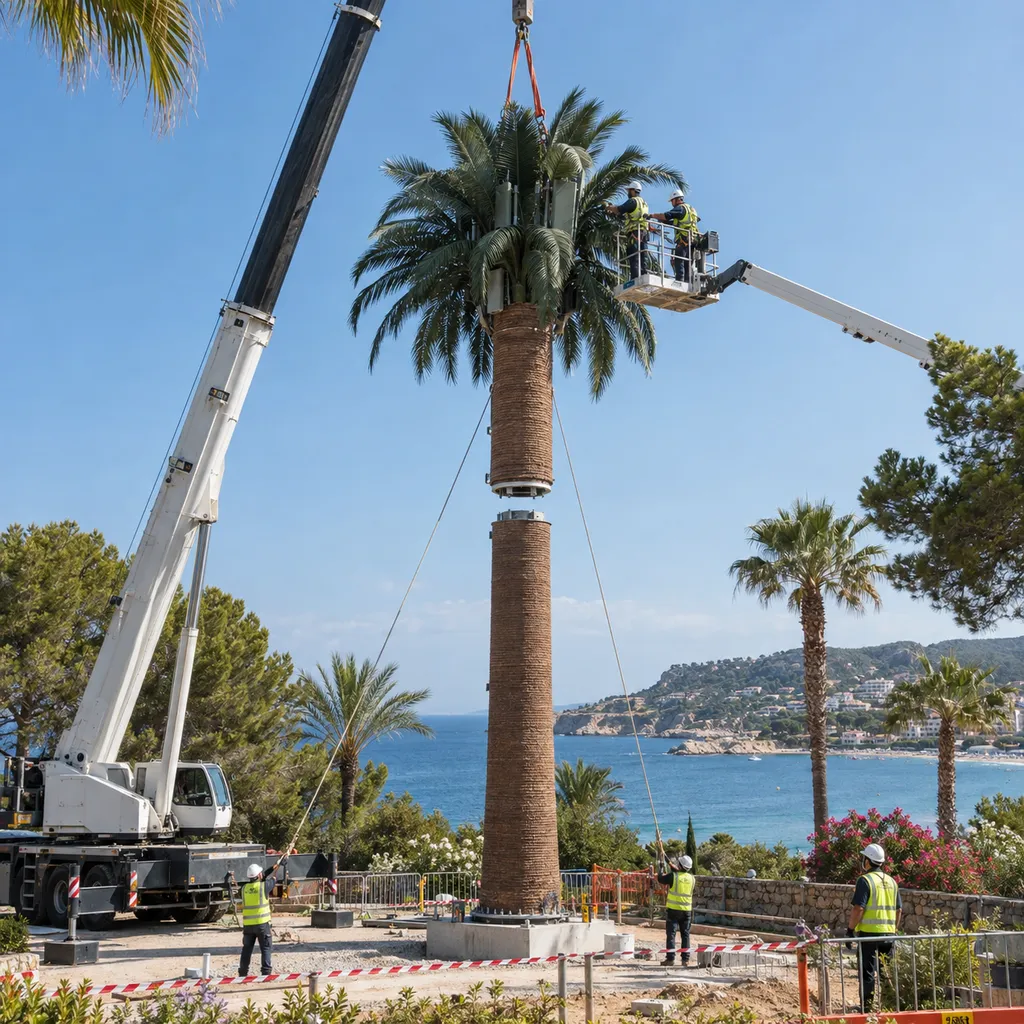
The flanged connection type is preferred for a 27 m coastal tourism tower because it provides repeatable bolt inspection, controlled erection sequence, and straightforward section replacement if a section is damaged during transport or after a severe weather event. A standard site package includes anchor-bolt templates, base plate, nuts, washers, grout allowance, earthing lugs, cable entry details, and anti-climbing protection beginning around 3 m above finished grade. For a tourism area with 1 narrow access road, the flanged system can reduce heavy-lift complexity compared with a fully welded long pole requiring oversized transport.
The FRP cladding uses glass fiber with polyester or vinyl ester resin, UV-stabilized gel coat, and molded texture to resemble a palm trunk and canopy. ASTM D4923 is commonly referenced for reinforced thermosetting plastic poles, while IEC 61109 provides relevant outdoor composite-insulator aging concepts for polymeric materials exposed to UV, pollution, and moisture. In coastal air with salt aerosol, FRP cladding avoids the repainting cycle typical of decorative steel shells and preserves the camouflage function over 10-year inspection intervals when the resin system is correctly selected.
Coastal Tourism Applications
The primary application is low-visual-impact wireless coverage for coastal tourism assets with 2 to 6 radio sectors, such as beach resorts, marinas, promenade roads, national scenic areas, ferry terminals, island microgrids, and coastal emergency corridors. A 27 m antenna centerline can cover wider waterfront terrain than a 12 m to 18 m small cell pole, while avoiding the visual mass of a 30 m lattice tower. In many tourism zones, permitting teams evaluate height, shadow, aviation lighting, and color more intensely than pure load capacity, so the monopalm format addresses both planning and RF needs.
For a representative MENA coastal resort scenario, 1 tower can support 6 4G/5G panel antennas on 2 levels, 1 aviation light, 1 lightning air terminal, and a concrete foundation sized around 18 m3 to 24 m3 after soil verification. If the alternative is 3 separate 15 m small poles distributed through guest-facing areas, the 27 m monopalm can reduce visible pole count by 66.7% while centralizing power, fiber, grounding, inspection, and security into 1 controlled telecom compound. This is a representative engineering scenario only and is not a claim that any customer deployed, purchased, approved, or achieved these results.
Compared with a conventional exposed steel monopole of equal height, the monopalm configuration increases decorative material cost but reduces visual conflict, planning resistance, and rework risk for coastal tourism projects where aesthetics can dominate approval schedules. Compared with a pure FRP structural pole, the steel-with-FRP-cladding approach provides higher stiffness and a familiar structural calculation pathway for 41 m/s wind and 450 kg representative tip load. The tradeoff is weight: steel is heavier than FRP by more than 60% in many pole classes, but it can be easier for local engineers to certify under EN 1993 or TIA-222-H.
Cloud Monitoring
The tower can be supplied as a passive telecom support structure or integrated with SOLARTODO smart-infrastructure monitoring for 24/7 asset supervision. Optional sensors include door status, tilt, vibration, cabinet temperature, smoke, flood, AC power, DC power, battery state, and aviation-light status, with 1 gateway sending alarms to a cloud dashboard or to a customer network operations center. IEEE communications reliability principles and IEC 62305 lightning-zone concepts are relevant because a tower site often combines high elevation, exposed conductors, RF cabling, power electronics, and backup power in 1 compact fenced area.
For telecom operators integrating solar backup or hybrid energy at the compound, Learn about topic pages can support decisions on DC power, earthing, surge protection, and battery autonomy. NREL technical resources on distributed energy and resilience highlight the importance of site-level power continuity, while IEA digital-infrastructure analysis links telecom uptime with modern energy-system management. A coastal telecom tower that also hosts smart lighting, CCTV, environmental sensors, or public Wi-Fi can become 1 shared vertical asset instead of 4 to 6 duplicated street structures.
Engineering, Manufacturing, and Quality Control
Manufacturing begins with structural calculation, antenna-loading confirmation, flange design, steel tube forming, welding, galvanizing, coating, FRP molding, and trial assembly. The pole steel is normally Q355 or comparable structural steel, with tube pricing in the reference range of about 1,500 USD per ton including galvanizing before project-specific fabrication factors. Factory quality control should include weld visual inspection, dimensional checks, galvanizing thickness readings, flange flatness checks, bolt-hole alignment, FRP color consistency, UV gel-coat review, and a 1-set packing inspection before shipment.
Installation typically follows 9 steps: geotechnical review, foundation excavation, rebar and anchor template placement, concrete pour, curing, delivery inspection, section lifting, bolt torqueing, and RF accessory installation. Concrete foundations for a 27 m coastal pole often require approximately 18 m3 to 24 m3 depending on soil bearing, groundwater, overturning moment, and local wind code partial factors. The EPC package should include method statements, lifting plan, torque records, grounding test records below 4 ohm where required, as-built photos, and a commissioning checklist signed by the site engineer.
Lightning protection is not optional on a 27 m exposed coastal tower because the structure becomes 1 of the tallest conductive objects within the local terrain. A typical system includes an air terminal, down conductor, bonding points, surge protection coordination, and a grounding network designed to achieve less than 4 ohm resistance where soil conditions allow. IEC 62305 provides the broader lightning-risk framework, while site-specific RF grounding practices should also follow operator standards for coaxial shields, equipment cabinets, and surge arresters.
EPC Investment Analysis and Pricing Structure
SOLARTODO defines EPC as engineering, procurement, construction, commissioning, and 1-year warranty support for 1 complete 27 m tower site. Engineering includes drawings, load coordination, bill of materials, quality-control documents, foundation assumptions, and construction method statements. Procurement includes steel pole sections, FRP cladding, antenna platforms, bolts, lightning protection, cable support, warning light, and packing. Construction includes civil foundation, lifting, assembly, grounding, accessory installation, and commissioning records for 1 operational telecom support asset.
| Pricing tier | Scope | Price range, USD |
|---|---|---|
| FOB Supply | Equipment only, ex-works China | 31,170-51,628 |
| CIF Delivered | Equipment plus ocean freight and insurance | 39,861-66,023 |
| EPC Turnkey | Fully installed, commissioned, and covered by 1-year warranty | 50,274-75,924 |
| Volume band | Discount from qualifying equipment value | Typical buyer profile |
|---|---|---|
| 50+ towers | 5% | Regional operator rollout |
| 100+ towers | 10% | National tourism or coastal coverage program |
| 250+ towers | 15% | Multi-country telecom infrastructure framework |
The representative EPC investment case uses a 62,950 USD midpoint installed budget for 1 tower, compared with 3 smaller decorative poles at about 24,000 USD each after civil works, power, and permitting, or roughly 72,000 USD total. In that comparison, the monopalm configuration can save about 9,050 USD in duplicated civil and power works, equal to 12.6% of the alternative installed cost, while reducing recurring inspections from 3 pole compounds to 1 compound. If annual visual-maintenance, access, and inspection savings are 3,000 USD, the simple payback on the incremental camouflage package can fall in the 3-year to 5-year range, depending on local permitting costs.
Payment terms are normally 30% T/T advance and 70% against bill of lading for FOB or CIF supply orders, or 100% irrevocable L/C at sight for approved international buyers. Project financing can be discussed for infrastructure packages above 1,000,000 USD when the buyer provides company documents, project location, offtake or operator background, and shipment schedule. For formal pricing, drawings, and warranty scope, contact [email protected] with the 27 m height, 41 m/s wind speed, 6 antenna schedule, and destination port.
Compliance Notes and Buyer Checklist
The buyer should confirm 6 inputs before ordering: wind code, exposure category, soil report, antenna dimensions, cable count, and visual-permit restrictions. TIA-222-H is widely used for U.S.-style antenna-support calculations, EN 1993-3-1 covers European tower and mast steel design, ISO 1461 covers hot-dip galvanized coatings, ASTM D4923 is relevant for FRP pole materials, and IEC 62305 addresses lightning-risk management. For coastal tourism environments, SOLARTODO recommends specifying marine-grade fasteners, sealed cable entries, anti-climbing protection at 3 m, and inspection access for every flange.
For broader design background, Learn about topic resources can be used with operator RF standards, local civil codes, and independent geotechnical reports. IRENA and IEA both describe the growing link between clean energy, digital infrastructure, and resilient communities, while BloombergNEF market analysis tracks the investment shift toward distributed assets and smart infrastructure. This 27 m tower is therefore best evaluated not only as 1 telecom support pole, but as 1 long-life vertical platform for communications, safety, lighting, sensing, and coastal resilience over a 30-year design horizon.
Technical Specifications
| Tower Height | 27m |
| Tower Type | camouflage_monopalm |
| Material | steel_with_frp_cladding |
| Application | coastal_tourism |
| Connection Type | flanged |
| Antenna Platforms | 2levels |
| Antenna Capacity | 6antennas |
| Design Wind Speed | 41m/s |
| Total Tip Load | 450kg |
| Foundation Type | reinforced concrete block or pile-cap foundation |
| Corrosion Protection | hot-dip galvanized steel with marine-grade coating option |
| Design Life | 30years |
| Standards | TIA-222-H / EN 1993-3-1 / IEC 62305 / ISO 1461 |
Price Breakdown
| Item | Quantity | Unit Price | Subtotal |
|---|---|---|---|
| Steel flanged monopalm pole, hot-dip galvanized | 1 pcs | $23,500 | $23,500 |
| FRP trunk cladding and palm canopy set | 1 pcs | $6,400 | $6,400 |
| Antenna platform assemblies, installed | 2 pcs | $800 | $1,600 |
| Cable tray system, 1 m sections | 27 pcs | $10 | $270 |
| Climbing ladder and safety rail, 1 m sections | 27 pcs | $15 | $405 |
| Lightning protection system | 1 pcs | $500 | $500 |
| Aircraft warning light set | 1 pcs | $300 | $300 |
| Concrete foundation, 1 m3 modules | 20 pcs | $300 | $6,000 |
| Ocean freight, insurance, and inland logistics allowance | 1 pcs | $6,000 | $6,000 |
| Installation and commissioning | 1 pcs | $9,800 | $9,800 |
| Engineering, drawings, and quality control | 1 pcs | $5,200 | $5,200 |
| 1-Year warranty and technical support | 1 pcs | $2,975 | $2,975 |
| Total Price Range | $50,274 - $75,924 | ||
Frequently Asked Questions
What is included in the EPC turnkey price for this 27 m monopalm tower?
Can the tower support 5G antennas in a coastal resort area?
Why use steel with FRP cladding instead of a bare steel monopole?
What maintenance is required in marine environments?
Which standards are relevant for design and acceptance?
Certifications & Standards



Data Sources & References
- •TIA-222-H Antenna Supporting Structures and Antennas
- •EN 1993-3-1 Eurocode 3 Towers, Masts and Chimneys
- •IEC 62305 Lightning Protection Standard
- •ASTM D4923 Reinforced Thermosetting Plastic Poles
- •NREL Distributed Energy and Resilience Resources
- •IEA World Energy Outlook 2025 infrastructure analysis
- •IRENA Renewable Energy and Smart Infrastructure Publications
Interested in this solution?
Contact us for a customized quote based on your specific requirements.
Contact Us