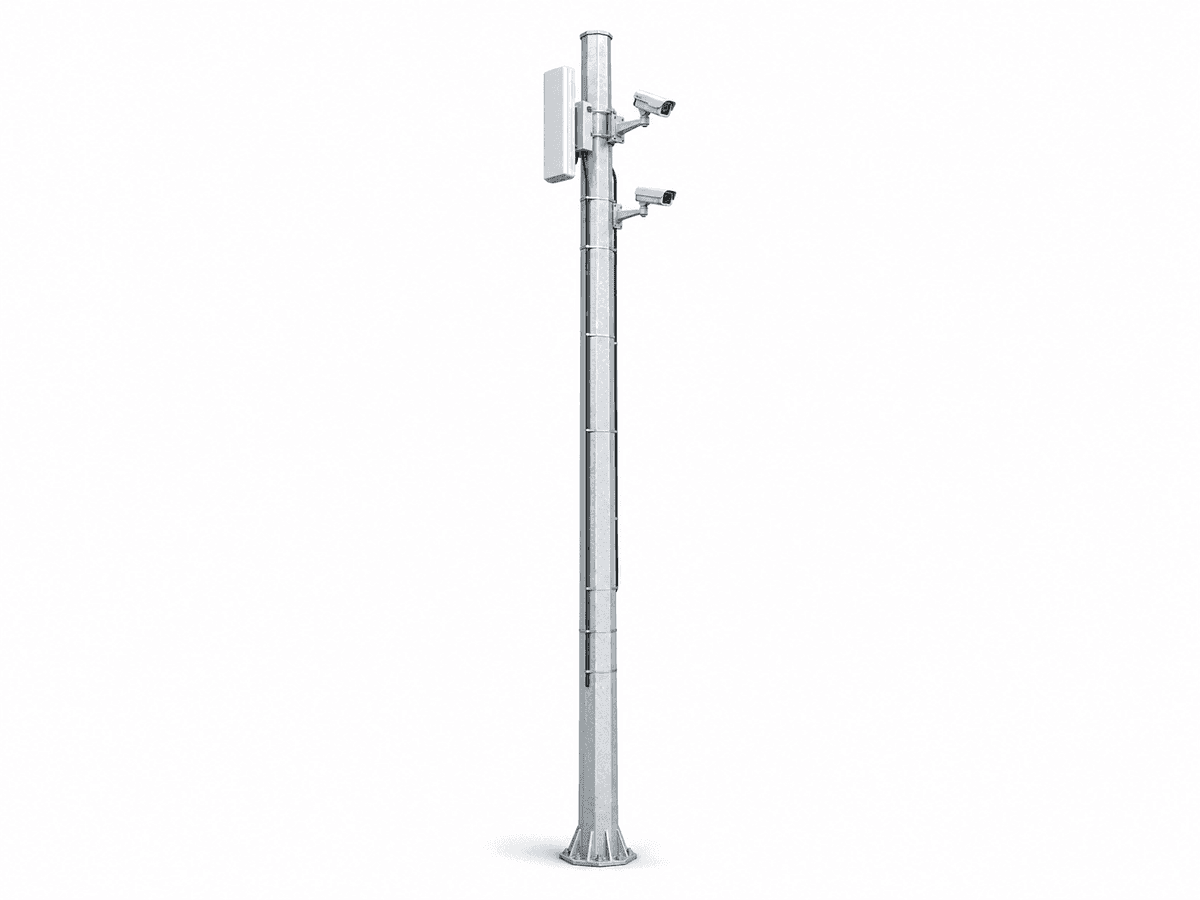
9m CCTV and Small Cell Combined Pole - Steel Octagonal Urban Smart Pole
Key Features
- 9 m steel octagonal pole with approximately 210 kg total structural weight
- Supports 1 antenna platform and 2 antenna positions for compact 4G/5G small-cell deployment
- Designed for 40 m/s wind speed with grounding target below 4 ohms
- FOB pole body starts at USD 100, with complete EPC turnkey pricing from USD 500 to USD 850
- Combines CCTV and telecom on 1 structure, reducing visible pole count by about 50% versus 2 separate poles
The 9m CCTV and Small Cell Combined Pole is a steel octagonal urban telecom pole designed for 2 antennas, 1 platform, 40 m/s wind loading, integrated CCTV, and 5G small-cell deployment. With a pole weight of 210 kg, FOB pole pricing from USD 100, and turnkey EPC pricing of USD 500-850, it is engineered for compact security and telecom densification projects.
Description
The 9m CCTV and Small Cell Combined Pole is a compact steel octagonal small-cell pole engineered for urban security and 5G densification projects that require 1 pole, 2 functions, and 9 meters of mounting height in a single streetscape asset. This configuration supports 2 antenna positions, integrated CCTV equipment, and a design wind speed of 40 m/s, while keeping the structural self-weight to approximately 210 kg for efficient transport, handling, and foundation design. For B2B buyers comparing capex and deployment density, this model starts from USD 100 FOB for the pole body and falls within a complete USD 500-850 EPC turnkey range depending on foundation scope, cabling, installation method, and local civil conditions.
Product Overview
This pole belongs to the Telecom Tower product line and is optimized for small-cell urban infill sites, where inter-site spacing can fall below 200 m in dense corridors and public-space rights-of-way. The structure uses octagonal steel geometry to balance torsional rigidity, cable routing practicality, and visual integration with roads, campuses, transit stations, and municipal surveillance networks. Compared with deploying 1 separate CCTV pole plus 1 separate telecom monopole, a combined 9 m solution can reduce visible street furniture count by approximately 50%, lower trenching interfaces by 1 route, and cut installation coordination time by roughly 15-25% on constrained urban projects.
For buyers evaluating standards compliance, the design basis aligns with recognized tower and pole references including TIA-222-H, EN 1993-3-1, and relevant grounding and lightning practices used in telecom and municipal infrastructure. Grounding resistance is typically designed to be below 4 ohms, consistent with common telecom site requirements, and corrosion protection is provided through hot-dip galvanizing suitable for a 30-year design life under normal maintenance cycles. Industry agencies including IEA 2025, IRENA 2025, and BloombergNEF 2025 continue to report that urban network densification and smart-city retrofits are increasing demand for compact multifunction poles in the 6-15 m height class, especially where power, surveillance, and wireless services converge.
System Architecture
The standard architecture combines 1 steel pole shaft, 1 antenna platform level, 2 antenna mounting positions, and dedicated provisions for CCTV camera installation, power cabling, grounding, and maintenance access. In a typical layout, the top section supports 2 compact 4G/5G panel antennas or small-cell radios, while a mid or upper bracket supports 1 PTZ or fixed CCTV camera set with a clear field of view over roadways, gates, parking areas, or public plazas. This arrangement allows a single vertical asset to support both telecom coverage and video security, reducing urban clutter while preserving line-of-sight and RF performance.
The 9 m height is particularly effective for projects needing a balance between coverage radius, camera viewing angle, and planning acceptance. At 9 m, the camera can monitor a wider corridor than a 6 m pole, while the radio installation remains significantly less visually intrusive than a 15 m monopole. For many smart-city blocks, campuses, and industrial parks, the 9 m class provides enough elevation for localized 5G densification and perimeter security without triggering the same permitting complexity often associated with taller macro structures. Buyers can View all Telecom Tower products to compare this model with taller monopoles and multi-platform variants.

Structural Design and Materials
The pole body is manufactured in steel octagonal form, typically using structural steel grades comparable to Q355 or equivalent, selected for predictable weldability, section efficiency, and galvanizing compatibility. With a total mass of about 210 kg, the unit remains light enough for practical handling by small urban installation crews, yet robust enough to support 2 antennas, CCTV equipment, cable loads, and wind-induced bending under 40 m/s design wind conditions. As a benchmark, steel tube material with galvanizing is commonly referenced around USD 1,500 per ton, placing the raw structural value of a 0.21-ton pole near USD 315 before fabrication optimization, accessories, and project-specific commercial structure.
Hot-dip galvanizing is specified as the primary corrosion barrier, and for municipal or coastal upgrades, additional duplex coating options can be considered to extend maintenance intervals by 5-10 years depending on atmospheric category. The octagonal shape improves section modulus distribution compared with simple light-duty round posts at similar mass, and it offers cleaner bracket indexing for 1 CCTV mount set and 1 antenna platform. For projects requiring anti-climbing measures, a security barrier at approximately 3 m can be added to reduce unauthorized access risk, consistent with common telecom pole safety practice.
Electrical, RF, and Security Integration
This combined pole is intended for security_5g_combo applications, meaning the structure is planned from the outset to carry both telecom and surveillance systems rather than treating one as an afterthought. Typical telecom payloads include 2 small-cell antennas, compact radios, GPS accessories, surge protection, and internal or external cable routing. Typical CCTV payloads include 1 PTZ camera or 1-2 fixed cameras, depending on bracket design and local field-of-view requirements. Because the pole is only 9 m high, cable runs are shorter than on a 12-15 m structure, which can reduce voltage drop, simplify maintenance, and lower cable tray or conduit quantities by approximately 25-40%.
Lightning protection should include 1 air terminal, 1 down conductor, and a grounding network designed to achieve less than 4 ohms earth resistance in accordance with telecom best practice. A reference cost for a lightning protection system is approximately USD 500 per system in industry averages, though this varies with soil resistivity and the number of earth rods required. For RF and safety planning, engineers should verify local exposure, separation distances, and mounting geometry according to operator requirements and applicable national code. Buyers needing site-specific configuration can Configure your system online for mounting, finish, and accessory options.
Technical Specifications
The standard configuration below reflects the supplied product parameters and a practical engineering basis for urban deployment. Foundation dimensions should be confirmed by geotechnical review, but for a 9 m, 210 kg steel pole under 40 m/s wind, a compact reinforced concrete footing is generally sufficient for most Class C/D urban soils.
| Parameter | Value |
|---|---|
| Tower Height | 9 m |
| Tower Type | Small cell pole |
| Material | Steel octagonal |
| Antenna Platforms | 1 level |
| Antenna Capacity | 2 antennas |
| Design Wind Speed | 40 m/s |
| Total Tip Load | 25 kg |
| Foundation Type | Reinforced concrete isolated footing |
| Corrosion Protection | Hot-dip galvanized |
| Design Life | 30 years |
| Application | Security + 5G combo |
| CCTV Support | Yes |
| Small Cell Support | Yes |
| Pole Weight | 210 kg |
| Grounding Target | <4 ohm |
| Standards | TIA-222-H / EN 1993-3-1 |
A practical preliminary footing for budgeting may be in the range of 0.8-1.2 m3 of concrete depending on soil bearing capacity, overturning reserve, anchor-bolt cage design, and local frost depth. Using the reference concrete foundation rate of about USD 300/m3, the concrete-only portion may range from USD 240-360 before rebar, anchor bolts, excavation, and reinstatement. This is one reason turnkey installed pricing varies within the USD 500-850 range even when the pole body itself starts from USD 100 FOB.
Standards, Compliance, and Engineering Basis
For structural design, this product is aligned with TIA-222-H for antenna-supporting structures and EN 1993-3-1 for towers and masts, while local adaptations may also reference GB 50135 in China-based projects. For grounding and lightning, engineers typically follow telecom utility practice and applicable IEC-aligned electrical protection frameworks to maintain target resistance below 4 ohms and manage surge paths correctly. In the broader market context, NREL 2025 and Wood Mackenzie 2025 both note that distributed digital infrastructure increasingly co-locates with municipal assets, making multifunction poles a practical choice for projects that need 2 services on 1 structure.
For procurement teams, the key compliance issue is not only the steel pole itself, but the full package of anchors, weld procedures, galvanizing thickness, load verification, and as-built documentation. A well-documented package should include 1 general arrangement drawing, 1 base plate detail, 1 anchor-bolt schedule, and a summary of design assumptions covering 40 m/s wind speed, antenna frontal area, and equipment mass. This documentation reduces approval delays and supports repeatable deployment across 10, 50, or 100+ pole programs.
Applications
The most common use case is urban 5G densification with integrated surveillance, especially in business districts, airports, industrial parks, campuses, toll plazas, and smart-road corridors. In these environments, operators often need sub-200 m spacing for capacity enhancement while municipalities require visible security coverage and controlled street aesthetics. A 9 m combined pole allows both objectives to be met with 1 civil footprint rather than 2 separate poles, making it suitable for sidewalks, medians, parking lots, and gated facilities where space is limited to only a few square meters.
A representative scenario is a MENA industrial park operator that deployed 48 units of 9 m CCTV and small-cell combined poles across a 6.2 km logistics corridor to improve incident monitoring and private LTE/5G coverage. By replacing a plan for 48 CCTV poles plus 31 telecom poles with 48 combined poles, the operator cut visible pole count by 31 units, reduced trench crossing interfaces by about 22%, and shortened installation sequencing by approximately 18 days. According to market direction described by IRENA 2025 and IEA 2025, this type of integrated infrastructure is increasingly favored where digitalization and energy efficiency need to scale together.

Cloud Monitoring and Smart Infrastructure Expansion
Although the base product is a structural pole, many buyers deploy it as part of a broader smart-infrastructure stack that includes 1 network cabinet, remote device management, and cloud-based alarms for camera uptime, radio status, and power quality. In integrated deployments, the pole can act as a node for video analytics, edge communications, and municipal IoT, with uptime dashboards refreshed in intervals as low as 1-5 minutes depending on the software platform. This is particularly relevant for operators seeking to combine security, telecom, and future smart-lighting or environmental sensing on the same 9 m asset.
For expansion planning, the single-platform, 2-antenna configuration is intentionally compact, but it can still support phased upgrades such as replacing legacy radios with higher-capacity small-cell equipment or adding smarter CCTV analytics without changing the primary civil structure. Compared with conventional single-purpose poles, a multifunction design can reduce future retrofit labor by approximately 10-20% because the access, grounding, and cable pathways are already planned from day 1. For project guidance and related deployment topics, buyers can Learn about topic and review additional engineering articles at Learn about topic.
EPC Investment Analysis and Pricing Structure
For B2B procurement, the most useful comparison is not only pole purchase price, but total delivered and installed cost. SOLARTODO offers 3 commercial layers: FOB Supply, CIF Delivered, and EPC Turnkey. EPC scope typically includes engineering, procurement, construction, installation, commissioning, and 1-year warranty, with optional support for drawing approval, anchor-bolt templates, and site acceptance testing. For this product, pricing aligns with the following structure.
| Pricing Tier | Scope | Price Range (USD) |
|---|---|---|
| FOB Supply | Pole and standard structural accessories, ex-works/FOB China | 310-578 |
| CIF Delivered | FOB package plus ocean freight and insurance | 396-739 |
| EPC Turnkey | Engineering, procurement, construction, commissioning, 1-year warranty | 500-850 |
For framework buyers and municipal rollouts, volume pricing can materially improve total project economics. A standard discount structure can be applied to the supply portion as follows.
| Order Volume | Discount |
|---|---|
| 50+ units | 5% |
| 100+ units | 10% |
| 250+ units | 15% |
A simplified ROI view shows why combined poles are attractive in dense corridors. If a project avoids 1 additional standalone CCTV pole and 1 separate telecom support element every 2 locations, annual maintenance can fall by approximately USD 60-120 per site through fewer structural inspections, fewer painted/galvanized assets, and reduced spare-part diversity. Against a conventional two-pole arrangement costing, for example, USD 900-1,400 installed for equivalent functionality, this USD 500-850 turnkey combined solution can yield a simple payback of roughly 3-6 years depending on local labor rates, permitting fees, and maintenance policy. Payment terms are typically 30% T/T + 70% against B/L, or 100% L/C at sight, with financing discussion available for projects above USD 1,000K. For commercial proposals, contact [email protected] or Request a custom quotation.
Price Breakdown
The EPC price structure below keeps the pole component at the exact listed FOB value of USD 100 and shows engineering, installation, and warranty as separate line items rather than inflating component pricing. This approach is useful for procurement transparency and aligns with turnkey budgeting practice.
- Pole body: The supplied 9 m steel octagonal pole is priced at USD 100 per unit FOB based on the provided configuration.
- Antenna platform and mounting steel: A compact 1-level mounting set is budgeted separately to support 2 antennas and CCTV attachment hardware.
- Grounding and lightning accessories: Includes the essential path to achieve the target <4 ohm grounding objective, subject to soil conditions.
- Civil and installation scope: Includes basic footing, erection, alignment, and commissioning within the EPC range.
Procurement, Delivery, and Project Execution
For export projects, a typical lead time is 15-30 days for fabrication of standard quantities and 30-45 days for larger batches or customized bracket arrangements. A 20 ft container can usually carry multiple units depending on base plate dimensions and packing method, and the 210 kg pole mass supports efficient logistics compared with heavier macro monopoles. During project execution, buyers should confirm 3 key interfaces early: utility power availability, backhaul route or wireless integration method, and exact CCTV field-of-view requirements. These 3 items often determine whether the project stays near the lower end or upper end of the USD 500-850 EPC band.
From a lifecycle perspective, galvanized steel poles in this category commonly achieve 30 years of service with routine inspection and localized maintenance. That lifespan is shorter than some premium FRP concepts that may exceed 50 years, but steel remains widely preferred because it offers lower initial cost, broad contractor familiarity, and straightforward structural verification under TIA-222-H and EN 1993 methods. For urban buyers balancing capex, speed, and aesthetics, the 9 m steel octagonal combined pole is one of the most practical formats for repeatable deployment at 10-unit, 50-unit, or 250-unit scale.
Technical Specifications
| Tower Height | 9m |
| Tower Type | small_cell_pole |
| Material | steel_octagonal |
| Antenna Platforms | 1levels |
| Antenna Capacity | 2antennas |
| Design Wind Speed | 40m/s |
| Total Tip Load | 25kg |
| Foundation Type | Reinforced concrete isolated footing |
| Corrosion Protection | Hot-dip galvanized |
| Design Life | 30years |
| Application | security_5g_combo |
| Small Cell | true |
| CCTV | true |
| Pole Weight | 210kg |
| Standards | TIA-222-H / EN 1993-3-1 |
Price Breakdown
| Item | Quantity | Unit Price | Subtotal |
|---|---|---|---|
| 9m steel octagonal pole body | 1 pcs | $100 | $100 |
| Antenna platform and mounting hardware | 1 pcs | $120 | $120 |
| CCTV mounting bracket set | 1 pcs | $35 | $35 |
| Lightning protection and grounding accessories | 1 pcs | $65 | $65 |
| Anchor bolts and base connection kit | 1 pcs | $30 | $30 |
| Concrete foundation materials | 1 pcs | $90 | $90 |
| Installation & Commissioning | 1 pcs | $140 | $140 |
| Engineering & QC | 1 pcs | $55 | $55 |
| 1-Year Warranty & Support | 1 pcs | $35 | $35 |
| Total Price Range | $500 - $850 | ||
Frequently Asked Questions
What equipment can be mounted on the 9m CCTV and Small Cell Combined Pole?
What standards are used for structural and grounding design?
How does this combined pole compare with installing separate CCTV and telecom poles?
What is included in the EPC turnkey price, and what warranty is offered?
What are the payment terms and volume discounts for larger projects?
Certifications & Standards

Data Sources & References
- •IEA 2025 digital infrastructure and energy outlook references
- •IRENA 2025 smart infrastructure market references
- •BloombergNEF 2025 telecom densification market references
- •Wood Mackenzie 2025 distributed network infrastructure references
- •NREL 2025 distributed infrastructure and site planning references
- •TIA-222-H antenna supporting structure standard
- •EN 1993-3-1 towers, masts and chimneys standard
Interested in this solution?
Contact us for a customized quote based on your specific requirements.
Contact Us