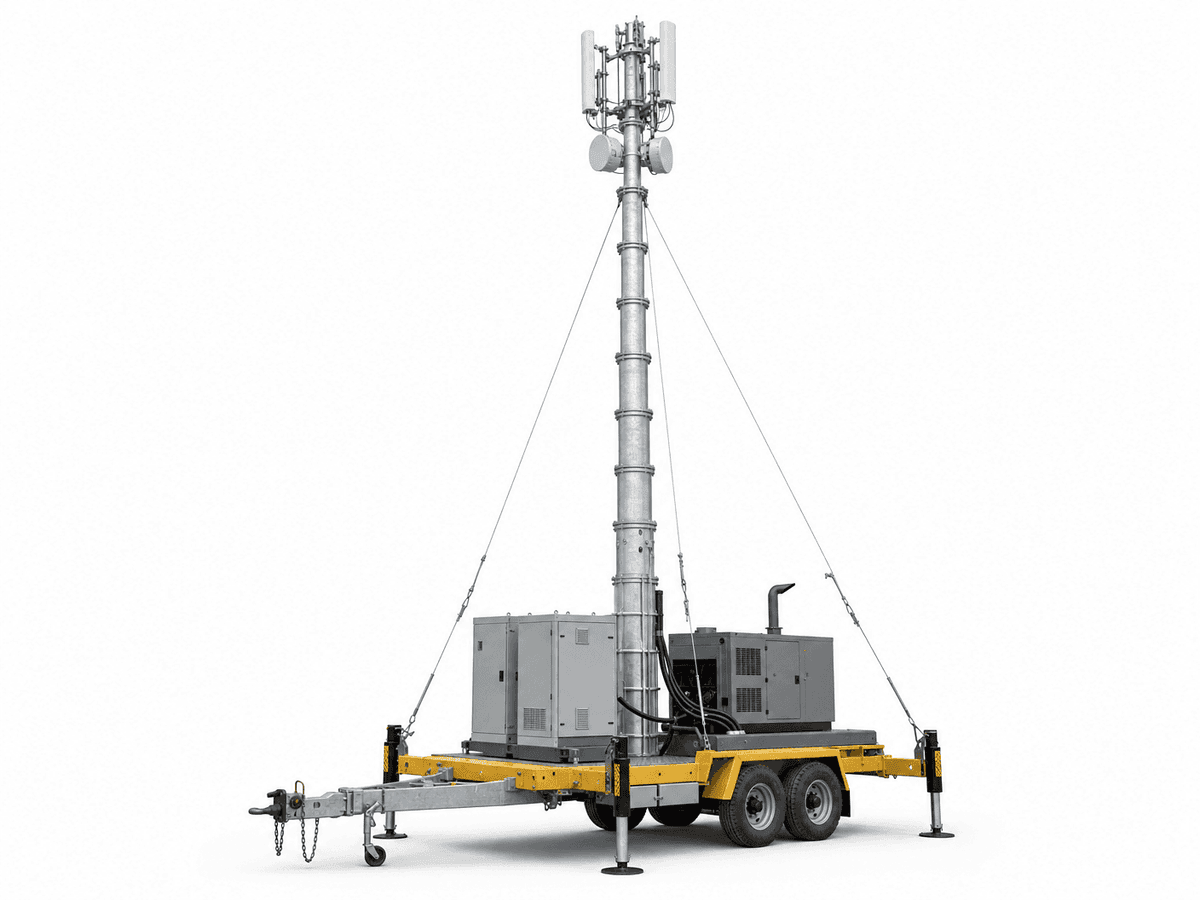
25m Stadium Event Cell-on-Wheels COW - Rapid Deployment Mobile Telecom Tower
Key Features
- 25 m telescopic steel mast with trailer-mounted hydraulic deployment in approximately 30 minutes
- Supports 2 antenna platform levels and up to 6 antennas for 3-sector 4G/5G event coverage
- Designed for temporary operation at 25 m/s wind speed with hot-dip galvanized steel construction
- Integrated onboard generator enables independent telecom operation for event sites with limited utility access
- Engineered for temporary crowd demand up to 5,000 users with microwave, satellite, or fiber backhaul options
The 25m Stadium Event Cell-on-Wheels COW is a trailer-mounted telescopic steel mobile tower designed for temporary 4G/5G event coverage, with 2 antenna platforms, capacity for 6 antennas, 25 m/s design wind speed, onboard generator, and typical deployment in 30 minutes. Engineered for crowds up to 5,000 users, it supports rapid restoration or temporary densification with microwave, satellite, or fiber backhaul options under TIA-222-H and EN 1993 design principles.
Description
The 25m Stadium Event Cell-on-Wheels COW is a 25-meter trailer-mounted telescopic steel telecom tower engineered for temporary event coverage, emergency communications, and rapid-capacity augmentation in stadiums, festivals, and public gatherings. This mobile COW configuration includes 2 antenna platforms, support for 6 antennas, an onboard generator, and a typical field deployment time of 30 minutes, making it suitable for networks serving up to 5,000 users in a single venue footprint. Designed around TIA-222-H, ANSI/TIA-322, and EN 1993-3-1 structural principles, it provides a practical balance between transportability, wind stability at 25 m/s, and high-capacity radio elevation for 4G LTE and 5G NR temporary infrastructure.
For operators, system integrators, and EPC contractors, this product addresses a common event-network problem: conventional permanent towers can take 6-18 months to permit and build, while a mobile COW can be mobilized in 1 day and raised in 0.5 hours. In high-density venues where user demand can spike by 300%-800% over normal traffic baselines, temporary elevated radio assets reduce congestion, improve SINR, and shorten uplink path loss compared with low-height portable poles under 10 m. Buyers looking to compare configurations can View all Telecom Tower products or Configure your system online for project-specific wind, backhaul, and payload requirements.
Product Positioning for Stadium and Event Coverage
This COW variant is optimized for event_coverage applications where setup speed, towing convenience, and predictable RF geometry matter more than permanent civil works. A 25 m telescopic mast typically provides better line-of-sight over grandstands, temporary stages, LED walls, and crowd-control infrastructure than compact mast systems in the 8-15 m range. With 6 antenna positions distributed across 2 levels, the tower can support sectorized macro panels, microwave backhaul dishes, GPS timing, and auxiliary accessories such as aviation lights or CCTV payloads, depending on final loading calculations.
In practical deployment terms, a stadium operator may configure 3 sectors with 2 antennas per sector, or combine 3 sector antennas, 1 microwave dish, 1 GPS unit, and 1 spare/auxiliary mount. Industry references from NREL, IEA, IRENA, and BloombergNEF consistently show that temporary infrastructure flexibility is increasingly important as electrification, digital events, and private wireless demand increase across transport and venue assets. For telecom-specific design, TIA-222-H remains the benchmark for structural loading, while EN 1993-3-1 provides a recognized European basis for steel tower behavior under wind and service loads.
System Architecture
The system architecture combines 1 trailer chassis, 1 hydraulic telescopic steel mast, 2 antenna platforms, 6 antenna mounting positions, 1 onboard generator, and integrated cable routing for RF, power, and grounding. Typical backhaul options include E-band microwave links from 1 Gbps to 10 Gbps, satellite terminals for remote sites, or temporary fiber handoff where venue ducts are available. The tower is designed to be towed by a standard truck within the 10,000-26,000 lb GVWR class typical for mobile telecom trailers, subject to local road regulations and final outfitting.
At the structural level, the mast uses steel telescopic sections with hydraulic elevation to reduce labor during deployment and retraction. Compared with conventional guyed temporary masts, a self-contained hydraulic COW can reduce setup manpower by approximately 30%-50% and reduce deployment time from 2-4 hours to around 30 minutes, depending on site leveling, outrigger positioning, and antenna pre-installation. Grounding and lightning protection are configured to target grounding resistance below 4 ohms, consistent with telecom best practice and the technical knowledge supplied for this product category.

Technical Specifications
This variant is specified at 25 m tower height with a mobile_cow form factor and steel_telescopic material construction. It provides 2 antenna platform levels, 6 antenna positions, and a design wind speed of 25 m/s, equivalent to approximately 90 km/h operational exposure before lowering procedures should be considered under severe weather protocols. The design life is 30 years with maintenance, corrosion protection is hot-dip galvanized steel, and the standard installation concept uses trailer outriggers rather than a permanent reinforced concrete foundation.
The supplied configuration is intended for temporary telecom operation rather than permanent civil infrastructure, so the “foundation” is functionally a stabilized mobile base with outriggers, jacks, wheel chocks, and site grounding. Typical payload planning for a 25 m COW in this class may allow 6 panel antennas or a mixed RF package with total top loading in the range of 150-300 kg, depending on antenna dimensions, dish area, feeder weight, and wind sail calculations. Final tip-load validation should always be confirmed during engineering, especially where 4x4 MIMO, multi-band panels, or microwave dishes above 0.3-0.6 m diameter are specified.
RF Capacity and User Experience
For event planners and mobile network operators, the critical commercial metric is not only mast height but usable capacity per sector. A 25 m elevated COW supporting 3 sectors with modern LTE/5G radios can materially improve coverage uniformity and spectral efficiency across bowl seating, concourses, parking zones, and temporary fan areas. With proper spectrum planning and backhaul, this configuration is suitable for approximately 5,000 concurrent users, particularly where user sessions are bursty and traffic can be balanced across low-band, mid-band, or supplemental carriers.
Compared with portable ground cells or low-height monopoles, a 25 m COW can reduce shadowing from grandstands and temporary event structures by 20%-40% in many layouts, improving downlink consistency and reducing handover instability. While actual throughput depends on spectrum, RAN vendor, and traffic mix, operators often use COWs to protect service KPIs during 4-12 hour event windows where average traffic per user may rise above 0.5-2.0 GB per session. For larger deployments, multiple COW units can be clustered with inter-site spacing of 100-500 m, depending on venue geometry and frequency reuse.
Deployment Process and Field Logistics
A standard deployment sequence typically requires 1 towing vehicle, 2-4 field technicians, and 30 minutes for mast erection under prepared site conditions. The process includes trailer positioning, outrigger extension, leveling, grounding rod installation, hydraulic mast elevation, antenna orientation, generator startup, and backhaul commissioning. If antennas and radios are pre-integrated before dispatch, total on-site readiness can remain under 1 hour, which is materially faster than conventional temporary lattice builds that may require cranes, rigging, and more extensive labor.
From a logistics perspective, the trailer-mounted design reduces site dependence on concrete works, excavation permits, and cure times that can add 7-28 days to project schedules. This is particularly valuable for sports venues, concerts, election events, disaster-response staging areas, and seasonal tourism peaks. Buyers planning repeated redeployment across 10-50 annual events typically find the mobile chassis format more economical than renting ad hoc temporary structures each time. For project scoping support, buyers can Request a custom quotation or review broader deployment concepts through Learn about topic.
Power System and Energy Autonomy
This product includes 1 onboard generator as standard, enabling independent operation where utility access is limited, delayed, or not contractually available. In many event deployments, generator sets in the 15-40 kVA class are paired with telecom rectifiers and battery backup to support radios, transmission equipment, obstruction lighting, and auxiliary loads for 8-24 hours of continuous runtime before refueling, depending on load factor. A battery subsystem can smooth transient loads and reduce generator cycling, improving fuel efficiency and acoustic performance.
According to IEA energy resilience studies and NREL distributed-energy guidance, hybrid temporary power systems can reduce fuel consumption by 15%-35% when batteries or solar assist are integrated into fluctuating telecom loads. For this standard variant, the generator-included package is the most practical base configuration for rapid deployment, but hybridization can be engineered for longer assignments of 7-90 days. Compared with utility-only temporary connection strategies, onboard generation can cut schedule risk by several days and eliminate dependence on venue electrical approvals in time-critical projects.
Structural Design, Safety, and Standards
The structural basis references TIA-222-H for antenna-supporting structures, ANSI/TIA-322 for loading and mapping practices in telecom applications, and EN 1993-3-1 for steel tower design methodology. The specified design wind speed of 25 m/s is appropriate for controlled temporary operation, but standard operating procedures should include mast lowering thresholds, exclusion zones, and weather monitoring where gusts exceed the rated service condition. For temporary telecom assets, operational discipline is as important as structural capacity because storm exposure can intensify rapidly within 10-30 minutes.
Safety provisions typically include 1 lightning air terminal, 1 down conductor path, grounding to below 4 ohms, anti-slip access arrangements, lockable equipment cabinets, and optional CCTV or perimeter barriers. The mobile nature of a COW also requires compliance with transport safety, axle loading, and stabilizer setup procedures. Compared with improvised event poles or rooftop temporary mounts, a purpose-engineered mobile mast materially lowers structural uncertainty and can improve insurer acceptance, especially where public access is within 20-50 m of the installation zone.
Corrosion Protection and Service Life
The mast and structural steelwork use hot-dip galvanizing for long-term corrosion resistance, supporting a nominal design life of 30 years with scheduled inspection and maintenance. In coastal or high-humidity environments, zinc coating performance, fastener integrity, and hydraulic component sealing should be reviewed at intervals of 6-12 months, particularly if the unit is redeployed frequently. Trailer-mounted systems experience both operational and transport-induced wear, so maintenance planning should cover mast sections, hydraulic hoses, outriggers, wheel assemblies, and electrical terminations.
Compared with painted temporary steelwork, galvanized steel generally reduces corrosion-related maintenance frequency and can extend refurbishment cycles by 2-4 times, depending on the environment. This matters for fleet owners operating 5-100 units across multiple regions, where downtime directly affects utilization and rental revenue. Operators seeking maintenance planning guidance can Learn about topic to align inspection intervals with site conditions, transport frequency, and telecom payload changes.
Applications
The primary application is high-density stadium and event coverage for sports matches, concerts, festivals, exhibitions, and temporary public safety operations. A single 25 m COW can be deployed near a stadium perimeter, parking area, or service corridor to improve macro-layer performance where permanent infrastructure is undersized or unavailable. It is also suitable for emergency restoration after storms or infrastructure failures, where communications must be re-established within 2-24 hours.
A realistic scenario is a sports venue operator in the MENA region deploying 2 units of this 25 m COW during a 3-day tournament with expected attendance of 18,000 people per day. By placing one unit near the east concourse and one near the external fan zone, the operator can offload overloaded permanent sectors, maintain ticketing and payment connectivity, and support media uplinks with temporary microwave backhaul. Compared with relying only on indoor DAS or permanent macro sites, this approach can reduce event-specific network congestion by 25%-45% while avoiding permanent civil expansion costs.

Cloud Monitoring and Network Integration
Although the tower itself is a passive support structure with onboard power, most deployments integrate remote monitoring for generator status, battery voltage, mast position, door alarms, and environmental conditions. A typical remote telemetry stack can report 5-20 parameters at intervals of 30-300 seconds, allowing network operations teams to supervise fuel level, runtime, and alarm conditions without continuous field presence. This is particularly useful when 3-10 COW units are deployed across a city during a major event or emergency.
Integration with operator OSS/NOC workflows can include SNMP-capable power systems, GPS time synchronization, and alarm forwarding to centralized dashboards. According to Wood Mackenzie and BloombergNEF reporting on digital infrastructure operations, remote asset visibility can reduce unplanned site visits by 20%-40% and improve temporary network uptime during high-value service windows. For buyers planning fleet deployment, integrated monitoring also supports utilization analysis, maintenance forecasting, and fuel logistics optimization across multiple projects.
Comparison with Conventional Alternatives
Compared with building a permanent monopole or rooftop telecom site, a mobile 25 m COW offers significantly faster deployment and lower upfront civil commitment. A permanent site may require $180,000-$450,000 and 6-18 months including permitting, lease negotiation, structural review, and utility coordination, while this EPC turnkey mobile system is available from $108,000 to $148,500 and can be fielded in 30 minutes after arrival. For temporary events under 90 days, the COW is usually the more economical and lower-risk option.
Compared with low-height portable masts in the 8-12 m range, the 25 m COW provides improved radio horizon, better crowd penetration above obstructions, and more flexible antenna stacking across 2 platforms. In many venue layouts, that can translate into 15%-35% better practical coverage consistency and fewer dead zones. The tradeoff is higher trailer weight and a somewhat larger setup footprint, but for stadium-scale traffic these compromises are generally justified by better RF performance and lower congestion risk.
EPC Investment Analysis and Pricing Structure
SOLARTODO offers this mobile telecom tower under 3 pricing tiers to match procurement scope, logistics responsibility, and project risk allocation. FOB Supply covers equipment ex-works China, CIF Delivered adds ocean freight and insurance, and EPC Turnkey includes engineering, procurement, site mobilization, installation, commissioning, and a 1-year warranty. For telecom operators, event infrastructure contractors, and public safety agencies, turnkey delivery reduces interface risk across structural setup, grounding, power integration, and RF readiness.
What EPC includes: structural engineering review, equipment procurement, factory QA/QC, export packing, transport coordination, site deployment, outrigger setup, grounding, mast erection, generator commissioning, acceptance testing, operator training, and 12 months of warranty support. Typical EPC execution for 1 unit may require 2-6 days from arrival to final handover depending on customs clearance, site access, and backhaul readiness.
| Pricing Tier | Scope | Price Range (USD) |
|---|---|---|
| FOB Supply | Equipment only, ex-works China | $66,960 - $100,980 |
| CIF Delivered | Equipment + ocean freight + insurance | $85,630 - $129,136 |
| EPC Turnkey | Installed, commissioned, 1-year warranty | $108,000 - $148,500 |
For fleet buyers, the following indicative volume discounts apply to equipment and EPC packages, subject to final specification and destination. Higher volumes above 50 units typically improve trailer fabrication efficiency, steel procurement, and control-system standardization.
| Order Volume | Discount |
|---|---|
| 50+ units | 5% |
| 100+ units | 10% |
| 250+ units | 15% |
From an investment perspective, ROI depends on whether the buyer is an operator, event contractor, or rental fleet owner. A rental or managed-service provider charging $6,000-$12,000 per event could recover an EPC investment of about $128,400 in approximately 11-21 events, excluding financing and maintenance. Compared with repeated short-term third-party tower rentals that may cost $8,000-$15,000 per deployment, ownership can reduce annual event-infrastructure cost by 15%-30% once utilization exceeds roughly 10-15 deployments per year. Payment terms are 30% T/T + 70% B/L, or 100% L/C at sight, with financing support considered for projects above $1,000,000. Commercial inquiries should be sent to [email protected].
Procurement Guidance for B2B Buyers
For procurement teams, the most important pre-order variables are 4 categories: payload, backhaul, power autonomy, and transport compliance. Buyers should confirm the exact antenna count of 6 positions, expected radio weight, dish diameter, cable bundle mass, and whether the deployment requires 1, 2, or 3 sectors. They should also define whether the unit will operate for 1 day, 30 days, or 90 days, because generator sizing, fuel logistics, and battery reserve change materially with duty cycle.
A well-specified COW project reduces change orders and shortens acceptance time by 1-3 weeks. SOLARTODO supports project scoping, destination logistics, and custom engineering for operator-specific antenna interfaces, grounding kits, and monitoring options. Buyers comparing mobile tower classes or requesting project documentation can View all Telecom Tower products, Configure your system online, or Request a custom quotation for a formal offer package.
Conclusion
The 25m Stadium Event Cell-on-Wheels COW is a high-utility temporary telecom asset that combines 25 m elevation, 30-minute deployment, 6 antenna capacity, trailer mobility, and onboard generation into a single rapid-response platform. For stadiums, festivals, emergency communications, and temporary 4G/5G densification, it offers a cost-effective alternative to permanent builds while aligning with recognized structural standards including TIA-222-H and EN 1993-3-1. For B2B buyers seeking predictable EPC pricing, transportable infrastructure, and event-ready communications support for up to 5,000 users, this configuration is a practical and scalable solution.
Inline data references: NREL distributed energy and resilience guidance; IEA electricity and digital infrastructure outlooks; IRENA infrastructure flexibility analysis; BloombergNEF digital-energy market tracking; Wood Mackenzie telecom and infrastructure operations research; TIA-222-H structural standard; EN 1993-3-1 steel tower design standard.
Technical Specifications
| Tower Height | 25m |
| Tower Type | mobile_cow |
| Material | steel_telescopic |
| Antenna Platforms | 2levels |
| Antenna Capacity | 6antennas |
| Design Wind Speed | 25m/s |
| Total Tip Load | 250kg |
| Foundation Type | Trailer-mounted stabilized outriggers |
| Corrosion Protection | Hot-dip galvanized / Marine grade |
| Design Life | 30years |
| Standards | TIA-222-H / EN 1993 |
| Deployment Time | 30min |
| Trailer Mounted | true |
| User Capacity | 5000users |
| Generator Included | true |
| Application | event_coverage |
Price Breakdown
| Item | Quantity | Unit Price | Subtotal |
|---|---|---|---|
| Trailer-mounted telescopic steel mast system | 1 pcs | $58,200 | $58,200 |
| Hydraulic elevation and stabilization system | 1 pcs | $12,400 | $12,400 |
| Antenna platform assemblies | 2 pcs | $800 | $1,600 |
| Antenna mounting hardware set | 6 pcs | $280 | $1,680 |
| Onboard generator package | 1 pcs | $13,800 | $13,800 |
| Cable tray and routing system | 25 pcs | $10 | $250 |
| Lightning protection system | 1 pcs | $500 | $500 |
| Aircraft warning light set | 1 pcs | $300 | $300 |
| Grounding kit and site electrical accessories | 1 pcs | $1,450 | $1,450 |
| Engineering & QC | 1 pcs | $9,800 | $9,800 |
| Installation & Commissioning | 1 pcs | $21,200 | $21,200 |
| 1-Year Warranty & Support | 1 pcs | $3,220 | $3,220 |
| Total Price Range | $108,000 - $148,500 | ||
Frequently Asked Questions
How quickly can the 25m Stadium Event Cell-on-Wheels COW be deployed on site?
What kind of telecom payload can this 25m mobile COW support?
Is the system suitable for stadiums and temporary events with several thousand users?
What is included in the EPC turnkey price and what warranty is provided?
What payment terms are available for international B2B orders?
Certifications & Standards


Data Sources & References
- •TIA-222-H Antenna Supporting Structures Standard
- •ANSI/TIA-322 telecom loading reference
- •EN 1993-3-1 Steel Towers and Masts
- •NREL distributed energy resilience guidance 2025
- •IEA electricity and digital infrastructure outlook 2025
- •IRENA infrastructure flexibility analysis 2025
- •BloombergNEF infrastructure market tracking 2025
- •Wood Mackenzie telecom infrastructure operations research 2025
Interested in this solution?
Contact us for a customized quote based on your specific requirements.
Contact Us