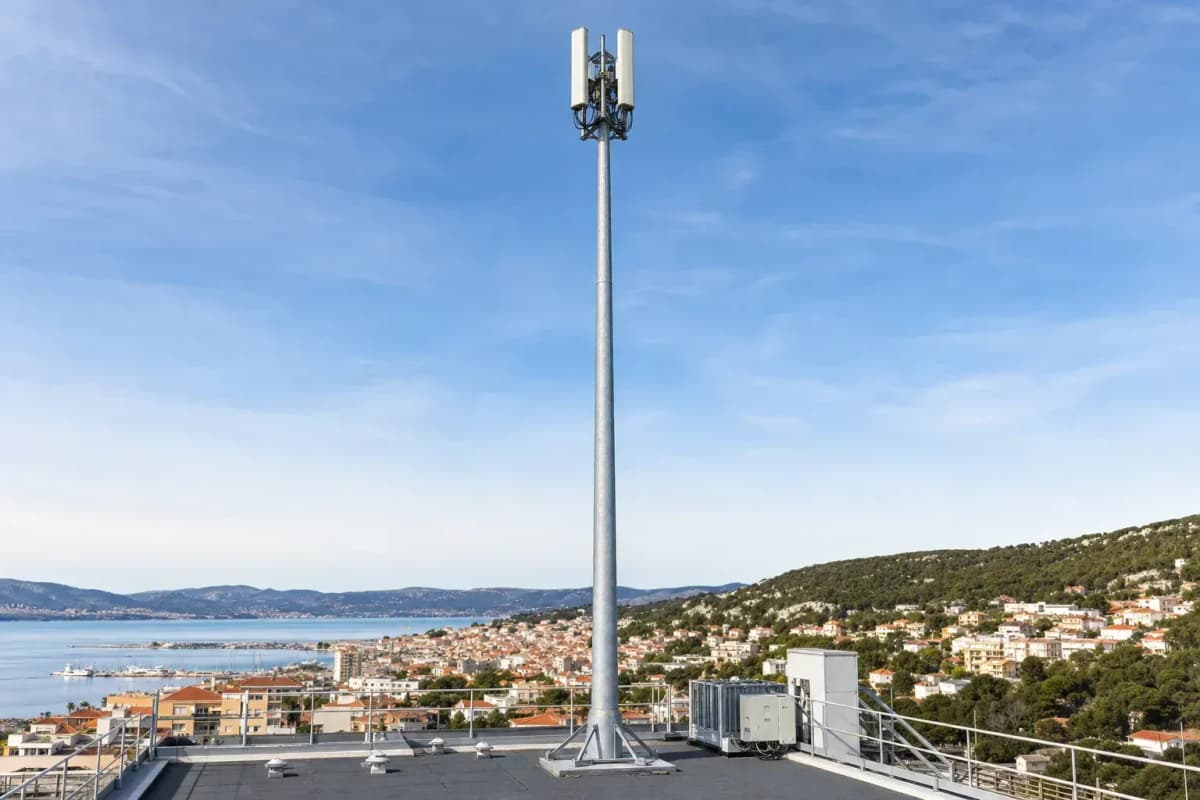
19m Rooftop Tower Building Mount Slip-Joint - 39 m/s Steel Telecom Support
Key Features
- 19 m rooftop steel-tube tower adds height above the roofline without 1 m² of new land acquisition.
- 39 m/s design wind speed supports telecom rooftop deployments in moderate to high wind zones after local code verification.
- 1 antenna platform supports 3 antennas for 4G, 5G, microwave, GPS, or smart-infrastructure backhaul.
- Slip-joint steel tube construction provides fast sectional assembly with a 30-year design life under maintenance.
- EPC turnkey price range is USD 11,614-18,171 including installation, commissioning, and 1-year warranty.
The 19m Rooftop Tower Building Mount Slip-Joint is a steel-tube telecom tower for 3 antennas on 1 platform, rated for 39 m/s design wind speed. EPC turnkey pricing is USD 11,614-18,171 with engineering, installation, commissioning, and 1-year warranty included.
Description
The 19m Rooftop Tower Building Mount Slip-Joint is a building-mounted steel-tube telecom tower designed for 3 antennas on 1 antenna platform, with a 39 m/s design wind speed and a 30-year design life. It extends coverage 19 m above the roofline without acquiring 1 m² of new land, making it suitable for 4G, 5G, microwave backhaul, GPS timing, and aviation-lighted rooftop telecom sites.
Product Overview
This rooftop tower uses hot-dip galvanized steel tube sections with slip-joint connections, allowing 2 or more tubular sections to overlap under controlled insertion depth rather than relying only on bolted flange plates. For B2B buyers comparing rooftop densification options, View all Telecom Tower products to benchmark this 19 m model against 5-25 m rooftop, monopole, and light-lattice alternatives from SOLARTODO.
The design intent is a compact rooftop extension for buildings where existing elevation provides 10-80 m of total radio reach before the 19 m tower is added. A conventional greenfield ground tower may require 25-100 m² of compound space, 1 larger foundation package, and separate access works, while this rooftop configuration can reduce land take by approximately 100% and foundation concrete volume by 40-70% when the host structure is verified by a qualified engineer.
System Architecture
The tower assembly includes 1 galvanized steel-tube shaft, 1 rooftop base frame, 1 antenna platform level, 3 antenna mounting positions, 19 m of cable routing allowance, 1 lightning air terminal, 1 down-conductor path, and 1 aircraft warning light set where aviation rules require it. The slip-joint interface distributes axial and bending loads through overlapped tube contact length, and final geometry should be checked against TIA-222-H for US projects or EN 1993-3-1 for European steel tower design.
A complete rooftop site normally has 4 load paths: antenna wind load into brackets, brackets into the tower shaft, shaft forces into the rooftop base frame, and base reactions into the building beams or reinforced concrete slab. Before procurement, SOLARTODO recommends a structural survey covering at least 3 checks: roof live-load capacity, anchor pull-out capacity, and overturning resistance under 39 m/s wind speed with the specified 3-antenna configuration.
Technical Specifications
| Parameter | Value |
|---|---|
| Tower height above roofline | 19 m |
| Tower type | Rooftop building-mounted tower |
| Main material | Hot-dip galvanized steel tube, Q355-class equivalent |
| Connection type | Slip-joint tubular connection |
| Antenna platforms | 1 level |
| Antenna capacity | 3 antennas |
| Design wind speed | 39 m/s |
| Representative total tip load | 180 kg |
| Corrosion protection | Hot-dip galvanized or marine-grade coating |
| Design life | 30 years with inspection and maintenance |
The 39 m/s wind rating corresponds to approximately 140 km/h basic wind speed before project-specific exposure, topography, gust, and importance factors are applied. Final design should use the local wind map, rooftop category, antenna projected area, and shielding assumptions required by TIA-222-H, EN 1991, or the applicable national annex for 1 final permit calculation package.
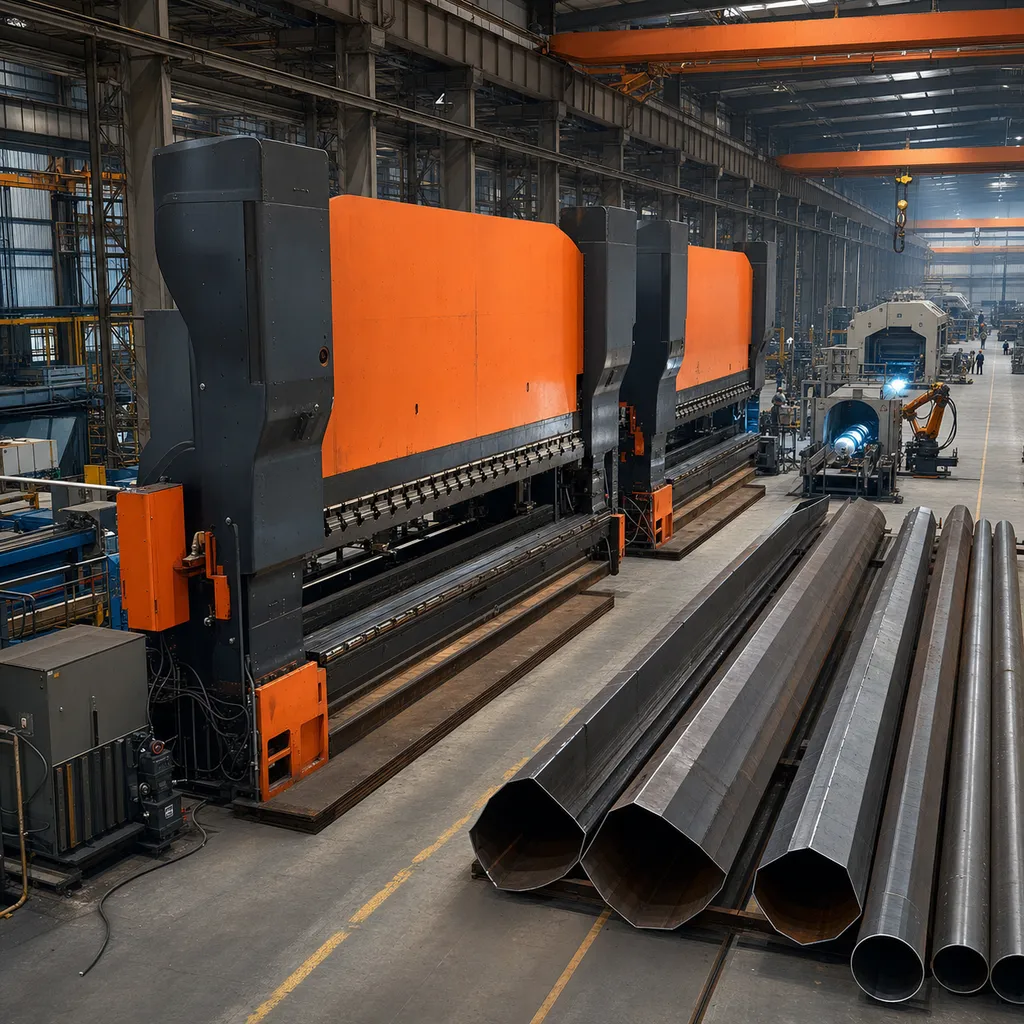
Steel tube construction is selected because it balances weight, stiffness, fabrication tolerance, and serviceability for a 19 m rooftop installation. Compared with a same-height light lattice mast, a tubular shaft can reduce visible member count by more than 50% and simplify cable concealment, while a lattice option may reduce steel mass by 10-25% on projects where appearance and wind area are less constrained.
Standards, Grounding, and Safety
The lightning protection package should include 1 air terminal, 1 down conductor, bonding to metallic tower parts, surge protection coordination for radio equipment, and a grounding system tested to a target resistance below 4 ohms where soil and building conditions allow. IEC 62305 provides lightning-risk principles, while IEEE Std 81 is widely used for grounding resistance and soil resistivity measurement practices.
Access and anti-climbing details should be specified before fabrication because a 19 m rooftop tower can require either an external ladder with safety rail or a restricted-access maintenance plan using mobile fall-arrest equipment. For public or shared buildings, a 3 m anti-climbing barrier, locked roof hatch, CCTV option, and 1 documented rescue plan reduce unauthorized access risk during the 30-year service period.
Hot-dip galvanizing should be specified to ISO 1461 or a project-equivalent coating standard, with marine-grade coating added for coastal sites within 5 km of saltwater or industrial zones with high chloride exposure. A typical inspection plan includes 1 baseline coating report, 1 post-installation torque report, annual visual inspections, and detailed bolt and corrosion checks every 3-5 years.
Applications
This 19 m rooftop tower is suitable for mobile network densification, campus private networks, industrial IoT gateways, smart-city camera backhaul, utility telemetry, and emergency communications where 3 antennas can be accommodated on 1 elevated platform. Configure your system online when the site requires custom antenna size, microwave dish diameter, cable tray width, or a different 5-25 m rooftop height.
For a representative MENA solar farm scenario, a 19 m rooftop tower mounted on an inverter-room or control-building roof can support 3 antennas for SCADA backhaul, site Wi-Fi, and security camera uplink across a 1-5 km operating zone, subject to line-of-sight and radio-frequency planning. This is a representative engineering scenario only, not a claim that any customer purchased, deployed, or achieved a specific result.
The same product can be integrated with SOLARTODO solar, storage, lighting, and security packages for hybrid infrastructure sites that need 24/7 communications availability. Buyers can Learn about topic for solar-plus-telecom infrastructure planning, and can Request a custom quotation when roof drawings, antenna data sheets, and wind-zone requirements are ready.
Cloud Monitoring
A tower itself is passive steel infrastructure, but a telecom site can be connected to 1 cloud monitoring layer through cabinet sensors, aviation light status, door contacts, surge counters, rectifier alarms, and energy-meter data. For remote assets, the IEA has highlighted digitalization as a major grid and infrastructure enabler, and telecom monitoring often reduces truck rolls by 1-4 visits per site per year when alarms are integrated with operations workflows.
Optional monitoring points can include 1 tilt sensor, 1 cabinet temperature sensor, 1 AC or DC energy meter, 1 door sensor, and 1 aviation-light fault relay. This data can support preventive maintenance, but structural acceptance still depends on physical inspection, torque verification, coating condition, anchor condition, and engineering records rather than cloud data alone.
EPC Investment Analysis and Pricing Structure
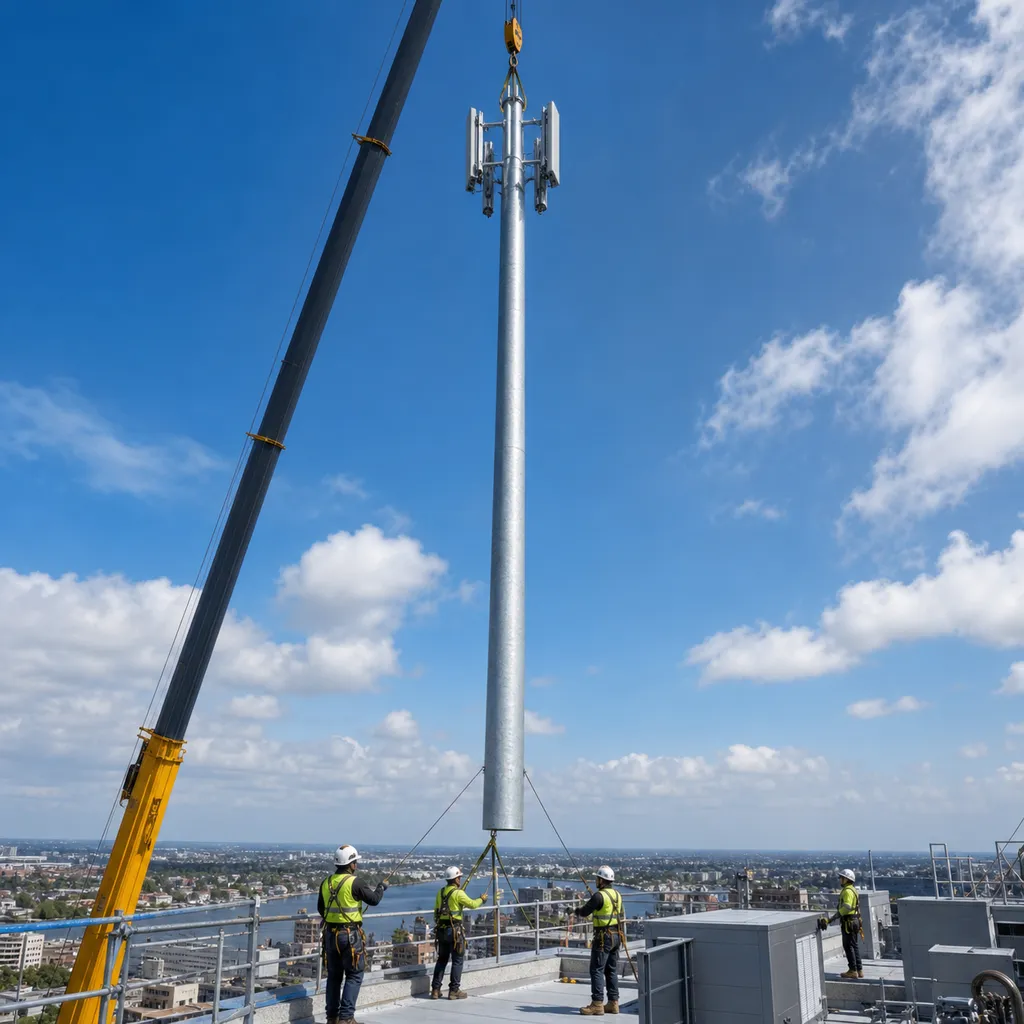
EPC turnkey delivery for this 19 m rooftop tower includes 5 work packages: engineering review, procurement, construction, commissioning, and 1-year warranty support. The EPC scope normally covers site survey, structural drawings, bill of materials, factory fabrication, galvanizing, packing, ocean freight coordination when applicable, rooftop installation, antenna-platform assembly, grounding continuity test, handover documents, and 1 commissioning checklist.
| Pricing tier | Scope | Price range, USD |
|---|---|---|
| FOB Supply | Equipment only, ex-works China | 7,201-12,356 |
| CIF Delivered | Equipment plus ocean freight and insurance | 9,209-15,801 |
| EPC Turnkey | Fully installed, commissioned, and 1-year warranty | 11,614-18,171 |
| Volume tier | Discount | Example use |
|---|---|---|
| 50+ units | 5% | Regional rooftop densification batch |
| 100+ units | 10% | Multi-city 4G/5G upgrade program |
| 250+ units | 15% | National framework procurement |
For ROI analysis, the main economic comparison is rooftop reuse versus new ground-tower development, because rooftop mounting can avoid 1 land lease, 1 fenced compound, and a larger concrete foundation. If avoided land, permitting, and civil works save USD 3,000-8,000 per site, the incremental payback against a conventional alternative can be 1-3 years, depending on roof reinforcement cost, access cost, and antenna revenue assumptions.
Payment terms are 30% T/T deposit plus 70% against bill of lading, or 100% irrevocable L/C at sight for approved bank instruments. Project financing can be discussed for programs above USD 1,000K, and procurement teams can contact [email protected] for commercial files, compliance documents, or a project-specific EPC quotation.
Procurement and Engineering Inputs
To quote accurately within the USD 11,614-18,171 EPC range, SOLARTODO needs at least 7 inputs: project country, building height, roof structural drawings, wind speed or local code, antenna dimensions, cable count, site access method, and corrosion category. Missing roof data normally adds 1 survey step and may shift the design from direct anchoring to reinforced beam transfer or ballast-supported framing.
The antenna load assumption for this page is 3 antennas and a representative 180 kg total tip-load allowance, but final capacity is governed by antenna projected area, bracket eccentricity, ice loading where relevant, and serviceability limits. Microwave dishes above 0.6-1.2 m diameter may require a separate mount check because dish wind area can exceed typical panel-antenna loading.
Market Context and Buyer Guidance
The IEA World Energy Outlook 2025, IRENA renewable energy statistics, and NREL grid-modernization research all point to rising electrification, digital monitoring, and distributed infrastructure needs across power and communications networks. For telecom tower buyers, this means rooftop assets increasingly need to coexist with solar rooftops, energy storage cabinets, CCTV, and smart-lighting nodes within 1 coordinated site layout.
Procurement teams should specify 4 deliverables before purchase: structural calculation basis, galvanizing standard, anchor or base-frame drawing, and commissioning checklist. Engineering teams should verify 3 constraints before approval: rooftop load path, fall-protection access, and electromagnetic or line-of-sight clearance for the intended 4G, 5G, microwave, GPS, or telemetry antennas.
Compliance Notes
This product page references TIA-222-H, EN 1993-3-1, IEC 62305, IEEE Std 81, ISO 1461, IEA, IRENA, and NREL as design, safety, market, or technical context sources. Certification or compliance for a specific 19 m tower is project-dependent and must be confirmed through the final drawings, material certificates, galvanizing reports, anchor design, and local authority requirements for 1 permitted installation.
Technical Specifications
| Tower Height | 19m |
| Tower Type | rooftop |
| Application | building mount |
| Material | steel tube |
| Connection Type | slip joint |
| Antenna Platforms | 1levels |
| Antenna Capacity | 3antennas |
| Design Wind Speed | 39m/s |
| Total Tip Load | 180kg |
| Foundation Type | rooftop base frame with anchor or reinforced beam transfer |
| Corrosion Protection | Hot-dip galvanized / Marine grade |
| Design Life | 30years |
| Standards | TIA-222-H / EN 1993 / IEC 62305 / IEEE Std 81 |
Price Breakdown
| Item | Quantity | Unit Price | Subtotal |
|---|---|---|---|
| Q355 galvanized steel tube tower sections | 3.8 tons | $1,500 | $5,700 |
| Slip-joint splice hardware set | 1 pcs | $650 | $650 |
| Rooftop base frame and anchor package | 1 pcs | $1,250 | $1,250 |
| Antenna platform, installed | 1 pcs | $800 | $800 |
| Cable tray system | 19 m | $10 | $190 |
| External ladder and safety rail | 19 m | $15 | $285 |
| Lightning protection system | 1 pcs | $500 | $500 |
| Aircraft warning light set | 1 pcs | $300 | $300 |
| Galvanized fasteners and rooftop accessories | 1 pcs | $420 | $420 |
| Engineering, drawings, and QC documentation | 1 pcs | $1,430 | $1,430 |
| Installation and commissioning | 3.8 tons | $200 | $760 |
| Crane access and site logistics allowance | 1 pcs | $850 | $850 |
| 1-Year warranty and support | 1 pcs | $620 | $620 |
| Total Price Range | $11,614 - $18,171 | ||
Frequently Asked Questions
What is included in the EPC turnkey price for the 19 m rooftop tower?
Can this rooftop tower support 5G antennas and microwave dishes?
What building information is required before ordering?
Which standards apply to the tower design and grounding system?
How long does installation usually take on a prepared rooftop?
Certifications & Standards



Data Sources & References
- •TIA-222-H Structural Standard for Antenna Supporting Structures and Antennas
- •EN 1993-3-1 Eurocode 3 Towers, Masts and Chimneys
- •IEC 62305 Lightning Protection Standard
- •IEEE Std 81 Grounding Resistance Measurement Guide
- •ISO 1461 Hot-Dip Galvanized Coatings Standard
- •IEA World Energy Outlook 2025
- •IRENA Renewable Energy Statistics 2025
- •NREL grid modernization and distributed energy research
Interested in this solution?
Contact us for a customized quote based on your specific requirements.
Contact Us