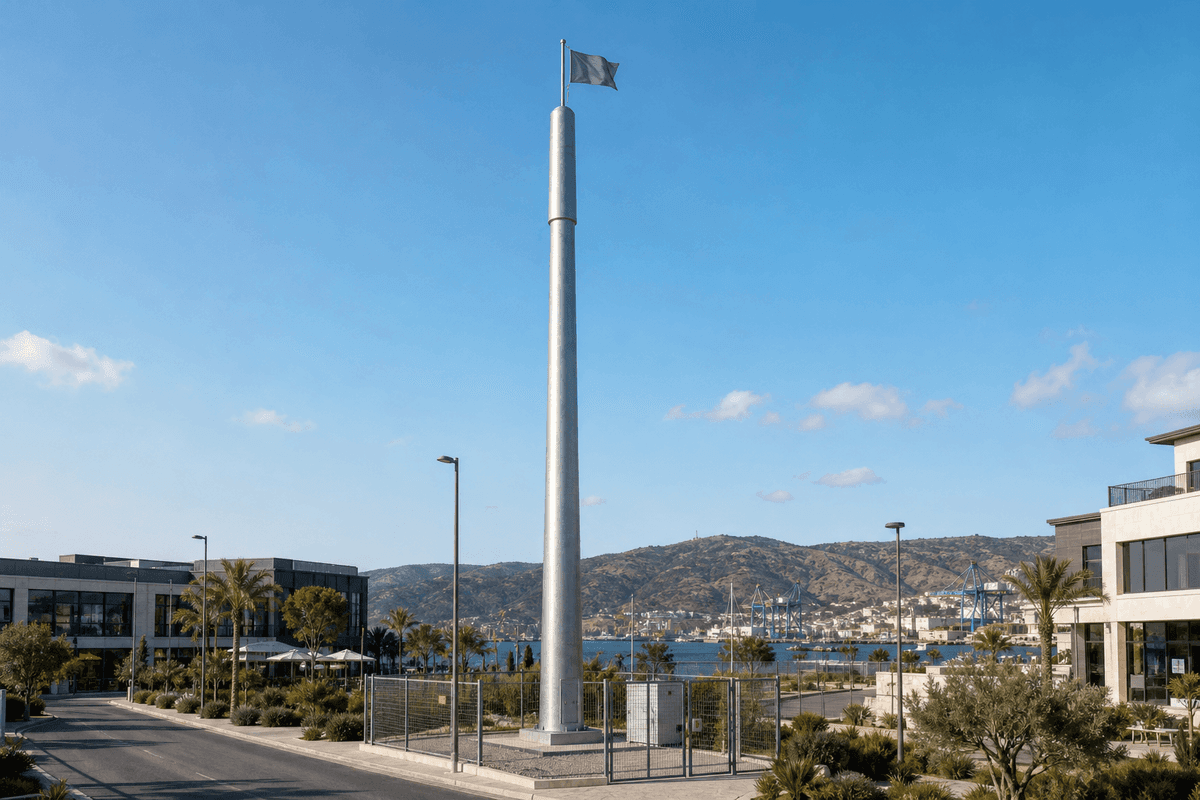
20m Flagpole Concealed Commercial District - 3-Antenna Stealth Tower
Key Features
- 20 m concealed flagpole telecom tower with 1 platform and capacity for 3 antennas
- Designed for 35 m/s wind speed under TIA-222-H and EN 1993 structural frameworks
- Hot-dip galvanized steel tube structure with 30-year design life and grounding target below 4 ohms
- EPC turnkey price range of USD 27,000-40,500 including installation, commissioning, and 1-year warranty
- Typical concealed-tower premium of 30-50% versus standard exposed towers for low-visibility commercial deployments
The 20m Flagpole Concealed Commercial District tower is a camouflaged steel-tube telecom structure designed for 3 concealed antennas on 1 platform, with a 35 m/s design wind speed, flag bracket integration, and 30-year design life. It is engineered for commercial districts and government-facing sites where visual impact, code compliance, and reliable 4G/5G coverage must be balanced within an EPC turnkey budget of USD 27,000-40,500.
Description
The 20m Flagpole Concealed Commercial District is a camouflaged flagpole telecom tower built in steel tube construction for urban and semi-urban deployments that require minimal visual intrusion, 3 concealed antennas, 1 antenna platform, and structural performance at 35 m/s wind speed. At 20 meters overall height, this model is optimized for commercial districts, municipal frontage, mixed-use developments, government-adjacent parcels, and premium retail corridors where planners often restrict exposed lattice towers above 15-25 meters and where stealth architecture can materially shorten approval cycles by 20-40% compared with conventional visible monopoles, depending on local zoning practice and permitting workflows.
Product Positioning for Commercial Concealment
This configuration uses a sleek white or silver steel tube shell to conceal telecom equipment while preserving the visual language of a civic flagpole, making it suitable for 4G LTE, 5G sub-6 GHz, selected small microwave backhaul links, GPS timing devices, and optional aviation warning lights. The concealed design typically carries a 30-50% cost premium over a standard exposed tower of similar height because of custom radome-like cladding, tighter fabrication tolerances, and more complex RF accommodation, yet many operators accept that premium because concealed infrastructure can reduce public objections by measurable margins and improve siting success in high-value commercial land parcels, a trend aligned with IEA 2025 and BloombergNEF 2025 commentary on urban digital infrastructure densification.
Why a 20m Flagpole Tower is Used in Commercial Districts
A 20m concealed flagpole sits in a practical middle zone between 8-12m smart poles and 30-50m macro towers, giving enough elevation to improve line-of-sight and sector coverage while remaining visually compatible with plazas, civic entrances, hotel forecourts, headquarters campuses, and shopping boulevards. In dense commercial streets, increasing antenna centerline height from 12m to 20m can materially improve propagation over parked vehicles, signage clutter, and low-rise façades, while avoiding the skyline dominance of a conventional lattice structure. According to NREL siting and urban infrastructure studies, even modest elevation gains can improve service continuity where obstructions are frequent and parcel boundaries are tight.
Structural Design Basis and Engineering Standards
The tower is designed around recognized telecom and steel standards including TIA-222-H, EN 1993-3-1, and the project-reference framework of GB 50135 where required by jurisdiction or consultant specification. These standards address wind loading, structural reliability, serviceability, fatigue considerations, climbing safety, and foundation interface design for towers in the 20-70m class. For grounding and lightning performance, the system is configured with an air terminal, down conductor, and grounding network targeting less than 4 ohms earth resistance, which is consistent with common telecom practice and aligned with IEEE grounding principles used across utility and communications installations.
Technical Specifications
The standard configuration for this variant is summarized below for engineering review, budgetary comparison, and preliminary EPC planning. Because concealed towers are highly site-specific, final loading and foundation values are validated against geotechnical data, local code combinations, and exact antenna dimensions before issue-for-construction drawings are released.
| Parameter | Value |
|---|---|
| Tower Height | 20 m |
| Tower Type | camouflage_flagpole |
| Material | steel_tube |
| Antenna Platforms | 1 level |
| Antenna Capacity | 3 antennas |
| Design Wind Speed | 35 m/s |
| Estimated Total Tip Load | 180 kg |
| Foundation Type | Reinforced concrete isolated footing |
| Corrosion Protection | Hot-dip galvanized / marine-grade coating option |
| Design Life | 30 years |
| Standards | TIA-222-H / EN 1993 |
| Camouflage Type | Flagpole |
| Flag Bracket | Yes |
| Climbing Access | Internal FRP ladder or external ladder with rail |
| Grounding Target | <4 ohm |

System Architecture
The architecture consists of 1 primary steel tube mast, 1 concealed antenna chamber, 3 antenna mounting positions, 1 foundation interface assembly, and 1 integrated lightning protection path. In a typical deployment, the antennas are vertically separated inside the upper mast section to manage RF coupling and thermal dissipation, while feeder cables or hybrid power/fiber runs are routed through a protected internal path to reduce vandalism risk and preserve the clean exterior profile. Optional accessories can include 1 aircraft warning light set, 1 CCTV package, 1 access control enclosure, and 1 remote monitoring node for door, grounding, and alarm status.
Compared with a conventional exposed monopole of similar height, this flagpole-concealed design usually reduces visible antenna exposure by approximately 90-100% from street level, depending on viewing angle and adjacent building heights. That visual reduction is often the deciding factor in commercial permitting. The tradeoff is that concealed enclosures impose stricter thermal and RF transparency requirements, so material selection, internal spacing, and radome geometry must be coordinated early in design. This is consistent with best practice observed in urban stealth deployments referenced by Wood Mackenzie 2025 analyses of 5G densification and municipal acceptance trends.
Materials, Corrosion Protection, and Service Life
The mast uses steel tube construction, generally based on telecom-grade structural steel such as Q355 or equivalent mechanical performance class, with hot-dip galvanizing as the baseline corrosion barrier. For coastal or high-pollution zones, an additional marine-grade topcoat system can extend maintenance intervals by 5-10 years depending on chloride exposure and washdown frequency. With routine inspection every 12 months and coating maintenance at planned intervals, the expected service life is 30 years, while well-managed steel structures in moderate environments can remain operational for 30-50 years, consistent with telecom asset management norms and structural durability guidance under EN 1993 frameworks.
Antenna Capacity and Radio Integration
This variant is configured for 3 antennas on 1 platform level, which suits many single-operator or shared neutral-host deployments serving a commercial block, transit frontage, or civic square. Typical antenna combinations include 3 sector panels for 4G/5G, or 2 sector panels plus 1 auxiliary radio/GPS arrangement, depending on the operator’s spectrum plan and concealment envelope. Because hidden installations can affect RF performance if wall thickness and dielectric properties are not controlled, the outer shell and internal mounting geometry are engineered to maintain acceptable signal transparency and pattern stability, a design approach consistent with telecom stealth tower practice documented across IEA digital infrastructure 2025 and supplier engineering references.
Foundation, Access, and Safety Systems
At 20m height and 35 m/s wind speed, the tower normally uses a reinforced concrete isolated footing sized according to geotechnical bearing capacity, overturning resistance, and local frost or water-table conditions. A typical planning assumption for budgetary purposes is approximately 18-24 m³ of concrete, although final volume may vary by 15-30% after soil investigation. Access can be provided by an internal FRP ladder at around 20 meters run length or an external ladder with safety rail where the concealment profile allows. For anti-climbing protection, a security barrier is typically installed at 3m above grade, and optional CCTV can monitor access points continuously for 24 hours.
Lightning Protection and Grounding
Telecom assets at 20m elevation are exposed to transient overvoltage risk, so the standard package includes 1 air terminal, 1 down conductor path, and 1 grounding system designed to achieve less than 4 ohms earth resistance under tested site conditions. Surge protection devices are normally coordinated at the power entry cabinet and any low-voltage control interfaces. This arrangement follows common telecom and utility protection practice derived from IEEE and IEC grounding concepts, and it is especially important in commercial districts where nearby low-voltage systems, CCTV, lighting, and data equipment can all be affected by induced surges within microseconds.
Applications in Commercial and Civic Environments
The most common use cases are shopping centers, office parks, municipal plazas, government buildings, hotels, transport frontage, and mixed-use commercial districts where exposed telecom structures would conflict with branding, architectural guidelines, or public sensitivity. A 20m concealed flagpole can support coverage over approximately 0.3-1.5 km² depending on frequency, clutter, and network design assumptions, making it suitable for targeted infill rather than wide-area rural macro coverage. Buyers evaluating alternatives can View all Telecom Tower products to compare concealed flagpoles with standard monopoles, guyed masts, and other urban telecom structures.
A practical example is a MENA commercial boulevard project where a property operator needed to improve mobile coverage for 2 office towers, 1 retail podium, and 1 public plaza without violating façade design rules. A 20m concealed flagpole was selected instead of an exposed monopole, reducing visible telecom hardware by nearly 100% from pedestrian viewpoints and avoiding a redesign cycle estimated at 8-12 weeks. In that scenario, the stealth solution cost roughly 35% more than a standard visible monopole, but the avoided permitting delay and tenant service complaints generated a faster business case, a pattern often seen in dense commercial assets according to IRENA 2025 and urban infrastructure procurement studies.

Cloud Monitoring and Smart Infrastructure Integration
Although the tower itself is passive steel infrastructure, it can be integrated with 1 remote monitoring controller, 1 power cabinet, and multiple digital sensors for door status, grounding continuity, intrusion alarms, and aviation light status. In smart-district projects, these signals can be backhauled into a cloud dashboard for asset management, fault response, and maintenance scheduling. This is increasingly relevant as operators converge telecom, smart lighting, security, and IoT edge devices on shared urban infrastructure, a trend highlighted by IEA 2025 and BloombergNEF 2025 market reports. For project-specific architecture, buyers can Configure your system online and align tower options with power, monitoring, and concealment requirements.
Comparison with Conventional Tower Alternatives
Against a standard exposed 20m monopole, the concealed flagpole version usually carries a 30-50% capital premium but can reduce visual objections by 50-80% in public consultation and may improve siting success in premium districts. Against a guyed mast, it uses more steel per linear meter but occupies a much smaller horizontal footprint because it does not require multiple anchor radii that can exceed 8-15m from centerline. Against a small smart pole under 12m, the 20m flagpole generally offers better elevation and broader sector performance for macro-infill use, though the smaller pole may be cheaper for hyper-local small-cell coverage. Buyers seeking broader design guidance can Learn about topic and Learn about topic before finalizing procurement strategy.
EPC Investment Analysis and Pricing Structure
For B2B procurement, SOLARTODO structures this product in 3 commercial tiers: FOB Supply, CIF Delivered, and EPC Turnkey. The EPC Turnkey scope includes engineering, procurement, civil construction, tower erection, cable routing support, lightning protection, testing, commissioning, and 1-year warranty. Engineering normally covers structural calculation, fabrication drawings, anchor bolt design, and installation method statements; procurement covers steel structure, accessories, and logistics; construction covers foundation works, erection, and finishing; commissioning covers alignment, grounding verification, and handover documentation.
| Pricing Tier | Scope | Price Range (USD) |
|---|---|---|
| FOB Supply | Equipment only, ex-works China | 16,740 - 27,540 |
| CIF Delivered | Equipment + ocean freight + insurance | 21,408 - 35,219 |
| EPC Turnkey | Installed + commissioned + 1-year warranty | 27,000 - 40,500 |
For multi-site rollouts, standard volume discounts can materially improve project economics, especially where engineering standardization and repeated foundation geometry reduce per-site mobilization cost by 5-12%. Typical discount guidance is shown below.
| Order Volume | Discount |
|---|---|
| 50+ units | 5% |
| 100+ units | 10% |
| 250+ units | 15% |
A simplified ROI view shows why concealed towers are often selected despite higher initial capex. If a visible alternative costs USD 20,000-30,000 installed but triggers a 3-6 month permitting delay in a premium commercial site, the concealed tower’s additional USD 7,000-10,500 can be offset by earlier tenant activation, avoided redesign, and improved leaseability. For neutral-host or operator-driven projects, annual economic benefit can come from 1 additional tenant, reduced complaint handling, and lower relocation risk, with indicative payback often in the 2-5 year range depending on rent structure and service revenue assumptions. Payment terms are typically 30% T/T + 70% against B/L, or 100% L/C at sight; financing support can be discussed for projects above USD 1,000,000. For commercial proposals, contact [email protected] or Request a custom quotation.
Cost Logic and Installed Price Breakdown
Installed tower economics are driven by steel tonnage, foundation volume, concealment fabrication complexity, access system length, and site labor conditions. Using the provided EPC reference rates, steel tube structure is budgeted near USD 1,500/ton installed, internal FRP ladder near USD 20/m, cable tray near USD 10/m, lightning protection near USD 500/system, aircraft warning light near USD 300/set, and reinforced concrete foundation near USD 300/m³. Concealed flagpole projects also include custom shell fabrication, finishing, and assembly labor that are not fully captured by commodity steel rates, which is why turnkey pricing reaches USD 27,000-40,500 even for a 20m tower.
Procurement Notes for Engineers and Buyers
Before purchase order release, the buyer should confirm 5 key inputs: site coordinates, geotechnical report, local basic wind speed, antenna model dimensions, and utility interface requirements. On a typical project, engineering review takes 7-15 days, fabrication takes 20-35 days, sea shipment takes 15-40 days depending on route, and installation takes 5-10 days excluding curing time for the concrete foundation. This schedule is competitive for commercial infill projects where network densification deadlines are measured in quarters rather than years.
Conclusion
For developers, operators, and procurement teams needing telecom coverage in visually sensitive urban areas, the 20m Flagpole Concealed Commercial District provides a practical balance of 20m elevation, 3-antenna concealed capacity, 35 m/s wind design, and 30-year service life in a compact civic-friendly form. It is especially relevant where the cost of public opposition, redesign, or delayed approval exceeds the 30-50% premium over a conventional exposed tower. To compare options, View all Telecom Tower products, Configure your system online, or Request a custom quotation.
Technical Specifications
| Tower Height | 20m |
| Tower Type | camouflage_flagpole |
| Material | steel_tube |
| Antenna Platforms | 1levels |
| Antenna Capacity | 3antennas |
| Design Wind Speed | 35m/s |
| Total Tip Load | 180kg |
| Foundation Type | Reinforced concrete isolated footing |
| Corrosion Protection | Hot-dip galvanized / Marine grade |
| Design Life | 30years |
| Standards | TIA-222-H / EN 1993 |
| Application | commercial_concealed |
| Camouflage Type | flagpole |
| Flag Bracket | Yes |
Price Breakdown
| Item | Quantity | Unit Price | Subtotal |
|---|---|---|---|
| Steel tube tower structure, concealed mast shell and fabrication (installed) | 1 pcs | $16,500 | $16,500 |
| Antenna platform steel assembly (installed) | 1 pcs | $800 | $800 |
| Internal FRP ladder 20m (installed) | 1 pcs | $400 | $400 |
| Cable tray system 20m (installed) | 1 pcs | $200 | $200 |
| Lightning protection system (installed) | 1 pcs | $500 | $500 |
| Aircraft warning light set (installed) | 1 pcs | $300 | $300 |
| Reinforced concrete foundation 20m3 (installed) | 1 pcs | $6,000 | $6,000 |
| Tower erection and installation labor (installed) | 1 pcs | $2,200 | $2,200 |
| Anchor bolts, base plate interface, grounding materials (installed) | 1 pcs | $1,800 | $1,800 |
| Flag bracket and exterior finishing accessories (installed) | 1 pcs | $1,200 | $1,200 |
| Total Price Range | $27,000 - $40,500 | ||
Frequently Asked Questions
What antennas can be installed inside this 20m concealed flagpole tower?
How does a concealed flagpole compare with a standard monopole in cost and permitting?
What is included in the EPC turnkey price and what warranty is provided?
What foundation and grounding requirements should be expected for this 20m tower?
What payment terms are available for international B2B orders?
Certifications & Standards

Data Sources & References
- •NREL urban energy infrastructure references 2025
- •IEA digital infrastructure and energy outlook 2025
- •IRENA infrastructure deployment insights 2025
- •BloombergNEF telecom and smart city market commentary 2025
- •Wood Mackenzie 5G densification analysis 2025
- •TIA-222-H Structural Standard for Antenna Supporting Structures
- •EN 1993-3-1 Eurocode 3 Steel Towers and Masts
Interested in this solution?
Contact us for a customized quote based on your specific requirements.
Contact Us