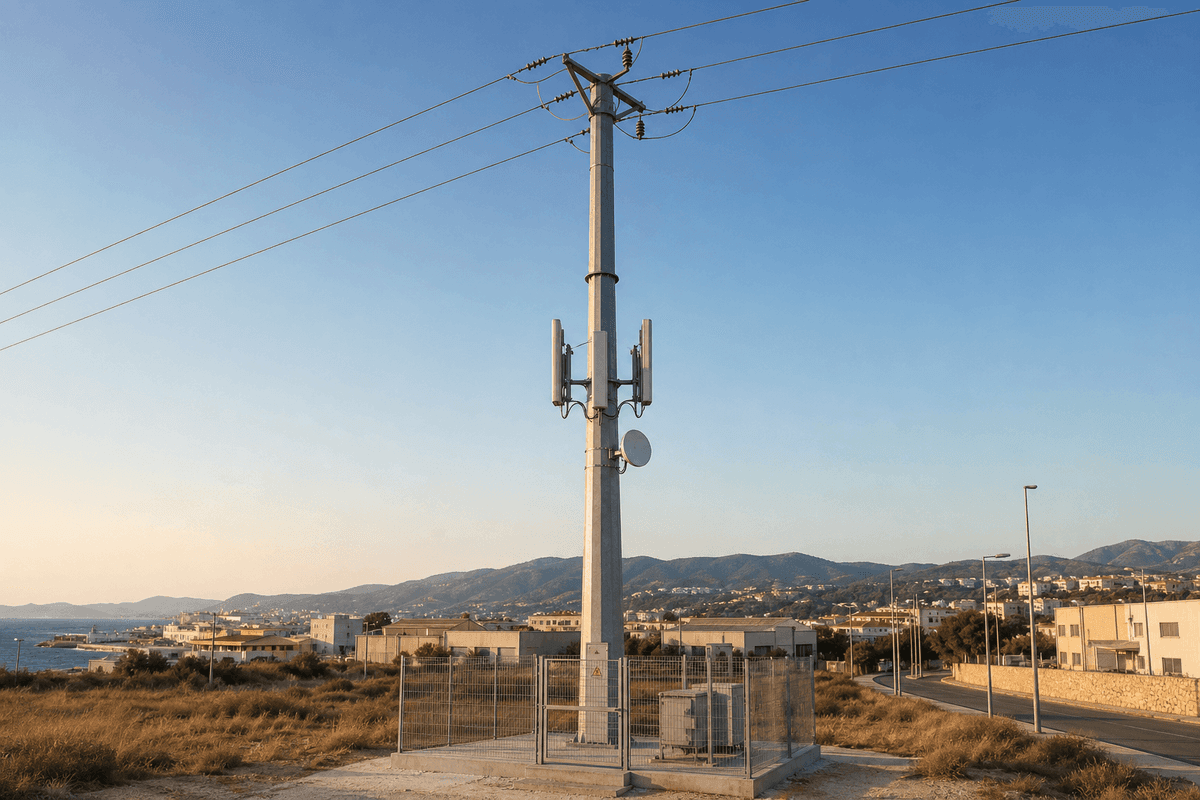
18m Joint-Use Utility Pole Power+Telecom - Steel Octagonal Shared Infrastructure
Key Features
- 18m steel octagonal joint-use pole for combined 10kV power and telecom deployment on 1 structure
- Supports 1 antenna platform with capacity for 3 antennas under 40m/s design wind speed
- Shared infrastructure can reduce corridor pole count by 30% to 50% versus separate installations
- Lightning protection system designed for grounding resistance below 4 ohms with 30-year design life
- EPC turnkey price range of $9,500 to $14,900 per site with 1-year warranty included
The 18m Joint-Use Utility Pole Power+Telecom is a steel octagonal shared-use pole designed for 10kV distribution and telecom colocation on a single 18m structure. It supports 1 antenna platform with capacity for 3 antennas, is engineered for 40m/s wind regions, and provides a 30-year design life under TIA-222-H and EN 1993-3-1 design methodology.
Description
The 18m Joint-Use Utility Pole Power+Telecom is a shared steel octagonal utility structure engineered to combine 10kV power distribution and telecom equipment mounting on a single 18m pole, reducing right-of-way congestion, civil work duplication, and pole count by as much as 30% to 50% versus separate line and telecom supports. This configuration includes 1 antenna platform, capacity for 3 telecom antennas, and structural design for 40m/s wind speed, making it suitable for rural electrification corridors, peri-urban smart infrastructure, and utility-telecom co-deployment projects where CAPEX discipline and land-use efficiency are critical.
For utilities, telecom operators, EPC contractors, and infrastructure developers, this model provides a practical balance between structural strength, installation speed, and lifecycle cost over a 30-year design life. The pole uses steel octagonal construction with hot-dip galvanizing, integrates lightning protection targeting grounding resistance below 4 ohms, and supports joint-use planning under recognized frameworks including TIA-222-H, EN 1993-3-1, and GB 50135. Buyers comparing shared infrastructure options can also View all Telecom Tower products or Configure your system online for project-specific loading and foundation conditions.
Product Overview
Joint-use utility poles are increasingly deployed where one corridor must carry both medium-voltage power and wireless communications over distances of 5km to 200km. By consolidating assets into one vertical structure of 18m, project owners can reduce trenching interfaces, lower permit complexity by 1 to 2 approval packages, and simplify maintenance routing for field teams. According to IRENA grid modernization studies and IEA infrastructure outlooks, shared utility assets can materially improve rural service economics when electrification and digital connectivity are developed in the same phase, especially in lower-density regions with fewer than 100 customers per km².
This SOLARTODO configuration is optimized for power_telecom_shared applications, where the upper or offset zone carries telecom equipment while the power cross-arm and conductor clearances remain compliant with local utility separation rules. In practice, a shared pole can reduce corridor clutter compared with installing 2 separate poles every 40m to 80m, and can lower foundation concrete consumption by approximately 15% to 35% depending on soil class and route geometry. For buyers planning network expansion in utility, telecom, or smart-city programs, Request a custom quotation to verify loading combinations, access constraints, and local code adaptations.
System Architecture
The architecture of this 18m joint-use pole is based on a steel octagonal shaft with a telecom mounting zone, a dedicated 1-level antenna platform, integrated cable management, external climbing system, and a power attachment arrangement configured for 10kV distribution service. The telecom side is specified for 3 antennas, typically supporting 4G LTE, entry-level 5G, private LTE, microwave auxiliary equipment, GPS timing units, or low-profile surveillance payloads below the allowable tip and face load envelope. A typical telecom loading package ranges from 45kg to 180kg, depending on antenna dimensions and feeder strategy.
The power side is configured for shared-use distribution where conductor spacing, phase clearances, and earthing must be coordinated with telecom RF equipment and maintenance access. In many utility projects, the pole is installed at line intervals of 50m to 100m, while telecom spacing depends on RF propagation, backhaul topology, and terrain clutter. Compared with a conventional standalone telecom monopole plus separate concrete or steel utility pole, the joint-use design can reduce steel tonnage at route level by 10% to 25% and lower installation mobilization events from 2 crews to 1 coordinated crew, improving schedule control.
| System Element | Configuration | Typical Value |
|---|---|---|
| Pole height | Shared-use pole | 18 m |
| Power service | Medium-voltage distribution | 10 kV |
| Telecom platform | Antenna mounting level | 1 |
| Antenna capacity | Panel or mixed payload | 3 antennas |
| Design wind speed | Structural basis | 40 m/s |
| Material | Main shaft | Steel octagonal |
| Grounding target | Lightning protection | <4 ohms |
| Design life | With maintenance | 30 years |

Technical Specifications
The structural basis for this pole follows the supplied configuration of 18m height, steel octagonal material, 1 antenna platform, 3-antenna capacity, and 40m/s design wind speed. For practical engineering, a conservative telecom top-load assumption for this configuration is approximately 150kg, including antennas, mounting steel, cabling, and accessories, although final values must be verified by project-specific wind area calculations under TIA-222-H. Foundation selection typically falls into reinforced concrete direct-embed or anchor-base solutions depending on geotechnical conditions, with concrete volumes commonly in the 4m³ to 8m³ range for standard soils.
Corrosion protection is specified as hot-dip galvanized steel, generally with zinc coating appropriate for utility and telecom outdoor service. In coastal or industrial atmospheres with chloride or sulfur exposure above baseline inland conditions, optional marine-grade detailing and coating upgrades can extend maintenance intervals by 3 to 7 years. Industry references from NREL and Wood Mackenzie consistently show that lifecycle performance in outdoor energy infrastructure is strongly linked to corrosion management, grounding quality, and preventive inspection frequency, not only initial material thickness.
The telecom mounting arrangement supports 3 antennas on 1 platform, which is appropriate for small rural macro coverage, utility SCADA communications, private network extensions, or compact public network overlays. Typical panel dimensions in such applications range from 1.2m to 2.5m in length, with individual unit masses from 12kg to 35kg. If microwave dishes, aviation lights, or CCTV are added, the total projected area and eccentric load must be recalculated. Buyers needing alternate loading envelopes can Learn about topic or submit route and equipment schedules through the SOLARTODO engineering team.
Structural Design, Safety, and Standards
This product is intended for engineering verification under TIA-222-H, EN 1993-3-1, and GB 50135, which are widely referenced for telecom support structures and steel tower design. Wind design at 40m/s corresponds to approximately 144km/h, and actual compliance depends on terrain category, topographic factor, gust effects, importance category, and antenna projected area. In utility corridors, separation distances between energized 10kV conductors and telecom maintenance zones must also comply with local utility codes, lockout-tagout practice, and national electrical safety requirements.
The lightning protection package includes an air terminal, down conductor, and grounding system designed to achieve resistance below 4 ohms, a threshold commonly used in telecom and utility installations to improve surge dissipation. Surge protection coordination is recommended at both the telecom cabinet and power interface, especially in regions with more than 30 thunderstorm days per year. IEC guidance on earthing and protection coordination, together with utility grounding practice, should be applied during detailed engineering because soil resistivity can vary from below 50 ohm-m to above 1,000 ohm-m, significantly affecting electrode design.
Access safety is addressed through an external ladder with safety rail, anti-climbing barrier positioned at approximately 3m height, and optional security monitoring such as CCTV or tamper alarms. For operators with more than 50 sites, standardizing anti-climb hardware and lock systems can reduce maintenance response time by 10% to 20%. These measures are particularly relevant in shared-use environments where utility and telecom teams may access the same asset under separate operational procedures.
Materials and Corrosion Protection
The main shaft uses steel octagonal construction, typically selected because it offers high torsional stiffness, efficient fabrication, and easier bracket integration than many lattice alternatives below 20m height. Compared with conventional concrete utility poles used only for power, galvanized steel joint-use poles can provide more flexible telecom attachment options and easier retrofitting for antennas, cable trays, or warning lights. Compared with installing 2 separate structures, one for power and one for telecom, this integrated design can reduce route visual clutter by roughly 50% and lower cumulative hardware interfaces by 20% to 40%.
Hot-dip galvanizing is the standard corrosion protection system, and expected service life can reach 30 years with periodic inspection and maintenance. In many climates, inspection intervals of 12 months for visual checks and 36 to 60 months for detailed structural review are common. Where projects are located within 5km of a coastline or in highly corrosive industrial belts, optional duplex coating systems can be specified to improve coating durability. This matters because corrosion rates can increase by 2x to 4x in aggressive environments relative to dry inland sites.
Power and Telecom Integration Benefits
The primary economic advantage of a joint-use pole is infrastructure sharing. A route that would otherwise require 100 power poles plus 100 telecom poles may be redesigned into approximately 100 shared poles, subject to line geometry and RF planning, cutting total pole count by up to 50%. This can reduce land-use negotiations, simplify transport planning, and lower installation traffic movements by 20% to 35%. For utility-led broadband, private LTE for distribution automation, or rural mobile expansion, these savings often have more impact than marginal differences in steel price per ton.
From an operational perspective, colocating telecom on utility assets can improve network resilience when utility SCADA, metering backhaul, and public connectivity are coordinated. For example, one 18m shared pole may host 3 panel antennas supporting utility communications and public access while carrying 10kV lines for local electrification. According to IEA and BloombergNEF market commentary on digitalized grids, integrated communications are increasingly important for outage management, distributed energy resource visibility, and smart infrastructure scaling over the next 5 to 10 years.
Applications
Typical applications include rural electrification corridors, plantation and mining roads, peri-urban utility upgrades, smart agriculture zones, industrial estates, and municipal smart-road programs. In a rural feeder extension of 12km, shared poles spaced at roughly 60m could reduce the total number of installed vertical structures by more than 150 units compared with separate utility and telecom deployment, depending on route topology. This makes the product well suited to regions where logistics cost exceeds 15% of total project CAPEX.
A practical scenario is a solar farm operator in the MENA region deploying a 10kV collector extension and private LTE coverage across a 6km access corridor. By selecting 18m joint-use steel poles with 3 antennas per site at selected intervals, the operator can support power delivery, security connectivity, and O&M communications on one route. Compared with separate telecom monopoles and utility poles, the shared approach can reduce civil interfaces by approximately 25%, shorten deployment by 3 to 6 weeks, and improve maintenance access through a single asset registry.
For utility and telecom planners seeking similar deployments, SOLARTODO provides related engineering resources at Learn about topic and product selection support through View all Telecom Tower products.

Installation and Foundation Considerations
Installation of an 18m steel octagonal shared-use pole generally involves survey, excavation, reinforcement, concrete pour, curing, pole erection, conductor hardware installation, telecom mounting, grounding, and commissioning. For standard soil conditions, foundation concrete volume often ranges from 4m³ to 8m³, and foundation cost at the provided benchmark of $300/m³ typically contributes $1,200 to $2,400 to EPC cost. Crane access, route slope above 8%, or poor soil with bearing capacity below 150kPa can increase foundation and erection cost.
The external ladder plus safety rail is priced at approximately $15/m, so an 18m run is about $270 installed. Cable tray systems at $10/m add about $180 for the same height, while the lightning protection package is approximately $500 per system. These benchmark numbers help procurement teams understand that final EPC price is driven less by isolated accessories and more by steel mass, galvanizing, logistics, and foundation complexity. For route programs above 50 poles, standardization can reduce per-site engineering hours by 10% to 15%.
Cloud Monitoring and O&M Readiness
Although the pole itself is a passive structure, it is commonly integrated into cloud-connected telecom and utility monitoring architectures. Operators may add site sensors for door status, power quality, grounding continuity, tilt, or camera feeds, with data uplinked every 1 to 15 minutes depending on SCADA policy. For networks larger than 100 sites, remote alarms can reduce truck rolls by 15% to 30%, especially when combined with predictive maintenance rules for grounding degradation, unauthorized access, or antenna misalignment.
O&M planning should include annual visual inspection, grounding test intervals of 12 to 24 months, coating checks, bolt torque verification, and post-storm assessment after wind events above 25m/s. For utility-telecom shared assets, a unified maintenance record and asset ID system can reduce documentation errors by 20% compared with separate ownership records. Buyers wanting digital integration advice can Configure your system online or Request a custom quotation with monitoring scope included.
EPC Investment Analysis and Pricing Structure
For this product, EPC Turnkey includes 5 core scopes: engineering, procurement, construction, commissioning, and 1-year warranty. Engineering covers structural calculation, general arrangement drawings, and foundation recommendations; procurement includes the pole, platform, ladder, cable management, lightning protection, and hardware; construction covers civil works and erection; commissioning includes grounding and installation verification; warranty covers defects within the agreed 12-month period after commissioning. For larger programs above $1,000K, financing support may be discussed case by case.
Pricing Tiers
| Pricing Tier | Scope | Price Range (USD) |
|---|---|---|
| FOB Supply | Equipment only, ex-works China | $5,890 - $10,132 |
| CIF Delivered | Equipment + ocean freight + insurance | $7,532 - $12,957 |
| EPC Turnkey | Fully installed + commissioned + 1yr warranty | $9,500 - $14,900 |
Volume Discounts
| Order Volume | Discount |
|---|---|
| 50+ units | 5% |
| 100+ units | 10% |
| 250+ units | 15% |
At the EPC range of $9,500 to $14,900 per installed pole, shared-use deployment is often more economical than building a separate utility pole plus telecom monopole combination, which can easily reach $13,000 to $22,000 combined in many markets once duplicate foundations, logistics, and labor are included. This means route-level savings of roughly 10% to 35% are achievable, especially for programs above 20 sites. Annual savings come from reduced inspection routes, fewer land agreements, and lower spare-parts complexity, often totaling $300 to $900 per site per year.
A simplified ROI example: if a developer avoids $3,500 of extra structure and civil cost per location and saves $500/year in O&M, the incremental payback versus separate infrastructure is effectively immediate at commissioning, with additional lifecycle benefit over 10 to 15 years. In utility broadband, private network, or smart-road applications, the business case strengthens further when the shared pole enables new telecom revenue or reduces outage response times by even 5% to 10%. Standard payment terms are 30% T/T + 70% against B/L, or 100% L/C at sight. For quotations and commercial discussion, contact [email protected].
Why B2B Buyers Specify This Model
Procurement managers typically evaluate 4 factors: structural compliance, installed cost, lead time, and maintainability. This model is attractive because it delivers a practical 18m shared-use height, supports 3 antennas, meets a 40m/s wind basis, and aligns with recognized standards rather than proprietary geometry. For EPC contractors, one standardized pole family can simplify BoM control across 10 to 500 sites, improving forecast accuracy and reducing engineering change orders.
Engineers also value the ability to adapt the same basic pole for utility communications, public mobile coverage, CCTV, or microwave edge equipment with limited redesign. Compared with a conventional dedicated telecom monopole, this joint-use configuration may sacrifice some payload flexibility but can cut total corridor CAPEX by 15% to 30% where power infrastructure is required anyway. That tradeoff is often favorable in rural, industrial, and smart-infrastructure projects where asset sharing is more important than maximum antenna count.
Conclusion
The 18m Joint-Use Utility Pole Power+Telecom is a technically efficient solution for combining 10kV power distribution and 3-antenna telecom capacity on one steel octagonal structure with 40m/s wind design and 30-year service target. It is best suited to utilities, telecom operators, and EPC firms seeking lower route-level CAPEX, fewer structures, and easier shared-corridor deployment under standards such as TIA-222-H and EN 1993-3-1.
For project planning, buyers can View all Telecom Tower products, Configure your system online, or Request a custom quotation. SOLARTODO also provides additional technical references and application guidance at Learn about topic for teams comparing pole classes, foundation methods, grounding design, and shared infrastructure economics.
Technical Specifications
| Tower Height | 18m |
| Tower Type | joint_use_pole |
| Material | steel_octagonal |
| Antenna Platforms | 1levels |
| Antenna Capacity | 3antennas |
| Design Wind Speed | 40m/s |
| Total Tip Load | 150kg |
| Foundation Type | Reinforced concrete direct-embed / anchor-base |
| Corrosion Protection | Hot-dip galvanized / Marine grade optional |
| Design Life | 30years |
| Application | power_telecom_shared |
| Power Voltage | 10kV |
| Telecom Sharing | true |
| Standards | TIA-222-H / EN 1993-3-1 / GB 50135 |
Price Breakdown
| Item | Quantity | Unit Price | Subtotal |
|---|---|---|---|
| Steel octagonal pole shaft with galvanizing (installed) | 1 pcs | $4,200 | $4,200 |
| Antenna platform steel assembly (installed) | 1 pcs | $800 | $800 |
| External climbing ladder + safety rail 18m (installed) | 1 pcs | $270 | $270 |
| Cable tray system 18m (installed) | 1 pcs | $180 | $180 |
| Lightning protection system (installed) | 1 pcs | $500 | $500 |
| Aircraft warning light set (installed) | 1 pcs | $300 | $300 |
| Reinforced concrete foundation 6m3 (installed) | 1 pcs | $1,800 | $1,800 |
| Pole erection and installation labor (installed) | 1 pcs | $950 | $950 |
| Grounding electrodes, connectors, and testing (installed) | 1 pcs | $420 | $420 |
| Power-telecom mounting hardware and brackets (installed) | 1 pcs | $680 | $680 |
| Total Price Range | $9,500 - $14,900 | ||
Frequently Asked Questions
What is the main advantage of an 18m joint-use utility pole compared with separate power and telecom poles?
What standards are typically used for structural design and safety verification?
Can this pole support 4G or 5G telecom equipment in addition to utility communications?
What is included in the EPC turnkey price and what warranty is provided?
How long does installation usually take for one 18m shared-use pole?
Certifications & Standards

Data Sources & References
- •NREL infrastructure and outdoor systems engineering references
- •IEA energy infrastructure and digital grid outlook
- •IRENA rural electrification and grid modernization references
- •BloombergNEF telecom-energy infrastructure market commentary
- •Wood Mackenzie network infrastructure cost benchmarking
- •TIA-222-H structural standard
- •EN 1993-3-1 steel tower standard
Interested in this solution?
Contact us for a customized quote based on your specific requirements.
Contact Us