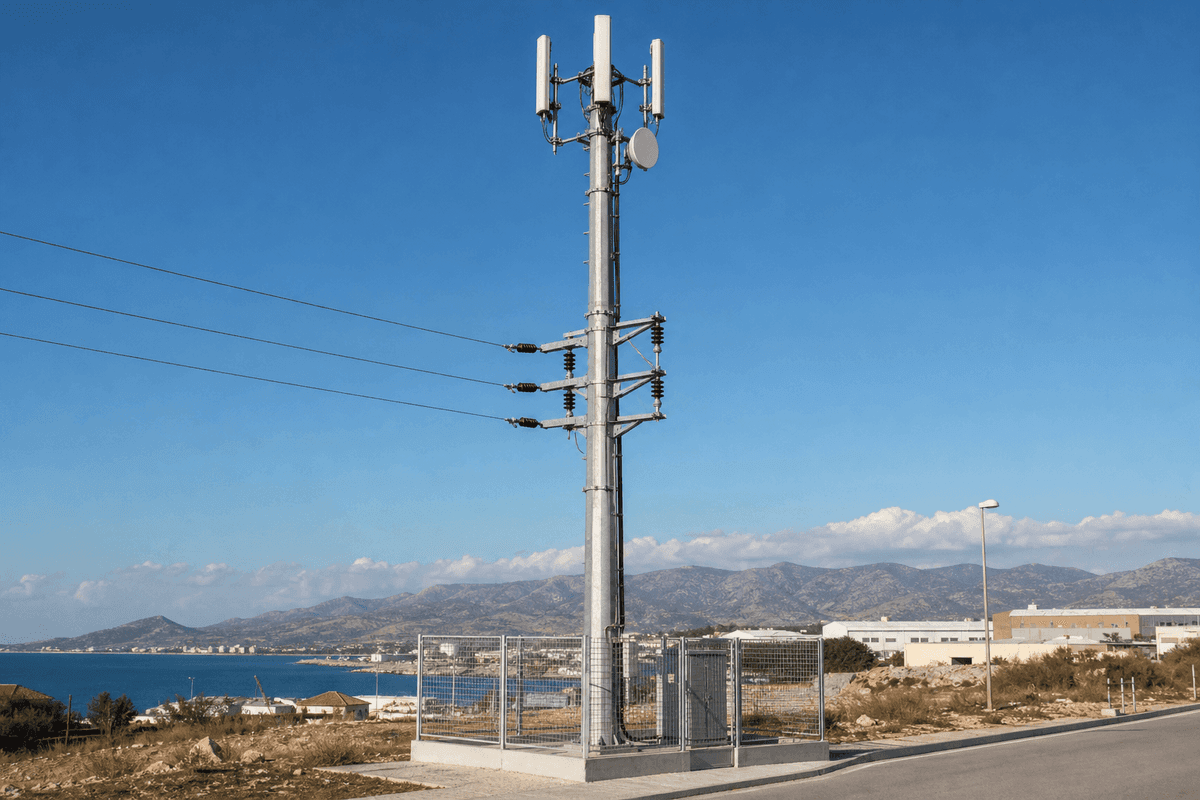
12m Distribution Telecom Shared Pole - 10kV Joint-Use Steel Pole
Key Features
- 12 m joint-use steel round pole for 10 kV distribution plus 3 telecom antennas on 1 shared structure
- Designed for 40 m/s wind speed with approximately 320 kg pole mass and 30-year service life
- Reference FOB pole price starts at USD 130, with EPC turnkey range of USD 650-1,100 per site
- Supports 1 antenna platform and can reduce corridor infrastructure count by 30%-50% versus 2 separate poles
- Hot-dip galvanized steel construction with grounding target below 4 ohms and typical foundation volume of 0.8-1.5 m3
The 12m Distribution Telecom Shared Pole is a hot-dip galvanized steel round joint-use pole engineered for 10kV distribution and 3 telecom antennas on 1 platform, with a 40 m/s design wind speed and 320 kg pole mass. It is designed for utility-roadside and peri-urban shared infrastructure projects that need lower CAPEX, faster deployment, and 30-year structural service life under TIA-222-H and EN 1993 design principles.
Description
The 12m Distribution Telecom Shared Pole is a 12 m hot-dip galvanized steel round joint-use pole configured for 10 kV distribution and 1 antenna platform supporting up to 3 telecom antennas under a 40 m/s design wind condition. With a pole body weight of approximately 320 kg and a reference FOB pole price of USD 130, this shared-infrastructure solution is intended for roadside utility corridors, village broadband expansion, industrial parks, and peri-urban smart infrastructure projects where one asset must carry both medium-voltage distribution hardware and telecom equipment within a compact 12 m envelope.
Unlike a telecom-only monopole, this model is a joint-use pole for combined distribution + telecom sharing, which means the mechanical layout, clearances, grounding, and loading assumptions must be coordinated across 2 utility functions instead of 1. In practical deployment, utilities typically reserve the upper or offset telecom zone for 3 sector antennas or a compact microwave backhaul set, while the electrical zone is arranged for 10 kV line hardware with code-compliant separation distances. For buyers evaluating alternatives, a shared pole can reduce corridor occupation by approximately 30% to 50% compared with installing 1 separate power pole and 1 separate telecom pole, while also lowering civil works and permit interfaces on rights-of-way shorter than 5 km.
Product Positioning and Use Case
This product belongs to the SOLARTODO Telecom Tower line, but this specific variant is configured as a distribution telecom shared pole rather than a telecom-only monopole. That distinction matters because telecom-only poles generally exclude conductors, insulators, and power clearances, while this 12 m model is engineered around a dual-service scenario with 10 kV distribution on the same structure. Buyers can View all Telecom Tower products to compare single-purpose and shared-use structures, or Configure your system online to define pole height, antenna count, wind zone, and utility loading in 1 digital workflow.
A typical deployment scenario is a rural broadband and feeder rehabilitation package covering 18 villages across a 42 km corridor in MENA or Sub-Saharan Africa. In one such planning model, a utility developer used 12 m shared poles at every 60 m to 80 m span interval, carrying 10 kV distribution plus 3 small cellular antennas at selected nodes to improve 4G coverage for approximately 12,000 users while avoiding a second line of telecom poles. Relative to a conventional two-pole approach, the project team estimated civil excavation reductions of roughly 35%, steel tonnage savings of 15% to 20% per served kilometer, and permit processing time reduction of nearly 25%, depending on local authority review procedures.
System Architecture
The structural architecture uses a steel round pole body with hot-dip galvanizing, a single telecom mounting level, and a foundation system sized to local geotechnical conditions, wind exposure, and conductor tension. In most 12 m joint-use designs, the pole includes 1 top or side-mounted telecom platform, utility crossarm or bracket hardware, grounding down-conductor integration, and cable routing provisions for RF and power accessories. Typical design verification references include TIA-222-H for communication structure loading, EN 1993-3-1 for steel tower and mast principles, and local utility construction standards for 10 kV line clearance and insulation coordination.

From a mechanical standpoint, the telecom payload on a 12 m shared pole is intentionally moderate at 3 antennas and 1 platform, because the electrical function already consumes structural capacity through conductor tension, insulator dead load, and wind sail area from line hardware. In procurement practice, this means the buyer should define at least 6 core inputs before final engineering: voltage level, span length, conductor type, antenna dimensions, basic wind speed, and soil bearing capacity. For projects above 50 poles, SOLARTODO typically recommends a line-route matrix covering 3 load cases minimum: everyday operation, broken-wire contingency, and maximum wind event.
Technical Specifications
The standard configuration is based on a 12 m above-ground pole height, joint_use_pole type, steel_round material, 1 antenna platform, 3 antenna capacity, and 40 m/s design wind speed. The indicative structural mass is 320 kg, which aligns with a compact medium-duty shared-use steel pole in Q355 or equivalent grade with galvanizing thickness generally targeted around 70 μm to 100 μm, subject to ISO 1461 or equivalent galvanizing practice. Design life is specified at 30 years, although service life can extend beyond 30 years with periodic inspection at 12-month to 24-month intervals and coating maintenance in coastal or high-pollution environments.
Electrical integration normally supports 10 kV distribution hardware with utility-specific insulator sets, line fittings, and earthing. Telecom integration is commonly used for 4G LTE, compact 5G radios, point-to-point microwave under 1 m diameter, GPS accessories, and low-power surveillance or smart-city nodes. The grounding target for telecom lightning protection is generally less than 4 ohms, consistent with common telecom practice, while the utility earthing system must also satisfy local distribution code requirements. For technical background on structure design and integrated infrastructure planning, buyers can Learn about topic and review additional engineering articles through Learn about topic before tender issuance.
Materials, Corrosion Protection, and Structural Reliability
The pole body is manufactured from structural steel, typically Q355 or equivalent, with hot-dip galvanizing selected for long outdoor service under UV exposure, rainfall, and airborne contaminants. At a reference installed steel tube cost of approximately USD 1,500 per ton, the 320 kg pole body corresponds to a base installed material-and-erection value near USD 480 before accessories, foundation, and commissioning. This cost structure is one reason shared poles remain attractive in emerging-market utility upgrades where the target installed budget is often below USD 1,100 per location for standardized roadside deployment.
Compared with a conventional concrete distribution pole plus a separate telecom mast, a galvanized steel shared pole can reduce total installed weight by roughly 10% to 25% and simplify logistics to 1 truck drop and 1 foundation zone in many projects. Steel also offers predictable fabrication tolerances within ±2 mm to ±5 mm for critical bracket interfaces, which helps antenna alignment and utility hardware fit-up. Where chloride exposure exceeds typical inland conditions, buyers should specify marine-grade detailing, sealed cable entries, and more frequent inspection intervals such as every 12 months rather than every 24 months.
Electrical and Telecom Integration Considerations
Joint-use structures require strict separation of electrical and telecom zones, because the safety regime for 10 kV conductors is fundamentally different from the access regime for RF equipment. In a standard 12 m arrangement, the electrical attachment zone occupies the upper distribution band, while the telecom mounting level is offset or vertically separated according to local utility and telecom code requirements. Access control, lockout-tagout, and climbing restrictions should be defined for at least 2 maintenance teams: line crews and telecom technicians. In many jurisdictions, anti-climb barriers are positioned around 3 m above grade, and warning signage is installed at 2 or more visible faces.
For antenna loading, 3 panel antennas are suitable for small macro, rural infill, utility private LTE, or hybrid public-network leasing models. If each antenna presents approximately 0.25 m² to 0.40 m² projected area, the total telecom sail area may remain below 1.2 m², helping the shared pole stay within the 40 m/s wind envelope. Cable routing should separate RF feeders, DC power, and utility earthing conductors, with UV-stable clamps at intervals of roughly 0.5 m to 1.0 m. Surge protection should be installed on telecom power circuits and at equipment interfaces in accordance with IEC-oriented lightning and surge mitigation practice.
Standards and Data References
Engineering decisions for this product should be benchmarked against recognized standards and sector data. Structural loading is commonly checked against TIA-222-H and EN 1993-3-1, while galvanizing practice is often aligned with ISO 1461 and weld quality with applicable ISO or AWS procedures. For energy and infrastructure planning context, market demand for shared utility assets is supported by network densification and electrification trends reported by the IEA, IRENA, BloombergNEF, and Wood Mackenzie. For resilience and distributed infrastructure economics, project teams also frequently reference NREL guidance on system reliability and site optimization, especially where telecom uptime targets exceed 99.5%. These sources collectively support the case that integrated infrastructure can lower total corridor CAPEX by double-digit percentages when asset sharing rates exceed 1.5 tenants or functions per site.
Applications
The 12 m shared pole is suitable for 5 common application classes: rural distribution with cellular infill, industrial park utility corridors, smart-road lighting and surveillance backhaul, utility private LTE for grid automation, and village electrification plus broadband expansion. In industrial estates of 1 km² to 3 km², developers often place shared poles every 70 m to 120 m to combine feeder distribution with CCTV uplinks and wireless backhaul. In peri-urban roads, municipalities can use the same structure to support 10 kV distribution, 3 antennas, and optional smart devices, reducing visual clutter and minimizing the number of separate foundations by up to 50%.

A practical example is a utility-roadside upgrade serving a 9.6 km corridor with 128 poles, where every 8th pole carried telecom equipment for public network roaming and utility SCADA backhaul. The project model used 16 shared telecom nodes, each with 3 antennas, and estimated annual O&M savings of approximately USD 9,000 to USD 14,000 compared with maintaining separate leased telecom sites and independent line structures. For utilities seeking a tailored design package, the fastest path is to Request a custom quotation with route length, wind zone, voltage, and antenna data attached in 1 inquiry.
Installation, Foundation, and Maintenance
Foundation sizing depends on soil bearing capacity, overturning moment, frost depth, and conductor tension, but for a 12 m steel shared pole the concrete volume often falls near 0.8 m³ to 1.5 m³ in ordinary soils. At an installed concrete foundation benchmark of USD 300/m³, the foundation cost typically contributes USD 240 to USD 450 per pole before rebar variation and excavation difficulty. Installation labor for steel structures is relatively modest at around USD 200 per ton, so the 320 kg pole erection labor component is roughly USD 64, excluding crane mobilization and line shutdown coordination.
Routine maintenance should be scheduled at 6-month visual intervals and 12-month formal inspections, with torque checks, corrosion review, grounding resistance tests, and antenna bracket verification. The lightning protection system should include 1 air terminal, 1 down conductor, and a grounding network designed to achieve less than 4 ohms where practical. If the site is in a coastal zone with salt deposition above inland norms, owners should plan coating touch-up and hardware replacement cycles potentially 20% to 30% more frequently than in dry continental climates.
EPC Investment Analysis and Pricing Structure
For procurement teams, SOLARTODO offers 3 commercial pathways: equipment-only supply, delivered supply, and full EPC execution. EPC Turnkey typically includes 5 major scopes: engineering, procurement, construction, commissioning, and 1-year warranty support. Engineering covers structural calculations, shop drawings, and foundation recommendations; procurement covers pole steelwork, galvanizing, brackets, and telecom mounting hardware; construction covers civil works, erection, grounding, and accessory installation; commissioning covers alignment, earthing verification, and documentation; warranty covers workmanship and supplied components under agreed operating conditions.
| Pricing Tier | Scope | Price Range (USD) |
|---|---|---|
| FOB Supply | Equipment only, ex-works China | 403 - 748 |
| CIF Delivered | Equipment + ocean freight + insurance | 515 - 957 |
| EPC Turnkey | Installed + commissioned + 1-year warranty | 650 - 1100 |
For larger utility frameworks, volume pricing can improve project economics materially. A standard discount schedule is shown below and is typically applied to equipment value or negotiated EPC packages above baseline quantities.
| Order Volume | Discount |
|---|---|
| 50+ units | 5% |
| 100+ units | 10% |
| 250+ units | 15% |
From an ROI perspective, the shared-pole concept often pays back through avoided duplicate infrastructure rather than direct energy savings. If a developer avoids a second telecom support structure costing USD 700 to USD 1,400 installed and reduces annual corridor maintenance by USD 70 to USD 150 per node, the incremental premium of a shared-use design can be recovered in roughly 2 to 5 years, depending on tenancy revenue, lease avoidance, and civil cost differentials. Against a conventional two-structure alternative, a 12 m shared pole can reduce total installed corridor cost by approximately 15% to 35% when utility and telecom stakeholders coordinate design before tender stage.
Payment terms are typically 30% T/T deposit and 70% against B/L, or 100% L/C at sight for qualified counterparties. Financing support can be discussed for projects above USD 1,000K total contract value, especially where deployment exceeds 100 poles and includes network accessories. For commercial review, BOQ validation, or route-specific EPC budgeting, contact [email protected].
Why B2B Buyers Select This Configuration
For EPC contractors, the main value of this 12 m model is standardization across a large number of medium-duty sites. A single pole family with 1 platform, 3 antennas, 10 kV utility compatibility, and 40 m/s wind design simplifies procurement, warehousing, and field training across 50 to 500 locations. For utilities and telecom operators, the model supports asset sharing without moving to a much taller 15 m to 18 m structure, which can trigger stricter permitting or more complex crane access in dense roadside environments.
For consultants and developers, the relatively low USD 650 to USD 1,100 EPC range makes this product suitable for donor-funded electrification, rural broadband, and smart-infrastructure pilot programs with tight CAPEX controls. The reference FOB pole price of USD 130 also provides a transparent baseline for comparing steel content and fabrication value against local alternatives. In many tenders, the key differentiator is not only hardware price but the ability to deliver repeatable engineering across 3 disciplines: structural, electrical, and telecom.
Procurement Guidance
Before issuing an RFQ, buyers should prepare at least 8 data points: route map, pole spacing, conductor specification, voltage class, basic wind speed, soil report, antenna dimensions, and grounding target. For projects above 20 sites, a schedule of accessories should also identify whether each location needs 1 antenna platform, cable tray length, anti-climb device, warning signs, and lightning kit. This reduces variation orders and can shorten technical clarification cycles by 1 to 3 weeks during bid evaluation.
SOLARTODO supports OEM/ODM supply, documentation packs, and project-level customization for utilities, towercos, and EPC firms. To compare this model with adjacent heights and loading classes, View all Telecom Tower products. To move directly into design selection, Configure your system online, or Request a custom quotation for line-route and foundation-specific pricing within 24 to 72 hours depending on project complexity.
Technical Specifications
| Tower Height | 12m |
| Tower Type | joint_use_pole |
| Material | steel_round |
| Antenna Platforms | 1levels |
| Antenna Capacity | 3antennas |
| Design Wind Speed | 40m/s |
| Total Tip Load | 60kg |
| Foundation Type | Reinforced concrete pad or pier foundation |
| Corrosion Protection | Hot-dip galvanized |
| Design Life | 30years |
| Standards | TIA-222-H / EN 1993 / ISO 1461 |
| Power Voltage | 10kV |
| Telecom Sharing | true |
| Pole Weight | 320kg |
| FOB Pole Price | 130USD |
Price Breakdown
| Item | Quantity | Unit Price | Subtotal |
|---|---|---|---|
| Steel round pole body, galvanized (installed) | 1 pcs | $480 | $480 |
| Antenna platform, steel (installed) | 1 pcs | $800 | $800 |
| Lightning protection system (installed) | 1 pcs | $500 | $500 |
| Climbing ladder with safety rail (12m installed) | 1 pcs | $180 | $180 |
| Cable tray system (12m installed) | 1 pcs | $120 | $120 |
| Concrete foundation, 1.0m3 (installed) | 1 pcs | $300 | $300 |
| Steel structure installation labor | 1 pcs | $64 | $64 |
| Total Price Range | $650 - $1,100 | ||
Frequently Asked Questions
Is this a telecom-only monopole or a true joint-use distribution and telecom pole?
What telecom equipment can be installed on the 12m shared pole?
What is included in the EPC turnkey price range of USD 650-1,100?
What standards and design references are typically used for this product?
What warranty and payment terms are available for bulk orders?
Certifications & Standards


Data Sources & References
- •NREL distributed infrastructure and resilience references
- •IEA network electrification and digital infrastructure outlook
- •IRENA power system and infrastructure planning references
- •BloombergNEF telecom-energy infrastructure market tracking
- •Wood Mackenzie grid and connectivity deployment analysis
- •EN 1993-3-1 Steel towers and masts
- •TIA-222-H Structural Standard for Antenna Supporting Structures
Interested in this solution?
Contact us for a customized quote based on your specific requirements.
Contact Us