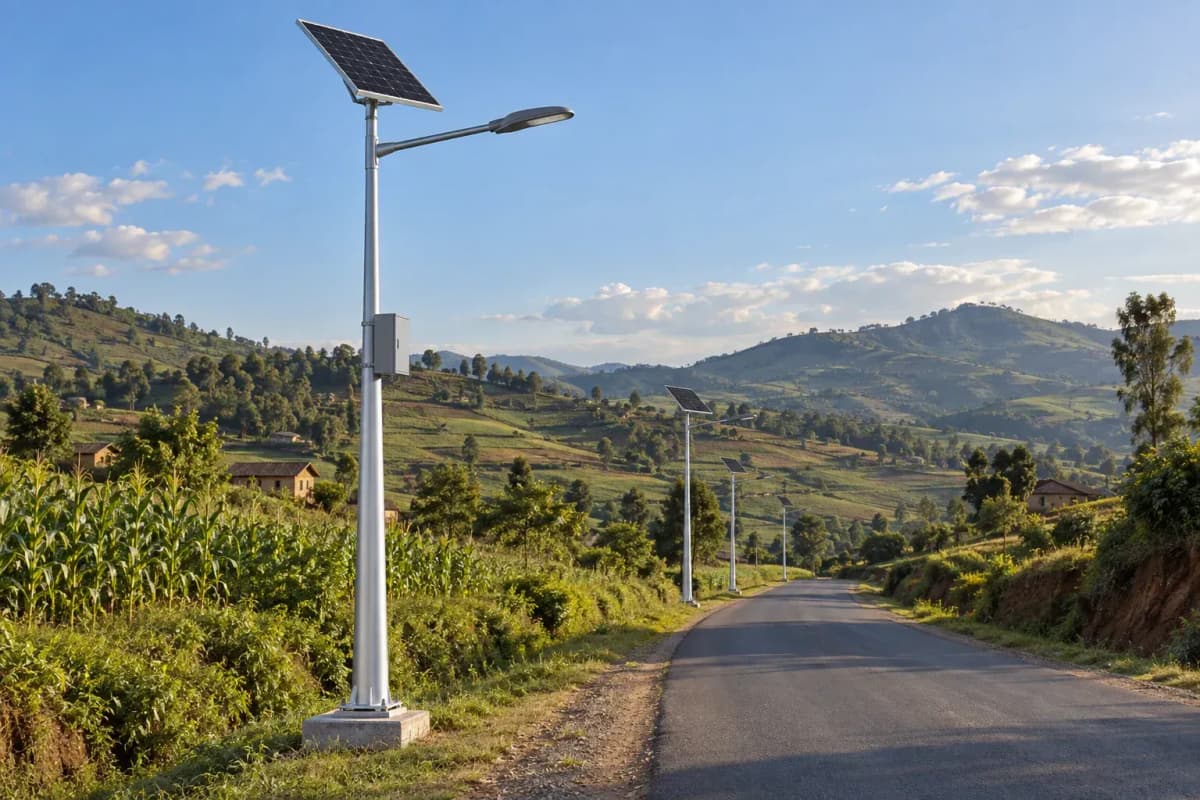
10.4m Split Solar Streetlight 164W - Highland LFP System
Key Features
- 10.4m aluminum-alloy pole with 160km/h highland wind-resistance target
- 164W LED luminaire delivering about 27,880 lm at 170 lm/W
- 328Wp TOPCon solar panel with 19-23% module-efficiency class
- 1476Wh LiFePO4 battery designed for 7 rainy days of autonomy
- EPC turnkey price range of $1,003-$1,748 per installed unit
The 10.4m Split Solar Streetlight 164W combines a 328Wp TOPCon module, 1476Wh LiFePO4 battery, 27,880 lm LED output, and 7-day autonomy for highland roads, industrial sites, and off-grid perimeter lighting.
Description
The 10.4m Split Solar Streetlight 164W is a highland-rated off-grid lighting system with a 328Wp monocrystalline TOPCon solar panel, 1476Wh LiFePO4 battery, 164W LED luminaire, and 7 rainy days of autonomy. Designed for 10.4m mounting height and aluminum-alloy pole construction, it targets public roads, mine roads, logistics yards, solar farms, and remote smart-infrastructure corridors where grid extension can exceed 1,000m of cable per feeder.
SOLARTODO specifies this split solar streetlight for B2B projects requiring separated serviceable components, adjustable PV tilt, and long-life energy storage. Compared with compact all-in-one lights in the 60W to 120W class, the 164W split configuration supports a larger 328Wp array, a larger 1476Wh battery, and easier field replacement of 3 major assemblies: PV module, luminaire, and battery enclosure. Buyers can View all Solar Street Light products or Configure your system online before tender submission.
System Architecture
The system uses a split architecture with 1 solar panel mounted on an optimized arm or top bracket, 1 cobra-head LED luminaire mounted at road-facing angle, 1 MPPT controller, and 1 LiFePO4 battery placed in the pole base or separate weatherproof box. This layout is recommended for 10m to 14m poles because the PV module can be oriented for higher annual yield while the battery remains accessible at ground level for maintenance within 15 minutes by a trained 2-person crew.
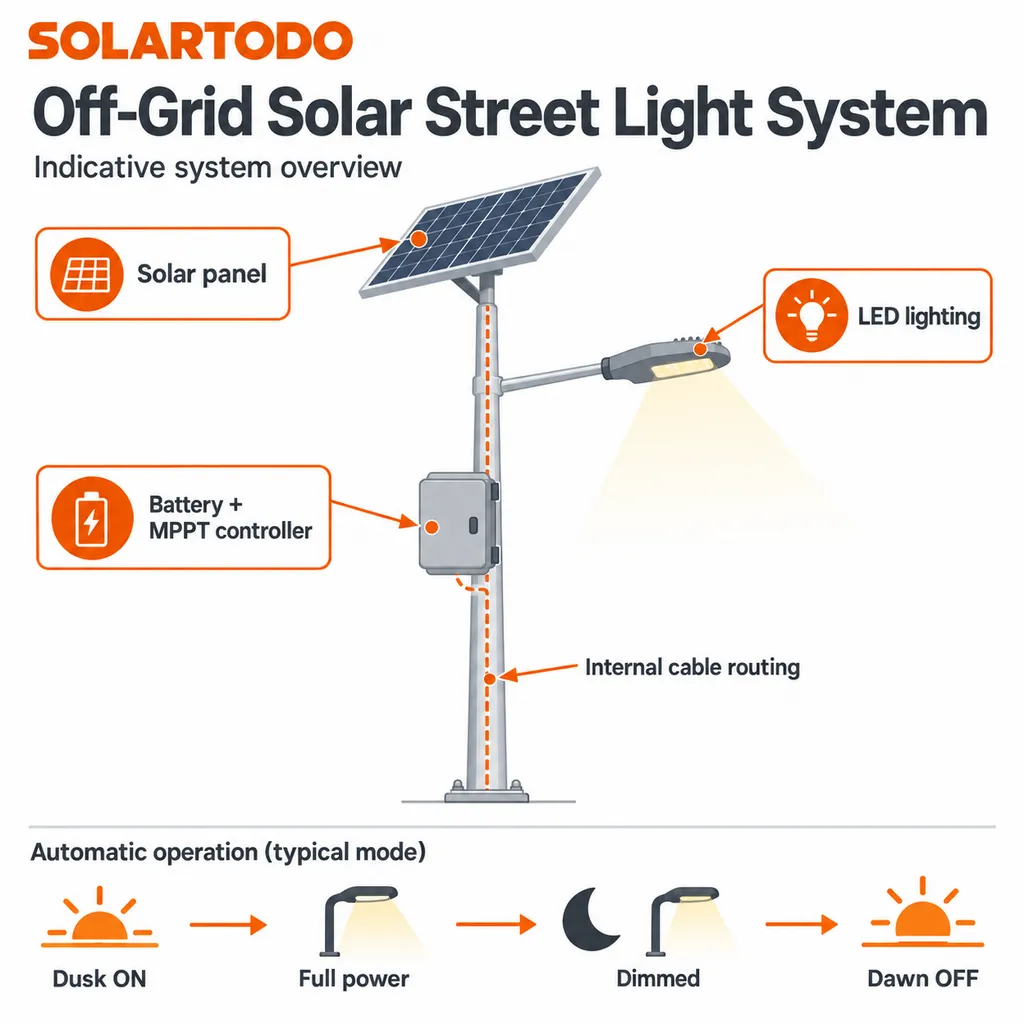
The 328Wp PV module is based on monocrystalline TOPCon technology with typical module efficiency in the 19% to 23% range and a 25-year design life when selected under IEC 61215 and IEC 61730 test frameworks. NREL PVWatts guidance is useful for yield estimation because a fixed-tilt 328Wp array at high-altitude locations above 2000m can benefit from stronger irradiance, although snow, dust, and local shading should be modeled with at least 12 monthly resource inputs.
The 1476Wh LFP battery is sized for dusk-to-dawn operation with 12h nightly lighting and 7 rainy days of reserve using dimming logic rather than constant 164W operation for 84 continuous hours. LiFePO4 chemistry is specified because IEC 62619-aligned industrial battery packs commonly deliver 2000+ deep cycles with BMS protection, while low-temperature charging protection reduces lithium plating risk below 0°C in highland winter conditions.
The MPPT controller is matched to the 328Wp panel and should operate above 98% peak tracking efficiency under stable irradiance. In practical road lighting schedules, the controller runs 4 operating blocks: dusk ramp-up, traffic peak period, late-night dimming, and dawn shutdown. This control strategy can reduce energy use by up to 60% compared with a fixed-output 164W luminaire, while still keeping safe visibility during high-traffic intervals.
Technical Specifications
| Parameter | Specification |
|---|---|
| Pole height | 10.4 m |
| LED power | 164 W |
| Estimated luminous flux | 27,880 lm at 170 lm/W |
| Solar panel | 328 Wp TOPCon mono |
| Battery | 1476 Wh LiFePO4 |
| Autonomy | 7 rainy days |
| Pole material | Aluminum alloy |
| Wind resistance | 160 km/h design target |
| Lighting schedule | 12 h/day dusk-to-dawn |
| Warranty | 3 years system, 5 years pole |
The luminaire package uses high-efficacy LED chips from classes such as Bridgelux, Cree, or Lumileds, with an expected efficacy above 170 lm/W and a rated service life above 50,000 hours when thermally managed. IEC 60598 is the primary luminaire safety reference, while IP66 or IP67 sealing protects the optical chamber and driver bay from rain, road dust, and wind-driven particulates at speeds above 150km/h.
The aluminum-alloy pole is selected for a 10.4m highland configuration because it reduces weight compared with a galvanized-steel equivalent and improves handling during mountain-road logistics. For procurement modeling, SOLARTODO uses an indicative aluminum pole cost near $22 per meter, giving a 10.4m pole component basis of about $228.80 before project-specific anchorage, packing, and installation factors are applied.
Highland Climate Engineering
Highland lighting projects usually combine 4 stress factors: ultraviolet exposure, temperature swing, wind load, and low-temperature battery charging. This 10.4m model addresses those constraints with UV-resistant cables, corrosion-resistant aluminum pole surfaces, a 160km/h wind-resistance target, and LFP battery management configured for -20°C to +60°C operation. IEEE 1562 standalone PV guidance supports conservative sizing because off-grid systems must maintain service during multi-day low-sun periods.
For a representative MENA highland solar-farm scenario at 2200m elevation, a developer may specify 1 light every 30m along a 3km perimeter road, resulting in about 100 light points. At EPC pricing of $1,003 to $1,748 per unit, the installed lighting budget would range from $100,300 to $174,800 before optional CCTV, trench sharing, or site-security integration, and the 328Wp module reduces grid-dependence to 0kWh imported on typical sunny operating days.
Compared with a conventional grid-tied 150W to 180W streetlight requiring trenching, copper cable, distribution boards, and recurring electricity purchases, a split solar streetlight can reduce civil electrical works by 40% to 70% on remote roads where cable runs exceed 500m. The exact saving depends on soil class, grid distance, and labor rate, but the avoided trenching alone can exceed $20 to $60 per meter in difficult terrain.
Cloud Monitoring
The controller can support optional 4G or LoRa monitoring with 1 device ID per pole, remote dimming schedules, fault alerts, battery voltage trends, charge/discharge logs, and lamp status reporting. For a 100-pole project, the platform can reduce night inspection rounds from 7 days per week to exception-based maintenance, because operators can prioritize the 1% to 3% of nodes reporting battery, panel, or luminaire faults.
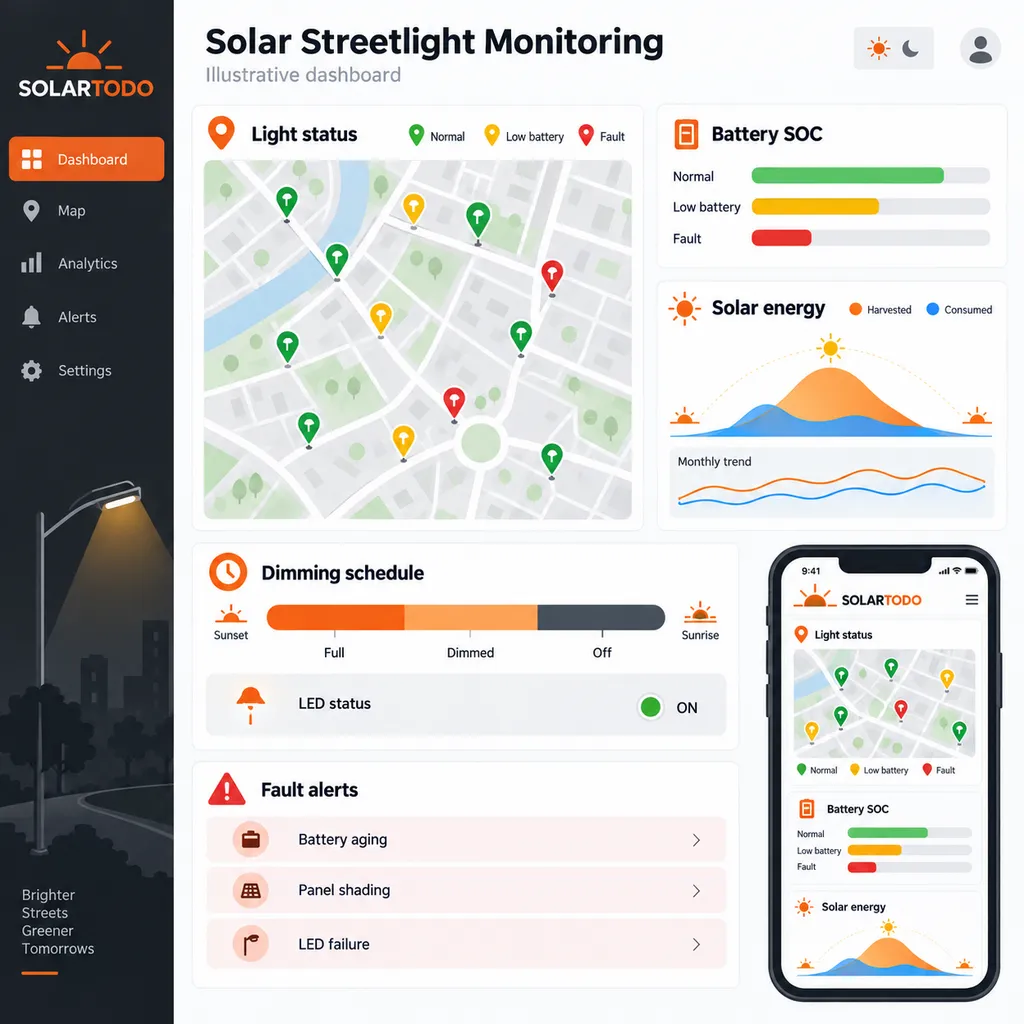
Cloud-connected solar lighting is especially useful for industrial campuses, border roads, logistics parks, water facilities, and telecom corridors where outage response targets are measured in hours rather than weeks. IEA energy-efficiency analysis repeatedly identifies lighting controls as a major source of electrical savings, and IRENA off-grid renewable guidance supports modular solar infrastructure where grid reliability is weak or capital extension costs are high.
EPC Investment Analysis and Pricing Structure
EPC turnkey delivery includes 5 commercial scopes: engineering, procurement, construction, commissioning, and 1-year installed-system support. Engineering covers pole spacing, illumination assumptions, foundation sizing, single-line documentation, and compliance review against IEC 62124 standalone PV principles. Procurement covers the 328Wp module, 1476Wh LFP battery, 164W luminaire, MPPT controller, pole, cabling, packing, and optional monitoring hardware. Construction covers foundation, lifting, wiring, installation, aiming, and safe energization.
| Pricing tier | Scope | Unit price range |
|---|---|---|
| FOB Supply | Equipment only, ex-works China | $622 - $1,189 |
| CIF Delivered | Equipment plus ocean freight and insurance | $699 - $1,336 |
| EPC Turnkey | Installed, commissioned, and supported for 1 year | $1,003 - $1,748 |
| Order volume | Indicative discount | EPC planning note |
|---|---|---|
| 50+ units | 5% | Suitable for 1.5km road lighting at 30m spacing |
| 100+ units | 10% | Suitable for 3km perimeter or access-road projects |
| 250+ units | 15% | Suitable for city, highway, or utility-scale framework contracts |
A 100-unit EPC project priced near the mid-point of $1,375 per unit has an installed budget of about $137,500 before taxes and local authority fees. If each solar unit offsets a conventional 164W grid luminaire for 12h per night, annual avoided grid consumption is about 718kWh per pole or 71,800kWh for 100 poles. At $0.15/kWh, direct electricity savings are about $10,770 per year, while avoided trenching, transformer, and cable costs can shorten practical payback to roughly 3 to 6 years on remote sites.
Payment terms are normally 30% T/T deposit plus 70% against bill of lading, or 100% irrevocable L/C at sight for qualified buyers. Project financing can be reviewed for solar-lighting packages above $1,000K, subject to country risk, bank documentation, EPC scope, and buyer credit profile. For bill of quantities, drawings, and delivery planning, Request a custom quotation or contact [email protected] with quantity, road width, pole spacing, and destination port.
Applications and Design Guidance
The 10.4m 164W split system is best suited to 2-lane rural roads, solar-farm internal roads, mine access lanes, logistics yards, airport service roads, and perimeter-security routes requiring high mounting height. A 10.4m pole can support wider spacing than a 6m or 8m pole when optics are selected correctly, but final spacing should be verified by a lighting simulation using road width, target lux, uniformity ratio, and 30m to 40m candidate intervals.
Procurement teams should compare 3 variables before ordering: target illumination class, local solar resource, and rainy-season duration. In areas with 4.0 peak-sun-hours per day, a 328Wp panel produces about 1.31kWh/day before system losses; after 20% losses, useful daily energy is near 1.05kWh. That energy budget supports adaptive dimming schedules better than all-night 164W constant output, which would require about 1.97kWh per 12h night.
For standards alignment, SOLARTODO recommends referencing IEC 62124 for standalone PV performance verification, IEC 60598 for luminaire safety, IEC 61215 and IEC 61730 for PV module qualification, IEC 62619 for industrial lithium battery safety, and IEEE 1562 for standalone PV array sizing practice. Buyers can Learn about topic when preparing specification language for public tenders or multi-country procurement programs.
A typical bill of quantities includes 1 aluminum-alloy pole, 1 164W LED luminaire, 1 328Wp TOPCon PV module, 1 1476Wh LFP battery pack, 1 MPPT controller, 1 foundation kit, 1 cable set, and 1 installation package. Options can add 1 smart node, 1 4G module, 1 PIR sensor, dual-arm luminaires, anti-theft bolts, or project-color powder coating, depending on tender scope and maintenance policy.
Procurement Notes
SOLARTODO supplies solar street lighting for solar, energy-storage, smart-lighting, security, telecom, power-tower, and smart-agriculture projects through https://solartodo.com. The 10.4m 164W split model is positioned between medium 80W road lights and heavy 200W dual-head split systems, giving EPC buyers a balanced specification when a 328Wp panel and 1476Wh battery are required but a 2-luminaire head is not necessary.
Before issuing a purchase order, buyers should provide at least 8 inputs: country, nearest port, road width, pole spacing, average nightly lighting hours, rainy-day requirement, wind-speed requirement, and required certifications. A complete submittal package can include datasheets, wiring diagrams, foundation drawings, packing list, warranty statement, and photometric files for Dialux-style review within a typical 3 to 7 business day engineering cycle.
For related design background, procurement managers can Learn about topic and compare PV generation assumptions with NREL PVWatts, IRENA renewable cost references, and IEA efficiency guidance. This evidence-based approach helps engineering teams specify 7-day autonomy, 160km/h wind design, IP66/IP67 protection, and 50,000-hour LED life without relying on unverified deployment claims.
Technical Specifications
| Pole Height | 10.4m |
| LED Power | 164W |
| Luminous Flux | 27880lm |
| Solar Panel | 328Wp |
| Battery Capacity | 1476Wh LFP |
| Autonomy | 7rainy days |
| Pole Material | Aluminum alloy |
| Wind Resistance | 160km/h |
| Operating Temperature | -20 to +60°C |
| Lighting Hours | 12h/day |
| Warranty | 3 years system, 5 years pole |
Price Breakdown
| Item | Quantity | Unit Price | Subtotal |
|---|---|---|---|
| 328Wp TOPCon Solar Panel | 1 pcs | $33 | $33 |
| 1476Wh LiFePO4 Battery Pack | 1 pcs | $148 | $148 |
| 164W Split LED Cobra-Head Luminaire | 1 pcs | $74 | $74 |
| 328W MPPT Solar Charge Controller | 1 pcs | $98 | $98 |
| 10.4m Aluminum Alloy Pole | 1 pcs | $229 | $229 |
| Concrete Foundation and Anchor Kit | 1 pcs | $100 | $100 |
| Battery Box, DC Cable Set, Connectors | 1 pcs | $80 | $80 |
| Installation and Commissioning | 1 pcs | $380 | $380 |
| Engineering, Documentation, and QC | 1 pcs | $110 | $110 |
| 1-Year Warranty and Support | 1 pcs | $99 | $99 |
| Total Price Range | $1,003 - $1,748 | ||
Frequently Asked Questions
What is included in the EPC turnkey price?
How is the 7-day autonomy calculated for a 164W light?
Why use a split solar streetlight instead of an all-in-one model?
Which standards are relevant for this product?
What information is needed for a custom quotation?
Certifications & Standards



Data Sources & References
- •IEC 62124 photovoltaic standalone system design verification
- •IEC 60598 luminaire safety requirements
- •IEC 61215 and IEC 61730 photovoltaic module qualification and safety
- •IEC 62619 industrial lithium battery safety
- •IEEE 1562 standalone photovoltaic array sizing guidance
- •NREL PVWatts solar energy production modeling
- •IEA and IRENA renewable-energy and efficiency guidance
Interested in this solution?
Contact us for a customized quote based on your specific requirements.
Contact Us