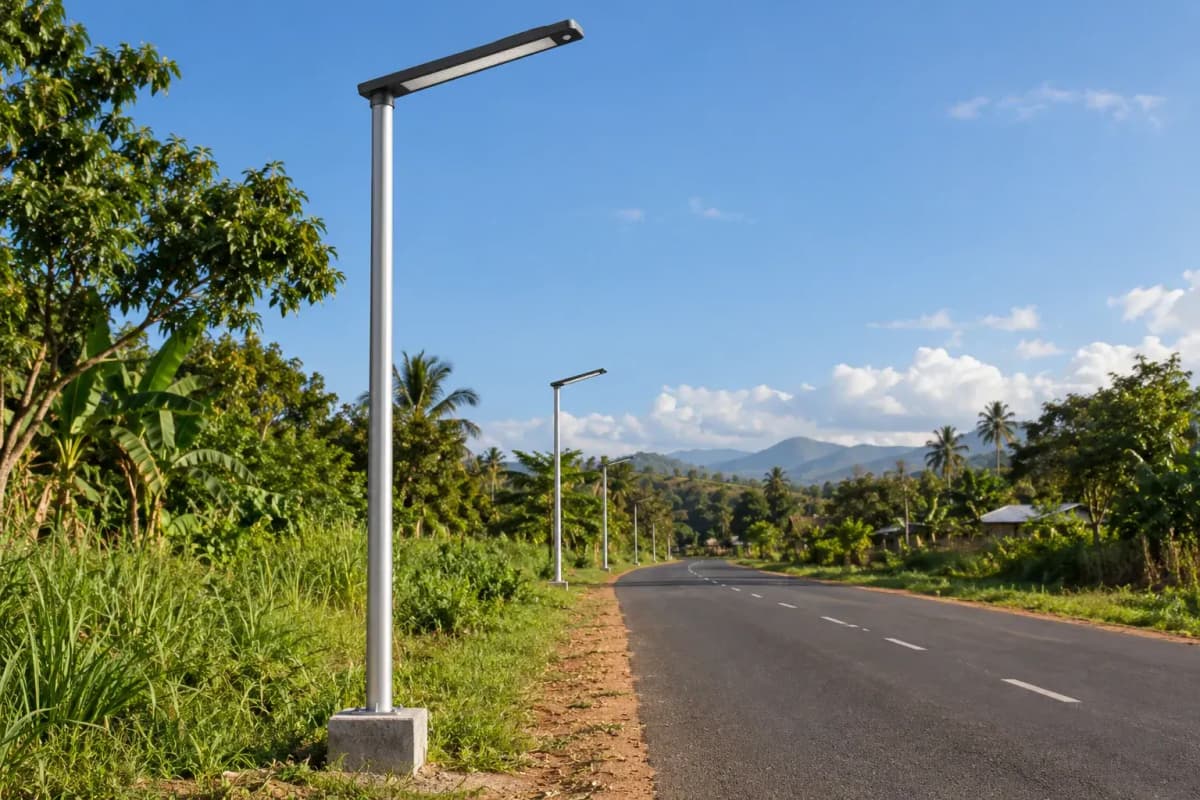
5.8m All-in-One Solar Streetlight 48W - Tropical LFP Smart Lighting
Key Features
- 48W LED engine delivering approximately 8,160 lm at >170 lm/W chip-level efficacy
- 106Wp monocrystalline TOPCon panel with 19-23% efficiency and 25-year module design life
- 432Wh LiFePO4 battery with 2,000+ deep cycles and BMS-based temperature protection
- 7 rainy days of autonomy for tropical monsoon applications with smart dimming control
- 5.8m aluminum-alloy pole with 160 km/h wind-resistance design target
5.8m all-in-one solar streetlight with 48W LED, 106Wp TOPCon panel, 432Wh LiFePO4 battery, IP67 tropical enclosure, and 7-day autonomy. EPC turnkey pricing is USD 187-313 per pole with engineering, installation, commissioning, and 1-year support.
Description
The 5.8m All-in-One Solar Streetlight 48W is a tropical-duty integrated lighting system with a 48 W LED engine, 106 Wp monocrystalline TOPCon solar module, and 432 Wh LiFePO4 battery mounted on a lightweight 5.8 m aluminum-alloy pole. It is specified for 12 hours per night, 7 rainy days of autonomy, and an EPC turnkey budget of USD 187-313 per pole for roads, parks, perimeter routes, and distributed smart-infrastructure sites.
This model belongs to SOLARTODO's Solar Street Light line and is designed for procurement teams that need a repeatable 4-6 m class pole solution without trenching, AC distribution, or separate battery cabinets. For the full family, see View all Solar Street Light products, and for site-specific spacing, battery sizing, and pole counts, use Configure your system online.
Technical Specifications
| Parameter | Value | Engineering note |
|---|---|---|
| Pole height | 5.8 m | Suitable for pedestrian roads, internal factory streets, parking aisles, and village access roads with typical 15-22 m spacing. |
| LED power | 48 W | High-efficiency LED chips at >170 lm/W provide approximately 8,160 lm before optical and thermal losses. |
| Solar panel | 106 Wp TOPCon mono | TOPCon cell technology supports typical module efficiency of 19-23% and a design life of 25 years. |
| Battery | 432 Wh LiFePO4 | LFP chemistry supports 2,000+ deep cycles with BMS protection for charge, discharge, and temperature events. |
| Autonomy | 7 rainy days | Designed for monsoon-prone tropical sites where low irradiance may persist for 3-7 nights. |
| Ingress protection | IP67 target | Enclosure strategy follows the IP-code framework of IEC 60529, which classifies dust and water protection for electrical equipment up to 72.5 kV. |
| Operating temperature | -20°C to +60°C | Tropical configuration uses anti-fungal coating, sealed cable glands, and derated charging logic above 45°C. |
| Wind resistance | 160 km/h | Pole, bracket, and fasteners should be checked against the local 10 m reference wind map before final BOQ release. |
The specification aligns with solar standalone-system design principles in IEC 62124, which addresses functionality, autonomy, and recovery after low battery state of charge for PV systems. Luminaire safety should be evaluated under IEC 60598-1:2024, while project-level illumination targets should be matched to the buyer's road class, mounting height, lane width, and local public-lighting code.
System Architecture
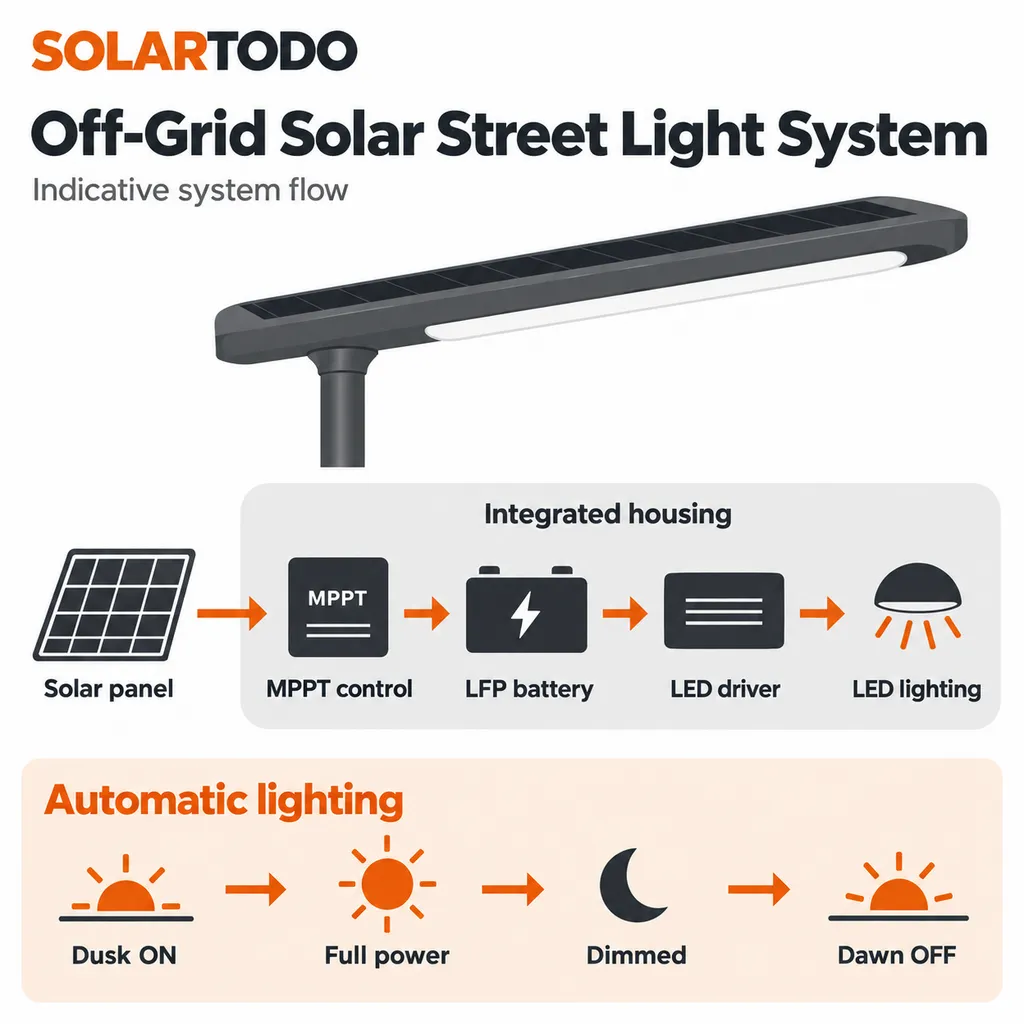
The all-in-one architecture places 4 core subsystems in the pole-top luminaire: the 106 Wp PV module, MPPT controller, 432 Wh LFP battery pack, and 48 W LED optical engine. This eliminates the external battery box, long DC cable runs, and split-controller cabinet used by many conventional solar lights, reducing visible components from roughly 5 assemblies to 2 assemblies: pole plus integrated head.
Energy flows from the TOPCon panel through a high-efficiency MPPT controller rated at >98% tracking efficiency under matched voltage conditions. During the day, the controller charges the 432 Wh LFP battery; after dusk, the load program supplies the 48 W LED channel according to time-based and PIR motion rules, with optional 4G or LoRa telemetry for fleet management.
A full-power operating profile of 48 W x 12 h would require 576 Wh/night, so a real streetlight profile must use dimming to match the 432 Wh battery and daily solar harvest. A common tropical schedule is 4 h at 100%, 6 h at 35%, and 2 h at 60% when motion is detected, giving an expected base draw near 329 Wh/night before controller losses and allowing the battery to cover multi-day low-irradiance events.
The integrated head can reduce installation time to about 30 minutes per pole after the foundation has cured, compared with roughly 2-4 hours for a grid-connected pole that needs AC cabling, conduit, junction boxes, and feeder testing. On isolated roads where trenching can exceed 20 m per pole, this design can reduce new underground cable length by up to 100% and grid electricity consumption by 100% for the lighting point.
Solar, Battery, and Lighting Performance
The 106 Wp panel is sized for compact geometry on a 5.8 m pole while still supporting a 48 W LED package when dimming is used. In regions with 4.5-5.5 peak sun hours/day, typical gross PV production is 477-583 Wh/day before temperature, soiling, wiring, and MPPT losses; final control programming should use the lower seasonal month rather than the annual average.
NREL's PVWatts methodology uses location-specific irradiance and derate inputs to estimate PV energy production, making it a practical screening tool for small distributed assets such as 1-pole or 500-pole lighting packages (NREL PVWatts). For a 106 Wp module in a hot tropical zone, engineering teams should model at least 14% aggregate system loss and add a soiling factor where dust, salt, or leaves reduce module yield.
The 432 Wh LFP battery is selected for high cycle life, thermal stability, and lower maintenance burden than lead-acid gel batteries. At 80% usable depth of discharge, the energy available is approximately 346 Wh, which supports a motion-adaptive profile while protecting cell life across more than 2,000 deep cycles.
The LED module is specified at 48 W with premium-class chips such as Bridgelux, Cree, or Lumileds, with an efficacy target above 170 lm/W and a service life above 50,000 hours. At 12 h/night, that life corresponds to more than 11 years of nightly operation before lumen-maintenance replacement planning, although drivers and batteries normally have shorter replacement intervals.
Tropical Climate Design
The tropical package prioritizes high humidity, rain splash, insects, fungal growth, and elevated battery temperature, all of which can reduce field reliability within 1-3 seasons if not addressed. The sealed luminaire is specified around an IP67 target, anti-fungal internal coating, conformal-coated PCB areas, stainless fasteners, and UV-resistant optical materials.
Aluminum alloy is used for the 5.8 m pole because it reduces mass compared with hot-dip galvanized steel and helps simplify manual handling during 1-pole or 100-pole deployments. For coastal sites within 5 km of salt spray, SOLARTODO can evaluate FRP or upgraded coatings, while inland tropical sites normally balance aluminum weight, corrosion behavior, and procurement cost.
Thermal design is critical because LFP charging should be controlled as ambient conditions approach 55-60°C inside sealed housings. The BMS monitors pack voltage, current, and temperature, and the controller can reduce charge current or dim the LED output when internal temperature exceeds the programmed threshold by 1-2 control steps.
Representative Scenario: MENA Industrial Access Road
For a representative MENA industrial-access-road scenario, assume 100 poles, 5.8 m mounting height, 20 m pole spacing, 12 h/night service, and an average tariff of USD 0.16/kWh. Each 48 W grid LED alternative consumes about 210 kWh/year, so 100 grid-connected fixtures consume about 21,000 kWh/year before feeder losses, timers, or photocell drift.
A solar configuration removes that annual lighting energy from the utility bill and also avoids trenching on up to 2,000 m of road edge when no AC lighting feeder exists. Compared with a conventional grid-connected alternative, the solar option can reduce operating electricity by 100%, reduce underground lighting cable by up to 100%, and shorten pole-top commissioning checks to roughly 30 minutes per lighting point after civil works.
The comparison should not be read as a universal payback claim because grid proximity, labor rates, civil works, and import duty can shift project economics by more than 20%. It is a representative procurement model for early budgeting; buyers should request a site-specific quote with road width, desired lux level, GPS coordinates, and 3-5 photos through Request a custom quotation.
Applications
The 48 W / 5.8 m format is best matched to pedestrian areas, campus roads, parking lanes, village streets, resort paths, perimeter walks, and low-speed access roads where a 4-6 m lighting class is appropriate. For highways, container yards, or wide arterial roads above 2 lanes, buyers should consider 80-150 W solar luminaires on 8-10 m poles from the same product line.
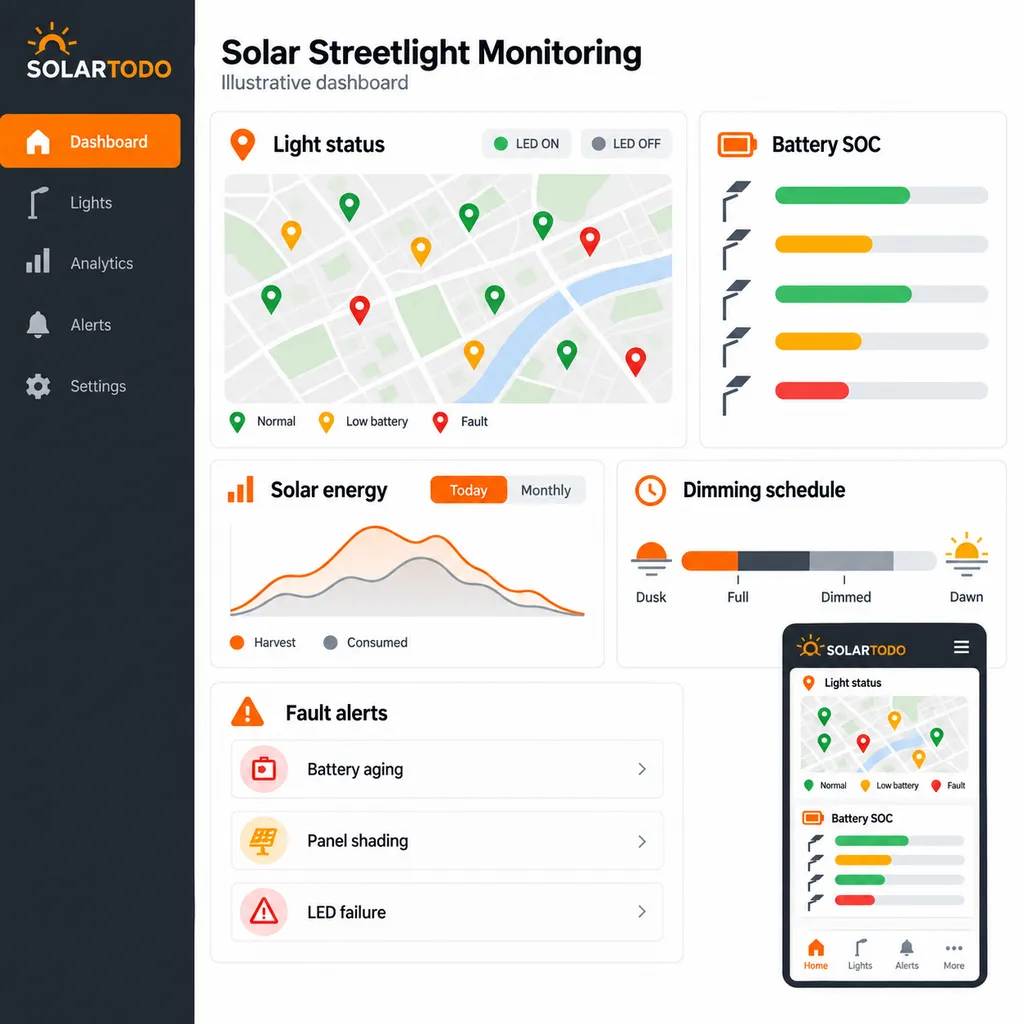
In smart-infrastructure projects, the integrated head can be paired with a LoRa gateway or 4G controller so maintenance teams can view charging status, fault alerts, dimming schedules, and battery voltage across 50-1,000 poles. To understand related sizing logic and standalone PV design, see Learn about topic and SOLARTODO's solar streetlight knowledge resources for 20-150 W lighting classes.
Cloud Monitoring
Cloud monitoring is optional but recommended for fleets above 50 poles, because a single failed charger or shaded panel can otherwise remain unnoticed for 7-30 days. A monitored controller can report battery voltage, PV input, load current, operating mode, and fault status at intervals such as 15 minutes, 1 hour, or 24 hours, depending on SIM-card cost and project policy.
Motion-adaptive dimming can reduce energy use by up to 60% compared with a fixed all-night full-output profile, especially where pedestrian or vehicle traffic is intermittent after 23:00. PIR logic should be configured with detection zones, hold time, and brightness steps during commissioning, because a 10-second delay and a 60-second delay can produce very different user experience and battery draw.
EPC Investment Analysis and Pricing Structure
EPC turnkey delivery includes 5 work scopes: engineering, procurement, construction, commissioning, and 1-year site support. For this model, engineering covers lighting layout, pole foundation guidance, battery autonomy check, logistics plan, and quality-control documentation; procurement covers the integrated luminaire, 5.8 m aluminum pole, fasteners, embedded cage, controller program, and packaging.
| Pricing tier | Scope | Unit price range, USD/pole |
|---|---|---|
| FOB Supply | Equipment only, ex-works China | 116-213 |
| CIF Delivered | Equipment plus ocean freight and insurance | 130-239 |
| EPC Turnkey | Installed, commissioned, and covered by 1-year warranty | 187-313 |
| Order quantity | Indicative discount | Procurement note |
|---|---|---|
| 50+ poles | 5% | Suitable for roads of roughly 1 km at 20 m spacing. |
| 100+ poles | 10% | Common batch for campuses, parks, and industrial estates above 2 km. |
| 250+ poles | 15% | Best for municipal corridors, resorts, and district programs above 5 km. |
The midpoint EPC price is approximately USD 250/pole, while the listed EPC range is USD 187-313/pole depending on foundation depth, freight lane, monitoring option, and local labor rate. Payment terms are 30% T/T + 70% against B/L, or 100% L/C at sight; project financing can be reviewed for orders above USD 1,000,000 with bankable documents and credit approval.
ROI depends on whether the buyer compares against an existing energized pole or a new lighting corridor. Against a new grid-connected alternative of USD 280-520/pole plus about 210 kWh/year of electricity and USD 15-35/year of maintenance visits, the solar EPC option can show immediate capex parity on remote roads and a typical 4-6 year payback where avoided energy and avoided trenching are both counted.
For procurement files, SOLARTODO can provide a BOQ, datasheet, packing list, foundation drawing, and commissioning checklist within 2-5 working days after receiving coordinates and road geometry. For pricing confirmation, contact [email protected] or use Request a custom quotation with the target quantity, delivery country, and required Incoterm.
Standards, Market Context, and Procurement Notes
IEA's Renewables 2025 report states that renewable capacity additions for 2025-2030 total about 4,600 GW, with distributed PV making up 42% of overall PV expansion (IEA). That macro trend supports off-grid lighting procurement because module availability, controller supply, and PV logistics are increasingly standardized across both utility and distributed markets.
IRENA reports that solar PV generation cost in 2025 remained around USD 44/MWh, while more than 90% of utility-scale renewable projects commissioned in 2025 produced power below the cheapest new fossil-fuel alternative in their market (IRENA 2026). Although a 48 W streetlight is not a utility plant, the same PV and battery manufacturing scale lowers the component cost base for small standalone systems.
For battery context, IRENA notes that solar-plus-storage costs have fallen sharply, with battery storage costs down 93% since 2010 in its 24/7 renewables analysis (IRENA 2026). This cost trajectory is one reason LFP batteries have replaced lead-acid batteries in many 3-7 day autonomy solar-lighting designs.
Procurement teams should verify 5 items before purchase: minimum monthly irradiation, required road lux level, pole spacing, wind zone, and warranty service model. A correct 48 W specification is not only the LED wattage; it is the balance among 106 Wp charging power, 432 Wh storage, optical distribution, dimming schedule, and the civil foundation used in the actual site.
Ordering Guidance
A typical order file includes 1 datasheet, 1 foundation drawing, 1 packing list, 1 installation manual, and 1 commissioning checklist per project batch. Buyers should state whether they need FOB, CIF, or EPC pricing; SOLARTODO will then map the USD 116-213, USD 130-239, or USD 187-313 tier to the requested country and quantity.
For engineering selection, start with the 5.8 m / 48 W model when roads are narrow, pole spacing is under 22 m, and the required maintained illumination is moderate. Move to 80 W or 100 W variants when the road is wider than 6 m, when pole spacing exceeds 25 m, or when the project requires higher uniformity than the compact optical footprint can deliver.
Technical Specifications
| Pole Height | 5.8m |
| LED Power | 48W |
| Luminous Flux | 8160lm |
| Solar Panel | 106Wp |
| Battery Capacity | 432Wh (LiFePO4) |
| Autonomy | 7rainy days |
| Pole Material | Aluminum alloy |
| Wind Resistance | 160km/h |
| Operating Temperature | -20 to +60°C |
| Lighting Hours | 12h/day dusk-to-dawn |
| Warranty | 3 years system, 5 years pole |
Price Breakdown
| Item | Quantity | Unit Price | Subtotal |
|---|---|---|---|
| All-in-One 48W Solar Luminaire with 106Wp panel and 432Wh LFP battery | 1 pcs | $62 | $62 |
| 5.8m Aluminum Alloy Pole | 1 pcs | $128 | $128 |
| Concrete Foundation and Anchor Cage | 1 pcs | $80 | $80 |
| Installation & Commissioning | 1 pcs | $18 | $18 |
| Engineering, Lighting Layout & QC | 1 pcs | $12 | $12 |
| 1-Year Warranty & Support | 1 pcs | $8 | $8 |
| Total Price Range | $187 - $313 | ||
Frequently Asked Questions
What is included in the EPC turnkey price of USD 187-313 per pole?
How does the 432Wh battery support 7 rainy days with a 48W LED?
Is the 5.8m pole suitable for highways or wide arterial roads?
Which standards are relevant for this solar streetlight?
Can the light be monitored remotely by a city or facility team?
Certifications & Standards


Data Sources & References
- •NREL PVWatts Calculator, https://pvwatts.nrel.gov/
- •IEC 62124:2004 PV stand-alone systems design verification, https://webstore.iec.ch/en/publication/6483
- •IEC 60598-1:2024 luminaires general requirements, https://webstore.iec.ch/en/publication/66620
- •IEC 60529 IP Code, https://webstore.iec.ch/en/publication/2447
- •IEA Renewables 2025, https://www.iea.org/reports/renewables-2025/renewable-electricity
- •IRENA Renewable Power Generation Costs in 2025, https://www.irena.org/Publications/2026/Jul/Renewable-Power-Generation-Costs-in-2025
- •IRENA 24/7 Renewables Outcompete Fossil Fuels on Firm Costs, https://www.irena.org/News/pressreleases/2026/May/24-7-Renewables-Outcompete-Fossil-Fuels-on-Firm-Costs
Interested in this solution?
Contact us for a customized quote based on your specific requirements.
Contact Us