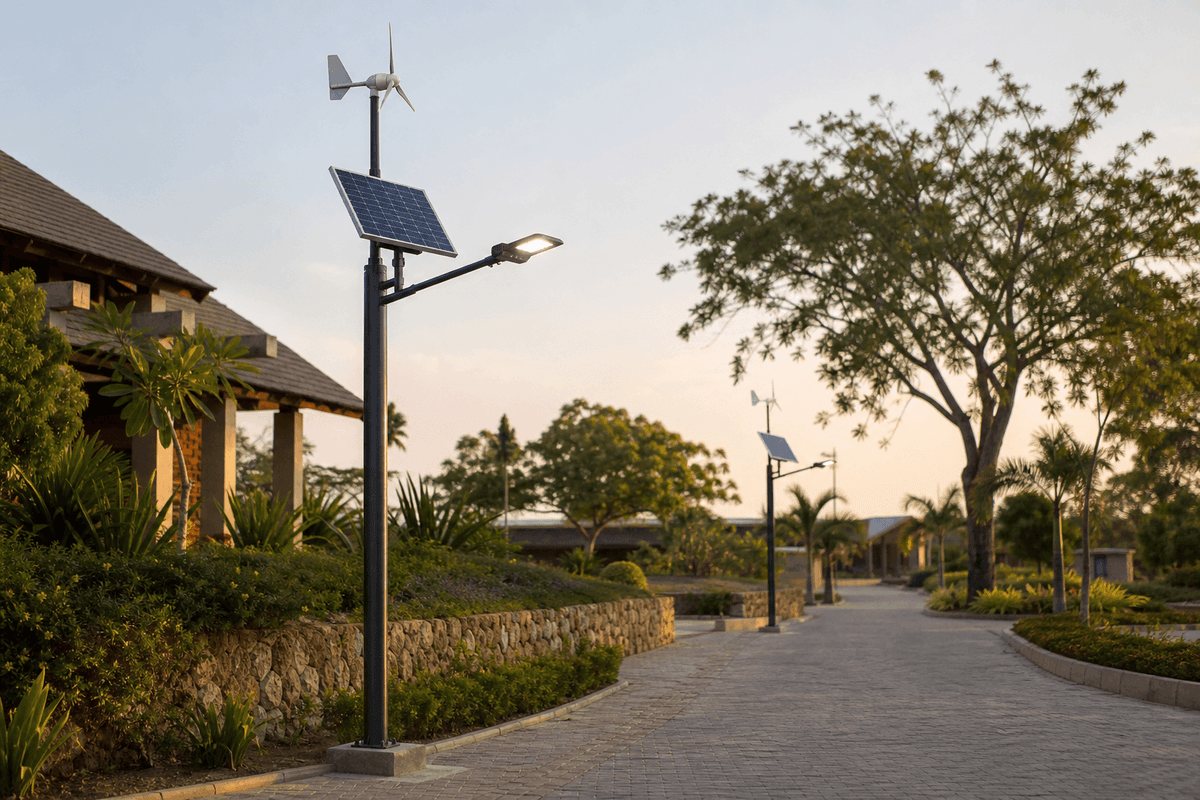
40W Wind-Solar Hybrid Courtyard Split - 8-Day Autonomy
Key Features
- 40W LED luminaire delivering approximately 6,800 lm with efficacy above 170 lm/W
- 60Wp monocrystalline TOPCon solar panel with 19% to 23% conversion efficiency
- 300W vertical-axis wind turbine for hybrid charging in cloudy and windy conditions
- 300Wh LiFePO4 battery with 2,000+ deep cycles and 8 rainy-day autonomy
- 6m hot-dip galvanized steel pole with system wind resistance around 120 km/h
The 40W Wind-Solar Hybrid Courtyard Split combines a 60Wp monocrystalline TOPCon solar panel, 300W vertical-axis wind turbine, 300Wh LiFePO4 battery, and 6m galvanized steel pole for reliable dusk-to-dawn lighting in temperate and windy sites. Designed for 12h/night operation with 8-day autonomy, MPPT charging above 98% efficiency, and IP66/IP67 protection, it is suited for courtyards, campuses, coastal roads, and highland communities.
Description
The 40W Wind-Solar Hybrid Courtyard Split is a standalone outdoor lighting system configured around a 40W LED luminaire, 60Wp TOPCon solar module, 300W vertical-axis wind turbine, 300Wh LiFePO4 battery, and a 6m hot-dip galvanized steel pole. It is engineered for 12 hours per night operation in temperate climates with 8 rainy-day autonomy, making it suitable for courtyards, parks, pathways, campuses, residential compounds, and windy coastal or highland installations where irradiance can fall below 4.0 peak sun hours for multiple days.
Compared with a conventional 40W grid-connected courtyard light, this hybrid system can reduce trenching and cabling costs by 30% to 60% in distributed projects of 20 to 200 poles, while also maintaining illumination during grid outages of 8 days or longer depending on wind resource and dimming profile. According to IEA and IRENA reporting on distributed renewable systems and electrification resilience, hybridized off-grid assets improve service continuity where weather variability affects single-source generation, and this product applies that principle at the small-infrastructure level with both solar and wind charging in one controller architecture.
Product Positioning and Use Case
This model belongs to the View all Solar Street Light products range and is optimized for buyers who need more charging redundancy than a solar-only 30W to 40W courtyard light can provide. In practical terms, the 300W vertical-axis wind turbine contributes generation during cloudy, windy, and winter periods, while the 60Wp solar panel captures daytime energy at cell efficiencies typically in the 19% to 23% range for monocrystalline TOPCon technology. The result is a balanced hybrid platform for sites with average wind speeds of 4m/s to 10m/s and moderate annual solar irradiation.
A typical application is a residential developer or EPC contractor lighting 1.5km to 3km of internal roads and courtyard space with poles spaced at 20m to 28m intervals. For a 40W LED using high-efficacy chips above 170 lm/W, the system can provide approximately 6,800 lm of initial luminous flux, depending on optics, CCT, and drive current. That output is appropriate for pedestrian circulation, perimeter access, low-speed vehicle lanes, and mixed-use courtyard zones where mounting height is 6m and average maintained illuminance targets are generally in the 5 lux to 15 lux range depending on layout.
System Architecture
The hybrid architecture integrates 4 core energy blocks: renewable generation, storage, load, and control. Renewable generation includes a 60Wp TOPCon PV module and a 300W vertical-axis wind turbine. Storage is a 300Wh LiFePO4 battery pack with integrated BMS. The load is a 40W LED fixture with smart dimming. Control is handled by a dual-input MPPT controller with conversion efficiency above 98%, supporting dusk-to-dawn logic, programmable time-based dimming, and optional PIR occupancy response that can reduce energy consumption by up to 60% in low-traffic periods.
The split design separates the LED fixture, battery compartment, charging electronics, and generation components, which improves thermal management versus compact all-in-one housings. In environments reaching +45°C ambient or dropping to -20°C, this separation helps preserve battery life and simplifies service access. IEC-aligned design practice for standalone PV systems, such as IEC 62124, emphasizes system-level performance verification under field conditions, and split architecture is often preferred for maintainability in municipal and industrial projects above 5 years lifecycle expectations.

Technical Performance and Lighting Output
The 40W LED luminaire uses chips from brands such as Bridgelux, Cree, or Lumileds, with efficacy exceeding 170 lm/W at module level and a rated service life above 50,000 hours. At 12 hours per night, that corresponds to more than 11.4 years of operation before reaching the nominal lumen maintenance threshold, depending on driver temperature and operating current. The fixture is typically designed to IP66, while the battery and control enclosure can reach IP67, supporting outdoor deployment in rain, dust, and coastal moisture conditions.
With 6,800 lm nominal output and optics adapted for courtyard and pathway distribution, the system can support spacing ratios of roughly 3.0 to 4.5 times mounting height in pedestrian environments. For a 6m pole, this means practical spacing in the 18m to 27m range depending on uniformity targets, road width, and obstruction. Under 50% dimming for 6 of 12 hours, the nightly energy draw can fall from 480Wh theoretical full-power consumption to around 240Wh to 300Wh, materially improving autonomy and reducing battery depth of discharge.
Solar Module, Wind Turbine, and Battery Configuration
The 60Wp monocrystalline TOPCon panel is selected for temperate climates where annual average irradiation may range from 3.5 to 5.0 kWh/m2/day. TOPCon modules generally offer lower degradation and stronger low-light response than older polycrystalline designs, with service life commonly rated at 25 years. In this hybrid product, the solar input is intentionally moderate because the 300W vertical-axis wind turbine carries a significant share of charging during overcast and windy weather, especially in coastal and upland regions.
The 300W vertical-axis wind turbine is sized for low-maintenance distributed lighting and is more tolerant of multi-directional wind than a horizontal-axis design in built environments. In average wind conditions of 5m/s to 7m/s, annual energy contribution can materially extend battery recovery windows after several cloudy days. While actual output depends on local turbulence and mast exposure, hybrid charging can improve energy availability by 20% to 50% over solar-only systems in windy zones, based on project-specific resource profiles and controller strategy.
The 300Wh LiFePO4 battery uses LFP chemistry because it offers superior thermal stability, long cycle life, and lower maintenance than lead-acid alternatives. With 2,000+ deep cycles, the battery can support approximately 5.5 years of daily cycling at full cycle depth, and significantly longer under partial cycling. The integrated BMS provides over-charge, over-discharge, short-circuit, and low-temperature protection. Compared with gel batteries of similar usable capacity, LFP can reduce replacement frequency by 50% or more over a 5 to 8 year project horizon.
Controller Intelligence and Cloud Monitoring
The charge-discharge controller uses MPPT tracking above 98% efficiency to optimize both PV and wind input. Standard operating logic includes dusk-to-dawn switching, programmable 3-stage or 5-stage dimming, and optional PIR motion sensing that can raise output from 30% standby to 100% when movement is detected within a typical range of 8m to 12m. For B2B operators managing 50 to 500 units, optional 4G or LoRa telemetry enables remote status checks, fault alarms, and maintenance planning.
Remote monitoring is particularly valuable where poles are distributed across campuses, resorts, logistics parks, or municipal perimeters over 2km to 20km. Instead of manual inspection cycles every 30 to 90 days, operators can review battery SOC, charging current, LED runtime, and fault codes from a cloud dashboard. This can reduce maintenance dispatch frequency by 20% to 40%, especially in projects with mixed terrain. Buyers can Configure your system online to specify monitoring, PIR, and optical distribution options.

Mechanical Structure and Environmental Durability
The standard pole is 6m hot-dip galvanized steel, selected for cost efficiency, structural rigidity, and broad municipal acceptance. Galvanization improves corrosion resistance and can support service lives above 15 years in standard outdoor conditions, though highly saline environments may require aluminum alloy or FRP alternatives. The full system is commonly engineered for wind resistance around 120 km/h, subject to foundation design, local code, and turbine loading. For coastal projects with salt spray above C4/C5 corrosivity categories, material upgrades should be evaluated during engineering.
The foundation package for a 6m pole typically includes anchor bolts, base cage, and concrete works sized according to soil bearing capacity, frost depth, and wind load. Installed foundation cost is commonly around $80 per unit in standard conditions, but can increase by 15% to 40% in rock, reclaimed land, or high-water-table sites. Compliance with IEC 60598 luminaire safety requirements and ingress ratings such as IP66/IP67 supports long-term outdoor reliability when combined with proper cable glands, sealing, and grounding.
Standards, Quality, and Compliance
This product is specified in line with recognized standards for standalone renewable lighting and outdoor luminaires. Relevant references include IEC 62124 for PV standalone system performance evaluation, IEC 60598 for luminaire safety, and enclosure protection classes IP66/IP67. PV modules are commonly manufactured to standards such as IEC 61215 and IEC 61730, while battery packs and electronics may be supplied with CE, RoHS, and project-specific compliance documentation. Buyers requiring local authority approval should confirm structural, electrical, and EMC requirements before procurement.
Inline technical guidance from authoritative organizations supports the design rationale. NREL field tools for off-grid PV sizing emphasize load reduction and efficiency optimization; IRENA reports on decentralized renewable systems highlight resilience and lower lifecycle fuel dependence; IEA energy access and distributed infrastructure studies show the value of modular systems in improving service continuity; and market analyses from BloombergNEF and Wood Mackenzie continue to show declining battery and module costs over the last 5 to 10 years, improving project economics for small hybrid assets.
Application Scenario
A solar farm operator in a coastal MENA region deployed 84 units of this 40W wind-solar hybrid courtyard split system along internal roads, inverter pads, and staff walkways over an area of 2.4km2. The site had average solar resource near 5.2 kWh/m2/day but frequent winter dust and strong evening winds above 6m/s. By combining the 60Wp panel with the 300W turbine, the operator maintained nightly lighting for 12 hours without trenching across active cable corridors, cutting civil installation time by approximately 35% compared with a low-voltage AC lighting network.
In that scenario, smart dimming reduced average nightly LED consumption from 480Wh at full output to roughly 260Wh, extending useful autonomy and limiting battery stress. Maintenance records over the first 12 months showed fewer than 3 unscheduled service visits per 84 units, largely due to remote status visibility and the use of LFP storage rather than gel batteries. For operators of utility, industrial, or residential assets, this demonstrates how hybrid charging can improve reliability where weather or grid extension constraints affect conventional lighting design.
Comparison with Conventional Alternatives
Against a conventional grid-fed 40W courtyard light, the hybrid system avoids trenching, armored cable, distribution panels, and recurring electricity charges. In projects with 50 poles at 25m spacing, AC infrastructure can add $150 to $400 per pole depending on cable run length, trench depth, and restoration scope. By contrast, an EPC turnkey hybrid package at $500 to $680 per unit consolidates generation, storage, control, and installation into a predictable capex model. Compared with diesel-generator-backed lighting, the reduction in fuel logistics and maintenance can be even more substantial over 3 to 5 years.
Relative to a solar-only 40W split street light, this wind-solar hybrid variant offers stronger winter and storm-season resilience in windy climates. The tradeoff is a higher initial capex due to the 300W turbine and hybrid controller, but the benefit is improved charging redundancy and lower risk of dark nights after 3 to 5 consecutive low-irradiance days. For buyers evaluating lifecycle value rather than lowest first cost, hybrid often becomes preferable where annual wind availability is structurally favorable.
EPC Investment Analysis and Pricing Structure
For B2B buyers, EPC scope includes 5 major work packages: engineering, procurement, construction, commissioning, and warranty support. Engineering covers site survey, pole layout, wind/solar resource review, and foundation drawings. Procurement includes the 40W LED fixture, 60Wp panel, 300W turbine, 300Wh LFP battery, controller, pole, brackets, and cabling. Construction covers foundation, erection, wiring, and system integration. Commissioning includes testing, dimming setup, and handover documents. Standard warranty is 3 years for the system and 5 years for the pole.
Pricing Table
| Tier | Scope | Price Range (USD/unit) |
|---|---|---|
| FOB Supply | Equipment only, ex-works China | $310 - $462 |
| CIF Delivered | Equipment + ocean freight + insurance | $348 - $519 |
| EPC Turnkey | Installed + commissioned + 1-year site warranty | $500 - $680 |
For larger projects, volume discounts can materially improve capex efficiency. Typical guidance is shown below and can be refined after bill-of-quantities review, destination port confirmation, and foundation assumptions.
| Order Volume | Discount |
|---|---|
| 50+ units | 5% |
| 100+ units | 10% |
| 250+ units | 15% |
A simplified ROI comparison shows the economics clearly. If a conventional AC courtyard light incurs $18 to $35 per year in electricity and $10 to $25 per year in maintenance and network upkeep, annual operating cost can reach $28 to $60 per pole. A hybrid standalone light largely eliminates grid electricity cost and reduces infrastructure maintenance, so incremental payback versus AC alternatives often falls in the 4 to 7 year range where trenching is expensive. Compared with diesel-supported remote lighting, payback can be shorter at 2 to 4 years. For project pricing, payment terms are typically 30% T/T + 70% against B/L, or 100% L/C at sight; financing support may be available for projects above $1,000K. For quotations and commercial terms, contact [email protected] or Request a custom quotation.
Price Breakdown Reference
The EPC installed cost is built from real component benchmarks. Based on current reference pricing, the 60Wp TOPCon panel contributes about $6, the 300Wh LFP battery about $30, the 40W LED module about $18, the MPPT controller about $18, the 300W wind turbine about $190, the 6m galvanized steel pole about $96, and the foundation about $80. Additional hardware, cabling, brackets, assembly labor, erection, testing, and overhead typically add $92 to $242, bringing the turnkey total into the $500 to $680 range.
Procurement Guidance
For consultants and procurement managers, the key sizing variables are 4 factors: wind resource, solar resource, nightly operating profile, and spacing requirement. If the site has average wind speeds below 3m/s, a solar-only configuration may be more cost-effective. If winter wind regularly exceeds 5m/s and cloud cover persists for 2 to 5 days, hybrid becomes more defensible. Buyers can Learn about topic for general sizing principles and Learn about topic for maintenance planning, or submit site coordinates and lux targets for a tailored proposal.
In summary, the 40W Wind-Solar Hybrid Courtyard Split is a technically balanced solution for distributed lighting projects needing 6m mounting height, 6,800 lm class output, 300Wh LFP storage, and 8-day autonomy in temperate, windy environments. It is particularly effective where grid extension is costly, resilience matters, and operators want a serviceable split architecture with optional cloud monitoring. For EPCs, municipalities, developers, and industrial asset owners, it offers a practical midpoint between low-cost solar-only lights and larger high-capacity hybrid roadway systems.
Technical Specifications
| Pole Height | 6m |
| LED Power | 40W |
| Luminous Flux | 6800lm |
| Solar Panel | 60Wp |
| Wind Turbine | 300W |
| Battery Capacity | 300Wh (LiFePO4) |
| Autonomy | 8rainy days |
| Pole Material | Hot-dip galvanized steel |
| Wind Resistance | 120km/h |
| Operating Temperature | -20 to +45°C |
| Lighting Hours | 12h/day |
| Controller Efficiency | 98%+ MPPT |
| Ingress Protection | IP66/IP67 |
| Warranty | 3 years system, 5 years pole |
| Climate | Temperate |
| System Type | Wind-Solar Hybrid Split |
Price Breakdown
| Item | Quantity | Unit Price | Subtotal |
|---|---|---|---|
| 40W LED luminaire module (installed) | 1 pcs | $18 | $18 |
| 60Wp mono TOPCon solar panel (installed) | 1 pcs | $6 | $6 |
| 300W vertical-axis wind turbine (installed) | 1 pcs | $190 | $190 |
| 300Wh LiFePO4 battery pack with BMS (installed) | 1 pcs | $30 | $30 |
| Hybrid MPPT controller (installed) | 1 pcs | $18 | $18 |
| 6m hot-dip galvanized steel pole (installed) | 1 pcs | $96 | $96 |
| Concrete foundation and anchor assembly (installed) | 1 pcs | $80 | $80 |
| Brackets, cabling, fasteners, and junction accessories (installed) | 1 pcs | $22 | $22 |
| Installation labor, erection, testing, and commissioning | 1 pcs | $90 | $90 |
| Total Price Range | $500 - $680 | ||
Frequently Asked Questions
What sites are best suited for the 40W wind-solar hybrid courtyard split light?
How long can the system operate during cloudy or rainy weather?
What are the pricing options and what does EPC turnkey include?
What warranty is provided for the system and major components?
Can the light be integrated with remote monitoring or smart dimming?
Certifications & Standards





Data Sources & References
- •NREL PVWatts and off-grid PV design references 2025
- •IEA distributed energy and resilience publications 2024-2025
- •IRENA renewable mini-grid and decentralized energy reports 2024-2025
- •IEC 62124 standalone PV system performance standard
- •IEC 60598 luminaire safety standard
- •BloombergNEF battery and solar cost trend references 2024-2025
- •Wood Mackenzie solar and storage market analysis 2024-2025
Interested in this solution?
Contact us for a customized quote based on your specific requirements.
Contact Us