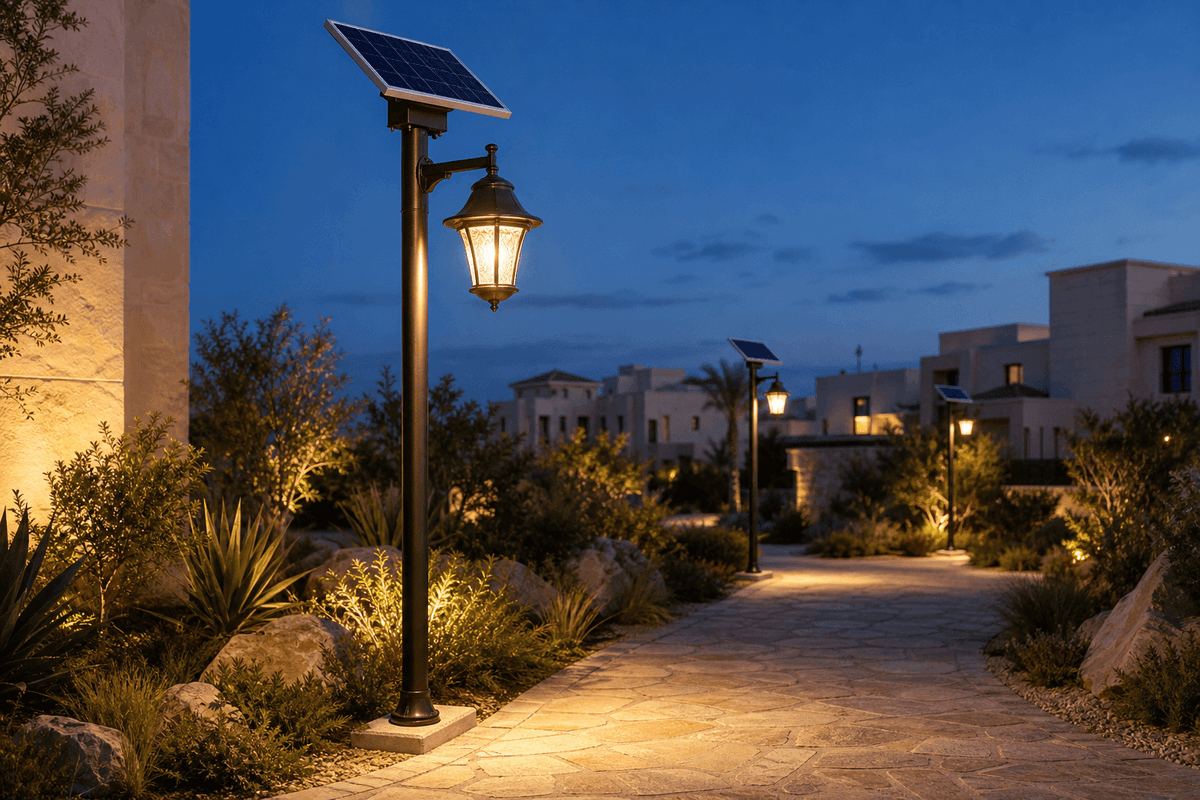
2.5m Residential Courtyard Garden Light 10W - 3-Day Solar LFP System
Key Features
- 2.5m aluminum-alloy pole optimized for residential courtyard and pathway lighting
- 10W LED module delivers approximately 1,700 lm at >170 lm/W efficacy
- 20Wp monocrystalline TOPCon solar panel with 19-23% conversion efficiency
- 60Wh LiFePO4 battery supports 3 rainy days of autonomy with smart dimming
- EPC turnkey pricing ranges from USD 80 to USD 120 per installed unit
The 2.5m Residential Courtyard Garden Light 10W is a temperate-climate solar street light configured with a 20Wp monocrystalline TOPCon panel, 60Wh LiFePO4 battery, 10W LED engine, and 3-day autonomy. Designed for villas, courtyards, pathways, and residential compounds, it delivers efficient 3000K warm-white lighting with MPPT charging, aluminum-alloy pole construction, and IEC-aligned outdoor protection.
Description
The 2.5m Residential Courtyard Garden Light 10W is a compact solar street light for residential courtyards, villa gardens, pedestrian paths, and low-height landscape lighting applications where 2.5m mounting height, 10W LED power, 20Wp solar input, and 60Wh LiFePO4 storage are the correct engineering balance. In a standard temperate design case with 12h/night operation and 3 rainy-day autonomy, this configuration prioritizes visual comfort at 3000K, low glare, and low maintenance over the 50,000+ hour service life typical of quality outdoor LED modules.
For B2B buyers, this model sits in the small-format garden-light segment of the Solar Street Light range, with an EPC turnkey price of USD 80-120 per unit, FOB supply of USD 50-82, and CIF delivered pricing of USD 56-92. The system uses a monocrystalline TOPCon module with 19-23% efficiency, an LFP battery rated for 2,000+ deep cycles, and an MPPT controller above 98% conversion efficiency, aligning with design principles referenced in IEC 62124 for stand-alone PV performance and IEC 60598 for luminaire safety and construction.
Product Positioning and Use Case
This 10W garden light is engineered for residential compounds, sidewalks, courtyards, community parks, townhouse entrances, and landscaped internal roads where the target mounting height is typically 2.5m and the required illumination zone is usually 4-8m in diameter depending on spacing, surface reflectance, and dimming profile. With an estimated LED efficacy above 170 lm/W, the fixture output is approximately 1,700 lm, which is appropriate for low-speed pedestrian areas and decorative-security hybrid lighting rather than high-speed traffic roads.
Compared with a conventional 220V AC bollard or garden pole light using trenching, conduit, and grid power, a stand-alone solar system can reduce site electrical infrastructure by 70-90% on small projects because it avoids cable runs, distribution panels, and meter coordination. According to cost patterns published across distributed lighting case studies by IRENA and market reports from BloombergNEF, low-power off-grid solar lighting often becomes more cost-efficient than wired lighting when trenching distances exceed 15-30m per pole, especially in retrofit courtyards, resorts, and gated communities where civil work can exceed the luminaire cost itself.
System Architecture
The system architecture consists of 5 primary subsystems: a 20Wp TOPCon PV panel, a 60Wh LiFePO4 battery pack, a 10W LED luminaire head, an MPPT charge controller, and a 2.5m aluminum-alloy pole with mounting hardware. During daylight hours, the panel charges the battery through the MPPT controller at conversion efficiency above 98%; at dusk, the controller switches automatically to lighting mode and can maintain 12h/day dusk-to-dawn operation under standard temperate irradiance assumptions.
The battery chemistry is LiFePO4, selected because it typically delivers 2,000-4,000 cycles at partial depth of discharge and offers superior thermal stability versus lead-acid systems. For a residential garden application, a 60Wh battery paired with smart dimming can support the specified 3-day autonomy in temperate conditions, while the integrated BMS provides protections for overcharge, over-discharge, short circuit, and low-temperature charging conditions. This architecture follows practical off-grid lighting design recommendations commonly seen in NREL field studies and IEA PVPS guidance for small autonomous PV systems.

Technical Specifications
At 10W rated LED power, the luminaire is optimized for pathway and courtyard illumination rather than roadway-class lux levels. Assuming 170 lm/W module efficacy, nominal luminous flux is approximately 1,700 lm, and the warm-white 3000K color temperature is better suited for residential visual comfort than the harsher 5700-6500K often used in municipal roads. The operating temperature range is -20°C to +45°C, which matches a temperate-climate deployment envelope for most residential projects in Europe, North America, East Asia, and similar regions.
The 20Wp solar panel uses monocrystalline TOPCon cells with 19-23% efficiency and a design life of approximately 25 years under standard module aging assumptions. The aluminum-alloy pole reduces weight by roughly 20-35% versus equivalent steel structures in this height class, simplifying installation in landscaped zones and reducing corrosion risk in irrigated gardens. For mechanical design, a practical wind resistance rating of 120 km/h is appropriate for this 2.5m courtyard pole when correctly anchored to a suitable foundation or base plate.
Lighting Performance and Energy Balance
A 10W LED operating for 12 hours per night requires 120Wh/day at full output, so this product relies on a smart dimming strategy rather than fixed 100% output all night. In a common profile, the light runs at 100% for 4 hours, then 30-50% for 8 hours, producing a daily energy demand of roughly 64-80Wh/day. That load profile is consistent with a 20Wp panel in temperate climates receiving approximately 4.0-4.5 peak sun hours, yielding around 80-90Wh/day after controller and battery losses.
This is why the controller specification matters. An MPPT controller above 98% efficiency can improve harvest by 10-20% versus basic PWM in low-power systems with variable irradiance, especially during winter mornings and partial-cloud conditions. Smart dimming, including PIR-triggered brightening or time-based reduction, can reduce net energy consumption by up to 60%, which is consistent with practical field savings reported across intelligent outdoor lighting deployments and aligned with efficiency trends discussed by IEA and NREL in distributed lighting analyses.
Materials, Durability, and Outdoor Protection
The luminaire and pole assembly is designed for long outdoor service with IP66/IP67-grade protection at critical electrical interfaces, depending on final housing configuration. The aluminum-alloy pole is particularly suitable for residential projects where appearance, low mass, and corrosion resistance are priorities; compared with hot-dip galvanized steel, aluminum often provides lower handling weight and cleaner architectural integration at heights below 4m. The pole warranty is 5 years, while the full system warranty is 3 years.
The LED engine uses chips from brands such as Bridgelux, Cree, or Lumileds, each commonly specified for 50,000+ hours L70 service life in outdoor fixtures. At 12h/day, that corresponds to more than 11 years of operation before lumen depreciation reaches common replacement thresholds. The battery, by contrast, is the principal wear component; with 2,000+ cycles, expected replacement timing is often 5-7 years depending on depth of discharge, climate, and dimming schedule.
Standards and Compliance Framework
For procurement teams, the most relevant standards are IEC 62124 for stand-alone PV system performance assessment, IEC 60598 for luminaires, and ingress protection classifications such as IP66/IP67 for outdoor reliability. The PV module technology generally references manufacturing and safety frameworks such as IEC 61215 and IEC 61730, while battery packs and electronics are commonly supplied with CE and transport-compliance documentation. These standards do not guarantee project success by themselves, but they reduce technical risk across manufacturing, testing, and field deployment.
Industry guidance from IRENA, IEA, and Wood Mackenzie consistently shows that procurement quality matters more than nominal wattage alone. In low-power solar lighting, under-sized batteries, low-grade controllers, and poor sealing can reduce useful life by 30-50% even when headline specifications look similar. For that reason, SOLARTODO recommends buyers evaluate not only the 10W LED rating but also Wh storage, controller efficiency, IP rating, and actual autonomy assumptions. For related design guidance, buyers can Learn about topic and compare sizing logic before ordering.
Smart Controls and Optional Cloud Monitoring
The standard configuration supports dusk-to-dawn automatic switching, programmable dimming, and motion-adaptive operation. In a residential compound with intermittent pedestrian traffic, PIR-based brightening can keep the lamp at 30% standby output and raise it to 100% output for 20-60 seconds when movement is detected. This approach improves battery reserve and extends autonomy from 1-2 nights to the specified 3 nights under reduced-sun conditions.
Optional remote monitoring via 4G or LoRa can be integrated for projects with 50 units or more, allowing status visibility for battery voltage, charging current, daily runtime, fault alerts, and location grouping. For developers and property managers, cloud monitoring reduces maintenance inspection time by 20-40% on distributed sites, particularly in residential communities, campuses, and resort properties. Buyers planning larger projects can Configure your system online to add dimming logic, communication modules, and alternative pole finishes.
Applications
This model is intended for 6 primary applications: villa courtyards, townhouse walkways, gated community internal paths, garden landscapes, small parking-edge lighting, and residential amenity zones. At 2.5m height, the fixture is visually proportionate for human-scale environments and helps avoid excessive glare that is common when 4-6m municipal poles are used in private gardens. The 3000K warm-white output is especially suitable for hospitality-style residential developments where visual comfort and landscape integration matter as much as security.
A practical deployment example is a 96-unit townhouse project in a temperate coastal city where the developer needed lighting for 1.2km of pedestrian paths and 38 courtyard nodes without opening newly finished paving for AC cable installation. By using 10W solar garden lights at 8-12m spacing, the project reduced civil electrical work by about 78% compared with a conventional wired scheme, while achieving nightly operation with 3-day backup and lowering annual maintenance callouts through autonomous operation and fault visibility. This type of project profile is increasingly common in distributed residential development according to BloombergNEF and IRENA market observations.

Comparison with Conventional Garden Lighting
A conventional 10-15W AC LED garden light may have a luminaire cost similar to or lower than the solar fixture itself, but total installed cost often rises sharply once trenching, conduits, cable, breakers, labor, and reinstatement are included. In many residential retrofits, wired installation can reach USD 120-250 per point before utility coordination, whereas this solar model is available at USD 80-120 EPC turnkey with no dependence on grid extension. That difference can produce installed-cost savings of 20-50% in dispersed courtyard layouts.
Operating expenditure is also lower because the solar light consumes 0 kWh from the grid. If a wired 10W light runs 12h/day, annual electricity use is about 43.8 kWh per unit; at USD 0.15/kWh, that equals USD 6.57/year in electricity alone, excluding maintenance. For a 100-unit residential project, that is 4,380 kWh/year and USD 657/year in avoided electricity purchases, while also reducing emissions depending on local grid carbon intensity. IEA and NREL both note that distributed solar lighting is particularly attractive where power tariffs, outage risk, or trenching costs are elevated.
EPC Investment Analysis and Pricing Structure
For project buyers, EPC means Engineering, Procurement, Construction, Commissioning, and Warranty delivered as one package. Engineering includes site layout, foundation recommendations, autonomy verification, and dimming logic selection; procurement covers panel, battery, luminaire, pole, controller, and hardware; construction includes installation and anchoring; commissioning includes runtime testing and parameter setup; and warranty includes 1 year EPC workmanship coverage, 3 years system warranty, and 5 years pole warranty. For quotations, contact [email protected] or Request a custom quotation.
| Pricing Tier | Scope | Price Range (USD/unit) |
|---|---|---|
| FOB Supply | Equipment only, ex-works China | 50-82 |
| CIF Delivered | Equipment + ocean freight + insurance | 56-92 |
| EPC Turnkey | Installed + commissioned + 1yr warranty | 80-120 |
For larger procurement volumes, standard discount guidance is structured around 3 thresholds. The table below applies to equipment or EPC package pricing depending on project scope, final specification, and destination-country installation conditions.
| Volume | Discount | Example on USD 100/unit |
|---|---|---|
| 50+ units | 5% | 95 |
| 100+ units | 10% | 90 |
| 250+ units | 15% | 85 |
From an ROI perspective, the economics depend on the alternative being replaced. Versus a new wired courtyard light with trenching at USD 140/unit installed and annual electricity plus maintenance at USD 10-15/unit, this solar system at USD 100/unit EPC midpoint can save approximately USD 40 upfront and USD 10/year operating cost, implying an immediate capex benefit and an effective payback of less than 1 year relative to the wired option. Versus replacing existing grid-connected lights where trenching is already sunk, annual savings are typically USD 7-12/unit, producing a simple payback of roughly 8-12 years, which remains acceptable in sites with outage risk or sustainability targets.
Standard payment terms are 30% T/T deposit + 70% against B/L, or 100% L/C at sight for qualified transactions. For projects above USD 1,000K, structured financing support can be discussed subject to jurisdiction, project profile, and credit review. Buyers comparing variants can View all Solar Street Light products or Learn about topic before finalizing BoQ and deployment strategy.
Procurement Notes for Engineers and Buyers
Engineers should verify 4 project variables before purchase: average daily irradiance, required nightly runtime, target lux level, and spacing. A 20Wp / 60Wh / 10W configuration is balanced for temperate residential use with dimming, but if the site has heavy tree shading, winter snow cover, or a strict requirement for 100% output for 12 hours, the battery should typically be increased to 80-120Wh and the panel to 30-40Wp. That is why layout-specific sizing is preferable to generic wattage selection.
Procurement managers should also assess packaging, spare ratio, and maintenance planning. For projects above 100 units, a spare-parts reserve of 2-3% for controllers, LED heads, and battery packs is common practice. Installation productivity for this 2.5m model is generally higher than for municipal poles: a trained crew can often complete 8-15 units/day depending on foundation method, site access, and whether anchor bases are pre-cast or cast in place. These factors materially influence the final EPC rate within the USD 80-120 range.
Conclusion
The 2.5m Residential Courtyard Garden Light 10W is a technically balanced solution for low-height residential lighting where 1,700 lm output, 20Wp solar charging, 60Wh LFP storage, 3000K warm-white light, and 3-day autonomy meet the real needs of courtyards and pedestrian spaces. It is not a high-power roadway luminaire; instead, it is a purpose-built garden and pathway product that minimizes trenching, eliminates grid electricity consumption, and supports long service life through TOPCon PV, MPPT charging, LiFePO4 storage, and IP66/IP67-grade protection.
For developers, EPC contractors, and property managers seeking a cost-controlled lighting point in the USD 80-120 turnkey range, this model offers a practical specification for villas, communities, and landscape projects. To move forward, buyers can Configure your system online, Request a custom quotation, or review the broader Solar Street Light portfolio for alternate heights, wattages, and smart-control options.
Technical Specifications
| Pole Height | 2.5m |
| LED Power | 10W |
| Luminous Flux | 1700lm |
| Solar Panel | 20Wp |
| Battery Capacity | 60Wh (LFP) |
| Autonomy | 3rainy days |
| Pole Material | aluminum_alloy |
| Wind Resistance | 120km/h |
| Operating Temperature | -20 to +45°C |
| Lighting Hours | 12h/day |
| Color Temperature | 3000K |
| Style | modern_minimalist |
| Type | garden |
| Warranty | 3 years system, 5 years pole |
Price Breakdown
| Item | Quantity | Unit Price | Subtotal |
|---|---|---|---|
| Monocrystalline TOPCon solar panel 20Wp (installed) | 1 pcs | $2 | $2 |
| LiFePO4 battery pack 60Wh with BMS (installed) | 1 pcs | $6 | $6 |
| 10W LED garden luminaire head with optics (installed) | 1 pcs | $5 | $5 |
| MPPT solar charge controller for 20Wp system (installed) | 1 pcs | $6 | $6 |
| 2.5m aluminum-alloy pole (installed) | 1 pcs | $55 | $55 |
| Foundation, anchor hardware, cable, assembly labor (installed) | 1 pcs | $18 | $18 |
| Total Price Range | $80 - $120 | ||
Frequently Asked Questions
Is a 10W solar garden light sufficient for residential courtyard lighting?
How does the 3-day autonomy work with only a 60Wh battery?
What is included in the EPC turnkey price of USD 80-120?
Can this model be connected to remote monitoring platforms?
What maintenance should buyers expect over the product life?
Certifications & Standards



Data Sources & References
- •NREL PVWatts 2025
- •IEA PVPS technical guidance
- •IRENA off-grid solar market analysis
- •BloombergNEF distributed solar lighting market references
- •Wood Mackenzie solar and storage supply chain outlook
- •IEC 62124 standalone PV system performance standard
- •IEC 60598 luminaire safety standard
Interested in this solution?
Contact us for a customized quote based on your specific requirements.
Contact Us