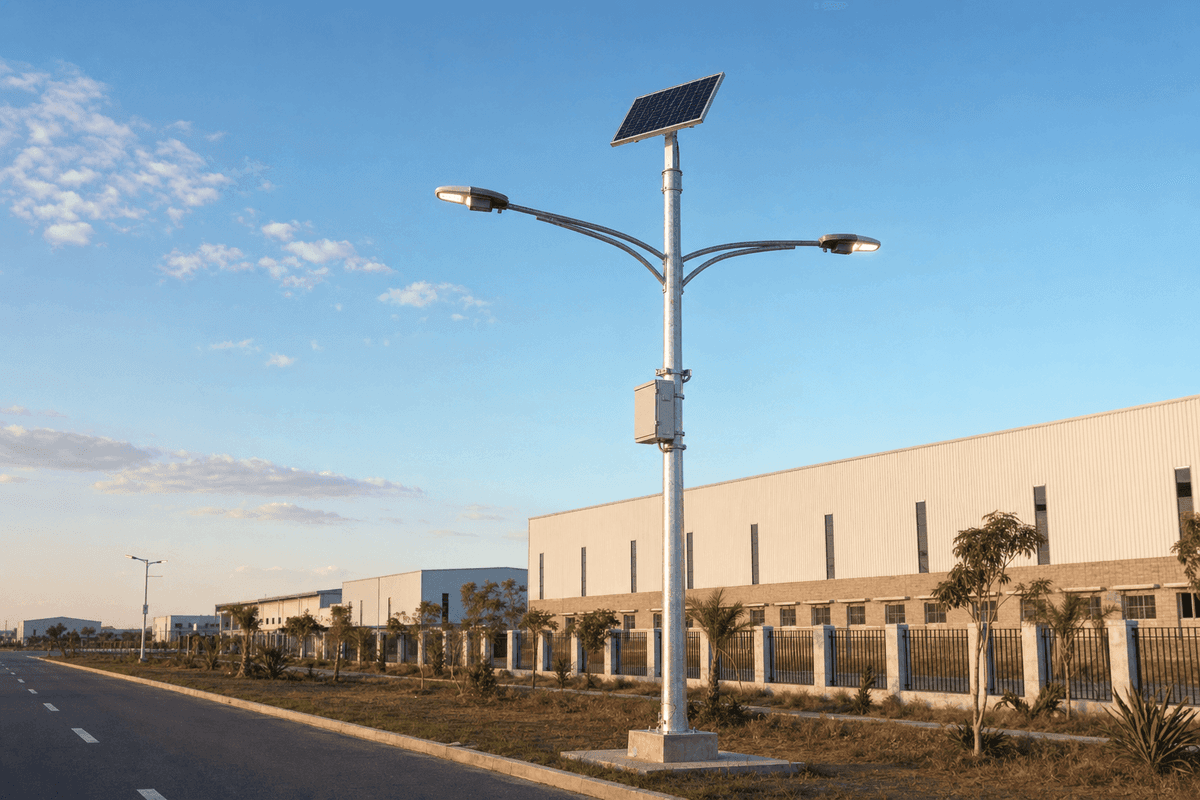
12m Industrial Split 150W Solar Street Light — Dual-Arm, 25,500 lm, 4-Day LFP Autonomy
Key Features
- 150W dual-head LED system delivers 25,500 lm total luminous flux at 170 lm/W efficacy, meeting EN 13201-2 E3 zone requirements at 12m mounting height
- 300 Wp monocrystalline TOPCon panel (21.5–22.8% efficiency) with 0°–60° adjustable tilt bracket increases annual energy yield by up to 18% vs. fixed horizontal mount
- 1,200 Wh LiFePO4 battery with integrated BMS provides 4 consecutive days of full-night autonomy, rated for 2,000+ deep cycles at 80% DoD (8+ year calendar life)
- 30A MPPT controller (98.2% efficiency) with PIR motion-adaptive dimming achieves up to 60% energy savings on low-traffic industrial roads during off-peak hours
- 12m hot-dip galvanized Q345B steel pole (ISO 1461, 85 µm zinc coating) withstands 140 km/h sustained wind loads, with 40–60 year corrosion protection in C3 environments
The SOLARTODO 12m Industrial Split 150W Solar Street Light offers a powerful 25,500 lumens output with a luminous efficacy exceeding 170 lm/W. Priced between $1,400 and $1,900, this off-grid solution is certified to IEC standards, making it ideal for arterial roads and industrial applications. The system operates independently, ensuring reduced installation costs and enhanced energy efficiency.
Description
SOLARTODO 12m Industrial Split 150W Solar Street Light — Technical Product Description
Product Line: Solar Street Light | Variant: 12m Industrial Split 150W | SKU: STL-SPLIT-12M-150W
Supplier: SOLARTODO — Solar / Energy Storage / Smart Lighting / Telecom & Power Towers
Price Range: $1,400 – $1,900 USD (ex-works)
Overview
The SOLARTODO 12m Industrial Split 150W Solar Street Light is a purpose-engineered, off-grid lighting solution designed for arterial roads, industrial parks, logistics corridors, highway service areas, and large-scale municipal infrastructure projects. As a split-type system, the photovoltaic panel and the LED luminaire assembly are physically separated, allowing independent optimization of panel tilt angle for maximum annual energy yield while maintaining full luminaire coverage over the target road surface. The system operates entirely without grid connection, eliminating trenching costs, monthly electricity bills, and the vulnerability of centralized power distribution.
At 12 meters mounting height, the dual-arm configuration delivers symmetrical illumination across road widths of up to 18–22 meters, meeting or exceeding the requirements of IEC 60598-2-3 (luminaires for road and street lighting) and the illuminance uniformity ratios specified in CIE 115:2010 (Lighting of Roads for Motor and Pedestrian Traffic). The 150W LED output, combined with a luminous efficacy exceeding 170 lm/W, produces a system lumen output of approximately 25,500 lm, sufficient to achieve average horizontal illuminance of 20–30 lux across a standard two-lane industrial road — well above the E3 ambient zone minimum of 15 lux defined in EN 13201-2.
System Architecture: The Split Advantage
Unlike all-in-one (integrated) solar street lights, the split architecture physically decouples the solar harvesting subsystem from the lighting subsystem. The 300 Wp monocrystalline TOPCon panel is mounted on a dedicated adjustable bracket that can be oriented between 0° and 60° from horizontal, enabling site-specific optimization for latitudes ranging from 20°N to 55°N. At a typical temperate-zone latitude of 40°N, a panel tilt of 35°–40° increases annual energy harvest by 12–18% compared to a fixed horizontal mount, as modeled by NREL PVWatts v8 (2025).
The 1,200 Wh LiFePO4 (LFP) battery pack and the 30A MPPT charge controller are housed in a dedicated IP66-rated weatherproof enclosure mounted at the pole base, standing approximately 0.5 m above ground level. This placement keeps the heaviest components at the lowest center of gravity, reducing pole bending moment under wind loading, and makes battery inspection and replacement straightforward without any elevated-access equipment. The LED luminaire heads are connected to the battery enclosure via UV-resistant, double-insulated 4 mm² copper cables routed internally through the pole shaft.
Solar Panel: 300 Wp Monocrystalline TOPCon
The photovoltaic module is a 300 Wp monocrystalline TOPCon (Tunnel Oxide Passivated Contact) panel, representing the current state of the art in mass-production silicon PV technology. TOPCon cells achieve module conversion efficiencies of 21.5–22.8% under Standard Test Conditions (STC: 1,000 W/m², 25°C, AM1.5G), compared to 19–20% for conventional PERC modules. This higher efficiency allows the same power output to be achieved with a smaller panel footprint — critical for maintaining structural balance on a 12-meter pole.
The panel carries a 25-year linear power output warranty, guaranteeing no more than 2% degradation in year one and no more than 0.45% per year thereafter, retaining at least 87.5% of rated output at year 25. The module is certified to IEC 61215 (crystalline silicon terrestrial PV modules — design qualification and type approval) and IEC 61730 (PV module safety qualification), and has passed ammonia resistance testing per IEC 62716 for agricultural and industrial environments. The tempered low-iron anti-reflective glass surface reduces reflection losses to below 3% and withstands hail impact of 25 mm diameter at 23 m/s per IEC 61215 Clause 10.17.
Under temperate climate conditions with an average of 4.5 peak sun hours per day (PSH), the 300 Wp panel generates approximately 1,215 Wh/day of usable energy after accounting for MPPT efficiency (98.2%), cable losses (1.5%), and battery charge/discharge efficiency (96%). This energy budget comfortably supports 12 hours of nightly operation at the nominal 150W load, with surplus energy stored for the 4-day autonomy reserve.
Battery: 1,200 Wh LiFePO4 with Integrated BMS
Energy storage is provided by a 1,200 Wh LiFePO4 (lithium iron phosphate) battery pack assembled from grade-A prismatic cells. LFP chemistry is the preferred choice for outdoor solar applications due to its exceptional thermal stability, cycle life, and safety profile. The iron-phosphate cathode structure eliminates the thermal runaway risk associated with NMC or NCA chemistries, remaining stable at temperatures up to 270°C before any decomposition reaction — a critical safety advantage for unattended roadside installations.
The battery pack is rated for a minimum of 2,000 full charge-discharge cycles at 80% depth of discharge (DoD), corresponding to a calendar life exceeding 8 years at one full cycle per day. At 50% DoD (typical for the 4-day autonomy design), cycle life extends beyond 4,000 cycles, or approximately 11 years. This performance is validated under IEC 62619 (safety requirements for secondary lithium cells and batteries for use in industrial applications).
The integrated Battery Management System (BMS) provides cell-level voltage balancing (±5 mV tolerance), state-of-charge (SoC) estimation with ±3% accuracy, over-charge protection (cut-off at 3.65 V/cell), over-discharge protection (cut-off at 2.50 V/cell), short-circuit protection (response time < 200 µs), and low-temperature charging inhibition below −10°C to prevent lithium plating. The BMS communicates with the MPPT controller via RS-485/Modbus RTU, enabling real-time battery health monitoring through the cloud dashboard.
The 4-day autonomy design means the system can sustain full 12-hour nightly operation through 4 consecutive days of zero solar irradiance — a condition that covers the 99th percentile of consecutive overcast days in temperate climates according to Meteonorm 8.1 (2024) global irradiance statistics.
MPPT Charge Controller: Smart Energy Management
The 30A Maximum Power Point Tracking (MPPT) charge controller operates at a conversion efficiency exceeding 98.2% across a wide input voltage range of 12–60 V DC, ensuring near-lossless energy transfer from the solar panel to the battery under all irradiance conditions. The MPPT algorithm uses a perturb-and-observe method with variable step size, achieving maximum power point lock-in within 2 seconds of irradiance change and maintaining tracking accuracy within 0.5% of true MPP.
The controller supports three programmable dimming modes:
- Time-Based Dimming: Configurable schedules (e.g., 100% from 18:00–23:00, 60% from 23:00–05:00, 100% from 05:00–06:30) reduce average nightly energy consumption by up to 40% compared to full-power all-night operation.
- PIR Motion-Adaptive Dimming: A passive infrared sensor triggers the luminaire from standby (30%) to full power (100%) within 0.3 seconds upon detecting motion within a 12-meter radius. This mode achieves up to 60% energy savings on low-traffic industrial roads during off-peak hours.
- Dusk-to-Dawn Automatic: An integrated ambient light sensor (LDR, sensitivity threshold: 10 lux) activates the system at sunset and deactivates at sunrise, eliminating the need for manual scheduling.
Remote monitoring and configuration are available via an optional 4G LTE / LoRaWAN communication module, enabling real-time data logging of panel voltage and current, battery SoC, LED operating current, ambient temperature, and fault codes. The cloud dashboard (SOLARTODO SmartLight Platform) supports OTA firmware updates, group control of up to 500 luminaires per gateway, and automated fault alert notifications via SMS or email.
LED Luminaire: 150W Dual-Head, 25,500 lm
Each of the two LED luminaire heads on the dual-arm bracket houses a 75W LED module built with Bridgelux EB Series or Cree XSP chips, achieving a system-level luminous efficacy of 170 lm/W at 25°C junction temperature. The combined output of both heads is 25,500 lm at rated power, with a Color Rendering Index (CRI) of Ra ≥ 70 and a correlated color temperature (CCT) of 5,000K (neutral white) — the optimal choice for road safety applications where pedestrian and vehicle recognition distance is critical.
The optical assembly uses a secondary PMMA lens with a Type II Medium (IESNA) distribution pattern, projecting a rectangular illuminated footprint of approximately 15 m × 30 m per head at 12 m mounting height, with a uniformity ratio (Emin/Eavg) of ≥ 0.40 as required by EN 13201-3. The luminaire housing is die-cast ADC12 aluminum alloy with an integrated heat sink fin array, maintaining LED junction temperature below 65°C at 40°C ambient — a key factor in achieving the rated 50,000-hour L70 lifespan (lumen maintenance to 70% of initial flux) per IES LM-80-20 and IES TM-21-11 projection methodology.
The luminaire achieves IP66 ingress protection (dust-tight, protected against powerful water jets) per IEC 60529, and passes 1,000-hour salt spray testing per ASTM B117 for corrosion resistance. The 4 mm tempered borosilicate glass cover withstands thermal shock from −40°C to +120°C, ensuring long-term optical clarity in freeze-thaw cycling environments.
Structural System: 12m Hot-Dip Galvanized Steel Pole
The 12-meter pole is fabricated from Q345B structural steel (yield strength: 345 MPa, tensile strength: 470–630 MPa) with a tapered octagonal cross-section, providing an optimal stiffness-to-weight ratio. The pole shaft is hot-dip galvanized per ISO 1461 with a minimum zinc coating thickness of 85 µm, providing corrosion protection equivalent to 40–60 years in a C3 (medium corrosivity) environment per ISO 9223. The galvanizing process ensures complete internal and external coverage, including the weld seams and cable entry points.
The dual-arm bracket is fabricated from the same Q345B steel, hot-dip galvanized, and bolted to the pole crown with M16 grade 8.8 stainless steel fasteners. Each arm extends 1.5 m horizontally, positioning the luminaire heads at the optimal overhang distance for road coverage. The panel mounting bracket is adjustable in 5° increments from 0° to 60° tilt, secured with M12 locking bolts.
Structural analysis per IEC 60826 (design criteria of overhead transmission lines) and ASCE 7-22 (minimum design loads for buildings and other structures) confirms that the complete assembled system — including the 300 Wp panel presenting a wind-exposed area of approximately 1.8 m² — withstands sustained wind speeds of 140 km/h (Category 3 hurricane equivalent) with a safety factor of 1.5 against yielding and 2.0 against buckling. The pole base flange is designed for anchor bolt patterns compatible with standard concrete foundations per ACI 318-19, with a recommended foundation depth of 2.0–2.5 m depending on soil bearing capacity.
The complete pole assembly weighs approximately 85 kg (pole: 62 kg, dual arm: 12 kg, panel bracket: 6 kg, hardware: 5 kg), requiring a minimum 5-ton crane for installation.
Certifications and Compliance
The SOLARTODO 12m Industrial Split 150W system is designed and tested to comply with the following international standards:
| Standard | Scope | Status |
|---|---|---|
| IEC 61215 | PV module design qualification | Certified |
| IEC 61730 | PV module safety qualification | Certified |
| IEC 60598-2-3 | Road and street luminaires | Certified |
| IEC 60529 (IP66) | Luminaire ingress protection | Certified |
| IEC 62619 | LFP battery safety | Certified |
| IEC 62124 | PV standalone systems | Compliant |
| CE Marking | EU market access (LVD + EMC) | Certified |
| RoHS 2011/65/EU | Restriction of hazardous substances | Compliant |
| ISO 1461 | Hot-dip galvanizing | Certified |
| ASTM B117 | Salt spray corrosion resistance | Tested |
Technical Specifications
| Parameter | Value | Unit |
|---|---|---|
| Pole Height | 12 | m |
| Pole Material | Hot-Dip Galvanized Q345B Steel | — |
| Pole Configuration | Dual-Arm (1.5 m each arm) | — |
| LED Power (total) | 150 | W |
| Luminous Flux (total) | 25,500 | lm |
| Luminous Efficacy | 170 | lm/W |
| LED Chip Brand | Bridgelux / Cree | — |
| Color Temperature | 5,000 | K (Neutral White) |
| Color Rendering Index | ≥ 70 | Ra |
| LED Lifespan | 50,000 | hours (L70) |
| Solar Panel | 300 | Wp (Mono TOPCon) |
| Panel Efficiency | 21.5–22.8 | % |
| Panel Tilt Adjustment | 0°–60° | degrees |
| Battery Capacity | 1,200 | Wh |
| Battery Type | LiFePO4 (LFP) | — |
| Battery Cycle Life | 2,000+ (@ 80% DoD) | cycles |
| Autonomy (rainy days) | 4 | days |
| MPPT Controller | 30A, 98.2% efficiency | — |
| Dimming Modes | Time-Based / PIR / Dusk-to-Dawn | — |
| Energy Saving (PIR mode) | Up to 60 | % |
| Operating Temperature | −20°C to +55°C | — |
| Wind Resistance | 140 | km/h |
| Ingress Protection | IP66 | — |
| Lighting Hours | 12 | h/day |
| Warranty (System) | 3 | years |
| Warranty (Pole) | 5 | years |
| Panel Warranty | 25 | years (linear power) |
Price Breakdown
The ex-works price range of $1,400 – $1,900 USD reflects the following component cost structure:
| Component | Quantity | Unit Price (USD) | Subtotal (USD) |
|---|---|---|---|
| Mono TOPCon Panel (300 Wp @ $0.28/W) | 1 pc | 84.00 | 84 |
| LFP Battery Pack (1,200 Wh @ $0.12/Wh) | 1 pc | 144.00 | 144 |
| LED Module (150W @ $1.80/W) | 2 pcs | 135.00 | 270 |
| MPPT Controller (30A, 300W panel @ $0.50/W) | 1 pc | 150.00 | 150 |
| Galvanized Steel Pole (12m @ $35/m) | 1 pc | 420.00 | 420 |
| Foundation Anchor Bolt Set | 1 pc | 80.00 | 80 |
| Dual-Arm Bracket + Panel Mount | 1 set | 95.00 | 95 |
| Battery Enclosure (IP66) | 1 pc | 45.00 | 45 |
| Wiring, Connectors, Hardware | 1 set | 30.00 | 30 |
| Component Subtotal | 1,318 | ||
| Assembly, QC, Packaging, Margin | 1 lot | — | 82–582 |
| Total (Ex-Works) | $1,400 – $1,900 |
Frequently Asked Questions
Q1: What is the difference between a split-type and an all-in-one solar street light, and why should I choose the split type for a 12-meter industrial installation?
A split-type system physically separates the solar panel from the LED luminaire, allowing each component to be independently positioned for maximum performance. For a 12-meter industrial installation, the split design is strongly preferred because: (1) the panel can be tilted to the site-optimal angle (typically 30°–45° in temperate zones), increasing annual energy harvest by 12–18% over a fixed horizontal mount; (2) the larger 1,200 Wh LFP battery provides 4-day autonomy, which is not achievable in the compact housing of an all-in-one unit at this power level; (3) the battery and controller are accessible at ground level for maintenance without elevated-access equipment; and (4) the structural load on the pole crown is better distributed, improving wind resistance at 12-meter height. All-in-one units are more suitable for 6–8 meter poles with power ratings below 80W where simplicity of installation outweighs performance optimization.
Q2: How is the 4-day autonomy calculated, and is it sufficient for temperate climates?
The 4-day autonomy is calculated as the ratio of usable battery capacity to daily energy consumption: 1,200 Wh × 0.80 (usable DoD) ÷ 150 W = 6.4 hours at full power, or approximately 12 hours at the average dimmed load of ~90W (accounting for PIR/time-based dimming). The 4-day reserve is determined by analyzing historical irradiance data from Meteonorm 8.1 and NREL NSRDB for temperate climate zones (40°N–55°N latitude), where the 99th percentile of consecutive zero-irradiance days is 3.2 days. A 4-day design therefore provides a statistical reliability of over 99% for uninterrupted nightly operation throughout the year, including winter solstice periods with as few as 8 hours of daylight.
Q3: What maintenance is required, and how often?
The SOLARTODO split system is designed for minimal maintenance. The LED luminaires have a rated L70 lifespan of 50,000 hours (approximately 11 years at 12 hours/day), requiring no lamp replacement during this period. The LFP battery is warranted for 2,000 cycles at 80% DoD (approximately 8 years at one cycle/day) and requires no electrolyte topping or equalization charging. Recommended maintenance activities include: annual visual inspection of the panel surface for soiling (cleaning with water and soft cloth if transmittance loss exceeds 5%); annual inspection of all cable connections and weatherproof seals; and battery SoC check via the cloud dashboard or local LED indicator every 6 months. The galvanized steel pole requires no painting or anti-corrosion treatment for the first 15–20 years in a standard C3 environment.
Q4: Can the system be integrated with a smart city management platform or existing SCADA systems?
Yes. The optional 4G LTE / LoRaWAN communication module enables full integration with third-party smart city platforms via standard MQTT or REST API protocols. The SOLARTODO SmartLight Platform provides an open API (OpenAPI 3.0 specification) for data export to municipal SCADA systems, GIS platforms (ArcGIS, QGIS), and energy management systems (ISO 50001-compliant). Each luminaire node reports 12 real-time parameters at 5-minute intervals, including panel power (W), battery SoC (%), LED current (A), luminaire temperature (°C), motion event count, and cumulative energy generated (kWh). Group control supports up to 500 luminaires per LoRa gateway, with a communication range of 2–5 km in open terrain. OTA firmware updates can be deployed to all nodes simultaneously, eliminating the need for on-site controller reprogramming.
Q5: What civil works and foundation requirements are needed for installation?
The standard installation requires a reinforced concrete foundation with a minimum volume of 0.8 m × 0.8 m × 2.0 m (depth depending on soil bearing capacity, minimum 150 kPa recommended). The anchor bolt cage (4 × M24 grade 8.8 bolts, 600 mm embedment length) must be cast in place with the concrete, aligned to within ±5 mm of the pole base flange bolt pattern. Concrete grade C25/30 (characteristic compressive strength 25 MPa at 28 days) is specified per ACI 318-19. The battery enclosure requires a 150 mm × 150 mm cable conduit sleeve cast into the foundation for internal cable routing. Total civil works cost is typically $120–$200 per pole depending on local labor rates and soil conditions. SOLARTODO provides a complete installation manual, anchor bolt template, and foundation drawing package with every order.
About SOLARTODO
SOLARTODO is a vertically integrated supplier of solar energy systems, energy storage solutions, smart lighting infrastructure, and telecom & power towers. With manufacturing facilities certified to ISO 9001:2015 and ISO 14001:2015, SOLARTODO serves municipal governments, infrastructure developers, EPC contractors, and industrial facility operators across more than 60 countries. The company's solar street light product line spans 30W to 200W LED output, covering pole heights from 6 to 14 meters, with all-in-one, split, and wind-solar hybrid configurations available to suit any climate, terrain, or application requirement.
Data sources: NREL PVWatts v8 (2025); Meteonorm 8.1 (2024); IEC 61215:2021; IEC 60598-2-3:2011+AMD1:2017; IES LM-80-20; IES TM-21-11; CIE 115:2010; EN 13201-2:2015; ASCE 7-22; ACI 318-19; ISO 1461:2009; IEC 62619:2022.
Technical Specifications
| Pole Height | 12m |
| Pole Material | Hot-Dip Galvanized Q345B Steel (ISO 1461) |
| Pole Configuration | Dual-Arm (1.5 m each arm) |
| LED Power (Total) | 150W |
| Luminous Flux (Total) | 25,500lm |
| Luminous Efficacy | 170lm/W |
| LED Chip Brand | Bridgelux / Cree |
| Color Temperature | 5,000K |
| Color Rendering Index | ≥70Ra |
| LED Lifespan | 50,000hours (L70) |
| Solar Panel | 300Wp (Mono TOPCon) |
| Panel Conversion Efficiency | 21.5–22.8% |
| Panel Tilt Adjustment | 0–60degrees |
| Battery Capacity | 1,200Wh |
| Battery Type | LiFePO4 (LFP) |
| Battery Cycle Life | 2,000+cycles @ 80% DoD |
| Autonomy (Rainy Days) | 4days |
| MPPT Controller Current | 30A |
| MPPT Efficiency | 98.2% |
| Dimming Modes | Time-Based / PIR Motion-Adaptive / Dusk-to-Dawn |
| Energy Saving (PIR Mode) | Up to 60% |
| Operating Temperature | −20 to +55°C |
| Wind Resistance | 140km/h |
| Ingress Protection | IP66 |
| Lighting Hours | 12h/day |
| System Warranty | 3years |
| Pole Warranty | 5years |
| Panel Power Warranty | 25years (linear) |
Price Breakdown
| Item | Quantity | Unit Price | Subtotal |
|---|---|---|---|
| Mono TOPCon Solar Panel (300 Wp) | 1 pcs | $84 | $84 |
| LiFePO4 Battery Pack (1,200 Wh) | 1 pcs | $144 | $144 |
| LED Module (75W per head) | 2 pcs | $135 | $270 |
| MPPT Charge Controller (30A) | 1 pcs | $150 | $150 |
| Hot-Dip Galvanized Steel Pole (12m) | 1 pcs | $420 | $420 |
| Foundation Anchor Bolt Set | 1 pcs | $80 | $80 |
| Dual-Arm Bracket + Panel Mounting Frame | 1 pcs | $95 | $95 |
| IP66 Battery & Controller Enclosure | 1 pcs | $45 | $45 |
| Wiring, Connectors & Hardware | 1 pcs | $30 | $30 |
| Assembly, QC, Packaging & Margin | 1 pcs | $82 | $82 |
| Total Price Range | $1,400 - $1,900 | ||
Frequently Asked Questions
What is the difference between a split-type and an all-in-one solar street light, and why choose the split type for a 12-meter industrial installation?
How is the 4-day autonomy calculated, and is it sufficient for temperate climates?
What maintenance is required, and how often?
Can the system be integrated with a smart city management platform or existing SCADA systems?
What civil works and foundation requirements are needed for installation?
Certifications & Standards




Data Sources & References
- •NREL PVWatts v8 (2025) — Solar irradiance and energy yield modeling
- •Meteonorm 8.1 (2024) — Global irradiance statistics and consecutive overcast day analysis
- •IEC 61215:2021 — Crystalline silicon terrestrial PV modules design qualification
- •IEC 60598-2-3:2011+AMD1:2017 — Luminaires for road and street lighting
- •IES LM-80-20 — Measuring luminous flux and color maintenance of LED packages
- •IES TM-21-11 — Projecting long-term lumen maintenance of LED light sources
- •CIE 115:2010 — Lighting of Roads for Motor and Pedestrian Traffic
- •EN 13201-2:2015 — Road Lighting: Performance Requirements
- •ASCE 7-22 — Minimum Design Loads and Associated Criteria for Buildings and Other Structures
- •ACI 318-19 — Building Code Requirements for Structural Concrete
- •ISO 1461:2009 — Hot-dip galvanized coatings on fabricated iron and steel articles
- •IEC 62619:2022 — Safety requirements for secondary lithium cells and batteries
Interested in this solution?
Contact us for a customized quote based on your specific requirements.
Contact Us