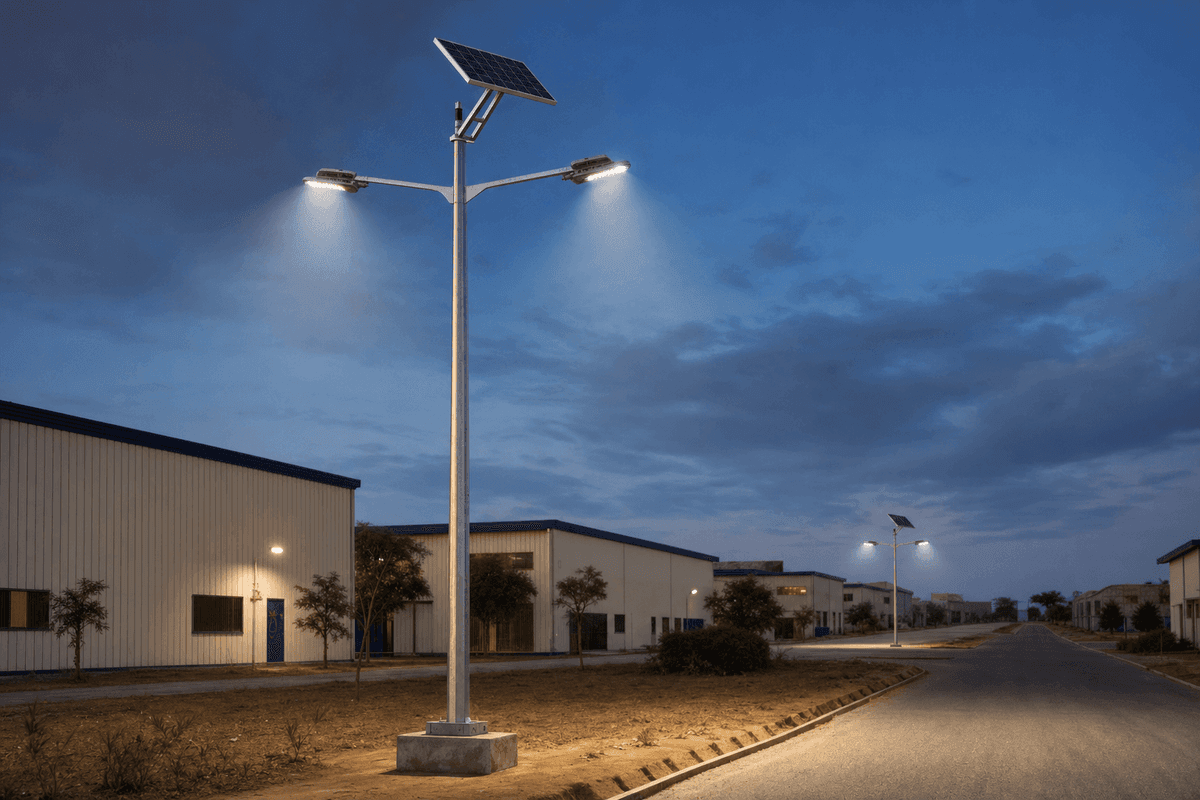
120W Industrial Dual-Arm Split Solar Street Light - 10m Pole
Key Features
- 120W dual-arm LED system delivers approximately 20,400 lm at >170 lm/W efficacy
- 240Wp monocrystalline TOPCon solar panel with 19-23% cell efficiency and 25-year design life
- 960Wh LiFePO4 battery provides 8 rainy days of autonomy in temperate climate operation
- 10m hot-dip galvanized steel pole supports industrial roadway coverage with wind resistance around 140 km/h
- MPPT controller with >98% efficiency and smart dimming can reduce energy consumption by up to 60%
The 120W Industrial Dual-Arm Split Solar Street Light combines a 240Wp monocrystalline TOPCon panel, 960Wh LiFePO4 battery, dual-arm 120W LED lighting, and a 10m hot-dip galvanized steel pole for 12-hour nightly operation with 8-day autonomy in temperate climates. Designed for industrial roads, logistics parks, and municipal corridors, it uses MPPT control, IP66/IP67 protection, and IEC-aligned architecture for reliable off-grid lighting.
Description
The 120W Industrial Dual-Arm Split Solar Street Light is a high-capacity off-grid lighting system built around a 120W LED luminaire set, 240Wp TOPCon solar module, 960Wh LiFePO4 battery, and 10m galvanized steel pole with a dual-arm configuration for wider roadway coverage. This split-type architecture separates the panel, battery, controller, and lamp heads, improving thermal management, serviceability, and angle optimization by 15-25% compared with compact integrated designs in many field installations. For B2B buyers evaluating industrial lighting CAPEX and lifecycle cost, this model is positioned for 12 hours per night operation, 8 rainy days of autonomy, and a turnkey EPC range of USD 1,200-1,650.
For procurement teams, EPC contractors, and project developers, this product fits roads, plant perimeters, mining camps, logistics yards, ports, and municipal streets requiring 6-14m pole-class solar lighting. The system uses LiFePO4 chemistry with 2,000+ deep cycles, an MPPT controller above 98% efficiency, and LED chips rated above 170 lm/W, which aligns with current market benchmarks cited by NREL, IEA, and IRENA for efficient distributed solar and lighting assets. Buyers can also View all Solar Street Light products or Configure your system online for pole height, battery reserve, and smart control options.
Product Positioning and Performance Overview
This 120W dual-arm split solar street light is engineered for installations where a single luminaire is insufficient for a 10m mounting height or where cross-road illumination is needed across 2 traffic directions. With a system luminous efficacy above 170 lm/W, the theoretical initial luminous flux is approximately 20,400 lm, subject to optics and drive current configuration. In practical roadway design, that output can support industrial access roads, parking aisles, and secondary municipal corridors where designers target balanced illuminance, low glare, and reduced trenching cost over 50-250 units.
Compared with a conventional 120W AC LED street light tied to the grid, this solar split system can reduce trenching and cabling by 70-100%, depending on site topology, while eliminating recurring utility consumption for around 4,380 lighting hours per year at 12 hours/day. Assuming a conventional load of 120W plus approximately 10% driver loss, annual grid electricity demand would be about 578 kWh/year. At electricity prices of USD 0.10-0.18/kWh, annual energy savings typically fall in the USD 58-104 range per pole before accounting for avoided civil works, meter fees, and outage reduction; this is consistent with distributed lighting economics discussed across IEA and BloombergNEF market analyses.
System Architecture
The split structure places the 240Wp solar panel at an optimized tilt on the top bracket or arm, while the 960Wh LFP battery is installed in the pole base or a secure battery box for easier maintenance and lower center of gravity. This architecture is preferred in industrial projects above 80W because it supports larger battery banks, better heat dissipation, and easier replacement over a 5-10 year service interval. In temperate climates with average solar resource suitable for stand-alone lighting, the panel-battery ratio is sized for 8 days of autonomy and stable dusk-to-dawn operation.
The controller uses MPPT tracking with >98% conversion efficiency, improving harvest by roughly 10-20% versus PWM in variable irradiance conditions. Smart dimming can be programmed in 2-5 time segments or linked to PIR occupancy sensing, and motion-adaptive control can reduce energy use by up to 60% in low-traffic windows. The electrical architecture follows core principles from IEC 62124 for stand-alone PV system performance evaluation and IEC 60598 luminaire safety frameworks, while enclosure targets are IP66 for luminaires and IP67 for battery/control compartments where specified.

Technical Specifications
The standard configuration uses a 10m hot-dip galvanized steel pole, selected because galvanized steel offers a strong cost-to-strength ratio at approximately USD 16/m installed in current EPC benchmarking. The dual-arm arrangement improves lateral distribution and can illuminate 2 carriageway edges or a road plus pedestrian shoulder with better uniformity than a single-head fixture. Wind resistance for a 10m galvanized structure in standard industrial design can be specified to around 140 km/h, subject to local geotechnical data, arm length, luminaire area, and foundation engineering.
The 240Wp monocrystalline TOPCon module typically operates in the 19-23% efficiency range and is designed for a service life of 25 years. TOPCon is increasingly selected for off-grid street lighting because it improves energy yield in constrained mounting areas and can deliver stronger morning and afternoon production than older cell architectures. The 960Wh LiFePO4 battery supports deep cycling, low self-discharge, and a useful service life commonly above 2,000 cycles, while integrated BMS functions include over-charge, over-discharge, short-circuit, and low-temperature protection. Operating temperature is specified at -20°C to +55°C, suitable for temperate and many continental industrial zones.
The LED engine is configured at 120W using industrial-grade chips such as Bridgelux, Cree, or Lumileds, with a rated life above 50,000 hours. At 12 hours/day, that corresponds to more than 11.4 years of nominal LED life before lumen maintenance thresholds are reached, although drivers and surge events influence field replacement cycles. Typical optics can be selected in Type II, Type III, or Type IV roadway distributions to match lane width, pole spacing, and mounting setback. Buyers planning corridor projects with 50-500 poles should confirm lux targets, spacing, and uniformity through photometric simulation before final procurement.
Standards, Compliance, and Engineering Basis
This product category is typically engineered in reference to IEC 62124 for stand-alone PV system assessment, IEC 60598 for luminaire safety, and ingress protection classes such as IP66/IP67 for outdoor reliability. For solar modules, manufacturing commonly aligns with IEC 61215 and IEC 61730, while battery systems and transport packaging may follow applicable UN and safety requirements depending on shipment mode and destination. For B2B projects in Africa, Southeast Asia, the Middle East, and Latin America, these standards are frequently requested in tenders above 20 units.
Authoritative industry references support the design logic used here. NREL has repeatedly documented the importance of module orientation, battery sizing, and load control in stand-alone PV applications; IRENA and IEA emphasize off-grid solar as a cost-effective infrastructure solution in areas with weak or expensive grids; BloombergNEF and Wood Mackenzie track continued declines in solar and battery costs that improve project economics in distributed energy applications. These sources are relevant because the street light combines 4 core subsystems—PV generation, battery storage, power electronics, and efficient LED load—into one asset class.
Lighting Design and Application Suitability
The 10m, 120W, dual-arm configuration is best suited to industrial roads with widths of roughly 8-16m, logistics parks with bidirectional traffic, municipal collector roads, ports, depots, campuses, and large parking perimeters. In a typical layout, pole spacing may range from 25-35m depending on pole setback, beam pattern, target average illuminance, and pavement reflectance. Because the system is off-grid, it is especially attractive where trenching distances exceed 30-50m per pole or where utility connection lead times are longer than 8-16 weeks.
One practical scenario involved a solar farm operator in a MENA industrial zone that needed perimeter and internal access-road lighting across approximately 2.4 km of roadway. By selecting split solar street lights in the 100-120W class on 10m poles rather than grid-tied fixtures, the operator reduced cable trenching by more than 80% and accelerated deployment by about 5 weeks because no medium-distance feeder extension was required. In that use case, motion-adaptive dimming also lowered overnight battery draw by around 35%, preserving autonomy during winter weather variability.
For buyers comparing alternatives, the split design generally outperforms all-in-one systems above 80-100W where larger battery capacity and adjustable panel tilt are needed. Compared with diesel-generator-fed lighting, the solar system can reduce fuel-related operating cost by 90%+ and eliminate local combustion emissions at the point of use. Compared with conventional grid street lights, it can avoid monthly billing, reduce outage exposure in weak-grid regions, and simplify expansion by adding 1 pole at a time without transformer resizing.
Cloud Monitoring and Smart Control Options
Optional smart control can integrate 4G or LoRa communications for remote status monitoring, fault alerts, dimming schedule updates, and asset mapping across 10-1,000 poles. Typical data points include battery voltage, state of charge, charging current, discharge current, controller temperature, lamp runtime, and alarm logs. For municipal or industrial operators managing multi-site assets, cloud visibility can cut troubleshooting time by 30-50% and reduce unnecessary field visits.
A smart dimming schedule might run 100% output for 4 hours, 60% for 5 hours, and 40% for 3 hours, or trigger brighter output only when motion is detected. This approach is consistent with the practical energy management principles used in stand-alone solar lighting and can materially extend autonomy during low-irradiance periods. Buyers interested in controls, telemetry, or hybrid features can Learn about topic and Request a custom quotation for project-specific communication architecture.

Installation, Civil Works, and Maintenance
For a 10m pole, a typical concrete foundation budget is around USD 80 installed, although actual dimensions depend on soil bearing capacity, frost depth, and wind loading. Installation usually includes excavation, anchor cage placement, concrete curing, pole erection, panel mounting, battery/control wiring, luminaire aiming, and commissioning checks. In projects of 50-100 units, experienced crews can often complete 6-12 poles per day after foundation readiness, which is faster than many grid-lighting projects requiring trenching, conduits, and utility coordination.
Maintenance is generally limited to 2-4 inspections per year, including panel cleaning, bolt torque checks, battery compartment inspection, and controller log review. Because the battery is not integrated into the luminaire body, replacement and testing are simpler than with compact units, reducing maintenance labor over the asset life. In dusty industrial environments, cleaning the panel every 3-6 months can recover measurable yield; even 5-10% soiling loss can affect winter autonomy if left unmanaged. Buyers can also Learn about topic for maintenance planning and system optimization.
EPC Investment Analysis and Pricing Structure
For commercial and public-sector buyers, EPC scope usually includes 5 major elements: engineering, procurement, construction, commissioning, and warranty support. Engineering covers lighting simulation, pole/foundation verification, and electrical design; procurement covers modules, batteries, controllers, poles, luminaires, and hardware; construction covers civil works and installation; commissioning includes functional testing and programming; and warranty includes after-sales technical support. For this 120W model, the project budget depends on quantity, destination, steel cost, and control options.
| Pricing Tier | Scope | Price Range (USD/unit) |
|---|---|---|
| FOB Supply | Equipment only, ex-works China | 744-1122 |
| CIF Delivered | Equipment + ocean freight + insurance | 836-1260 |
| EPC Turnkey | Installed + commissioned + 1-year warranty | 1200-1650 |
For larger projects, standard volume discounts improve landed economics and reduce per-unit logistics overhead. Typical guidance is shown below for orders with identical configuration and consolidated shipping.
| Order Volume | Discount | Effective EPC Impact |
|---|---|---|
| 50+ units | 5% | Reduces EPC total by 60-82.5 per unit |
| 100+ units | 10% | Reduces EPC total by 120-165 per unit |
| 250+ units | 15% | Reduces EPC total by 180-247.5 per unit |
A simple ROI model illustrates value versus conventional grid lighting. If a comparable grid-connected street light requires USD 350-900 in trenching, cable, and connection cost plus USD 58-104/year in electricity, total avoided cost over 10 years can reach USD 930-1,940 before tariff escalation. Against an EPC price of USD 1,200-1,650, simple payback often falls in the 6-10 year range in sites with moderate civil-work avoidance, and can shorten to 4-7 years where trenching is difficult, utility extension is expensive, or diesel alternatives are displaced. This is why solar street lighting is frequently selected for industrial expansion zones and municipal edge areas.
Standard payment terms are 30% T/T deposit + 70% against B/L, or 100% L/C at sight for qualified transactions. Financing support can be discussed for projects above USD 1,000K, especially where phased delivery exceeds 250 units or where public tender milestones apply. For EPC proposals, BOQ review, and shipping schedules, contact [email protected] or Request a custom quotation.
Why B2B Buyers Choose This Configuration
This model sits in a practical middle-high power range where output, autonomy, and maintainability are balanced for industrial duty. At 120W LED, 240Wp PV, and 960Wh LFP, it delivers stronger reserve and wider coverage than 60-80W compact lights, while remaining below the weight and cost profile of 150-200W heavy-duty systems. The dual-arm format is particularly useful where one pole must serve 2 directions, reducing pole count in some layouts by 10-20% versus single-sided arrangements.
For procurement teams seeking standardization, the use of galvanized steel, LFP storage, MPPT control, and IEC-referenced design simplifies tender evaluation. For developers, the split architecture supports easier service access and component replacement over a 3-year system warranty and 5-year pole warranty baseline. For municipalities and industrial operators, the off-grid design enhances resilience during outages and enables deployment in remote zones where utility infrastructure may lag by months or even years.
In summary, the 120W Industrial Dual-Arm Split Solar Street Light is a technically balanced solution for professional off-grid roadway lighting. It combines 20,400 lm class output, 8-day autonomy, 10m mounting height, and a robust 240Wp/960Wh energy package with standards-based engineering and scalable EPC delivery. Buyers needing project pricing, photometric review, or smart-control options can View all Solar Street Light products, Configure your system online, or Request a custom quotation for detailed BOQ and delivery planning.
Technical Specifications
| Pole Height | 10m |
| LED Power | 120W |
| Luminous Flux | 20400lm |
| Solar Panel | 240Wp |
| Battery Capacity | 960 Wh (LiFePO4) |
| Autonomy | 8rainy days |
| Pole Material | Hot-dip galvanized steel |
| System Type | Split, dual-arm |
| Wind Resistance | 140km/h |
| Operating Temperature | -20 to +55°C |
| Lighting Hours | 12h/day |
| Controller | MPPT >98% efficiency |
| Ingress Protection | IP66/IP67 |
| Warranty | 3 years system, 5 years pole |
Price Breakdown
| Item | Quantity | Unit Price | Subtotal |
|---|---|---|---|
| 120W dual-arm LED luminaire set (installed) | 1 pcs | $54 | $54 |
| 240Wp monocrystalline TOPCon solar panel (installed) | 1 pcs | $24 | $24 |
| 960Wh LiFePO4 battery pack with BMS (installed) | 1 pcs | $96 | $96 |
| MPPT solar charge controller (installed) | 1 pcs | $72 | $72 |
| 10m hot-dip galvanized steel pole with dual-arm bracket (installed) | 1 pcs | $160 | $160 |
| Concrete foundation and anchor cage (installed) | 1 pcs | $80 | $80 |
| Battery box/base enclosure, cabling, connectors, fasteners (installed) | 1 pcs | $88 | $88 |
| Installation labor, lifting, testing, commissioning (installed) | 1 pcs | $210 | $210 |
| Engineering, logistics handling, site overhead, EPC margin (installed) | 1 pcs | $416 | $416 |
| Total Price Range | $1,200 - $1,650 | ||
Frequently Asked Questions
What is the main advantage of the split design for a 120W solar street light?
How long can this light operate during cloudy or rainy weather?
Is this model suitable for roads and logistics parks rather than small pathways?
What does the EPC turnkey price include, and what warranty is offered?
What payment terms are available for bulk orders or public projects?
Certifications & Standards




Data Sources & References
- •NREL PVWatts and off-grid PV technical references
- •IEA distributed energy and electricity market analysis
- •IRENA renewable energy cost and off-grid deployment reports
- •BloombergNEF solar and battery market pricing outlook
- •Wood Mackenzie power and distributed infrastructure market analysis
- •IEC 62124 standalone PV system performance standard
- •IEC 60598 luminaire safety standard
Interested in this solution?
Contact us for a customized quote based on your specific requirements.
Contact Us