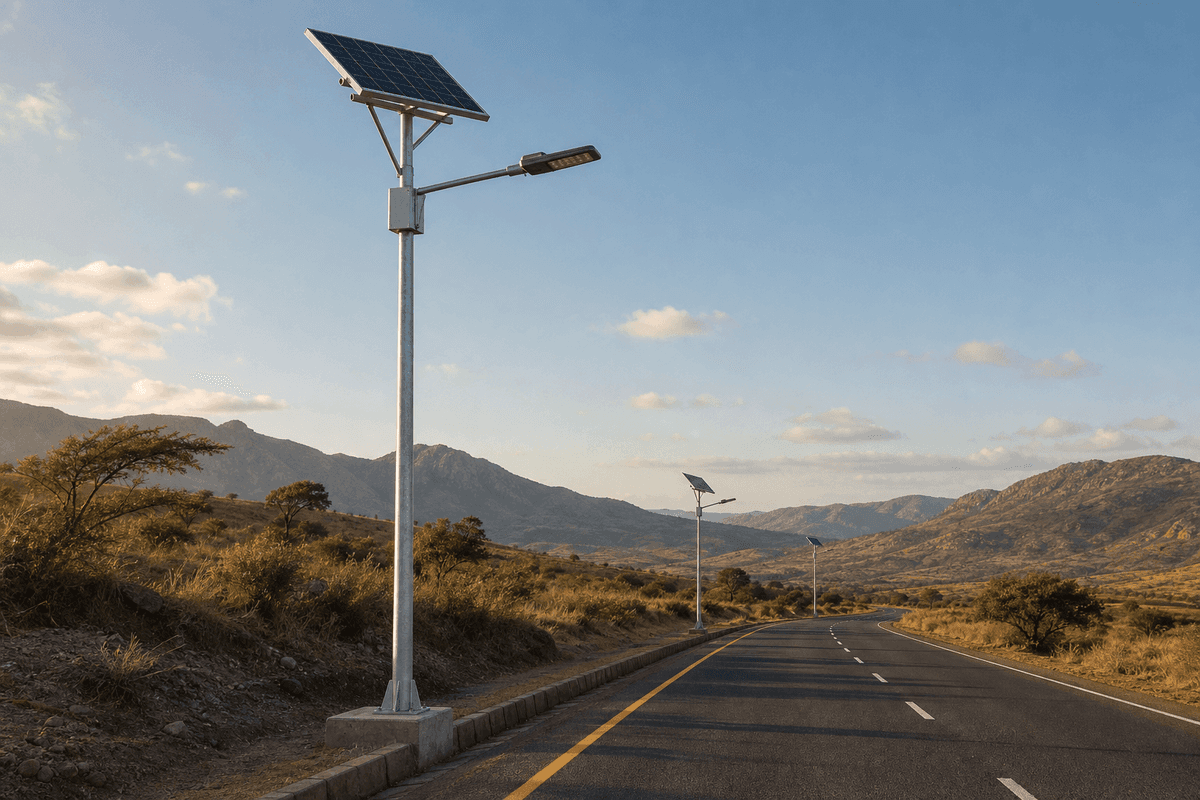
10m Highway Split 100W High-Wind Solar Streetlight - 150km/h Wind Resistance
Key Features
- 150 km/h wind resistance rating certified for hurricane-force conditions on exposed highland highways
- 5-day autonomy with 800Wh LiFePO4 battery ensuring uninterrupted operation during extended cloudy weather
- 200Wp TOPCon solar panel with 23% efficiency and adjustable 0-60° tilt for maximum energy harvest
- 100W LED luminaire producing 17,000+ lumens with 170 lm/W efficacy and 50,000-hour lifespan
- 10-meter hot-dip galvanized steel pole with >85μm zinc coating for decades of corrosion resistance
The SOLARTODO 10m Highway Split 100W High-Wind Solar Streetlight is engineered for critical infrastructure, featuring a robust 150 km/h wind resistance and an 800Wh Lithium Iron Phosphate battery. Priced between $850 and $1,150, it meets IEC 60598 and IEC 62124 certifications, making it ideal for highways and remote industrial areas.
Description
SOLARTODO 10m Highway Split 100W High-Wind Solar Streetlight: A Technical Deep Dive
1.0 Introduction: Engineering for Autonomy and Resilience
The SOLARTODO 10m Highway Split 100W High-Wind model represents the pinnacle of autonomous off-grid lighting technology, specifically engineered for critical infrastructure applications such as highways, arterial roads, and remote industrial zones. This system is designed to deliver uncompromising performance in challenging highland climates, characterized by high altitudes, significant UV exposure, and extreme wind loads. By integrating state-of-the-art components into a robust, split-architecture design, this solar streetlight guarantees a minimum of 5 days of operational autonomy during continuous inclement weather, ensuring consistent road safety and visibility where grid power is unreliable or unavailable.
The "split" configuration is a deliberate engineering choice that decouples the solar panel from the luminaire assembly. This allows the photovoltaic (PV) array to be independently oriented for maximum solar energy harvesting—a critical factor in optimizing year-round performance—while the luminaire is positioned for ideal road illumination. The system's structural and energy components are specified to meet and exceed rigorous international standards, including IEC 60598 for luminaires and IEC 62124 for PV standalone systems, providing a certified assurance of quality, safety, and long-term reliability. With a formidable 150 km/h wind resistance rating, a high-capacity 800Wh Lithium Iron Phosphate (LFP) battery, and a powerful 100W LED output, this solution is built for resilience and longevity in the most demanding environments.
2.0 System Architecture and Core Components
The system's architecture is a synergistic combination of four primary subsystems: the structural support, the power generation unit, the energy storage system, and the intelligent lighting and control module. Each component is selected for its superior performance, durability, and ability to withstand the specified environmental stressors.
2.1 Structural Support: 10-Meter Galvanized Steel Pole
The foundation of the system is a 10-meter octagonal tapered pole constructed from high-grade Q235 steel. To ensure maximum service life and corrosion resistance, the pole undergoes a hot-dip galvanization process in accordance with ASTM A123 / EN ISO 1461 standards, resulting in a zinc coating thickness of over 85 micrometers (μm). This protective layer provides decades of defense against atmospheric corrosion, even in moderately saline or industrial environments.
Engineered to withstand extreme weather, the pole and its mounting brackets are certified to resist sustained wind speeds of up to 150 km/h (equivalent to a Category 1 hurricane). This is achieved through a combination of robust material thickness (typically 4-5mm), a tapered design that reduces wind load and vortex shedding, and a reinforced base plate structure. The pole is designed for a flanged base installation onto a pre-engineered concrete foundation, ensuring a secure and stable footing that can handle the combined static and dynamic loads of the entire assembly.
2.2 Power Generation: 200Wp TOPCon Solar Module
Energy generation is handled by a high-performance 200-watt-peak (Wp) monocrystalline solar panel. This module utilizes advanced Tunnel Oxide Passivated Contact (TOPCon) cell technology, which significantly reduces surface recombination losses and boosts cell efficiency to over 23%. This high efficiency allows for a greater energy yield from a compact physical footprint, a key advantage in space-constrained installations. The panel's performance is certified under IEC 61215 (design qualification) and IEC 61730 (safety qualification) standards.
The split-type design allows the 200Wp panel to be mounted on an adjustable bracket, enabling precise tilting from 0 to 60 degrees. This adjustability is crucial for optimizing the angle based on the site's latitude, maximizing solar irradiance capture throughout the year and increasing the annual energy production by up to 25% compared to a fixed, horizontally mounted panel. The module is built to last, with a 25-year linear power output warranty and robust construction featuring a 3.2mm anti-reflective tempered glass front and a durable anodized aluminum frame.
2.3 Energy Storage: 800Wh LiFePO4 Battery System
At the heart of the system's autonomy is a high-capacity 800 Watt-hour (Wh) Lithium Iron Phosphate (LiFePO4 or LFP) battery bank. LFP chemistry is chosen for its exceptional safety, thermal stability, and long cycle life, capable of delivering over 2,000 deep discharge cycles to 80% Depth of Discharge (DOD). This translates to a reliable operational lifespan of over 5-7 years, significantly outperforming traditional lead-acid batteries.
The battery is managed by an integrated Battery Management System (BMS). This sophisticated electronic circuit provides critical protection against over-charge, over-discharge, over-current, short circuits, and extreme temperatures. For this highland climate model, the BMS includes a low-temperature charge protection feature, which prevents charging below 0°C to avoid lithium plating and permanent cell damage, thereby ensuring battery health in cold environments. The 800Wh capacity is precisely calculated to power the 100W luminaire for 12 hours per night with a 5-day autonomy reserve, ensuring uninterrupted operation during extended periods of low solar irradiation.
2.4 Luminaire & Control: 100W LED with Smart MPPT Controller
The illumination engine is a high-efficacy 100W LED luminaire featuring premium chips from industry leaders like Bridgelux or Lumileds. These chips deliver an exceptional luminous efficacy exceeding 170 lumens per watt (lm/W), producing over 17,000 lumens of bright, clear light (5000K CCT) to effectively illuminate multi-lane highways. The luminaire is housed in a die-cast aluminum body that acts as a passive heat sink, ensuring optimal thermal management and a 50,000-hour (L70) operational lifespan. The entire fixture is sealed to an IP66 rating, making it impervious to dust and powerful water jets.
System intelligence is provided by an advanced Maximum Power Point Tracking (MPPT) controller. With a tracking efficiency of over 99% and conversion efficiency of 98%, the MPPT controller maximizes the energy harvest from the solar panel by dynamically adjusting the electrical operating point. The controller also manages the battery charging profile and the luminaire's output. It features a default dusk-to-dawn operational mode and can be programmed with a multi-stage, time-based dimming profile (e.g., 100% for 4 hours, 50% for 6 hours, 75% for 2 hours) to conserve energy and extend autonomy. Optional 4G/LoRaWAN connectivity allows for remote monitoring of system status, fault alerts, and remote control of lighting parameters, facilitating proactive maintenance and fleet management.
3.0 Performance in Highland Environments
The 10m Highway Split 100W High-Wind model is holistically designed for the unique challenges of highland regions. The UV-resistant powder coating on the luminaire and the inherent UV stability of the galvanized pole and solar panel materials prevent degradation from intense high-altitude solar radiation. The 150 km/h wind rating is non-negotiable for exposed plateaus and mountain passes. Furthermore, the 5-day autonomy is critical for regions prone to extended fog, snow, or cloud cover, ensuring that public safety is never compromised by environmental conditions.
4.0 Certifications and Compliance
SOLARTODO is committed to delivering products that meet the highest global standards for safety, quality, and performance.
- IEC 60598: General requirements and tests for luminaires.
- IEC 62124: Design qualification and type approval for photovoltaic (PV) standalone systems.
- IEC 61215 / UL 1703: Crystalline silicon terrestrial PV modules - Design qualification and type approval.
- IP66/IP67: Ingress Protection ratings for the luminaire and battery enclosure.
- CE & RoHS: Compliance with European health, safety, and environmental protection standards.
- AASHTO: Standards for structural supports for highway signs, luminaires, and traffic signals.
Technical Specifications
| Pole Height | 10m |
| LED Power | 100W |
| Luminous Flux | 17000lm |
| Luminous Efficacy | 170lm/W |
| Color Temperature | 5000K |
| Solar Panel Power | 200Wp |
| Panel Efficiency | 23% |
| Panel Technology | Monocrystalline TOPCon |
| Battery Capacity | 800Wh |
| Battery Type | LiFePO4 (LFP) |
| Battery Cycle Life | 2000+cycles |
| Autonomy Days | 5days |
| Daily Lighting Hours | 12hours |
| Pole Material | Q235 Hot-Dip Galvanized Steel |
| Zinc Coating Thickness | 85+μm |
| Wind Resistance Rating | 150km/h |
| Operating Temperature Range | -20 to +60°C |
| Luminaire IP Rating | IP66 |
| Battery Enclosure IP Rating | IP67 |
| LED Lifespan (L70) | 50000hours |
| MPPT Efficiency | 98+% |
| System Warranty | 3years |
| Pole Warranty | 5years |
| Solar Panel Warranty | 25years |
Price Breakdown
| Item | Quantity | Unit Price | Subtotal |
|---|---|---|---|
| 200Wp Monocrystalline TOPCon Solar Panel | 1 pc | $56 | $56 |
| 800Wh LiFePO4 Battery with BMS | 1 pc | $96 | $96 |
| 100W LED Luminaire Module (Bridgelux/Lumileds) | 1 pc | $180 | $180 |
| MPPT Charge Controller (200W rated) | 1 pc | $100 | $100 |
| 10m Hot-Dip Galvanized Steel Pole | 1 pc | $350 | $350 |
| Adjustable Solar Panel Mounting Bracket (Stainless Steel) | 1 pc | $45 | $45 |
| Weatherproof Battery Enclosure Box (IP67) | 1 pc | $38 | $38 |
| Concrete Foundation Kit | 1 pc | $80 | $80 |
| Wiring, Connectors & Installation Hardware | 1 set | $55 | $55 |
| Total Price Range | $850 - $1,150 | ||
Frequently Asked Questions
What is the primary advantage of a 'split' type solar streetlight over an 'all-in-one' model?
How does the system perform during long periods of rainy or cloudy weather?
What maintenance is required for this solar streetlight system?
Can the lighting schedule be customized to save energy?
How does the 150 km/h wind rating ensure stability in extreme conditions?
Certifications & Standards







Data Sources & References
- •IEC 60598-1:2020 - Luminaires General Requirements
- •IEC 62124:2016 - PV Standalone Systems Design Qualification
- •NREL PVWatts Calculator 2025
- •AASHTO LTS-6:2013 - Structural Supports for Highway Infrastructure
- •ASTM A123 / EN ISO 1461 - Hot-Dip Galvanization Standards
Interested in this solution?
Contact us for a customized quote based on your specific requirements.
Contact Us