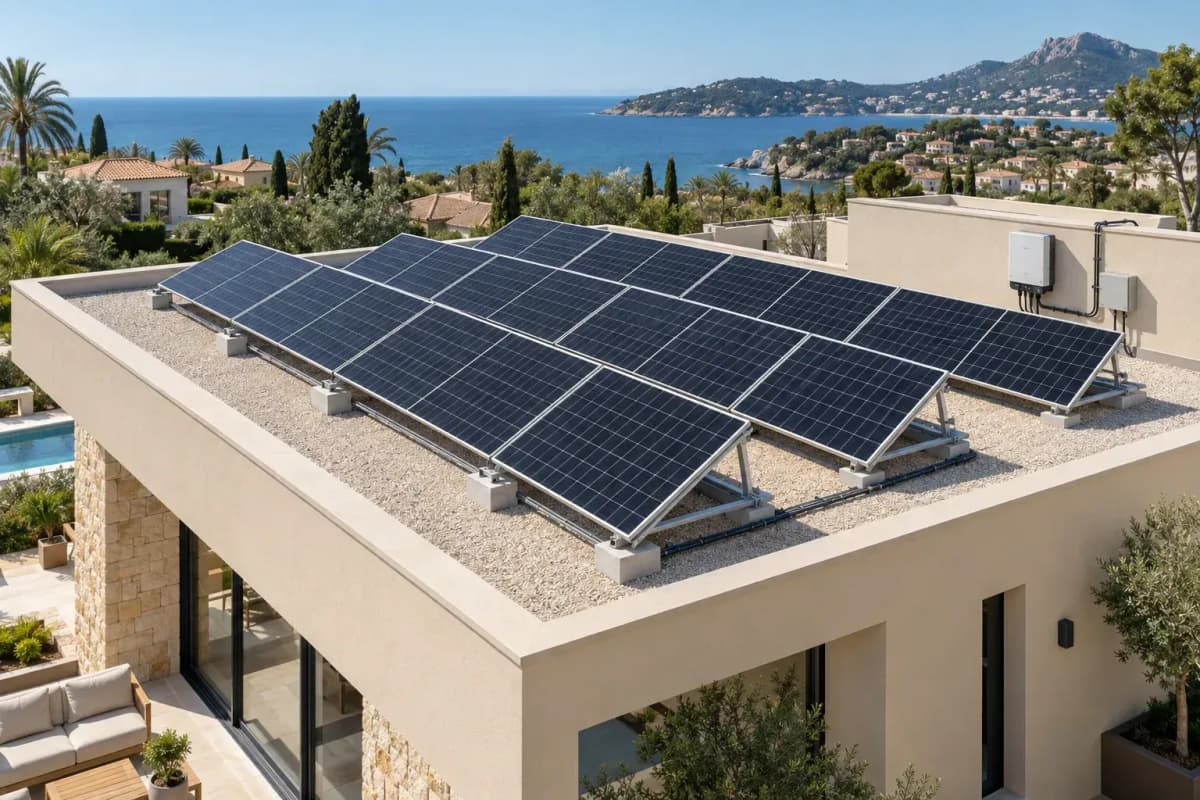
10kW Residential Rooftop Mono-PERC Fixed PV System - 20 Degree Tilt
Key Features
- 10.0 kWp residential rooftop PV system with fixed 20 degree array geometry
- 21.5% mono-PERC module efficiency using 550-580 W mainstream module class
- Estimated 14.2 MWh annual generation and 16.2% capacity factor in a representative scenario
- EPC turnkey price range of USD 5,800-7,500 with 1-year workmanship support
- Estimated 6.0 tCO2 annual offset using 0.42 kg CO2/kWh grid factor
The 10kW Residential Rooftop Mono-PERC Fixed PV system uses 21.5% efficient mono-PERC modules, a fixed 20 degree roof array, and a 10kW class inverter architecture for grid-connected homes. SOLARTODO prices the EPC turnkey package at USD 5,800-7,500, with estimated annual generation of 14.2 MWh under a representative high-irradiance residential scenario.
Description
The 10kW Residential Rooftop Mono-PERC Fixed system is a 10.0 kWp grid-connected solar PV package using 21.5% efficient mono-PERC modules, a fixed 20 degree roof tilt, and residential string or micro-inverter topology. For B2B buyers, installers, and housing developers, SOLARTODO positions this configuration as a mature 25-year rooftop generation asset with EPC turnkey pricing from USD 5,800 to USD 7,500 and equipment-only FOB supply from USD 3,596 to USD 5,100.
1. Product Scope and Buyer Fit
This residential rooftop PV system is designed for single-family villas, townhouses, small apartment blocks, and developer-led housing programs requiring approximately 10 kWp of DC capacity per roof. The design uses mono-PERC modules in the 550-580 W mainstream class, typically requiring 18 modules at 560 W or a similar bill of materials to reach about 10.08 kWp before inverter clipping, roof setbacks, or local code adjustments.
Mono-PERC remains a cost-effective crystalline silicon technology with module efficiencies around 21.0-22.5%, although 2025-2026 procurement trends show many new utility projects moving toward TOPCon and HJT for higher bifacial yield. For residential roofs, PERC still offers strong supply availability, known degradation behavior, and simpler bankability review, while buyers evaluating future upgrades can View all Solar PV System products for TOPCon, bifacial, tracker, or hybrid storage variants.
The core engineering assumption is a fixed rooftop array at 20 degrees, which avoids tracker motors, slew drives, wind-stow logic, and additional maintenance points. Compared with a small dual-axis residential tracker, a fixed roof structure can reduce mounting and controls complexity by more than 50% while sacrificing site-dependent tracking gain, making it more appropriate for houses where roof geometry and structural load limits dominate the design.
2. Technical Specifications
| Parameter | Value |
|---|---|
| Nominal DC capacity | 10.0 kWp |
| Typical module count | 18 x 560 W class |
| Module technology | Mono-PERC, half-cut cells |
| Module efficiency | 21.5% |
| Array type | Fixed rooftop |
| Tilt angle | 20 degrees |
| Estimated module surface | 46.5 m² |
| Practical roof allowance | 55-60 m² |
| Estimated annual generation | 14.2 MWh/year |
| Capacity factor | 16.2% |
| Estimated CO2 offset | 6.0 tCO2/year |
| Warranty basis | 25-year panels, 10-year inverter |
NREL PVWatts is widely used for preliminary PV production modeling because it estimates grid-connected PV energy using inputs such as DC system size, module type, array type, system losses, tilt, azimuth, inverter efficiency, and weather data NREL PVWatts. For this page, SOLARTODO uses a representative annual output of 14,200 kWh for a 10 kWp roof array, equivalent to a 16.2% capacity factor calculated as 14,200 kWh divided by 87,600 kWh of theoretical full-output annual energy.
3. System Architecture
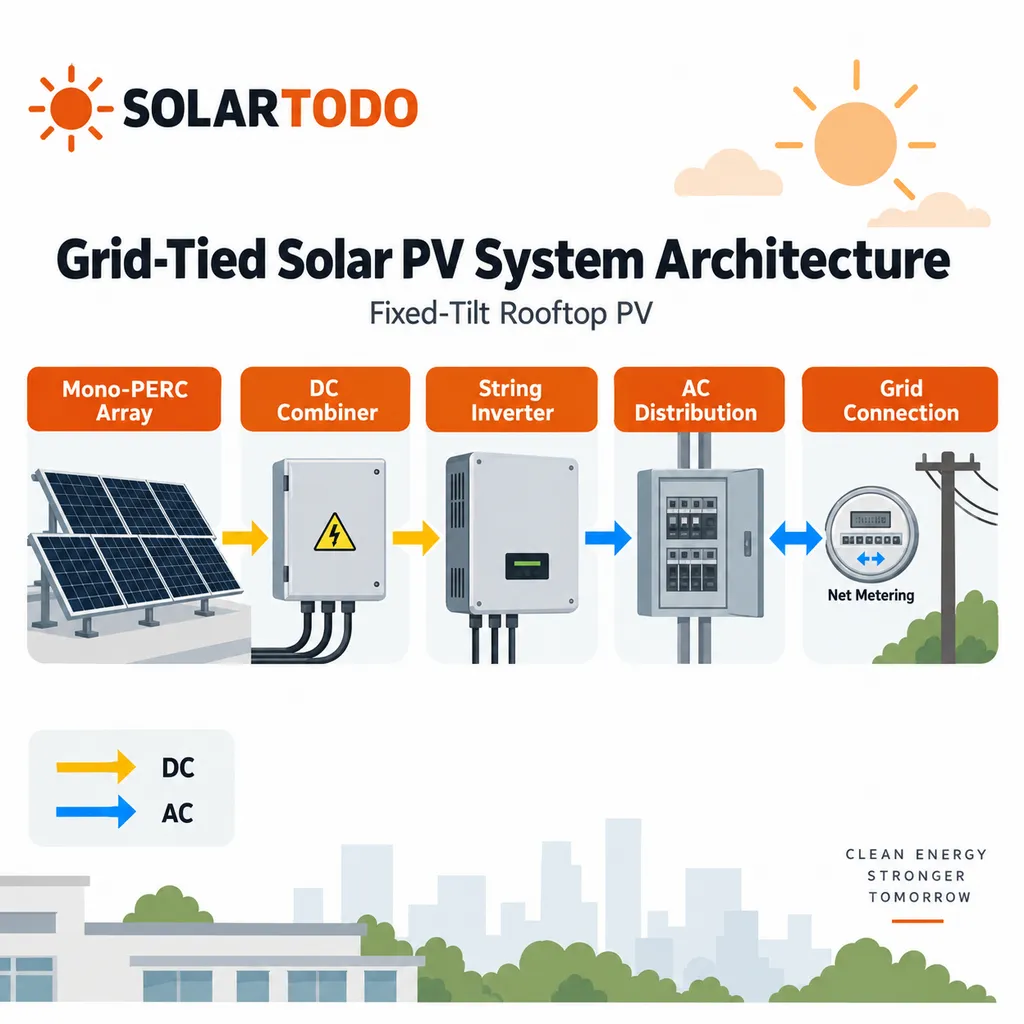
The architecture contains 4 primary layers: PV modules, DC protection, inverter conversion, and AC interconnection. In a typical 10 kWp residential design, the array is divided into 2 strings of approximately 9 modules each, subject to final module voltage, local minimum temperature, inverter MPPT range, and national electrical code requirements.
The inverter layer can use 1 string inverter around 8-10 kW AC for lower cost or 18 micro-inverters/optimizers where roof planes, shading, or module-level monitoring requirements justify the added electronics. String inverter designs generally reduce installed electronics count by more than 90% compared with module-level conversion, while micro-inverter designs can improve shade tolerance on multi-plane roofs with 2-4 orientations.
DC balance-of-system components include PV cable, MC4-compatible connectors, isolators, rooftop conduit, surge protection devices, and grounding conductors sized for local code and 600-1,500 V equipment ratings. AC infrastructure typically includes a breaker, isolator, production meter interface, labeling, and commissioning tests covering insulation resistance, polarity, open-circuit voltage, short-circuit current, and inverter grid synchronization.
4. Standards, Compliance, and Safety Basis
PV modules for this configuration should be procured with IEC 61215 design qualification and IEC 61730 safety qualification, because these standards address type approval, construction requirements, and electrical or mechanical safety for crystalline PV modules. IEC 61730-1:2023 defines construction requirements for safe module operation, while IEC 61730-2:2023 covers required safety tests for module qualification IEC 61730-1.
For North American or NEC-influenced projects, legacy module references may include UL 1703 for flat-plate photovoltaic modules and panels, which covers modules used on buildings or freestanding systems up to 1,500 V maximum system voltage UL 1703. Many current procurement packages now reference UL 61730-1 and UL 61730-2, but UL 1703 remains common in historical submittals and lender technical files.
Grid-interactive inverters should support anti-islanding behavior consistent with IEC 62116, which provides a test procedure for islanding prevention measures in utility-interconnected PV inverters IEC 62116. A 10 kW residential system should also be checked against local interconnection rules, export limits, rapid-shutdown requirements, roof fire setbacks, and utility metering rules before purchase order release.
5. Representative Residential Rooftop Scenario
For a representative MENA residential rooftop scenario, assume a south-facing or near-south roof, 20 degree tilt, 5.2 kWh/m²/day average plane-of-array resource, 14% total system losses, and 10.0 kWp DC nameplate capacity. Under these assumptions, the system produces about 14.2 MWh/year, enough to offset a large share of annual consumption for a household using 1,000-1,400 kWh/month.
At a blended avoided electricity value of USD 0.14/kWh, the annual energy value is approximately USD 1,988 before maintenance, inverter replacement reserves, or net-metering constraints. With EPC turnkey pricing around USD 6,500 at the midpoint, the simple payback is about 3.3 years, while a 25-year energy life can deliver more than 319 MWh after first-year output and conservative degradation assumptions.
The estimated carbon benefit uses a grid-emissions placeholder of 0.42 kg CO2/kWh, resulting in about 6.0 tCO2/year avoided for 14,200 kWh of annual generation. Buyers should replace this factor with national grid data, because coal-heavy grids may exceed 0.70 kg CO2/kWh while gas- and renewable-heavy grids may fall below 0.30 kg CO2/kWh.
6. Market Context and Technology Positioning
The IEA reports that distributed solar PV applications, including residential and commercial rooftop systems, account for 42% of overall PV expansion in its Renewables 2025 analysis IEA Renewables 2025. This matters for procurement teams because residential rooftop portfolios increasingly require standardized 5-15 kW kits, repeatable commissioning documents, and remote monitoring across hundreds of roofs.
IRENA estimated the global weighted average LCOE of newly commissioned utility-scale solar PV at about USD 0.043/kWh in 2024, demonstrating why PV remains a benchmark technology for low-cost electricity procurement IRENA Renewable Power Generation Costs 2024. Residential rooftop PV has different permitting, labor, and retail-tariff economics, but the same module price decline and inverter standardization support competitive lifecycle costs.
For 2025-2026 purchasing, the main comparison is not whether PV works, but whether mono-PERC, TOPCon, or HJT provides the best portfolio value. Mono-PERC typically offers lower upfront cost and mature supply, while TOPCon may offer higher wattage and lower degradation; for this 10 kW fixed residential variant, SOLARTODO treats PERC as a proven cost option rather than the absolute highest-yield option.
7. Cloud Monitoring
The system can include 1 cloud monitoring gateway or inverter-native data logger reporting production, voltage, current, inverter status, and alarms at intervals as short as 5-15 minutes, depending on platform settings. Portfolio operators can use monitoring to compare expected versus actual yield, flag underperforming roofs below 90% of modeled output, and schedule cleaning or service visits based on measurable loss.
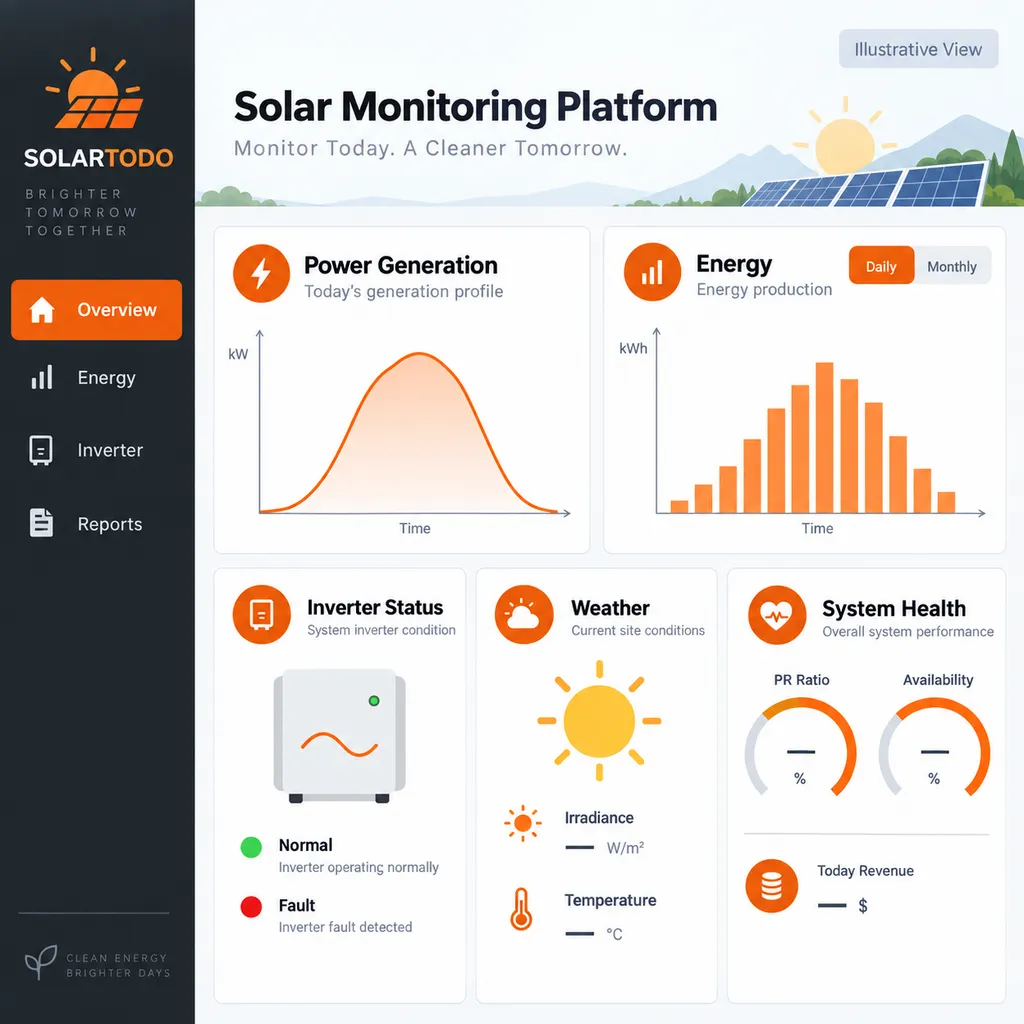
Monitoring should not be treated as a substitute for commissioning, because the first 7 days of operation are used to validate string polarity, inverter synchronization, daily generation curve shape, and customer metering behavior. SOLARTODO recommends that project developers define alarm escalation rules, installer response times, and data ownership terms before installing more than 50 systems across a housing program.
8. EPC Investment Analysis and Pricing Structure
EPC turnkey scope includes 5 delivery blocks: engineering, procurement, construction, commissioning, and a 1-year workmanship or support warranty. Engineering covers layout, single-line diagrams, string sizing, wind or roof attachment review, and interconnection files; procurement covers modules, inverters, mounting, cabling, protection, monitoring, packing, and QA; construction covers roof mounting, cable routing, AC connection, labeling, and site cleanup.
| Pricing tier | Scope | Price range |
|---|---|---|
| FOB Supply | Equipment only, ex-works China | USD 3,596-5,100 |
| CIF Delivered | Equipment plus ocean freight and insurance | USD 3,967-5,627 |
| EPC Turnkey | Installed, commissioned, and 1-year warranty | USD 5,800-7,500 |
| Volume band | Discount from standard equipment quotation |
|---|---|
| 50+ systems | 5% |
| 100+ systems | 10% |
| 250+ systems | 15% |
The ROI structure depends on retail tariff, self-consumption ratio, export credit, financing rate, and roof shading. At 14.2 MWh/year, a site consuming 70% of production at USD 0.18/kWh and exporting 30% at USD 0.06/kWh realizes about USD 1,917/year, compared with USD 2,556/year if 100% of generation offsets retail energy at USD 0.18/kWh.
Compared with buying all energy from the grid at USD 0.18/kWh, the midpoint EPC system cost of USD 6,500 produces a simplified first-year levelized cost near USD 0.025/kWh over 25 years before finance, inverter reserve, and O&M adjustments. This comparison is sensitive to tariff policy, but it illustrates why residential PV can reduce delivered electricity cost by more than 80% versus high retail tariffs when self-consumption is strong.
Standard payment terms are 30% T/T deposit plus 70% against B/L, or 100% L/C at sight for qualified buyers. Project financing can be discussed for portfolios above USD 5,000K, and EPC buyers can contact [email protected] or Request a custom quotation with roof count, grid standard, country, target commissioning date, and required documentation package.
9. Procurement Notes and Configuration Path
Before quotation, buyers should confirm 8 inputs: country, grid voltage, roof type, usable area, azimuth, shading, metering rule, and preferred inverter topology. The Configure your system online workflow can convert these values into a preliminary bill of materials, while Learn about topic pages provide background on PV modules, inverter selection, and rooftop design constraints.
For EPC tenders, SOLARTODO recommends comparing at least 3 bid dimensions beyond headline price: certified component list, commissioning checklist, and warranty response time. Buyers evaluating technology shifts can also use Learn about topic to compare PERC with TOPCon, because a 1-2 percentage point efficiency difference can affect roof coverage, logistics, and long-term yield in space-limited residential projects.
10. Operating Life, Warranty, and Maintenance
A properly installed fixed rooftop PV system has no tracker motors and typically requires 2-4 preventive maintenance visits per year depending on dust, rainfall, and roof access. Routine tasks include visual inspection, torque spot checks, inverter log review, insulation checks, module cleaning if soiling exceeds 3-5%, and verification that generation remains within modeled seasonal bands.
The standard warranty structure is 25 years for panels and 10 years for the inverter, with optional inverter warranty extension depending on brand and country. Module performance warranties are normally separate from workmanship warranties, so procurement files should distinguish product warranty, linear power warranty, installation warranty, and remote monitoring support before contract signature.
Technical Specifications
| System Capacity | 10kWp |
| Module Type | Mono-PERC |
| Module Efficiency | 21.5% |
| Array Configuration | Fixed residential rooftop |
| Tilt Angle | 20degrees |
| Estimated Annual Generation | 14.2MWh/year |
| Capacity Factor | 16.2% |
| System Area | 46.5 module area; 55-60 practical roof allowancem² |
| CO2 Offset | 6.0tons/year |
| Payback Period | 3.3years |
| LCOE | 0.025USD/kWh |
| Warranty | 25-year panels, 10-year inverter |
Price Breakdown
| Item | Quantity | Unit Price | Subtotal |
|---|---|---|---|
| Mono-PERC PV Modules 560 W Class | 18 pcs | $102 | $1,836 |
| Residential String Inverter 10 kW | 1 pcs | $800 | $800 |
| Fixed Rooftop Mounting System | 1 pcs | $800 | $800 |
| DC Cable, Connectors, Isolators and SPD | 1 pcs | $500 | $500 |
| AC Protection and Grid Connection Hardware | 1 pcs | $350 | $350 |
| Cloud Monitoring Gateway and Setup | 1 pcs | $500 | $500 |
| Engineering, Design and QC Documentation | 1 pcs | $550 | $550 |
| Installation and Commissioning Labor | 1 pcs | $950 | $950 |
| 1-Year Warranty and Remote Support | 1 pcs | $400 | $400 |
| Total Price Range | $5,800 - $7,500 | ||
Frequently Asked Questions
What does the 10kW EPC turnkey price include?
How many solar panels are required for this 10kW residential system?
Is mono-PERC still suitable in 2026 when TOPCon is growing?
What annual energy output should buyers expect from a 10kW roof array?
Which certifications should be checked before procurement?
Certifications & Standards



Data Sources & References
- •NREL PVWatts Calculator, https://pvwatts.nrel.gov/
- •IEA Renewables 2025, https://www.iea.org/reports/renewables-2025/renewable-electricity
- •IRENA Renewable Power Generation Costs in 2024, https://www.irena.org/Digital-Report/Renewable-Power-Generation-Costs-in-2024
- •IEC 61730-1:2023, https://webstore.iec.ch/en/publication/59803
- •IEC 62116:2014, https://webstore.iec.ch/en/publication/6479
- •UL 1703, https://www.shopulstandards.com/ProductDetail.aspx?UniqueKey=7893
Interested in this solution?
Contact us for a customized quote based on your specific requirements.
Contact Us