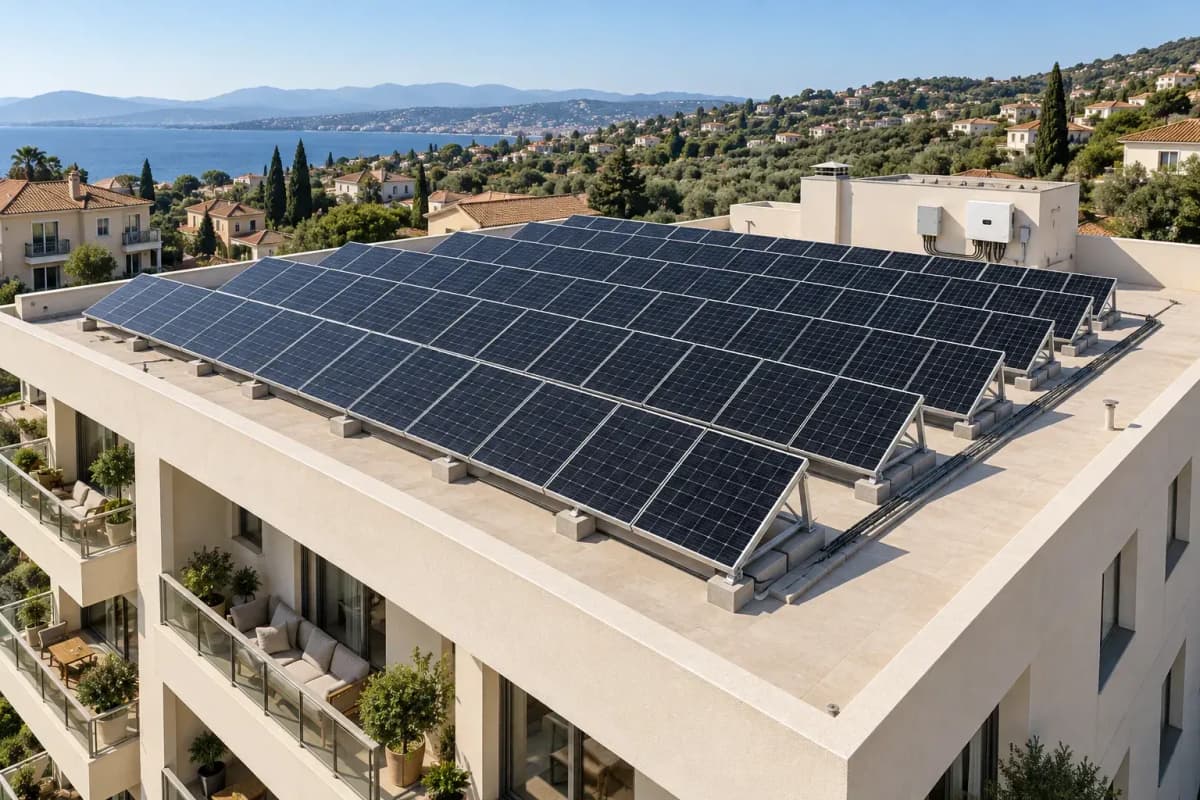
50kW Residential Rooftop HJT Fixed - 25deg High-Efficiency Rooftop PV System
Key Features
- 50.4kWp DC rooftop PV system using 72 pcs of 700W-class HJT bifacial modules
- 25.3% module efficiency with HJT temperature coefficient around -0.24%/degC
- Estimated 71.8MWh annual generation at 16.4% capacity factor in the representative model
- Practical roof area requirement of about 210-230m2 including access and setbacks
- EPC turnkey price range of $24,800-$34,800, equal to about $0.50-$0.70/W installed
The 50kW Residential Rooftop HJT Fixed system is a 50.4kWp DC solar PV package using 72 high-efficiency 700W-class HJT bifacial modules at 25deg fixed tilt. It is designed for large villas, estates, residential compounds, and small community buildings needing IEC/UL-aligned rooftop generation with EPC turnkey pricing of $24,800-$34,800.
Description
The 50kW Residential Rooftop HJT Fixed system is a 50.4kWp DC rooftop solar PV configuration using 72 pieces of 700W-class HJT bifacial modules, 25.3% module efficiency, and a 25deg fixed-tilt array for high-yield residential and light-commercial roofs. SOLARTODO specifies this package for 3-phase properties, villas, residential compounds, clubhouses, and estates requiring approximately 71.8MWh/year of clean electricity, subject to local irradiance, shading, roof azimuth, and grid-export rules.
Product Overview
This product belongs to SOLARTODO's Solar PV System line and is designed as a grid-tied rooftop EPC package with 50kW nominal AC capacity and 50.4kWp DC module capacity. Buyers comparing residential rooftop solar, C&I rooftop solar, and small distributed generation projects can View all Solar PV System products or Configure your system online with 8+ design inputs including capacity, module type, tilt, application, and array type.
HJT, or heterojunction technology, combines crystalline silicon with thin amorphous silicon passivation layers to reduce recombination losses and support mass-production efficiencies of 24-26%. For this 50kW system, the specified 25.3% module efficiency means the active module area is approximately 199m2 before service walkways, fire setbacks, inverter space, and roof-access clearances increase the practical roof requirement to about 210-230m2.
The 25deg fixed mounting angle is selected as a robust residential-rooftop default because it balances annual yield, wind exposure, drainage, and maintenance access in many low- to mid-latitude sites. Compared with a conventional 550W TOPCon rooftop package using roughly 91 modules for the same 50kW DC capacity, this HJT layout can reduce module count by about 21% and cut clamp, rail, connector, and handling points by a similar order of magnitude.
System Architecture
The core architecture includes 72 HJT bifacial PV modules, 2 string inverters rated around 25kW each, DC string protection, AC distribution, smart metering, internet monitoring, fixed aluminum mounting, earthing, surge protection, and commissioning documentation. The system is normally arranged into 4-6 DC strings, depending on module voltage, local minimum temperature, inverter MPPT window, roof segmentation, and applicable electrical code.
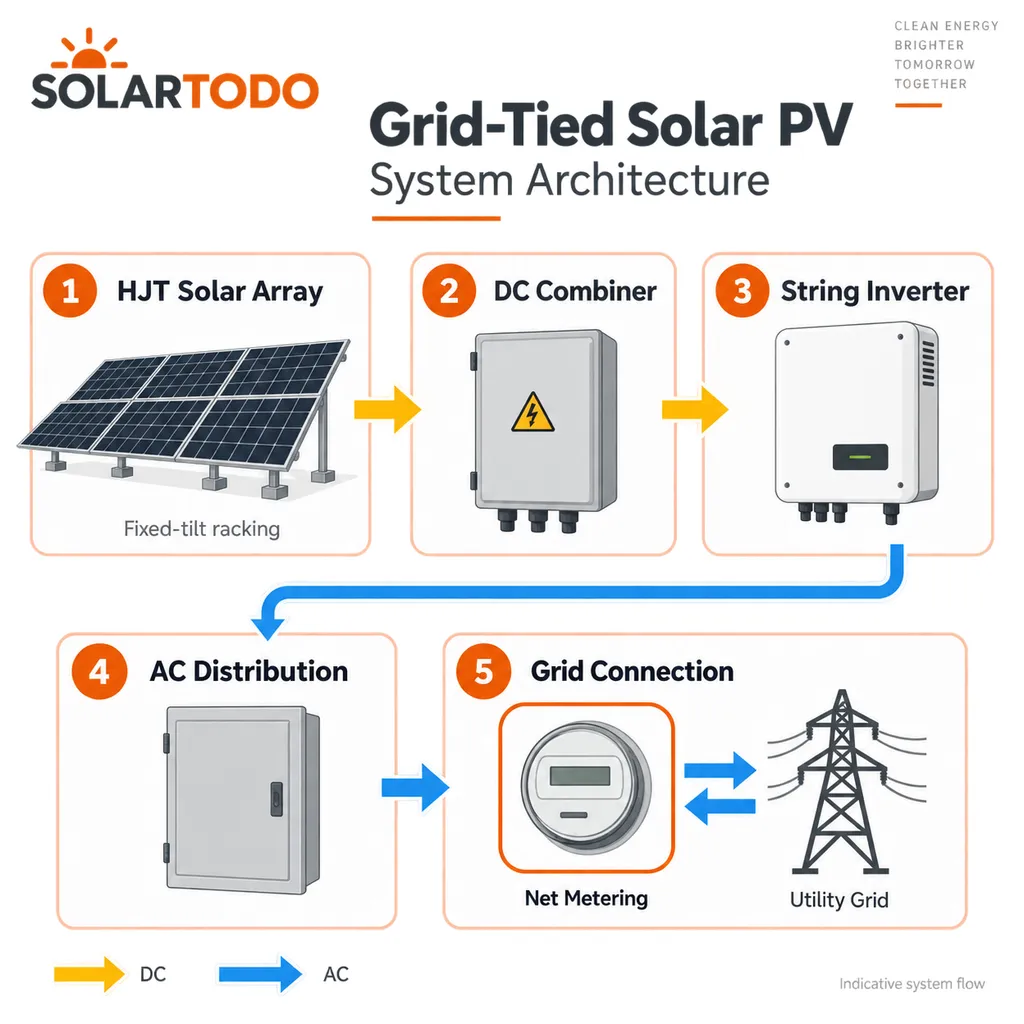
The DC/AC ratio is typically configured between 1.05 and 1.25 for rooftop projects, and this 50.4kWp DC to 50kW AC reference design uses a conservative 1.008 ratio for projects where export clipping must be minimized. In locations with stronger noon irradiance or tariff structures favoring morning and afternoon energy, SOLARTODO can adjust inverter loading, string count, and azimuth split during engineering review.
The inverter layer uses transformerless string inverters rather than a central inverter because a 50kW residential rooftop system benefits from 2 independent MPPT blocks, easier 1-person service access, and lower outage concentration. Micro-inverters can be considered for roofs with more than 4 shade zones, but the per-watt cost is commonly higher than string architecture at this 50kW scale.
Technical Specifications
The design capacity is 50.4kWp DC and 50kW AC, with 72 modules at approximately 700W each and a module efficiency target of 25.3%. Under a representative 1,425kWh/kWp-year specific yield, the modeled annual generation is about 71.8MWh/year, equal to a 16.4% capacity factor and approximately 5.98MWh/month averaged over 12 months.
| Parameter | Reference value |
|---|---|
| DC capacity | 50.4kWp |
| AC inverter capacity | 50kW |
| Module technology | HJT bifacial |
| Module efficiency | 25.3% |
| Module count | 72 pcs |
| Nominal module class | 700W |
| Fixed tilt angle | 25deg |
| Estimated annual generation | 71.8MWh/year |
| Practical roof area | 210-230m2 |
| Expected capacity factor | 16.4% |
| Estimated CO2 offset | 31.6tCO2/year at 0.44kg/kWh |
SOLARTODO uses the provided configuration parameters of 50kW capacity, HJT module type, 0.253 efficiency ratio, fixed array, residential rooftop application, and 25deg tilt as the baseline for quotation. Final bill of materials can vary by 5-12% because rail length, ballast or penetration method, cable routing, roof height, grid cabinet distance, and utility interconnection scope differ across sites.
HJT Module Performance
HJT modules are well suited to hot rooftops because the temperature coefficient is typically about -0.24%/degC, compared with many conventional crystalline modules around -0.30% to -0.35%/degC. At a 45degC operating cell temperature, that 0.06-0.11 percentage-point-per-degree advantage can preserve roughly 1.2-2.2% more power than a conventional alternative across a 20degC temperature rise.
Bifaciality of HJT modules can reach 90-95%, although rooftop rear-side gain is usually lower than ground-mounted projects because the roof surface is closer and less reflective. On light-colored membrane roofs or reflective metal roofs, SOLARTODO may model an additional 2-6% bifacial yield; on dark tile or asphalt roofs, rear-side gain may be limited to 0-2%.
The degradation profile is another reason HJT is appropriate for 25-year residential assets: the technology is LID-free in normal use, and annual degradation is commonly specified around 0.4%/year after the first year. A 90% output guarantee at year 25 supports long-term energy planning for homeowners, landlords, and residential-compound operators who evaluate cash flow over 10-30 years.
For comparable high-output products, the HJT category includes examples such as Huasun Himalaya G12-132 modules above 700W and Risen HJT modules reaching the 745W class. SOLARTODO may substitute equivalent Tier-1 HJT modules when electrical parameters, IEC 61215 type qualification, IEC 61730 safety qualification, warranty terms, dimensions, and connector specifications remain compatible.
Standards, Compliance, and Engineering Basis
The module compliance framework references IEC 61215 for terrestrial PV module design qualification and type approval, as described by the IEC for long-term operation in open-air climates, and IEC 61730 for PV module safety construction and testing. North American buyers may additionally request UL 1703 legacy documentation or UL 61730 listings, while interconnection studies often refer to IEEE 1547-2018 for distributed energy resource interoperability.
Inverter and anti-islanding requirements are normally reviewed against IEC 62116, IEEE 1547, and the local utility grid code, with protection settings confirmed during commissioning. For a 50kW residential rooftop, the engineering pack typically includes 1 single-line diagram, 1 array layout, 1 equipment datasheet set, 1 string calculation, 1 grounding concept, 1 monitoring setup, and 1 commissioning checklist.
Performance modeling is aligned with NREL PVWatts Version 8 concepts, where array type, module type, tilt, azimuth, losses, inverter efficiency, and weather data determine annual kWh output. NREL notes that PVWatts estimates grid-connected PV electricity production using nameplate capacity and array orientation inputs, which makes it suitable for early-stage feasibility before detailed shade analysis.
Market context also supports the specification: the IEA Renewables 2025 analysis reports that solar PV continues to account for most renewable capacity growth through 2030, while IRENA's 2024 cost database reports global utility-scale solar PV LCOE around $0.043/kWh. Those utility figures do not equal rooftop EPC costs, but they confirm why distributed solar remains a major procurement category for 2025-2026 buyers.
Representative Scenario
Representative MENA residential-compound scenario: assume a 50.4kWp DC system installed on a 220m2 flat concrete roof at 25deg tilt, 1,425kWh/kWp-year specific yield, 14% total system losses, and an avoided electricity cost of $0.10/kWh. Under these assumptions, annual generation is about 71,800kWh, annual bill savings are about $7,180, and simple payback is approximately 3.5-4.8 years across the $24,800-$34,800 EPC range.
This scenario is illustrative only and is not a claim that any customer achieved the stated output, savings, or payback. A bankable estimate requires at least 12 months of utility bills, roof drawings, 15-minute load data where available, local irradiation data, shading review, tariff confirmation, export-credit rules, structural assessment, and grid interconnection approval.
Applications
The 50kW size is appropriate for large residential villas, gated-community facilities, apartment common loads, water-pump houses, carport roofs, clubhouses, and mixed residential-commercial buildings with daytime loads above 20-40kW. It can offset air-conditioning, pool pumps, EV charging, lighting, elevators, irrigation pumps, security systems, and smart-building controls without requiring battery storage in the base package.
For customers combining solar with storage, SOLARTODO can add a 50-200kWh LFP battery cabinet and hybrid inverter architecture, but this listed variant is PV-only and grid-tied. Buyers planning energy storage, smart lighting, telecom power, or security integration can Learn about topic or Request a custom quotation for a multi-system design.
Cloud Monitoring
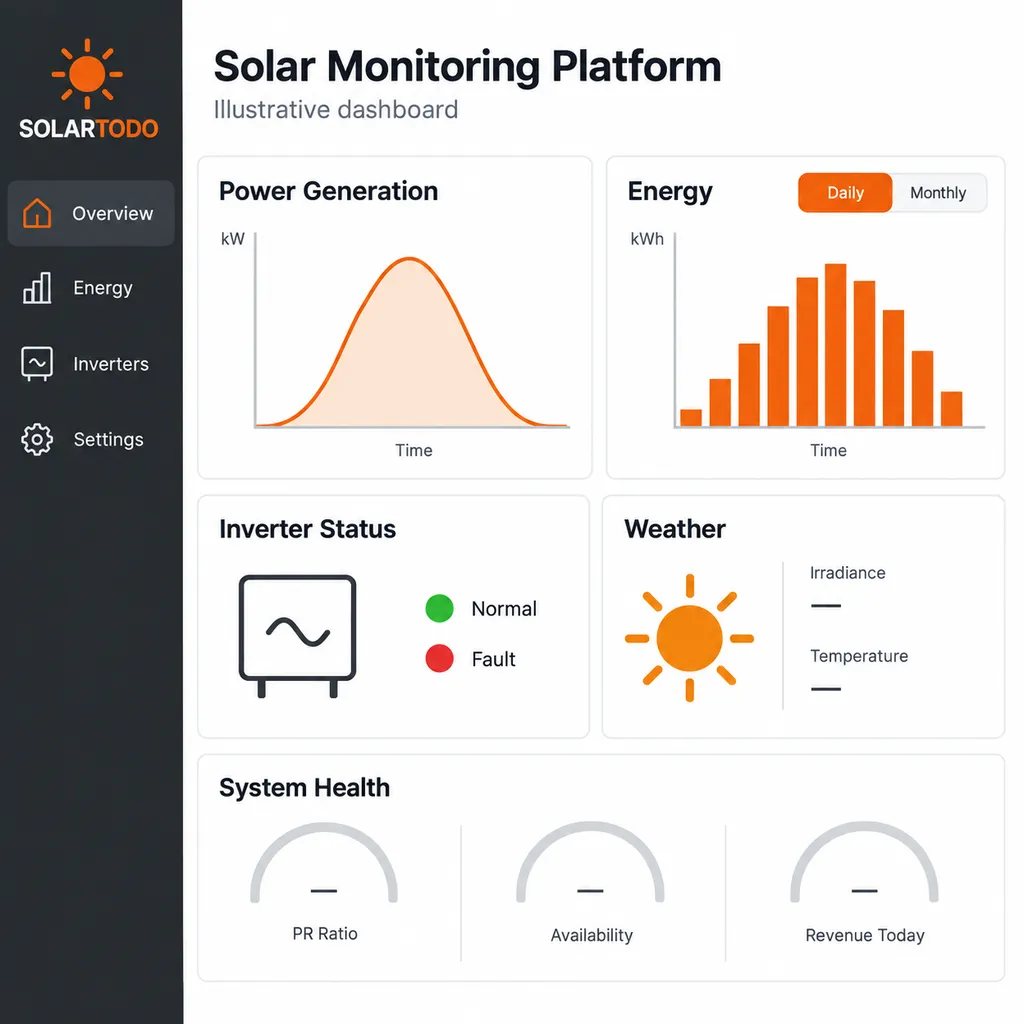
The monitoring layer provides inverter status, string-level MPPT trends, daily kWh yield, monthly kWh yield, grid voltage, AC frequency, fault alarms, and exported-energy data through a cloud portal or local gateway. A typical 50kW system records at 5-15 minute intervals, enabling operators to identify underperforming strings, soiling events, grid trips, and abnormal inverter temperature before monthly energy losses exceed 3-5%.
Remote monitoring is especially valuable for residential estates with multiple service contractors because it creates 1 shared source for uptime, energy, and alarm records. SOLARTODO recommends comparing actual generation against a weather-adjusted baseline every 30 days and scheduling module cleaning when soiling losses exceed 4% or when local dust events visibly reduce irradiance capture.
EPC Investment Analysis and Pricing Structure
EPC turnkey scope includes engineering, procurement, construction, commissioning, and a 1-year workmanship and support warranty, while module and inverter product warranties follow manufacturer terms. For this 50kW residential rooftop HJT fixed system, the supplied EPC range is $24,800-$34,800, equivalent to about $0.50-$0.70/W installed before taxes, permitting fees, utility charges, or unusual structural reinforcement.
| Pricing tier | Scope | Price range |
|---|---|---|
| FOB Supply | Equipment only, ex-works China | $15,376-$23,664 |
| CIF Delivered | Equipment plus ocean freight and insurance | $16,964-$26,108 |
| EPC Turnkey | Installed, commissioned, and 1-year EPC support | $24,800-$34,800 |
| Volume band | Discount reference | Typical buyer profile |
|---|---|---|
| 50+ systems | 5% | Residential developer phase order |
| 100+ systems | 10% | Dealer or compound portfolio |
| 250+ systems | 15% | Framework procurement program |
ROI depends on tariff, self-consumption ratio, net-metering value, and financing cost, but a $29,740 midpoint EPC price with $7,180/year representative savings gives a 4.1-year simple payback. Compared with diesel self-generation at $0.25/kWh fuel-and-service cost, 71,800kWh/year of solar energy can avoid about $17,950/year before backup-generator fixed costs.
Payment terms are normally 30% T/T deposit + 70% against B/L copy, or 100% L/C at sight for qualified orders, with project financing review available for portfolios above $5,000K. Commercial buyers should contact [email protected] with 1 roof plan, 12 electricity bills, 3 site photos, and target delivery date for an engineering quotation.
Procurement Notes
The FOB package normally includes PV modules, inverters, mounting, protection devices, DC cable, AC cabinet components, communication hardware, labels, and export packing. The CIF package adds ocean freight and insurance to the destination port, while EPC adds installation labor, testing, commissioning, site engineering, handover documents, and 1-year support.
Lead time is typically 3-6 weeks for equipment preparation and 1-3 weeks for site installation after civil readiness, subject to module allocation, shipping route, customs clearance, and grid-connection approval. For portfolios above 100 systems, SOLARTODO recommends locking module dimensions, inverter brand, connector type, and rail profile for at least 1 procurement quarter to reduce replacement-engineering work.
Sustainability and Lifecycle Value
Using a 0.44kgCO2/kWh grid-emission factor, the 71.8MWh/year reference output offsets approximately 31.6tCO2/year and about 790tCO2 over 25 years before degradation adjustment. Because HJT degradation can be around 0.4%/year, lifetime generation remains strong for homeowners and asset managers planning 2 or 3 inverter replacement cycles over a 30-year roof life.
IRENA's 2024 renewable-cost analysis shows solar PV remains one of the lowest-cost new-generation options globally, while IEA 2025 market analysis shows solar capacity additions continue to dominate renewable growth. For a residential buyer, the practical value is not a global average but the ability to convert 210-230m2 of unused roof area into a 50kW power asset with documented IEC/UL-aligned components.
Buyer Checklist
Before ordering, confirm 6 technical inputs: usable roof area above 210m2, roof load allowance, 3-phase grid availability, daytime load profile, interconnection rules, and shading from parapets or nearby buildings. A 50kW rooftop system is small enough for fast installation yet large enough to justify professional EPC documentation, string design, monitoring setup, and structured procurement control.
SOLARTODO supports EPC partners, developers, and procurement managers with component selection, bill of materials, shipping documents, and commissioning templates for repeatable deployment. Buyers can Request a custom quotation, review View all Solar PV System products, or use Configure your system online to compare 10kW, 30kW, 50kW, and 100kW rooftop packages.
Technical Specifications
| System Capacity | 50.4kWp |
| Nominal AC Capacity | 50kW |
| Module Type | HJT bifacial |
| Module Efficiency | 25.3% |
| Array Configuration | Fixed rooftop |
| Tilt Angle | 25deg |
| Estimated Annual Generation | 71.8MWh/year |
| Capacity Factor | 16.4% |
| System Area | 210-230m2 |
| CO2 Offset | 31.6tons/year |
| Payback Period | 3.5-4.8years |
| LCOE | 0.028-0.039USD/kWh |
| Warranty | 25yr panels, 10yr inverter, 1yr EPC support |
Price Breakdown
| Item | Quantity | Unit Price | Subtotal |
|---|---|---|---|
| 700W-class HJT bifacial solar modules | 72 pcs | $155 | $11,160 |
| 25kW string inverter | 2 pcs | $1,800 | $3,600 |
| Fixed rooftop mounting system | 1 pcs | $3,600 | $3,600 |
| DC cables and PV connectors | 1 pcs | $1,200 | $1,200 |
| DC combiner and protection devices | 2 pcs | $450 | $900 |
| AC distribution and grid cabinet materials | 1 pcs | $1,600 | $1,600 |
| Cloud monitoring gateway and meter | 1 pcs | $500 | $500 |
| Engineering design and quality control | 1 pcs | $2,200 | $2,200 |
| Installation and commissioning labor | 1 pcs | $4,800 | $4,800 |
| Grid connection support and testing | 1 pcs | $2,000 | $2,000 |
| 1-year warranty and support service | 1 pcs | $980 | $980 |
| Total Price Range | $24,800 - $34,800 | ||
Frequently Asked Questions
What is included in the EPC turnkey price for the 50kW Residential Rooftop HJT Fixed system?
How much roof area is required for a 50kW HJT fixed rooftop system?
Why use HJT modules instead of standard TOPCon modules for this 50kW system?
What annual generation should buyers expect from this 50kW rooftop solar system?
Which standards and warranties apply to the system?
Certifications & Standards


Data Sources & References
- •NREL PVWatts Version 8 - https://developer.nrel.gov/docs/solar/pvwatts/v8/
- •IEC 61215-1:2016 - https://webstore.iec.ch/en/publication/24312
- •IEC 61730-1:2023 - https://webstore.iec.ch/en/publication/59803
- •UL 1703 / UL 61730 solar module certification - https://www.ul.com/services/solar-materials-and-components-certification
- •IEEE 1547 DER interconnection standard - https://standards.ieee.org/ieee/1547/10906/
- •IEA Renewables 2025 - https://www.iea.org/reports/renewables-2025/renewable-electricity
- •IRENA Renewable Power Generation Costs in 2024 - https://www.irena.org/Digital-Report/Renewable-Power-Generation-Costs-in-2024
Interested in this solution?
Contact us for a customized quote based on your specific requirements.
Contact Us