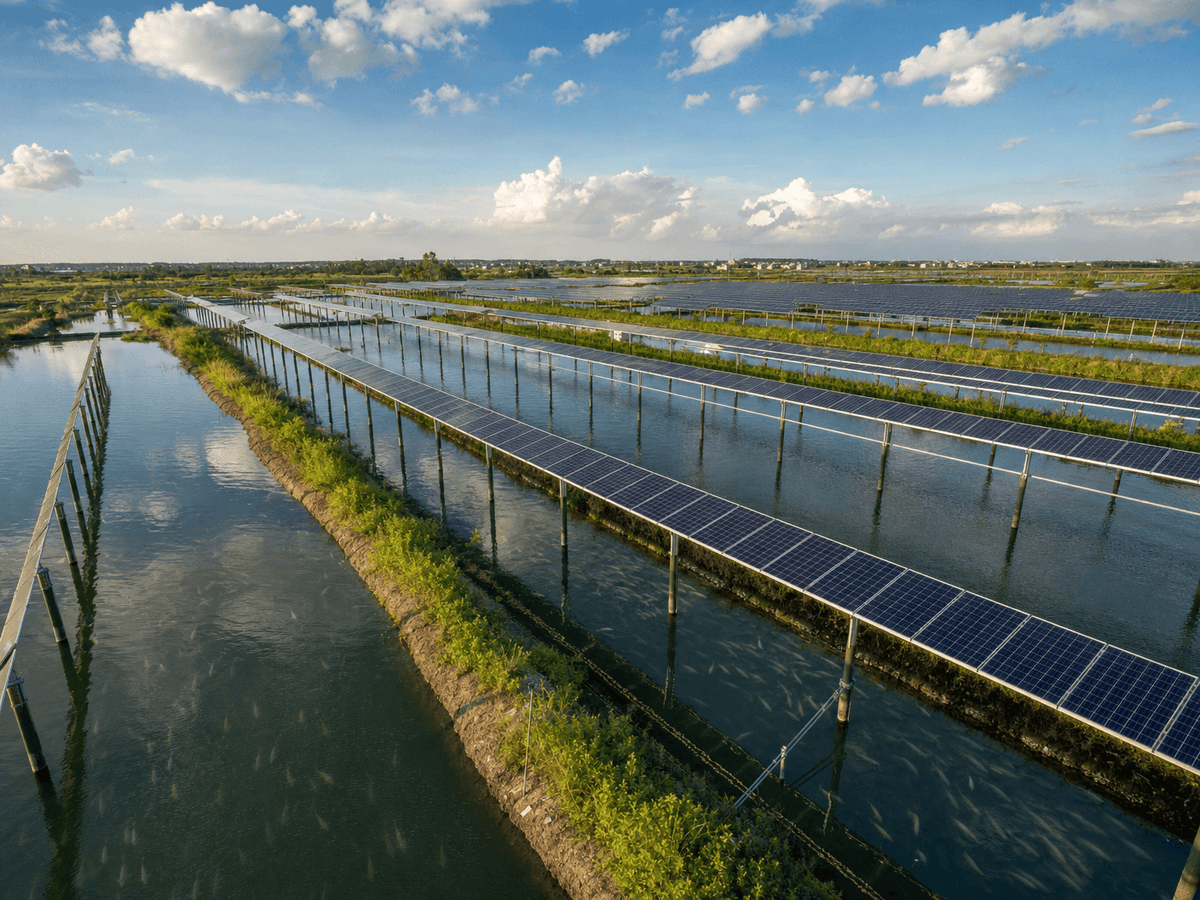
750kW Fishery-Solar Complementary - Bifacial 1-Axis PV System
Key Features
- 750 kWp DC fishery-solar PV system with approximately 1,072 × 700 W bifacial modules
- 22% module efficiency with 10-30% bifacial rear-side gain depending on water reflectivity and layout
- 1-axis tracking increases annual yield by 15-25% versus fixed-tilt PV in suitable irradiance zones
- Estimated annual generation of about 1,500 MWh with roughly 900 tons/year CO2 offset
- EPC turnkey pricing from USD 283,500 to USD 362,200 with 25-year panel and 10-year inverter warranty structure
The 750kW Fishery-Solar Complementary system is a utility-scale solar PV solution designed for aquaculture ponds and water-surface-adjacent installations, using 22% efficient bifacial modules and 1-axis tracking to increase yield by 15-25% over fixed-tilt designs. Engineered for dual-use fishery applications, it combines approximately 750 kWp DC capacity, elevated corrosion-resistant structures, and grid-ready power conversion for lower LCOE and improved land-water productivity.
Description
The 750kW Fishery-Solar Complementary system is a 750 kWp utility-scale solar PV plant engineered for aquaculture and fishery environments where water surface utilization, power generation, and agricultural productivity must coexist within the same project boundary. It combines 22% module efficiency, bifacial PV technology, and 1-axis tracking to improve annual energy yield by 15-25% versus fixed-tilt systems, while elevated mounting above pond or embankment zones supports fishery operations and maintenance access. For buyers evaluating medium-scale distributed generation or sub-utility projects, this configuration is designed to balance CAPEX, corrosion resistance, and long-term energy performance within an EPC turnkey range of USD 283,500 to USD 362,200.
In practical engineering terms, a 750 kW fishery-solar plant is typically selected for commercial aquaculture bases, cooperative fish farms, cold-chain support loads, aeration systems, pumping stations, and village-level feeders with daytime demand profiles between 400 kW and 900 kW. Because the project uses bifacial modules over water-adjacent surfaces, rear-side gain can add 10-30% depending on reflected irradiance, row spacing, and surface albedo, which aligns with bifacial performance ranges documented by NREL and deployment trends summarized by IRENA. Compared with a conventional diesel-powered fishery energy setup, this solar configuration can reduce fuel-related operating expenditure by 50-80% and materially lower maintenance events over a 25-year asset life, especially where diesel prices exceed USD 0.90/L.
Why Fishery-Solar Complementary Design Matters
Fishery-solar complementary projects are a form of agrivoltaics optimized for aquaculture, where the same site can produce electricity and aquatic products with limited conflict between the 2 outputs. In a typical pond-based deployment, the elevated PV structure is installed more than 1 meter above the operational zone, and many projects use clear heights of 2.5-4.5 meters to preserve feeding, netting, aeration, and inspection pathways. This dual-use model can improve area productivity per hectare by 1.3-1.8 times compared with single-use fishery land, depending on local irradiance, pond geometry, and stocking density. For developers seeking higher revenue density from constrained land assets, this is often superior to a standard ground-mount farm that produces only electricity.
The water-surface environment also changes the thermal and optical behavior of the PV field. Module operating temperature can be 2-5°C lower than inland ground-mounted arrays under similar irradiance because of evaporative and convective effects near water, which can improve real-world generation by 1-3% depending on climate. At the same time, the design must account for humidity above 75%, salt or mineral exposure in some ponds, higher corrosion risk, cable routing protection, and stricter structural analysis for service walkways and maintenance loads. Relevant module and safety compliance references include IEC 61215 for design qualification, IEC 61730 for PV module safety, UL 1703 legacy market recognition in some procurement frameworks, and IEC 62116 for inverter anti-islanding behavior.
System Architecture
This 750 kWp configuration is generally based on high-power bifacial modules in the 680-710 W class, making approximately 1,070-1,103 modules a realistic engineering range depending on final DC/AC ratio and exact module wattage. With a common 700 W bifacial module selection, the array uses about 1,072 modules to reach 750.4 kWp DC installed capacity. These modules are mounted on a single-axis horizontal tracker, which follows the sun through the day and typically increases annual specific yield by 15-25% compared with fixed-tilt structures, especially at latitudes between 15° and 35° where tracker economics are strongest according to market studies from BloombergNEF and system simulations commonly benchmarked with NREL PVWatts.
For inverter topology, a 750 kW fishery project usually favors either 1 central inverter in the 630-800 kW AC class or multiple high-power string inverters totaling 600-700 kW AC, depending on grid code, redundancy requirements, and maintenance strategy. In fishery environments, many EPC buyers prefer string-based segmentation because a failure in 1 unit affects a smaller fraction of plant output, while central inverters can reduce per-watt cost at this scale. DC/AC ratios in the 1.15-1.30 range are common, and a ratio of roughly 1.20 can improve inverter loading and annual yield without excessive clipping in most irradiance conditions.

The support structure for this application uses hot-dip galvanized steel, zinc-aluminum-magnesium coated steel, or marine-grade aluminum in selected subcomponents, with corrosion protection designed for 20-25 years of outdoor service. Tracker torque tubes, bearings, and fasteners should be specified for high-humidity duty, and cable management should maintain clearance from splash zones and service equipment. In many fishery deployments, row spacing is engineered between 5 meters and 8 meters to preserve pond access, reduce mutual shading, and maintain rear-side irradiance exposure. This is not simply a standard utility tracker placed over water; it requires structural detailing for fishery operations, O&M safety, and long-span access planning.
Technical Specifications
Based on the provided configuration, the system specification can be summarized as follows: System Capacity: 750 kWp; Module Type: bifacial; Module Efficiency: 22%; Array Configuration: 1-axis. Estimated annual generation for a well-sited project is approximately 1,350-1,650 MWh/year, assuming specific yield of 1,800-2,200 kWh/kWp/year in strong solar regions and tracker-assisted bifacial gain. A representative planning figure of 1,500 MWh/year is reasonable for early-stage budgeting. This corresponds to a capacity factor of about 22.8%, annual CO2 offset of roughly 900 tons/year using a grid emissions factor near 0.60 tCO2/MWh, and an indicative system area of around 6,000-8,500 m² depending on tracker spacing and fishery access corridors.
For LCOE, a well-executed project in a high-irradiance region can achieve approximately USD 0.025-0.038/kWh, which is consistent with utility and distributed PV cost trajectories reported by IRENA and IEA for favorable markets. Simple payback often falls between 3.8 and 6.5 years when daytime self-consumption is high and displaced electricity costs are above USD 0.08-0.12/kWh. Standard warranty structure is 25 years for PV module performance and 10 years for inverter equipment, with EPC workmanship coverage of 1 year included in the turnkey package and optional extensions available for 2-5 additional years.
Energy Yield and Performance Modeling
A 750 kWp bifacial tracker system installed in a fishery setting can outperform a monofacial fixed-tilt design by a meaningful margin because 3 effects combine at once: tracker gain, bifacial rear-side gain, and lower module operating temperature near water. If a conventional fixed monofacial array at the same site produces 1,250 MWh/year, the fishery-solar complementary design may produce 1,500 MWh/year or more, representing about 20% additional annual output. That difference of 250 MWh/year can materially improve project IRR, especially where power offsets retail or commercial tariffs rather than wholesale feed-in rates.
From a degradation perspective, modern TOPCon and HJT bifacial modules generally target first-year degradation around 1% or less and linear annual degradation near 0.4% thereafter, though actual warranty terms vary by manufacturer. Over 25 years, this can preserve more than 87-89% of nameplate output under standard warranty curves. According to Wood Mackenzie and broader market observations entering 2025-2026, TOPCon technology accounts for roughly 60% of new module shipments, while 700 W+ large-format modules are now mainstream in utility procurement. For B2B buyers, this means the 750kW platform can be sourced with bankable components that align with current market liquidity and replacement availability.
Fishery Benefits Beyond Power Generation
The fishery value proposition is not limited to electricity. Partial shading over ponds can lower peak water temperature by 1-3°C in hot seasons, which may reduce thermal stress for selected species and decrease evaporation losses by a measurable margin, although exact biological effects depend on stocking method, dissolved oxygen control, and local climate. In some deployments, operators report reduced algae pressure in heavily exposed pond sections because light intensity is moderated. The key engineering point is that the PV layout should preserve enough open-water ratio, often 30-50%, to maintain species-specific growth conditions and operational flexibility.
A solar farm operator in a coastal aquaculture zone in the MENA region, for example, could deploy a 750 kW fishery-solar system across 2-3 hectares of pond infrastructure to offset daytime aeration, pumping, and refrigeration loads totaling 1,200-1,500 MWh/year. If the project generates 1,520 MWh/year and self-consumes 70%, annual electricity cost savings at USD 0.11/kWh could exceed USD 117,000, before accounting for diesel displacement and reduced outage exposure. Compared with a fully diesel-backed power model, annual CO2 emissions may fall by approximately 900-1,100 tons, while noise and fuel logistics are significantly reduced.
Cloud Monitoring and O&M Digitalization
Remote monitoring is essential in distributed aquaculture energy projects because sites are often spread across multiple ponds and may have limited on-site technical staff. A modern monitoring platform tracks inverter status, string current, irradiance, tracker angle, combiner alarms, and cumulative generation in intervals as short as 5 minutes. With properly configured analytics, operators can identify underperforming strings, tracker stow events, and communication failures within 1 hour, improving availability above 98% in well-managed assets. This is especially important in fishery applications where daytime loads such as aeration may be operationally critical.
For procurement teams evaluating lifecycle cost, cloud-based O&M can reduce troubleshooting travel frequency by 20-40% and shorten fault response time by 30-60% compared with plants that rely on manual monthly inspection alone. SOLARTODO supports project planning and product selection through View all Solar PV System products, technical guidance via Learn about topic, and pre-sales design through Configure your system online. Buyers with location-specific irradiance, corrosion class, or grid interconnection requirements can also Request a custom quotation for site-calibrated engineering.

Compliance, Safety, and Bankability
For bankable procurement, module selection should comply with IEC 61215 and IEC 61730, while inverter equipment should align with IEC 62116 and local grid code requirements for anti-islanding, voltage ride-through, and power quality. Depending on market destination, additional conformity may include CE marking, EMC requirements, and utility interconnection studies referencing IEEE practices for protection coordination. In fishery environments, insulation resistance checks, DC connector integrity, and earthing continuity are particularly important because humidity, salt mist, and service activity can raise long-term reliability risk if material selection is weak.
From an insurance and lender perspective, a 750 kW project with documented component traceability, corrosion-resistant structure, and SCADA data retention is easier to underwrite than an improvised mixed-brand installation. This matters because the difference between 97% and 99% availability over 1,500 MWh/year is about 30 MWh/year, which at USD 0.10/kWh equals USD 3,000/year in value. Over 10 years, that gap can exceed USD 30,000 before discounting. For this reason, serious B2B buyers usually prioritize tested BOS design, spare parts planning, and O&M visibility over the lowest headline equipment price.
EPC Investment Analysis and Pricing Structure
The EPC turnkey scope for this 750 kW fishery-solar system includes 5 core packages: engineering, procurement, construction, commissioning, and warranty support. Engineering covers layout design, electrical single-line diagrams, structural calculations, and tracker integration; procurement includes modules, inverters, mounting, cables, combiner and AC infrastructure; construction covers civil and mechanical installation, electrical works, and testing; commissioning includes energization and performance verification; and the turnkey package includes 1-year workmanship and support coverage. For projects with specialized fishery civil interfaces, design review normally includes 1-2 rounds of site adaptation before final approval.
Pricing table
| Tier | Scope | Price Range (USD) |
|---|---|---|
| FOB Supply | Equipment only, ex-works China | 175,770 - 246,296 |
| CIF Delivered | Equipment + ocean freight + insurance | 193,927 - 271,738 |
| EPC Turnkey | Installed, commissioned, 1-year warranty | 283,500 - 362,200 |
Volume discount table
| Order Volume | Discount |
|---|---|
| 50+ systems | 5% |
| 100+ systems | 10% |
| 250+ systems | 15% |
On ROI, if the plant produces 1,500 MWh/year and offsets power at USD 0.10/kWh, annual gross electricity savings are about USD 150,000. Using an EPC midpoint near USD 322,000, simple payback can be approximately 2.9 years before financing and O&M, or around 3.5-5.0 years after including operating costs, downtime allowance, and conservative degradation assumptions. Compared with diesel generation at USD 0.22-0.35/kWh, annual savings could rise to USD 180,000-375,000 depending on runtime and fuel logistics. Payment terms are 30% T/T + 70% B/L, or 100% L/C at sight; financing support is available for projects above USD 5,000K. For quotations and commercial terms, contact [email protected].
Procurement Guidance for B2B Buyers
For EPC contractors, fishery cooperatives, and project developers, the most important pre-order inputs are 6 items: site coordinates, annual load profile, pond geometry, water chemistry or corrosion class, interconnection voltage, and local wind design criteria. A difference of only 2-3 meters in row spacing or maintenance access can change steel volume, tracker count, and cable routing enough to affect project cost by several percentage points. Likewise, if the local grid requires export limitation, the inverter and EMS strategy may need additional controls that should be budgeted before tender close.
Buyers comparing options should also evaluate whether a fixed-tilt system with lower CAPEX or a tracker system with higher yield is more suitable. At 750 kW, a tracker often wins where irradiance is strong and O&M access is manageable, but fixed-tilt may remain attractive in cyclone-prone or highly constrained sites. For decision support, SOLARTODO provides product comparison and technical resources at Learn about topic, plus direct engineering inquiry through Request a custom quotation. In many cases, a 2-4 week front-end design cycle is enough to convert a concept budget into a tender-ready bill of materials.
Conclusion
The 750kW Fishery-Solar Complementary system is designed for buyers who need more than a generic PV plant: it is a dual-use energy platform built for aquaculture operations, high-humidity conditions, and long-term asset productivity. With 22% efficient bifacial modules, 1-axis tracking, estimated generation of around 1,500 MWh/year, and EPC pricing from USD 283,500 to USD 362,200, it offers a technically credible path to lower electricity cost, reduced diesel dependence, and better site utilization over 25 years. For projects seeking high-yield solar integrated with fishery infrastructure, this configuration is aligned with current 2025-2026 component trends, recognized IEC standards, and practical B2B procurement requirements.
Technical Specifications
| System Capacity | 750kWp |
| Module Type | Bifacial |
| Module Efficiency | 22% |
| Array Configuration | 1-axis tracker |
| Application | Fishery-solar complementary |
| Water Surface | Yes |
| Estimated Annual Generation | 1500MWh |
| Capacity Factor | 22.8% |
| System Area | 7000m² |
| CO2 Offset | 900tons/year |
| Payback Period | 4.5years |
| LCOE | 0.031USD/kWh |
| Warranty | 25-year panels, 10-year inverter |
Price Breakdown
| Item | Quantity | Unit Price | Subtotal |
|---|---|---|---|
| 700W bifacial solar modules | 1072 pcs | $154 | $165,088 |
| Central inverter 630kW class | 1 pcs | $37,500 | $37,500 |
| Single-axis tracker structure set | 1 pcs | $90,000 | $90,000 |
| DC cables and combiner boxes | 1 pcs | $15,000 | $15,000 |
| AC infrastructure and protection | 1 pcs | $22,500 | $22,500 |
| Monitoring and SCADA system | 1 pcs | $500 | $500 |
| Engineering & QC | 1 pcs | $8,500 | $8,500 |
| Installation & Commissioning | 1 pcs | $60,000 | $60,000 |
| 1-Year Warranty & Support | 1 pcs | $3,000 | $3,000 |
| Total Price Range | $283,500 - $362,200 | ||
Frequently Asked Questions
What makes this 750kW system suitable for fishery and aquaculture projects?
How much more energy can bifacial modules and 1-axis tracking generate?
What is included in the EPC turnkey price?
What warranties and standards apply to this system?
How fast is the investment payback for a 750kW fishery-solar project?
Certifications & Standards


Data Sources & References
- •NREL PVWatts 2025
- •IRENA Renewable Power Generation Costs 2024/2025
- •IEA World Energy Outlook 2025
- •BloombergNEF PV Market Outlook 2025
- •Wood Mackenzie Global Solar Module Market 2025
- •IEC 61215
- •IEC 61730
Interested in this solution?
Contact us for a customized quote based on your specific requirements.
Contact Us