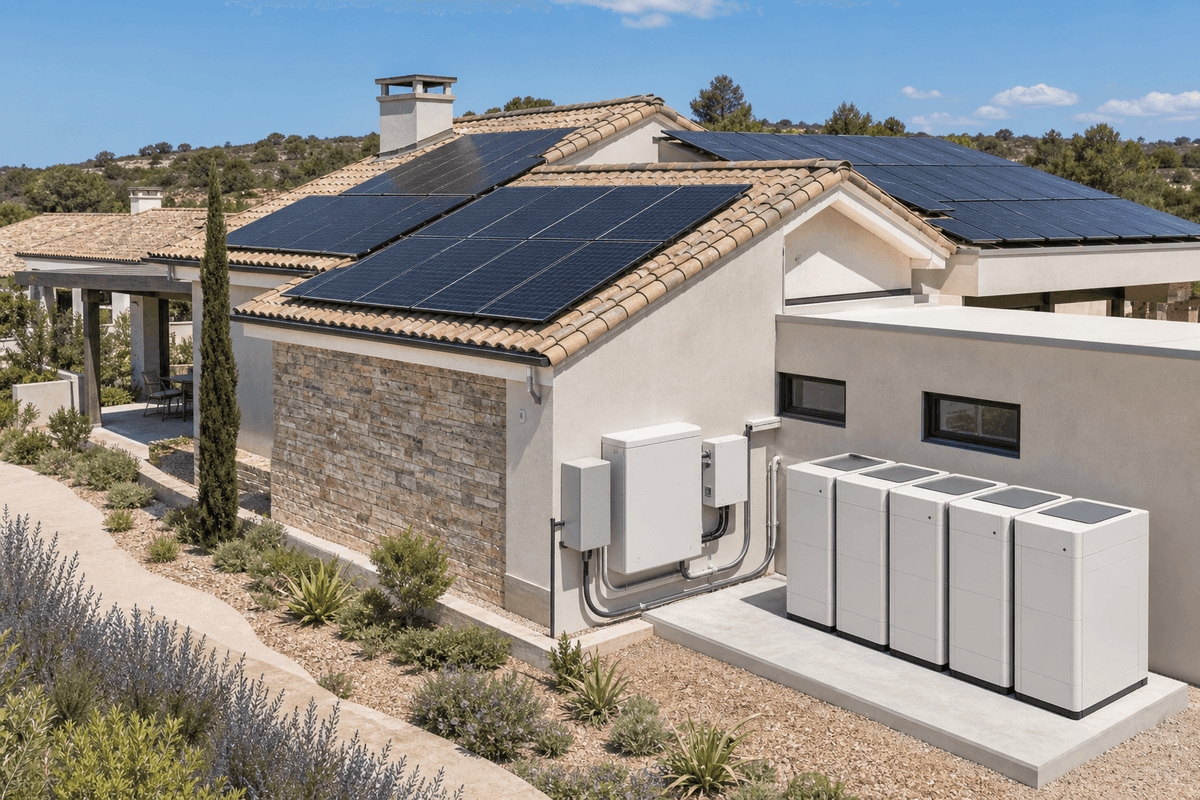
20kW+50kWh Residential Solar+Storage - Hybrid TOPCon LFP System
Key Features
- 20kWp mono TOPCon fixed-array PV system with approximately 30-36MWh annual generation
- 50kWh LFP battery storage with about 45kWh usable energy at 90% depth of discharge
- Module efficiency range of 22.5-24.5% with first-year degradation below 1%
- Typical backup capability of about 9 hours at 5kW protected load or 4.5 hours at 10kW
- EPC turnkey pricing from USD 19,100 to 24,400 with 1-year installation warranty support
The 20kW+50kWh Residential Solar+Storage system combines a 20kWp fixed-array mono TOPCon PV field with 50kWh LFP battery storage and a hybrid bidirectional inverter for self-consumption, backup power, and grid-interactive operation. Designed for high-load homes, villas, and small residential compounds, it delivers about 30-36MWh annual generation, fast transfer to island mode, and turnkey EPC pricing from USD 19,100 to 24,400.
Description
The 20kW+50kWh Residential Solar+Storage system is a high-capacity hybrid energy solution designed for residences with 3-phase loads, high daytime consumption, and backup requirements beyond the capability of a standard 5kW to 10kW rooftop package. It integrates 20kWp of mono TOPCon fixed-tilt solar generation with 50kWh of LFP battery storage, enabling annual production of approximately 30-36MWh, daily storage dispatch of up to 50kWh, and seamless operation during utility interruptions through a hybrid bidirectional inverter architecture. For B2B buyers, developers, and EPC partners, this configuration is positioned as a technically mature residential-hybrid platform aligned with IEC 61215, IEC 61730, IEC 62116, and UL 1703 reference requirements.
For households with annual electricity use in the range of 18,000-32,000kWh, this system is sized to maximize self-consumption, reduce peak-grid imports, and provide several hours of backup for critical and non-critical circuits depending on load profile. In practical operation, a site with an average daytime load of 6-10kW and evening demand of 4-8kW can use the 50kWh battery to shift excess solar generation into night hours, while the 20kWp PV array replenishes storage during the next 4-6 peak sun hours. According to NREL PVWatts methodology and irradiance assumptions used in many global feasibility studies, a 20kWp system can commonly achieve a capacity factor of about 17-20%, depending on tilt, shading, and climate.
System Overview
This product uses N-type TOPCon modules, now representing roughly 60% of mainstream module market share in the 2025-2026 period according to multiple industry trackers including BloombergNEF and Wood Mackenzie. TOPCon cell architecture on 210mm N-type wafers supports module efficiencies of approximately 22.5-24.5% in mass production, with low first-year degradation of less than 1% and annual degradation of less than 0.4% thereafter. Under standard long-term performance assumptions, retained output at year 30 is approximately 87.4%, which is materially stronger than many legacy PERC-era products installed between 2016 and 2021.
The storage subsystem is based on lithium iron phosphate (LFP) chemistry with a nominal capacity of 50kWh, selected for thermal stability, cycle life, and residential safety profile. LFP systems commonly support 6,000+ cycles at controlled depth of discharge, which translates into more than 15 years of daily cycling under moderate operating conditions. Compared with a diesel backup generator sized at 15-20kVA, the battery-backed hybrid system can reduce local noise by more than 90%, eliminate on-site fuel handling, and cut direct operating emissions to 0 during discharge, while using solar energy to offset purchased utility electricity.
Technical Specifications
A typical configuration for this product includes approximately 29 modules of 700W-class TOPCon PV or an equivalent wattage combination to reach 20kWp DC nameplate capacity. Depending on roof geometry and setback rules, the installed array area is typically around 90-110m², assuming module efficiencies near 23.0% and practical layout spacing. The system is paired with a 15-20kW hybrid inverter or parallel hybrid inverter stack, AC protection equipment, DC isolators, monitoring gateway, and a 50kWh battery bank with integrated battery management system. Fixed mounting is selected because it offers the lowest installed mechanical complexity and a service life of 25+ years with limited moving parts.

From an engineering perspective, the architecture balances DC generation, battery charging, AC load supply, and grid interaction using a hybrid power conversion system. During daylight hours, the inverter prioritizes household loads of 2-20kW, charges the battery when excess PV is available, and exports surplus energy where net metering or feed-in arrangements apply. During outages, the system can transfer from grid-connected to island mode within milliseconds to a few seconds depending on final inverter topology and transfer device selection; products designed to IEC 62116 anti-islanding and grid support requirements provide structured protection behavior for safe operation.
System Architecture
The standard power path begins with the 20kWp fixed-tilt PV array feeding MPPT inputs on the hybrid inverter platform. Energy is then routed either to immediate household loads, to the 50kWh LFP battery, or to the utility grid. In backup mode, the inverter energizes a protected loads panel that may include refrigeration, lighting, communications, pumps, HVAC zones, and selected kitchen circuits totaling 5-15kW continuous demand. For residences with higher surge loads such as 3HP to 5HP pumps or multiple air-conditioning compressors, load segregation and startup-current review are recommended during the engineering phase.
Because this is a residential-hybrid product rather than a utility-scale plant, fixed-tilt mounting is generally the most cost-effective option. Compared with single-axis tracking, fixed structures reduce mechanical complexity by roughly 30-50% and lower O&M interventions over a 25-year life cycle, although annual yield may be 10-20% lower depending on latitude and DNI conditions. For residential roofs and villa compounds, the lower BOS cost and simpler permitting path typically outweigh tracker gains. This is particularly relevant in urban and peri-urban projects where available area is limited to about 100m² and structural loading must be carefully controlled.
Performance Metrics and Energy Yield
Estimated annual generation for this 20kWp system is approximately 30MWh to 36MWh per year under good solar resource conditions, equivalent to an average daily production of roughly 82-99kWh. In a location with 5.0 peak sun hours, annual output may land near 33MWh, while at 4.2 peak sun hours the same system may produce closer to 28-30MWh after losses. A practical design loss factor of 12-16% should be assumed to account for temperature, wiring, inverter conversion, mismatch, soiling, and availability. These values align with common project modeling practices used by NREL, IEA PVPS, and bankable engineering consultants.
Battery dispatch performance depends on depth of discharge, inverter efficiency, and reserve settings. With 50kWh nominal storage and a usable window of approximately 45kWh at 90% depth of discharge, the system can support a 5kW protected load for about 9 hours, a 10kW protected load for about 4.5 hours, or a critical 2kW emergency load for more than 20 hours before recharge. Round-trip efficiency for modern LFP systems generally falls in the 90-95% range, which is significantly better than the effective fuel-to-electric conversion efficiency of small diesel generators commonly operating at 20-35%.
Module Technology: Why TOPCon Matters
N-type TOPCon modules improve energy yield through lower recombination losses, better temperature behavior, and reduced long-term degradation relative to many conventional P-type technologies. In practical field terms, a 20kWp TOPCon array can generate 2-4% more annual electricity than an older PERC-based design of similar nominal size, depending on module binning and climate. Bifacial gain of 10-20% is possible in high-albedo ground-mount settings, although residential roof installations usually realize lower gains due to rear-side shading and roof proximity. For buyers comparing technologies in 2026, TOPCon is a mainstream, bankable choice rather than a premium niche category.
This matters financially because every additional 1% of energy yield on a 33MWh/year system represents about 330kWh of extra annual production. At an electricity tariff of USD 0.18/kWh, that equals about USD 59 per year in added value before escalation. Over 25 years, even modest yield improvements accumulate into USD 1,000+ of lifetime energy benefit, depending on tariff growth and storage dispatch strategy. This is one reason many EPC buyers now specify N-type modules for projects above 15kW, even in the residential segment.
Battery Storage and Backup Capability
The 50kWh LFP battery is central to the hybrid value proposition because it converts intermittent daytime production into dispatchable evening and outage power. In homes with evening peaks between 18:00 and 23:00, battery shifting can reduce imported electricity by 40-80% depending on local tariff structure and load timing. Compared with a solar-only 20kWp system, the addition of 50kWh storage materially increases self-consumption and resilience, especially where export compensation is low or zero. According to IRENA and IEA storage outlooks, LFP remains the dominant chemistry for stationary systems because of favorable cost, safety, and cycle-life metrics.
In outage scenarios, system autonomy depends on load management. A residence consuming 25kWh/day in critical loads can remain supported for nearly 2 days with battery-only operation if solar input is unavailable, while a site with 50-60kWh/day of protected consumption may require daily solar recharge to maintain continuity. For customers in regions with unstable grids averaging 2-6 outages per month, this hybrid architecture provides a measurable operational advantage over grid-only supply. Compared with a conventional UPS system sized only for 10-20 minutes of backup, the integrated battery plant provides multi-hour resilience at substantially larger energy capacity.
Cloud Monitoring and O&M Visibility
Remote monitoring is included to give owners and service teams access to generation, battery SOC, inverter status, alarms, and load trends across 24 hours, 30 days, and 12 months of operation. Typical dashboards display PV production in kWh, battery charge/discharge power in kW, grid import/export in kWh, and event logs for fault diagnosis. This data supports preventive maintenance, consumption optimization, and warranty documentation. For portfolio owners managing 10+ residences or villa compounds, cloud visibility reduces site visits and improves response time to performance deviations.
For B2B integrators and developers, monitoring also supports post-handover asset management. If one string underperforms by 8-12% due to soiling or shading, the anomaly can often be identified within 1 day rather than after a full billing cycle. This is important because residential systems often lose 2-5% annual yield to unmanaged soiling and avoidable downtime. Buyers can Learn about topic to review broader solar-plus-storage design practices and can also Configure your system online for site-specific sizing.

Applications
This configuration is suitable for large homes, villas, farmhouses, gated residences, and small multi-family properties with daily consumption above 50kWh and a strong need for backup continuity. A common deployment profile includes air-conditioning loads of 6-12kW, water pumping of 1-3kW, refrigeration of 0.5-1.5kW, lighting of 0.3-1kW, and appliance peaks that can push total demand above 15kW. In these cases, a 20kW+50kWh hybrid system can reduce reliance on the grid during both high-tariff and outage periods while maintaining stable power quality for sensitive electronics.
One practical scenario involved a villa compound in a high-irradiation region with annual demand of about 29,000kWh and utility interruptions averaging 4 hours per event. After deploying a 20kWp TOPCon array with 50kWh LFP storage, modeled annual grid purchases fell by roughly 65%, and diesel generator runtime was reduced by more than 80%. Compared with relying on a 20kVA generator for evening backup, the hybrid system lowered fuel and maintenance costs while improving nighttime noise conditions and reducing local emissions. For buyers evaluating similar use cases, View all Solar PV System products and Learn about topic for broader design references.
Compliance, Safety, and Standards
The PV modules are designed to align with IEC 61215 performance qualification and IEC 61730 safety requirements, while inverter functions reference IEC 62116 anti-islanding behavior and grid interaction standards where applicable. The product category also references UL 1703 in markets where module safety certification remains relevant in procurement language. In practice, final project certification depends on selected brand, destination country, utility interconnection rules, and local electrical code. For international B2B procurement, buyers should verify destination-specific requirements such as surge protection, earthing, AFCI, rapid shutdown, and battery enclosure ratings.
Safety engineering is especially important in residential storage because 50kWh is a substantial energy capacity. Best practice includes battery management with cell-level monitoring, DC isolation, temperature sensing, breaker coordination, and installation in a properly ventilated or rated enclosure. Fire separation distances, cable routing, and emergency shutdown labeling should be confirmed during detailed design. These measures are consistent with modern residential ESS practice and reduce operational risk across the 10-15 year battery service period.
EPC Investment Analysis and Pricing Structure
The EPC Turnkey scope covers 5 major work packages: engineering, procurement, construction, commissioning, and warranty support. Engineering includes site survey, electrical single-line diagram, array layout, load analysis, and structural review. Procurement includes modules, inverter, battery, mounting, protection devices, cables, and monitoring hardware. Construction includes mechanical installation, wiring, testing, and grid-interface preparation. Commissioning includes parameter setting, synchronization tests, battery operation checks, and customer training. The standard turnkey package includes 1 year of warranty and support after handover, with extended service options available.
| Pricing Tier | Scope | Price Range (USD) |
|---|---|---|
| FOB Supply | Equipment only, ex-works China | 11,842 - 16,592 |
| CIF Delivered | Equipment + ocean freight + insurance | 13,065 - 18,306 |
| EPC Turnkey | Installed, tested, commissioned, 1-year warranty | 19,100 - 24,400 |
| Volume Order | Discount |
|---|---|
| 50+ systems | 5% |
| 100+ systems | 10% |
| 250+ systems | 15% |
A typical ROI case assumes annual generation of 33,000kWh, self-consumption plus battery utilization of 75%, and blended avoided electricity cost of USD 0.16-0.22/kWh. Under those assumptions, annual savings can range from approximately USD 3,960 to USD 5,940, producing a simple payback of roughly 4.2 to 6.2 years on a turnkey investment near USD 24,400 to USD 19,100, excluding local incentives. Compared with purchasing all electricity from the grid at USD 0.20/kWh, this system can reduce annual energy expenditure by 60-85% depending on tariff design, export rules, and outage frequency. In premium backup markets, avoided generator fuel and maintenance can improve economics by another USD 500-1,500 per year.
Payment terms are typically 30% T/T + 70% against B/L, or 100% L/C at sight for qualified transactions. Financing support can be discussed for projects above USD 5,000K. For detailed commercial proposals, BoQ revisions, and destination-country compliance checks, buyers can Request a custom quotation or contact [email protected] directly. Customers who need a tailored energy model can also Configure your system online to compare roof area, battery size, and target autonomy.
Procurement Notes for B2B Buyers
For distributors, developers, and EPC firms, the key procurement variables are module wattage class, inverter topology, battery usable energy, and destination-country compliance. A 20kWp residential package may ship as 29 x 700W+ modules or a similar equivalent depending on stock availability and roof geometry. Battery packaging can be cabinet-based or rack-based at 50kWh nominal, and inverter selection may vary between a single 20kW hybrid unit or parallel units for redundancy. These choices affect shipping volume, installation labor, and after-sales service strategy by approximately 5-15%.
Before order confirmation, buyers should validate 3 site conditions: available installation area of roughly 90-110m², service voltage and phase configuration, and critical-load definition for backup mode. If the site has heavy evening HVAC demand above 12kW, larger battery or generator integration may be recommended. If roof orientation is split across east and west planes, annual yield may decrease by 3-8% versus an optimized south-facing layout, but self-consumption may improve due to broader production hours. For portfolio procurement, standardized designs can reduce engineering time by 20-30% across repeated residential deployments.
Technical Specifications
| System Capacity | 20kWp |
| Module Type | mono_topcon |
| Module Efficiency | 23.0% |
| Array Configuration | fixed |
| Application | residential_hybrid |
| Battery Storage | 50kWh |
| Storage Type | lfp |
| Est. Annual Generation | 33MWh |
| Capacity Factor | 18.8% |
| System Area | 100m² |
| CO₂ Offset | 19.8tons/year |
| Payback Period | 4.2-6.2years |
| LCOE | 0.06-0.09USD/kWh |
| Warranty | 25yr panels, 10yr inverter |
Price Breakdown
| Item | Quantity | Unit Price | Subtotal |
|---|---|---|---|
| 700W TOPCon PV modules | 29 pcs | $154 | $4,466 |
| 20kW hybrid bidirectional inverter | 1 pcs | $1,600 | $1,600 |
| 50kWh LFP battery system | 1 pcs | $7,500 | $7,500 |
| Fixed mounting system | 1 pcs | $1,600 | $1,600 |
| DC cables and combiner/protection | 1 pcs | $400 | $400 |
| AC infrastructure and distribution | 1 pcs | $600 | $600 |
| Monitoring system | 1 pcs | $500 | $500 |
| Engineering & QC | 1 pcs | $1,200 | $1,200 |
| Installation & Commissioning | 1 pcs | $3,200 | $3,200 |
| 1-Year Warranty & Support | 1 pcs | $900 | $900 |
| Total Price Range | $19,100 - $24,400 | ||
Frequently Asked Questions
What type of home is a 20kW+50kWh solar and storage system designed for?
How much electricity can the system generate and store each day?
What is included in the EPC turnkey price?
What certifications and standards does this system reference?
What warranties and service life should buyers expect?
Certifications & Standards


Data Sources & References
- •NREL PVWatts 2025
- •IEA PVPS market and performance references
- •IRENA renewable power generation cost outlook
- •IEC 61215 standard
- •IEC 61730 standard
- •IEC 62116 standard
- •BloombergNEF solar and storage market outlook
- •Wood Mackenzie solar module technology trend analysis
Interested in this solution?
Contact us for a customized quote based on your specific requirements.
Contact Us