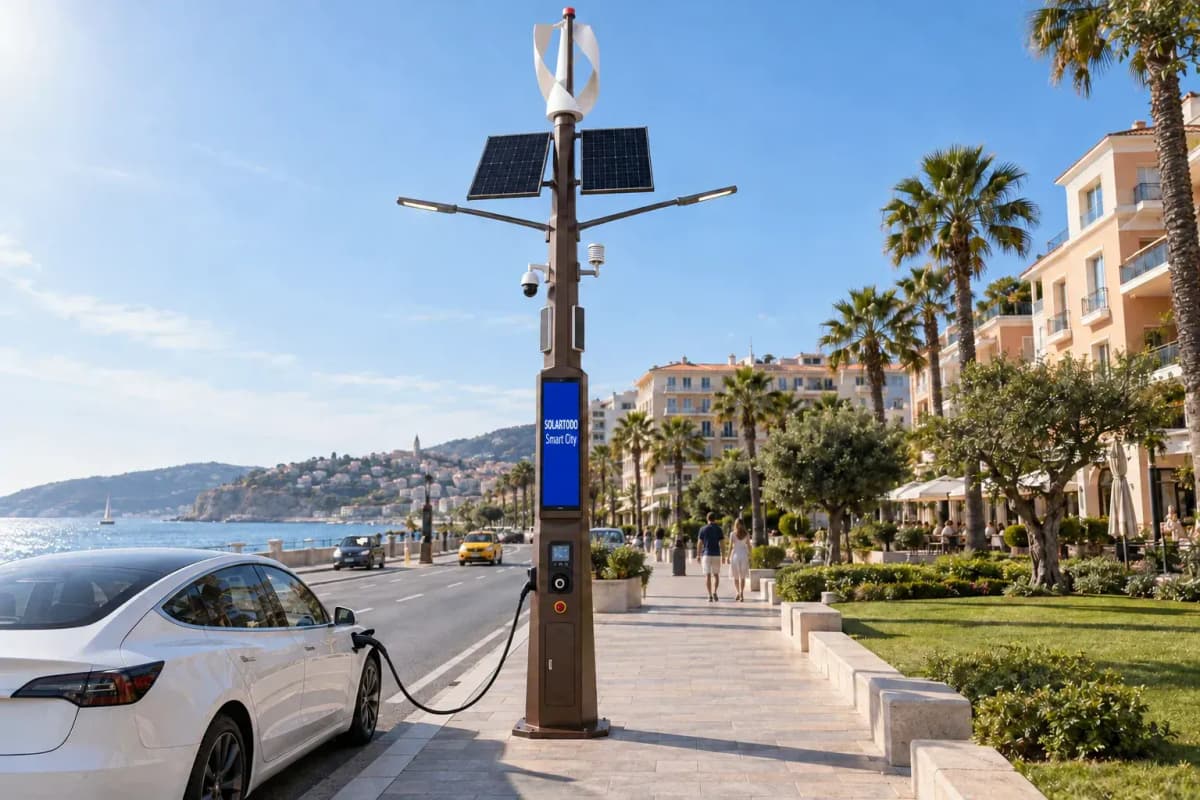
14m Wind-Solar Hybrid Smart Pole - Smart Community
Key Features
- 14m octagonal tapered steel pole with 45cm base diameter, 15cm top diameter, and RAL8011 antique bronze finish
- Hybrid self-powered package with 300W Savonius VAWT, 400W monocrystalline PV, 5kWh LFP battery, and grid backup
- Integrated 7kW Type 2 AC EV charger with OCPP 1.6J, 5m coiled cable, touchscreen, E-stop, and maintenance door
- Twin 1.5m arms with 2 × 80W LED luminaires, 150 lm/W efficacy, 4000K CCT, and 24,000 lm total output
- Smart-community module set includes 4MP IR camera, 8-parameter ENV sensor, 30W IP speaker, 1000 × 2000mm P3 LED display, WiFi 6, 5G, and LoRaWAN
The 14m Wind-Solar Hybrid Smart Pole integrates a 300W Savonius VAWT, 400W monocrystalline PV, 5kWh LFP storage, 160W LED lighting, 7kW OCPP EV charging, P3 LED display, 4MP camera, 8-parameter sensing, PA audio, WiFi 6, 5G, and LoRaWAN in 1 continuous steel pole structure.
Description
The 14m Wind-Solar Hybrid Smart Pole · Smart Community is a 10-in-1 integrated smart streetlight for residential districts, campuses, municipal roads, and mixed-use communities requiring lighting, EV charging, surveillance, sensing, communications, and public messaging from 1 pole footprint. Each 14m octagonal tapered steel pole combines a 300W Savonius vertical-axis wind turbine, 2 × 200W monocrystalline PV modules, a 5kWh LFP battery, 2 × 80W LED luminaires, a 7kW Type 2 AC charger, a 1000 × 2000mm P3 LED display, and 5G + WiFi 6 + LoRaWAN connectivity.
The system is designed for projects where 109 poles at 35m spacing can create approximately 3.8km of smart-community coverage with distributed energy, safety, and digital-service nodes. Unlike a conventional streetlight plus a separate EV charger cabinet, the lower 2.2m of this pole is the EV charging cabinet itself, welded as 1 continuous steel structure to reduce separate civil foundations, separate cabinet anchoring, and exposed cable paths by an estimated 30-50% depending on site layout.
Product Definition and Use Case
This variant belongs to SOLARTODO’s Smart Streetlight product line and is intended for smart communities that need 10 integrated functions in 1 roadside asset. The product architecture covers LED lighting, wind generation, solar generation, battery storage, EV charging, video surveillance, environmental sensing, emergency SOS, IP public address, LED advertising, and wireless gateway service; buyers can View all Smart Streetlight (10-in-1 Multi-function Pole) products when comparing 6m, 8m, 10m, 12m, and 14m configurations.
The 14m pole uses an octagonal tapered steel shaft with a 45cm base diameter and 15cm top diameter, finished in antique bronze RAL8011 for community streets, plazas, and residential entrances. The pole spacing of 35m supports a practical design density of about 28.6 poles per linear kilometer, so a 109-unit package can cover about 3,815m of roadway or pathway alignment before branch roads, parking bays, and intersections are added.
System Architecture
The hybrid power system places a 300W Savonius bucket VAWT at the apex, using 2 curved scoops in a 60cm × 90cm rotor envelope with a red aviation LED for top visibility. Solar input is provided by 2 × 200W deep-black monocrystalline panels on symmetric east-west A-frame brackets at 15 degrees, giving 400W of nominal PV capacity per pole and 43.6kW of PV nameplate capacity across 109 poles.
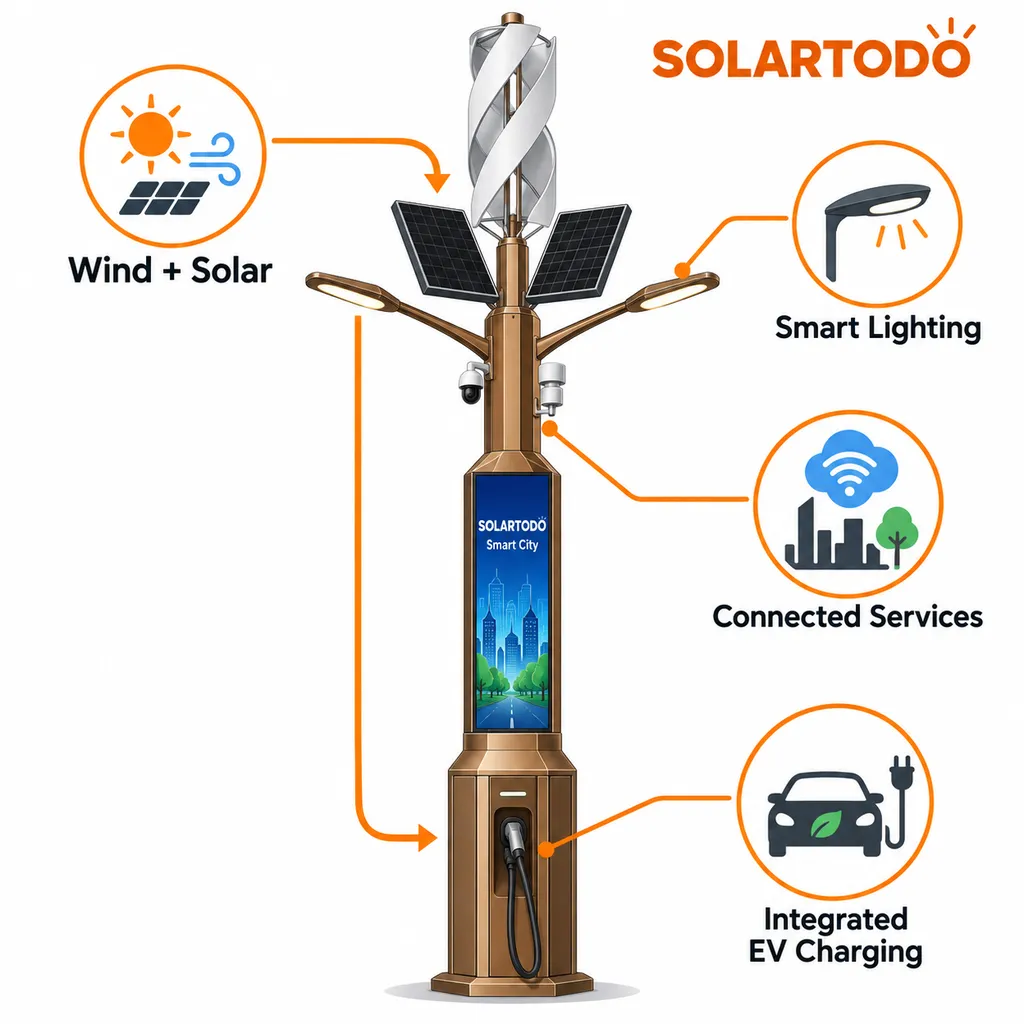
Energy storage uses a 5kWh lithium iron phosphate battery inside the pole base with an MPPT controller to manage PV and wind charging. For a 109-pole site, the distributed storage total is 545kWh, which allows the community owner to spread backup capacity across many points rather than concentrating all storage in 1 electrical room.
The smart pole includes backup grid tie for reliability, and interconnection design should be coordinated with the local utility under the same discipline used for distributed energy resources. IEEE 1547 defines performance and interoperability requirements for distributed energy resources connected to electric power systems, so it is a relevant reference when a community connects 109 hybrid poles to a grid-backed feeder rather than operating them as purely standalone assets IEEE 1547.
Technical Specifications
| Subsystem | Specification | Project-Relevant Value |
|---|---|---|
| Pole structure | Octagonal tapered steel | 14m height, 45cm base, 15cm top |
| Wind generation | Savonius VAWT | 300W, 60 × 90cm rotor |
| Solar generation | Monocrystalline PV | 2 × 200W, 15 degree east-west tilt |
| Battery | LFP storage | 5kWh inside pole base |
| Lighting | Twin LED arms | 2 × 80W, 150 lm/W, 4000K |
| EV charging | AC single gun | 7kW, Type 2, OCPP 1.6J |
| Display | P3 LED screen | 1000 × 2000mm, >6000 cd/m2 |
| Camera | Bullet camera | 4MP, 50m IR |
| Sensor | Environmental | 8 parameters |
| Gateway | Wireless and wired | WiFi 6, 5G, GbE, LoRaWAN |
The twin luminaire arrangement uses 1.5m symmetric arms with a +8 degree upward tilt and 2 × 80W LED heads rated at 150 lm/W and 4000K neutral-white output. Total LED load is 160W per pole, and the design provides 24,000 lumens per pole before optical distribution losses, which is suitable for community roads, parking lanes, and walkable public areas when photometric spacing is validated by Dialux or equivalent software.
The camera subsystem uses 1 fixed 4MP bullet camera with 50m infrared range on a 30cm short-arm bracket, providing a surveillance envelope that matches typical pole-to-pole spacing of 35m. For 109 poles, the camera count is 109 fixed video points, so network planning should budget upstream video bandwidth separately from telemetry, public WiFi, OCPP, and environmental-sensor traffic.
The environmental head measures 8 parameters: temperature, humidity, wind, pressure, noise, PM2.5, PM10, and illuminance. These measurements support community dashboards, maintenance alarms, and air-quality awareness, while the pole’s 5G + LoRaWAN gateway allows low-power field devices to report data without adding a second mast or cabinet.
Integrated EV Charging Cabinet
The lower 2.2m of the pole is not a bolt-on charger pedestal; it is the EV charging cabinet, welded into the same continuous steel pole body. The charger provides 7kW single-gun AC output with a Type 2 connector, OCPP 1.6J communication, a 5m coiled cable, touchscreen, E-stop, and maintenance door, which reduces sidewalk clutter compared with 1 pole plus 1 separate charger pillar.
IEC 62196-2:2022 is the relevant connector reference because it covers dimensional compatibility requirements for AC plugs, socket-outlets, vehicle connectors, and vehicle inlets used in conductive EV charging IEC 62196-2. For communities with 109 poles, the theoretical installed AC charging capacity is 763kW if every 7kW charger is energized, although practical feeder sizing normally applies diversity factors based on parking turnover and tariff policy.
The 5m cable supports curbside charging without forcing drivers to align the vehicle inlet within 1m of the pole face. For procurement, the integrated structure also reduces the number of separate outdoor enclosures from 2 to 1 per charging point, which can lower waterproofing, grounding, and vandal-resistance inspection points by 50% at each location.
Lighting, Safety, and Public Communication
The lighting subsystem is designed around IEC 60598 luminaire safety principles, since IEC 60598-1 covers general safety requirements for luminaires up to 1,000V supply voltage IEC 60598-1. The IP66 enclosure target, -40°C to +55°C operating range, and 25-year design life align with municipal expectations for outdoor assets that must survive heat, dust, rain, cleaning cycles, and seasonal thermal movement.
A 30W IP networked audio column is integrated flush against the flat pole face as a slim 10cm × 50cm perforated aluminum tube, color-matched to RAL8011 so the device reads as part of the pole rather than a separate speaker box. The 93dB rating supports routine announcements, emergency alerts, and coordinated community messages over TCP/IP.
The emergency function uses a 1-press SOS button with camera linkage, allowing a site operator to pair a location-tagged event with the 4MP camera feed. In a 109-pole deployment, every SOS location can be mapped to a pole ID, feeder segment, charger ID, gateway ID, and camera stream, improving dispatch accuracy compared with anonymous emergency call points.
LED Display and Digital Signage
The portrait LED advertising display is a P3 outdoor module sized 1000 × 2000mm with brightness above 6000 cd/m2. The required display content is strictly “SOLARTODO Smart City” in white sans-serif text on a deep-blue background, with no other imagery, so the screen can be specified as a controlled identity and information surface rather than an unrestricted advertising billboard.
At 35m spacing, 109 displays create 218m2 of total digital display surface, calculated from 2.0m2 per pole. Procurement teams should define operating schedules, local luminance limits, and permitted content rules before commissioning, because outdoor displays above 6000 cd/m2 can require night dimming and municipal review in many urban jurisdictions.
Cloud Monitoring
Each pole connects through a dual-mode WiFi 6 and 5G gateway with GbE uplink and LoRaWAN support, mounted flush at 8.7m on the flat pole face. The housing is color-matched so paint flows visually across the device boundary, similar to a flush rear camera module on a unibody device, reducing visual fragmentation on a 14m streetscape asset.
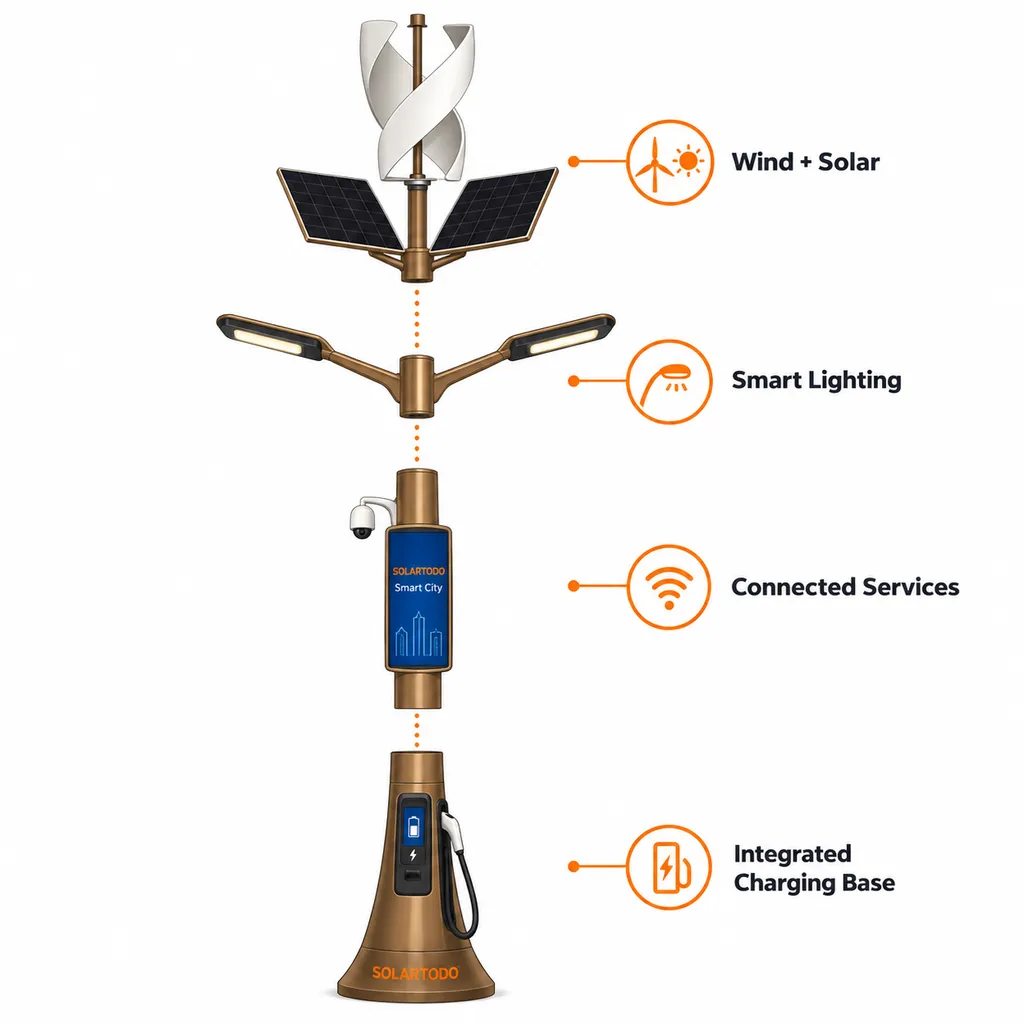
The cloud layer can monitor lamp status, PV charging, wind input, battery state of charge, charger sessions, OCPP events, camera health, SOS alarms, audio endpoints, gateway uptime, and display schedules. For a 109-unit project, the asset register should track at least 109 pole IDs, 109 charger IDs, 109 battery IDs, 218 LED luminaire heads, 109 cameras, 109 displays, and 109 environmental sensors.
NREL’s PVWatts model is widely used to estimate PV electricity production from array size, location, tilt, and weather data, making it a useful early-stage tool for checking the 400W PV subsystem before detailed engineering NREL PVWatts. IRENA reports that renewable power cost databases now cover more than 25,000 projects, which gives developers a broader benchmark for PV, wind, storage, and balance-of-system assumptions IRENA Renewable Costs 2024.
Representative Scenario
For a representative MENA smart-community scenario, assume 109 poles are installed along 3.8km of internal roads, with 5.5 peak sun hours per day, moderate evening wind, and a lighting schedule of 11 hours per night. The 43.6kW PV array could produce a planning-level 239.8kWh/day before system losses, while the 32.7kW wind nameplate capacity provides a secondary source during cloudy or nighttime periods when local wind is available.
In that scenario, LED lighting demand is 160W × 109 poles × 11 hours, or about 191.8kWh/night before dimming. If adaptive dimming reduces average power by 35%, the lighting load falls to about 124.7kWh/night, leaving more battery capacity for sensors, gateway service, emergency audio, and limited charger-support functions; EV charging remains primarily grid-backed because 1 full 7kW hour requires 7kWh.
Compared with a conventional alternative using 109 grid-only streetlights, 109 separate EV pedestals, 109 separate CCTV mounts, and multiple gateway boxes, the integrated pole can reduce visible roadside asset count by roughly 40-60% depending on how many functions are consolidated at each location. This comparison is a planning estimate, not a guaranteed site result, because civil works, trenching depth, feeder distance, labor rates, and local code enforcement vary by country and municipality.
EPC Investment Analysis and Pricing Structure
EPC delivery includes engineering, procurement, construction, commissioning, and a 1-year warranty for a fully installed smart-pole system. Engineering covers pole foundation design, wind-load review, cable routing, grounding, lightning protection, lighting layout, network topology, EV charger commissioning, and OCPP platform integration for 1 site or a multi-phase community package.
| Pricing tier | Scope | Unit price range, USD |
|---|---|---|
| FOB Supply | Equipment only, ex-works China | $992-$3,944 |
| CIF Delivered | Equipment plus ocean freight and insurance | $1,114-$4,431 |
| EPC Turnkey | Installed, commissioned, and 1-year warranty | $1,600-$5,800 |
| Order quantity | Discount | Typical procurement effect |
|---|---|---|
| 50+ units | 5% | Suitable for 1 neighborhood loop or campus phase |
| 100+ units | 10% | Suitable for the 109-pole smart-community package |
| 250+ units | 15% | Suitable for district-scale or multi-site rollout |
ROI should be evaluated from 4 measurable streams: avoided conventional equipment, lighting energy savings, charger service revenue, and reduced maintenance visits. For example, if adaptive lighting saves 67.1kWh/night across 109 poles and grid energy is $0.14/kWh, annual lighting savings are about $3,429; if 20 chargers average 2 paid sessions per day at 12kWh/session and a $0.10/kWh margin, annual gross charger margin adds about $17,520 before platform fees and local taxes.
A practical payback model should compare the EPC turnkey cost against separate streetlight poles, separate EV chargers, CCTV poles, PA columns, environmental stations, gateways, trenching, foundations, and commissioning labor. The IEA reports that public charging deployment must keep pace with EV adoption and that public charging points grew 40% in 2023, supporting the case for combining charging access with normal community infrastructure renewal IEA Global EV Outlook 2024.
Standard payment terms are 30% T/T deposit plus 70% against bill of lading, or 100% irrevocable L/C at sight. Project financing can be discussed for orders above $1,000K, and engineering teams can Configure your system online or Request a custom quotation with site drawings, target quantity, voltage, wind zone, and telecom requirements; commercial contact is [email protected].
Standards, Compliance, and Engineering Notes
Applicable references include IEC 60598 for luminaires, IEC 62196-2 for Type 2 AC EV charging interfaces, GB/T 37024 for smart pole system terminology and management references, and IEEE 1547 when the hybrid DER system interfaces with a utility grid. For PV modeling and yield assumptions, NREL PVWatts and local TMY datasets should be used before final battery autonomy and charger-diversity values are frozen.
IRENA’s 2024 cost analysis notes that utility-scale solar PV installed costs fell by 86% between 2010 and 2023, which helps explain why 400W PV can now be integrated into street furniture without making the PV module the dominant cost driver IRENA 2023 Cost Report. For hybrid poles, however, civil works, steel, EV safety, telecom, display brightness, and commissioning can dominate total installed cost more than the 2 PV modules themselves.
Applications
The 14m hybrid pole is suitable for smart communities, university roads, industrial parks, mixed-use developments, waterfront promenades, public parking streets, and municipal demonstration corridors with EV readiness. A buyer planning 109 units should reserve drawings for 109 foundations, 109 grounding points, 109 feeder connections, 109 charger network records, and 1 centralized platform dashboard before factory acceptance testing.
SOLARTODO supplies solar, energy storage, smart lighting, security, telecom, power towers, and smart-agriculture infrastructure, so this pole can be coordinated with larger site packages such as distributed PV canopies, battery rooms, CCTV control centers, and edge-gateway networks. Buyers can review related technical guidance at Learn about topic and compare smart-pole procurement considerations through the same Learn about topic knowledge library.
For specification finalization, the recommended buyer data pack contains 6 files: site plan, road cross-section, wind-speed requirement, grid voltage and phase data, EV charging policy, and communications topology. With those 6 inputs, SOLARTODO can align the 14m pole height, foundation loads, feeder capacity, OCPP settings, camera angles, gateway backhaul, and LED display operation before production drawings are released.
Technical Specifications
| Pole Height | 14m |
| Pole Type | Octagonal tapered steel, base Ø45cm to top Ø15cm |
| Finish | Antique bronze RAL8011 |
| Integrated Modules | 10-in-1 |
| Wind Turbine | Savonius bucket VAWT, 2 curved scoops, Ø60 × 90cm, 300W |
| Solar Power | 2 × 200 monocrystalline deep-black panels at 15° tiltW |
| Battery Capacity | 5kWh |
| LED Power | 160W |
| Luminous Efficacy | 150lm/W |
| Color Temperature | 4000K |
| Camera | 4MP bullet camera with 50m IR |
| Environmental Sensor | 8 parameters: temperature, humidity, wind, pressure, noise, PM2.5, PM10, illuminance |
| EV Charging | 7kW single-gun AC Type 2 charger, OCPP 1.6J, 5m cable |
| LED Display | P3 vertical screen, 1000 × 2000mm, >6000 cd/m2 |
| Communication | WiFi 6 + 5G gateway + GbE uplink + LoRaWAN |
| IP Rating | IP66 |
| Operating Temperature | -40 to +55°C |
| Pole Spacing | 35m |
| Design Life | 25years |
| Energy Saving | 35% |
| Project Quantity Reference | 109pcs |
Price Breakdown
| Item | Quantity | Unit Price | Subtotal |
|---|---|---|---|
| 14m octagonal tapered steel pole with integrated EV cabinet | 1 pcs | $1,200 | $1,200 |
| 300W Savonius VAWT with red aviation LED | 1 pcs | $420 | $420 |
| 200W monocrystalline PV module with A-frame bracket | 2 pcs | $120 | $240 |
| 5kWh LFP battery with MPPT controller | 1 pcs | $900 | $900 |
| 80W LED luminaire head on twin-arm assembly | 2 pcs | $95 | $190 |
| 4MP bullet camera with 50m IR bracket | 1 pcs | $94 | $94 |
| 8-parameter environmental sensor | 1 pcs | $201 | $201 |
| 30W IP audio column speaker | 1 pcs | $92 | $92 |
| 7kW OCPP Type 2 AC EV charger integrated kit | 1 pcs | $201 | $201 |
| P3 outdoor LED display 1000 × 2000mm | 1 pcs | $950 | $950 |
| WiFi 6 + 5G + LoRaWAN gateway | 1 pcs | $260 | $260 |
| Accessories, breakers, surge protection, cabling | 1 pcs | $160 | $160 |
| Engineering, drawings, and quality control | 1 pcs | $280 | $280 |
| Installation and commissioning | 1 pcs | $650 | $650 |
| 1-year warranty and support | 1 pcs | $180 | $180 |
| Total Price Range | $1,600 - $5,800 | ||
Frequently Asked Questions
What makes the 14m hybrid smart pole different from a normal streetlight with add-on devices?
Can the pole operate without grid power?
What is included in EPC turnkey pricing and warranty?
Which standards are relevant for this configuration?
How should a 109-unit smart-community project be planned?
Certifications & Standards


Data Sources & References
- •NREL PVWatts Calculator
- •IEC 60598-1:2024
- •IEC 62196-2:2022
- •IEEE Std 1547
- •IRENA Renewable Power Generation Costs in 2023
- •IRENA Renewable Power Generation Costs in 2024
- •IEA Global EV Outlook 2024
Interested in this solution?
Contact us for a customized quote based on your specific requirements.
Contact Us