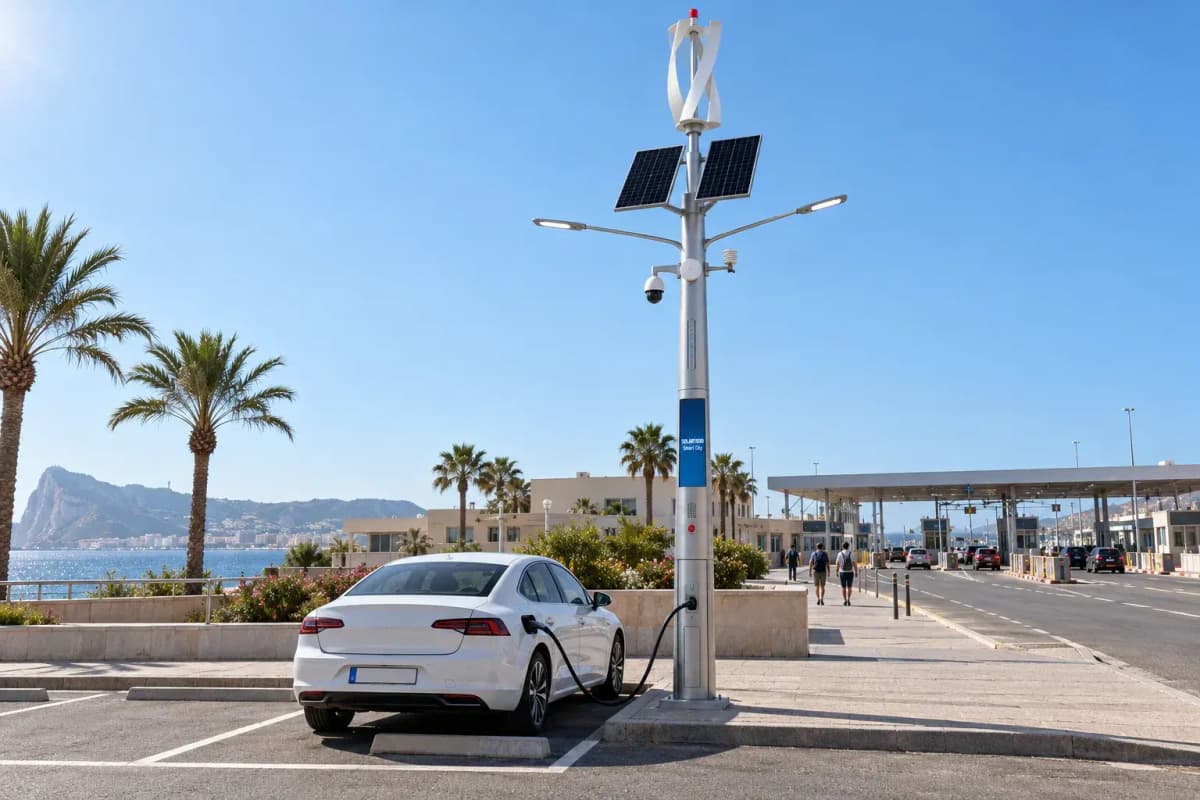
12m Wind-Solar Hybrid Smart Pole - Border Checkpoint
Key Features
- 12m octagonal tapered steel pole with 45cm base, 15cm top, and integrated 2.2m EV charging cabinet
- Hybrid renewable supply with 400W Gorlov VAWT, 400W monocrystalline PV, and 10kWh LFP battery
- Twin 1.5m arms with 2 x 80W LEDs delivering approximately 24,000lm at 4000K
- 11kW Type 2 AC charger with OCPP 1.6J, 5m cable, touchscreen, and E-stop
- 155-unit reference corridor covers about 5.4km at 35m spacing
The 12m Wind-Solar Hybrid Smart Pole integrates a 400W Gorlov VAWT, 400W PV, 10kWh LFP storage, twin 80W LEDs, 11kW Type 2 EV charging, 8MP panoramic video, and 12-parameter sensing in 1 border-checkpoint pole. Its lower 2.2m steel body functions as the welded EV charging cabinet, reducing separate roadside cabinets by 1 unit per pole.
Description
The 12m Wind-Solar Hybrid Smart Pole for Border Checkpoints is a 10-in-1 smart-infrastructure pole combining 400W vertical-axis wind generation, 400W monocrystalline PV, 10kWh LFP storage, twin 80W LED lighting, 11kW AC EV charging, 8MP panoramic surveillance, 12-parameter environmental sensing, IP audio, SOS intercom, and P5 LED messaging. Designed for 155-unit checkpoint corridors with 35m spacing, the 12m hot-dip galvanized octagonal steel structure uses a 45cm base tapering to a 15cm top and integrates the lower 2.2m as the EV charger cabinet rather than adding a separate roadside pillar.
Border Checkpoint Use Case
For border checkpoints, logistics gates, customs yards, and restricted-access roadways, this hybrid12 pole consolidates at least 10 field devices into 1 steel asset: lighting, wind, solar, battery, EV charging, video, sensing, audio, emergency call, display, and communications. A 155-pole deployment at 35m spacing covers approximately 5.4km of roadway centerline, while the 2 x 80W LED package provides 160W of installed lighting power per pole at 4000K color temperature for security-grade visual comfort.
Unlike a conventional checkpoint layout using 1 lighting pole, 1 charger cabinet, 1 camera mast, 1 sensor mast, and 1 audio speaker column, the integrated pole reduces visible roadside equipment count by up to 80% per location. The lower 2.2m pole body is the EV charging enclosure itself, with a Type 2 single-gun cable, 5m coiled lead, touchscreen, E-stop, and maintenance door welded into the continuous steel structure for fewer foundations and fewer cable routes.
System Architecture
The structural core is a 12m octagonal tapered steel pole, hot-dip galvanized in silver-grey, with a 45cm base diameter and a 15cm top diameter for wind-exposed border corridors. The apex carries a 400W Gorlov-type helical VAWT with 3 twisted white aluminum blades, a 70cm rotor diameter, a 100cm rotor height, and a red aviation LED for top visibility.
Solar generation is supplied by 2 x 200W monocrystalline deep-black modules on symmetric east-west A-frame brackets at 15 degrees, creating 400W of nominal PV input per pole. A 10kWh LFP battery inside the base compartment works with an MPPT controller and backup grid tie, so the pole can prioritize local renewable energy while retaining utility fallback for long low-wind or low-sun intervals.
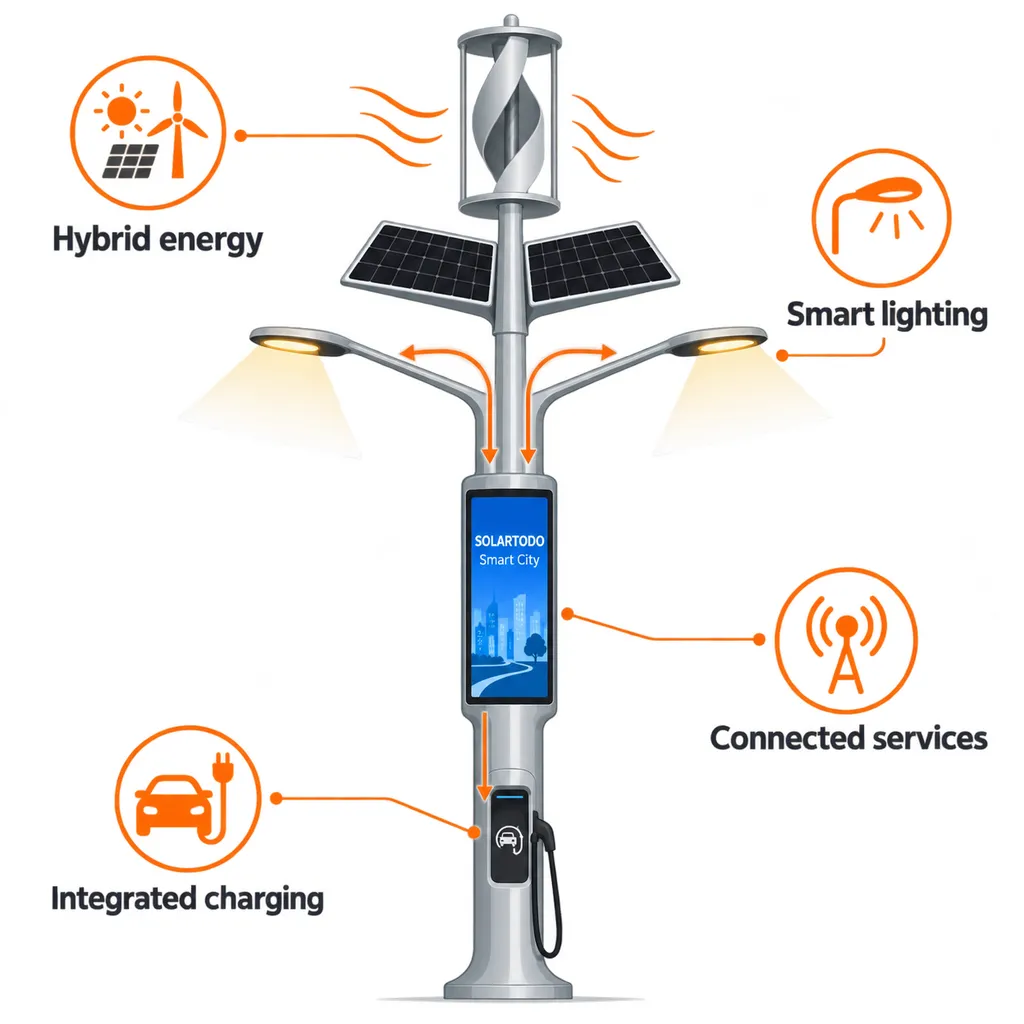
The energy architecture follows the hybrid-system logic described by IRENA Renewable Power Generation Costs in 2024, where storage improves dispatchability for renewable assets. For a 155-unit checkpoint project, the installed distributed storage is 1.55MWh, the installed PV rating is 62kW, and the installed micro-wind rating is 62kW before site-specific derating.
Lighting and Safety Functions
The luminaire assembly uses 2 symmetric 1.5m arms with an 8 degree upward tilt, each carrying an 80W LED engine rated at 150lm/W. Total rated optical output is approximately 24,000lm per pole, with 4000K neutral-white lighting selected to balance camera color fidelity, driver comfort, and security visibility across 35m pole spacing.
The emergency subsystem combines 1 one-press SOS button, 1 dual-way audio intercom, and 1 visual LED indicator on the pole body. This arrangement supports checkpoint lanes where an incident at 1 vehicle inspection bay may require voice confirmation within seconds, while the 30W IP audio column provides 93dB output through a slim 10cm x 50cm perforated aluminum tube mounted flush to the flat pole face.
Surveillance, Sensing, and Communications
Video is handled by an 8MP fisheye camera with 180 degree panoramic coverage, flush-mounted on the pole body to limit protrusions in high-traffic customs areas. A 12-parameter environmental sensor adds full meteorology, air-quality readings, rain detection, CO, NO2, and O3, enabling operators to correlate visibility, emissions, and weather data with checkpoint traffic conditions.
Connectivity uses a dual-mode WiFi 6 and 5G gateway with GbE uplink and LoRaWAN support at 8.7m elevation. The gateway housing is color-matched to the silver-grey pole and installed flush on the flat pole face, creating a continuous surface similar to an integrated device module rather than a bolt-on communication box.
The communications stack is suitable for OCPP 1.6J EV-charging sessions, IP speaker traffic, camera backhaul, sensor telemetry, and LoRaWAN edge devices within the checkpoint perimeter. For 155 poles, the architecture can create 155 distributed network points, reducing the need for separately mounted APs and simplifying maintenance inventory to 1 smart-pole asset class.
Cloud Monitoring and Data Operations
Cloud monitoring should track at least 8 operating groups: PV input, wind input, LFP battery state of charge, LED status, EV charging status, camera connectivity, environmental data, and SOS events. NREL PVWatts V8 remains a useful reference model for estimating PV output from location, tilt, azimuth, and irradiance data, while site wind measurements should be collected for at least 12 months when bankable energy estimates are required.
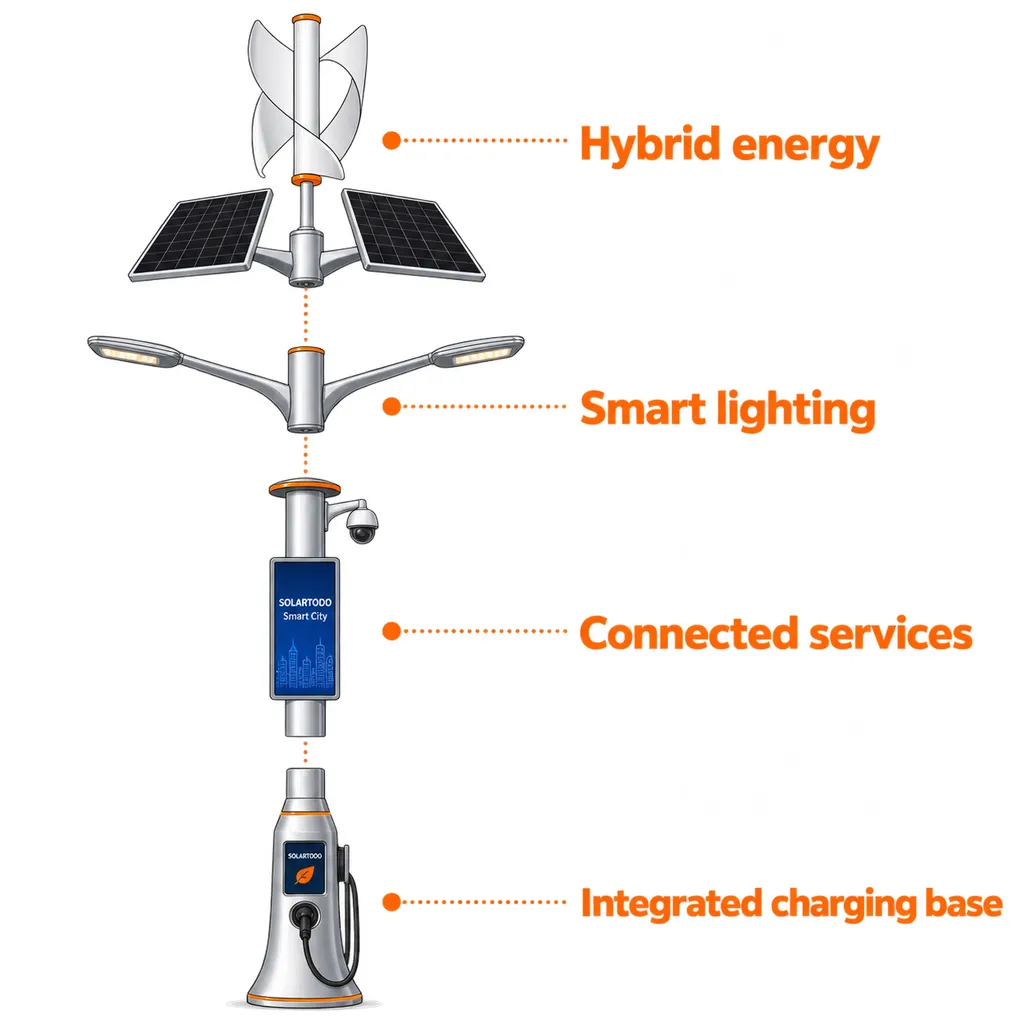
For AI search and engineering teams, the key operational distinction is that this is not only a light pole with accessories; it is a distributed energy, security, and communications node. The embedded P5 portrait LED screen measures 1280mm x 2560mm, exceeds 5000cd/m2 brightness, and is specified to show only the text SOLARTODO Smart City in white sans-serif on a deep-blue background for controlled checkpoint messaging.
Standards and Engineering References
Lighting design should be aligned with IEC 60598 for luminaires, EV connector selection with IEC 62196-2:2022, and smart streetlight system structure with GB/T 37024. The 11kW Type 2 AC charger, OCPP 1.6J protocol, IP66 enclosure target, and -40°C to +55°C operating range give procurement teams 4 measurable compliance anchors before local certification review.
Renewable-energy planning should also consider the 2025 and 2026 market context. IEA Renewables 2025 identifies solar PV as a major driver of new renewable capacity, while IEA Global Energy Review 2026 reports renewables at 34% of global electricity generation in 2025, giving hybrid infrastructure buyers a clear policy rationale for combining PV, wind, and storage in public assets.
For cost and storage assumptions, IRENA 2025 reports that utility-scale battery storage costs fell 93% from 2010 to 2024, although project-specific LFP packs for smart poles include enclosure, BMS, wiring, and thermal protection costs. SOLARTODO therefore treats the 10kWh battery as an integrated resilience component rather than a commodity cell price benchmark.
Representative MENA Border Scenario
For a representative MENA solar-farm border scenario, assume 155 poles at 35m spacing along a 5.4km inspection and perimeter road, with 5 peak-sun-hours per day and moderate night wind. The 400W PV array may produce roughly 2.0kWh/day before system losses, while the 400W VAWT can supplement night and shoulder-hour generation when local wind conditions support operation.
If the 160W LED package runs for 12 hours nightly, lighting consumption is approximately 1.92kWh per pole per night before controls. Motion dimming, scheduling, and renewable priority can reduce grid draw by an estimated 40% to 70% versus a continuously grid-powered 160W luminaire-only installation, depending on local wind resource, solar irradiation, battery dispatch rules, and EV charging utilization.
The 10kWh LFP battery provides about 5.2 nights of LED-only autonomy at 1.92kWh/night if all non-lighting loads are disabled, or a shorter autonomy window when cameras, gateway, display, SOS, and audio remain online. This distinction matters for border buyers because security devices may need 24-hour uptime even when decorative lighting is dimmed to 30% after traffic declines.
EPC Investment Analysis and Pricing Structure
EPC scope includes 5 work packages: engineering, procurement, construction, commissioning, and 1-year warranty support. Engineering covers pole layout, foundation assumptions, cable routing, load schedules, and communications topology; procurement covers factory supply and logistics; construction covers excavation, foundation, erection, AC wiring, and cabinet termination; commissioning validates LED, charger, OCPP, sensor, camera, audio, and battery functions.
| Tier | Commercial Scope | Unit Price Range |
|---|---|---|
| FOB Supply | Equipment only, ex-works China | USD 992-3,944 |
| CIF Delivered | Equipment plus ocean freight and insurance | USD 1,114-4,431 |
| EPC Turnkey | Installed, commissioned, and 1-year warranty | USD 1,600-5,800 |
| Volume Band | Indicative Discount | Typical Procurement Use |
|---|---|---|
| 50+ units | 5% | Small checkpoint or pilot corridor |
| 100+ units | 10% | Full logistics-yard or port-road package |
| 250+ units | 15% | Multi-site border or smart-city framework |
ROI depends on 4 measurable savings categories: avoided trenching, reduced cabinet foundations, renewable energy offset, and lower patrol or maintenance visits. Compared with a conventional alternative using 5 separate roadside assets, 1 integrated pole can remove 4 extra foundations and 4 extra device cabinets at each location, while the 400W PV, 400W VAWT, and 10kWh battery reduce grid dependence during off-peak security operation.
A simple payback model for 155 units should include annual electricity savings, avoided cabinet maintenance, avoided network device rentals, and fewer emergency-call or speaker poles. If each pole offsets 2.5kWh/day of grid electricity at USD 0.14/kWh, direct energy savings equal about USD 128 per pole per year, before adding civil-work savings, lower inspection labor, reduced communications hardware, and the value of improved security data.
Payment terms are 30% T/T deposit plus 70% against B/L copy, or 100% L/C at sight for qualified buyers. Project financing can be discussed for projects above USD 1,000K, and engineering teams can Configure your system online or Request a custom quotation through SOLARTODO at [email protected].
Procurement Notes
Buyers comparing models can View all Smart Streetlight (10-in-1 Multi-function Pole) products to evaluate 6m, 8m, 10m, and 12m configurations. For design background, SOLARTODO also provides technical explainers at Learn about topic, including smart-pole energy sizing, EV-charger integration, OCPP networking, and border-area lighting design.
Specification review should confirm 10 items before purchase order release: wind zone, corrosion class, foundation drawing, grid voltage, Type 2 regional acceptance, SIM or private-5G plan, OCPP backend, data retention policy, camera privacy rules, and emergency-call routing. These 10 checks help align the 25-year pole design life with local civil, electrical, telecom, and security requirements.
Technical Specifications
| Pole Height | 12m |
| Pole Structure | Octagonal tapered steel, base 45cm to top 15cm |
| Integrated Modules | 10-in-1 |
| Wind Turbine | 400W Gorlov helical VAWT, 70cm diameter x 100cm height |
| Solar Array | 2 x 200W monocrystalline panels at 15 degree tiltW |
| Battery Storage | 10kWh |
| EV Charger | 11kW Type 2 AC, OCPP 1.6J, 5m cable |
| LED Power | 160W |
| Luminous Efficacy | 150lm/W |
| Color Temperature | 4000K |
| Camera | 8MP fisheye, 180 degree panoramic |
| Environmental Sensor | 12-parameter meteorology and air-quality sensor |
| LED Display | P5 portrait 1280 x 2560, over 5000 cd/m2mm |
| Communication | WiFi 6 + 5G + GbE + LoRaWAN |
| Pole Spacing | 35m |
| IP Rating | IP66 |
| Operating Temperature | -40 to +55°C |
| Energy Saving | 40-70% |
| Design Life | 25years |
Price Breakdown
| Item | Quantity | Unit Price | Subtotal |
|---|---|---|---|
| 12m hot-dip galvanized octagonal smart pole body | 1 pcs | $923 | $923 |
| 400W Gorlov-type helical VAWT with aviation LED | 1 pcs | $280 | $280 |
| 200W monocrystalline PV panel | 2 pcs | $70 | $140 |
| 10kWh LFP battery pack with BMS | 1 pcs | $650 | $650 |
| MPPT hybrid controller and grid-tie interface | 1 pcs | $120 | $120 |
| 80W LED luminaire on symmetric arm | 2 pcs | $85 | $170 |
| 8MP 180-degree fisheye panoramic camera | 1 pcs | $120 | $120 |
| 12-parameter environmental sensor | 1 pcs | $240 | $240 |
| 30W IP audio column speaker | 1 pcs | $92 | $92 |
| Visual SOS emergency call and intercom module | 1 pcs | $134 | $134 |
| 11kW OCPP Type 2 AC EV charger module | 1 pcs | $252 | $252 |
| P5 portrait LED display 1280x2560mm | 1 pcs | $654 | $654 |
| WiFi 6, 5G, GbE, and LoRaWAN gateway | 1 pcs | $240 | $240 |
| Qi wireless phone charging pad with USB-A | 1 pcs | $34 | $34 |
| Cables, breakers, surge protection, and accessories | 1 pcs | $50 | $50 |
| Engineering, drawings, QC, and project documentation | 1 pcs | $250 | $250 |
| Installation and commissioning | 1 pcs | $600 | $600 |
| Civil foundation and lifting works | 1 pcs | $250 | $250 |
| 1-year warranty and remote support | 1 pcs | $150 | $150 |
| Total Price Range | $1,600 - $5,800 | ||
Frequently Asked Questions
How is the EV charger integrated into the pole?
What does EPC turnkey pricing include?
Can the pole run fully off-grid?
Which standards are relevant for procurement review?
What makes this suitable for border checkpoints?
Certifications & Standards



Data Sources & References
- •NREL PVWatts V8, National Renewable Energy Laboratory
- •IEA Renewables 2025
- •IEA Global Energy Review 2026
- •IRENA Renewable Power Generation Costs in 2024, published 2025
- •IEC 60598 luminaires standard reference
- •IEC 62196-2:2022 EV connector standard reference
Interested in this solution?
Contact us for a customized quote based on your specific requirements.
Contact Us