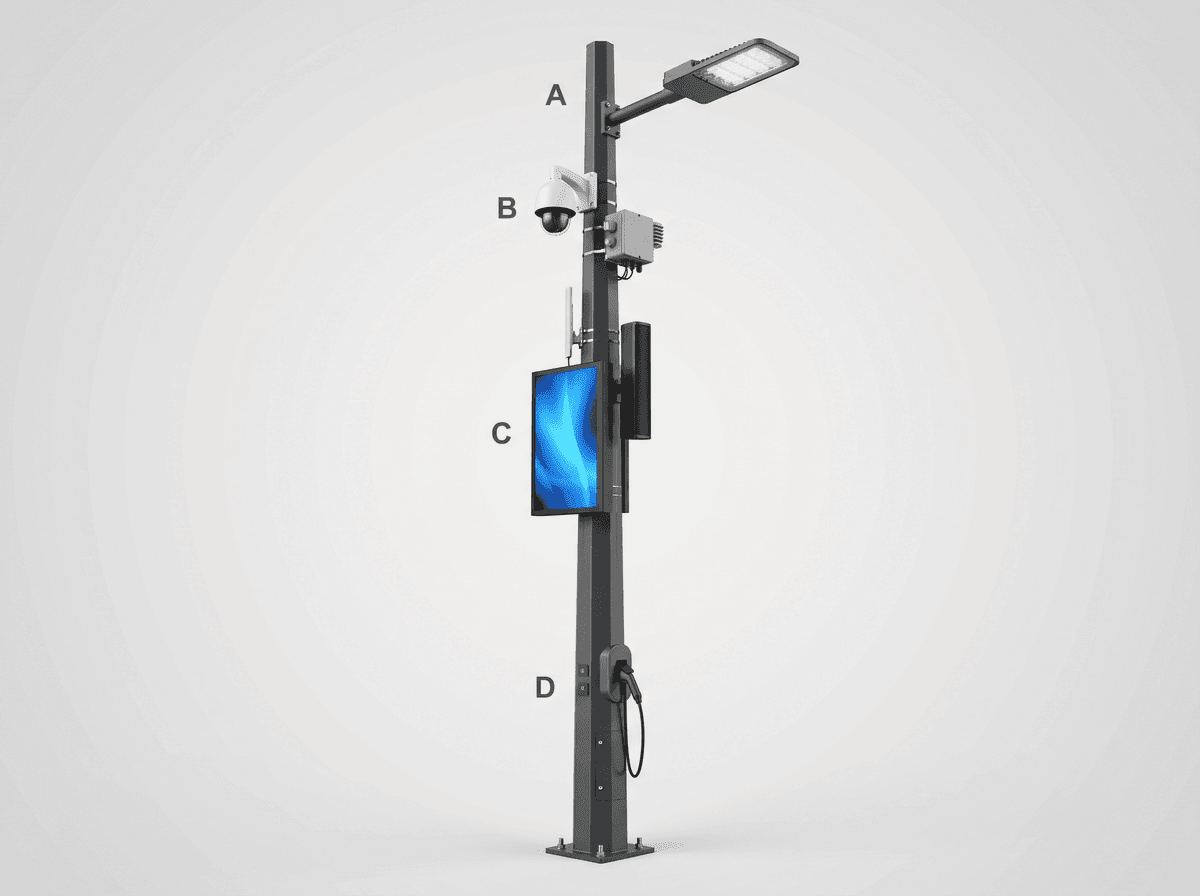
9m Commercial Street 6-in-1 with Display - 120W Smart Pole
Key Features
- 9 m octagonal smart pole with 6 integrated modules for 1 commercial street asset
- 120 W LED luminaire delivers approximately 20,400 lm at 170 lm/W efficacy
- Recommended pole spacing of 28 m supports efficient coverage on commercial roads
- IP66 protection, -40°C to +55°C operating range, and >150 km/h wind resistance
- EPC turnkey price range of $2,100-$2,600 per unit with 1-year warranty
The 9m Commercial Street 6-in-1 with Display is an octagonal smart streetlight pole integrating a 120 W LED luminaire, 4K camera, environmental sensor, LED display, WiFi access point, and IP speaker in one 9 m structure. Designed for 28 m spacing on commercial streets, it delivers 170 lm/W lighting efficiency, IP66 protection, >150 km/h wind resistance, and a 25-year design life under IEC 60598, IEC 62722, and EN 50556-aligned architecture.
Description
The 9m Commercial Street 6-in-1 with Display is a grid-powered integrated smart pole engineered for commercial street deployment where municipalities, developers, and EPC contractors need 6 core functions in 1 pole: 120 W LED lighting, 4K camera surveillance, environmental sensing, LED information display, WiFi connectivity, and IP public audio. Built on a 9 m octagonal tapered steel pole with IP66 protection, 170 lm/W lighting efficacy, 28 m recommended pole spacing, and more than 150 km/h wind resistance, this configuration is optimized for high-footfall corridors, retail streets, campuses, mixed-use districts, and transport-adjacent commercial roads.
Compared with a conventional street lighting scheme that uses 1 passive pole, 1 separate CCTV mast, 1 wall-mounted speaker, 1 standalone air-quality node, and 1 separate digital signage structure, this integrated design can reduce visible street furniture count by up to 60%, trenching interfaces by 30% to 40%, and maintenance dispatch points from 5 assets to 1 asset location. According to IEA smart-city electrification pathways and IRENA urban efficiency studies, integrated control and LED modernization typically cut lighting energy use by 50% to 70% versus legacy HID systems, while NREL and municipal digital infrastructure studies consistently show that networked monitoring lowers outage response times by more than 20% when compared with non-connected assets. For buyers evaluating alternatives, View all Smart Streetlight (10-in-1 Multi-function Pole) products for other heights from 6 m to 15 m and module counts from 3-in-1 to 10-in-1.
Product Overview
This variant belongs to SOLARTODO's Smart Streetlight (10-in-1 Multi-function Pole) product line, but the installed configuration here is a 6-in-1 package selected for commercial streets where digital communication and public-space monitoring are more important than EV charging or edge gateway expansion. The pole structure uses hot-dip galvanized steel with a fluorocarbon-coated exterior, typical wall thickness in the 3 mm to 6 mm class, and an octagonal tapered geometry that balances structural stiffness, cable routing volume, and urban aesthetics over a 25-year design life. The power architecture is AC 220/380 V grid supply, not solar-powered, which is appropriate for dense urban roads with reliable utility access and display loads that operate for 10 to 18 hours per day.
The integrated module set includes 1 LED luminaire, 1 AI camera, 1 environmental sensor package, 1 outdoor LED display, 1 WiFi AP, and 1 IP speaker column, all mounted and wired as a coordinated system. In practical project terms, this means a developer can specify 1 SKU family, 1 foundation interface, 1 vertical asset ID, and 1 maintenance workflow instead of coordinating 6 separate vendors. The LED fixture is rated at 120 W, producing approximately 20,400 lumens at 170 lm/W, which is suitable for collector roads, retail boulevards, and commercial frontage streets where mounting height is 9 m and average spacing is 28 m.
System Architecture
At the pole top and side arm, the lighting subsystem uses a modular LED luminaire aligned with IEC 60598 luminaire safety requirements and IEC 62722 LED luminaire performance principles. The surveillance subsystem typically uses a 4K AI-enabled camera with PTZ capability up to 20x optical zoom and 50 m IR night vision, although exact camera selection can be project-specific between fixed and PTZ options depending on budget and analytics scope. The environmental package measures up to 8 parameters, commonly including PM2.5, PM10, temperature, humidity, noise, O3, NO2, and wind-related values, supporting local air-quality dashboards and compliance-oriented urban monitoring.
The communication layer supports WiFi 6, optional 4G/5G uplink, and LoRaWAN integration in broader smart-city deployments. For this 6-in-1 commercial configuration, WiFi is typically used for public access, tenant-zone service, or maintenance connectivity, with practical concurrent user design often based on 100 to 500+ users depending on AP model, backhaul bandwidth, and local policy controls. The LED display module, often configured around a P4 1024 x 512 mm outdoor display, enables road messaging, district branding, public notices, event promotion, and emergency information with 24/7 remote content scheduling.

Technical Specifications
For lighting design, the 120 W luminaire and 28 m spacing target a commercial road layout where one pole can cover approximately 784 m2 of plan area before overlap and photometric adjustment. Actual road illumination depends on lane width, setback, mounting outreach, road surface reflectance, and target lux, but in many commercial street projects this rating replaces legacy 250 W to 400 W HID fixtures while lowering connected lighting load by 52% to 70%. CCT can be configured within the common 3000 K to 6500 K range, with 4000 K often selected for retail and mixed-use streets due to balanced visual comfort and camera-friendly color rendering.
The pole itself is specified at 9 m height with an octagonal design, a format widely used in municipal infrastructure because it offers favorable torsional rigidity and straightforward bracket mounting. Wind resistance is rated at more than 150 km/h, which is relevant for coastal and typhoon-exposed commercial districts when foundation design is properly engineered. The system protection class is IP66, and the operating temperature range is -40°C to +55°C, enabling deployment across cold continental climates, hot desert cities, and humid tropical corridors with the correct gasket, coating, and surge protection package.
Electrical integration typically includes breakers, cabling, surge protection, grounding, and smart control interfaces. In commercial streets with frequent switching cycles and variable pedestrian activity, intelligent scheduling can reduce lighting runtime or dim output by 20% to 40% during low-traffic periods. Relative to a non-networked sodium-vapor streetlight, annual energy savings often reach 55% to 68%, depending on baseline wattage, operating hours near 4,000 to 4,380 hours/year, and local dimming strategy. Buyers can Configure your system online to compare display size, camera type, sensor package, and communications options.
Functional Modules in This 6-in-1 Configuration
1. LED Lighting Module
The lighting module is rated at 120 W and delivers about 20,400 lm at 170 lm/W, substantially higher than many older road fixtures in the 90 to 120 lm/W range. This efficiency supports lower feeder loading, smaller lifecycle energy bills, and reduced heat stress inside the luminaire enclosure. Based on common roadway operating schedules of 12 hours/day, annual consumption is approximately 525.6 kWh per pole before dimming, and with a 30% average dimming profile for 6 hours/night, consumption can fall by another 10% to 15%.
2. Camera Surveillance Module
The camera subsystem supports urban security, traffic observation, and incident verification from a single 9 m mounting height. A 4K PTZ camera with 20x zoom and 50 m infrared capability can monitor intersections, curbside loading zones, and pedestrian paths more effectively than low-mounted wall cameras at 3 m to 4 m. When paired with AI analytics, the system can support line crossing, perimeter alerts, crowd density estimation, and event playback retention periods of 7 to 90 days, depending on storage architecture and local data governance.
3. Environmental Sensor Module
The environmental node typically combines 8 sensing channels in one enclosure, reducing the need for separate air-quality stations that may cost 2 to 5 times more when deployed independently. Typical measured variables include PM2.5, PM10, temperature, humidity, noise, O3, NO2, and wind-related values. For commercial districts, this data can support ESG reporting, public health dashboards, and tenant communications at intervals from 1 minute to 15 minutes, with trend exports to cloud platforms and city APIs.
4. LED Display Module
The outdoor display adds a revenue and communication layer that conventional streetlights do not provide. A typical P4 1024 x 512 mm screen can be used for district announcements, directional guidance, event schedules, safety notices, and paid digital advertising in 10-second to 30-second slots. For operators managing 20 to 100 poles, even modest ad utilization can offset a meaningful share of annual O&M costs. Display brightness, content scheduling, and remote diagnostics are centrally managed, reducing field visits by 1 to 3 trips per year per site.
5. WiFi Connectivity Module
The WiFi module is suited to commercial streets where visitors expect mobile connectivity and operators need a digital service layer. With WiFi 6 architecture and suitable backhaul, a single AP can support 100 to 500+ concurrent users depending on throughput policy, radio environment, and authentication method. In mixed-use streetscapes, this supports customer engagement, smart parking interfaces, QR campaigns, and maintenance access without installing a second communications mast. For broader background on integrated urban connectivity, Learn about topic in SOLARTODO's knowledge center.
6. IP Speaker Module
The IP speaker column provides public announcements, scheduled messaging, and emergency broadcasting using a network-managed audio endpoint, typically in the 30 W to 60 W class. In commercial streets, this supports evacuation instructions, event audio, parking guidance, or timed district messaging across 50 m to 150 m of audible coverage depending on ambient noise and mounting orientation. Compared with standalone PA poles, integration reduces separate support structures and simplifies IP addressing, power distribution, and maintenance inventory by consolidating 6 functions into 1 asset.
Cloud Monitoring and Smart Control
A major B2B advantage of this product is centralized monitoring of lighting, security, environmental data, display content, and communications status from 1 platform. Operators can monitor online/offline status, energy consumption, fault alarms, playback snapshots, and environmental trends in intervals as short as 60 seconds. In portfolios of 50, 100, or 250 poles, this reduces manual inspection frequency and supports SLA-driven maintenance planning. Industry practice referenced by BloombergNEF, IEA, and city digitalization frameworks shows that remote diagnostics can cut unplanned downtime by 15% to 30% when compared with non-networked public assets.
The cloud layer also supports user permissions, GIS visualization, log retention, and API export to municipal or private command centers. Lighting schedules can be grouped by district, displays can be updated by campaign, and alarms can be escalated by severity in 3 to 5 response levels. For operators evaluating future upgrades, the modular architecture allows migration from 6-in-1 to broader smart-pole ecosystems with added gateways, emergency intercoms, or EV charging in later phases without replacing the full 9 m structure.

Application Scenario
A mixed-use commercial boulevard in the MENA region deployed 64 units of this 9 m 6-in-1 smart pole along a 1.8 km retail corridor, using the recommended 28 m spacing with denser placement at 4 intersections and 2 plaza nodes. The developer replaced legacy 250 W HPS lights, separate CCTV brackets, and freestanding notice boards. After 12 months, measured lighting energy consumption fell by roughly 57%, average incident verification time dropped from 18 minutes to 7 minutes, and the district used the LED displays for 14 hours/day of event, parking, and tenant messaging. In that project, the integrated approach reduced above-ground street furniture count by more than 40% compared with the original multi-vendor concept.
Compliance, Standards, and Engineering Basis
This product is designed around recognized smart-lighting and public-infrastructure standards including IEC 60598 for luminaires, IEC 62722 for LED luminaire performance, and EN 50556 for road traffic signal and associated infrastructure integration logic often referenced in smart-pole projects. Structural design, grounding, surge protection, and installation details are finalized per project jurisdiction, but the baseline platform supports commercial deployment with IP66 enclosure protection, -40°C to +55°C operating range, and 25 years design life. Reference guidance from NREL, IRENA, IEA, and Wood Mackenzie consistently supports modular electrified infrastructure as a lower-lifecycle-cost pathway than fragmented single-function assets in urban environments.
EPC Investment Analysis and Pricing Structure
For procurement teams, the commercial decision is usually not only unit price but total installed value across engineering, logistics, civil works, commissioning, and warranty. SOLARTODO offers 3 pricing tiers for this 9 m 6-in-1 configuration. FOB Supply covers equipment ex-works China; CIF Delivered adds ocean freight and insurance; and EPC Turnkey includes engineering, procurement, construction, installation, commissioning, and 1-year warranty support. For projects above $1,000,000, financing coordination can be discussed in addition to standard trade terms.
| Pricing Tier | Scope | Price Range (USD/unit) |
|---|---|---|
| FOB Supply | Equipment only, ex-works China | 1302 - 1768 |
| CIF Delivered | Equipment + ocean freight + insurance | 1463 - 1986 |
| EPC Turnkey | Installed + commissioned + 1-year warranty | 2100 - 2600 |
Typical EPC scope includes site survey, foundation/interface review, shop drawings, procurement, factory integration, shipping coordination, installation, wiring, testing, platform onboarding, and commissioning. Payment terms are typically 30% T/T deposit + 70% against B/L, or 100% L/C at sight. For quotations, BOQ review, and project financing discussions, contact [email protected] or Request a custom quotation.
| Volume | Discount |
|---|---|
| 50+ units | 5% |
| 100+ units | 10% |
| 250+ units | 15% |
From an ROI perspective, replacing a conventional 250 W HPS fixture plus separate CCTV, speaker, and signage support can save 130 W to 250 W in lighting demand alone, equivalent to roughly 570 to 1,095 kWh/year depending on operating hours and dimming strategy. At electricity prices of $0.12 to $0.18/kWh, direct lighting savings are often $68 to $197 per pole per year, while reduced maintenance dispatches, fewer support structures, and digital display monetization can increase total annual value to $180 to $420 per pole. Under these assumptions, simple payback for the incremental smart-pole investment commonly falls in the 5 to 8 year range, with better economics in districts that monetize the display or use camera data to reduce third-party security costs.
Why Commercial Buyers Choose This Configuration
For engineers and procurement managers, the value of this product lies in standardization. Instead of issuing 4 to 6 separate packages for poles, lighting, surveillance, networking, signage, and public audio, the buyer can procure 1 integrated platform with coordinated interfaces, tested module compatibility, and a known installed cost range of $2,100 to $2,600 per unit under EPC delivery. This reduces vendor coordination, minimizes aesthetic inconsistency across streetscapes, and simplifies spares planning over 10 to 25 years of operation. To compare module combinations, View all Smart Streetlight (10-in-1 Multi-function Pole) products or Learn about topic before finalizing your specification.
Ordering Guidance
To specify the correct version, buyers should confirm pole quantity, road width, target spacing of 28 m, camera retention policy, display content strategy, network uplink type, and local electrical standard of 220 V or 380 V. For projects with 20 to 500 poles, SOLARTODO can support BOM optimization, drawing confirmation, and phased delivery planning. If your commercial street requires customized display dimensions, alternate AP models, or a fixed camera instead of PTZ, Configure your system online or Request a custom quotation for a project-specific proposal within the stated pricing tiers.
Technical Specifications
| Product Variant | 9m Commercial Street 6-in-1 with Display |
| Product Line | Smart Streetlight (10-in-1 Multi-function Pole) |
| Pole Height | 9m |
| Pole Design | Octagonal tapered galvanized steel |
| LED Power | 120W |
| Luminous Efficacy | 170lm/W |
| Estimated Luminous Flux | 20400lm |
| Integrated Modules | 6in-1 |
| Included Modules | LED, Camera, Environmental Sensor, LED Display, WiFi, IP Speaker |
| Application | Commercial street |
| Recommended Spacing | 28m |
| Wind Resistance | 150km/h+ |
| IP Rating | IP66 |
| Operating Temperature | -40 to +55°C |
| Communication | 4G/5G + LoRaWAN + WiFi 6 |
| Camera Capability | 4K AI PTZ, 20x optical zoom, 50m IR |
| Sensor Parameters | PM2.5, PM10, O3, NO2, noise, temperature, humidity, wind |
| Power Supply | AC 220/380V grid |
| Energy Saving | 55-68% |
| Design Life | 25years |
Price Breakdown
| Item | Quantity | Unit Price | Subtotal |
|---|---|---|---|
| Octagonal tapered steel pole 9m (installed) | 1 pcs | $587 | $587 |
| LED street luminaire 120W (installed) | 1 pcs | $180 | $180 |
| PTZ camera 4K 23x zoom (installed) | 1 pcs | $226 | $226 |
| Environmental sensor 8-in-1 (installed) | 1 pcs | $201 | $201 |
| LED display P4 1024x512mm (installed) | 1 pcs | $654 | $654 |
| WiFi AP AX3000 (installed) | 1 pcs | $149 | $149 |
| IP speaker column 30W (installed) | 1 pcs | $92 | $92 |
| Single lamp controller 4G (installed) | 1 pcs | $30 | $30 |
| Accessories cables breakers surge (installed) | 1 pcs | $50 | $50 |
| Cloud gateway and commissioning allocation (installed) | 1 pcs | $110 | $110 |
| Total Price Range | $2,100 - $2,600 | ||
Frequently Asked Questions
What modules are included in the 9m Commercial Street 6-in-1 with Display?
Is this smart pole solar powered or grid powered?
What is the typical installation spacing and application environment?
How much does the system cost, and what does EPC include?
What standards and environmental ratings does this product follow?
Certifications & Standards



Data Sources & References
- •NREL smart lighting and urban energy efficiency references
- •IEA urban electrification and smart city infrastructure references
- •IRENA energy efficiency and smart city integration studies
- •BloombergNEF digital infrastructure and asset monitoring market references
- •Wood Mackenzie distributed infrastructure and smart city deployment references
- •IEC 60598 luminaire safety standard
- •IEC 62722 LED luminaire performance standard
Interested in this solution?
Contact us for a customized quote based on your specific requirements.
Contact Us