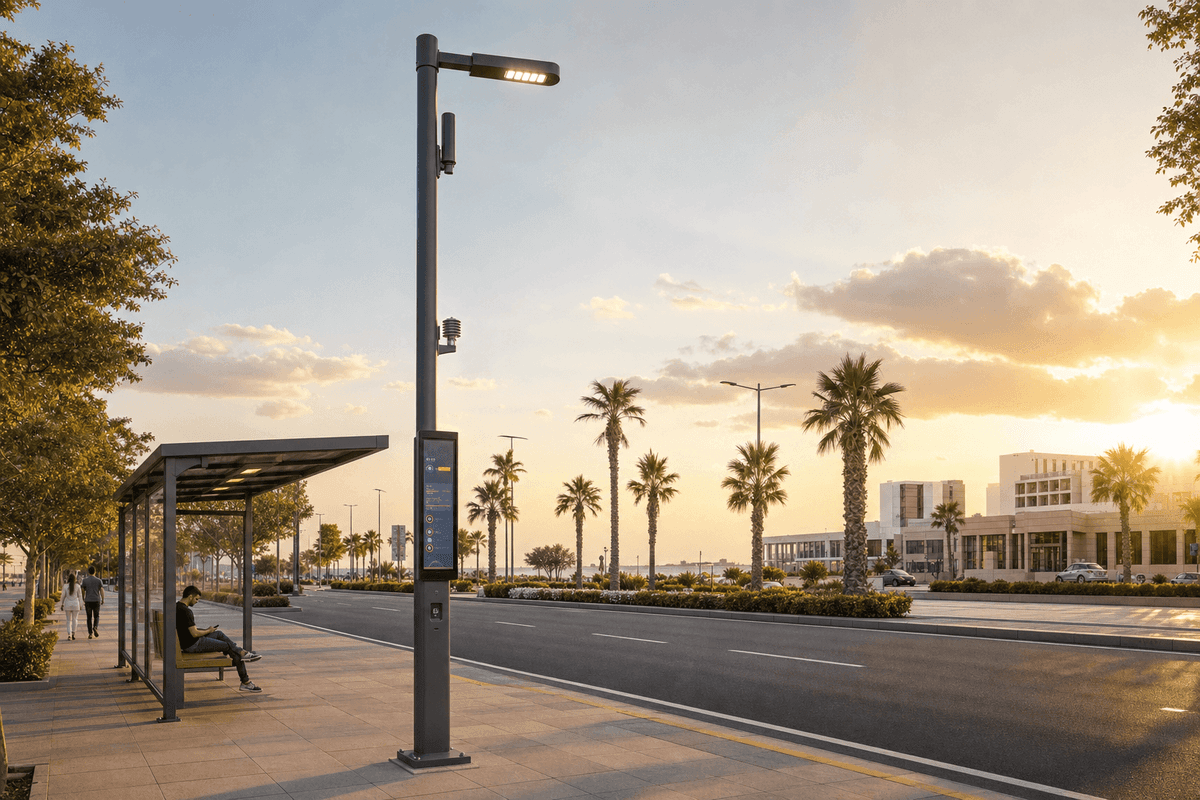
8m Bus Stop Smart Pole with Info Display - 5-in-1 Urban Node
Key Features
- 8 m round conical smart pole integrates 5 functional modules in 1 structure for bus stop deployment
- 80 W LED luminaire delivers approximately 13,600 lm at 170 lm/W for efficient public lighting
- IP66 protection, -40°C to +55°C operating range, and >150 km/h wind resistance for outdoor durability
- Portrait LED information display supports transit messaging with EPC installed reference price of USD 654 per unit
- EPC turnkey pricing ranges from USD 1,500 to USD 1,900 per pole with 25-year design life
The 8m Bus Stop Smart Pole with Info Display is a grid-powered 5-in-1 smart streetlight system integrating an 80W LED luminaire, AI camera, WiFi access point, portrait LED information display, and USB charging in one round conical pole. Designed for bus stop applications, it delivers 13,600 lm at 170 lm/W, IP66 protection, 25-year structural life, and EPC turnkey pricing from USD 1,500 to USD 1,900.
Description
The 8m Bus Stop Smart Pole with Info Display is a 5-in-1 integrated smart streetlight engineered for public transport nodes, curbside passenger shelters, and municipal smart mobility projects. This configuration combines 1 x 80W LED luminaire, 1 x AI camera, 1 x WiFi access point, 1 x portrait LED information display, and 1 x USB charging module on an 8 m round conical steel pole for compact deployment in high-footfall bus stop environments. For B2B buyers evaluating lifecycle value, the system is specified for 170 lm/W luminous efficacy, IP66 ingress protection, -40°C to +55°C operation, 4G/5G + LoRaWAN communications, and a 25-year design life under properly engineered foundations and maintenance schedules.
Compared with a conventional bus stop setup using 1 separate 8 m lighting pole, 1 wall-mounted display, 1 standalone CCTV mast, 1 consumer WiFi router, and 1 exposed charger box, this integrated pole can reduce visible street furniture count by approximately 60% to 80%, simplify trenching interfaces from 4-5 device points to 1 consolidated pole base, and lower recurring maintenance visits by an estimated 20% to 35% depending on city O&M practices. The design aligns with the modular smart pole approach referenced in EN 50556, while luminaire performance is specified in line with IEC 60598 and IEC 62722. For buyers comparing smart urban infrastructure options, View all Smart Streetlight (10-in-1 Multi-function Pole) products for adjacent 3-in-1 to 10-in-1 variants.
Product Positioning for Bus Stop Infrastructure
At bus stops, passenger dwell time typically ranges from 3 minutes to 15 minutes, which makes this location suitable for combining illumination, information delivery, surveillance, and public connectivity on a single asset. The portrait-oriented LED display is optimized for route notices, estimated arrival times, public service announcements, and emergency messaging, while the 80W LED luminaire supports roadway-edge and platform illumination with an output of approximately 13,600 lumens. The pole’s round conical design provides a cleaner visual profile than octagonal heavy-duty city-center poles and is well suited to transport corridors where municipalities require lower visual clutter but still need 5 functional modules in one structure.
For transit agencies and EPC contractors, the value proposition is not only hardware consolidation but also data integration. A bus stop equipped with 1 smart pole per bay can centralize lighting schedules, display content, camera feeds, and WiFi status through a common backhaul path. According to IEA urban digitalization and efficiency studies, connected public infrastructure can improve utilization and fault response times by more than 20% when compared with isolated legacy assets. In practical procurement terms, replacing 5 independent product categories with 1 engineered assembly reduces supplier coordination steps, civil interface risks, and acceptance testing complexity during project delivery.
Core Functional Modules
This variant integrates 5 modules selected specifically for bus stop service. The LED luminaire uses an 80W high-efficacy engine rated at 170 lm/W, delivering stable illumination for waiting zones, curb edges, and adjacent sidewalks. The AI camera supports security monitoring and can be configured for passenger flow analytics, queue observation, or incident review, with common smart pole camera references in the market including 4K resolution, 20x optical zoom, and 50 m IR night vision depending on final project scope. The WiFi module extends passenger internet access and can support high-density public usage, with platform-grade AP options commonly rated for 500+ concurrent users.
The portrait LED display is the defining feature for this bus stop version. A typical installed reference for a P4 LED display at 1024 x 512 mm is approximately USD 654 installed, making it one of the highest functional value components after the pole structure itself. In a bus stop scenario, portrait orientation improves readability in narrow footprints because vertical layouts can present 2 to 4 route blocks, 1 service alert area, and 1 advertising or public information zone without requiring a wide cabinet. The USB charging module adds low-power passenger utility, supporting 5V charging for phones and small devices, and is especially relevant in transit hubs where average passenger phone battery anxiety influences perceived service quality.
Structural Design and Environmental Durability
The pole structure is specified as 8 m height with round conical geometry, a practical format for transport corridors that balances aesthetics, wind loading, and manufacturing efficiency. Based on the supplied smart pole template, the system is rated for wind resistance above 150 km/h, and the steel body is generally produced using hot-dip galvanized steel with an exterior protective coating system suitable for urban outdoor exposure. Typical wall thickness in integrated smart poles falls within the 3 mm to 6 mm range depending on structural calculation, local code, arm load, and seismic or wind requirements.
For outdoor electronics, enclosure protection is a major procurement criterion. This product is specified at IP66, which is appropriate for heavy rain, dust ingress control, and roadside contamination. Operating temperature is -40°C to +55°C, enabling deployment across continental climates, coastal cities, and high-summer transport corridors. Industry design practice also requires surge protection, grounding, and breaker coordination at the pole base, especially where utility power quality is unstable. Buyers planning coastal or high-salinity installations should request coating thickness, salt spray test data, and anchor-bolt material details during tender review.
Lighting Performance and Energy Efficiency
The integrated luminaire is rated at 80W with 170 lm/W efficacy, equivalent to approximately 13,600 lumens under nominal operating conditions. For bus stop lighting, this output level is generally appropriate for illuminating a waiting zone, signage area, and adjacent pedestrian approach when mounted at 8 m with suitable optic selection. Compared with legacy 150W high-pressure sodium street lighting, an 80W LED system can reduce fixture power demand by roughly 46.7%, while improving color rendering and startup response. Compared with older 120W metal-halide class fixtures, savings remain near 33.3% before adding dimming schedules.
In municipal operations, lighting energy is only one part of the total power profile. The display, WiFi, camera, and charging functions add continuous or intermittent load, so integrated control becomes important. With scheduled dimming, adaptive display brightness, and off-peak WiFi management, annual electricity reduction versus a non-optimized multi-device bus stop can still reach 15% to 30% depending on duty cycle. NREL and IEA efficiency guidance consistently shows that controls and connected operation materially improve real-world savings compared with static-output equipment. Buyers seeking advanced dimming logic can Configure your system online to match local lux targets and operating hours.
System Architecture
From an EPC perspective, this product follows a centralized smart pole architecture in which 1 utility feed, 1 pole base cabinet zone, and 1 communication stack support 5 integrated functions. The standard communication template includes 4G/5G + LoRaWAN, while WiFi service is delivered through the onboard access point. In a typical deployment, the LED luminaire and display are remotely scheduled, the camera streams or records events, the USB charger is current-limited for safety, and all modules report status to a cloud dashboard or municipal platform through a secure gateway layer.

The architecture is compatible with the broader smart city trend toward edge-connected assets. While this 5-in-1 bus stop version does not include every optional function found in larger 10-in-1 poles, it preserves modular upgradeability for future additions such as sensors, audio, or emergency call equipment. This matters because urban infrastructure cycles often exceed 10 years, while digital modules may refresh every 3 to 5 years. IRENA and BloombergNEF have both emphasized the value of modular electrified infrastructure in reducing stranded asset risk as cities digitize transport and public services.
Technical Specifications
The baseline technical envelope for this variant includes 8 m pole height, 80W LED power, 170 lm/W efficacy, 5 integrated modules, IP66 protection, -40°C to +55°C temperature range, 4G/5G + LoRaWAN communication, more than 150 km/h wind resistance, and 25-year design life. The pole form is round conical, and the display orientation is portrait, which is especially suitable for route information and narrow platform footprints. Standard utility supply is AC220V/380V grid power, with internal distribution coordinated through breakers, surge protection, and smart control interfaces.
For display and digital communications, the exact specification can be adjusted by project. A common reference point is 1 x P4 LED display at approximately 1024 x 512 mm, while WiFi can be supplied as 300M class or AX3000 class depending on user density and backhaul quality. Camera selection can range from 4MP fixed AI cameras to 4K PTZ units, though bus stop projects often balance cost and coverage by choosing fixed or mini-PTZ solutions. If your bid requires a named module schedule, Request a custom quotation with target quantities, drawing requirements, and destination country.
Cloud Monitoring and Smart Operations
Cloud monitoring converts the pole from a passive lighting asset into an active urban node. Through remote supervision, operators can track lamp status, display uptime, camera connectivity, network health, and fault alarms for each installed pole. This reduces manual inspection frequency from, for example, 12 site visits per year to 4 to 6 targeted visits per year in many municipal O&M models. Smart asset management also shortens fault response windows, which is relevant at bus stops where display outages and dark zones directly affect passenger experience and safety perception.
A cloud-enabled deployment also supports content scheduling for the information display. Transit notices can be updated in minutes instead of days, and municipal public service announcements can be pushed across 10, 50, or 500 poles from one interface. Wood Mackenzie and IEA smart infrastructure analyses have repeatedly shown that centralized management improves operational consistency and lowers service restoration time. For buyers planning integrated urban systems, Learn about topic and Learn about topic for broader guidance on smart lighting, communications, and public infrastructure convergence.

Application Scenario
A municipal transport operator in the MENA region deployed 36 units of integrated bus stop smart poles across 12 bus corridors serving approximately 18,000 daily passengers. Before the upgrade, each stop used 1 sodium lamp, 1 printed timetable case, and ad hoc third-party CCTV coverage, resulting in inconsistent service information and high maintenance fragmentation. After installation of 8 m smart poles with digital display and WiFi, the authority reported a projected reduction of 28% in annual maintenance dispatches, a lighting energy reduction of about 45% versus legacy 150W HPS, and improved incident review coverage through centralized camera visibility.
The same project also benefited from revenue and service flexibility. The portrait display allocated roughly 70% of screen time to transit data and 30% to municipal announcements or paid messaging, supporting a partial operating-cost offset. Because the system used 1 engineered pole platform instead of 4 separate roadside devices, civil works were simplified at constrained curb zones where underground utility conflicts were common. This type of deployment is increasingly aligned with smart mobility funding frameworks cited by IEA and IRENA, where digital public infrastructure is evaluated not only on energy savings but also on service quality and asset utilization.
Comparison with Conventional Bus Stop Infrastructure
A conventional bus stop technology stack often consists of 1 lighting pole, 1 separate CCTV pole or wall bracket, 1 display enclosure, 1 consumer-grade router, and 1 charging kiosk, each with different suppliers, warranties, and cable routes. That arrangement increases installation interfaces from roughly 1 integrated foundation and feeder to 3 or more physical mounting systems, often adding 15% to 30% in coordination overhead during EPC delivery. It also creates more visible clutter and more points of failure in public space.
By contrast, the integrated 5-in-1 pole consolidates these assets into 1 vertical structure with coordinated factory assembly and acceptance testing. For many urban projects, this can reduce on-site installation time by 1 to 2 labor-days per stop, depending on foundation readiness and utility access. It can also reduce spare-part complexity because the city manages one structured bill of materials instead of mixed retail-grade devices. For procurement managers, that means fewer vendor lines, clearer warranty boundaries, and more predictable lifecycle costing over 5 years to 10 years.
EPC Investment Analysis and Pricing Structure
For this product, EPC means a complete delivery scope covering engineering, procurement, construction, installation, commissioning, and 1-year warranty support. Engineering typically includes structural review, layout confirmation, electrical single-line coordination, and module integration. Procurement covers the pole, luminaire, display, camera, WiFi, charging interface, cables, breakers, and surge protection. Construction includes foundation interface, erection, wiring, testing, and final commissioning. For projects above USD 1,000,000, financing support may be discussed case by case through SOLARTODO commercial channels.
Three-Tier Pricing Table
| Commercial Term | Scope | Price Range (USD/unit) |
|---|---|---|
| FOB Supply | Equipment only, ex-works China | 930 - 1292 |
| CIF Delivered | Equipment + ocean freight + insurance | 1045 - 1451 |
| EPC Turnkey | Installed + commissioned + 1-year warranty | 1500 - 1900 |
Volume Discount Table
| Order Quantity | Discount |
|---|---|
| 50+ units | 5% |
| 100+ units | 10% |
| 250+ units | 15% |
For ROI, a representative comparison can be made against a conventional bus stop package with 150W HPS lighting, separate display support hardware, and fragmented maintenance contracts. If the integrated pole saves approximately USD 90 to USD 140 per year in energy and maintenance combined, and if incremental capex versus a basic non-integrated setup is around USD 350 to USD 600, simple payback can fall in the range of 2.5 to 6.5 years depending on local labor cost and electricity tariff. Over a 10-year operating period, total avoided maintenance and replacement events may exceed USD 900 to USD 1,400 per pole, especially where separate CCTV and display enclosures would otherwise require independent service visits.
Standard payment terms are 30% T/T in advance + 70% against B/L, or 100% L/C at sight for qualified transactions. For budgetary proposals, framework agreements, or project-specific EPC schedules, contact [email protected]. Buyers can also Request a custom quotation for destination-specific freight, tax assumptions, and installation scope.
Procurement Notes for Engineers and Developers
Engineers preparing tenders should verify foundation design loads, local wind code, display brightness requirements, camera privacy compliance, and backhaul availability before freezing the module schedule. At least 5 technical checkpoints should be reviewed: pole structural calculation, feeder specification, grounding resistance target, surge protection coordination, and display content management interface. If the bus stop is located in a high-vandalism area, buyers may also specify tamper-resistant fasteners, reinforced access doors, and IK-rated protective glazing.
Developers planning phased rollouts often start with 10 to 20 pilot poles, validate uptime and passenger response for 3 to 6 months, then scale to corridor-wide deployment. This staged approach reduces integration risk and allows the city to optimize display content policy, WiFi bandwidth limits, and camera retention settings before ordering 50+ units. For technical background on smart infrastructure deployment models, Learn about topic and compare adjacent system architectures within the SOLARTODO portfolio.
Why This Variant Fits Bus Stops
Not every smart pole requires 10 modules. For bus stop infrastructure, the most-used functions are often lighting, visible information, surveillance, connectivity, and low-power charging. This 5-in-1 configuration concentrates budget on those 5 practical functions rather than adding underutilized hardware. At an EPC turnkey range of USD 1,500 to USD 1,900, it sits well below high-end USD 48,000 city-integrated 10-in-1 poles while still delivering measurable gains in safety, passenger communication, and digital service readiness.
For transport authorities, advertisers, EPC firms, and smart city integrators, the 8m Bus Stop Smart Pole with Info Display is a cost-rational option for upgrading public transit nodes with a single engineered asset. It combines 8 m structural height, 80W efficient lighting, 5 integrated modules, and standards-aligned design into a deployable platform for modern bus stop environments. To benchmark this model against other multi-function poles, View all Smart Streetlight (10-in-1 Multi-function Pole) products or Configure your system online.
Technical Specifications
| Product Variant | 8m Bus Stop Smart Pole with Info Display |
| Product Line | Smart Streetlight (10-in-1 Multi-function Pole) |
| Pole Height | 8m |
| Pole Design | Round conical |
| Application | Bus stop |
| Integrated Modules | 5in-1 |
| LED Power | 80W |
| Luminous Efficacy | 170lm/W |
| Estimated Luminous Flux | 13600lm |
| Display Orientation | Portrait |
| Wind Resistance | 150km/h+ |
| IP Rating | IP66 |
| Operating Temperature | -40 to +55°C |
| Communication | 4G/5G + LoRaWAN + WiFi |
| Energy Saving | 46.7% |
| Power Supply | AC220/380V grid |
| Design Life | 25years |
Price Breakdown
| Item | Quantity | Unit Price | Subtotal |
|---|---|---|---|
| 8m round conical steel smart pole structure (installed) | 1 pcs | $503 | $503 |
| LED luminaire 80W with driver and mounting (installed) | 1 pcs | $118 | $118 |
| Fixed AI camera 4MP/4K class with mounting (installed) | 1 pcs | $126 | $126 |
| WiFi AP AX3000 class (installed) | 1 pcs | $149 | $149 |
| Portrait LED display P4 1024x512mm (installed) | 1 pcs | $654 | $654 |
| USB charging module (installed) | 1 pcs | $34 | $34 |
| Accessories, cables, breakers, surge protection (installed) | 1 pcs | $50 | $50 |
| Cloud platform integration and commissioning (installed) | 1 pcs | $66 | $66 |
| Total Price Range | $1,500 - $1,900 | ||
Frequently Asked Questions
What functions are included in this 8m bus stop smart pole?
Is this product solar powered or grid powered?
What standards and protection ratings apply to the pole?
What is included in the EPC turnkey price and warranty?
How does this compare economically with conventional bus stop equipment?
Certifications & Standards



Data Sources & References
- •NREL lighting and smart controls reference materials
- •IEA energy efficiency and digital infrastructure publications
- •IRENA urban energy transition and smart infrastructure analyses
- •BloombergNEF electrification and connected infrastructure market references
- •Wood Mackenzie smart city and distributed infrastructure research
- •IEC 60598 luminaires standard
- •IEC 62722 LED luminaire performance standard
Interested in this solution?
Contact us for a customized quote based on your specific requirements.
Contact Us