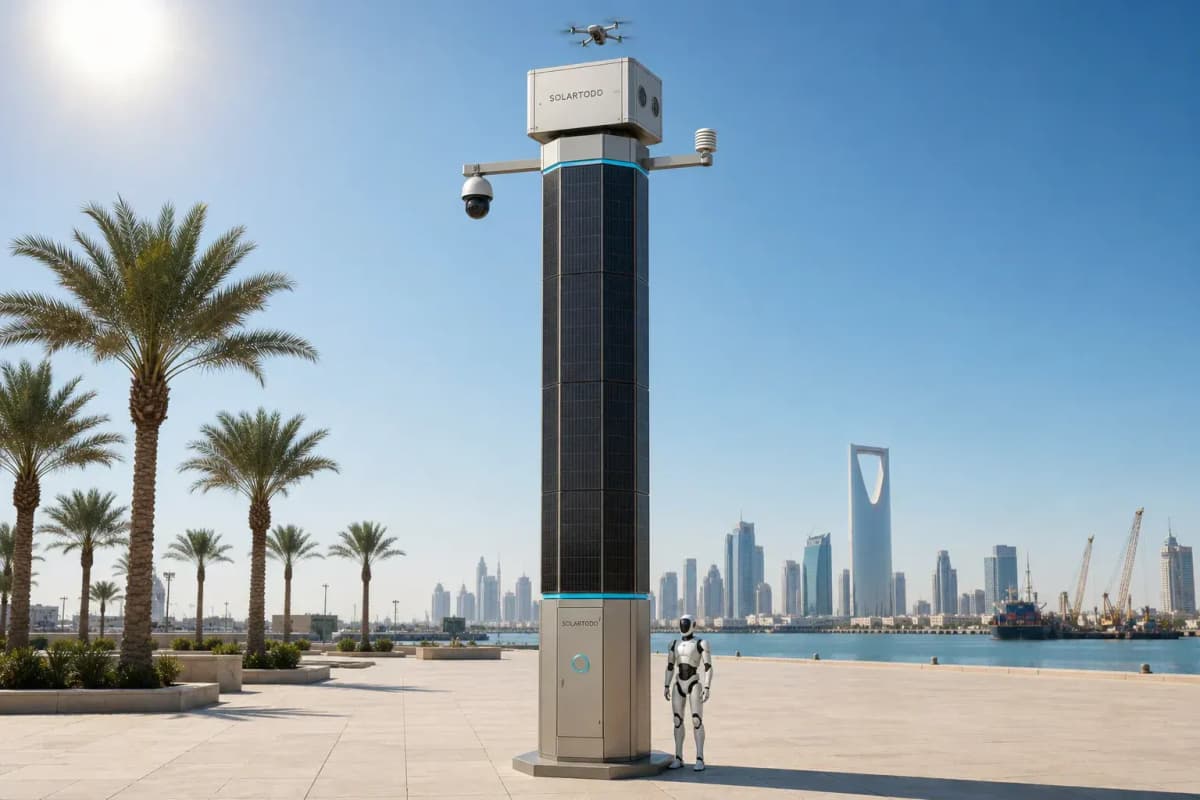
12m Smart Pole with Drone Dock (Sky Hub) - Industrial Port Off-Grid Edge Node
Key Features
- 12 m pure smart pole with drone dock, automated battery hot-swap, and 9 integrated edge-node functions
- 2.8-3.2 kWp on-pole PV replenishment with realistic 1.0-1.3 kW DC clear-sky peak output
- 5-20 kWh-class battery storage supports off-grid operation and high-power drone or robot duty cycles
- 77-pole industrial-port layout at approximately 30 m spacing can cover about 2.31 km of perimeter corridor
- EPC turnkey price range is $6,500-$13,000 per installed and commissioned pole with 1-year warranty
The 12m SOLARTODO Sky Hub is a pure smart pole for industrial ports, combining a drone dock, automated battery hot-swap, Jetson-class edge AI, 9-in-1 environmental sensing, IP66 outdoor protection, 5-20 kWh battery buffering, and approximately 2.8-3.2 kWp of on-pole PV replenishment. EPC turnkey pricing is $6,500-$13,000 per pole for engineering, procurement, installation, commissioning, and 1-year warranty support.
Description
The 12m Smart Pole with Drone Dock (Sky Hub) - Industrial Port is a pure smart pole, not a lighting product, engineered as a 12 m off-grid edge node for port security, perimeter inspection, drone operations, robot coordination, and local AI processing. Each pole integrates approximately 2.8-3.2 kWp of vertical on-pole photovoltaic replenishment, 5-20 kWh-class battery buffering, IP66-rated outdoor electronics, 4G/5G plus LoRaWAN communications, and a drone service architecture designed for repeated autonomous sorties under human-authorized operational rules.
For B2B buyers comparing port-area smart infrastructure, the Sky Hub consolidates 9 core functions into 1 pole-mounted micro-station: sensing, edge compute, drone launch and recovery, drone battery exchange, mission management, ground-robot support, environmental monitoring, common-operating-picture reporting, and non-lethal counter-UAS coordination. A 77-pole industrial-port deployment at approximately 30 m spacing can create a distributed inspection grid covering about 2.31 km of linear perimeter before site-specific offsets, customs clearances, foundations, and radio-planning studies are applied.
Product Definition and Industrial-Port Use
Sky Hub is specified for industrial ports where 24-hour asset inspection, restricted-zone awareness, crane-yard visibility, fence-line response, and berth-side event reporting must continue even when local power distribution is constrained. Unlike a conventional camera pole with 1 fixed network device and a dependence on trenching, this 12 m node combines local AI inference, battery-buffered power, and autonomous field operations in 1 vertical infrastructure point, reducing the need for separate equipment cabinets, separate drone charging shelters, and separate environmental stations by up to 60% in a typical brownfield retrofit.
The product is aligned with SOLARTODO's smart-infrastructure portfolio, and buyers can View all Smart Streetlight (10-in-1 Multi-function Pole) products while treating this variant as a non-lighting Sky Hub configuration. For project sizing, procurement teams can Configure your system online with 12 m height, drone variant, communications, storage size, and port-specific sensor options, then Request a custom quotation for EPC scope, foundation design, customs terms, and commissioning milestones.
System Architecture
The 12 m Sky Hub architecture has 5 physical layers: structural pole, on-pole PV replenishment, battery and power electronics, edge-compute and sensing equipment, and the drone/robot service interface. The PV surface is treated as a replenishment layer with approximately 1.0-1.3 kW DC clear-sky peak output in a high-irradiance region and about 7-10 kWh/day under favorable site conditions, while the battery absorbs high-power drone and robot duty cycles rather than promising unlimited solar-only operation.
The edge AI layer uses Jetson-class compute to process video, environmental data, drone state, and mission queues locally on the pole. Raw video and sensor streams stay on the pole for local processing, while only de-identified event metadata, health status, task logs, and alarm summaries are transmitted to the command view, supporting data-minimization principles consistent with PDPL/LGPD-oriented design and IEC 62443-style industrial cybersecurity segmentation.
Drone Dock and Automated Operations
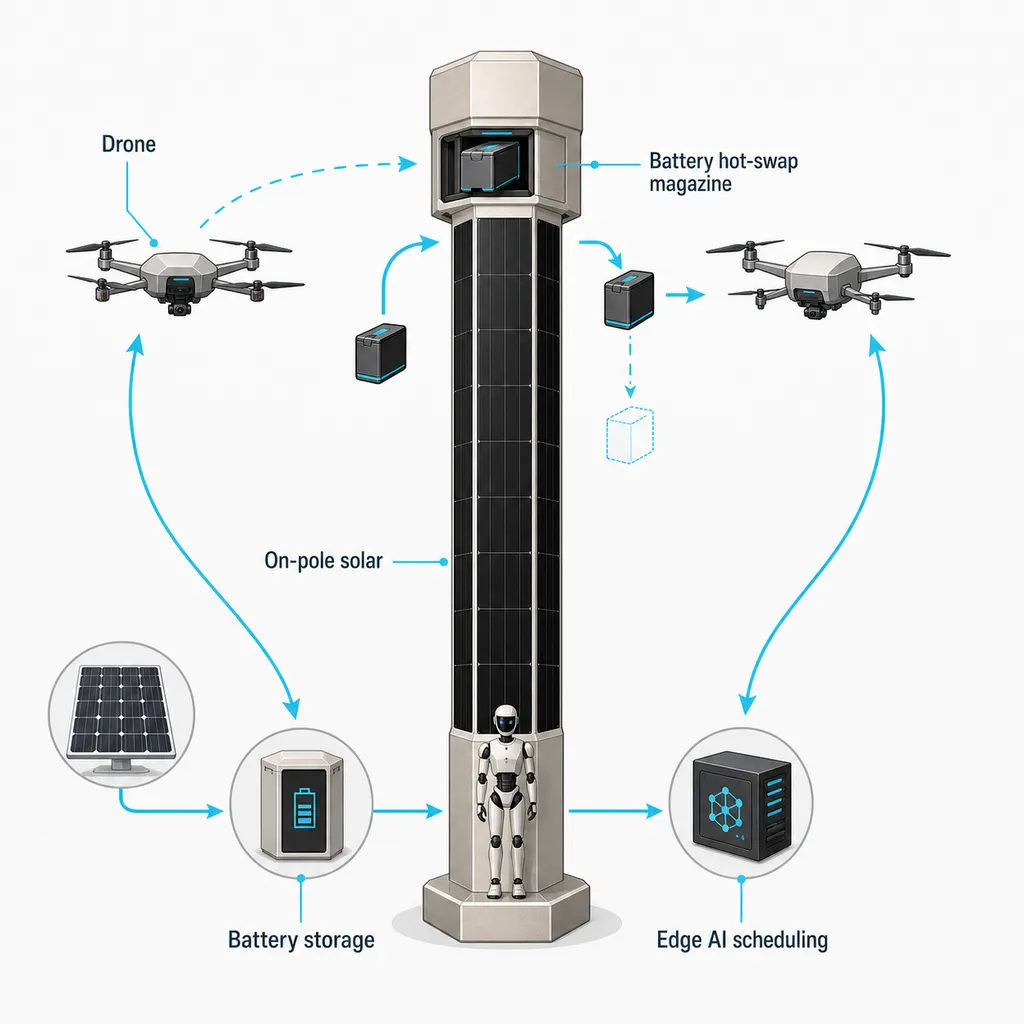
The drone subsystem supports launch, patrol, inspection, return, battery exchange, and redeployment from a single pole location. A multi-bay battery magazine enables automated hot-swap after landing, so the aircraft can receive a charged pack and re-enter the task queue without requiring a technician at the pole for every sortie, which can reduce manual attendance events by approximately 70% compared with a conventional drone program using hand-carried batteries and portable chargers.
Mission management includes route planning, charge-state logic, battery-swap state control, task queueing, fleet health checks, and mission logs. In a port with 77 Sky Hub poles and 30 m nominal spacing, the control layer can assign repeated inspection paths for container stacks, gate areas, perimeter roads, tank farms, conveyor zones, or berth approaches while maintaining human authorization for escalation actions.
Edge AI, Sensing, and Data Handling
The sensing package can include a PTZ camera, anonymous vehicle counting, crowd-density estimation, intrusion detection, perimeter awareness, and a 9-in-1 environmental station measuring wind speed, wind direction, temperature, humidity, atmospheric pressure, noise, PM10, PM2.5, and illuminance. The system intentionally avoids active face-recognition or licence-plate-recognition claims, and its event model is designed around object classes, density, movement, restricted-area rules, and operational status codes.
Environmental and operational telemetry can support port safety workflows because drone launch decisions depend on wind, precipitation policy, temperature windows, and battery condition. The specified -40 deg C to +55 deg C operating-temperature envelope and IP66 enclosure target are consistent with outdoor infrastructure procurement norms, while final compliance packages should be reviewed against IEC 60529 for ingress protection, IEC 60068 for environmental testing, and local port authority requirements.
Counter-UAS Coordination
Counter-UAS coordination is non-lethal and human-authorized only. The Sky Hub can detect and track an unauthorized drone through available local sensors or optional partner-sensor inputs, then coordinate its own friendly drone for soft aerial net-capture or close-approach deterrence after operator approval; it does not use hard-kill effects, jamming, RF denial, GNSS denial, autonomous attack, or destructive interception.
Radar is not integrated as standard pole hardware, but partner radar or site security systems can be used as optional inputs if the port authority already operates such sensors. This architecture keeps the pole focused on edge processing, command coordination, and controlled field response while leaving regulated RF systems, aviation rules, and enforcement authorization to the local security design approved for the specific jurisdiction.
Energy System and Off-Grid Design
The Sky Hub is fully off-grid in the sense that it is not designed to depend on city, site, or grid power for normal operation, yet it does not claim unlimited solar self-sufficiency. The on-pole solar body provides approximately 2.8-3.2 kWp nameplate capacity, while realistic clear-sky output is about 1.0-1.3 kW DC peak and 7-10 kWh/day in high-irradiance regions because only a portion of the vertical faces receive direct sun at any 1 time.
Battery storage is sized in the 5-20 kWh class according to drone frequency, robot charging demand, communication uptime, and local autonomy requirements. NREL's PVWatts methodology emphasizes that irradiance, orientation, temperature, and system losses materially affect PV energy yield, so SOLARTODO treats site-specific energy modeling as a required EPC engineering step rather than a fixed global output guarantee (NREL PVWatts, 2025).
Standards, Engineering Assumptions, and Compliance References
PV module selection should be evaluated against IEC 61215 for terrestrial PV design qualification and IEC 61730 for PV module safety qualification, while outdoor enclosures should be assessed against IEC 60529 IP ratings. Structural design for a 12 m pole should be checked under local wind codes, soil bearing reports, corrosion category, foundation depth, anchor-bolt layout, and port-specific equipment-loading assumptions before procurement release.
For industrial automation and security networks, IEC 62443 provides a recognized reference family for segmentation, access control, and security-level thinking across operational technology systems. For drone operations, buyers should align flight rules, geofencing, maintenance logs, operator authority, and beyond-visual-line-of-sight procedures with the applicable civil aviation authority in the country of deployment, because 1 pole specification cannot override national aviation law.
Representative MENA Industrial-Port Scenario
For a representative MENA industrial-port scenario, assume 77 Sky Hub poles placed at approximately 30 m intervals along a 2.31 km perimeter corridor with high solar resource, dusty conditions, and mixed crane, vehicle, and pedestrian activity. If each pole averages 7-10 kWh/day of PV replenishment and carries 10 kWh of battery storage, the distributed field layer provides roughly 539-770 kWh/day of replenishment across the 77-node network before derating, cleaning losses, seasonal variation, and mission duty-cycle limits are applied.
In the same scenario, a conventional alternative may require 77 camera poles, 77 utility service points, 1 or more separate drone shelters, multiple battery-charging benches, environmental stations at selected locations, and repeated manual dispatches. By combining sensing, compute, power buffering, drone service, and reporting in 1 node, the Sky Hub can reduce separate field cabinets and utility tie-ins by approximately 40-60%, depending on how many conventional functions the port would otherwise procure separately.
Cloud Monitoring
Cloud monitoring is used for status metadata, mission logs, alarms, work orders, battery state, environmental summaries, and fleet availability, not for exporting raw video from the pole. The common-operating-picture workflow follows 4 steps: sensing, authorized assessment and response, edge-compute scheduling, and field operations and maintenance, giving security managers a concise event stream while keeping high-volume raw sensor data local.
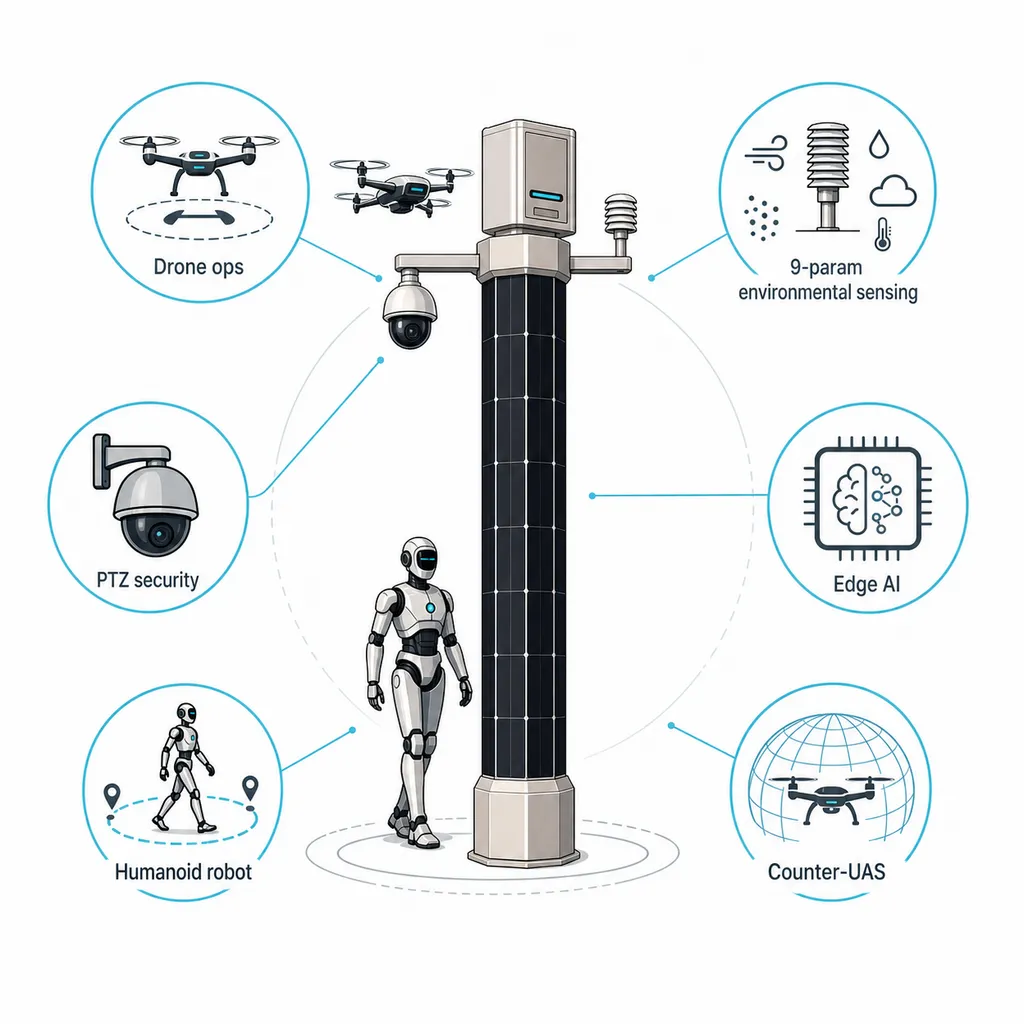
The platform view can support 5 practical operating roles: security operator, maintenance planner, energy manager, drone supervisor, and procurement or asset owner. To understand the technical basis for distributed monitoring and edge processing, buyers can Learn about topic, then request a project-specific drawing set that defines the exact data interfaces, alarm codes, retention windows, and permission levels.
Applications
Primary applications include port perimeter patrol, tank-farm inspection, container-yard observation, restricted-zone alarm response, utility corridor checks, berth-side safety monitoring, and autonomous inspection dispatch after a security or maintenance event. A 12 m height provides an elevated sensor and communications position suitable for many industrial yards, while exact sight lines should be validated by a camera-coverage study using 3D obstructions, stacking rules, crane geometry, and site fencing.
Secondary applications include ground-robot coordination, automated response to sensor alarms, environmental reporting at industrial boundaries, and support for command-center work orders. In 2025 market analysis, the IEA and IRENA both emphasized that electrification, distributed renewable energy, and digital infrastructure require better planning and integration, which makes off-grid edge nodes relevant where grid extension, civil works, or downtime risk can dominate project cost.
EPC Investment Analysis and Pricing Structure
EPC turnkey delivery includes 5 work packages: engineering, procurement, construction, commissioning, and 1-year warranty support. Engineering covers pole loading, foundation assumptions, communications layout, energy model, and interface definition; procurement covers the 12 m pole, drone dock, edge compute, battery, PV replenishment, sensing, and controls; construction covers foundation, installation, cabling, enclosure setup, and site acceptance; commissioning covers power tests, communications tests, mission workflow checks, and operator handover.
| Pricing tier | Scope | Unit price range |
|---|---|---|
| FOB Supply | Equipment only, ex-works China | $4,030-$8,840 |
| CIF Delivered | Equipment plus ocean freight and insurance | $4,527-$9,931 |
| EPC Turnkey | Installed, commissioned, and covered by 1-year warranty | $6,500-$13,000 |
| Volume band | Indicative discount | Example procurement logic |
|---|---|---|
| 50+ units | 5% | Multi-gate industrial park or small port perimeter |
| 100+ units | 10% | Large port district or multi-zone infrastructure package |
| 250+ units | 15% | City-scale or national framework procurement |
ROI depends on avoided trenching, avoided utility service points, reduced manual inspection, and fewer separate drone-support assets. If a conventional port program spends $2,000 per pole-equivalent on electrical service, $1,200 per year on manual inspection visits, and $600 per year on distributed device maintenance, a $6,500-$13,000 EPC Sky Hub may target a 3-6 year payback where labor access, power trenching, and outage risk are the main avoided costs.
Payment terms are typically 30% T/T advance plus 70% against bill of lading, or 100% irrevocable L/C at sight for qualified international trade. Project financing can be discussed for programs above $1,000K, and engineering teams should contact [email protected] with site coordinates, quantity, required storage autonomy, drone duty cycle, and civil-work assumptions for a bankable quote.
Buyer Notes
The 12 m Sky Hub should be procured as a project-based engineered system, not as a generic catalog pole, because 1 port may prioritize C-UAS coordination while another may prioritize inspection frequency, battery autonomy, or environmental reporting. Final bills of material, certifications, warranty terms, export packaging, foundation drawings, and commissioning scripts are subject to engineering confirmation before production.
Authoritative reference points for buyer due diligence include IEC 61215 and IEC 61730 for PV modules, IEC 60529 for enclosure ingress protection, IEC 62443 for industrial-control cybersecurity architecture, NREL PVWatts for PV yield modeling, IRENA renewable-energy cost and deployment analysis, and IEA electricity and renewables outlooks. These 6 reference families help procurement teams separate verified engineering assumptions from unsupported performance claims.
Technical Specifications
| Pole Height | 12m |
| Lighting Load | 0W |
| Integrated Modules | 9-in-1 |
| PV Replenishment Nameplate | 2.8-3.2kWp |
| Realistic Clear-Sky PV Peak | 1.0-1.3kW DC |
| Typical Daily PV Replenishment | 7-10kWh/day |
| Battery Storage Class | 5-20kWh |
| Wind Resistance | site-specific engineering confirmation required |
| IP Rating | IP66 |
| Operating Temperature | -40 to +55deg C |
| Communication | 4G/5G + LoRaWAN |
| Data Handling | local raw-data processing; de-identified metadata export only |
| Design Life | 25years |
| Representative Deployment Spacing | 30m |
| Representative Project Quantity | 77pcs |
Price Breakdown
| Item | Quantity | Unit Price | Subtotal |
|---|---|---|---|
| 12m octagonal tapered steel pole | 1 pcs | $923 | $923 |
| Drone dock with automated battery hot-swap magazine | 1 pcs | $3,200 | $3,200 |
| Jetson-class edge AI compute module and controller | 1 pcs | $950 | $950 |
| PTZ camera with local AI event processing | 1 pcs | $226 | $226 |
| 9-in-1 environmental sensor station | 1 pcs | $218 | $218 |
| Smart cloud gateway IoT hub | 1 pcs | $92 | $92 |
| 4G/5G plus LoRaWAN communication package | 1 pcs | $260 | $260 |
| On-pole PV replenishment surface, 2.8-3.2 kWp class | 1 pcs | $1,350 | $1,350 |
| Battery storage system, 10 kWh representative configuration | 1 pcs | $1,800 | $1,800 |
| Ground robot wireless charging interface | 1 pcs | $650 | $650 |
| C-UAS coordination software and safety logic package | 1 pcs | $600 | $600 |
| Accessories, cables, breakers, and surge protection | 1 pcs | $50 | $50 |
| Cloud platform SaaS access | 1 pcs | $0 | $0 |
| Engineering, drawings, and quality control | 1 pcs | $700 | $700 |
| Installation and commissioning | 1 pcs | $1,200 | $1,200 |
| 1-year warranty and technical support | 1 pcs | $600 | $600 |
| Total Price Range | $6,500 - $13,000 | ||
Frequently Asked Questions
Is the 12m Sky Hub a smart streetlight or a lighting pole?
How does the drone dock operate without site power?
What is included in the EPC turnkey price and warranty?
Does the system upload raw video to the cloud?
Can Sky Hub perform counter-UAS response at a port?
Certifications & Standards


Data Sources & References
- •NREL PVWatts Calculator Documentation 2025
- •IEC 61215 Terrestrial photovoltaic modules design qualification and type approval
- •IEC 61730 Photovoltaic module safety qualification
- •IEC 60529 Degrees of protection provided by enclosures
- •IEC 62443 Industrial communication networks cybersecurity standards
- •IRENA Renewable Power Generation Costs 2024
- •IEA World Energy Outlook and Renewables market analysis 2025
Interested in this solution?
Contact us for a customized quote based on your specific requirements.
Contact Us