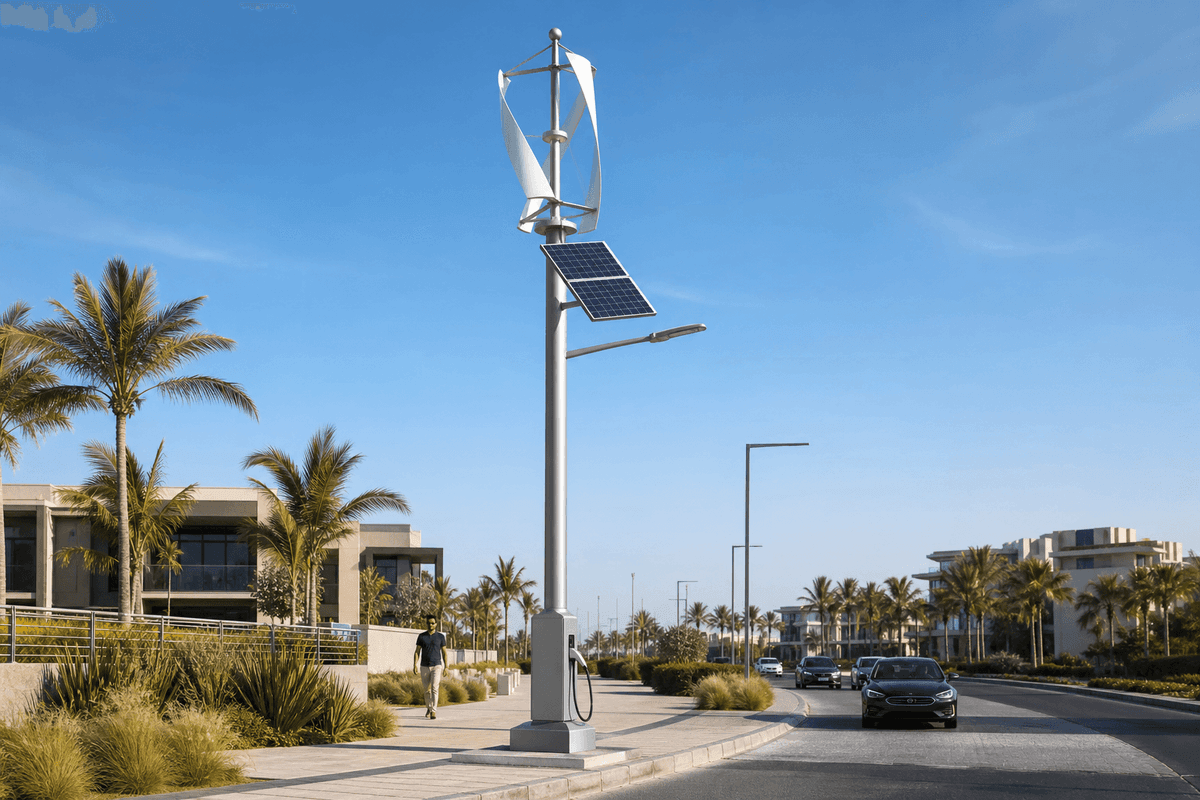
12m Wind-Solar Hybrid Smart Pole with VAWT + Monocrystalline + Welded EV Charging Base - 11-in-1 Hybrid Boulevard System
Key Features
- 12m octagonal tapered steel smart pole with 11 integrated subsystems and 180km/h wind resistance
- Hybrid generation with 1×300-500W VAWT plus 2×100-200W monocrystalline panels for up to 900W nameplate input
- 160W LED roadway lighting at 170 lm/W delivers approximately 27,200 lumens with twin arms at +8° tilt
- Integrated welded 2.2m EV charging base supports 7kW or 11kW AC Type 2 charging in one continuous structure
- Internal LFP battery options of 5kWh, 10kWh, or 15kWh support resilient operation from -40°C to +55°C
The 12m Wind-Solar Hybrid Smart Pole combines a 400-500W vertical-axis wind turbine, 2×100-200W monocrystalline panels, 160W LED lighting, integrated Type 2 EV charging, LFP battery storage, communications, surveillance, and public-safety modules in one 11-in-1 octagonal steel structure. Designed for 30-35m boulevard spacing and 180km/h wind resistance, it supports self-powered operation with grid backup for smart-city, campus, waterfront, and transport-corridor deployments.
Description
The 12m Wind-Solar Hybrid Smart Pole with VAWT + Monocrystalline + Welded EV Charging Base is an 11-in-1 integrated smart streetlight platform engineered for mixed-energy urban infrastructure, combining a 12m octagonal tapered steel pole, 160W LED roadway luminaire, 400-500W vertical-axis wind turbine, 2 monocrystalline solar panels rated 100W, 150W, or 200W each, 5-15kWh LFP battery storage, and a 7kW or 11kW Type 2 AC EV charger in a single welded structure. The lower 2.2m of the pole forms the charging cabinet as one continuous steel body rather than a separate pedestal, reducing footprint by approximately 30-40% compared with conventional pole-plus-bollard layouts while preserving boulevard aesthetics and cable routing discipline.
Built for the Americas, Pacific, and Southeast Asia hybrid boulevard use case, this variant supports typical pole spacing of 30m, 32m, or 35m, with the standard engineering basis at 32m. The apex-mounted VAWT is positioned from 11.8m to 12.0m, while the solar array occupies the 10.2m to 11.2m zone on a symmetric 15° east-west A-frame. This geometry allows simultaneous wind capture, solar generation, and unobstructed smart-device mounting, while the upward-tilted twin-arm luminaire at +8° improves roadway distribution on broad carriageways. For buyers comparing integrated smart poles, View all Smart Streetlight (10-in-1 Multi-function Pole) products for platform-level configuration differences.
Product Positioning and Integrated Functions
This flagship hybrid model integrates 11 major subsystems: VAWT, monocrystalline solar panels, 160W LED lighting, PTZ camera, environmental sensor, IP audio column, emergency call unit, WiFi 6/5G communications, welded EV charging base, portrait LED display, and internal LFP battery. The communications unit mounts on the shaft at 8.7m, not under the luminaire arm, helping maintain RF separation and service access. The portrait LED display is locked to show “SOLARTODO Smart City” text only, supporting standardized municipal branding and reducing content-control complexity across fleets of 50, 100, or 250+ poles.
From an infrastructure planning perspective, the hybrid architecture is intended to reduce trenching dependency and improve resilience during partial grid outages lasting 2-8 hours, depending on battery size, charging load, and local irradiance/wind resource. According to IRENA and IEA market analyses, hybrid distributed energy systems can improve public-infrastructure uptime while lowering operating expenditure where electricity tariffs exceed $0.12-$0.25/kWh and where diesel backup logistics are expensive. For public-lighting performance and safety, the luminaire design aligns with IEC 60598 and LED module expectations under IEC 62722, while EV charging interface selection follows IEC 62196-2 Type 2 Mennekes standards.
Structural Design and Materials
The pole uses an octagonal tapered steel body with hot-dip corrosion protection and exterior architectural coating options in RAL 7021 dark grey, RAL 9005 black, RAL 7024 charcoal, RAL 6014 military green, RAL 8011 antique bronze, and RAL 1036 champagne gold. At 12m overall height and a wind rating of 180km/h, the structure is intended for coastal boulevards, campuses, industrial parks, marinas, and arterial roads where combined dead load and dynamic load from wind, solar, display, and telecom devices must be evaluated together. In engineering review, designers should verify foundation, anchor cage, and local gust factors against site code requirements and fatigue assumptions under recurring wind events.
The welded EV charging base is a defining mechanical feature. Instead of attaching a separate 1.2-1.6m charging bollard near the pole, the lower 2.2m is fabricated as a single integrated charging cabinet within the pole envelope. This arrangement reduces civil coordination interfaces from approximately 3 systems to 1 system—pole, charger, and battery enclosure become one assembly—thereby simplifying conduit routing, reducing exposed cable lengths by 2-5m, and improving vandal resistance. In practical procurement terms, fewer independent cabinets also reduce SKU complexity for projects above 100 units.
Energy Generation and Storage System
The wind subsystem supports 3 VAWT options: Gorlov helical 400W, Darrieus H-type 500W, or Savonius bucket 300W. For boulevard deployments with multi-directional airflow, the Gorlov and Savonius geometries can offer stable low-turbulence response, while the Darrieus option can provide higher nominal output under stronger, more uniform wind regimes. The turbine is mounted at the apex between 11.8m and 12.0m, where wind speed is generally higher than at pedestrian level. Reference methodologies from NREL indicate that even modest increases in mounting height can improve annual wind energy capture due to the vertical wind profile, though actual output depends on roughness class, obstructions, and local Weibull distribution.
The solar subsystem uses 2 deep-black monocrystalline modules in 100W, 150W, or 200W ratings, for a total installed PV capacity of 200W, 300W, or 400W. The symmetric east-west layout at 15° tilt is selected to broaden the generation window across morning and afternoon hours rather than maximizing noon-only peak. This is particularly useful when the pole powers communications, sensing, and standby systems over 12-24 hours. Based on NREL PVWatts style modeling principles, a 400W PV array in favorable climates can produce several hundred kilowatt-hours annually, supporting auxiliary loads and reducing grid import for low-duty charging and smart devices.
Battery storage is provided by an internal LFP pack with 5kWh, 10kWh, or 15kWh options located inside the pole base. Lithium iron phosphate chemistry is widely selected for public infrastructure due to thermal stability, long cycle life, and favorable safety characteristics relative to some other lithium-ion chemistries. In a typical low-demand smart-pole profile where EV charging is opportunistic rather than continuous, a 10kWh battery can buffer nighttime lighting, communication standby loads, camera operation, and emergency services for multiple hours. For battery safety and integration, project engineers should consider IEC 62619, local electrical code, and utility interconnection rules where grid backup tie is enabled.
Lighting, Surveillance, and Public-Safety Modules
Roadway lighting is delivered through a 160W LED system on twin symmetric arms with +8° upward tilt, using an efficacy baseline of 170 lm/W for total nominal luminous flux around 27,200 lumens. This output is suitable for boulevard, frontage-road, and mixed pedestrian-vehicle zones depending on mounting height, optics, road width, and local illuminance targets. Compared with legacy 250W high-pressure sodium fixtures commonly delivering lower system efficacy, the LED package can reduce lighting electricity demand by roughly 36-45% while improving color rendering and digital controllability. Lighting design should still be validated against roadway class and local standards.
The surveillance package includes PTZ camera options such as 22cm dome, 15cm mini dome, or 4MP IR bullet. The common smart-pole baseline supports 20x optical zoom and 50m IR night vision, enabling lane observation, public-space monitoring, and event verification from a single elevated node. For city operators deploying 20-200 poles, PTZ coverage can reduce the number of standalone camera masts required along corridors, especially when combined with edge analytics. System planners should align deployment with local privacy laws, retention policies, and network uplink capacity.
Environmental monitoring can be configured in 4-parameter, 8-parameter, or 12-parameter versions, measuring combinations of PM2.5, PM10, temperature, humidity, noise, O3, NO2, wind speed, and related variables. This allows one pole to function as both lighting and microclimate station, which is useful for ports, campuses, school zones, and urban heat-island studies. A distributed network of 25-50 poles can provide block-level data granularity that fixed rooftop stations often cannot capture. For municipal digital twins and ESG reporting, this data supports evidence-based policy and operational alerts.
Public communication and safety are handled by 1 or 2 IP audio columns, an SOS emergency call module, and optional shaft-mounted WiFi 6, 5G small cell, or dual WiFi 6 + 5G communications. WiFi 6 access points in this class can support 500+ concurrent users under favorable backhaul and RF conditions, making the pole suitable for parks, waterfronts, event streets, and transit interchanges. The emergency call function is valuable for campuses and smart-city corridors, where response time can be reduced when audio, video, and geolocation are integrated into one node.
EV Charging Integration
The integrated charger is available in 7kW or 11kW AC, using a Type 2 IEC 62196-2 Mennekes connector. The charger is physically incorporated into the welded lower 2.2m structure, which improves visual consistency and reduces the number of separate foundations from 2 to 1 compared with a conventional streetlight plus adjacent charger pedestal. For fleet parking, curbside charging, and destination charging, the 11kW option is generally preferred where three-phase supply is available and local code permits. Smart charging logic can be integrated via OCPP-based ecosystems depending on final charger controller selection.
In practical use, this hybrid pole is not intended to fully power high-throughput EV charging from wind and solar alone. Instead, the renewable subsystem offsets auxiliary and standby loads, supports resilience, and reduces net imported energy over time, while the charger operates primarily with grid backup tie. This hybrid strategy is more realistic for public infrastructure because it balances visible sustainability with charging reliability. Compared with a standalone 11kW charger plus conventional 12m light pole, the integrated design can reduce installed streetscape clutter by 1 cabinet per parking bay and streamline maintenance dispatches by consolidating assets.
System Architecture
At the control level, the pole combines renewable charging management, battery protection, luminaire control, video surveillance, environmental sensing, public audio, emergency communications, display control, and telecom backhaul into one managed endpoint. Typical architecture includes MPPT control, protected AC/DC distribution, surge protection, smart metering, and remote telemetry. Communication paths can use 4G, 5G, WiFi 6, and LoRaWAN, depending on city network policy and device density. Buyers planning larger deployments can Configure your system online to align charger power, battery size, display pixel pitch, and sensor package with project KPIs.

For standards alignment, lighting references include IEC 60598 and IEC 62722, EV connector compliance references IEC 62196-2, and smart-pole system integration can be benchmarked against EN 50556 concepts for road lighting support structures and associated equipment integration. For surge and grounding design, engineers should also review local adoptions of IEC 61643, IEEE grounding practices, and utility interconnection requirements. In high-lightning regions with annual thunderstorm days above 40-60 days, layered surge protection and low-resistance grounding are strongly recommended.
Cloud Monitoring and Data Management
The platform supports cloud-based supervision for status monitoring, alarms, lighting schedules, charger session visibility, battery state-of-charge, sensor dashboards, and device health metrics. In a deployment of 100 poles, operators can centralize maintenance alerts, reduce manual inspections, and compare corridor-level energy performance by district. This is increasingly important as cities move from isolated pilot assets to networked infrastructure portfolios. For broader implementation guidance, Learn about topic and Learn about topic for related smart-city, solar-storage, and infrastructure integration resources.
A practical example is a waterfront boulevard operator in Sydney deploying 48 units across a 1.5km mixed pedestrian and EV parking corridor. By selecting 400W Gorlov VAWT, 2×200W PV, 10kWh LFP, and 11kW charging, the operator used the poles to combine lighting, security, public WiFi, and destination charging without adding separate camera masts or charger bollards. Compared with a conventional layout of one 12m light pole plus one independent charger pedestal plus one camera post, the integrated hybrid pole reduced visible street furniture count by roughly 33% and shortened installation interfaces from 3 trades to 1 coordinated EPC package.

Performance Comparison vs Conventional Alternatives
Compared with a conventional 12m roadway pole using a separate 250W HPS fixture, standalone CCTV post, separate environmental monitor, and detached 7-11kW charger pedestal, this integrated hybrid system can reduce total streetscape equipment count by 25-50%, depending on baseline design. LED lighting alone can cut fixture energy consumption by around 36-45%, while hybrid renewable support can offset part of the auxiliary load for communications and standby electronics. In regions where trenching, cabinet foundations, and traffic control account for 20-35% of installed cost, combining functions into one structure can materially improve project economics.
For public-sector buyers evaluating lifecycle value, the design life target is 25 years, operating temperature range is -40°C to +55°C, and enclosure protection is IP66 for key outdoor subsystems. These values are relevant for coastal humidity, desert heat, and tropical rainfall conditions common in Miami, Austin, São Paulo, Singapore, and Sydney. Industry references from BloombergNEF, Wood Mackenzie, IEA, and IRENA continue to show that integrated electrification and digitalization assets deliver stronger ROI where infrastructure must serve multiple functions from one civil footprint.
EPC Investment Analysis and Pricing Structure
For B2B projects, EPC scope typically includes 5 stages: engineering, procurement, construction, commissioning, and warranty support. Engineering covers foundation drawings, electrical single-line design, load verification, and communication architecture. Procurement covers the pole, charger, renewable modules, battery, controls, and accessories. Construction includes installation, wiring, lifting, anchoring, and civil coordination. Commissioning includes software setup, charger testing, lighting verification, and network onboarding. Standard turnkey supply includes a 1-year warranty with remote support and spare-parts guidance.
| Pricing Tier | Scope | Price Range (USD/unit) |
|---|---|---|
| FOB Supply | Equipment only, ex-works China | $2,790 - $3,944 |
| CIF Delivered | Equipment + ocean freight + insurance | $3,134 - $4,431 |
| EPC Turnkey | Installed, commissioned, 1-year warranty | $4,500 - $5,800 |
| Order Volume | Discount |
|---|---|
| 50+ units | 5% |
| 100+ units | 10% |
| 250+ units | 15% |
A typical ROI model compares this hybrid smart pole against a conventional bundle consisting of 1 light pole, 1 charger pedestal, 1 camera mast, 1 environmental sensor post, and separate communications mounting. Depending on local labor rates and utility tariffs, annual savings can come from 3 channels: lower lighting energy, fewer separate maintenance visits, and reduced civil/asset duplication. In markets with electricity rates around $0.15/kWh and maintenance savings of $150-$300 per pole per year, payback for the integrated premium can fall in the 4-7 year range, especially when replacing multiple standalone assets. For project commercial terms, payment is typically 30% T/T deposit + 70% against B/L, or 100% L/C at sight; financing support is available for projects above $1,000K. For quotations and EPC discussion, contact [email protected] or Request a custom quotation.
Technical Specifications
The standard configuration includes 12m pole height, 160W LED power, 170 lm/W luminous efficacy, 11-in-1 integration, 180km/h wind resistance, IP66 protection, -40°C to +55°C operating temperature, 4G/5G + LoRaWAN communication compatibility, and a 25-year design life. Recommended spacing is 32m, with project options at 30m and 35m depending on roadway photometrics and local standards. Renewable generation options include 300-900W combined nominal nameplate, depending on selected VAWT and PV sizes, while storage ranges from 5kWh to 15kWh LFP.
For procurement teams, the key value of this configuration is not only hardware consolidation but also interface reduction. One pole can replace up to 5 separate urban devices while preserving a single visual language across a smart boulevard. This is particularly useful for municipalities, industrial parks, airports, universities, and developers standardizing infrastructure packages across 10, 50, or 500 locations. For detailed project adaptation, foundation design, charger options, and communications architecture should always be finalized against local code, utility conditions, and authority approvals.
Technical Specifications
| Variant ID | hybrid_wind_solar_12m |
| Product Line | Smart Streetlight (10-in-1 Multi-function Pole) |
| Pole Height | 12m |
| Height Options | 11 / 12m |
| Pole Design | Octagonal tapered steel |
| Pole Color Options | RAL7021 / RAL9005 / RAL7024 / RAL6014 / RAL8011 / RAL1036 |
| Integrated Modules | 11in-1 |
| LED Power | 160W |
| Luminous Efficacy | 170lm/W |
| Luminaire Configuration | Twin arms with +8° upward tilt |
| Recommended Pole Spacing | 32m |
| Spacing Options | 30 / 32 / 35m |
| Wind Resistance | 180km/h |
| VAWT Options | Gorlov helical 400W / Darrieus H-type 500W / Savonius bucket 300W |
| VAWT Position | 11.8 to 12.0m |
| Solar Panel Type | Monocrystalline deep black |
| Solar Panel Quantity | 2pcs |
| Solar Panel Power Options | 100 / 150 / 200W |
| Solar Mount | A-frame 15° tilt symmetric east-west |
| Solar Panel Position | 10.2 to 11.2m |
| Battery Chemistry | LFP |
| Battery Capacity Options | 5 / 10 / 15kWh |
| Battery Location | Inside pole base |
| EV Charger Integration | Pole base welded 2.2m single structure |
| EV Charger Power Options | 7 / 11kW |
| EV Connector | Type 2 IEC 62196-2 Mennekes |
| Camera Options | PTZ 22cm dome / PTZ 15cm mini dome / Bullet 4MP IR50m |
| Environmental Sensor Options | 4 / 8 / 12 parameter |
| Communication Options | WiFi 6 / 5G small cell / dual WiFi 6 + 5G |
| WiFi Mount Position | Pole shaft 8.7m |
| Audio Options | 1x or 2x IP audio columns |
| Display Options | P3 1000x2000mm / P4 960x1920mm / P5 1280x2560mm |
| Display Text Lock | SOLARTODO Smart City |
| IP Rating | IP66 |
| Operating Temperature | -40 to +55°C |
| Communication | 4G/5G + LoRaWAN |
| Application | Americas Pacific hybrid boulevard |
| Design Life | 25years |
Price Breakdown
| Item | Quantity | Unit Price | Subtotal |
|---|---|---|---|
| 12m octagonal tapered steel pole with welded 2.2m charging base | 1 pcs | $923 | $923 |
| 160W LED twin-arm luminaire set | 1 pcs | $180 | $180 |
| VAWT generator assembly (Gorlov/Darrieus/Savonius average FOB) | 1 pcs | $320 | $320 |
| Monocrystalline solar panels 150W average | 2 pcs | $85 | $170 |
| LFP battery pack 10kWh integrated base system | 1 pcs | $980 | $980 |
| MPPT controller and hybrid power management | 1 pcs | $180 | $180 |
| PTZ camera 4K 23x zoom | 1 pcs | $226 | $226 |
| Environmental sensor 8-in-1 | 1 pcs | $201 | $201 |
| IP audio column | 1 pcs | $92 | $92 |
| SOS emergency call unit | 1 pcs | $134 | $134 |
| WiFi 6 / 5G communication module | 1 pcs | $149 | $149 |
| Portrait LED display P4 | 1 pcs | $654 | $654 |
| 11kW AC EV charger OCPP | 1 pcs | $252 | $252 |
| Accessories, breakers, surge protection, cabling | 1 pcs | $50 | $50 |
| Engineering & QC | 1 pcs | $420 | $420 |
| Installation & Commissioning | 1 pcs | $640 | $640 |
| 1-Year Warranty & Remote Support | 1 pcs | $210 | $210 |
| Total Price Range | $4,500 - $5,800 | ||
Frequently Asked Questions
Can this hybrid pole operate fully off-grid while also charging EVs?
What wind turbine and solar panel combinations are available?
How is the EV charger integrated into the pole structure?
What is included in EPC pricing and what warranty is provided?
Which applications are most suitable for this 12m hybrid smart pole?
Certifications & Standards


Data Sources & References
- •NREL PVWatts 2025
- •NREL Distributed Wind Resource Assessment references
- •IEA World Energy Outlook 2025
- •IRENA Renewable Power Generation Cost references
- •BloombergNEF EV Charging Infrastructure market references
- •Wood Mackenzie distributed energy and charging infrastructure research
- •IEC 60598 / IEC 62722 / IEC 62196-2 standards references
Interested in this solution?
Contact us for a customized quote based on your specific requirements.
Contact Us