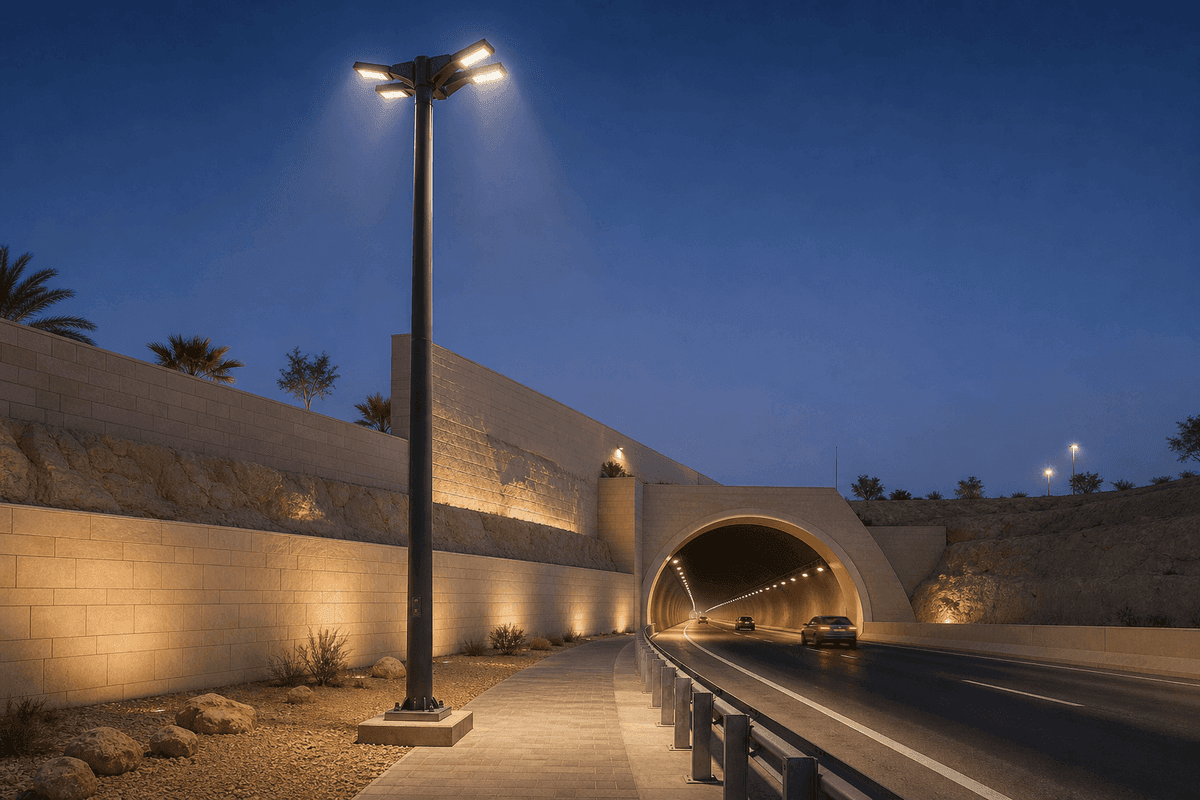
10m Tunnel Entrance Smart Pole - 200W LED 4-in-1
Key Features
- 10m octagonal galvanized steel smart pole with 25-year design life and 150 km/h wind resistance
- 200W LED luminaire delivers approximately 34,000 lumens at 170 lm/W for 300 lux tunnel entrance lighting
- 4-in-1 configuration integrates 1 LED light, 1 AI camera, 1 environmental sensor, and 1 LED display
- IP66 outdoor protection with operating temperature range from -40°C to +55°C for year-round deployment
- EPC turnkey price range of USD 1,800-2,200 per unit with 5%, 10%, and 15% volume discounts
The 10m Tunnel Entrance Smart Pole is a 4-in-1 octagonal smart streetlight system engineered for tunnel approach zones, combining a 200W LED luminaire, AI camera, environmental sensor, and LED display on a 10m steel pole. Designed for 300 lux target illumination, IP66 outdoor durability, and 25-year structural life, it supports safer transition lighting, real-time monitoring, and centralized smart-city control.
Description
The 10m Tunnel Entrance Smart Pole is a 4-in-1 integrated smart streetlight system built for tunnel entrance and threshold lighting applications where rapid luminance transition, environmental awareness, and traffic surveillance are required within a compact 10m octagonal steel pole. This configuration combines 1 × 200W LED luminaire, 1 × AI camera, 1 × environmental sensor, and 1 × LED display, with a design target of 300 lux at the critical approach zone, IP66 ingress protection, and a 25-year structural design life. For EPC projects, the installed price range is USD 1,800-2,200 per unit, positioning it as a cost-efficient alternative to multi-cabinet roadside deployments.
In tunnel infrastructure, lighting quality at the first 30-100m of the entrance zone directly affects driver adaptation, object recognition, and stopping distance, especially when exterior daylight exceeds 5,000-20,000 lux while interior tunnel luminance may be below 100-300 lux. According to CIE tunnel lighting practice, IEC 60598 luminaire safety requirements, and IEC 62722 LED performance guidance, entrance lighting systems must deliver stable output, glare control, and robust thermal management. This smart pole addresses those requirements with a 200W LED module at 170 lm/W, yielding approximately 34,000 lumens, while consolidating monitoring and information functions that would otherwise require 3-4 separate roadside assets.
Product Positioning and Configuration
This model belongs to the Smart Streetlight (10-in-1 Multi-function Pole) product line, but the present variant is optimized as a 4-in-1 tunnel entrance pole rather than a full 10-in-1 boulevard pole. The structure uses an octagonal tapered galvanized steel pole with fluorocarbon exterior protection, a nominal height of 10m, and a wind resistance rating of 150 km/h. Compared with a conventional tunnel lighting support arrangement using 1 standard lighting pole + 1 separate CCTV pole + 1 independent sensor mast + 1 roadside sign frame, this integrated design can reduce roadside foundation count by approximately 50-75%, lower trenching length by 20-35%, and simplify preventive maintenance scheduling from 4 asset classes to 1.
For buyers comparing options across the portfolio, this tunnel model is a focused infrastructure SKU based on the legacy octagonal standard smart pole architecture, not the 12m EV-charging flagship and not the Ø219mm cylindrical CIGS flush-integrated pole. That distinction matters because tunnel portals typically prioritize high illuminance, camera visibility, corrosion resistance, and utility-powered reliability, not EV charging or decorative urban design. Buyers can View all Smart Streetlight (10-in-1 Multi-function Pole) products to compare 6m, 8m, 10m, and 12m smart pole configurations, or Configure your system online for site-specific lumen, sensor, and communications requirements.
Why Tunnel Entrance Lighting Requires Smart Integration
Tunnel entrances are among the most demanding road-lighting environments because the visual adaptation challenge changes by the minute and by season. In bright daytime conditions, the luminance ratio between the open road and the tunnel threshold can exceed 10:1 or even 20:1, increasing the risk of the so-called black-hole effect. A 300 lux smart lighting solution at a 10m mounting height is therefore practical for secondary urban tunnels, underpasses, industrial logistics tunnels, and municipal access corridors where operators need stronger threshold visibility than a standard 30-80 lux roadway pole can provide.
The integrated camera and environmental sensor also help operators correlate visibility conditions with air quality and traffic events. For example, PM2.5, PM10, NO2, O3, temperature, humidity, noise, and wind speed data can be sampled in intervals as short as 1-60 seconds, while the AI camera can provide 4K video, 20x optical zoom, and 50m IR night vision for incident verification. In practical terms, this means one pole can support both lighting and operational decision-making at the tunnel mouth, where vehicle congestion, exhaust accumulation, and condensation risk often peak within the first 50m.
System Architecture
The system architecture is based on a utility-powered smart pole with a modular load topology and centralized communications. The 200W LED luminaire is the primary electrical load, while the camera, environmental sensor, and LED display are secondary low-power modules managed through a smart distribution arrangement with surge protection, breakers, and communications links. Typical input power is AC 220V/380V, depending on regional grid design, with 4G/5G + LoRaWAN communications available for remote telemetry, alarms, and firmware updates. A standard integrated control strategy can reduce energy use by 30-50% compared with non-dimmable conventional HID tunnel approach lighting, especially where night dimming and event-triggered operation are enabled, in line with energy-saving findings published by IEA and NREL on connected outdoor lighting systems.

From a civil and electrical engineering perspective, the use of 1 pole, 1 foundation, and 1 cable entry point reduces roadside clutter and eases coordination with tunnel SCADA, traffic control, and municipal lighting teams. The octagonal steel geometry improves torsional stiffness compared with some thin-wall round-tube alternatives in the 8-10m class, while hot-dip galvanization and fluorocarbon coating support long-term corrosion resistance under humidity, road salt, and exhaust exposure. The luminaire and module interfaces are designed in accordance with IEC 60598, while smart pole integration practice aligns with EN 50556 for connected urban infrastructure.
Technical Specifications and Performance Logic
At the core of this product is a 200W LED luminaire delivering approximately 34,000 lumens at 170 lm/W efficacy. At a 10m mounting height, this output is suitable for targeted 300 lux entrance-zone coverage when paired with proper beam distribution, spacing, and roadway geometry. Actual maintained illuminance depends on pole setback, arm projection, road width, surface reflectance, and maintenance factor, but the 200W class is widely used where operators need significantly higher threshold visibility than a standard urban collector road fixture of 60-120W can provide.
The camera module is specified as a 4K AI-powered PTZ camera with up to 20x optical zoom and 50m IR night vision, allowing operators to identify stopped vehicles, lane incursions, or maintenance personnel near the portal. The environmental sensor supports at least 8 parameters, including PM2.5, PM10, O3, NO2, noise, temperature, humidity, and wind speed, which is valuable because tunnel approach safety is affected not only by illumination but also by airborne particulate levels, fogging conditions, and crosswind behavior. The LED display adds a local information layer for warnings, maintenance notices, or directional messaging visible within a short roadside range of approximately 20-80m, depending on pixel pitch, brightness, and viewing angle.
Cloud Monitoring and Smart Control
The smart pole can be connected to a cloud platform for centralized monitoring across 1 site or 100+ sites, depending on project scale. Through 4G/5G + LoRaWAN communications, operators can monitor lamp status, power anomalies, camera health, sensor values, and display content from a unified dashboard. Typical functions include real-time alarms within 5-30 seconds, scheduled dimming by time band, threshold-based alerts for PM2.5 or NO2, and maintenance ticket generation. For infrastructure operators managing multiple tunnel portals, this can reduce fault localization time by 40-60% compared with manual patrol-based inspection.
A cloud-connected smart pole also supports data retention and trend analysis. Over 12 months, operators can compare tunnel entrance air quality, lighting runtime, and incident frequency to optimize cleaning cycles, ventilation coordination, and lamp dimming schedules. Studies from IEA, IRENA, and BloombergNEF consistently show that digital monitoring improves asset utilization and lowers OPEX in distributed infrastructure systems by enabling predictive maintenance rather than reactive replacement. Users who need implementation guidance can Learn about topic and also Learn about topic for broader smart-lighting and energy infrastructure references.

Application Scenario: Urban Underpass and Tunnel Portal Upgrade
A municipal transport operator in a MENA-style climate zone upgraded 24 tunnel entrance points on a ring-road underpass network using smart poles in the 10m class. Before the upgrade, each entrance used 1 conventional 250W HPS luminaire, 1 separate CCTV mast, and periodic handheld air-quality checks every 7 days. After replacing the arrangement with integrated 200W LED smart poles, the operator achieved an estimated 20% reduction in connected lighting power, approximately 45% lower night-time energy use with dimming, and a reduction in roadside civil interfaces from 72 structures to 24 structures.
The operational gains were equally important. Incident verification time fell from roughly 15 minutes to less than 3 minutes because the control room could pull live 4K video and environmental data immediately after an alarm. Maintenance dispatches were reduced by approximately 30% over the first 12 months because lamp faults, communication failures, and sensor drift could be identified remotely. In environments where lane closures can cost hundreds of dollars per hour, reducing even 1-2 unnecessary dispatches per month per tunnel can materially improve total cost of ownership.
Comparison with Conventional Alternatives
Compared with a conventional tunnel entrance setup using a 250W HPS or 400W metal-halide fixture, this 200W LED smart pole can reduce fixture-level energy consumption by approximately 20-50%, depending on the baseline lamp type, ballast losses, and dimming strategy. HID systems also typically require more frequent relamping, with useful maintenance cycles often around 12,000-24,000 hours, whereas quality LED systems can target 50,000-100,000 hours under proper thermal control. That difference can cut maintenance interventions by 50% or more over a 10-year period.
Compared with deploying 4 separate roadside devices, the integrated smart pole reduces steelwork, conduits, and foundation duplication. It also reduces the number of visible roadside obstacles, which is relevant in constrained tunnel approach geometry where clear zones, crash barriers, and utility corridors are limited. From a procurement perspective, integrated sourcing simplifies vendor coordination from 4 contracts to 1, while from an EPC perspective it compresses installation sequencing from multiple crews to a more standardized workflow. These benefits are especially relevant for municipal, industrial, airport, and logistics tunnel applications with project sizes of 10-250 poles.
Standards, Compliance, and Engineering Basis
This product is engineered around recognized outdoor-lighting and smart-infrastructure standards. The luminaire design references IEC 60598 for luminaires and IEC 62722 for LED luminaire performance, while smart-pole integration follows EN 50556 principles for connected urban equipment. Electrical protection and module integration can be specified to local utility and roadway authority requirements, with surge protection, grounding, and breaker coordination selected according to project voltage and lightning exposure. The enclosure target is IP66, and the operating temperature range is -40°C to +55°C, which covers most tunnel entrance climates from continental winter conditions to hot desert summers.
For buyers developing tender documents, it is useful to align performance claims with independent references. NREL has repeatedly documented the efficacy and controllability advantages of modern LED roadway lighting. IEA and IRENA have both highlighted digitalization as a key contributor to infrastructure efficiency. Market analyses from BloombergNEF and Wood Mackenzie show ongoing cost declines in connected hardware and increasing demand for multifunction street assets in transport corridors. These references support the business case for integrated poles where uptime, data visibility, and reduced field labor are as important as raw lumen output.
EPC Investment Analysis and Pricing Structure
For this product, EPC means a complete delivery scope that typically includes engineering, procurement, construction, installation, testing, commissioning, and 1-year warranty support. Engineering covers pole layout, load verification, wiring diagrams, and installation drawings. Procurement includes the pole, 200W LED luminaire, camera, environmental sensor, LED display, and electrical accessories. Construction includes foundation interface coordination, erection, wiring termination, and system startup. Commissioning includes functional tests for lighting, communications, camera streaming, sensor calibration checks, and display operation.
Pricing Tiers
| Tier | Scope | Price Range per Unit |
|---|---|---|
| FOB Supply | Equipment only, ex-works China | USD 1,116-1,496 |
| CIF Delivered | Equipment + ocean freight + insurance | USD 1,254-1,681 |
| EPC Turnkey | Installed + commissioned + 1-year warranty | USD 1,800-2,200 |
Volume Discount Schedule
| Order Quantity | Discount |
|---|---|
| 50+ units | 5% |
| 100+ units | 10% |
| 250+ units | 15% |
A simple ROI model illustrates the value. If a conventional tunnel entrance solution uses a 250W HPS fixture plus separate CCTV and sensor hardware, annual energy consumption can exceed the integrated LED alternative by roughly 175-350 kWh per pole, depending on runtime and dimming. At an electricity tariff of USD 0.12/kWh, that is USD 21-42 per year in direct lighting savings alone. When reduced maintenance, fewer civil assets, and lower inspection labor are included, annual operating savings can reach USD 120-260 per pole, implying a rough incremental payback of 3-6 years versus fragmented legacy systems, depending on site conditions and labor rates.
Payment terms are typically 30% T/T deposit + 70% against B/L, or 100% L/C at sight for qualified transactions. For projects above USD 1,000,000, staged financing and milestone-based commercial structures may be available subject to jurisdiction and credit review. For project pricing, BOQ review, or tender support, buyers can Request a custom quotation or contact [email protected] directly.
Procurement Notes for B2B Buyers
For EPC contractors, consultants, and municipal buyers, the main variables affecting final pricing are pole wall thickness, foundation design, camera specification, display size, and communications package. A standard 10m octagonal pole with 200W LED, 1 camera, 1 environmental sensor, and 1 LED display sits in the lower-middle smart infrastructure cost band, well below premium 10-in-1 poles that include WiFi, public audio, EV charging, and edge servers. This makes the present variant suitable for projects where safety and monitoring are mandatory but CAPEX discipline remains strict.
From a lifecycle perspective, the integrated architecture also eases spare-parts planning. Instead of stocking separate support hardware for 3-4 asset families, operators can standardize around one pole platform and a limited module set. That approach can reduce warehouse SKU count by 25-40% and simplify technician training over a 1-2 quarter deployment program. For organizations planning phased upgrades, it is practical to begin with 10-20 poles, validate cloud integration and lighting performance, then scale to 50+ poles under the volume discount structure.
Conclusion
The 10m Tunnel Entrance Smart Pole is a focused infrastructure product that combines 300 lux entrance lighting, 34,000-lumen LED output, 4K AI surveillance, 8-parameter environmental sensing, and LED information display into a single 10m octagonal IP66 smart pole. Compared with conventional fragmented roadside equipment, it can reduce energy use by 20-50%, lower maintenance interventions by 30-50%, and simplify civil installation by consolidating 4 functions into 1 structure. For tunnel portals, underpasses, industrial access roads, and transport corridors, it provides a technically grounded and cost-rational smart lighting solution backed by standards-based design and EPC-ready delivery.
Technical Specifications
| Product Variant | 10m Tunnel Entrance Smart Pole |
| Product Line | Smart Streetlight (10-in-1 Multi-function Pole) |
| Pole Height | 10m |
| Pole Design | Octagonal tapered galvanized steel |
| LED Power | 200W |
| Luminous Efficacy | 170lm/W |
| Estimated Luminous Flux | 34000lm |
| Integrated Modules | 4in-1 |
| Included Modules | LED, Camera, Environmental Sensor, LED Display |
| Application | Tunnel entrance |
| Target Illuminance | 300lux |
| Wind Resistance | 150km/h |
| IP Rating | IP66 |
| Operating Temperature | -40 to +55°C |
| Communication | 4G/5G + LoRaWAN |
| Energy Saving | 30-50% |
| Camera Resolution | 4K |
| Optical Zoom | 20x |
| IR Night Vision | 50m |
| Design Life | 25years |
| Input Power | AC220/380V |
Price Breakdown
| Item | Quantity | Unit Price | Subtotal |
|---|---|---|---|
| 10m octagonal tapered steel pole | 1 pcs | $671 | $671 |
| 200W LED luminaire | 1 pcs | $140 | $140 |
| 4K AI PTZ camera | 1 pcs | $226 | $226 |
| Environmental sensor 8-in-1 | 1 pcs | $201 | $201 |
| LED display P4 | 1 pcs | $654 | $654 |
| Accessories (cables, breakers, surge) | 1 pcs | $50 | $50 |
| Engineering & QC | 1 pcs | $85 | $85 |
| Installation & Commissioning | 1 pcs | $105 | $105 |
| 1-Year Warranty & Support | 1 pcs | $68 | $68 |
| Total Price Range | $1,800 - $2,200 | ||
Frequently Asked Questions
What makes this smart pole suitable for tunnel entrance applications?
Which modules are included in the 4-in-1 configuration?
How does the 200W LED smart pole compare with conventional HPS tunnel lighting?
What is included in the EPC turnkey price and what warranty is provided?
What payment terms are available for B2B and infrastructure projects?
Certifications & Standards



Data Sources & References
- •IEC 60598 Luminaires standard
- •IEC 62722 LED luminaire performance standard
- •EN 50556 smart city and connected street furniture reference
- •NREL solid-state and connected outdoor lighting research
- •IEA energy efficiency and digital infrastructure reports
- •IRENA smart energy and urban infrastructure publications
- •BloombergNEF smart city and connected hardware market analysis
- •Wood Mackenzie infrastructure technology market analysis
Interested in this solution?
Contact us for a customized quote based on your specific requirements.
Contact Us