Rice Paddy Smart Irrigation 63ha - 25-Sensor Solar 4G IoT System
Key Features
- 63 ha rice paddy coverage with 25 total weather, soil, and water-level sensors
- 10-minute default data interval, configurable from 1 to 60 minutes
- 4G LTE cloud communication with SMS, email, and app push alerts
- Solar-large power kit with LFP battery for outdoor field operation
- EPC turnkey price range from $3,422 to $4,526 including commissioning
Rice Paddy Smart Irrigation 63ha is a solar-powered 4G smart agriculture IoT package with 25 weather, soil, and water-level sensors for rice paddy irrigation scheduling, cloud alerts, and EPC turnkey delivery from $3,422 to $4,526.
Description
Rice Paddy Smart Irrigation 63ha is a 25-sensor smart agriculture IoT monitoring system for rice fields requiring weather, soil, and water-level data at 10-minute intervals. The package combines 4G communication, solar-large power, standard cloud analytics, and EPC turnkey delivery priced from $3,422 to $4,526 for 63 hectares.
This SOLARTODO configuration is designed for B2B buyers managing 1 contiguous rice block of approximately 630,000 m², where water depth, soil moisture, rainfall, evapotranspiration, and pump timing must be controlled with measurable evidence instead of manual inspection. It belongs to the Smart Agriculture IoT Monitoring System product line and can be adapted through the online configurator for farms larger than 63 ha.
Application Context: Rice Paddy Irrigation
Rice paddy irrigation is normally managed around field water depth, rainfall events, crop stage, and pumping cost, and a 63 ha block can require dozens of manual gauge readings per week during transplanting, tillering, heading, and grain filling. This system uses 25 distributed data points to replace periodic observation with logged measurements, enabling irrigation teams to compare 10-minute field data with pump schedules, rainfall totals, and agronomic thresholds.
Compared with conventional calendar irrigation, sensor-guided paddy control can reduce unnecessary water application by about 15% to 50% when operators apply alternate wetting and drying or similar rules correctly; FAO describes AWD as a lowland rice water-saving method, and CGIAR reports up to 30% water-use reduction with no yield penalty when properly managed (FAO AWD overview, CGIAR AWD brief). SOLARTODO treats these figures as planning references, not guaranteed project results, because actual savings depend on soil percolation, canal leakage, pump efficiency, field levelling, and farmer operating discipline.
System Architecture
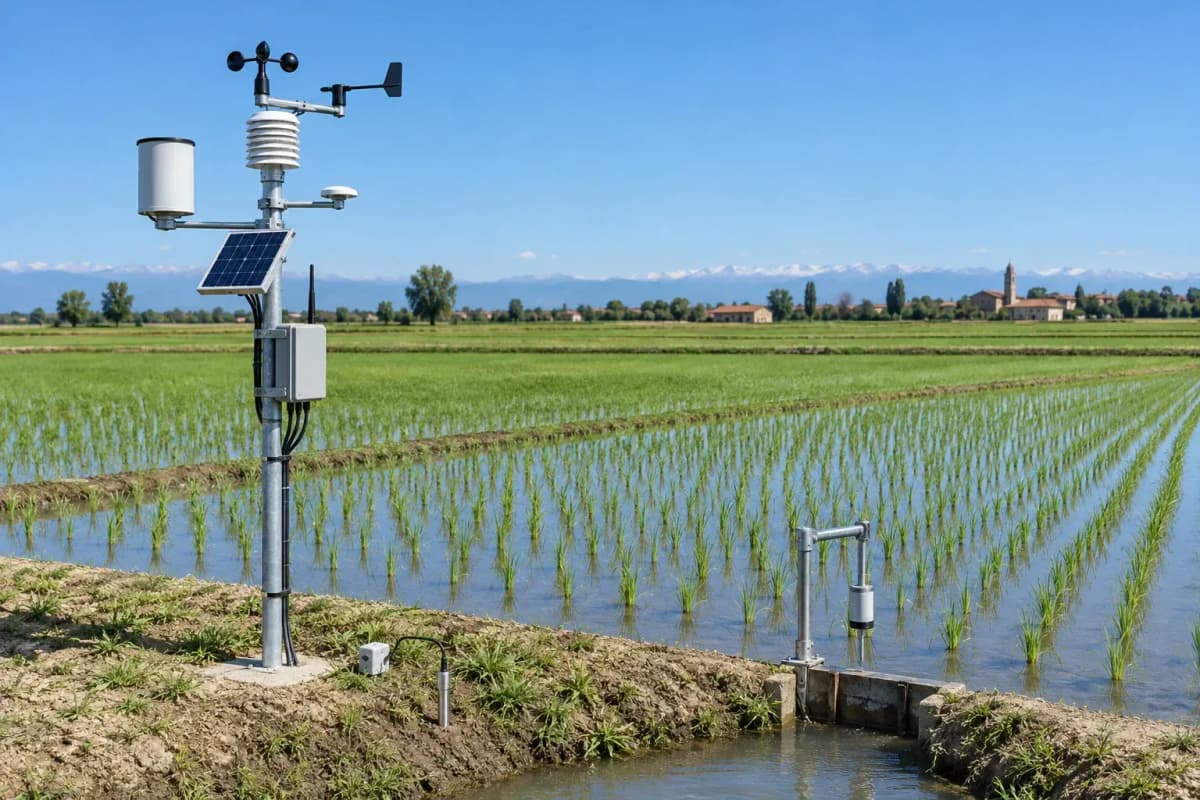
The 63 ha architecture uses 1 professional weather station, 16 soil monitoring points, 8 water-level monitoring points, 1 4G gateway, 1 solar-large power kit, and a standard cloud dashboard. Sensor density is approximately 0.40 monitoring points per hectare, which is suitable for a single rice-production zone with canal-side and tail-end plots separated by no more than several hundred metres of hydraulic variation.
The weather station measures temperature, humidity, wind speed, wind direction, rainfall, solar radiation, atmospheric pressure, and evapotranspiration, giving 8 core weather variables for irrigation planning. WMO-No. 8 is the main international reference for meteorological observation methods, including surface wind, temperature, humidity, pressure, precipitation, and radiation measurement practices (WMO Guide to Instruments and Methods of Observation).
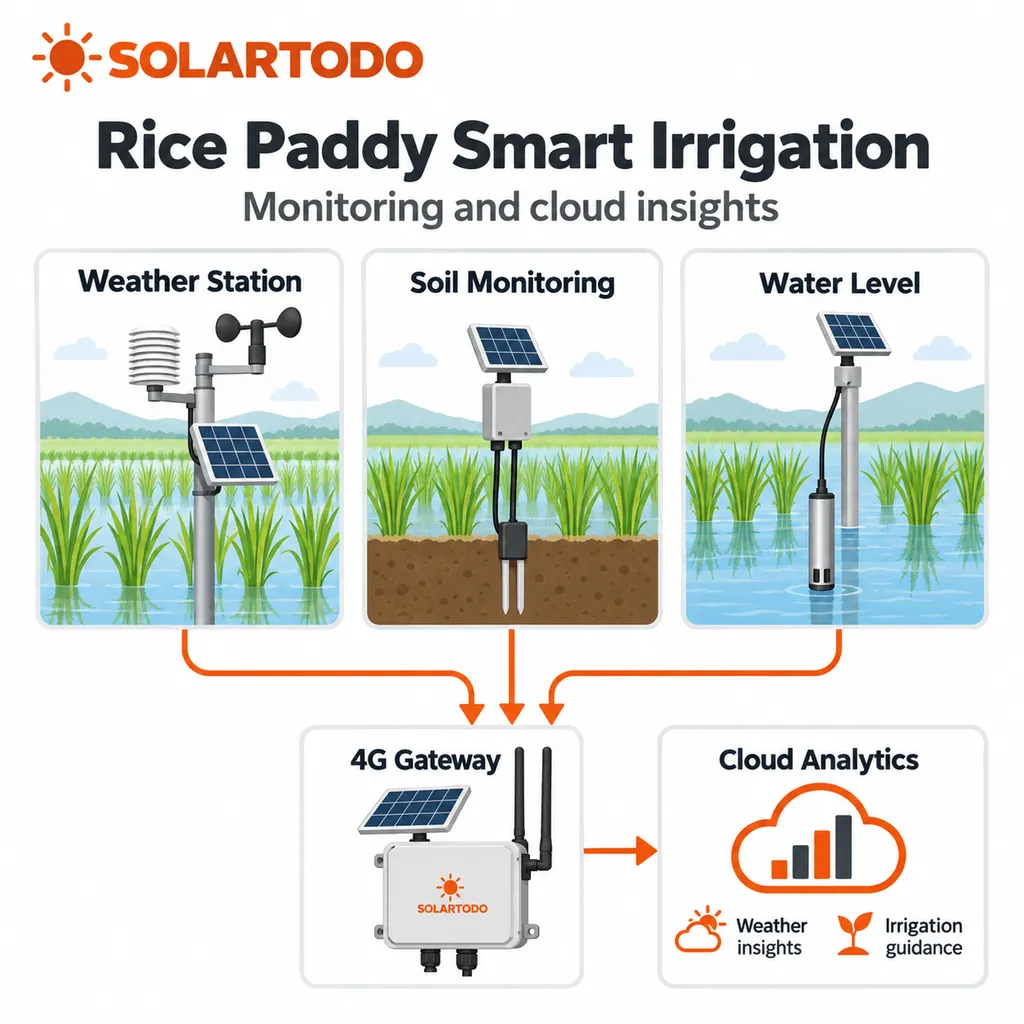
The soil subsystem uses multi-depth monitoring at 10 cm, 20 cm, 40 cm, and 60 cm layers where probe selection supports volumetric moisture from 0% to 100%, soil temperature from -30 °C to 70 °C, electrical conductivity, pH, and NPK trend indicators. For rice, the 10 cm and 20 cm depths are usually the highest-frequency decision layers, while 40 cm and 60 cm data help identify deep percolation, delayed drainage, and salinity movement.
The water-level subsystem is the defining feature for this variant, with 8 paddy water-level nodes installed at representative head, middle, and tail plots. Each node supports irrigation timing decisions by recording flooded depth, dry-down trend, and recovery after pump operation, which is critical when 1 pump cycle may affect multiple plots at different rates.
Communication is based on 4G LTE, selected because rice-growing regions often need direct cloud uplink without farm-owned broadband and because 4G supports image, firmware, and higher-frequency telemetry better than narrowband-only designs. Where local radio clustering is required, a LoRaWAN gateway can cover up to a 10 km radius under favourable line-of-sight conditions, while regional parameters must follow LoRa Alliance rules for the country of operation (LoRa Alliance Regional Parameters).
The solar-large power subsystem uses outdoor solar panels and LFP batteries sized for multi-day operation, with component planning informed by PV monitoring practices rather than grid-only assumptions. IEC 61724-1 defines terminology, equipment, and methods for photovoltaic system monitoring, and it is a useful reference when specifying solar-powered field telemetry reliability for 1 remote gateway and 25 sensor endpoints (IEC 61724-1:2021).
Technical Specifications
The standard data interval is 10 minutes, configurable from 1 to 60 minutes depending on battery budget, mobile-network stability, and irrigation response time. In a typical 24-hour cycle, each sensor can create 144 readings, meaning 25 sensors can generate approximately 3,600 timestamped measurements per day before aggregation, alarms, and dashboard visualization.
The gateway stores data during temporary network interruption and retransmits records after 4G recovery, reducing data gaps during storms, tower maintenance, or weak-signal periods. For agricultural machinery integration, ISO 11783, also known as ISOBUS, specifies serial control and communication networks for tractors and agricultural machinery, making it a useful reference when farm management platforms need machine-readable data exchange (ISO 11783-1:2017).
The system enclosure strategy uses IP67 or IP68-rated sensor housings, corrosion-resistant probes, UV-stable cabling, and sealed connectors designed for flooded fields, mud, fertilizer, and seasonal temperature exposure. Hardware warranty is 2 years, cloud warranty is 1 year, and field batteries are selected for multi-season maintenance intervals rather than single-crop replacement.
Cloud Monitoring
The standard cloud tier provides real-time maps, historical charts, sensor status, irrigation event logging, and SMS, email, and app push alerts. For 25 devices reporting every 10 minutes, the dashboard can show field-level trend lines for water depth, moisture, rainfall, evapotranspiration, and abnormal offline duration in less than 1 crop-cycle review screen.
AI-assisted functions include crop growth-stage tagging, irrigation recommendation rules, pest-risk warning inputs from weather trends, and yield-risk forecasting based on water stress duration. These recommendations should be configured by crop calendar, variety, soil texture, and local agronomic policy, because a 5 cm water-depth rule in 1 soil type may not equal the same root-zone condition in another field.
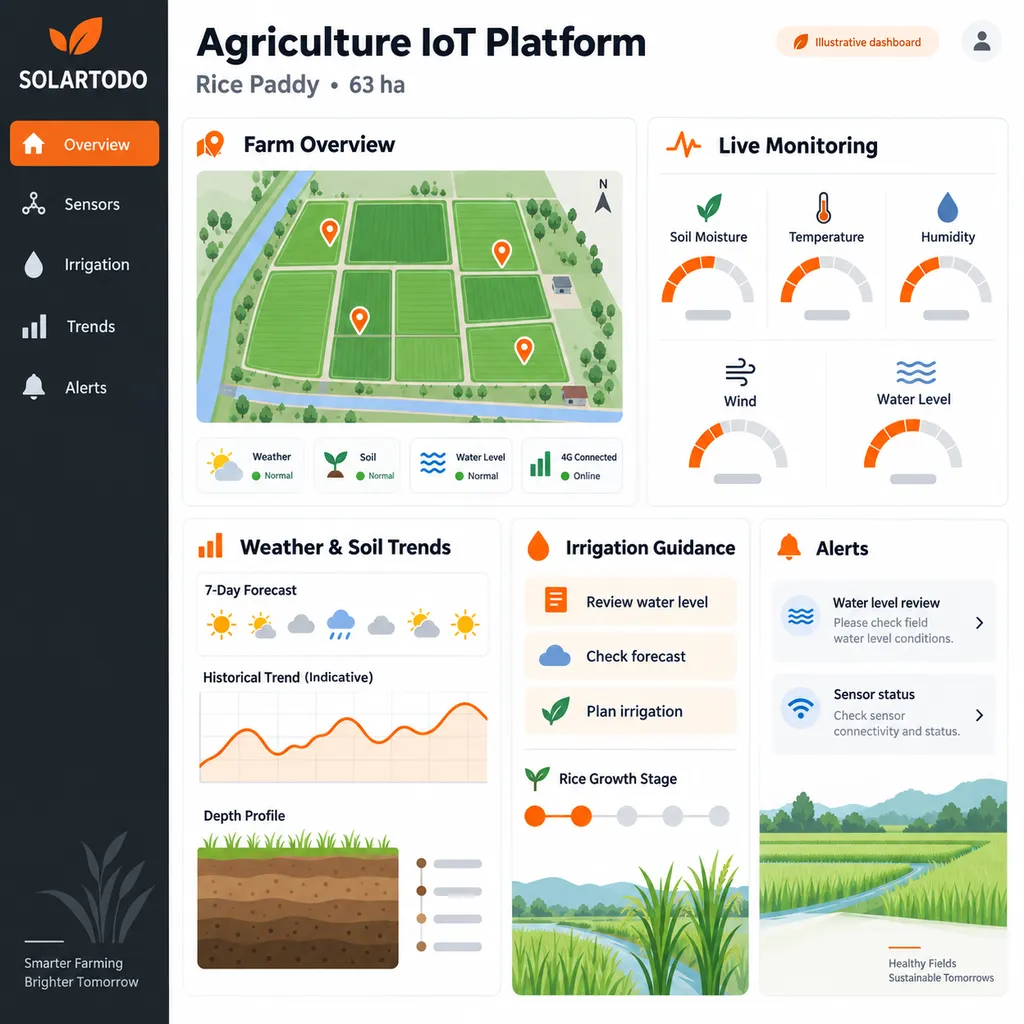
REST API access is included for farm ERP, pump controllers, irrigation valve panels, reporting software, and third-party agronomy models. NREL notes that high-quality solar radiation and resource data support energy-system design, and the same principle applies to solar-powered field instrumentation where weather data quality affects both irrigation logic and power autonomy assumptions (NREL solar resource data).
Representative Scenario
Representative MENA rice-farm scenario: A 63 ha irrigated rice block uses 1 canal intake, 2 pump groups, and 8 water-level zones during a 120-day season. The SOLARTODO system places the weather station near the service road, soil probes across 16 root-zone points, and 8 water-level nodes at high, middle, and low hydraulic positions so that operators can compare rainfall, evapotranspiration, and ponding depth before each pump run.
In this scenario, the buyer uses a conservative 20% water-saving target rather than a best-case 50% target, because field levelling, canal seepage, and pump efficiency are unknown before commissioning. If baseline pumping and water-management cost is $7,500 per season for 63 ha, a 20% reduction equals about $1,500 per season, before considering labour savings, reduced over-irrigation, and fewer emergency field inspections.
EPC Investment Analysis and Pricing Structure
EPC turnkey delivery includes engineering, procurement, construction, commissioning, operator training, cloud onboarding, and a 1-year EPC support period. For this 63 ha package, SOLARTODO prices FOB supply from $2,122 to $3,078, CIF delivered from $2,214 to $3,211, and EPC turnkey from $3,422 to $4,526, with all values shown in USD.
| Tier | Scope | Price Range |
|---|---|---|
| FOB Supply | Equipment only, ex-works China | $2,122-$3,078 |
| CIF Delivered | Equipment plus ocean freight and insurance | $2,214-$3,211 |
| EPC Turnkey | Installed, commissioned, trained, and supported for 1 year | $3,422-$4,526 |
| Volume Band | Discount | Typical Use |
|---|---|---|
| 50+ systems | 5% | Regional distributor stocking |
| 100+ systems | 10% | Multi-farm program procurement |
| 250+ systems | 15% | Government or utility-scale agriculture rollout |
The EPC cost is higher than FOB by about $1,300 to $1,448 because installation labour, engineering, QA, cloud setup, waterproofing checks, gateway configuration, and site training are included as separate services. This structure avoids inflating component prices and gives procurement teams a clearer bill of materials for audit and tender comparison.
A typical ROI model uses annual savings from water, diesel or grid pumping energy, labour, and crop-risk reduction. If a 63 ha site saves $1,500 to $2,400 per year through lower pumping and fewer manual inspections, the $3,422 to $4,526 EPC system payback is approximately 1.4 to 3.0 years, excluding any yield improvement or water-allocation penalty reduction.
Payment terms are 30% T/T deposit plus 70% against B/L, or 100% L/C at sight for approved bank instruments. Project financing can be discussed for programs above $1,000K, and engineering or procurement teams can request a custom quotation by contacting [email protected] with field maps, crop calendar, irrigation method, and target installation date.
Procurement Notes
For tendering, buyers should confirm whether the 63 ha field is continuous or split into multiple plots, because 2 separated blocks may require a second gateway, added solar capacity, or extra mounting hardware. The 25-sensor default package is best treated as a baseline design, while final placement should be adjusted after 1 site survey, 1 canal inspection, and 1 mobile-signal test.
SOLARTODO recommends documenting acceptance tests with at least 3 checks: sensor data visible in the dashboard, alert delivery confirmed through SMS/email/app, and 4G recovery verified after a controlled network interruption. For more background on solar-powered agriculture, see the SOLARTODO knowledge center, and for renewable energy in agri-food systems see the IRENA and FAO report describing how renewables support agricultural energy and food-security goals (IRENA renewable energy for agri-food systems).
Buyer Fit
This 63 ha variant is suitable for rice growers, irrigation districts, EPC contractors, agricultural cooperatives, and public-sector water-efficiency programs that need auditable data rather than isolated farm gadgets. Buyers comparing multiple smart-agriculture systems should evaluate at least 5 criteria: sensor density, water-level coverage, outdoor enclosure rating, cloud/API capability, and local installation support.
The system does not claim a verified customer deployment, approved government result, or guaranteed yield increase without a project reference supplied for that specific site. Instead, it provides a standards-aligned monitoring platform that lets operators measure rice water depth, root-zone conditions, rainfall, and solar-powered device status across 63 ha with 25 field sensors and 1 cloud workflow.
For related background on monitoring architecture, buyers can learn about smart agriculture IoT design before specifying sensor density, communication topology, and EPC acceptance criteria. For catalogue navigation, view all Smart Agriculture IoT Monitoring System products or configure your system online using the 63 ha rice-paddy parameters as the starting point.
Technical Specifications
| Coverage Area | 63ha |
| Application | rice_paddy |
| Crop | rice |
| Monitoring Types | weather, soil, water_level |
| Total Sensors | 25sensors |
| Water Level Monitoring | true |
| Communication | 4g |
| Power Supply | solar_large |
| Data Interval | 10 min, configurable 1-60 min |
| Cloud Platform | standard |
| Alert Channels | SMS + Email + App Push |
| API Access | REST API included |
| Warranty | 2 years hardware, 1 year cloud |
Price Breakdown
| Item | Quantity | Unit Price | Subtotal |
|---|---|---|---|
| Professional weather station with mounting | 1 pcs | $350 | $350 |
| Soil moisture monitoring probe nodes | 16 pcs | $55 | $880 |
| Rice paddy water-level sensor nodes | 8 pcs | $65 | $520 |
| 4G gateway and antenna kit | 1 pcs | $110 | $110 |
| Solar-large power kit with LFP battery | 1 pcs | $225 | $225 |
| Standard cloud platform license | 25 pcs | $12 | $300 |
| API and irrigation controller integration | 1 pcs | $250 | $250 |
| Installation and operator training | 1 pcs | $500 | $500 |
| Engineering layout and QC documentation | 1 pcs | $300 | $300 |
| Commissioning and data validation | 1 pcs | $250 | $250 |
| 1-year EPC warranty and support | 1 pcs | $250 | $250 |
| Total Price Range | $3,422 - $4,526 | ||
Frequently Asked Questions
What is included in the EPC turnkey price for the 63 ha rice paddy system?
How many sensors are included and where are they used?
Can the system automatically control pumps or irrigation valves?
What water savings should a buyer assume for ROI planning?
Does 4G communication work better than LoRaWAN for this variant?
Certifications & Standards


Data Sources & References
- •FAO Alternate Wetting and Drying rice irrigation guidance
- •CGIAR CCAFS Alternate Wetting and Drying in irrigated rice
- •WMO-No. 8 Guide to Instruments and Methods of Observation
- •ISO 11783-1:2017 agricultural machinery communication standard
- •IEC 61724-1:2021 photovoltaic system performance monitoring
- •NREL solar resource data and monitoring references
- •IRENA and FAO Renewable Energy for Agri-food Systems report
Interested in this solution?
Contact us for a customized quote based on your specific requirements.
Contact Us