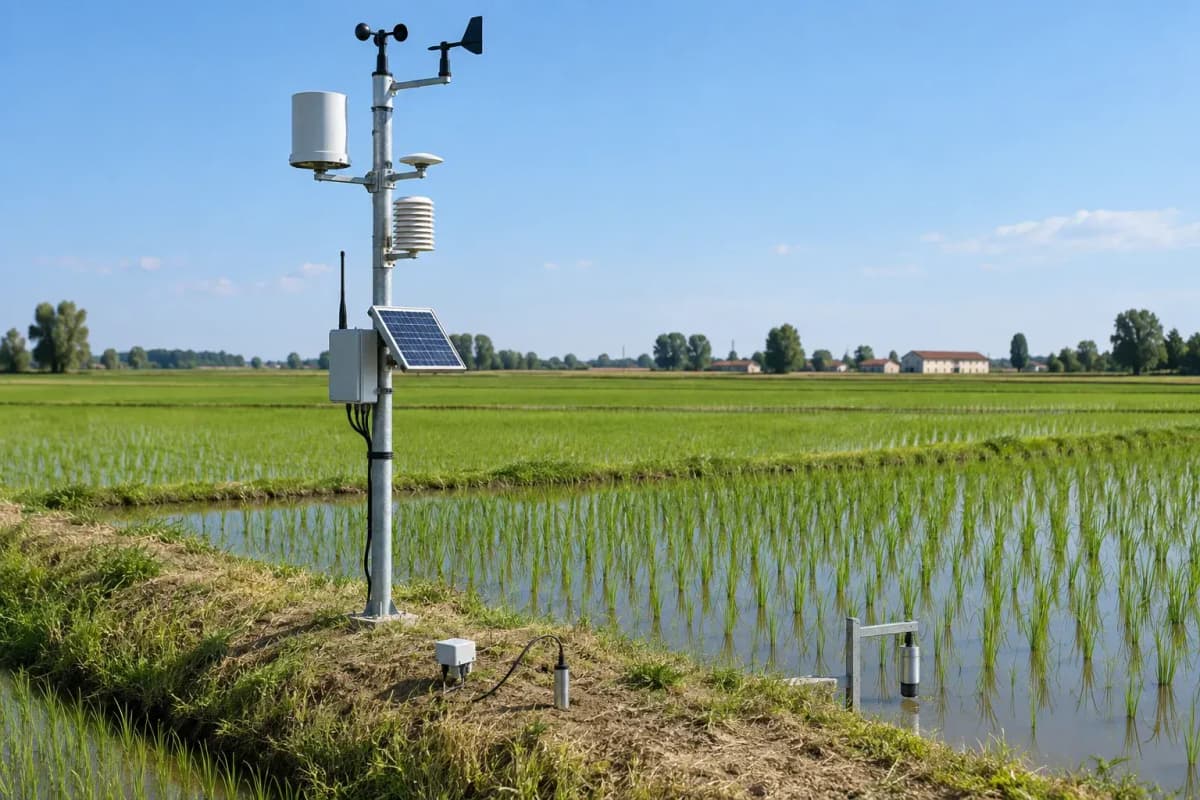
Rice Paddy Smart Irrigation 57ha - LoRaWAN Solar Monitoring
Key Features
- 57 ha rice paddy coverage with 20 LoRaWAN field sensors for weather, soil, and water-level monitoring
- 10-minute default data interval, configurable from 1 to 60 minutes for irrigation scheduling
- 1 LoRaWAN gateway designed for up to 10 km radius and hundreds of future sensor nodes
- Solar medium power package with 2 outdoor PV-LFP kits for maintenance-light field operation
- EPC turnkey budget of USD 3,274-4,330 including commissioning and 1-year support
Rice Paddy Smart Irrigation 57ha is a solar-powered LoRaWAN system for 57 hectares of rice production, using 20 field sensors for weather, soil, and water-level monitoring at 10-minute intervals. The EPC turnkey range is USD 3,274-4,330 with engineering, installation, commissioning, 1-year cloud service, and 2-year hardware warranty.
Description
Rice Paddy Smart Irrigation 57ha is a SOLARTODO Smart Agriculture IoT Monitoring System for 57 hectares of rice paddy, specified with 20 LoRaWAN field sensors, solar medium power kits, and 10-minute data intervals. The system combines weather, soil, and water-level monitoring for rice irrigation decisions, with EPC turnkey pricing from USD 3,274 to USD 4,330 and standard cloud analytics for engineering, procurement, construction, commissioning, and 1-year support.
Product Overview
This 57 ha configuration is designed for rice farms, irrigation districts, agri-industrial estates, and food-security programs that need measured control of flooded or alternate wetting and drying irrigation across multiple blocks. The sensor package monitors 3 operating domains: local weather, multi-depth soil conditions, and standing water level, giving agronomists a 24-hour data stream instead of relying on 1 or 2 manual inspections per day.
For rice paddies, water depth is usually managed within narrow agronomic windows, and even a 5 cm error across 57 ha can represent thousands of cubic meters of avoidable pumping. The system supports decisions based on rainfall, evapotranspiration, soil moisture, and water-level trends, aligning with WMO-No. 8 observation practice for temperature, humidity, wind, rain, radiation, pressure, evaporation, and soil moisture measurement as described by the World Meteorological Organization: https://community.wmo.int/site/knowledge-hub/programmes-and-initiatives/instruments-and-methods-of-observation-programme-imop/guide-instruments-and-methods-of-observation-wmo-no-8.
The platform is positioned as a field instrumentation layer, not as an unsupported yield guarantee; no customer deployment, purchase, or verified harvest result is claimed for this 57 ha product page. Published rice water-management literature provides the benchmark: IRRI reports that alternate wetting and drying can save up to 30% of irrigation water without yield loss in suitable irrigated areas, while a 2017 meta-analysis in FAO AGRIS found 23.4% lower water use under mild AWD conditions compared with continuous flooding: https://waterice.irri.org/how-we-work and https://agris.fao.org/search/en/providers/122535/records/65e001e1b766d82b1803f8e9.
System Architecture
The architecture uses 1 LoRaWAN gateway, 20 field sensors, solar-powered nodes, and a standard cloud tier to collect agronomic data every 10 minutes, which equals 144 measurements per day per sensor channel when the default interval is retained. LoRaWAN is selected because the LoRa Alliance describes it as a low-power wide-area architecture for battery-operated IoT devices with long-range, low-cost, bidirectional connectivity and support for redundant operation: https://lora-alliance.org/lorawan-for-developers/.
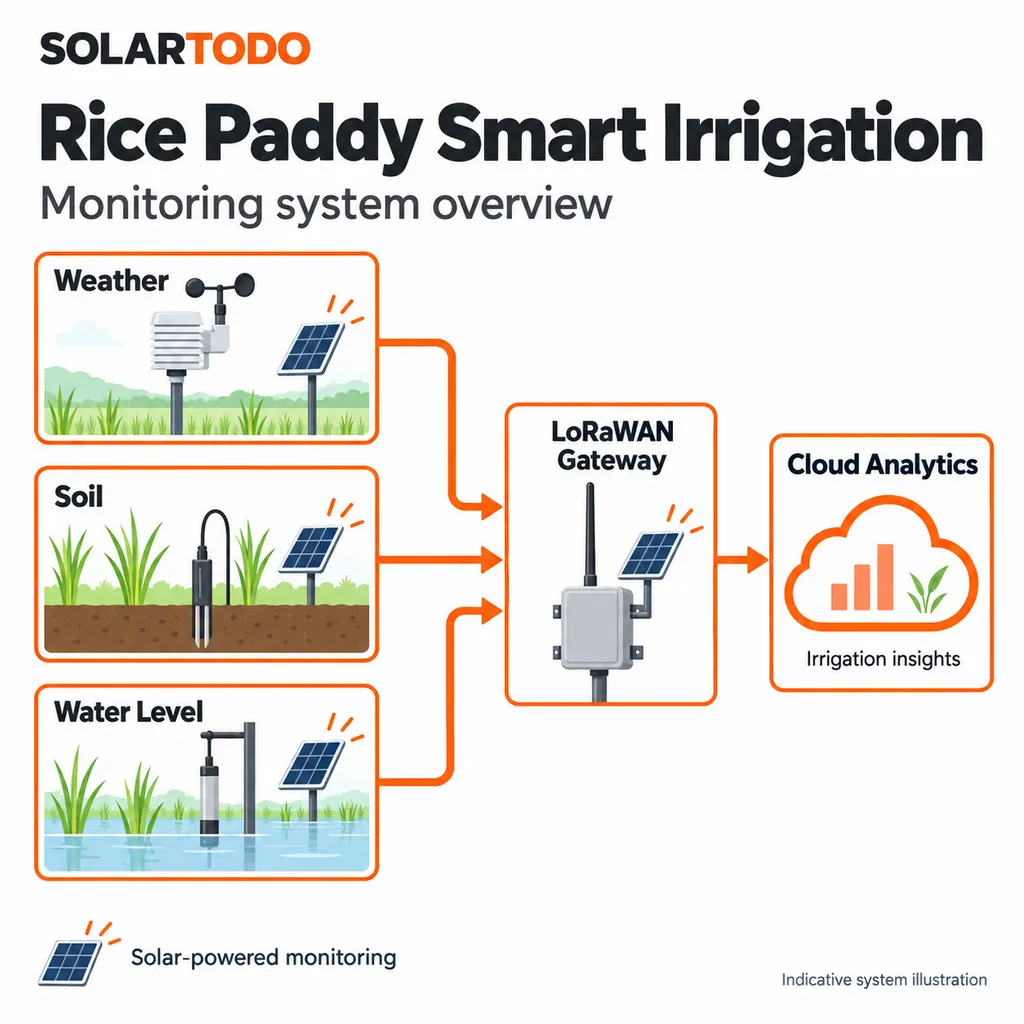
A typical 57 ha layout divides the project into 4 to 8 hydraulic zones, with soil probes installed at representative high, middle, and low points and water-level sensors placed near inlet, outlet, and control bund locations. The gateway can cover a nominal 10 km radius in suitable line-of-sight conditions, while the final antenna height, terrain, crop canopy, and farm buildings should be checked during the EPC radio survey.
Weather monitoring includes temperature, relative humidity, wind speed, wind direction, rainfall, solar radiation, atmospheric pressure, and evapotranspiration variables, giving irrigation managers at least 8 weather-related inputs for each scheduling cycle. Soil monitoring uses multi-depth probes at 10 cm, 20 cm, 40 cm, and 60 cm layers, enabling comparison between the shallow root zone and deeper moisture reserves before pumps or sluice gates are activated.
Water-level monitoring is enabled for this variant because rice paddies rely on controlled ponding, drainage, and re-flooding at specific crop stages. Compared with conventional manual staff-gauge readings taken once every 24 hours, a 10-minute telemetry interval can increase observation frequency by 144 times, which reduces the chance that rainfall, seepage, or over-irrigation remains unnoticed for a full day.
Technical Specifications
The base configuration covers 57 hectares, uses 20 sensors, and supports 3 monitoring types: weather, soil, and water level. Communication is LoRaWAN, power is solar medium, the cloud tier is standard, alert channels include SMS, email, and app push, and REST API access is included for third-party irrigation software, SCADA, or farm-management platforms.
Sensor enclosures are specified around outdoor agriculture conditions, with IP67 or IP68 protection targets where submerged or splash-prone installation is expected. IEC 60529 defines the international IP Code framework for enclosure protection against solids and water, making it the correct reference for procurement teams comparing IP67 water ingress, IP68 submerged service, and cable-gland requirements: https://webstore.iec.ch/en/publication/2449.
The agriculture data layer can align with ISO 11783, commonly known as ISOBUS, where farm machinery, controllers, and implements need standardized communication concepts. ISO lists ISO 11783-1:2017 as a serial data network for control and communications on agricultural and forestry equipment, giving engineering teams a recognized reference when integrating sensor data with tractors, controllers, and future automated valves: https://www.iso.org/standard/57556.html.
The solar medium power package uses outdoor PV and LFP battery subsystems sized for continuous sensor operation, with the reference bill of materials using 2 medium solar power kits. IRENA identifies solar-based irrigation solutions as a reliable and cost-effective option for decentralized irrigation where the water-energy-food nexus is critical, especially when diesel fuel, grid outages, or remote pumping points increase operating risk: https://www.irena.org/Publications/2016/Jun/Solar-Pumping-for-Irrigation-Improving-livelihoods-and-sustainability.
Cloud Monitoring
The standard cloud platform provides real-time dashboards, historical trend charts, threshold alarms, device health status, and AI-assisted irrigation recommendations based on 10-minute readings. With 20 sensors and 144 daily readings, the platform can process 2,880 sensor time-stamps per day before channel-level expansion, making it suitable for weekly agronomy reviews, monthly water accounting, and seasonal performance reports.
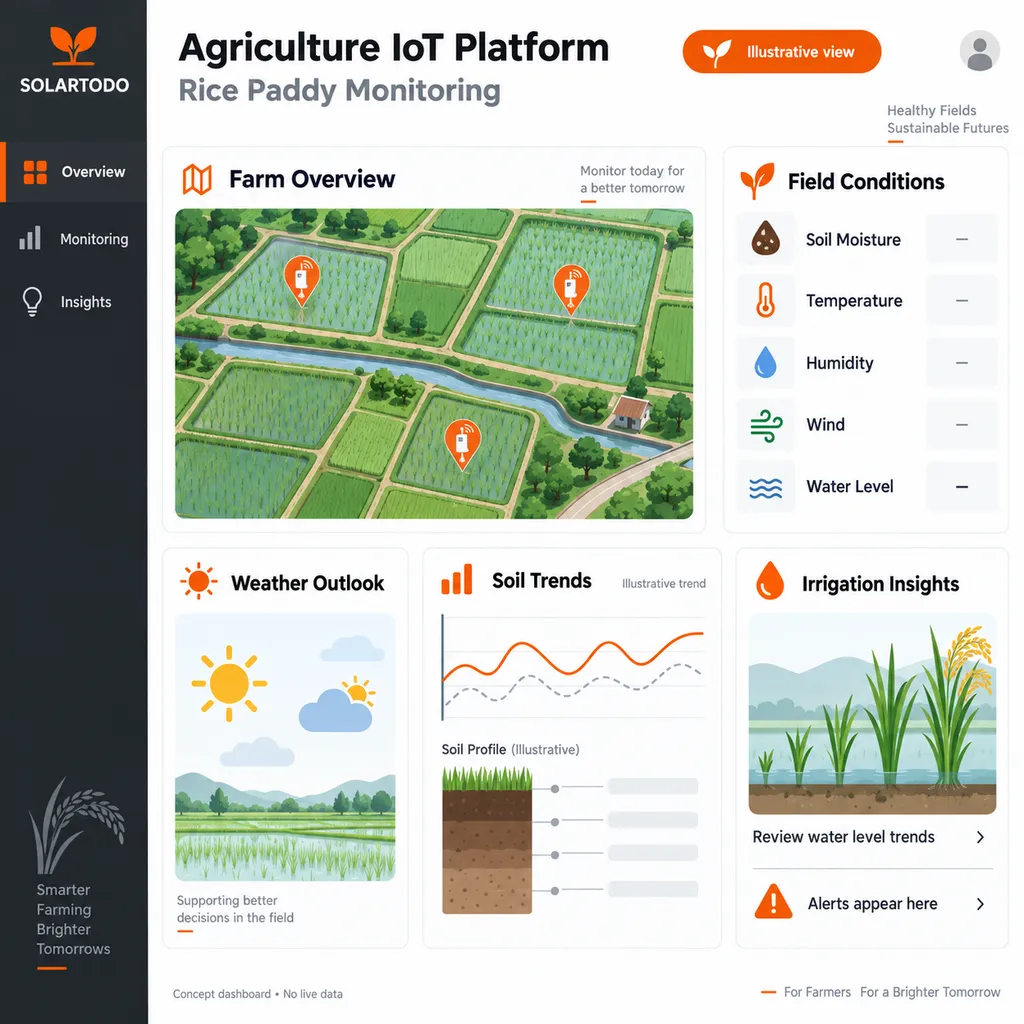
The cloud workflow supports 3 practical alert types: missing data, agronomic threshold deviation, and equipment exception. If a water-level sensor reports a falling level below a configured threshold for 2 consecutive 10-minute intervals, the platform can issue an app push, email, or SMS alert within 20 minutes, allowing the operator to check leakage, pump failure, blocked inlet, or bund damage.
AI functions are used as decision support, not as autonomous agronomic authority, and can include crop growth modeling, irrigation recommendation, pest outbreak risk, and yield forecasting inputs. The International Energy Agency notes that digitalisation can make energy systems more connected, intelligent, efficient, reliable, and sustainable, and the same 4 operating principles apply to solar-powered irrigation telemetry when pumps, sensors, and dashboards are linked: https://www.iea.org/reports/digitalisation-and-energy.
Representative MENA Rice Farm Scenario
For a representative MENA rice farm scenario, assume a 57 ha lowland field with 6 water-control blocks, diesel or grid-assisted pumping, and irrigation decisions historically based on 1 manual water-level inspection per day. Installing 20 LoRaWAN sensors at 10-minute intervals creates a continuous water-balance record that can support mild AWD scheduling, rainfall shutoff, and pump-hour reduction while keeping agronomists informed during the 90 to 140 days of a typical rice season.
In this representative scenario, a conservative 15% reduction in pump water and a moderate 10% reduction in labor inspection time can be used for financial modeling when no site-specific baseline exists. If the farm currently spends USD 9,000 per season on pumping energy, labor checks, and avoidable drainage losses, a 15% improvement equals USD 1,350 per season, giving a simple payback of about 2.4 to 3.2 seasons against the USD 3,274-4,330 EPC price range.
The comparison with a conventional alternative is direct: manual gauges, paper logs, and fixed irrigation calendars provide 1 to 2 observations per day, while this system can provide 144 observations per day per sensor channel. Relative to fixed-schedule flooding, monitored AWD control can target the 23.4% to 30% water-saving range reported in rice literature under suitable soil and management conditions, but SOLARTODO treats these numbers as planning benchmarks rather than guaranteed outcomes.
Applications
Primary applications include 57 ha rice paddy irrigation monitoring, water-level supervision at field inlets and outlets, soil moisture tracking across 4 depth layers, local weather recording, and pump or valve decision support. The system can also serve agricultural research plots, seed-production farms, irrigation cooperatives, and government demonstration sites where 20 sensor points are enough to characterize a medium-size command area.
Procurement teams can View all Smart Agriculture IoT Monitoring System products when comparing this 57 ha rice configuration with orchard, greenhouse, storage, pest-monitoring, or larger multi-gateway variants. Engineers can Configure your system online to adjust sensor count from 20 units to 50, 100, or 250 units when coverage, redundancy, or zone count increases.
For technical background on irrigation telemetry, buyers can Learn about topic and review SOLARTODO knowledge resources on solar power, IoT monitoring, and field data integration. For budget validation, import documentation, or tender formatting, project developers can Request a custom quotation with 57 ha layout drawings, crop calendar, expected sensor positions, and any 1-year or 2-year service-level requirements.
EPC Investment Analysis and Pricing Structure
EPC turnkey delivery includes 5 work scopes: engineering survey, procurement, construction, commissioning, and warranty support. For this 57 ha configuration, engineering covers radio planning, sensor placement, power sizing, and dashboard setup; procurement covers 20 sensors, 1 gateway, solar kits, mounting, and cables; construction covers installation and field labeling; commissioning verifies data upload, alert rules, and user training; warranty covers 1 year of cloud support and 2 years of hardware coverage.
| Pricing tier | Scope | Price range |
|---|---|---|
| FOB Supply | Equipment only, ex-works China | USD 2,030-2,944 |
| CIF Delivered | Equipment plus ocean freight and insurance | USD 2,118-3,071 |
| EPC Turnkey | Fully installed, commissioned, and 1-year warranty | USD 3,274-4,330 |
| Volume threshold | Discount | Typical buyer use case |
|---|---|---|
| 50+ systems | 5% | Multi-farm procurement across 2 to 5 districts |
| 100+ systems | 10% | Provincial irrigation modernization program |
| 250+ systems | 15% | National or utility-scale agriculture IoT rollout |
The EPC cost model separates equipment cost from field labor, engineering, commissioning, and warranty, which prevents hidden markups inside sensor unit prices. The listed USD 3,274-4,330 range is suitable for budgetary planning, while final cost can change by 5% to 20% when the site requires taller masts, extra gateways, civil works, valve actuators, trenching, local permits, or non-standard communication backhaul.
ROI depends on water price, pumping energy tariff, labor cost, field leakage, rainfall variability, and whether irrigation water is paid volumetrically or by flat seasonal charge. A conservative model using USD 1,350 annual savings gives a 2.4 to 3.2 year simple payback, while farms with metered water, diesel pumping, or frequent over-irrigation may model faster payback if verified site data supports a 20% to 30% operating-cost reduction.
Payment terms are 30% T/T deposit plus 70% against bill of lading, or 100% irrevocable L/C at sight for qualified international buyers. Project financing can be discussed for programs above USD 1,000,000, and procurement teams can contact [email protected] for a 57 ha quotation, compliance matrix, packing list, and EPC implementation schedule.
Procurement Notes
Before order release, buyers should confirm 6 site details: field map, gateway mast location, cellular or Ethernet backhaul, pump-control interface, desired water-depth thresholds, and cloud user roles. SOLARTODO recommends a 1-day remote technical review for small projects and a 2-to-3-day field survey for multi-site programs above 100 ha or more than 50 sensors.
The system is best specified as an instrumentation and decision-support layer rather than a complete irrigation civil-works package unless valve actuators, pump panels, and canal structures are added to the EPC scope. For a 57 ha rice paddy, the practical procurement outcome is clearer water visibility, faster exception detection, and better evidence for irrigation scheduling over 1 full growing season.
Technical Specifications
| Coverage Area | 57ha |
| Application | rice_paddy |
| Crop | rice |
| Monitoring Types | weather, soil, water_level |
| Total Sensors | 20sensors |
| Communication | LoRaWAN |
| Gateway Coverage | 10km radius nominal |
| Power Supply | solar_medium |
| Solar Power Kit Size | 80W reference kit |
| Battery Chemistry | LFP |
| Data Interval | 10min configurable 1-60 |
| Soil Probe Depths | 10, 20, 40, 60cm |
| Soil Moisture Range | 0-100% volumetric |
| Soil Temperature Range | -30 to 70C |
| Water Level Monitoring | enabled |
| Cloud Platform | standard |
| Alert Channels | SMS + Email + App Push |
| API Access | REST API included |
| Hardware Warranty | 2years |
| Cloud Support Warranty | 1year |
Price Breakdown
| Item | Quantity | Unit Price | Subtotal |
|---|---|---|---|
| Professional weather station, 10-parameter | 1 pcs | $1,200 | $1,200 |
| Multi-depth soil moisture and temperature probe node | 12 pcs | $55 | $660 |
| Solar water-level monitoring sensor node | 8 pcs | $85 | $680 |
| LoRaWAN gateway | 1 pcs | $225 | $225 |
| Solar power kit, medium 80W with LFP battery | 2 pcs | $225 | $450 |
| Standard cloud platform, first year device license | 21 pcs | $12 | $252 |
| Irrigation API and valve relay interface panel | 1 pcs | $189 | $189 |
| Installation and commissioning | 1 pcs | $500 | $500 |
| Engineering, radio survey, and QC documentation | 1 pcs | $90 | $90 |
| 1-year warranty and technical support | 1 pcs | $50 | $50 |
| Total Price Range | $3,274 - $4,330 | ||
Frequently Asked Questions
What does the Rice Paddy Smart Irrigation 57ha system monitor?
How is this system different from manual rice irrigation checks?
What is included in the EPC turnkey price and warranty?
Can the 20-sensor configuration be expanded later?
Does SOLARTODO guarantee 30% water saving or yield increase?
Certifications & Standards


Data Sources & References
- •WMO Guide to Instruments and Methods of Observation WMO-No. 8: https://community.wmo.int/site/knowledge-hub/programmes-and-initiatives/instruments-and-methods-of-observation-programme-imop/guide-instruments-and-methods-of-observation-wmo-no-8
- •ISO 11783-1:2017 agricultural serial data network: https://www.iso.org/standard/57556.html
- •IEC 60529 IP Code enclosure protection: https://webstore.iec.ch/en/publication/2449
- •LoRa Alliance LoRaWAN for Developers: https://lora-alliance.org/lorawan-for-developers/
- •IRRI Water-Efficient and Climate-Resilient Rice Production: https://waterice.irri.org/how-we-work
- •FAO AGRIS rice yields and water use under AWD meta-analysis: https://agris.fao.org/search/en/providers/122535/records/65e001e1b766d82b1803f8e9
- •IRENA Solar Pumping for Irrigation: https://www.irena.org/Publications/2016/Jun/Solar-Pumping-for-Irrigation-Improving-livelihoods-and-sustainability
- •IEA Digitalisation and Energy: https://www.iea.org/reports/digitalisation-and-energy
Interested in this solution?
Contact us for a customized quote based on your specific requirements.
Contact Us